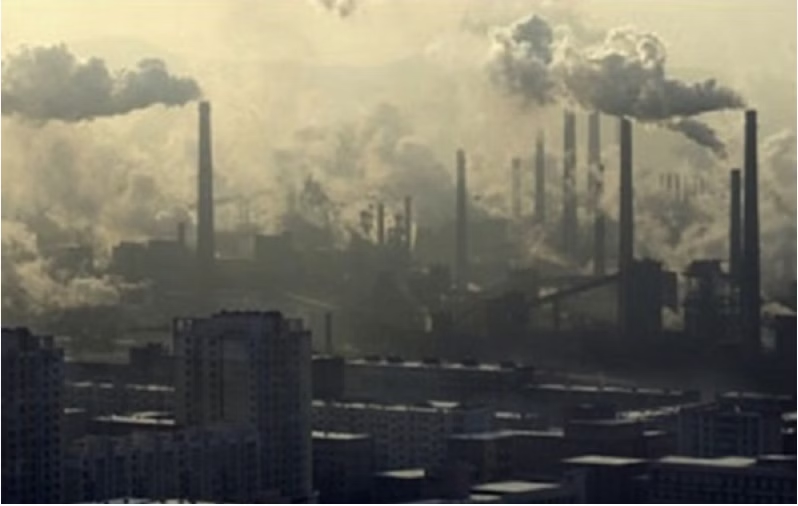
Fossil fuel lobbyists in the Canadian delegation include representatives of the Canadian Association of Petroleum Producers (CAPP), a lobby group that represents Canada’s oil and natural gas producers. Credit: C2C Journal
Delegation’s composition consistent with new KBPO report revealing this year’s U.N. climate talks have the largest number of fossil fuel lobbyists to date.
Lobbyists and representatives of Canada’s oil and gas industry are part of Canada’s official delegation to this year’s U.N. climate talks in Brazil, in keeping with the high number of fossil fuel representatives in attendance at the summit.
About a dozen individuals representing fossil fuel interests were part of the 240-person Canadian delegation, according to documents reviewed by DeSmog as well as a Nov. 12 Canadian Press article.
“Fossil fuel lobbyists have no place at the U.N. climate negotiations,” Emilia Belliveau, program manager of energy transition with Environmental Defence, said in a statement to DeSmog.
“Their presence here with official badges from Canada undermines the work of Canadians attending COP30 who are genuinely working to advance climate action,” she said.
This year’s U.N. climate talks have the single largest share of fossil fuel lobbyists in attendance to date. Some 1,600 people — or one out of every 25 attendees — are fossil industry or related lobbyists, according to an analysis by Kick Big Polluters Out (KBPO), an alliance of climate and justice organizations that push to remove fossil fuel companies and their lobbyists from influencing climate negotiations and policymaking.
The presence of so many Canadian fossil fuel sector representatives exemplifies the report’s findings.
“It demonstrates the extent by which the current government is aligned with oil industry interests,” Patrick Bonin, the Bloc Québécois’ environment and climate change critic, said in a statement to DeSmog.
“The oil and gas industry is the biggest lobby in Canada,” Bonin continued, “so it’s like inviting the fox into the henhouse … Giving them access to the delegation gives them far greater influence than regular participants.”
Fossil fuel lobbyists in the Canadian delegation include representatives of the Canadian Association of Petroleum Producers (CAPP), a lobby group that represents Canada’s oil and natural gas producers; Tourmaline Oil, Canada’s largest natural gas producer; CarbonAi; the International Emissions Trading Association (IETA), the Global CCS Institute; and the gas industry advocacy group Energy for a Secure Future.
Huge Industry Presence
KBPO’s analysis reveals that fossil fuel lobbyists at COP30 outnumber every national delegation except for Brazil, the host country. The number of lobbyists also represents a 12 percent increase over last year’s COP conference held in Baku, Azerbaijan.
Fossil fuel lobbyists received two-thirds more passes to COP30 than the total number of delegates from the 10 most climate-affected nations on Earth, the KBPO report said. This highlights “how industry presence continues to dwarf that of those on the frontlines of the climate crisis,” KBPO said in a statement that accompanied the report’s release.
The influence of major trade associations at COP30 is palpable, with the IETA bringing 60 representatives, including delegates from oil and gas giants ExxonMobil, BP, and TotalEnergies. These associations are “a primary vehicle for fossil fuel influence, according to a KBPO statement.
Kathleen Sullivan, global managing director with IETA, is in the COP30 Canadian delegation. It also includes Jay Averill, assistant vice president of communications with CAPP; Scott Volk and Tim Shaw of Tourmaline Oil; and Todd Smith, Ontario’s former energy minister who advocated for an expansion of nuclear power. Smith left office in August 2024 to become vice president of marketing and business development with CANDU Energy Inc., a manufacturer of nuclear reactors.
The Canadian delegation also includes several representatives from Energy for a Secure Future, a lobby group that advocates for continued fossil fuel use to ensure “energy affordability.” The group states on their website that “our gas energy can respond to the needs of our friends around the world who are facing punishing energy costs and are left with options that drive up global emissions.”
Canadian “Carbon Bombs”
However, Canada’s natural gas industry is a major contributor of rising global emissions. The nation’s natural gas resources have been described as “carbon bombs” for their potential to release billions of tonnes of CO2 into the atmosphere, according to a 2024 DeSmog article.
“The spectacle of Canada’s COP delegation [serving as] a Trojan horse for fossil fuel interests like Tourmaline and the CAPP is shocking,” said James Browning, executive director of F Minus, a climate accountability group. F Minus recently issued a report detailing numerous conflicts of interest that have resulted from Canadian environmental organization sharing lobbyists who also serve major polluters.
“Lobbying decisionmakers in secret is really just another day at the office for these climate denialists, given the failure of Canada’s lobbyist disclosure system to fully capture the extent of their dealings with Canadian officials,” Browning said in a statement to DeSmog.
“COP may be 5,000 kilometres away, but the deeper scandal here is that Tourmaline’s and CAPP’s lobbyists enjoy a similar, extraordinary level of secrecy in their meetings with government officials every day in Ottawa,” he said.
CAPP has misled the public about emissions from Canada’s oil and gas sector, and has campaigned against anti-greenwashing laws. Heather Feldbusch, one of Pierre Poilievre’s campaign’s inner circle, was formerly a lobbyist with Alberta Counsel Inc., which represents Tourmaline.
“At the COP negotiations two years ago, governments took a historic step by committing to transition away from fossil fuels in energy systems in a just, orderly, and equitable manner,” Keith Stewart, senior energy strategist with Greenpeace Canada, said in a statement to DeSmog. “By including fossil fuel lobbyists in our official delegation, Canada is undermining that global effort and risks being seen as negotiating in bad faith.”
“CAPP has been fighting against effective climate action for decades and should be shown the door, not the red carpet,” he added.
Another organization with a stake in fossil fuels included in the Canadian delegation is the Global CCS Institute, a carbon capture advocacy group based in Australia. Critics have long argued that carbon capture is an expensive false solution designed to give fossil fuel production an air of social acceptability. Canadian Prime Minister Mark Carney has used the term “low carbon oil” in reference to carbon capture, despite experts arguing that the term is nonsense.
“Inviting fossil fuel lobbyists into global climate negotiations is as misguided as letting the tobacco industry write health policy, and Canada is compounding the problem by weakening its own greenwashing rules” Sabaa Khan, director general, Quebec and Atlantic Canada, with the David Suzuki Foundation, said in a statement to DeSmog.
DeSmog reached out to Keean Nembhard, press secretary for Canadian environment minister Julie Dabrusin, but did not receive a statement by press time.
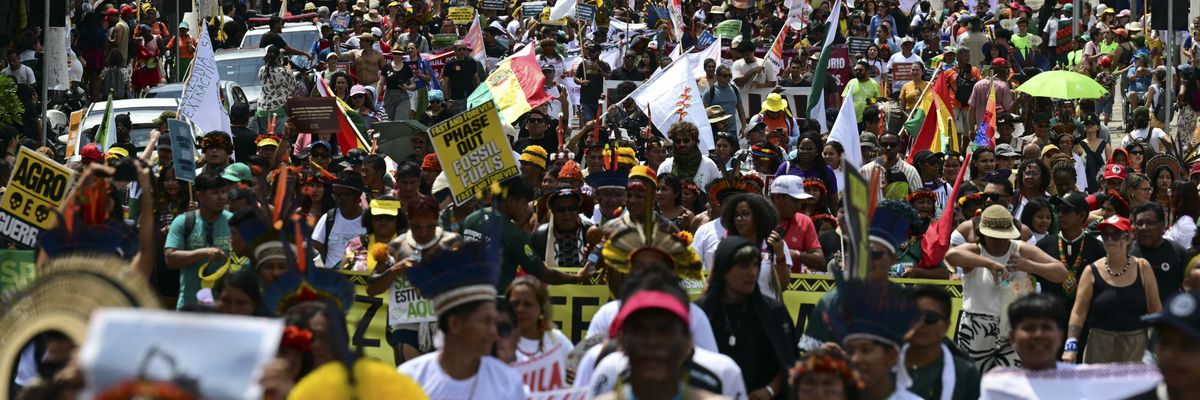
Thousands of people take part in the so-called “Great People’s March” in the sidelines of the COP30 UN Climate Change Conference in Belem, Para State, Brazil on November 15, 2025. Tens of thousands of people attended the march to demand “real solutions” to human-caused global warming , and which comes at the halfway point of contentious COP30 negotiations following two Indigenous-led protests that disrupted proceedings earlier in the week. (Photo by Pablo Porciuncula / AFP via Getty Images)
“It is time to put these old fuels where they belong—in the ground of history.”
An estimated 50,000 people took to the streets of Belém do Pará, Brazil, on Saturday to demonstrate outside the halls of the United Nations annual climate summit, holding a “Great People’s March” and makeshift “Funeral for Fossil Fuels” as they demanded a just transition toward a more renewable energy system and egalitarian economy.
Organized by civil society organizations and Indigenous Peoples groups from Brazil and beyond, the tens of thousands who marched outside the thirtieth Conference of the Parties (COP30) summit called for an end to the rapacious greed of the oil, gas, and coal companies as they advocated for big polluters to pay for the large-scale damage their businesses have caused worldwide over the last century.
“We are tens of thousands here today, on the streets of Belém, to show negotiators at COP30 that this is what people power looks like,” said Carolina Pasquali, executive director of Greenpeace Brazil, said as the march took hold. “Yesterday we found out that one in every 25 COP30 participants is a fossil fuel lobbyist, proportionally a 12% increase from last year’s COP. How can the climate crisis be solved while those creating it are influencing the talks and delaying decisions? The people are getting fed up–enough talking, we need action and we need it now.”
The report by the Kick Big Polluters Out coalition last week showed that at least 1,600 lobbyists from the fossil fuel industry are present at the conference, making it the second-largest delegation overall, second only to Brazil’s, the host nation.
“It’s common sense that you cannot solve a problem by giving power to those who caused it,” said Jax Bongon from the Philippines-based IBON International, a member of the coalition, in a Friday statement. “Yet three decades and 30 COPs later, more than 1,500 fossil fuel lobbyists are roaming the climate talks as if they belong here. It is infuriating to watch their influence deepen year after year, making a mockery of the process and of the communities suffering its consequences.”
While the overwhelming presence of fossil fuel lobbyists has once again diminished hopes that anything worthwhile will emerge from the conference, the tens of thousands in the streets on Saturday represented the ongoing determination of the global climate movement.
João Talocchi, co-founder of Alianza Potência Energética Latin America, one of the key groups behind the “Funeral for Fossil Fuels” portion of the day’s action—which included mock caskets for the oil, gas, and coal companies alongside parades of jungle animals, wind turbines, and solar panels representing what’s at stake and the better path forward—noted the key leadership of Indigenous groups from across the Global South.
“From the Global South to the world, we are showing what a fair and courageous energy transition must look like,” said Talochhi.
Ilan Zugman, director of 350.org in Latin America and the Caribbean, noted the significance of the demonstration, including the symbolism of the funeral procession.
“We march symbolically burying fossil fuels because they are the root of the crisis threatening our lives,” explained Zugman. “Humanity already knows the way forward: clean energy, climate justice, and respect for the peoples who protect life. What is missing is political courage to break once and for all with oil, gas, and coal. It is time to put these old fuels where they belong—in the ground of history.”
With the COP30 at its midway point, climate activists warn that not nearly enough progress is being made, with the outsized influence of the fossil fuel industry one of the key reasons that governments, year after year and decade after decade, continue to drag their feet when it comes to taking the kind of aggressive actions to stem the climate crisis that scientists and experts say is necessary.
“We are taking to the streets because, while governments are not acting fast enough to make polluters pay for their climate damages at COP30, extreme weather events continue to wreak havoc across the globe,” said Abdoulaye Diallo, co-head of Greenpeace International’s “Make Polluters Pay” campaign. “That is why we are here, carrying the climate polluters bill, showing the projected economic damages of more than $5 trillion from the emissions of just five oil and gas companies over the last decade.”
“Fossil fuel companies are destroying our planet, and people are paying the price,” said Diallo. “Negotiators must wake up to the growing public and political pressure to make polluters pay, and agree to new polluter taxes in the final COP30 outcome.”
Shoppers browse produce at Sabor Tropical Supermarket in Miami Beach, Florida on July 23, 2022. Photo by: Jeffrey Greenberg/Universal Images Group via Getty Images
Although President Donald Trump didn’t actually confess that his global trade war is driving up the cost of groceries for Americans, he did finally drop his dubiously named “reciprocal” tariffs on key imports on Friday.
According to a White Housefact sheet, Trump’s new executive order ends his tariffs on beef; cocoa and spices; coffee and tea; bananas, oranges, and tomatoes; other tropical fruits and fruit juices; and fertilizers.
The New York Times had reported Thursday that “the Trump administration is preparing broad exemptions to certain tariffs in an effort to ease elevated food prices that have provoked anxiety for American consumers.”
The reporting drew critiques of the administration’s economic policies, including from members of Congress such as Senate Finance Committee Ranking Member Ron Wyden (D-Ore.), who said that “Trump just admitted it: Americans are footing the bill for his disastrous tariffs.”
“While this move may alleviate some of the cost increases Trump caused, it will not stop the larger problems of rising inflation, business uncertainty, and economic damage done by Trump’s crazy tariff scheme.”
Also responding to the Times reporting, Sen. Elizabeth Warren (D-Mass.) wrote on social media Friday: “After months of increasing grocery prices, Donald Trump is finally admitting he was wrong. Americans are literally paying the price for Trump’s mistakes.”
More lawmakers and other critics piled on after Trump issued the order. CNN‘s Jim Sciutto said: “Trump administration now acknowledging what economists and business leaders have told us from the beginning: that tariffs are driving up prices.”
MeidasTouch and its editor in chief, Ron Filipkowski, also called out the president on social media, with the outlet sarcastically noting, “But Trump said his tariffs don’t raise prices.”
Congressman Don Beyer (D-Va), who serves on the House Ways and Means Subcommittee on Trade, said in a Friday statement that “President Trump is finally admitting what we always knew: His tariffs are raising prices for the American people.”
“After getting drubbed in recent elections because of voters’ fury that Trump has broken his promises to fix inflation, the White House is trying to cast this tariff retreat as a ‘pivot to affordability,’” Beyer said, referencing Democrats who won key races last week, from more moderate Mikie Sherrill and Abigail Spanberger, the incoming governors of New Jersey and Virginia, to democratic socialist Mayors-elect Zohran Mamdani of New York City and Katie Wilson of Seattle.
In addition to those electoral victories for Democrats, last week featured a debate over Trump’s trade war at the US Supreme Court. According to Beyer: “The simple truth is that Republicans want credit for something they think the Supreme Court will force them to do anyway, after oral arguments before the court on Trump’s illegal abuses of trade authorities went badly for the administration. Trump is still keeping the vast majority of his tariffs in place, and his administration is also planning new tariffs in anticipation of a Supreme Court loss.”
“The same logic—that Trump’s tariffs are driving up prices on coffee, fruit, and other comestibles—is equally true for the thousands of other goods on which his tariffs remain,” he continued. “While this move may alleviate some of the cost increases Trump caused, it will not stop the larger problems of rising inflation, business uncertainty, and economic damage done by Trump’s crazy tariff scheme.”
“Only Congress can do that, by reclaiming its legal responsibility under the Constitution to regulate trade, and permanently ending Trump’s trade war chaos,” he stressed. “All but a handful of Republicans in Congress are still refusing to stand up to Trump, stop his tariffs, and lower costs for the American people, and unless they find a backbone, our economy will continue to suffer.”
As the Associated Pressnoted Friday, “The president signed the executive order after announcing that the U.S. had reached framework agreements with Ecuador, Guatemala, El Salvador, and Argentina designed to ease import levies on agricultural products produced in those countries.”
Trump’s order also came just a day after Democrats on the congressional Joint Economic Committee released a report showing that US families are paying roughly $700 more each month for basic items since Trump returned to office in January—with households in some states, such as Alaska and California, facing an average of over $1,000 monthly.
The president has floated sending Americans a $2,000 check, purportedly funded by revenue collected from his tariffs, but as Common Dreamsreported Wednesday, economist Dean Baker of the Center for Economic and Policy Research crunched the numbers and found that the proposed “dividend” doesn’t add up.
Widespread bullying and violence reported at the army training college | James Battershill
An 11-month investigation reveals culture of violence, criminality and sexual abuse at army training centre for teens
The British Army is the only military in Europe that still recruits 16-year-olds.
That’s how old Hamish* was when he joined last year. As is required of all 16- and 17-year-old sign-ups, who are legally still children but are given the titles of ‘junior soldiers’, he moved into the residential Army Foundation College Harrogate in the north of England to begin his military training.
“In the first couple of weeks, it’s brilliant,” he said of his early days in the army, explaining that most teenage recruits “see it as a brilliant way of earning money”, particularly “if you haven’t really got any GCSEs”.
“But then things start to break down,” he said. Hamish soon witnessed boys being repeatedly punched in the head during fights with their peers or whipped with belts during initiation rituals, as well as other physical violence, including extreme bullying. Junior members of staff, he said, told the teenage recruits they did not need to know about such incidents, even encouraging them to physically “fight it out”.
Hamish is far from alone in his experiences at AFC Harrogate. An exclusive investigation by openDemocracy and the Children Rights International Network (CRIN) has revealed the shocking extent of the bullying, harassment, self-harm, sexual offences and safeguarding failures that teenagers who join the British Army are subject to.
Over the past 11 months, we have submitted dozens of Freedom of Information requests, worked with peers in the House of Lords to ask parliamentary questions, reviewed publicly available documents and data, as well as video footage of instances of violence at AFC Harrogate, and spoken to sources and experts to uncover the reality of life at the college. Our investigation found that between 1 January 2018 and September 2025:
The Ministry of Defence recorded 474 complaints of physical violence against junior soldiers at AFC Harrogate – an average of 62 a year
Staff members were the alleged perpetrators in 41 of these incidents
There were 176 complaints of “sexual allegations”, more than 30 of which were against college staff
The MoD recorded 214 complaints of bullying at the college
The college recorded an average of 20 incidents of self-harm every year
North Yorkshire Police recorded 24 crimes at the college in the first six months of 2025 alone, including five sexual offences
openDemocracy shared the number of allegations of physical violence with a teacher who spent more than a decade working in a mainstream school with a sixth form in England, where the pupils are the same age as those at AFC Harrogate, to ask if this was a normal rate. A school receiving such a high number of complaints in any given year, she said, “would be fucking nuts”.
Teachers from English state schools also told us that the 176 allegations of sexual abuse at AFC Harrogate “seems phenomenally high”. One said that in more than a decade of teaching at a sixth form college, she could only think of one such complaint.
Our findings raise serious concerns about the welfare of teenagers at AFC Harrogate.
Like many other Western militaries, the British Army is finding it increasingly difficult to bring in new recruits. In 2010, the army boasted nearly 110,000 troops; now, it struggles to meet its target of 73,000. The Ministry of Defence plans to spend £18m on attracting new personnel to the army this financial year, twice as much as The Daily Express reported it spent in 2023/24. It is likely that much of this spend will target 16- and 17-year-olds, whom CRIN has previously found make up around third of the army’s annual intake – but our investigation has thrown into doubt the care that the British Army will provide to those who sign up.
The failures we have uncovered at AFC Harrogate are not without tragic real-world consequences. CRIN previously found that more than half the British soldiers who have killed themselves while in active service over the past two decades had signed up to the military before they turned 18, with those who joined aged 16 or 17 more than twice as likely to take their own lives than those who joined as adults.
“These recruits,” CRIN’s Jim Wyke warned, “coming from the most deprived backgrounds, join wanting to serve their country, to better themselves, to build something of themselves – and what do they get? An education that would be illegal anywhere else in the UK. A significant risk of being bullied or physically and sexually abused, including by their instructors. And worst of all, a welfare system that prioritises the reputation of the army above the children under their command.
“The truth is simple: the army is exposing children to abuse, and when confronted with this is refusing to act. This is a scandal. Those who’ve signed up so young deserve better.”
Life at AFC Harrogate
As the UK’s only initial army training unit for child recruits, the Army Foundation College in Harrogate receives all 16- and 17-year-olds who join the British Army each year. On average, this is around 2,370 teenagers annually, according to data obtained through FOI.
Many of these junior soldier recruits have specific vulnerabilities.
The majority come from disadvantaged backgrounds: recruitment to the army is 57% higher in deprived areas than the wealthiest parts of the country. Last year’s AFC Harrogate intake also included 39 registered care leavers – twice as many as you might expect based on the proportion of children in care in the UK – according to a parliamentary question submitted on our behalf by Labour peer Baroness Lister. And 182 junior soldiers had an initial assessment at the MoD’s department of community mental health between 1 January 2019 and 31 December 2024, an FOI revealed.
Upon arriving at AFC Harrogate, these teenagers are placed in the care of around 500 members of staff at the college, the vast majority of whom are themselves members of the army who have undertaken a two-week course at the army instructor training school at Pirbright, before receiving on-the-job training.
The new junior soldiers join one of two ‘Phase 1’ courses: a 49-week programme for recruits who intend to join combat roles, and a shorter 23-week course for those who plan to go on to roles such as military engineers, field doctors, or logistics specialists. Both courses, the army website says, teach aspects of military life including fieldcraft, skill at arms, fitness training, qualities of a soldier and battlefield casualty drills.
Trainees also receive some, albeit limited, education from civilian staff. The Ministry of Defence (MoD) is not bound to the Education and Skills Act 2008, which requires 16- and 17-year-olds to be in education or training. As such, the college offers short ‘Functional Skills’ courses in English and Maths, which are below the level of GCSEs and do not offer an easy route to further qualifications.
AFC Harrogate’s promotional material often boasts that it has repeatedly been rated ‘outstanding’, the highest grade, by England’s education watchdog, Ofsted. Not mentioned is that the MoD has a bespoke commercial contract with Ofsted, with the government covering the costs of the inspections of AFC and other Initial Army Training Establishments. Under this memoriam of understanding, Ofsted inspects AFC on different criteria than it would a mainstream college.
In a glossy video on the army’s website, teenage recruits at AFC Harrogate extol the benefits of signing up to the military. One talks of the college’s “really good” facilities that include “pool tables and even a cinema, so you can always go down there and watch some films with your friends”. Another says the “wage here is mint”, boasting that “you’re 17 and earning like a grand a month”, and says it’s true that “the army is like a massive family” because she’s made “the strongest friends she’s ever had” in just five months.
But headlines from recent years reveal a darker side to the college.
Last year, former AFC Harrogate instructor Kerry-Anne Knight won her employment tribunal against the MoD over sexist and racist behaviour by her colleagues. And in February this year, an inquest into the suicide of 19-year-old royal artillery gunner Jaysley Beck heard that she had previously been in a relationship with an adult instructor at AFC Harrogate, which she attended from the age of 16 – an abuse of power that the military has since banned. The relationship officially started after she left the college. Another former Army sergeant major last month pleaded guilty to sexually assaulting Beck at Larkhill military base, which she went to after leaving Harrogate and where she took her own life.
For over a year, openDemocracy has worked to reveal how military enables abuse then closes ranks around perpetrators
Our investigation proves that these cases were not one-offs. We found widespread incidents of physical violence and bullying among junior soldiers and staff, as well as reports of criminal behaviour and sexual abuse.
Responding to our findings, Harrogate MP Tom Gordon said: “Cultures of harassment, abuse and misogyny have no place in our society, least of all within our Armed Forces. The Armed Forces are already suffering from significant recruitment and retention challenges, and statistics like these only serve to discourage young people from joining. It is crucial that the Armed Forces take direct and decisive action to address these issues.” Gordon also confirmed he has arranged a meeting with AFC Harrogate, saying “I look forward to hearing directly from the College about the steps they are taking.”
Describing our findings as “worrying,” army veteran, campaigner and author Diane Allen told openDemocracy: “The MoD stated recently that their values were laid out clearly in written doctrine. But my response was that ‘paper values’ are useless, unless young recruits see their instructors and the wider leadership demonstrate those values day to day. We hear the MoD press trot out the same, standard message – that the issues in our recruit training establishments are historic and resolved. This investigation shows up the lie.”
Physical and criminal violence
The Ministry of Defence recorded 433 complaints of physical violence between junior soldiers at AFC Harrogate between January 2018 and September 2025, an average of 62 a year. There were a further 41 complaints of staff being violent towards young recruits.
To put this into perspective, openDemocracy asked three randomly chosen mainstream colleges across England that had also been rated ‘outstanding’ by Ofsted how many complaints of violence they received during this same seven-and-a-half-year period. Two had not received any such complaints, while the third college had received just one.
Hamish, who left the British Army last year after six months, has since become a whistleblower over the extreme violence he witnessed and himself suffered at AFC Harrogate. He told CRIN there were “many fights, beatings in the bathrooms” at the college. These include one fight in which he was punched in the face, and another in which he saw a recruit “get scratched on the neck and then kicked in the stomach” by fellow junior soldiers.
These fights were often encouraged by AFC Harrogate’s lower-ranking staff, Hamish said, explaining that rather than attempting to stop physical violence, infantry corporals would encourage junior soldiers who were arguing to put on boxing gloves and fight it out in a ‘sanctioned fight’. Their attitude was “more or less, fuck it, fight it out. I’m not bothered [if you] do it behind closed doors, and I won’t need to know about it,” Hamish said.
openDemocracy has reviewed footage of one sanctioned fight, which Hamish filmed in 2024 and shared with the CRIN. The fight ends with one boy being repeatedly punched in the head after the instructor leaves the room. Hamish also shared a video of an initiation ceremony, known as a “hazing”, in which a boy doing press-ups is repeatedly whipped with a belt by a fellow junior soldier.
These altercations can spill into criminal behaviour. The Royal Military Police opened 105 investigations into physically violent crimes by soldiers at AFC Harrogate between 2018 and 2025, including 58 reports of battery and 22 reports of actual bodily harm, which carries a maximum prison sentence of five years, or seven where an attack was racially or religiously motivated. The outcomes of these investigations are not known.
While a soldier making a complaint against another member of the armed forces would likely be directed by their superiors to the military police in the first instance, any person alleging a soldier has done something that would be a crime in the civilian courts can instead choose to report it to civilian police force. AFC’s local force, North Yorkshire Police, recorded 13 incidents of “violence against the person” – a broad category of crimes that could range from common assault to more serious crimes such as grievous bodily harm – at the barracks in the first six months of 2025.
Bullying is also a serious problem at AFC, with the Ministry of Defence receiving 214 bullying complaints about the college between 2018 and 2025. The data, which was obtained under FOI, does not show whether the complaints relate to peer-on-peer bullying or staff-on-student bullying.
Hamish said that while senior staff would likely take action to stop bullying if they became aware of it, junior staff members’ attitude would again be, “if you’ve got a problem with somebody, fight it out, sort it out.” That approach might be okay for adults, he added, but “it shouldn’t come down like that at AFC.”
David* saw first-hand the impact that bullying at AFC had on his son, John*, who signed up to the British Army in September 2024, when he was 16. John had wanted a fresh start away from a group of friends who were getting into trouble, and David described his son’s first six weeks as “brilliant”, but said things soon took a darker turn.
“One of the corporals – an instructor – had it in for him,” said David. “He was singled out, made to do essays until early morning. It was just him.”
John’s parents turned to social media for advice. They contacted the college and the corporal was moved on from Harrogate, but worse was to come. “When he started phase one of training, the other boys in his room were bullying him,” David said. “He got hit, he got assaulted. When my wife FaceTimed him, he had a mark on his face.”
David and his wife complained to the Officer Commanding, the most senior position at AFC Harrogate – a difficult decision as they were worried it could lead to further bullying. The OC told the pair that it was being dealt with, but ultimately John chose to leave the army.
“My son has totally changed since he came back,” said David. “He’s a totally different boy than when he went away and not in a good way. He’s now got a referral to see a mental health nurse. It’s affected our family as my wife and I have been worried sick.
Bullying can leave recruits suicidal. In 2023, a teenager at AFC Harrogate attempted to take his own life with a gun, after experiencing severe bullying. A whistleblower told The Times that the man’s injuries were so severe he had to be air-lifted to help on a stretcher.
AFC Harrogate recorded 103 incidents of self harm between in the five years to 31 March 2024, an average of 20 a year, according to data that the MoD disclosed to Labour Peer Lord Coaker, the minister of state for defence, following a parliamentary question. openDemocracy and CRIN asked the MOD how many suicide attempts there had been, but was told it does not record this data.
We also asked the Yorkshire Ambulance Service how many call-outs it had received to AFC Harrogate since 2020. The total number was 86, of which 11 were category one, which are deemed to be the most urgent, life-threatening emergencies. Fifty were category two – “not life-threatening but require rapid response” – while the remainder were category three and four, the lowest two tiers of call-outs.
In contrast, three randomly selected Ofsted-rated ‘outstanding’ colleges received a total of 34 ambulance call outs in the same time period.
We put these figures to Rachel De Souza, the Children’s Commissioner for England, whose website says she has a legal duty to promote and protect the rights of children, especially “children who are living away from home”. Her office said it was aware of the issues at AFC Harrogate but did not respond to repeated requests for comment before our publication deadline.
Sexual abuse
The MoD has been dogged by repeated sexual abuse scandals in recent years, and AFC Harrogate is no exception.
In 2023, CRIN revealed that North Yorkshire Police had recorded nine rapes at the college between July 2022 and August 2023, as well as four lesser sexual offences.
Updated data shows the situation has not improved. The force told us it had recorded ten sexual offences at the college in the 18 months to July 2025, including rape of a male aged 16 and over, sexual assault on a female aged 13 and over, and sexual assault on a male aged 13 and over. There were also reports of harassment, stalking and assaults with and without injury. The data does not show how many of each of these assaults were recorded.
These figures do not include cases dealt with by the military justice system, such as a court martial last year, where a junior soldier received a suspended sentence after being found guilty of assault by penetration committed against a 17-year-old colleague who was in the medical wing.
Exclusive: Pervasive misogyny means 77% of troops accused of rape are found not guilty in military courts
The Royal Military Police recorded 122 sexual crimes against under-18s in uniform from 2021 to 2024. The data does not show how many of the victims and perpetrators were at AFC Harrogate, as some could have been in the equivalent training colleges for the Royal Navy or Royal Air Force.
We submitted multiple FOI requests to the MoD to determine the extent of sexual complaints, abuse and violence at the training barracks. While most were refused, a question asked to Parliament on our behalf by Baroness Lister revealed there were 176 “sexual allegations” at AFC Harrogate between 1 January 2018 and 30 June 2025, of which 32 were made against staff – an average of five a year.
Court martial records also gave some insight into sexual violence committed by staff at AFC. In 2024, instructor Corporal Irwin was found to have had sex with a child while acting in a position of trust, and instructor Corporal Conway was convicted of raping an adult colleague in her room. In January 2023, instructor Corporal Bartram was convicted for the serial sexual exploitation of six female under-18 recruits over ten months from July 2021.
“Sexual trauma can cause setbacks and life-long disadvantages for young people, impacting their emotional, mental, and physical health,” said Mags Godderidge, CEO of Survive North Yorkshire, which supports survivors of sexual violence in the region. “Many survivors face PTSD symptoms and psychological distress, including panic attacks, anxiety, and depression.
“Given the long-term and sometimes lifelong impact, organisations and institutions should be doing all they can to protect children from sexual harm – whether that harm is caused by peers or people in positions of trust.”
A college or a military base?
Despite the clear safeguarding concerns raised in this investigation, Ofsted continues to rate AFC Harrogate as “outstanding” for welfare – including in its 2023/24 report, the inspection for which came three months after the bullied recruit tried to take his own life using a gun and nine months after Cpl Bartram was convicted of sex offences against recruits under his care.
“If you’re an Ofsted inspector, you look at the fact that they have a welfare [officer], they have the chaplain, they have the games room and everything,” said whistleblower and former junior soldier Hamish. “So that ticks boxes. But I think if they went round the college and asked some of the recruits: do you feel that the support that is there? Do you feel like you can go to it? I feel like they would get quite a couple of noes.”
We approached Ofsted for comment but it told us it does not comment on individual units. It referred us to its handbook which states: “The aim of inspection is to evaluate the effectiveness and efficiency of arrangements to provide for the welfare of and care for trainees.” Inspections look at “quality of training and support; professional and personal development of trainees; quality of facilities, infrastructure and resources; and effectiveness of leadership and management.”
An Army spokesperson said that “unacceptable and criminal behaviour has absolutely no place in our Armed Forces”, but stood by the Ofsted report, saying it “highlighted that high standards of care, welfare, and safeguarding are deeply embedded in the Army Foundation College (Harrogate) training programmes”.
They added: “Robust procedures are in place to address any allegations, and we work hard to create an environment where personnel know any report will be met with action. This includes the Violence against Women and Girls Taskforce and our Victim and Witness Care Unit, which provides independent support to victims. The Defence Serious Crime Command assures all serving personnel that any reporting of a serious crime will be investigated independently from their chain of command.”
As well as Ofsted, wellbeing at AFC Harrogate is supported by a body known as the Independent Advisory Panel (IAP), set up in response to the Deepcut scandal in the 1990s, when four young soldiers at the barracks were found dead from gunshot wounds over a seven-year period.
In its terms of reference – obtained by openDemocracy and CRIN through FOI laws – the IAP described itself as “an independent, non-statutory source of advice, challenge, encouragement, and support.” But the document also states that “the IAP has no responsibility for and will not attempt to override the fundamental army principle of self-regulation vested in the Commanding Officer and the higher chain of command” and that it will “observe and record what they see without judgement.”
These terms raise questions over the panel’s effectiveness. As with Ofsted, the IAP has repeatedly failed to sanction AFC Harrogate during periods when our investigation has found distressing levels of sexual, physical and emotional violence within its ranks.
As for David, whose son John was so badly bullied at the college, his views on their failings are clear. “The college did not do enough to protect my son,” he said. “They’re 16-17-year-old boys, they are dumped in a room at night, they are left to their own devices, the corporals are not watching what’s happening. I’ve got twin boys aged 13 and I wouldn’t want them to go to Harrogate at all.”
Indigenous demonstrators shout slogans during a demonstration at Parque Central Cayambe, Ecuador, as part of the national strike on October 1, 2025 | Felipe Stanley/Agencia Press South/Getty Images
Taking from Trump’s playbook and reviving colonial trope, President Noboa labelled Indigenous protesters ‘terrorists’
Recent years have seen Western governments extoll their democratic values while leading increasingly harsh crackdowns on dissent, with activists arrested and accused of terrorism.
Now, Ecuador has gone even further. President Daniel Noboa’s far-right government met recent nationwide anti-austerity protests with a brutality that has left two protesters dead, 473 injured, 12 missing, and 206 detained, according to the Alliance of Human Rights Organisations of Ecuador.
A 31-day national strike erupted on 22 September, nine days after Noboa removed fuel subsidies, raising the price of diesel by 55% from $1.80 to $2.80 per gallon. The demonstrations, which disrupted the movement of goods and people across the country as protesters blocked main roads, were led by Ecuador’s largest Indigenous organisation, the Confederation of Indigenous Nationalities, which represents many of the people who will be the hardest hit by the price hikes.
The government responded by imposing a state of emergency and deploying troops to break up protesters, leading to state-inflicted violence that drew criticism from civil rights groups in Ecuador and across the world.
Human Rights Watch reported it had “verified 15 videos” of “soldiers or police officers forcibly dispersing peaceful demonstrations and using tear gas and other ‘less lethal’ weapons recklessly and indiscriminately”, while Amnesty International warned of “excessive use of force against protesters by the security forces, possible arbitrary arrests, as well as the opening of abusive criminal proceedings and freezing of bank accounts belonging to social leaders and protesters”.
The unrest came as Ecuadorian voters prepare to vote on a series of referendums on 16 November. Perhaps the most controversial question they will answer is over whether to accept foreign military bases on Ecuador’s territory.
The ballot does not explicitly refer to the United States, but it may as well do; this week, US homeland security secretary Kristi Noem made her second visit to the Latin American country in four months to scout out locations for new US military bases.
Noboa’s government has long pushed for greater alignment with the US. While Ecuadorian opposition leaders warn that US military bases would threaten Ecuador’s sovereignty, both Noboa and Donald Trump’s administrations argue that they would help to stop transnational crime gangs from using the country to smuggle drugs from South America into the US.
Although polls suggest a slight majority of voters are against the bases, many are still undecided. Regardless of how they vote, Trump’s influence over Noboa’s government is already clear from the reaction to the recent Indigenous-led demonstrations. Taking from the US president’s playbook, ministers accused protesters of carrying out “terrorist acts” – directly echoing language used against activists in the US – and at least 13 people have been charged with terrorism after allegedly attacking the offices of police in Otavalo, a city in northern Ecuador.
This decision to cry terrorism is part of a strategy to turn social discontent into a security threat. Rather than answering the demands of protesters – the majority of whom were the poor people, transport workers and Indigenous peoples who will be hardest hit by fuel price increases – the government has chosen to criminalise dissent and militarise social conflict to protect its austerity measures from popular resistance.
But protest is not terrorism. It is the democratic voice of those who suffer most from inequality.
Unequal sacrifices
In Ecuador, an oil-producing country, the dispute over fuel subsidies is a recurring issue.
The subsidies have kept prices for petrol and diesel artificially low since the 1970s, but consecutive governments have argued they put too much strain on the national budget, costing the state billions, while international financial institutions have criticised them for “distorting” the economy. In 2022, the subsidies were equivalent to around 2% of Ecuador’s GDP, according to a report by the Ministry of Economy and Finance.
But for farmers, truck drivers and informal workers, the subsidies provide indispensable respite from low incomes and rising living costs. Therein lies the clash: what governments see as an easy way to make savings on their balance sheet will mean hunger for many ordinary people.
One key measure of the cost of living in Ecuador is the monthly price of the ‘basic family basket’, a government-defined set of goods needed to sustain a family of four, including food, clothing, medicine, household items and transport costs. In May this year, the price of that basic family basket reached $812, while the monthly minimum wage remained at $470. This disparity will only worsen with the removal of the diesel subsidy, which will make transport, food and the production of goods more expensive.
Previous attempts to scrap the fuel subsidies have caused the social unrest that has marked Ecuadorian politics in recent years. Two previous governments tried to do so in 2019 and 2022. Both instances sparked huge demonstrations that forced ministers into U-turns.
This time, Noboa’s government, which was elected in 2023, does not appear to be backing down. The Confederation of Indigenous Nationalities eventually called off their strike on 23 October in the wake of the state’s brutal repression, having been unable to secure any concessions.
If the government does succeed in removing the subsidies, it will lead to rising costs that will not be borne equally across Ecuador, a plurinational and multi-ethnic country where wealth is concentrated in certain areas and among certain racial groups.
The most recent data finds that 72% of the population self-identifies as mestizo, a term that refers to a person of mixed European and Indigenous American ancestry. The next largest demographic group is the Montubio people (7.4%), a rural ethnic group from coastal Ecuador; followed by Afro-Ecuadorians (7.2%), who also primarily live in the coastal provinces; then Indigenous people (7%) who largely live in the highlands and Amazon; and white people (6.1%), who have historically been based in larger cities.
The Afro-Ecuadorians and Indigenous populations in the country’s Amazon and rural coastal provinces will suffer most from the increases in transport and labour costs. Many of the families who will be affected are already impoverished, with a 40% poverty rate in these areas, far above the national rate of 28%.
Ecuador’s coast is dominated by export-oriented agribusiness and ports; the Andean highlands by public administration, services and manufacturing; while the oil extraction in the Amazonian east accounts for a large part of the country’s national income, without translating into local well-being.
The paradox is evident: the territories that produce wealth also face the greatest inequalities and deficits in health, education and basic services.
Women will also be hit harder by the removal of the fuel subsidies than men. The country’s 3.6% unemployment rate masks key gender inequalities; among women the rate is 4.6%, compared to 2.8% among men. Similarly, only 27% of women have access to adequate employment, with sufficient income and stability, compared to 41% of men, according to official figures.
The greater job insecurity created by rising food and household goods prices will disproportionately affect women. They will be forced to work longer hours to survive, particularly where they are responsible for the care of children or elderly relatives – another burden that disproportionately falls on women.
There is no neutrality in austerity: there is a regressive redistribution that privileges fiscal balance at the expense of the country’s most impoverished.
‘Terrorism’ and state coercion
While protests started in the immediate aftermath of the announcement on 13 September that the subsidies would be scrapped, the coordinated national strike began on 22 September.
Over the following 31 days, news broadcasts were full of images of this resistance across Ecuador: closed roads in Cuenca, pots and pans banging in Quito, women and children fleeing tear gas in San Rafael de la Laguna.
President Noboa imposed a state of emergency in many provinces, a measure that suspends constitutional guarantees such as the freedom of assembly, the inviolability of the home and correspondence, and the freedom of movement due to curfews. Last year, the Constitutional Court issued a warning to the president over the repeated use of this tool, which it said should be applied only in “extraordinary” circumstances.
By also condemning the protesters as “terrorists”, the government aims to delegitimise collective action, depoliticise the dispute over income and enable repression. Labelling Indigenous people as ‘offenders’ revives an old colonial trope of ‘internal enemies’, where racialised bodies are seen as a threat to order.
Noboa’s discourse is also part of a well-known Latin American genealogy: during the years of counterinsurgency, the labels of ‘subversion’ and ‘terrorism’ justified massacres, states of siege and arbitrary detentions. Today, that same language is being revived to shield a neoliberal model that is based not on consensus but on coercion.
For now, the question is not whether Ecuador can sustain fuel subsidies in the long term, but who gets to decide this. Removing subsidies without dialogue or progressive compensation mechanisms is governing against the majority.
A truly democratic policy would require real dialogue with Indigenous, Afro-Ecuadorian and peasant organisations, and including their voices in defining policies on the prices of utilities, including fuel, water and energy.
Wage and labour reform is also needed to link the minimum wage to the cost of the basic basket of goods and reduce gender and ethnic gaps, as well as territorial investment in the Amazon and rural areas to provide health, education and basic services. Finally, the demilitarisation of social conflict and the repeal of laws that criminalise protest.
The Noboa government seems to be choosing another path: shielding austerity with repression. But labelling those who defend life and bread for their families as terrorists does not resolve the conflict: it deepens it.
Protest is the language of those who refuse to be expelled from history by a model that promises order in exchange for inequality and silence.
*Rose Barboza is a Brazilian researcher and doctoral candidate in Social Sciences at the Centre for Social Studies, University of Coimbra, Portugal. She specialises in transitional justice, feminist epistemologies and critical race theory. Her current work explores comparative cases of state repression and social movements across Latin America.