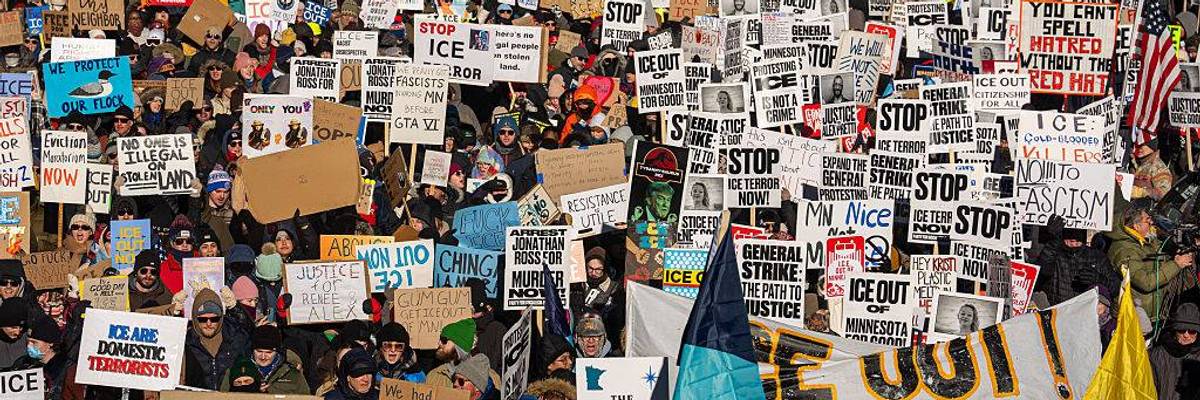
Thousands of protesters gather and march to demonstrate against Immigration and Customs Enforcement (ICE). (Photo by Jen Golbeck/SOPA Images/LightRocket via Getty Images)
“If you take away our democratic stability, we will take away the economic stability.”
A centrist Democratic US senator is now talking about taking drastic measures to protect democracy from President Donald Trump.
Speaking with the Court of History podcast on Thursday, Sen. Ruben Gallego (D-Ariz.) outlined a plan to stop Trump in case he tries to follow through on his threat to “nationalize the vote” ahead of the 2026 midterm elections or if he tried to enact ally Steve Bannon’s proposal to “surround the polls” with US Immigration and Custom Enforcement (ICE) agents.
“We have to prepare for the outmost scenario, the worst scenario,” said Gallego, “which is they try to either capture the ballot box as ballots are being counted, they try to stop the count, they try to surround polling places, whatever it is.”
Getting more specific, Gallego said that something like a general strike along the lines of the one that took place in Minneapolis last month to protest ICE deployment in the city would be justified.
“We need to make sure that we have an ultimate response to that which, I believe, has to be a true national strike,” he said, “in the sense that, if they do this, if they try to overthrow our democracy, if you are allied with democracy, do not go to work. If you’re a pilot, do not show up. If you drive a train, do not show up. If you’re a teacher, do not show up. We grind the country to a halt.”
Gallego acknowledged the damage that this would do to the US economy, but said that “if we have to destroy the stock market to save democracy, we need to accept that.”
He also said such an action would send an unmistakeable message to the billionaires who have given Trump their full-throated backing during his second term.
“The richest and the most powerful people in the world and in this country need to understand that that is a real possibility,” he emphasized. “There is no economic stability without democratic stability. If you take away our democratic stability, we will take away the economic stability.”
Gallego isn’t alone in saying that concrete steps may have to be taken to protect US democracy from the president this year.
Elections expert Rick Hasen, a law professor at the University of California, said in an interview published by the New Republic on Friday that both state and city governments, as well as individual citizens, may be needed to ensure the integrity of the 2026 midterms.
“I think states and local governments need to be prepared for this,” he said. “I would suggest trying to get injunctions against the federal government to keep them away. I would suggest that lawyers for voting rights groups and Democrats be prepared to go to court.”
Failing that, he said that citizens must be prepared to get involved on the ground.
“I mean, it may take people in the streets protecting the offices where ballots are being tabulated,” he said. “To take the Brooks Brothers riot—from the 2000 disputed election where some people were trying to storm an office where they were recounting ballots in Bush v. Gore—that would look very tame compared to what, you know, we might see in 2026.”
Donald Fuhrump says that Amerikkka doesn’t bother with crimes or charges anymore, not being 100% Amerikkkan and opposing his real estate intentions is enough.Donald Trump urges you to be a Climate Science denier like him. He says that he makes millions and millions for destroying the planet, Burn, Baby, Burn and Flood, Baby, Flood.Orcas discuss Donald Trump and the killer apes’ concept of democracy. Front Orca warns that Trump is crashing his country’s economy and that everything he does he does for the fantastically wealthy.
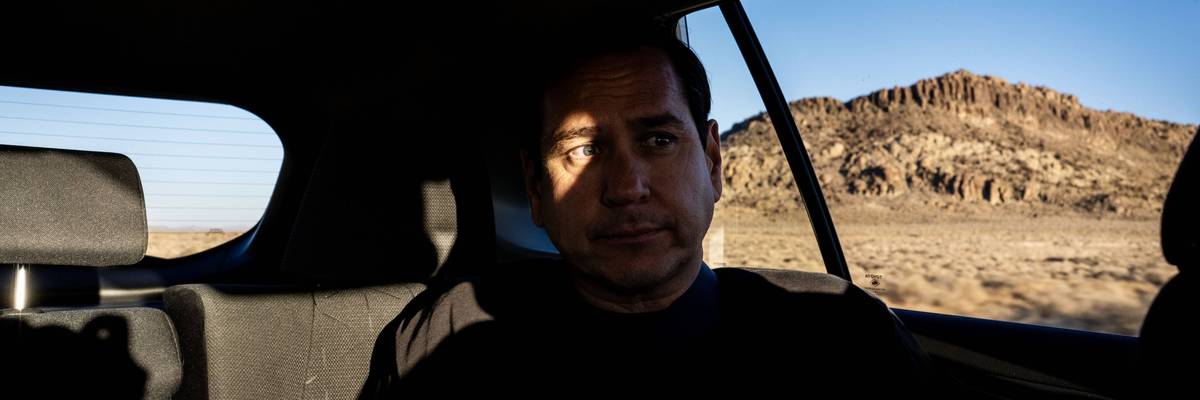
Nevada Secretary of State Cisco Aguilar is driven through rural Nevada to visit and support rural county clerks approximately three weeks before the 2024 presidential election in Reno, on Friday, October 11, 2024. Aguilar was one of the state election officials invited by the FBI to a secretive meeting about the 2026 midterm elections. (Melina Mara/The Washington Post via Getty Images)
Nevada Secretary of State Cisco Aguilar, who received the invite, said that what the president is “trying to do is really disrupt the midterm election.”
State election officials were left unnerved after being summoned by the FBI to a mysterious conference to discuss “preparations” for this year’s midterm elections, which President Donald Trump has recently called for Republicans to “nationalize” in violation of the Constitution.
On Tuesday, election officials in all 50 states received an email from Kellie M. Hardiman, who identified herself as an “FBI Election Executive.”
Hardiman said the officials were invited to a call on February 25 with “your election partners” at the FBI, the Department of Justice (DOJ), the Department of Homeland Security (DHS), the US Postal Inspection Service (USPIS), and the Election Assistance Commission (EAC).
🚨SCOOP: Trump’s FBI summoned state election officials from across the country for an unusual briefing on “preparations” for the midterms, according to emails I obtained.
It’s the “strangest thing in the world,” one top state election official told me. pic.twitter.com/09ZMuZFfzX
The email, obtained via a public records request by Matt Berg of Crooked Media, did not specify the purpose of the meeting other than to say it was “to prepare for the 2026 US midterm elections.”
Hardiman added that the FBI and other agencies “would like to invite you to a call where we can discuss our preparations for the cycle, as well as updates and resources we can provide to you and your staff.”
At the end of the email, she reiterated, “We look forward to speaking with you in support of the 2026 midterm elections.”
Berg said he contacted the FBI for comment, to which a spokesperson responded: “Thank you for reaching out. The FBI has no comment.”
The email has heightened fears that the Trump administration is meddling in the midterms or planning to do so; he has suggested on multiple occasions that the elections should be “canceled” outright. Republican strategists are reportedly increasingly worried that the GOP could lose control of both the US Senate and the House.
Although the Constitution plainly states that elections are to be run by state governments, Trump earlier this week said Republicans should “nationalize” elections and “take control of the voting in at least 15 places” led by Democrats.
Nevada Secretary of State Cisco Aguilar told Berg he’d never heard of a conference call like this. He said he wrote back to Hardiman: “Is this real? Given what’s occurred over the last two weeks, I am concerned.”
“I was just like, ‘What is this?’ It’s the strangest thing in the world that the FBI is reaching out to us and trying to coordinate election security,” Aguilar said. “It’s never happened in the past. The casualness which they did… it was just beyond crazy.”
A former DOJ official told Berg that while it is normal for the department to monitor elections, the email and conference call were highly unusual: “I can’t imagine why it would be coordinated in that way,” he said.
Another official who received the email told NBC Newsthat the message was “unusual and unexpected.”
Speaking of Hardiman, the official said, “No one has heard of this person—and we’re all wondering what an ‘FBI Election Executive’ is.” NBC reported that a LinkedIn page for Hardiman showed she was appointed to the position seven months ago.
The inclusion of the Department of Homeland Security as one of the election “partners” is also noteworthy, given the recent suggestion by Trump ally Steve Bannon that the president will “have ICE surround the polls,” referring to Immigration and Customs Enforcement.
The agency has increasingly acted as a sort of paramilitary force for Trump in the localities where it’s been deployed, most recently in Minnesota.
After federal agents killed three US citizens and provoked furious protests, Trump offered to withdraw agents from the state, but only if it turned over its voting rolls to the federal government.
At Trump’s apparent direction, the FBI raided an election hub in Atlanta last week to seize materials from the 2020 election to further his already disproven claims that his loss to former President Joe Biden was the result of fraud.
And earlier this week, it was reported that back in May, Director of National Intelligence Tulsi Gabbard sent a team to Puerto Rico to seize voting machines in an effort to investigate another outlandish Trump claim that they were hacked by Venezuela. Sources with knowledge of the investigation told Reuters that no evidence of that conspiracy was uncovered.
“It’s unconstitutional for the president to do what he wants to do,” Aguilar said. “We understand that what he’s trying to do is really disrupt the midterm election, because the ‘26 election is critical to the ‘28 election.”
Aguilar said officials in Nevada are “constantly preparing and strategizing” for whatever Trump might attempt and said, “We have to prepare for that litigation at a moment’s notice, and we will be prepared in Nevada to push back.”
Danny Miller, an attorney who has worked for Renew Democracy and Democracy Forward, expressed fear about Trump’s coordination of federal law enforcement agencies to patrol elections, given that he has already supported one violent attempt to overturn his loss in 2020.
“Trump will try to do something far worse than January 6th before all is said and done,” Miller said. “It’s up to civil society to use all the tools of democracy to stop him.”
Donald Fuhrump says that Amerikkka doesn’t bother with crimes or charges anymore, not being 100% Amerikkkan and opposing his real estate intentions is enough.Donald Trump urges you to be a Climate Science denier like him. He says that he makes millions and millions for destroying the planet, Burn, Baby, Burn and Flood, Baby, Flood.Orcas discuss Donald Trump and the killer apes’ concept of democracy. Front Orca warns that Trump is crashing his country’s economy and that everything he does he does for the fantastically wealthy.
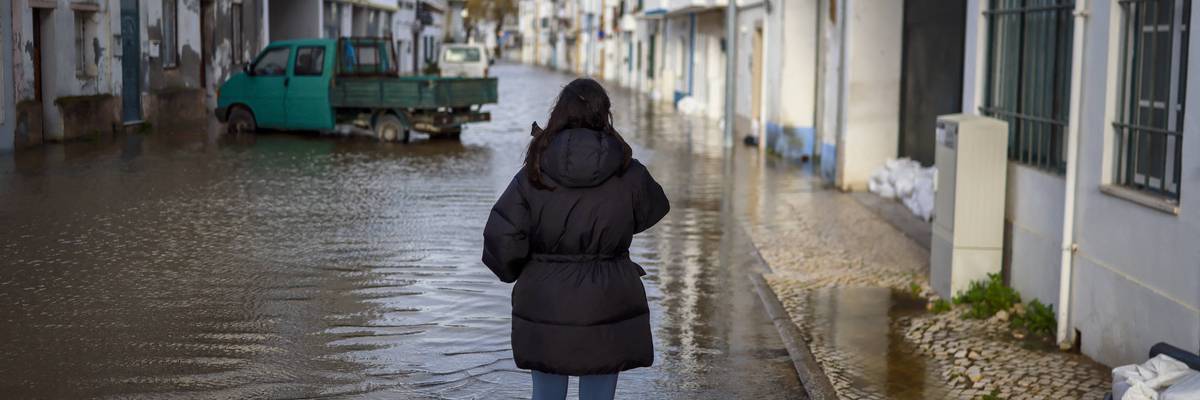
A woman observes floodwaters from the Sado River covering a street in Alcacer do Sal, Portugal, amid Storm Leonardo on February 5, 2026. (Photo by Patricia de Melo Moreira/AFP via Getty Images)
Current models “assume the future will behave like the past, even as we push the climate system into uncharted territory,” said the lead author of a new report that’s based on input from dozens of experts.
In a report published Thursday, UK experts highlighted the “growing gap between real-world climate risk and the economic analysis used to guide policy, supervision, and investment,” while also warning that because the “window for preventing catastrophic warming” is narrowing, ambitious action “cannot await perfected models.”
Various scientific institutions concur that 2025 was among the hottest years on record—and the ongoing failure of governments across the globe, particularly the Trump administration, to enact policies that would significantly cut planet-heating emissions from fossil fuels is pushing the Paris Agreement’s 1.5°C and 2°C goals for this century further out of reach.
The new report from the University of Exeter and the think tank Carbon Tracker Initiative, titled Recalibrating Climate Risk, incorporates the expert opinions of 68 climate scientists from Australia, Austria, Canada, China, France, Germany, the Netherlands, Norway, Spain, Sweden, the United Kingdom, and the United States.
“Our expert elicitation reveals a fundamental disconnect: Climate scientists understand that beyond 2°C, we’re not dealing with manageable economic adjustments,” said Jesse Abrams, lead author and senior impact fellow at Exeter’s Green Futures Solutions, in a statement.
“The climate scientists we surveyed were unambiguous,” he explained. “Current economic models systematically underestimate climate damages because they can’t capture what matters most—the cascading failures, threshold effects, and compounding shocks that define climate risk in a warmer world and could undermine the very foundations of economic growth.”
Abrams said that “for financial institutions and policymakers relying on these models, this isn’t a technical problem—it’s a fundamental misreading of the risks we face, which current models miss entirely because they assume the future will behave like the past, even as we push the climate system into uncharted territory.”
Communities around the world are already contending with devastating droughts, fires, and storms—and, as another report from researchers at Exeter and the UK’s Institute and Faculty of Actuaries (IFOA) pointed out last month, “above 1.5°C, we enter the danger zone where multiple climate tipping points may be triggered, such as the collapse of ice sheets in Greenland and Antarctica, permafrost melt, Amazon dieback, and changes in ocean circulation.”
The IFOA report “warned that when cascading and systemic risks are taken into account, warming of 2°C by 2050 could result in a 25% hit to projected GDP, rising to a halving of projected economic growth between 2070 and 2090,” BusinessGreen editor-in-chief James Murray reported Thursday. “Similarly, a report from consultancy Boston Consulting Group calculated a third of the global economic output could be lost under a scenario where temperatures reach 3°C above preindustrial levels by 2100.”
“The studies stand in stark contrast to some mainstream economic models that have suggested warming of 2°C or more will only reduce projected economic growth by a few percentage points—analyses that have been seized upon by opponents of climate action to argue that decarbonization policies can be dropped or delayed,” Murray noted.
Abrams told the Guardian that some current economic models “are saying we’ll have a 10% GDP loss at between 3°C and 4°C, but the physical climate scientists are saying the economy and society will cease to function as we know it. That’s a big mismatch.”
Laurie Laybourn, a Carbon Tracker board member and executive director of Strategic Climate Risks Initiative, cited another recent report that provides a bleak picture of the current moment and what lies ahead.
“As the UK government’s landmark security assessment of ecosystem collapse showed last week, we are currently living through a paradigm shift in the speed, scale, and severity of risks driven by the climate-nature crisis,” she said. “Yet, beyond this report, there has not been a corresponding paradigm shift in how regulators and government as a whole assess these risks.”
“Instead, they’re routinely underestimated if not missed entirely, meaning many regulations and government action are dangerously out of touch with reality,” she continued. “This threatens disaster when that reality catches up with us. So, it’s critical that policymakers change course, providing clear signals and guidance to markets that these risks should be priced accordingly, rather than downplayed.”
And, as the experts emphasized Thursday, it’s not just policymakers—investors are also still relying on “flawed economic advice,” said Carbon Tracker founder and CEO Mark Campanale. The result is “widespread complacency… with many investors viewing climate scenario analysis as a tick-box disclosure exercise.”
“Until the gap between scientists and economists’ expectations of future climate damages is closed and government bodies act to ensure the integrity of advice upon which investment decisions are made,” he added, “financial institutions will continue to chronically underprice climate risks—meaning that pension funds and taxpayers will remain dangerously exposed.”
Hetal Patel, head of sustainable investment research at Phoenix Group, the UK’s largest and retirement and savings business, said that her firm “supports the report’s call for a more robust and coordinated approach to climate‑risk modeling. Underestimating physical risk doesn’t just distort financial analysis and investment decisions, it underplays the real‑world consequences that will ultimately affect customer outcomes and society as a whole.”
The new report stresses that addressing the “fundamental disconnect between what climate scientists understand about climate impacts and how these impacts are represented in economic models” would require “research investments spanning years,” but rather than simply waiting for better modeling, decision-makers “must proceed on the basis of precautionary risk management, physical climate science, and observed impacts.”
Donald Trump urges you to be a Climate Science denier like him. He says that he makes millions and millions for destroying the planet, Burn, Baby, Burn and Flood, Baby, Flood.Nigel Farage urges you to ignore facts and reality and be a climate science denier like him and his Deputy Richard Tice. He says that Reform UK has received £Millions and £Millions from the fossil fuel industry to promote climate denial and destroy the planet.Elon Musk urges you to be a Fascist like him, says that you can ignore facts and reality then.
The UK’s climate saw a record-breaking 2025, with the year being both the warmest and sunniest seen since observations began.
The year 2025 has joined 2024, 2023, 2022 and 2014 in the UK’s top-five warmest years.
In this review, we take a look back at the UK’s climate in 2025 and place the record-breaking year in the context of human-caused climate change. We find:
It was the warmest and sunniest year on record. January and September were the only months that were cooler than average.
A Met Office attribution study estimates that 2025’s average temperature would have been exceptionally unlikely in pre-industrial times – but could now occur, on average, every three years.
Spring was the warmest on record, breaking a record set in 2024.
Spring was not only the sunniest on record, but the fourth-sunniest season ever recorded, after the summers of 1976, 1996 and 1911.
It was the warmest summer on record. The summer temperature record was made around 70 times more likely due to human-induced climate change.
The persistent high-pressure systems in spring and summer, which contributed to the warm and sunny conditions, also resulted in an extended dry spell – including the driest spring since 1974.
Wetter conditions at the end of the year alleviated some of the rain shortfall. The year concluded with 90% of average annual rainfall.
Storm Éowyn in late January was the most powerful wind storm in over a decade and the most severe storm in Northern Ireland since 1998.
Storm Floris in early August was not unprecedented for a storm, but was one of the most severe wind storms to affect Scotland during the summer.
Storm Amy in early October hit north-western parts of the UK, with heavy rain falling widely, resulting in the wettest day of the year for the UK overall.
The Met Office relies on the long-running HadUK-Grid dataset to place recent UK weather and climate into its historical context. The gridded, geographically complete dataset combines observational data for monthly temperature since 1884, rainfall since 1836 and sunshine since 1910.
Unless stated otherwise, the rankings of events and statements (such as “warmest on record”) in this article relate to the HadUK-Grid series.
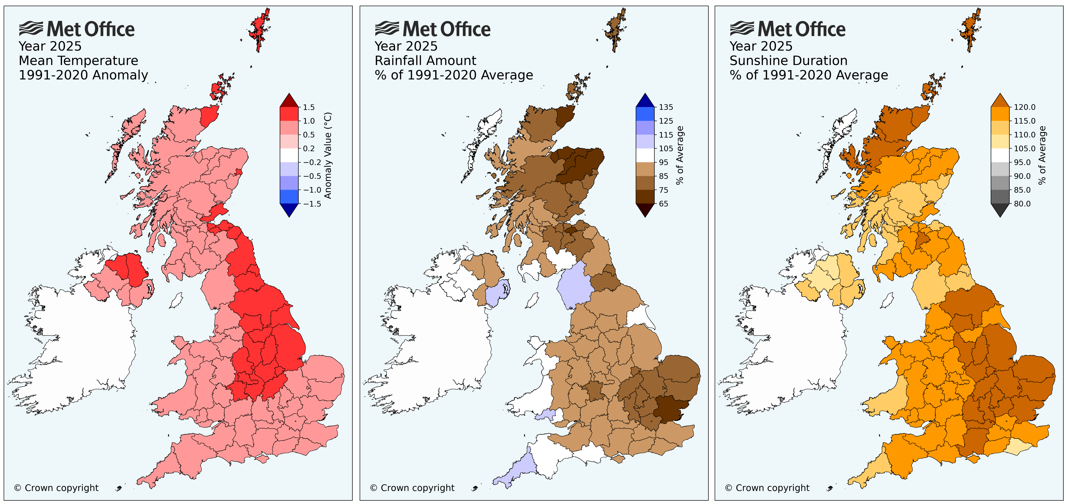
The “climate anomaly” maps below show the difference between the average temperature (left), rainfall total (middle) and sunshine duration (right) between 2025 and the 1991-2020 period. In other words, they show how much warmer, cooler, wetter, drier, sunnier or cloudier the year was than average for each county of the UK.
Maps showing anomalies in 2025 relative to a 1991-2020 reference period for temperature (C), precipitation (%) and sunshine (%). The darker shading indicates a greater departure from average. Credit: Met Office
The maps show that the whole country was warmer than average, with central and north-east England, parts of Northern Ireland and the tip of north-west Scotland, Orkney and Shetland seeing the greatest change.
The UK overall had 90% of average rainfall. The driest regions relative to average were around Essex, Moray and Aberdeenshire, which received less than 75% of normal annual rainfall.
In contrast, some western counties were slightly wetter than average – including Cornwall (110%) and Cumbria (107%).
Sunshine was above average across the UK, with eastern England and north Scotland exceeding 120% of the average.
Attribution
The UK’s absolute temperature averaged at 10.09C in 2025. This follows 2022 (at 10.03C) as the second time that the annual average temperature has exceeded 10C.
In our analysis of the UK’s climate in 2022 for Carbon Brief, we reported on a Met Office attribution study that found that human-caused climate change had increased the likelihood of UK annual absolute temperature averaging above 10C by a factor 160.
That study concluded that exceeding 10C – while unprecedented in the historical observational record – would become increasingly common and would likely occur every three-to-four years.
Three years on from that analysis and the 10C threshold has been breached for a second time – and an updated attribution analysis has been produced exploring the likelihood of a return of temperatures above the 10.09C recorded in 2025.
The study, which uses the same methodology as the 2022 paper, finds that UK annual mean temperatures above 10.09C are estimated to occur approximately every three years in the current climate. In contrast, they would have occurred around every 780 years in pre-industrial times.
Human-caused climate change has, therefore, increased the probability of average temperatures in excess of 10.09C by a factor of 260.
These results show that 2025’s record-breaking annual temperature – while unprecedented in the historical observational record – should be considered fairly normal in the current climate.
Climate projections indicate that, by the later part of the 21st century, a year like 2025 could be a relatively cool year.
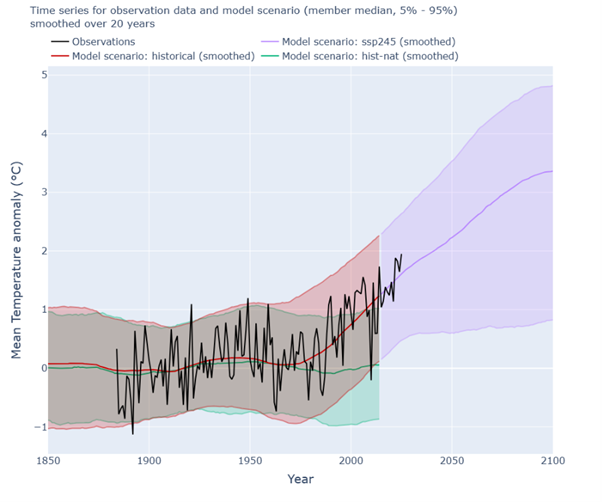
The figure below compares observations of UK annual average temperatures (black line) – relative to the long-term average – to climate model simulations that include (red/purple) or exclude (green) human-caused emissions of greenhouse gases and land-use change.
The green and red curves start to diverge from around the 1980s, suggesting that human influence is indeed the dominant factor in the warming trend. The shaded range of the simulations show that in our current and future climate, much warmer years than 2025 are plausible.
Colder years are also still possible, but it is much less likely that we would experience a cold year like 2010 – and exceptionally unlikely for a year to be in the top-10 coldest years for the UK. The most recent year to feature in the top-10 coldest years was 1963.
Timeseries of the UK annual mean temperature anomaly (w.r.t. 1901 – 1930). Observational data from HadUK-Grid (black). Simulations from the CMIP6 historical simulation including natural and human-caused drivers (red), SSP2-4.5 projections of future climate based on a “medium” emissions scenario (purple) and “hist-nat” simulations that include only natural drivers of climate such as solar and volcanic activity (green). Simulation data is represented as median values and filled 5-95th percentile ranges explored by members of the multi-model ensemble. Percentiles of simulation data are smoothed with a rolling window of 20 years, with historical and SSP2-4.5 combined into one continuous series. Observed data runs from 1884-2025. Credit: Met Office
Warmer, wetter, sunnier
Four of the UK’s last five years all appear in the top-five warmest years since 1884.
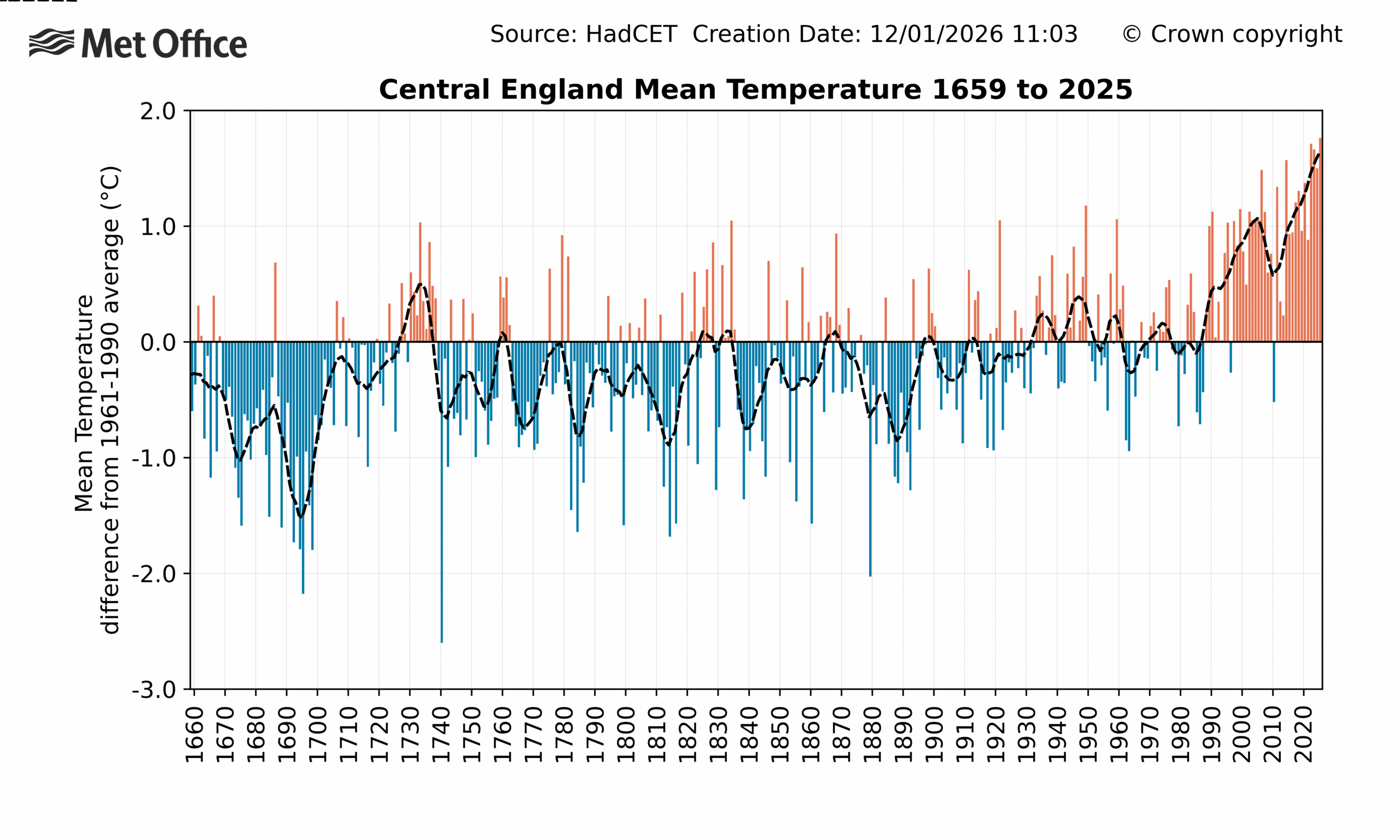
The Central England Temperature (CET) series is the longest continuous instrumental climate record in the world, dating back to 1659. Covering a region roughly enclosed by Lancashire, London and Bristol, it does not represent the whole of the UK. However, when averaged across a year and analysed across centuries, it does provide a multi-century perspective that is representative of climate variations and changes that impacted the UK.
As with the HadUK-Grid temperature record, the CET series also identifies 2025 as the warmest year on record. The longer-running temperature series identifies the same five years – in the same order – as the warmest on record. This is shown in the table below.
Year
UK (from HadUK-Grid)
Central England Temperature
2025
10.09C
11.23C
2022
10.03C
11.18C
2023
9.97C
11.13C
2014
9.88C
11.04C
2024
9.79C
10.96C
The graph below of the CET series shows that temperatures recorded in recent years are well outside the range of variability recorded over more than 300 years.
Average temperature anomalies (relative to a 1961-90 average) for each year in the CET series from 1659 to 2025. Colours show years that are above (red) or below (blue) average. The dashed line is a smoothed series to show the decadal variations and trend. Credit: Met Office
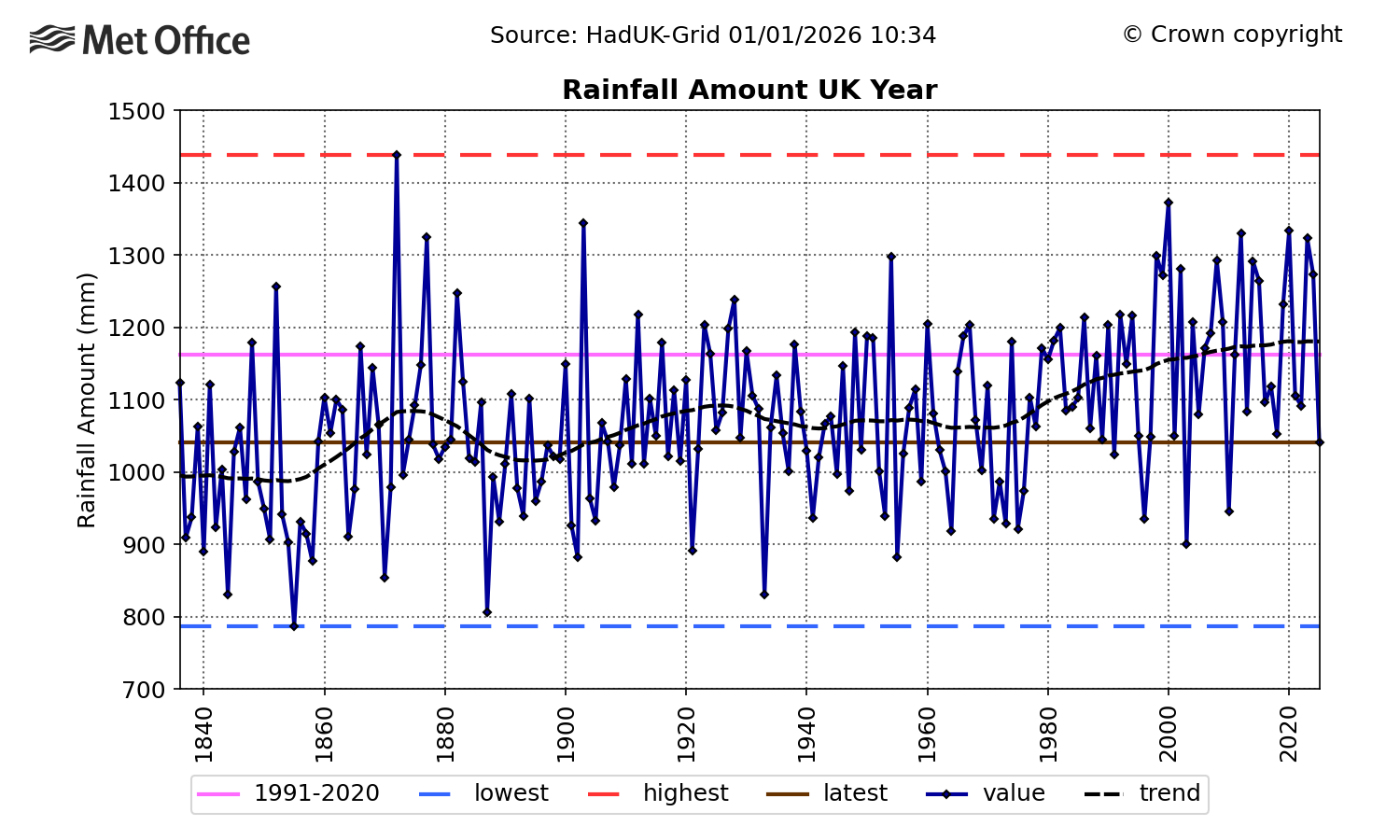
However, the UK is not only warming, it is also getting wetter and sunnier. The year 2025 was relatively dry, recording 90% of average rainfall. This made it the driest year recorded since 2010 and put it in contrast to relatively wet years in 2023 and 2024.
The longer-term trend can be seen in the figure below, which shows that 2025 was relatively dry compared to recent decades, but not exceptional in the longer-term historical context.
The last time the UK had a year in the top-10 driest was in 1955, whereas all five of the top-10 wettest years have occurred this millennium. The wettest year on record still stands as 1872.
Timeseries of UK total rainfall from 1836 to 2025. The trend is represented by a black dashed line, the 1991-2020 average is shown in pink and the highest and lowest values in the series are shown by the red and blue dashed lines, respectively. The 2025 value is represented by the horizontal brown line. Credit: Met Office
The drivers of annual rainfall trends are more complex than for temperature.
A significant factor in rainfall trends is a warming atmosphere’s ability to hold more moisture. However, this does not completely account for recent increases in rainfall.
Large-scale atmospheric circulation patterns – particularly features such as the jet stream and associated storm tracks across the North Atlantic – also play a crucial role. These are influenced by annual and decadal fluctuations in the Earth’s climate, as well as human-caused climate change.
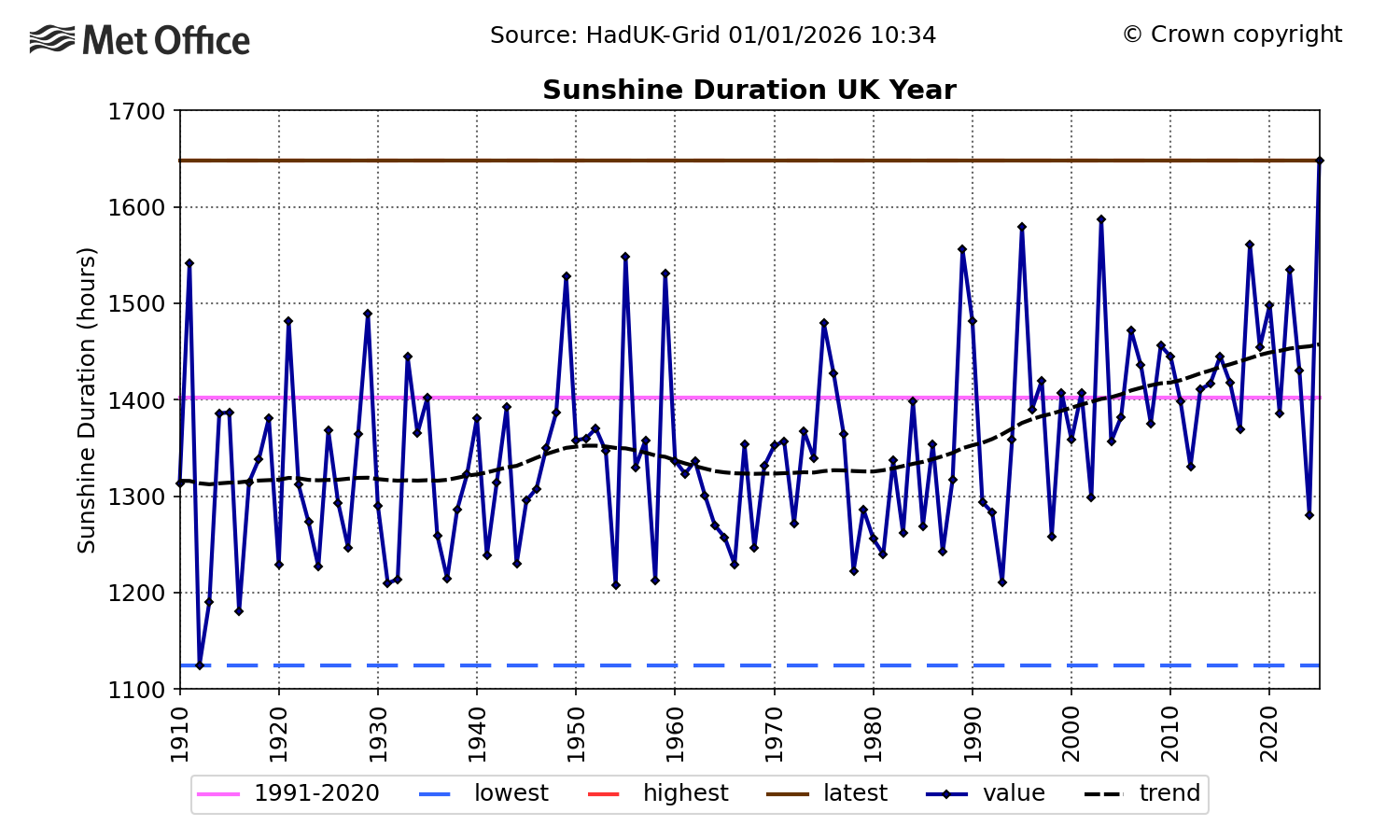
UK annual sunshine totals have also been rising since the 1980s, with 2025 setting a record by a considerable margin. This is in sharp contrast to 2024, which was the dullest year since 1998. This is shown in the graph below, where the dotted line shows the underlying long-term trend, with year-to-year variations removed.
Timeseries of UK total annual sunshine hours from 1910 to 2025. The trend is represented by a black dashed line, the 1991-2020 average is shown in pink and the highest and lowest values in the series are shown by the red and blue dashed lines, respectively. The 2025 value is represented by the horizontal brown line (which covers the red line for the highest in the record). Credit: Met Office
The cause of the sunshine trend is also uncertain, with both natural climate variability and human activity (through reduced regional air pollution caused by a reduction in aerosol emissions) potential contributors. Climate projections do not provide any strong evidence for how sunshine trends might develop.
The year in storms
The Met Office has been naming storms since 2015. Each storm-naming period runs from September to August.
(For more on storm naming in the UK, read Carbon Brief’s explainer.)
The criteria for storm naming has changed over time. It accounts for meteorological conditions, as well as the potential severity of impacts. As a result, comparisons between years can indicate relative levels of storm activity, but should not be done on a like-for-like basis.
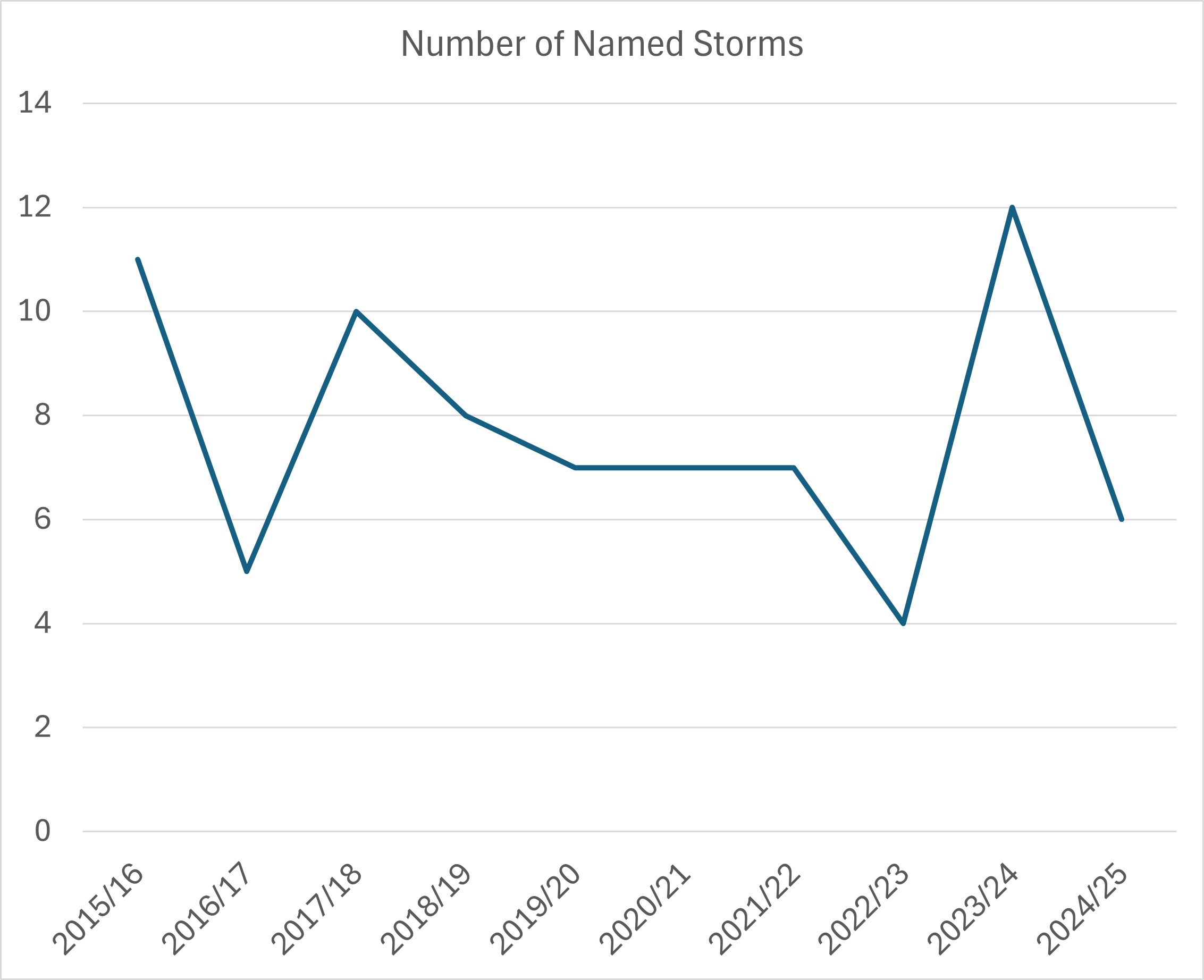
Between the 2015-16 and 2024-25 storm seasons, there have been, on average, 7.7 named storms each year, with a high of 12 recorded in the 2023-24 season and a low of four over 2022-23. This is shown in the line chart below.
Timeseries of the number of named storms for each storm-naming period (which runs from September to August) since 2015. It includes storms named by other Met Services that impacted the UK. Source: Met Office
By this measure, 2025 was not exceptional with six named storms – two from the 2024-25 season and four from 2025-26. These are listed in the table below.
Storm name
Date(s) of impact in UK
Maximum wind gust
Notable features
2024-25 names
Éowyn
24 January
87Kt (100mph), Drumalbin, Lanarkshire
Most powerful storm for over a decade
Floris
4-5 August
71Kt (82mph) at Wick Airport, Caithness
Equalled Scotland’s August gust speed record
2025-26 names
Amy
3-4 October
83Kt (96mph) at Tiree, Argyll
Significant disruption from flooding.
Benjamin (named by Meteo France)
22-23 October
52Kt (60mph) Needles, Isle Of Wight
Strongest winds affected northern France
Claudia (named by AEMET, Spain)
14 November
59Kt (68mph) Warcop Range, Cumbria
Extensive heavy rainfall across England and Wales
Bram
8-10 December
73Kt (84mph), Capel Curig, Conwy
Flooding from heavy rainfall on saturated ground.
Credit: Met Office storm centre
Storm Éowyn in January had the most severe winds of any storm in 2025. The Met Office issued a red warning for wind across Northern Ireland and the south-west and central belt of Scotland. An amber warning was issued for the northern half of the UK. At the peak of the storm, power outages were reported at around 1m homes.
Storms from October to December were notable for bringing some persistent and heavy rain during a period of wetter weather, in contrast to the extended dry spell earlier in the year.
Weather through the year
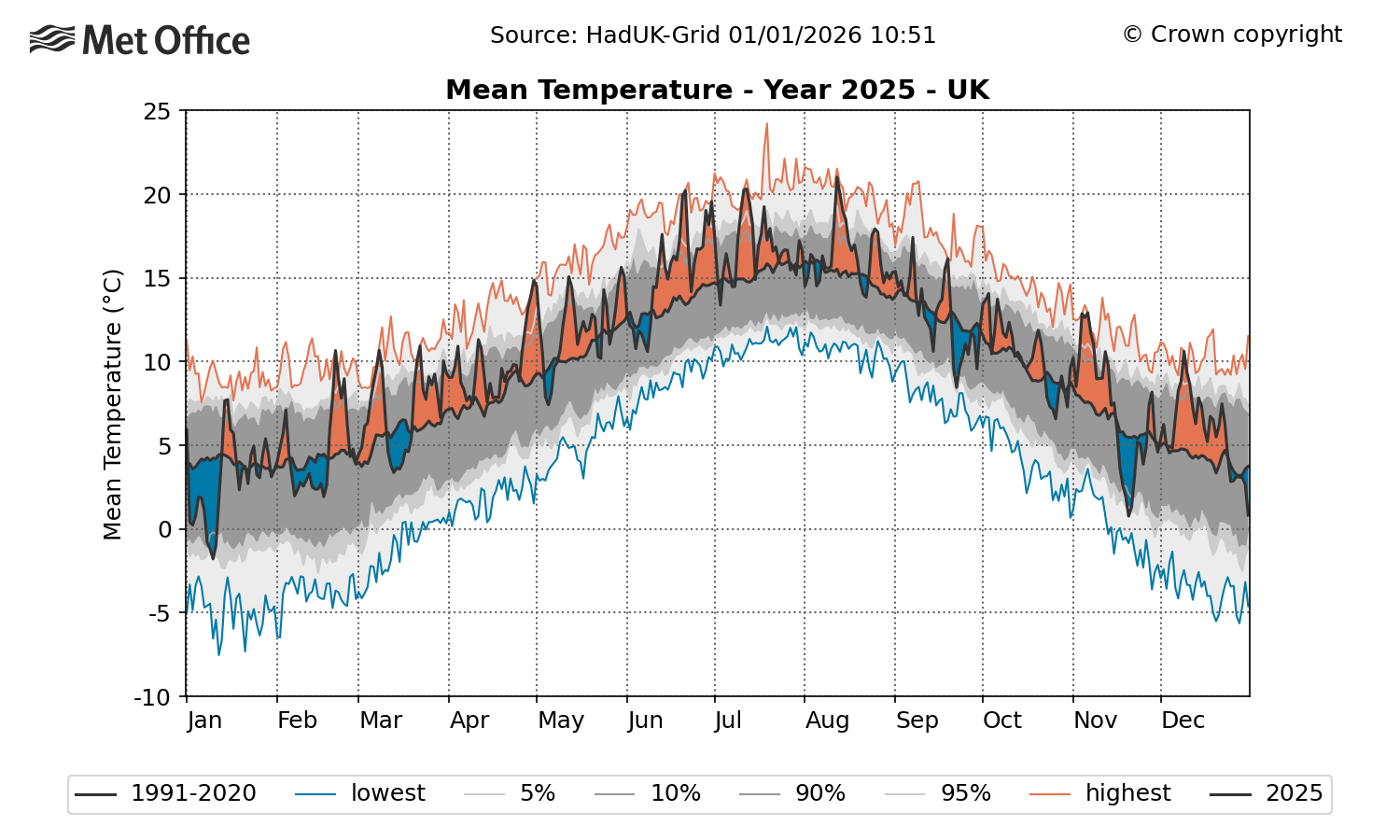
The charts below show the progression of temperature and rainfall through the course of 2025.
The plot below charts average daily temperature over the course of 2025, with orange shading showing warmer-than-average conditions. Overall, the year had 244 days – 66% of the total – where temperatures were above average.
On the other hand, cold spells – indicated by blue shading – were generally short-lived and not very severe, with the exception of events in early January and November.
Timeseries of daily UK average temperature during 2025. Orange shading indicates periods of above-average temperature and blue shading below average. The solid black line is the 1991-2020 reference period by day of the year. The grey shading reflects the 5th, 10th, 90th and 95th percentiles of the temperature distribution and the red and blue lines are the highest and lowest values for each day of the year, based on a dataset of daily data from 1960. Credit: Met Office
Fifty-one days in 2025 were in the top 5% warmest for the time of year in the historical record, but only one day – 20 November – was in the 5% of coldest.
The significant number of warmer days and absence of cool ones helps build a picture of how 2025 was the warmest year overall.
The highest daily maximum temperature recorded in the year was 35.8C at Faversham, Kent on 1 July during an early summer heatwave. The lowest minimum temperature was -18.9C, recorded at Altnaharra, Sutherland on 11 January.
A maximum annual temperature of 35.8C is not an exceptional high for recent years – especially when compared with 2022’s record of 40.3C. However it would have been a rare event in the 20th century, when just three years – 1932 (36.1C), 1976 (35.9C) and 1990 (37.1C) – saw a higher temperature.
In the 21st century, six years have seen temperatures above 35.8C – 2003, 2006, 2015, 2019, 2020, and 2022.
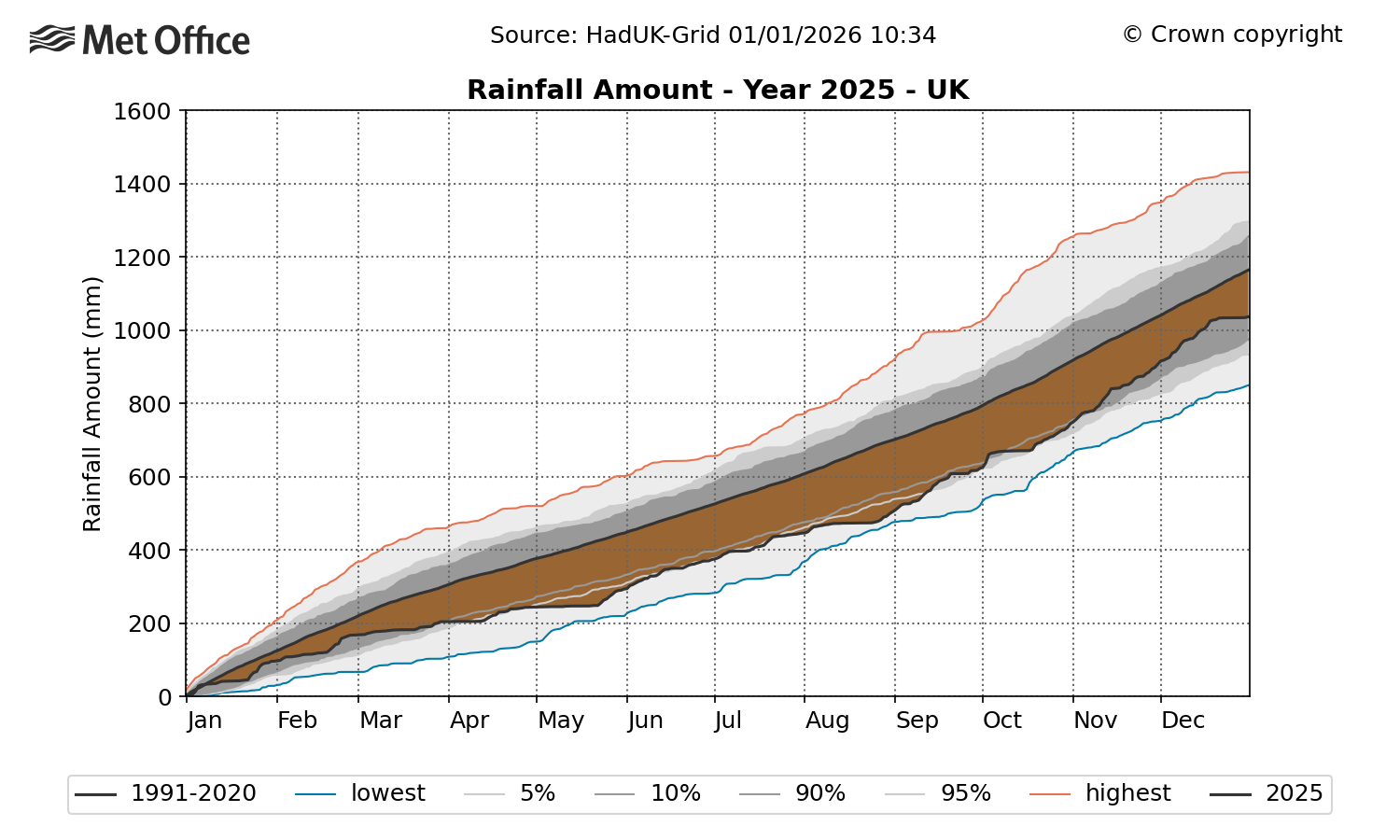
The plot below illustrates 2025’s below-average rainfall accumulation.
The brown shading – which represents the deficit in rainfall at that point of the year compared to the 1991-2020 average – highlights how rainfall totals were particularly low during the dry spring and summer period. The lower blue line shows how rainfall accumulation in 2025 came close to – but did not quite reach – a record low in late May and late August.
Wetter conditions in the autumn saw rainfall totals recover a little to reach 90% at the end of the year – which is below average, but not exceptional. As noted previously, there were regional variations.
Timeseries showing rainfall accumulation through 2025 for the UK. Brown shading represents a deficit in rainfall compared to average for that point in the year, and blue shading is an excess of rainfall compared to average. The solid line represents the 1991-2020 average and grey shading shows the 5th, 10th, 90th and 95th percentiles of the distribution. The blue and red lines represent the lowest and highest values based on a dataset of daily rainfall from 1891 to 2022. Credit: Met Office
Winter
In climate terms, the UK winter spans the calendar months of December, January and February.
The winter of 2024-25 was slightly warmer than average, but not exceptional, with an average temperature of 4.62C. This is 0.53C above the 1991-2020 average. The winter months had 89% of average rainfall and 94% of average sunshine.
New Year’s Day saw significant flooding that affected parts of Lancashire and the south side of Manchester. The River Mersey reached record levels in the wake of two days of heavy, persistent rain.
The coldest spell of 2025 occurred in early January, with significant snowfall in some regions.
Storm Éowyn and heavy rain at the end of January were the winter’s most impactful events, bringing high winds and flooding that resulted in considerable disruption.
Spring
Spring – which encompasses the months of March, April and May – was the warmest and sunniest on record, as well as the sixth driest.
The record high temperature came only one year after the previous record set in 2024, continuing a trend of increasing spring time temperature for the UK.
(A Met Office attribution analysis which explored the record-breaking temperatures of May 2024 showed that the temperatures were caused by a combination of a marine heatwave which persisted through May and into June and human-induced climate change.)
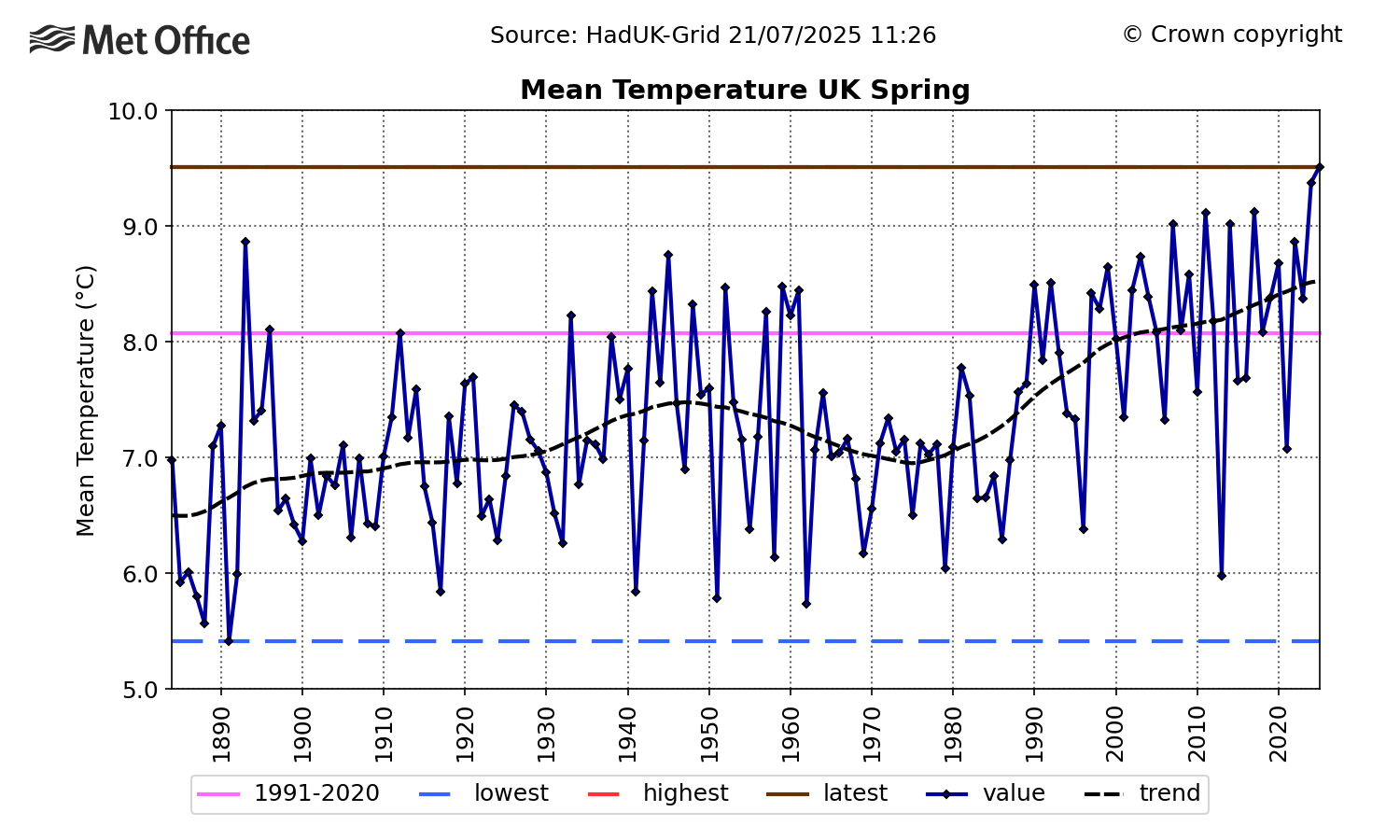
The timeseries below shows average spring temperature in the UK over 1884-2025. It shows a significant warming trend since the 1970s, with temperatures in 2024 and 2025 sitting well outside the range of variability observed in the late 19th and 20th centuries.
Timeseries of spring average absolute temperature for the UK over 1884-2025. The trend is represented by a black dashed line, the 1991-2020 average is shown in pink and the highest and lowest values in the series are shown by the red and blue dashed lines, respectively. The 2025 value is represented by the horizontal brown line (which covers the red line for the highest in the record). Credit: Met Office
The UK’s changing climate is having an impact on the natural cycles of many species and habitats. Citizen science initiatives have highlighted how “signs of spring” – for instance, the first flowering or first nest-building – occur increasingly early in the year.
Summer
Warm, sunny and dry conditions persisted into the summer season, drying out soils.
There were four heatwave events, which impacted almost all regions of the UK. Two of these events took place in June.
A marine heatwave also took place, with sea surface temperatures of 1.5-3C above the 1983-2012 average in the Celtic Sea, English Channel and southern North Sea.
An attribution study by the World Weather Attribution service estimated that human-caused climate change had made exceeding June heatwave thresholds around 10 times more likely. The research also found that one of the June heatwaves had been made 2-4C more intense as a result of human influence.
The five warmest summers recorded in the UK to date are 2025 (16.10C), 2018 (15.76C), 2006 (15.75C), 2003 (15.74C) and 2022 (15.71C).
Met Office analysis estimates that in a pre-industrial climate, a summer like 2025 would be expected to occur every 340 years. However, in the current climate, we could expect to see these sorts of summers roughly once every five years.
The study also shows that the UK could plausibly experience much hotter summers in the current and future climate. Events that would have been seen as extremes in the past are becoming more common.
A Met Office attribution study published in 2019 estimated that the then record-breaking summer of 2018 had a statistical return period of approximately eight-to-nine years. The summer of 2025 has broken that record in seven years, consistent with these previous findings.
The science is clear that UK summers are becoming warmer and extreme heat events are becoming more common. This could mean more significant impacts on people, infrastructure and the environment – both now and in the future.
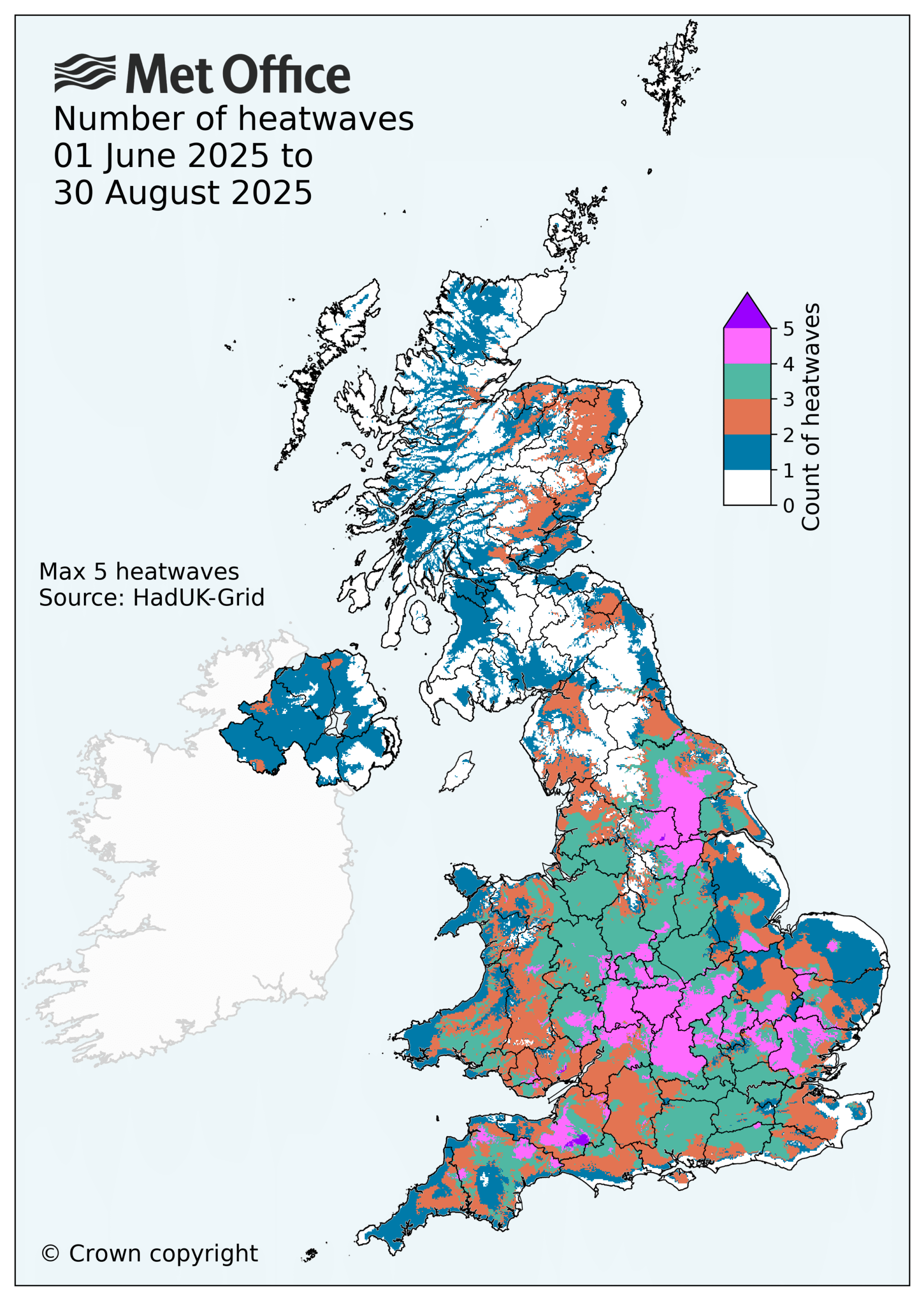
The map below plots the number of heatwaves that took place in June, July and August across the UK. It shows how a significant number of regions across saw three (green shading) or four (pink shading) heatwaves over the summer months.
Map showing the number of heatwaves by location during the summer of 2025. Source: Met Office
Autumn
Autumn and the month of December were marked with unsettled weather, with mild and wet conditions over the four-month period.
The season was warmer and wetter than average. Northern Ireland had its third-wettest autumn on record, Northern England its fifth wettest and Wales its 10th wettest.
Storm Amy set a record for highest gust speed for a storm in October, with 80Kt (92mph) recorded at Magilligan, County Londonderry.
Other major storms were notable for heavy rainfall that caused flooding. Storm Claudia brought heavy rainfall to central England and Wales in mid-November, which fell on already saturated ground.
The second half of November saw snow cause across the North York Moors during a cold northerly spell which saw some hard frosts. This was followed by generally mild and unsettled conditions until late December, when strong easterly winds brought more low temperatures and hard frosts.
The UK chalked up a number of significant climate records in 2025, particularly for high temperatures. This aligns with the well-established warming trend that is the result of human-caused climate change.
Climate attribution studies continue to provide further evidence that human factors are increasing the likelihood and severity of UK climate extremes.
Many of 2025’s records will not stand for long. There is a high chance they will be broken again in the near future as the climate continues to warm.
Donald Trump urges you to be a Climate Science denier like him. He says that he makes millions and millions for destroying the planet, Burn, Baby, Burn and Flood, Baby, Flood.Nigel Farage urges you to ignore facts and reality and be a climate science denier like him and his Deputy Richard Tice. He says that Reform UK has received £Millions and £Millions from the fossil fuel industry to promote climate denial and destroy the planet.Elon Musk urges you to be a Fascist like him, says that you can ignore facts and reality then.
Stagnating population growth would lead to fewer tax revenues and cause the government to borrow more, according to the thinktank. Photograph: Amer Ghazzal/Alamy Stock Photo/Alamy Live News.
Jump of £37bn in budget deficit by 2040 would force government to increase taxes, NIESR predicts
The UK economy would be 3.6% smaller by 2040 if net migration fell to zero, forcing the government to raise taxes to combat a much bigger budget deficit, a thinktank has predicted.
The National Institute of Economic and Social Research (NIESR) said falling birthrates in the UK and a sharp decrease in net migration last year had led it to consider what would happen if this trend continued to the end of the decade.
In this scenario the UK population would stop growing at about 70 million in 2030. The latest official figures showed the UK population was 69.3 million in 2024.
Dr Benjamin Caswell, a senior economist at NIESR, said: “Net zero migration leaves the economy 3.6% smaller by 2040 and this reflects slower employment growth and a smaller workforce.”
…
The forecast came after a sharp fall in net migration in 2025, from 649,000 to 204,000 in the year to June, after a tightening of work visa requirements by the Conservative government.
Additional measures by the Labour government around recruiting foreign workers within health and social care may bring down migration further, NIESR said. At the same time, the number of births and deaths in the UK have been more or less equal since the start of the decade, with any change in the UK population being driven by migration.
Keir Starmer refuses to be outcnuted by Nigel Farage’s chasing the racist bigot vote.Climate science denier Nigel Farage explains that it’s simple to blame asylum-seekers or Muslims for everything.Nigel Farage explains the politics of Reform UK: Racism, Fake anti-establishmentism, Deregulation, Corporatism, Climate Change Denial, Mysogyny and Transphobia.