3 journalists killed in Israeli airstrike on southern Lebanese city of Jezzine

Spread the love

This work by Middle East Monitor is licensed under a Creative Commons Attribution-NonCommercial-ShareAlike 4.0 International License

Burned press equipment and belongings are seen at the site of an Israeli airstrike in the Jezzine district of southern Lebanon, where three journalists, including Ali Shuaib of Al Manar TV, Fatima Fetuni of Al Mayadeen and photojournalist Mohammed Fetuni, were killed after their vehicle was targeted, on March 28, 2026. [Ahmed Kaddoura – Anadolu Agency]

Three journalists were killed on Saturday when an Israeli airstrike targeted a vehicle they were traveling in near the city of Jezzine in southern Lebanon, according to an Anadolu correspondent, Anadolu reports.

The deceased include Al-Manar TV correspondent Ali Shuaib, Al-Mayadeen correspondent Fatima Fatouni, and a cameraman.

In a statement, the Israeli army admitted the killing of Ali Shuaib, but did not comment on the death of the other two journalists.

Lebanese President Joseph Aoun said the attack constitutes a “blatant crime that violates all norms” and called on international bodies to take action.

Prime Minister Nawaf Salam also condemned the attack, urging respect for international law, according to the National News Agency.

Separately, the Syndicate of Workers in Visual and Audio Media in Lebanon said: “Targeting journalists in the field is a blatant attack on press freedom and a transparent attempt to silence free voices and obscure the serious human rights violations taking place.”

WHO: Israeli attacks cripple health services in Lebanon

“This crime not only targets specific individuals but also the entire media community and all those who strive to reveal the truth to the public,” it added in a statement.

In a news conference, Information Minister Paul Morcos said that Lebanon is preparing to file a complaint with the UN Security Council over the attack.

Earlier, the National News Agency reported that an Israeli airstrike targeted a car on the Al-Barad road in Jezzine, without providing further details.

Since dawn on Saturday, Israel launched airstrikes and artillery attacks on 42 towns, cities, and areas in Lebanon, most of them in the south, according to the news agency.

The Israeli offensive against Lebanon, which began on March 2, has resulted in 1,142 deaths and 3,315 injuries, according to the latest figures from the Lebanese Health Ministry.
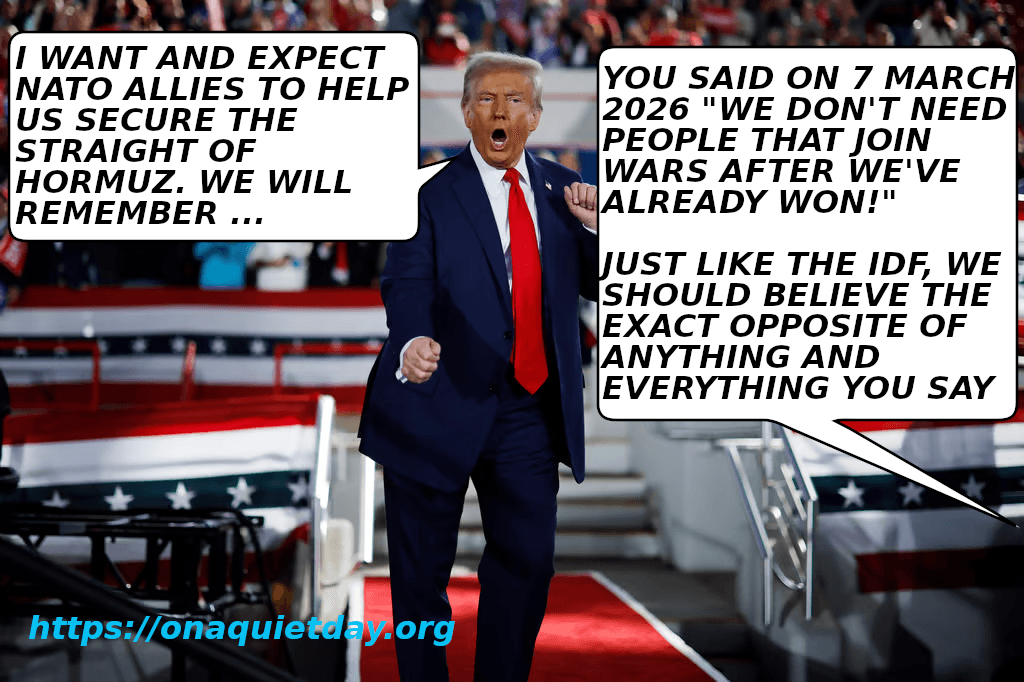
Donald Trump calls for help from NATO allies in securing the Straight of Hormuz despite saying on 7 March 2026 that they don't need people to join wars after they've already won.
Donald Trump calls for help from NATO allies in securing the Straight of Hormuz despite saying on 7 March 2026 that they don’t need people to join wars after they’ve already won.
Keir Starmer explains that UK is participating defensively in Trump and Israel's criminal war for Israel's genocidal expansion in Iran and states that he supports Zionism "without qualification". Keir Starmer said "I said it loud and clear – and meant it – that I support Zionism without qualification.” here: https://www.jewishnews.co.uk/keir-starmer-interview-i-will-work-to-eradicate-antisemitism-from-day-one/
Keir Starmer explains that UK is participating defensively in Trump and Israel’s criminal war for Israel’s genocidal expansion in Iran and states that he supports Zionism “without qualification”. Keir Starmer said “I said it loud and clear – and meant it – that I support Zionism without qualification.” here: https://www.jewishnews.co.uk/keir-starmer-interview-i-will-work-to-eradicate-antisemitism-from-day-one/
Orcas discuss how Trump was re-elected and him being an obviously insane, xenophobic Fascist.
Continue Reading3 journalists killed in Israeli airstrike on southern Lebanese city of Jezzine

With No End in Sight, Cost of Trump’s Illegal Iran War Balloons to at Least $25 Billion

Spread the love

Original article by Jake Johnson republished from Common Dreams under Creative Commons (CC BY-NC-ND 3.0). 

A member of the Iranian Red Crescent comforts a resident of an apartment block in northern Tehran destroyed by US-Israeli airstrikes on March 23, 2026. (Photo: AFP via Getty Images)

The new estimate comes amid warnings that the war, now in its fourth week, could “cost the US trillions of dollars in the decades to come.”

The price tag of US President Donald Trump’s illegal war on Iran is on track to surpass $25 billion by the end of this week as more American troops head to the Middle East, signaling a protracted conflict and possible ground invasion that would explode the war’s already massive financial and human costs.

The latest estimate of the dollar cost of the Iran assault to US taxpayers, who are also facing significantly higher prices at the pump because of the war, comes from the Center for American Progress (CAP). The liberal think tank noted Tuesday that, based on a combination of official figures from the Pentagon and outside estimates, “the Iran war’s cost has likely surpassed $20 billion already and will likely surpass $25 billion by the end of this week.”

RECOMMENDED…

U.S. Military Launches Operation Epic Fury Attacking Iran

$1 Billion Daily Cost of Trump’s Iran War Could Fund Food Aid, Healthcare for Tens of Millions

Trump's War of Choice in Iran Has Cost US Taxpayers Over $10 Billion in Just 10 Days

Trump’s War of Choice in Iran Has Cost US Taxpayers Over $10 Billion in Just 10 Days

CAP found that $25 billion would be enough to provide Medicaid coverage to around 3.1 million people for a year, or fund free school lunches for more than 29 million children for a full school year.

“While the cost of the war is funded through the Pentagon’s budget, and that money could not have been legally spent on domestic social programs, the spending nonetheless reflects a choice both Congress and the president made in allocating the country’s limited resources,” wrote Bobby Kogan, CAP’s senior director for federal budget policy. “This trade-off is particularly salient as Congress considers the president’s upcoming request.”

“Before Congress chooses to provide $200 billion in new funding for the US Department of Defense,” Kogan added, “it should seriously consider other ways that funding could be used, including improving people’s lives.”

“One of the officials lamented that Americans would be paying off the war for generations.”

The updated price tag came amid reports that the Pentagon approved a deployment of around 2,000 elite Army soldiers to the Middle East, heightening concerns that the Trump administration is preparing for a deeply unpopular ground invasion of Iran even as the president publicly declares victory.

Experts believe the true financial cost of the Iran war is likely much higher than what publicly available estimates indicate so far.

The Intercept’s Nick Turse reported last week that the Trump administration is “drastically undercounting the price tag of the US war with Iran, peddling fragmentary estimates that offer Americans a skewed understanding of the costs.”

Citing analysts, lawmakers, and unnamed US officials briefed on Iran operations, Turse reported that “the war is burning through between $1 billion and $2 billion per day—or roughly $11,500 to $23,000 per second.”

“The cost, the officials told The Intercept, could rise to a quarter trillion dollars or more over the coming months,” Turse added. “Even that is a drop in the bucket compared to the long-term expenses, which could cost the US trillions of dollars in the decades to come. One of the officials lamented that Americans would be paying off the war for generations.”

Climate science denier Donald Trump confirms that he knows nothing about democracy and that more liquid gold is being secured according to his policy of global privateering.
Continue ReadingWith No End in Sight, Cost of Trump’s Illegal Iran War Balloons to at Least $25 Billion

With Everyone Looking for Iran War Off-Ramp, Experts Offer ‘Exit Plan’

Spread the love

Original article by Brad Reed republished from Common Dreams under Creative Commons (CC BY-NC-ND 3.0). 

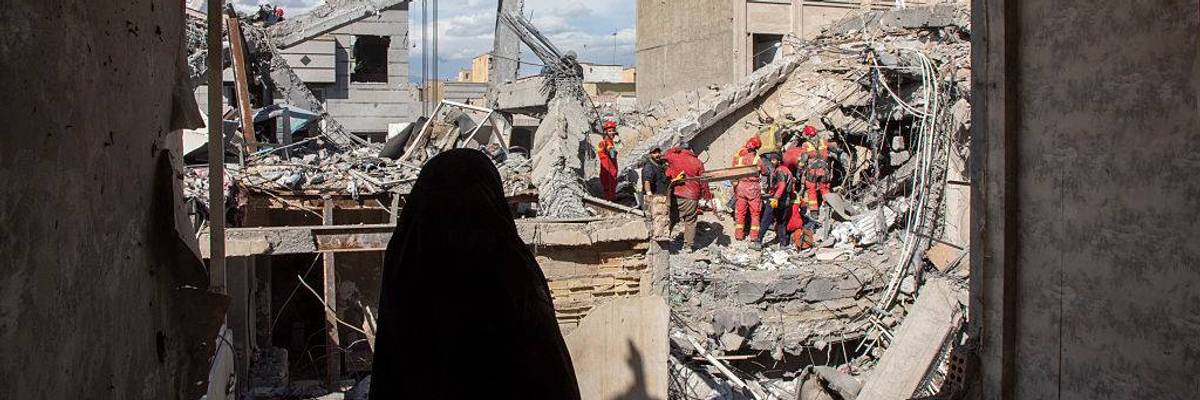
A woman looks on as residents and emergency workers sift through rubble of a residential building that was hit in an airstrike in the early hours of March 27, 2026 in Tehran, Iran. (Photo by Majid Saeedi/Getty Images)

“The United States and Iran are trapped in a conflict in which each new escalation only deepens a shared, losing predicament… Sooner rather than later, both will confront the urgency of finding an off-ramp.”

Multiple reports published in the last two days have indicated that President Donald Trump is seeking to wrap up his illegal war in Iran, which has significantly hurt his domestic political standing—partially by raising gas prices at a time when polls show US voters are primarily concerned about the cost of living.

While ending the Iran war will not be simple, some foreign policy experts believe that it can be done if both the US and Iran truly understand that deescalation is in both nations’ best interests.

RECOMMENDED…

U.S.-Israel War Against Iran

‘Unlike the United States,’ Says Security Chief, Iran ‘Has Prepared Itself for a Long War’

'This War Is Dumb as Hell': Military Historian Assesses Trump's Disaster in Iran

‘This War Is Dumb as Hell’: Military Historian Assesses Trump’s Disaster in Iran

George Beebe, director of grand strategy at the Quincy Institute for Responsible Statecraft and former director of the CIA’s Russia analysis, and Trita Parsi, executive vice president of the Quincy Institute, have written an essay published on Thursday by Foreign Policy outlining what an achievable Iran “exit plan” would look like.

The authors acknowledged the immense challenges in getting both sides to meet one another halfway, but said this option is preferable to a drawn-out war that will leave both nations poorer and bloodied.

On Iran’s side, argued Beebe and Parsi, a deal would involve renewing “its stated commitment to never pursue nuclear weapons,” re-opening the Strait of Hormuz to all shipping vessels, and making a commitment “to denominating at least half of its oil sales in US dollars rather than the Chinese yuan.”

The US, meanwhile, would “grant sanctions exemptions to countries prepared to finance Iran’s reconstruction” and “would also permit a specified group of states—such as China, India, South Korea, Japan, Turkey, Iraq, and others in the Gulf—to resume trade with Tehran and the purchase of Iranian oil, thereby easing global energy prices.”

Beebe and Parsi emphasized that this deal would only be a first step, and they said the next step would be restarting negotiations to establish a nuclear weapons agreement similar to the one previously negotiated by the Obama administration that Trump tore up during his first term.

“The United States and Iran are trapped in a conflict in which each new escalation only deepens a shared, losing predicament,” they wrote. “Neither can compel the other’s surrender. Sooner rather than later, both will confront the urgency of finding an off-ramp—one that does not hinge on the other’s humiliation.”

Even if Trump takes this course of action, however, there is no guarantee it will succeed, in part because of how much he has already damaged US alliances across the world.

In an analysis published Thursday, Sarah Yerkes, senior fellow at the Carnegie International Endowment for Peace’s Middle East Program, argued that even nations in the Middle East that stand to benefit from a weakened Iran are now thinking twice about their dependence on the US for their security needs, given that Trump’s war has resulted in Iran launching retaliatory strikes throughout the region.

Yerkes also highlighted how Trump’s handling of European allies is making it less likely that they will play a significant part in helping him end the conflict.

“Europe, which is not eager to enter what it sees as a war of choice, has refrained from proactively joining US and Israeli strikes,” Yerkes explained. “One of the clearest examples of the transatlantic rift was over the initial reaction to closures in the Strait of Hormuz, the shipping channel for approximately 20% of the world’s seaborne oil and LNG traffic. Multiple European countries refused to cow to Trump’s demand that they send warships to help keep the strait open, inviting public ire from Trump.”

The bottom line, warned Yerkes, is that “each day the war continues, without explicit goals or a clear exit strategy, opposition to the United States—from friends and foes, inside and outside—is also likely to grow, making America less safe and less secure.”

Donald Trump calls for help from NATO allies in securing the Straight of Hormuz despite saying on 7 March 2026 that they don't need people to join wars after they've already won.
Donald Trump calls for help from NATO allies in securing the Straight of Hormuz despite saying on 7 March 2026 that they don’t need people to join wars after they’ve already won.
Continue ReadingWith Everyone Looking for Iran War Off-Ramp, Experts Offer ‘Exit Plan’

‘We Must Act Now’: Tlaib Introduces Pair of Bills to Block US Support For Israel’s Lebanon Invasion

Spread the love

Original article by Stephen Prager republished from Common Dreams under Creative Commons (CC BY-NC-ND 3.0). 

US Rep. Rashida Tlaib (D-Mich.) speaks during a press conference with families of Americans killed by Israeli forces on September 16, 2025, in Washington DC. (Photo by Celal Gunes/Anadolu via Getty Images)

“We are witnessing the same genocidal playbook used against Palestinians in Gaza, now in Lebanon,” Rep. Rashida Tlaib said.

As Israel ramps up its devastating invasion of Lebanon, Rep. Rashida Tlaib has introduced legislation in the US House of Representatives aimed at blocking US support.

Israel’s latest onslaught against Lebanon, launched after the militant group Hezbollah retaliated against the joint US-Israeli attack against Iran at the end of February, has already killed more than 1,100 people, including at least 121 children, according to the Lebanese Health Ministry.

RECOMMENDED…

Israel Continues Air Strikes And Ground Offensive In Lebanon

From Lebanon to Iran, Says Sanders, US Must End Complicity in ‘Netanyahu’s Wars’

Casey Means Senate HELP

‘No More Weapons to Support an Illegal War’: Sanders Aims to Cut Off Israel Aid as Attacks Across Middle East Escalate

Many pieces of civilian infrastructure—including hospitals, schools, and residential buildings—have been attacked, and Israel has issued forced evacuation orders that have led more than 1 million people to be displaced from their homes.

“Thousands of families in our district with strong ties to Lebanon are living through immense pain,” said Tlaib, who represents a district that includes parts of Detroit and surrounding suburbs. “Many have lost loved ones, watched their grandparents’ towns and villages be completely destroyed, and seen relatives uprooted from their homes, not knowing if they will ever be able to return.”

Tlaib (D-Mich.), the only Palestinian-American member of Congress, introduced two resolutions on Friday. The first calls on the US to use its leverage to end Israel’s land and air assaults against Lebanese territory, denounce efforts at territorial expansion, and investigate alleged crimes against humanity.

The second, cosponsored by Reps. Delia Ramirez (D-Ill.) and Nydia Velázquez (D-NY), is a war powers resolution that would require President Donald Trump to remove US forces from participation in all military actions in Lebanon that have not been authorized by Congress.

In recent days, Israel has expanded its ground operation, aiming to control the entire territory south of the Litani River indefinitely. Leaders of the military campaign, such as Defense Minister Israel Katz, have suggested using the genocidal war in Gaza as a “model” for Lebanon, including the full destruction of residential areas.

“We are witnessing the same genocidal playbook used against Palestinians in Gaza, now in Lebanon,” Tlaib said. “Israeli leaders are openly celebrating it. This ethnic cleansing campaign is only possible because of US support, funded by our tax dollars. We must act now to stop these crimes against humanity and illegal invasion of Lebanon.”

Nathan Thompson, a senior analyst at Just Foreign Policy, which advised Tlaib on the legislation, told Common Dreams that although the US military and Israel Defense Forces (IDF) are “deeply operationally integrated, and have only become more so since October 7, 2023,” the extent of direct US involvement in Lebanon has been kept secret from the public.

“Military officials wouldn’t say whether or not they provided targeting assistance for Israel’s airstrikes on Hezbollah in 2024, and that’s exactly the type of action Congress has considered to be unauthorized ‘hostilities’ under the War Powers Act in the past,” Thompson said.

However, he said, “We know that the IDF and the US military are linked at the hip—on weapons sales, missile defense, targeting assistance, everything.”

Tlaib’s resolutions come as another war powers resolution to limit Trump’s ability to launch more attacks against Iran appears to have gained enough support to pass the House, although Democratic leadership has chosen to delay the vote until mid-April despite warnings that Trump may soon dramatically escalate the war, including with US ground troops.

That bill remains viable due to limited Republican support, including from Reps. Thomas Massie (Ky.), Warren Davidson (Ohio), and Nancy Mace (SC). While Massie has been a consistent anti-war vote, it’s unclear whether other Republicans, as well as some pro-Israel Democrats, would similarly sign onto a resolution concerning Lebanon.

Thompson said the Lebanon-related legislation is an “urgently necessary tool to end US complicity” as Israeli officials are “talking about functionally annexing southern Lebanon and recreating Gaza-level destruction there.”

He said, “A war powers vote forces all of Congress to go on the record: Do you want the US to enable this genocide, or not?”

Keir Starmer objects to criticism of the IDF. He asks how could anyone object to them starving people to death, forced marches like the Nazis did, bombing Gaza's hospitals and universities, mass-murdering journalists, healthworkers and starving people queuing for food, killing and raping prisoners and murdering children. He calls for people to stop obstructing his genocide for Israel.
Keir Starmer objects to criticism of the IDF. He asks how could anyone object to them starving people to death, forced marches like the Nazis did, bombing Gaza’s hospitals and universities, mass-murdering journalists, healthworkers and starving people queuing for food, killing and raping prisoners and murdering children. He calls for people to stop obstructing his genocide for Israel.
Continue Reading‘We Must Act Now’: Tlaib Introduces Pair of Bills to Block US Support For Israel’s Lebanon Invasion