The aircraft was above Baalbek when 18 people were killed there.
The UK flew a drone over Baalbek, Lebanon as Israel massacred 18 people and injured 28 others there on Wednesday, flight data shows.
The flight, first reported on by independent journalist Matt Kennard, left the RAF Akrotiri airbase in Cyprus at 8:22am local time, just hours before Israel’s massive and intense bombardment of civilian areas across Lebanon, which killed at least 303 people, including many children.
The General Atomics Protector RG1 drone circled in the sky near Baalbek for hours, data from AirNav Radar shows. The model is equipped with missiles and bombs and can be used for “surveillance, search and rescue, and armed operations”, according to the RAF’s website.
Prime minister Keir Starmer has repeatedly, and falsely, claimed that the UK’s only involvement in the war in the Middle East since 28 February is defensive.
Wednesday’s drone flight appears to mirror a pattern first seen at the height of Israel’s genocide in Gaza, when Starmer’s government flew numerous surveillance flights over the enclave on behalf of the apartheid state.
Keir Starmer explains that UK is actively supporting Israel’s genocidal expansion and repeats his previous quotation that he supports Zionism “without qualification”. Keir Starmer said “I said it loud and clear – and meant it – that I support Zionism without qualification.” here: https://www.jewishnews.co.uk/keir-starmer-interview-i-will-work-to-eradicate-antisemitism-from-day-one/Keir Starmer objects to criticism of the IDF. He asks how could anyone object to them starving people to death, forced marches like the Nazis did, bombing Gaza’s hospitals and universities, mass-murdering journalists, healthworkers and starving people queuing for food, killing and raping prisoners and murdering children. He calls for people to stop obstructing his genocide for Israel.
More than 3,300 now arrested under the Terrorism Act since 5 July 2025
Yesterday’s arrestees include Massive Attack band member Robert Del Naja
Arrests made following Met U-turn, despite leading legal figures warning the force that arrests would be unlawful in light of High Court ruling
The Met Police have confirmed 523 arrests in Trafalgar Square yesterday, where protesters staged a silent vigil against the genocide and the unlawful use of terrorism laws to silence opposition to the genocide. This brings the total number of arrests for defying the Palestine Action ban from 2,779 to over 3,302.
Last month the Met announced that the number of arrests for proscription offences relating to Palestine Action since the ban came into effect in July 2025, was 2,779 arrests.
The Met chose to make the arrests yesterday despite the High Court ruling in February that the proscription of Palestine Action was unlawful as a violation of the democratic rights to free speech and peaceful assembly. Leading legal figures warned the Met that arrests at this peaceful vigil would be unlawful in light of the High Court ruling, pending the hearing in the Court of Appeal on 28 and 29 April.
Many of those arrested were elderly or disabled, with ages ranging from 18 to 87. Arrestees included Robert Del Naja, the artist and musician from Massive Attack. The arrests took the number of terrorism arrests for quietly holding cardboard signs to over 3,300 since 5 July 2025.
Earlier in the day, a former Met police chief told BBC Radio 4 that arresting these peaceful protestors creates optics which are “very challenging for the police” and that there “will be a huge amount of people who have sympathy with what is going on with the views of Palestine Action.”
The Met Police’s mass arrests of protestors comes despite their stating publicly in February that they would not arrest people for holding signs, given the illegality of the proscription order. They said at the time that not arresting people, pending the Government’s appeal, was “the most proportionate approach we can take”. On 25 March, for reasons that are unclear, they announced a U-turn on this policy.
Meanwhile, the Devon and Cornwall Police undermined the Met’s decision by refusing to make arrests under Terrorism Act in Truro on 11 April. Protesters in Truro held exactly the same sign as protesters in London and police chose not to arrest, whereas the Met arrested 523 people.
Former Met Police chief superintendent, Dal Babu, said on BBC Radio 4:
“I think the difficulty is, when you’ve got 700 or 800 people who are willing to be arrested, that just isn’t practical. The optics of this will be very challenging for the police.
“It will present some significant difficulties for the police in terms of how they manage it and also be aware of the fact there will be a huge amount of people who have sympathy with what is going on with the views of Palestine Action.” [1]
A spokesperson for Defend Our Juries said:
“It is truly surreal that over 500 people have been arrested for defying a ban the High Court has declared unlawful. An already absurdly authoritarian measure has now descended even further into farce ahead of the Court of Appeal hearing this month.
“The Met Police has inexplicably reversed its position that, in light of the High Court ruling and pending the Government’s attempt to appeal, it would not arrest peaceful protesters defying the ban. Leading legal figures warned these arrests could themselves be unlawful, and the Met now seems destined to face legal challenge over what may amount to hundreds, if not thousands of unlawful arrests.
“The fact that Devon and Cornwall Police chose not to arrest protesters yesterday for holding the exact same signs only deepens the chaos surrounding the unlawful ban on Palestine Action and underlines a simple truth: this ban is unenforceable.
“It’s obvious to every sane observer that the Israeli and US governments are committing war crimes in Gaza, the West Bank, Iran and in Lebanon. Instead of standing up to these atrocities, which are already having dire consequences for the British public, Keir Starmer’s government supports them, including by criminalising peaceful protest against these heinous crimes.
Everyone who cares for democracy and the rule of law should be appalled by what is happening, and should ask themselves what they can do personally to prevent the descent into fascism.”
Keir Starmer explains that UK is actively supporting Israel’s genocidal expansion and repeats his previous quotation that he supports Zionism “without qualification”. Keir Starmer said “I said it loud and clear – and meant it – that I support Zionism without qualification.” here: https://www.jewishnews.co.uk/keir-starmer-interview-i-will-work-to-eradicate-antisemitism-from-day-one/Palestine Action joke that appeared in the UK satirical magazine ‘Private Eye’.Keir Starmer objects to criticism of the IDF. He asks how could anyone object to them starving people to death, forced marches like the Nazis did, bombing Gaza’s hospitals and universities, mass-murdering journalists, healthworkers and starving people queuing for food, killing and raping prisoners and murdering children. He calls for people to stop obstructing his genocide for Israel.
Roundhead and cavalier soldiers, wearing partisan hats, face each other and urge their dogs to attack each other (1643). State Library Victoria, Melbourne , CC BY-SA
Around 8pm on a cold February evening in 1733, a gentleman named Francis Peters was returning to his home near Knightsbridge, London, in a hackney cab, when someone knocked on the wooden shutters of the door. An armed horseman thrust a pistol inside, demanded Peters’s money and valuables and snatched a ring from his finger. Peters handed them over without fuss. But when the thief also snatched his hat and wig, he protested vigorously, though in vain – the robber rode away with his booty.
The puzzle, to the modern reader, is that the hat was worth only five shillings – far less than the watch (worth £4), the ring and the cash he had already handed over. So why make such a fuss?
Levellers wearing their hats. Bodleian Libraries, University of Oxford
The robber was later arrested and Peters made a point of going to see him in Newgate Prison as he awaited trial. He told him it had been bad manners to take his hat. The Old Bailey trial records tell us that the highwayman apologised.
Historically, hats had a significance that went far beyond fashion and keeping the head warm. For any respectable man in Tudor, Stuart and Hanoverian England, to go hatless was almost unthinkable, while for people lower down the social scale, it suggested total destitution. Suspects awaiting trial were often desperate to obtain a hat before appearing in court, to present at least a shred of respectability. But what made it so unthinkable for respectable men to appear hat-less?
As my new research explains, the power of social convention is certainly one part of the answer. Another is contemporary concerns over health and the belief that it was important to keep the head warm at all times. Wearing a nightcap, after all, was common practice. Peters raised his own health concerns when he pleaded with the highwayman. A man who wore a wig as well as a hat would generally have had his head shaved, so the theft left him bare-headed and vulnerable on a cold winter night.
Madness and status
There was another factor, too – the association of a bare head with madness, which was familiar through images of the shaven inmates of Bedlam. The strength of that association can be seen through another strange story – that of Thomas Ellwood, the teenage son of an Oxfordshire gentleman.
In 1659, by chance, Ellwood and his father had come across the Quakers, a new movement at the time. Thomas was intrigued but his father was appalled, and forbade him to attend any Quaker meetings. Thomas sneaked away regardless, even after his father had beaten him and banished him from the dinner table.
Eventually his father found a bizarre tactic that did work: he confiscated all his son’s hats. Many years later, Ellwood explained in his autobiography that the move had rendered him effectively a prisoner for many months, “unless I would have run about the country bare-headed, like a mad-man: which I did not see it my place to do”. He would have appeared deranged, and he recognised the shame that such behaviour would bring to a gentleman’s family.
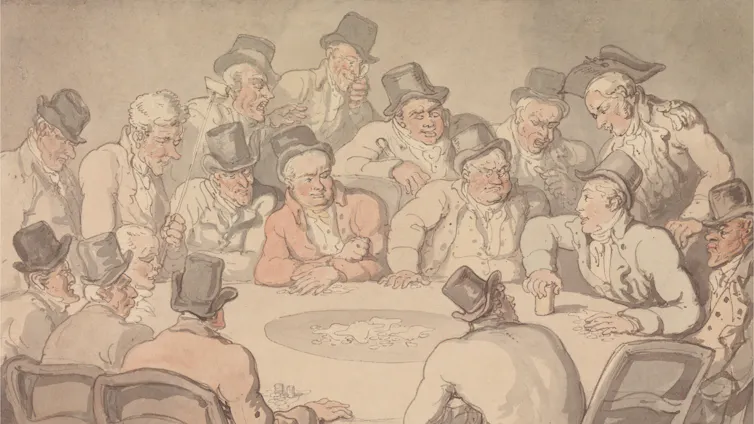
Hats were an indicator of status in early modern England. The only man not wearing a hat in this illustration is a servant in the gaming house and so a social inferior. Yale Center for British Art, Paul Mellon Collection, CC BY
As that concern suggests, the hat also had a far wider significance in this period as a marker of status and in associated gestures of deference. Unlike today, almost everyone wore a hat or, in the case of labourers and poor artisans, a flat cap. And convention required men and boys to doff the hat or cap in the presence of someone of higher status – a parent, master, employer, gentleman, magistrate, peer, or monarch.
Though there was no law to underpin “hat-honour”, the convention was firmly enforced. Many people who had grown up with this convention may have accepted it as part of the natural order of things, but having to “bow and scrape” to a harsh landlord, for example, was deeply resented by others. And in times of political upheaval, such as the civil wars of the 1640s, hat-honour could take on an ideological significance.
John Lilburne was a leader of the radical Leveller movement that was pressing for social reforms and a more accountable form of government. He refused to doff his hat when he was summoned to appear before the House of Lords for publishing illicit tracts, and announced his defiance in a pamphlet.
Many other radical leaders made similar gestures of defiance. Most notorious were the early Quakers, who refused on principle to doff their hats to anyone, explaining it as a gesture against the sin of pride and vanity.
Changing fashions
Refusing hat honour was an overt gesture of defiance associated with radicals, whether political, religious. But after the civil war of the 1640s ended with parliament’s victory over Charles I, the political order was turned upside down, and such gestures might now appeal to the defeated royalists.
At the trial of the king in January 1649, Charles himself refused to remove his hat when brought into court. As sovereign, he refused to recognise any superior on earth, or to accept that any court had the right to try him.
The importance of hat-honour gradually faded in later centuries, as manners became more informal and crowded cities made it ever less practicable. And finally, in the 1960s, the practice of men wearing hats abruptly ceased, for reasons that remain largely unexplained. The “swinging sixties” celebrated youth, informality and the rejection of old, hidebound conventions – and that cultural shift may provide at least a part of the answer.