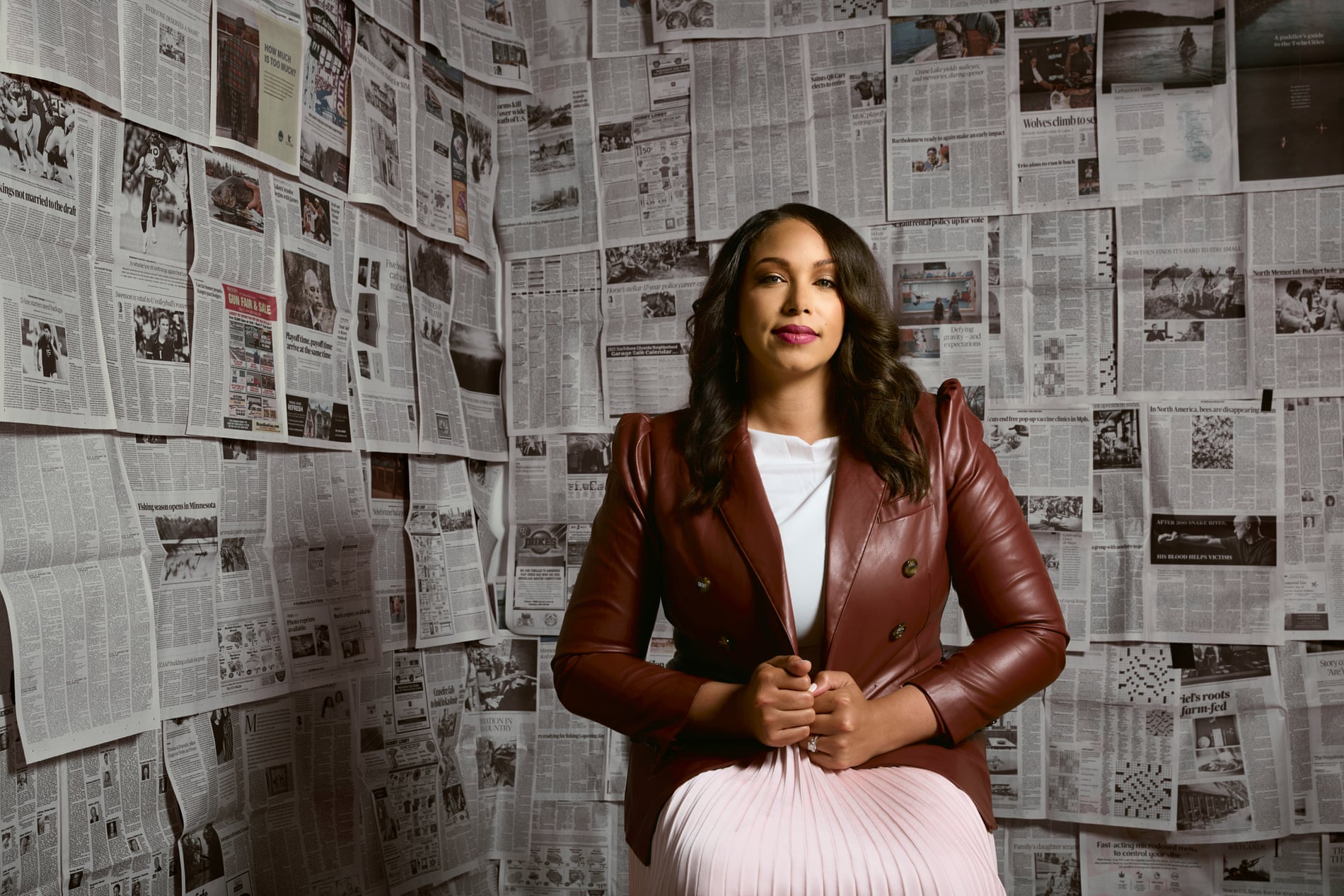
After Georgia Fort and Don Lemon reported from a church whose pastor reportedly works for ICE, agents arrested Fort in front of her children
When federal agents arrived at Georgia Fort’s front door to arrest her, she knew what to do: be a journalist.
Fort, an independent Minnesota reporter who faces criminal charges after covering a protest inside a St Paul church, took out her phone and spoke directly to the camera, livestreaming to her audience that her lawyer advised her to go with the agents. Her three kids were in the house at the time, she said.
“I’m going to have to hop off here and surrender to agents,” she said in the video on 30 January. “As a member of the press, I filmed the church protest a few weeks ago, and now I’m being arrested for that. It’s hard to understand how we have a constitution, constitutional rights, when you can just be arrested for being a member of the press.”
…
During the height of “Operation Metro Surge” in January, days after a federal agent killed Renee Good, dozens of people entered the church to call attention to one of its pastors, who reportedly served as an acting field director of Immigration and Customs Enforcement.
Nearly 40 people have been charged over the protest in a sprawling case that pits the first amendment rights to protest and report against the free exercise of religion. The Trump administration has made clear that the case is a high priority. Harmeet Dhillon, the head of the civil rights division at the Department of Justice, has said the government is “going to pursue this to the ends of the earth”, which the government said in legal filings was not a political statement but “mere promises to vigorously enforce federal criminal law”.
…
Fort often highlights attacks on journalists in her coverage, and she brings up the sustained attack on press freedom globally as context for her arrest. She points to journalists like Mario Guevara, a Latino journalist in Georgia who was deported by the Trump administration, and the hundreds of journalists killed in Gaza.
These attacks on journalists aren’t just personal – they are an attack on the public’s right to know, she said.
“Why would anybody not want you to know truth and facts?” she said. “Why would someone want to arrest and criminalize the people whose job it is to simply keep you informed?”
Elon Musk urges you to be a Fascist like him, says that you can ignore facts and reality then.Donald Trump warns against following the Onaquietday.org blog, says that he’s heard that she’s a witch with a black cat and a dangerous kitchen.
This work by Middle East Monitor is licensed under a Creative Commons Attribution-NonCommercial-ShareAlike 4.0 International License.
Protesters march through downtown Chicago during an “Emergency Protest” on April 8, 2026 in Chicago, Illinois, United States. [Jacek Boczarski – Anadolu Agency]
In the Middle East, the perception of ordinary Americans has long followed a familiar script: detached, uninformed, inward-looking, and politically shallow— a society of ‘gas guzzlers’, with little grasp of global realities beyond their immediate geography.
This perception did not emerge from thin air. It was cultivated—reinforced, even—by American political and media institutions themselves. Politicians claimed to speak on behalf of ‘the American people’, while mainstream media shaped what those people knew, and, crucially, what they did not know.
For decades, Americans overwhelmingly aligned with Israel. This was not merely ideological; it was instructional.
The public was told—repeatedly—that Israel reflected ‘American values’: democracy, civility, modernity. Palestinians and Arabs, by contrast, were framed as perpetual antagonists, initiators of violence, and ‘obstacles to peace’.
Some Americans embraced this framing on religious or ideological grounds. But for the majority, the pro-Israel position became a default—an inherited conclusion rooted in limited access to alternative information. Israel was ‘good’, Arabs were ‘bad’. The narrative was simple, binary, and rarely challenged.
With mainstream media as the primary source of information, this perception hardened over time. Support for Palestine, and for broader Arab causes, remained confined to academic spaces and activist circles—often informed by anti-colonial and anti-imperialist frameworks, but numerically marginal and politically contained.
The mainstream remained locked in place. But that lock has been broken.
The shift did not happen overnight. Among Democrats, cracks began to appear as early as the mid-2010s. In 2016, Gallup data still showed Democrats sympathizing more with Israelis than Palestinians. By 2018, that gap had narrowed. Significantly. By 2021, parity had nearly been reached. And by 2024–2025, Democrats—especially younger voters—were expressing majority sympathy for Palestinians, with some polls showing support exceeding 50 percent among those under 35.
This transformation was driven in part by grassroots activism, particularly within progressive circles, where Palestine became a central moral and political issue. But it was also driven by something far more consequential: the collapse of narrative control.
The Israeli genocide in Gaza accelerated this shift dramatically. Not only because of the scale of violence in the besieged Strip, but because, for the first time, the reality of war was not mediated solely through the filters of corporate media. Independent journalism, social media, and direct visual evidence disrupted decades of curated narratives.
The informational balance—long skewed—began to tip.
At the same time, American trust in mainstream media reached historic lows. According to Gallup, by 2025, only about 31 percent of Americans expressed trust in mass media to report news “fully, accurately, and fairly,” with trust among younger Americans even lower.
Up to this point, one could still argue that the shift remained politically contained: Democrats moving toward Palestine, Republicans remaining firmly aligned with Israel. But then came a rupture.
On February 27, 2026, Gallup released a poll showing that, for the first time in modern polling history, more Americans sympathized with Palestinians than with Israelis—41 percent to 36 percent. This was not a marginal fluctuation. It was a structural break.
That moment should have been seismic. Yet, it was not treated as such. Mainstream media largely buried the story. And within days, the political conversation shifted to a new crisis: the war with Iran.
In the weeks that followed, polling attention moved rapidly to American attitudes toward military escalation. Across multiple surveys, the outcome was consistent: Americans rejected war, and an even greater number rejected the idea of a prolonged military entanglement.
Yet mainstream commentary refused to connect the dots. Palestine was treated as one issue. Iran as another. Venezuela, interventionism, and global militarism as separate, disconnected phenomena. Each was analyzed in isolation, stripped of its broader political and moral context.
Instead of recognizing a pattern, commentators fragmented the evidence. Opposition to war was framed as ‘war fatigue’, or economic anxiety, or partisan resistance to President Donald Trump. The focus was placed on gas prices, electoral calculations, and political polarization—not on the possibility that Americans were making moral judgments independent of elite narratives.
But the pattern is there. And it is unmistakable.
True, Americans are still told what matters—Israel, Iran, energy security, the Strait of Hormuz, etc. The agenda remains largely intact. But the conclusions no longer follow automatically. The chain between attention and consent has been broken.
This is not simply a political shift. It is a cognitive and moral one. Economic concerns and partisan affiliations still shape public opinion, as they always have. But they no longer fully determine it.
Increasingly, Americans are evaluating global events through a moral lens—one that prioritizes civilian suffering, questions power asymmetries, and challenges the legitimacy of endless war.
This is not speculation. It is confirmed by data—most clearly in the case of Palestine, which has emerged as a moral compass for a wider transformation in American public consciousness. The shift in sympathy toward Palestinians is not an isolated anomaly, but a signal of a deeper rethinking of power, justice, and resistance. And it is likely irreversible.
Mainstream media will continue to set the agenda for the foreseeable future. But it has lost something far more important: its ability to manufacture consensus at scale.
That signals possibility. And perhaps, for the first time in generations, a reason for cautious—yet unmistakable—optimism: that ordinary Americans are no longer passive recipients of power, but active participants in shaping a more morally conscious political reality.
The views expressed in this article belong to the author and do not necessarily reflect the editorial policy of Middle East Monitor.
This work by Middle East Monitor is licensed under a Creative Commons Attribution-NonCommercial-ShareAlike 4.0 International License.
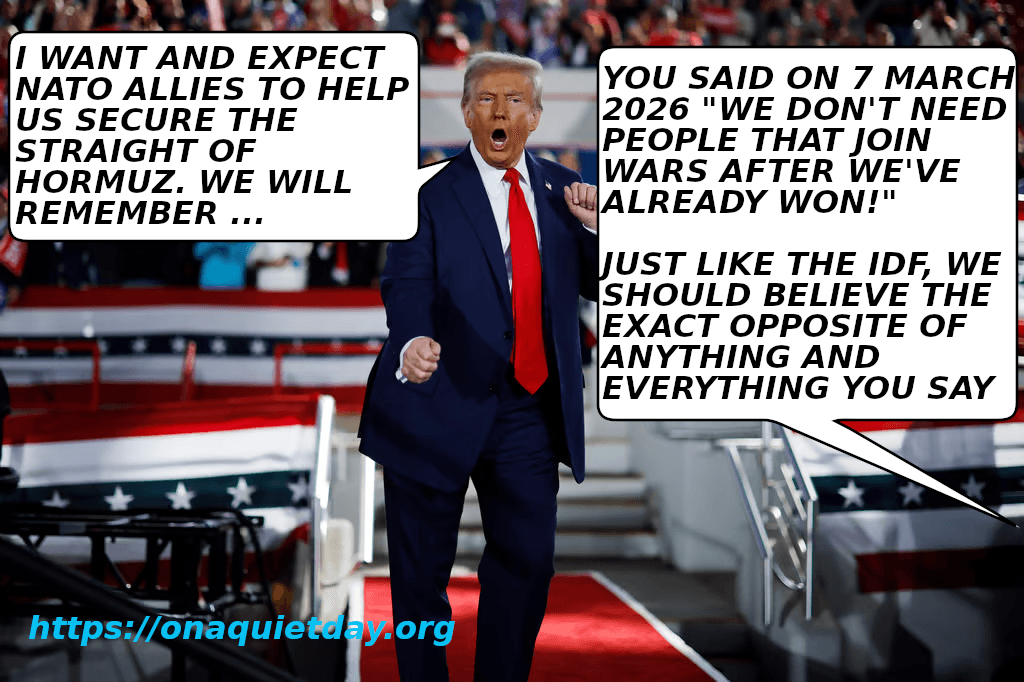
Keir Starmer explains that UK is actively supporting Israel’s genocidal expansion and repeats his previous quotation that he supports Zionism “without qualification”. Keir Starmer said “I said it loud and clear – and meant it – that I support Zionism without qualification.” here: https://www.jewishnews.co.uk/keir-starmer-interview-i-will-work-to-eradicate-antisemitism-from-day-one/Donald Trump calls for help from NATO allies in securing the Straight of Hormuz despite saying on 7 March 2026 that they don’t need people to join wars after they’ve already won. He’s challenged with the claim that he lies as much as the IDF.
This work by Middle East Monitor is licensed under a Creative Commons Attribution-NonCommercial-ShareAlike 4.0 International License.
A charity distributes meals to displaced Palestinians in the Rimal Neighborhood as food shortages persist due to the Israeli policy on aid entering the Gaza City, Palestine, on April 15, 2026. [Ahmed Jihad Ibrahim Al-arini – Anadolu Agency]
The Islamic Resistance Movement, Hamas condemned statements by the US Vice President J.D. Vance claiming that aid entering Gaza is at its highest level in five years, describing the remarks as “misleading and far removed from reality.”
In a statement issued Wednesday, Hamas said the claims represent an attempt to distort facts and obscure the ongoing humanitarian crisis in the Gaza Strip.
The movement stated that conditions on the ground contradict such assertions, pointing to Israel’s ongoing policies of “engineering starvation,” alongside strict restrictions on the entry of aid and disruption of essential supplies.
It added that Israeli authorities have not implemented the terms of the first phase of the ceasefire agreement, maintaining a blockade that leaves residents in “life under duress.”
Hamas said the situation has led to severe shortages of basic goods, including food, medicine, and fuel, citing reports by human rights organizations and international bodies.
The statement also noted that continued targeting of infrastructure is further worsening humanitarian conditions, contributing to what it described as an unprecedented level of crisis in the Gaza Strip.
This work by Middle East Monitor is licensed under a Creative Commons Attribution-NonCommercial-ShareAlike 4.0 International License.
Keir Starmer explains that UK is actively supporting Israel’s genocidal expansion and repeats his previous quotation that he supports Zionism “without qualification”. Keir Starmer said “I said it loud and clear – and meant it – that I support Zionism without qualification.” here: https://www.jewishnews.co.uk/keir-starmer-interview-i-will-work-to-eradicate-antisemitism-from-day-one/Donald Trump calls for help from NATO allies in securing the Straight of Hormuz despite saying on 7 March 2026 that they don’t need people to join wars after they’ve already won. He’s challenged with the claim that he lies as much as the IDF.
This work by Middle East Monitor is licensed under a Creative Commons Attribution-NonCommercial-ShareAlike 4.0 International License.
In this episode, we examine why the first round of Iran-US talks broke down, how Lebanon has moved to the centre of ceasefire negotiations and why Trump appears to be retreating from his earlier endorsement of Iran’s 10-point plan.
In this episode, we examine why the first round of Iran-US talks broke down, how Lebanon has moved to the centre of ceasefire negotiations and why Trump appears to be retreating from his earlier endorsement of Iran’s 10-point plan.
We also ask whether the war on Iran now amounts to a historic strategic defeat for both Washington and Tel Aviv, before looking at the build-up to war and Netanyahu’s role in shaping it. The discussion then turns to the growing rift between Pope Leo and Trump, the dangerous normalisation of political assassination and the rise in US soldiers refusing to fight with Iran. We close by considering why Israel is more dangerous than ever and what Viktor Orban’s defeat could mean for Israel and the global far right.
This work by Middle East Monitor is licensed under a Creative Commons Attribution-NonCommercial-ShareAlike 4.0 International License.
Keir Starmer explains that UK is actively supporting Israel’s genocidal expansion and repeats his previous quotation that he supports Zionism “without qualification”. Keir Starmer said “I said it loud and clear – and meant it – that I support Zionism without qualification.” here: https://www.jewishnews.co.uk/keir-starmer-interview-i-will-work-to-eradicate-antisemitism-from-day-one/Donald Trump calls for help from NATO allies in securing the Straight of Hormuz despite saying on 7 March 2026 that they don’t need people to join wars after they’ve already won. He’s challenged with the claim that he lies as much as the IDF.
This work by Middle East Monitor is licensed under a Creative Commons Attribution-NonCommercial-ShareAlike 4.0 International License.
Iranian military personnel take part in an exercise titled “Smart Control of the Strait of Hormuz”, launched by the Naval Forces of the Islamic Revolutionary Guard Corps, is being carried out in the Persian Gulf and the Strait of Hormuz on February 16, 2026. [Islamic Revolutionary Guard Corps – Anadolu Agency]
A military adviser to Iran’s Supreme Leader has warned that Iranian forces would sink US ships in the Strait of Hormuz if Washington acts as a “policeman” in the strategic waterway.
The warning was made on Wednesday amid ongoing tensions in the region, where the United States has imposed a military blockade on Iranian ports after Iran disrupted maritime navigation in the strait during more than six weeks of fighting, now paused under a fragile two-week ceasefire.
Mohsen Rezaei, a former commander-in-chief of Iran’s Revolutionary Guards who was appointed as a military adviser by Khamenei last month, criticised the US President in remarks broadcast on state television, according to AFP, saying: “Mr Trump wants to become the police of the Strait of Hormuz. Is this really your job? Is this the job of a powerful army like the US?”
Speaking in military uniform, he added: “These ships of yours will be sunk by our first missiles and have created a great danger for the US military. They can definitely be exposed to our missiles and we can destroy them.”
Rezaei, long considered a hardliner even within the Revolutionary Guard, also said that it would be “great” if the US launched a ground invasion of Iran, as “we would take thousands of hostages and then for each hostage we would get a billion dollars,” according to AFP.
He added: “I am not in favour of extending the ceasefire at all, and this is a personal view,” without giving further details.
Rezaei is a veteran figure in Iran’s political and military establishment and led the Revolutionary Guard between 1981 and 1997.
This work by Middle East Monitor is licensed under a Creative Commons Attribution-NonCommercial-ShareAlike 4.0 International License.
Keir Starmer explains that UK is actively supporting Israel’s genocidal expansion and repeats his previous quotation that he supports Zionism “without qualification”. Keir Starmer said “I said it loud and clear – and meant it – that I support Zionism without qualification.” here: https://www.jewishnews.co.uk/keir-starmer-interview-i-will-work-to-eradicate-antisemitism-from-day-one/Donald Trump calls for help from NATO allies in securing the Straight of Hormuz despite saying on 7 March 2026 that they don’t need people to join wars after they’ve already won. He’s challenged with the claim that he lies as much as the IDF.