Top civil servant boomeranged between government and Tony Blair Institute

Spread the love

Original article by Ethan Shone republished from OpenDemocracy under a Creative Commons Attribution-NonCommercial 4.0 International licence

Tony Blair’s think tank and consulting firm is proving to be highly influential with Labour in government 
| (Photo by Dan Kitwood/Getty Images)

Exclusive: Tech firms such as TBI are embedding staff in government, sparking fears AI policy is being ‘outsourced’

The Tony Blair Institute and the Ellison Institute of Technology sent senior staff members to work in the government department tasked with developing AI policy, openDemocracy can reveal.

UK tech firm Faculty, which has links to the TBI, also embedded a member of staff in the Department of Science, Information and Technology (DSIT).

In one case, the TBI hired a senior civil servant tasked with leading the government’s AI programme, then seconded them straight back to their old job in the department – a potential loophole in rules intended to stop former civil servants from using their connections to lobby old colleagues.

In another, a different TBI staffer wrote on LinkedIn that he had played a key role in drafting the government’s flagship AI Opportunities Action Plan, its far-reaching blueprint for AI policy, during an 11-month secondment to DSIT.

The government is not required to declare secondments, meaning there is no public record of the companies that gain significant access and influence through these arrangements – nor the policies their secondees advocate for.

But openDemocracy has found that arms firms Thales and Qinetiq, tech consultancy Capgemini, and pharmaceuticals giant AstraZeneca have also sent staff members to work in DSIT.

Responding to our findings, Kamila Kingstone, programme lead at said: “When individuals with close ties to vested commercial interests are embedded at the heart of policymaking, it creates real risks of conflicts of interest. It enables Big Tech to capture and help set the very rules that should regulate it.

“At a minimum, the government should publish annually a list of who has been brought in on secondment, their conflicts of interest, and any mitigations in place. At a time when public trust in politics is at rock bottom, the government should be going the extra mile to be sure it is transparent about who is influencing policy behind the scenes”

Green Party deputy leader Rachel Millward told openDemocracy: “Starmer’s Labour Party has no values or vision, so it has outsourced its policy development process to corporate interests. Unethical companies have funnelled dirty money through ‘think tanks’ and agencies to shape the government’s positions in favour of Big Tech.”

A government spokesperson told openDemocracy: “We make no apologies for bringing cutting-edge expertise from UK academia and industry into the heart of Government.”

‘Smooth transition’

Dr Laura Gilbert left her position as the director of the UK government’s Incubator for Artificial Intelligence programme in December 2024, ending a four-year career in the heart of government.

Less than four weeks later, she was back in the Department of Science, Information and Technology – the department tasked not only with developing the regulation of AI tech in the wider economy but also with its rollout across government.

This time, though, Gilbert was not on the civil service payroll, but working for the Tony Blair Institute, a consultancy founded by the former Labour prime minister to advise governments on various policy areas – particularly tech – and the Ellison Institute of Technology, an organisation founded by US billionaire tech mogul Larry Ellison, reportedly the world’s second-richest man.

The two firms had recruited her to run their joint AI for Government project before immediately seconding her back to her old office.

Gilbert’s secondment suggests a loophole in the business appointment rules, which state that senior civil servants leaving government to work in the private sector should “not become personally involved in lobbying the UK government on behalf of your new employer and/or its clients” for two years.

But there is no rule preventing their new employers from sending them straight back to work in government, where they can directly influence policy.

Gilbert told openDemocracy she was sent back to the department “to support the smooth transition of my dedicated and talented technical AI team into DSIT… working with my (interim) replacement to hand over for a short period via a secondment from the Ellison Institute”.

The TBI said Gilbert had “agreed to help oversee the transfer of her team into DSIT”, while the Ellison Institute did not respond to a request for comment.

After four months, Gilbert left DSIT again to take up her current role as head of AI in the TBI. But openDemocracy has uncovered that her secondment is part of a broader pattern of tech firms sending staff to shape Labour’s tech policy – a pattern that began when the party was still seen as the government-in-waiting.

In 2023, the Tony Blair Institute paid for Labour’s shadow tech secretary, Peter Kyle, to travel to Brussels to attend its programme on science and tech policy. The following year, he visited the US on a trip paid for by Lord Sainsbury, a Labour donor, and consulting firm Hakluyt & Company, which has interests in AI through an investment fund. There, Kyle met with tech giants, including Ellison’s Oracle.

Kyle also benefited from tech companies seconding staff to him. During the 2024 election campaign, Faculty, a company that provides software and consultancy on AI, sent a staff member to support his work.

While Labour reported that the staffer was in Kyle’s office on one day a week for two months, it valued the arrangement – a donation-in-kind – at £36,000. Based on a standard seven or eight-hour working day, this suggests their hourly salary was around £600.

Tech consulting firm Public Digital also seconded a senior member of staff to work for Kyle before the election. Emily Middleton, the staffer in question, was later brought into DSIT as a senior civil servant on a salary of between £125,000 and £208,000 after Kyle was appointed to lead it. She had previously been seconded to Labour Together.

In October 2024, Faculty sent a mid-level staffer to Kyle’s Department of Science, Innovation and Technology on a four-month secondment. It is not clear whether this was the same person who had been seconded to Kyle’s office earlier in the year.

Faculty has grown its government business since Labour took office, including winning its two largest ever public contracts: a £6m deal with the Department for Education and another worth £4.5m with the Ministry of Housing, Communities and Local Government.

The government declined to answer openDemocracy’s questions on the nature of the Faculty staffer’s work, while the firm did not respond to our request for comment.

The following month, in November 2024, the Tony Blair Institute paid for its senior policy adviser, Tom Westgarth, to be installed in DSIT.

Westgarth remained in the department for 11 months, with his LinkedIn page suggesting he held significant influence over public AI policy. It says he advised the government “on delivering the AI [Opportunities] Action Plan” and provided “strategic steer across a range of AI Action Plan priorities”.

“Labour are currently doing everything they possibly can to bring predatory Big Tech into the UK economy, on Big Tech’s terms,” said Jim Killock, the executive director at Open Rights Group. “They have collapsed competition regulation, shifted data protection to favour business needs over personal data, and promised Big Tech all the help they need to establish themselves at every level of government.

“Adding in senior officials who know how to do Big Tech’s bidding is just one more sign that the UK is being asset-stripped and locked into a future of permanent rent extraction by Big Tech. There is an alternative – a strategy for digital sovereignty that prioritises UK open source. We won’t get that by asking staff from the TBI and Ellison Institute to help write UK tech policy.”

A government spokesperson said: “We make no apologies for bringing cutting-edge expertise from UK academia and industry into the heart of government. We are determined to drive momentum on policies supporting some of the most important research and technologies of the future, by drawing on Britain’s wealth of science and tech expertise, and our secondment schemes are a key part of this.

“This government is a champion for our science and technology sectors across the board – not individual companies. The usual propriety and ethics rules apply for all of our secondees.”

The TBI said: “Tom Westgarth’s secondment is public knowledge, he announced it at the time.”

Original article by Ethan Shone republished from OpenDemocracy under a Creative Commons Attribution-NonCommercial 4.0 International licence

Keir Starmer explains that UK is participating defensively in Trump and Israel's criminal war for Israel's genocidal expansion in Iran and states that he supports Zionism "without qualification".
Keir Starmer explains that UK is participating defensively in Trump and Israel’s criminal war for Israel’s genocidal expansion in Iran and states that he supports Zionism “without qualification”. Starmer said it here:  https://www.jewishnews.co.uk/keir-starmer-interview-i-will-work-to-eradicate-antisemitism-from-day-one/
Keir Starmer says that the Labour Party under his leadership is intensely relaxed about assaulting those least able to defend themselves - the very poorest and most vulnerable.
Keir Starmer says that the Labour Party under his leadership is intensely relaxed about assaulting those least able to defend themselves – the very poorest and most vulnerable.
Keir Starmer explains that he feels no shame or guilt benefiting personally from gifts from the rich and powerful while insisting on policies of severe austerity.

Continue ReadingTop civil servant boomeranged between government and Tony Blair Institute

Leading US Papers Defend the Indefensible in Iran Aggression

Spread the love

Original article by Gregory Shupak republished from FAIR under a Creative Commons Attribution-NonCommercial-NoDerivs 3.0 Unported License.

The United States and Israel are, for the second time in less than a year, committing “the supreme international crime” against Iran (FAIR.org7/3/25). Editorials in three of the United States’ most prominent newspapers, the New York TimesWall Street Journal and Washington Post, offered varying degrees of support for the aggression.

The Times waffled about bombing Iran, the Journal enthusiastically supported it, and the Post had fewer concerns about the war than the Times but more than the Journal. Crucially, however, all three papers rationalized the US/Israeli assault.

The Journal provided full-fledged endorsements of the unprovoked attack, writing in its first editorial (3/1/26), headlined “It’s Too Soon for Iran ‘Off-Ramps,’” that “the first two days . . . have been a striking success.”

“The biggest mistake President Trump could make now would be to end the war too soon,” it said.

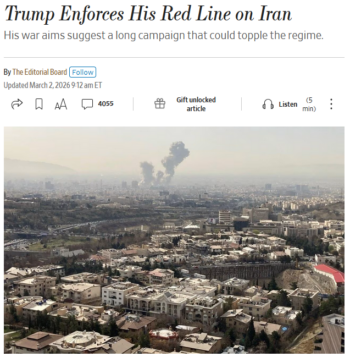
The Journal (3/2/26) took the same approach in its next editorial, “Trump Enforces His Red Line on Iran,” calling the aggression a “necessary act of deterrence.” “It carries risks as all wars do,” the piece read, “but it also has the potential to reshape the Middle East for the better and lead to a safer world.” The editors reiterated that their “main concern is that Mr. Trump may stop too soon.”

Killing upward of 175 Iranians at a girls’ elementary school (FAIR.org3/2/26) didn’t temper the degree to which the US/Israeli aggression was a “striking success,” nor was the possibility of similar massacres a “risk” or a “concern” of the editors.

‘Seeing this through’

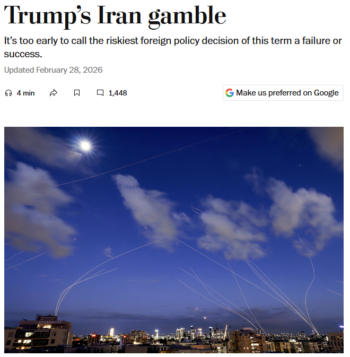
WaPo: Trump's Iran Gamble

The Washington Post (2/28/26) warned of “the danger of lobbing some bombs without seeing this through.”

The Washington Post (2/28/26) expressed some reservations about the choice to go to war under the headline “Trump’s Iran Gamble,” but they seemed to be largely related to questions of success and procedure: whether the war would turn into a “quagmire,” “what happens to US troops throughout the region,” and that “it’s essential that the people’s elected representatives get to vote on whether these strikes are justified.”

The paper’s remaining concerns echoed the hawks at the Journal, worrying Trump might not go far enough. The editors fretted about “the danger of lobbing some bombs without seeing this through” and warned that “freedom for the people” might not be achieved “without some US boots on the ground…. Yet Trump appears to lack any appetite for doing so.”

While the Post appeared to have doubts about Trump’s leadership and strategy, at no point did the paper say that he shouldn’t have started the war, nor made mention of the prohibition under both US (The Hill6/23/25) and international law (Conversation3/20/22) on assassinating heads of state.

‘A successful outcome’

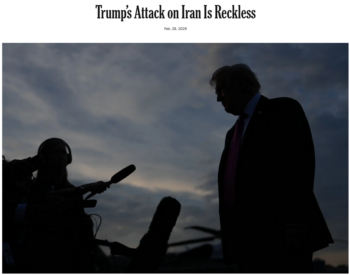
NYT: Trump’s Attack on Iran Is Reckless

The New York Times (2/28/26) maintains that “Iran’s government presents a distinct threat because it combines…murderous ideology with nuclear ambitions”—but Trump didn’t announce he was attacking them the right way.

Meanwhile, the New York Times’ strongest criticism (2/28/26) of the US/Israeli attack was that

Mr. Trump’s approach to Iran is reckless. His goals are ill-defined. He has failed to line up the international and domestic support that would be necessary to maximize the chances of a successful outcome. He has disregarded both domestic and international law for warfare.

While the authors were correct to suggest that the war is illegal, they nevertheless implied that a “successful outcome” to this war of aggression is desirable. That ending the war as soon as possible would be a “successful outcome” was not part of the Times’ calculus.

Like the Post, the Times’ criticisms were mostly based on proceduralism. The Times (2/28/26) complained that Trump

started this war without explaining to the American people and the world why he was doing so. Nor has he involved Congress, to which the Constitution grants the sole power to declare war. He instead posted a video at 2:30 a.m. Eastern on Saturday, shortly after bombing began, in which he said that Iran presented ”imminent threats” and called for the overthrow of its government.

Thus, the Times was more concerned with how Trump explained his war aims to the American public than with those aims themselves. Indeed, as we’ll see, the paper dedicated considerable space to shoring up the rationale for the US/Israeli attack.

‘Positive consequences’

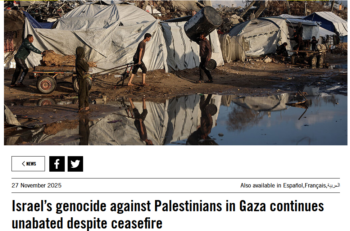
Amnesty: Israel’s genocide against Palestinians in Gaza continues unabated despite ceasefire

For the New York Times (2/28/26), Israel’s ability to continue its genocide in Gaza (Amnesty International, 11/27/25) without resistance from Hamas appears to be a “positive consequence” of bombing Iran.

One trait the propaganda in all three papers shared is the notion that Iranian foreign policy means that there are upsides to launching the all-out war with Iran. The New York Times‘ headline (2/28/26) called the attacks “reckless,” but the analysis bolstered the argument for the war about which they professed to be concerned:

Israel has reduced the threats from Hamas and Hezbollah (two of Iran’s terrorist proxies), attacked Iran directly and, with help from allies, mostly repelled its response. The new recognition of Iran’s limitations helped give rebels in Syria the confidence to march on Damascus and oust the horrific Assad regime, a longtime Iranian ally. Iran’s government did almost nothing to intervene. This recent history demonstrates that military action, for all its awful costs, can have positive consequences.

These “positive consequences” include a genocide in Gaza that, despite a so-called ceasefire, hasn’t ceased (Amnesty International, 11/27/25; Palestine Centre for Human Rights, 2/4/25). Sectarian massacres have followed the fall of Assad in Syria (FAIR.org6/2/25); similarly, in the first year of post-Assad Syria, Israel bombed the country even more than it had the previous year, and increased its theft of Syrian territory (Al Jazeera11/20/25). Nearly 4,000 Lebanese people were killed in the 2023–24 US-backed Israeli war on the country, Human Rights Watch noted, which included

apparently deliberate or indiscriminate attacks on journalistsciviliansmedicsfinancial institutions and peacekeepers, in addition to the widespread and unlawful use of white phosphorus in populated areas, among other violations. More than 1.2 million people were displaced by the time of the November ceasefire, thousands of buildings and houses were destroyed, and entire border villages were reduced to rubble.

Subsequently, Israel has violated a sham ceasefire in Lebanon more than 10,000 times, during which “positive consequences” continue to accrue, such as the killing of 12 people in late February attacks (Democracy Now!2/23/26).

‘Biggest state sponsor of terrorism’

The Washington Post (2/28/26) wrote:

For a generation, Iran has been the world’s biggest state sponsor of terrorism, backing Hamas, Hezbollah, the Houthis and other proxies as they wreaked havoc and killed Americans.

Linguistic choices used to rationalize war and genocide need to be rigorously scrutinized, and nowhere is this more necessary than when the word “terrorism” is being deployed to rationalize the mass murder of Muslim-majority populations. As Edward Said (New Left Review9–10/88) wrote:

The most striking thing about “terrorism,” as a phenomenon of the public sphere of communication and representation in the West, is its isolation from any explanation or mitigating circumstances, and its isolation as well from representations of most other dysfunctions, symptoms and maladies of the contemporary world…. [Terrorism has been] stripped of any right to be considered as other historical and social phenomena are considered, as something created by human beings in the world of human history.

Hamas’s violence against Israelis on October 7, 2023, came in the context of Israel killing more than 7,000 Palestinians over the previous 23 years, including more than 2,000 children (B’Tselem). Israel has for decades occupied, besieged and ethnically cleansed Palestinians (Electronic Intifada7/26/18), and is now committing genocide against them (UN, 9/16/25).

Hezbollah came into existence as a result of the Israeli invasion and occupation of Lebanon in the 1980s (Electronic Intifada1/16/24), and went on to win wide popular support in the country, as demonstrated by its winning more seats than other party in elections (FAIR.org10/10/24).

Yemen’s Ansar Allah, known at the Houthis, arose as a rebellion against Ali Abdullah Saleh, the nation’s US-backed dictator (BBC12/4/173/25/25). It gained power and prominence by continuing to struggle against his successor, Abd Rabbu Mansour Hadi, and then the “catastrophic” US/Saudi war on Yemen (In These Times4/13/23). Both Ansar Allah and Hezbollah are, it’s worth noting, guilty of helping the Palestinians resist the US/Israeli genocide (FAIR.org1/24/25).

If the Post wanted to help its readers make sense of the world, the paper would make some effort to explain who Hamas, Hezbollah and Ansar Allah are, and the contexts in which they have engaged in political violence, as well as the vastly more deadly and injurious violence initiated by the US and Israel they have faced. Instead, the paper offers a simplistic, ahistorical demonization of these groups as ideological scaffolding for “the supreme international crime” against Iran, as well as the slaughter of Palestinian, Lebanese and Yemeni people.

‘Main threat to the entire region’

Iran: Trump Enforces His Red Line on Iran

The Wall Street Journal (3/2/26) finds it “hard to imagine instability greater than what the [Iran’s] revolutionary regime has promoted for nearly five decades.”The first Wall StreetJournal (3/1/26) editorial claimed that Iran’s retaliatory strikes on Arab states where US forces are based, and from which attacks on Iran are being carried out, underscore that Iran “is the main threat to the entire region.”

The second (3/2/26) called the US/Israeli aggression “a necessary act of deterrence against a regime that is the world’s foremost promoter of terrorism.” The piece responded to the view that the war could lead to “new conflicts among other powers in the region” by saying, “Events are impossible to predict, but it’s hard to imagine instability greater than what the revolutionary regime has promoted for nearly five decades.”

It’s nonsensical to say that Iran is “the main threat to the entire region” and that “it’s hard to imagine instability greater” than that which Iran has “promoted in the region.” None of Iran’s alleged, unspecified crimes in the region come close to the actual bloodshed (not its mere “threat”) and “instability” the US and Israel have wrought in the “greater Middle East,” not only in Palestine, Lebanon, Syria and Yemen, but in Afghanistan (FAIR.org8/19/21), Iraq (BBC10/16/13Guardian3/4/00) and Libya (Alternet12/5/17).

‘The danger of lobbing some bombs’

All three papers also lent credence to the idea that it would be legitimate to conduct a war on Iran to prevent it from developing nuclear weapons. The Washington Post (2/28/26) asserted:

Iran cannot be allowed to develop a nuclear weapon. Trump insisted that last summer’s bunker-buster bombs totally “obliterated” Iran’s enrichment program, but now he says it needs to be “totally, again, obliterated.” It’s always been clear he was exaggerating the success of Operation Midnight Hammer, and Iran has remained unwilling to give up its goal of proliferation. The danger of lobbing some bombs without seeing this through is that Iran’s leaders could become more determined than ever to get a bomb to deter future strikes.

Yet the day before the US/Israeli aggression commenced, it came to light that Iran had agreed to not stockpile enriched uranium (CBS2/27/26). Without such nuclear fuel, it’s impossible to make a nuclear bomb. Contrary to the Post’s suggestion, Iran apparently was not “unwilling to give up” its alleged “goal of proliferation.”

The Wall Street Journal (3/2/26) acted as if this Iranian offer had not taken place, saying that Trump “gave Iran’s Supreme Leader, Ayatollah Ali Khamenei, ample chance to strike a deal on nuclear weapons and its missile force, but the ayatollah refused.” The editorial praised the US/Israeli campaign, saying that even if the Iranian government survives, “the nuclear program will be difficult and expensive to rebuild.”

Yet on February 18, International Atomic Energy Agency (IAEA) Director-General Rafael Grossi said the organization had not seen any indication that Iran might currently be working to develop a nuclear weapon (CBS2/19/26). How Iran might “rebuild” a program that it may not have in the first place is anyone’s guess.

A ‘worthy goal’

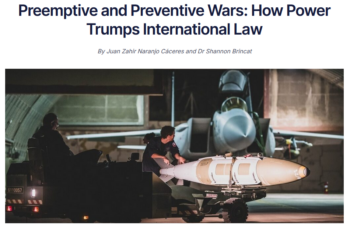
Australia Institute: Preemptive and Preventive Wars: How Power Trumps International Law

“Preventive strikes…have no basis under international law,” noted the Australian Institute of International Affairs (7/3/25). “Strikes cannot be justified solely on the grounds that a future attack is believed inevitable—as it is impossible to determine whether such a condition will ever come about.”

Even though the New York Times (2/28/26) noted that “Iran does not appear close to having a nuclear weapon,” the paper described “the elimination of Iran’s nuclear program” as a “worthy goal.” The paper added:

American presidents of both parties have rightly made a commitment to prevent Tehran from getting a bomb.

We recognize that fulfilling this commitment could justify military action at some point…. The consequences of allowing Iran to follow the path of North Korea—and acquire nuclear weapons after years of exploiting international patience—are too great.

“Prevent[ing] from getting a [nuclear] bomb” could not, in fact, “justify military action.” Pre-emptive or preventative wars “clearly” violate international law (Australian Institute of International Affairs, 7/3/25), so even if Iran was on the cusp of having a nuclear bomb, that would not be grounds to attack them.

None of the editorials in the TimesJournal or Post mentioned that, in the run up to the US/Israeli aggression, the IAEA said it had no evidence that Iran was working on nuclear weapons development, or that Iran had agreed to an arrangement under which it couldn’t develop a nuclear bomb. Instead, the papers implied that a nuclear-armed Iran was a near-term possibility, and that such a prospect would warrant bombing the country.

When scholars and students look back on 2026 and study how some of the US’s most prominent papers responded to the war of aggression on Iran, the main takeaway won’t be that the Journal offered unhesitating applause while the Times and the Post equivocated. It will be that all three defended the indefensible.

Original article by Gregory Shupak republished from FAIR under a Creative Commons Attribution-NonCommercial-NoDerivs 3.0 Unported License.

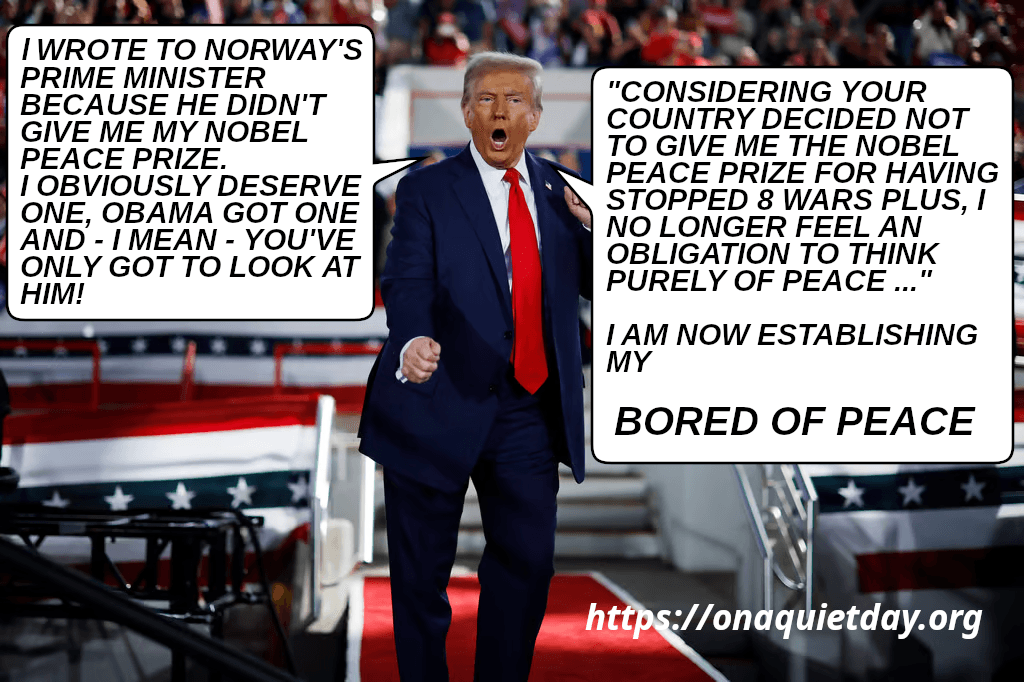
Donald Trump explains why he established his Bored of Peace
Donald Trump warns against following the https://onaquietday.org blog, says that it's easy atm, she only needs to report war crimes supporting Israel's genocidal expansion.
Donald Trump warns against following the https://onaquietday.org blog, says that it’s easy atm, she only needs to report war crimes supporting Israel’s genocidal expansion.
Elon Musk urges you to be a Fascist like him, says that you can ignore facts and reality then.

Continue ReadingLeading US Papers Defend the Indefensible in Iran Aggression

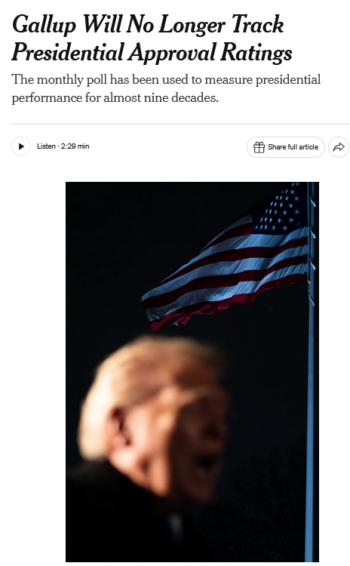
Gallup Ends Presidential Approval Polling After 88 Years—Likely Because a President Disapproved

Spread the love

Original article by David W. Moore republished from FAIR under a Creative Commons Attribution-NonCommercial-NoDerivs 3.0 Unported License.

The Gallup Poll announced this month it would no longer measure presidential approval or other national leadership ratings. It was a surprise to pollsters and journalists who report on public opinion, because George Gallup was the pollster who initiated presidential approval ratings in the 1930s. Over the past nine decades, the organization has developed the most extensive database available, allowing journalists to compare approval ratings among all presidents since Franklin D. Roosevelt at various stages of their tenure.

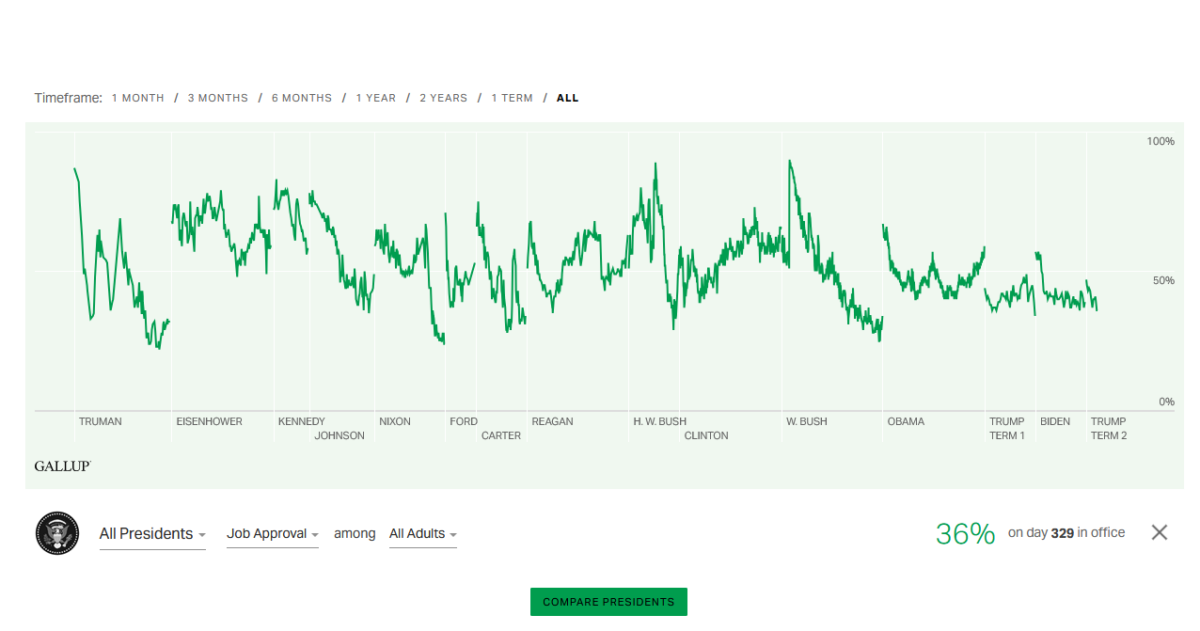
In fact, that very ability may have been the catalyst for Gallup dropping the ratings. Last November, Gallup (11/28/25) reported President Donald Trump’s approval rating as the lowest in his second term (36%), just barely above his lowest rating ever in January 2021, after he fomented the insurrection in an effort to avoid leaving office. His average approval rating in his first term was the lowest of any president since such polling began.

The November report also noted that Trump’s net approval ratings had dropped significantly on several items since the previous February/March: immigration (-9 points), situation in the Middle East (-7), economy (-6), federal budget (-12) and the situation in Ukraine (-10).

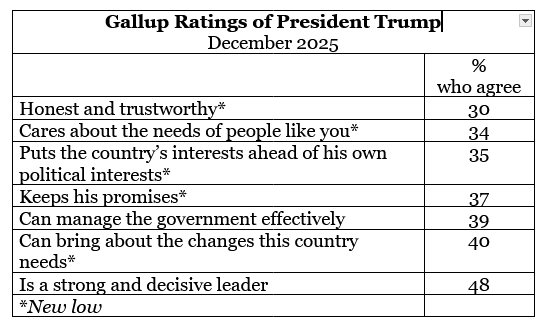
The December report (12/22/25) was not any better. Trump’s approval rating remained at 36%, while ratings on seven other personal characteristics were at a new low or near a new low:

Gallup Ratings of President Trump, December 2025

Also problematic for Gallup was that its approval ratings consistently showed numbers below the average of other polls. Across ten approval ratings Gallup published in 2025, the net rating averaged 8.7 points lower than the average that Nate Silver (formerly of 538 and now of Silver Bulletincompiled from other polls.

These are especially bad numbers. Trump doesn’t like bad numbers. He still has a lawsuit against an Iowa pollster whose pre-election numbers he didn’t like. And Gallup has extensive contracts with the federal government. It’s a no-brainer to infer that Gallup’s polling results may have caused the Gallup organization to re-evaluate the utility of continuing to report numbers that Trump hates.

No one knows if the White House let its dissatisfaction be known, or if the leaders at Gallup evaluated the zeitgeist on their own and took steps to mitigate possible financial problems with the US government. When asked by the Hill (2/11/26) “if Gallup had received any feedback from the White House or anyone in the current administration before making the decision,” the organization’s spokesperson apparently did not deny such an intervention, but said, “this is a strategic shift solely based on Gallup’s research goals and priorities.” Sounds like a yes to me.

The decision feels like the exclamation point marking the end of the Gallup Poll as envisioned by its founder.

The rise of Gallup

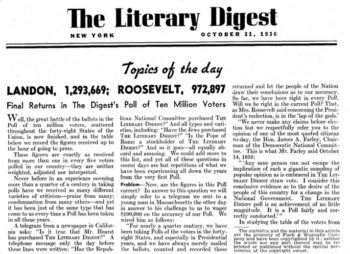
Literary Digest predicts a landslide victory for Alf Landon in the 1936 election

The Literary Digest (10/31/1936) predicted that Alf Landon would get 370 electoral votes and defeat Franklin Roosevelt in the 1936 election. He won eight, and did not.

On October 20, 1935, the Washington Post published  a new column, “America Speaks!” by Dr. George Gallup, who had recently founded the American Institute for Public Opinion. (See Chapter 2, “America Speaks,” in David W. Moore, The Superpollsters, 1995.) It would report on the first “scientific” measurement of the voters’ minds. And, Gallup guaranteed, he would predict the outcome of the 1936 election between Alf Landon and President Franklin Roosevelt closer than the famed, and highly respected, Literary Digest poll.

While the latter poll based its results on responses from 10 to 20 million ballots it had sent to voters across the country, those voters had been targeted because their names were on a “tel-auto” list—a marketing list of people who owned cars and telephones. Gallup surmised that those voters would be disproportionately of the upper socioeconomic strata, potentially biasing the results in favor of Republicans. The “scientific” sampling he used was intended to identify voters all across the socioeconomic spectrum, to obtain a truly representative sample of the whole population. Based on his knowledge of statistics, he recognized that such a sample need not be as gargantuan as the Literary Digest sample.

As it turned out, Gallup’s prediction was indeed closer than that of the Literary Digest poll. As were the results of two other “scientific” pollsters—Elmo “Bud” Roper and Archibald Crossley. The Literary Digest poll predicted a landslide victory for Alf Landon, while the three upstarts all correctly predicted a landslide victory for Roosevelt. The “scientific” method of sampling had shown that relatively small samples of voters, chosen carefully to include all varieties of voters, could accurately represent the larger population.

All three pollsters had their own organizations, but Gallup was the most aggressive advocate for this new way of polling. More so than the others, he engaged in frequent polling on policy matters, and thus became the leader of the new public opinion polling industry. Newspapers subscribed to his columns, and for four decades, his polling results were the most significant influences in defining what the public was thinking on major issues.

Of course, he continued his election polling as well, because he believed that accurate election predictions were essential to developing public confidence that polls could represent public opinion more generally. And he developed ratings of political leaders, initiated in 1938 with his presidential approval rating question: “Do you approve or disapprove today of Franklin Roosevelt’s job as president?”

Election polling, public policy polling and leadership ratings were the three signature aspects of the Gallup Poll.

New owner, new strategy

In the mid-1970s, the three major broadcast networks began to develop their own polls, each partnering with a major newspaper—ABC with the Washington PostCBS with the New York Times and NBC with the Wall Street JournalIn the ensuing decade, other national polls emerged as well, such as the Los Angeles Times polland occasional polls by Time and Newsweek.

By the late 1980s, the Gallup Poll had all but disappeared from national news stories. Few major newspapers continued to subscribe to Gallup’s polling service, because most newspapers got their poll results for free, recycled from the newspapers and television networks that conducted their own polls. George Gallup had died in 1984, and his two sons—Alec and George, Jr.—did not have the charisma or business acumen of their father. They waited until their mother had passed, in 1987, and then put the Gallup Poll up for sale.

The company that eventually bought Gallup was founded by Donald O. Clifton, a psychology professor at the University of Nebraska in Lincoln, who designed questions that would help match people with specific types of jobs. Based on his research, he eventually founded Selection Research Inc. (SRI) to help companies hire employees. (See  pp. 19-21, David W. Moore, The Opinion Makers, 2008.)

Among Clifton’s four children there was one son, Jim, who became president and CEO of the new Gallup Organization. One of his most brilliant moves came shortly after he assumed his new position. He was able to persuade Ted Turner, owner of CNN, to have the network join in a one-year polling partnership with Gallup for the 1992 election. The agreement included USA Today, which had been an occasional CNN partner.

It was an ideal arrangement for all three organizations. Gallup was finally back in the news, because its poll results were immediately published by both partners. And the two media organizations benefited from the credibility of the Gallup Poll. The arrangement worked well during the campaign, and subsequently was renewed in a multi-year contract.

(It was at this point, March 1993, that I joined Gallup as a vice president and managing editor of the Gallup Poll. My immediate supervisor was Frank Newport, editor-in-chief of the Gallup Poll. I remained with Gallup until April 2006.)

With Gallup back in the news, the company’s marketing business took off. When SRI acquired Gallup, it was like one guppy eating another—the annual revenues from SRI were only slightly larger than the annual revenues from Gallup (in the $12–15 million range). A decade later, SRI-Gallup’s revenues were estimated to exceed $200 million.

The strategy was clear: The “Gallup Poll” part of the company—the part that conducted opinion polls, as opposed to the marketing business of the new Gallup Organization—was the advertising that helped bring in clients. If the “Poll” were to lose credibility, that could hurt the business. And, slowly, the “Poll” did begin to lose credibility.

‘Gallup vs. the World’

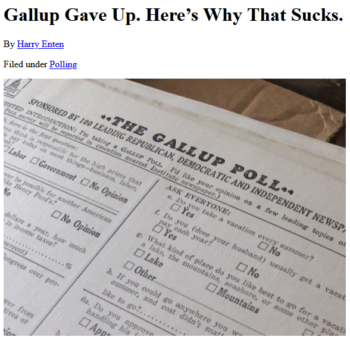
538: Gallup Gave Up. Here’s Why That Sucks.

Harry Enten (53810/17/15) noted that when Gallup stopped doing electoral polling in 2015, it took away the best tool for judging the accuracy of its opinion polling.

Despite the extensive public policy polling and widespread dissemination of Gallup’s results, its election polling was often controversial. In 2012, Nate Silver  wrote an analysis, “Gallup vs. the World” (New York Times10/18/12), describing numerous times when CNN/USA Today/Gallup’s results significantly diverged from the average of other polls, and even from final election results. From the beginning of the partnership, the election polling was erratic, he noted, with results showing “implausibly large swings in the race.” As he wrote, “In 1996, Gallup had Bill Clinton’s margin over Bob Dole increasing to 25 points from nine points over the course of four days.”

Then in 2000, it found “a 26-point swing toward Mr. Gore over the course of a month and a half. No other polling firm showed a swing remotely that large.” Silver pointed out that Gallup’s polling swung again, back toward Bush, putting him 13 points ahead on October 27―”just 10 days before an election that ended in a virtual tie.”

The problems continued. In 2015, 538‘s Harry Enten (10/7/15) wrote that Gallup had suffered

two consecutive elections in which its results were way off. Gallup’s final generic congressional ballot in 2010 had Republicans winning by 15 percentage points; they won by 7 points.

He also noted that in 2012, Gallup’s final poll showed Romney winning by one point. Obama won by four.

The partnership had begun to break apart in 2006, when Gallup dropped CNNUSA Today and Gallup continued working together, but in 20082010 and 2012, the final elections polls on Real Clear Politics list results under Gallup’s name alone, despite earlier polls in those years when the results were listed as USA Today/Gallup. The official breakup came in early 2013, when Politico (1/18/13) announced that “USA Today and Gallup, the polling organization, have announced a mutual decision to end their 20-year partnership.”

Gallup’s decline

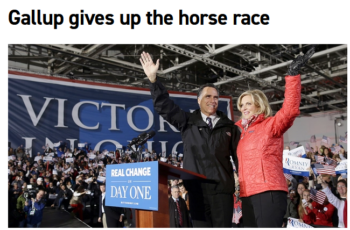
Politico: Gallup Gives Up the Horse Race

“We believe to put our time and money and brainpower into understanding the issues and priorities is where we can most have an impact,” Gallup editor-in-chief Frank Newport told Politico (10/7/15) in 2015.

That wasn’t the only bad news. In 2012, the Gallup Organization was sued by the federal government for bilking it out of millions of dollars, and for violating the Procurement Integrity Act by agreeing to hire a federal employee only if he could first increase the size of a government contract for Gallup.

In July 2013, the suit resulted in Gallup having to pay a $10.5 million fine for its transgressions, and—according to the Omaha World Herald (8/17/13)—removed Clifton from “authority over the company’s government division” as part of an agreement that allowed the company to “continue to compete for federal contracts.” It’s ironic that after such success in reviving the Gallup brand, Clifton was the one to tarnish it so profoundly.

After a bad election year in polling and the overbilling and procurement scandal, Gallup ultimately decided to give up election polling altogether. As Politico (10/7/15) wrote:

After a bruising 2012 cycle, in which its polls were farther off than most of its competitors, Gallup told Politico it isn’t planning any polls for the presidential primary horse race this cycle. And, even following an internal probe into what went wrong last time around, Gallup won’t commit to tracking the general election next year.

And it didn’t.

With no media partner, Gallup’s public policy polling also declined. It’s rare these days when Gallup conducts a poll that gets cited about some current national issue.

But Gallup did continue with regular polls on presidential approval and favorability ratings of political leaders. Until now. With the recent announcement, it no longer does regular election polling, public policy polling or leadership ratings—the three signature characteristics of George Gallup’s original vision of “American Speaks.” America continues to speak, but with respect to voter preferences, citizens’ views on controversial public policy issues, and how they view their leaders—Gallup is no longer listening.

The Gallup Poll still functions, of course. Its extensive data base is still available to journalists. It continues to conduct polls of Americans related to its Social Series, started in 2000.  The surveys track attitudes in a variety of areas over time, but they do not focus on current controversial public policy issues.

No questions, for example, about Epstein, tariffs, immigration enforcement and ICE, war with Iran, the capture of Venezuela’s president, vaccine mandates, housing policy, the war in Gaza, ways to address “affordability,” the use of presidential pardons, healthcare subsidies, Ukraine, crypto currency, and other policies that ask respondents to take a position in favor or opposed. Gallup apparently doesn’t want to offend, so virtually all of its questions are general in nature. It has become a shadow of its former self.

‘A big deal’?

NYT: Gallup Will No Longer Track Presidential Approval Ratings

“Gallup’s…88 years of data give historical context to what amounts to a monthly snapshot of Americans’ views,” wrote the New York Times (2/11/26). “Political and news media analysts have come to rely on the poll to understand shifting trends in the country over time.”

Does it matter?

Some media observers think so. The Washington Post (2/11/26) called it “a big deal,” with the paper’s polling director saying Gallup is “leaving Americans with a dimmer view into our politics.” Ruth Igielnik of the New York Times (2/11/26) bemoaned the loss of Gallup’s “high-quality surveys” and “record of accuracy.” Both cite Gallup’s long history and its use of telephone, rather than online, surveys.

But telephone surveys’ primacy is no longer undisputed (Data for Progress, 3/11/21; Pew, 4/19/23). Indeed, while the Gallup Poll is still a high-quality polling organization, it is not the leader in the industry. Nate Silver rates  polls by comparing their predictions with actual election results; Gallup gets a B+, better than average, but Silver finds at least 25 pollsters to be more accurate.

Despite their disappointment with the Gallup announcement, both Clement and Igielnik note that the New York Times tracked 51 polls measuring Trump’s approval rating in January—so many, Clement concludes, “that poll watchers may not have noticed the absence of Gallup’s monthly figures.”

When Gallup announced it would no longer conduct pre-election polls in 2015, Harry Enten (538, 10/7/15) gave a similar reaction:

There are still plenty of good polls, and Gallup’s decision, by itself, doesn’t change the overall polling landscape that much…. ABC News, CBS News, CNN, Fox News and NBC News have all published live-interview primary polls in the past couple of months. (They all have a better track record than Gallup, according to our ratings.)

The Gallup Organization is a highly successful business, with an estimated annual revenue of $500 million, employing over 2,000 employees. The Gallup Poll was always, as Silver notes, a “loss-leader,” essentially the organization’s advertising for its business. After SRI bought the Gallup name and its reputation, the Poll—focusing on George Gallup’s vision of election polls, public policy polls, and leadership ratings—was instrumental in stimulating business. Over the years, the controversies surrounding the Poll’s performance and results seemed to have hurt the business more than help it. Abandoning Gallup’s vision of “American Speaks” was a logical business decision.

The truth is, with all the other polls that exist today, hardly anyone seems to notice. Except, perhaps, the president of the United States. The “big deal” about Gallup’s announcement, then, has much less to do with the loss of one poll than with the pressure a US president is apparently exerting on the polling industry.


Featured image: Gallup’s presidential approval polling going back to 1945.

Original article by David W. Moore republished from FAIR under a Creative Commons Attribution-NonCommercial-NoDerivs 3.0 Unported License.

Orcas discuss how Trump was re-elected and him being an obviously insane, xenophobic Fascist.
Climate science denier Donald Trump says that more liquid gold is being secured according to his policy of global privateering
Donald Trump warns against following the https://onaquietday.org blog, says that it's easy atm, she only needs to report war crimes supporting Israel's genocidal expansion.
Donald Trump warns against following the https://onaquietday.org blog, says that it’s easy atm, she only needs to report war crimes supporting Israel’s genocidal expansion.

Continue ReadingGallup Ends Presidential Approval Polling After 88 Years—Likely Because a President Disapproved

Case against Kenyan communist leader Booker Omole already unraveling

Spread the love

Original article by Pavan Kulkarni republished from peoples dispatch under a Creative Commons Attribution-ShareAlike 4.0 (CC BY-SA) license.

General Secretary of the Communist Party Marxist – Kenya (CPM-K) Booker Ngesa Omole. Photo: BookerBiro/X

Withdrawing from the case, the complainant and the key witness named in the chargesheet has accused the police of fabricating charges and weaponizing the criminal justice system.

The chargesheet against Booker Omole, the general secretary of the Communist Party Marxist – Kenya (CPM-K), began to unravel in the very first pre-trial hearing on March 9. Abducted on February 24 without a warrant by men in plainclothes, tortured in custody, and imprisoned, Omole was released on bail on March 3.

​At his pre-trial hearing on Monday, the complainant and the main witness named by the police in the chargesheet submitted an affidavit in the court, saying that he was “unequivocally” withdrawing his “complaint and all statements recorded” pertaining to the case.

​Stating that “these proceedings are a weaponization of the criminal justice system aimed at … harassing and intimidating” Omole, he added that the police had fabricated the charges.​

“It is clear that the complainant was forced into this by the police,” Omole told Peoples Dispatch. “The Registrar of Firearms Bureau also presented a report to confirm that I am a legally registered owner of the firearm,” he was accused of possessing illegally.

Surviving an assassination attempt

It was the same firearm he had used to survive an assassination attempt last year during the Gen Z protests between June and July, sparked by police brutality amid a worsening cost-of-living crisis under the austerity regime instituted by President William Ruto.​

“Many activists suspected of being involved in the protests were being abducted without warrants and tortured,” Omole recalled. “Six gunmen broke into my house. I shot one dead at my bedroom door.”

​After a gun fight, “one more was found dead outside on the road, probably from a bullet wound. Others who fled were arrested, but the judicial enquiry never concluded.” The case went dark “because they were intelligence officers,” he maintains.

“It was an ambush.”

​“But I did not have this gun with me in the car when I was stopped” on February 24 at a roadblock set up at the bypass to turn to Nairobi on his way back from Isiolo, where he was travelling with a party comrade and a foreign delegate for political work and to raise funds.​

“It was an ambush. Some 20 men, without uniforms, surrounded our car and started to grab us. We did not know who they were. So we resisted and fought back,” he recalled. It was only when the public gathered, demanding to know who the men were, that they identified themselves as police.

​“The accusation that I threatened to kill them during this scuffle is ridiculous. There were 20 of them – armed – how could I have threatened to kill them?”​

They took all three into custody, along with their two cars, and drove them to the apartment the party had rented to host its international delegates. The police named the owner of this apartment, Andrew Amoth, as the main complainant and witness in the chargesheet.

A chargesheet riddled with contradictions

​The police maintain they swung into action after Amoth allegedly made a noise complaint against the guests who had rented his apartment. “But his apartment is in Nairobi. I was abducted on my way from Isiolo. How could I be making noise in Isiolo and Nairobi at the same time? When the police write a cooked story,” Omole remarked, “such contradictions appear.”  

​Upon their arrival at the apartment, the police allege that Omole drew his gun on the landlord. But Omole maintains he was already detained and brought there in police custody. “At no point did … Omole point a firearm at me,” the landlord insisted in his affidavit.

​Upon raiding the apartment, the police found 320,000 Kenyan shillings, equivalent to about USD 2,500, which they insisted was a fund to sponsor an insurgency against the government. They then drove Omole to the Mlolongo police station, where, according to Amoth’s affidavit, they tried to extort this amount from Omole.

“A well-known criminal within the police”

​The Officer Commanding Station (OCS) at Mlolongo is Peter Mugambi, whom Omole described as “a well-known criminal within the police. He is also a sworn anti-communist, Evangelical Christian.” Omole had already had a run-in with him back when he was the OCS of Bamburi. At the time, “he had accused me of organizing a terrorist cell to overthrow the government.”

​Now under his wing again at the Mlolongo police station, the police tortured Omole, dislocating his arm, already injured in the scuffle during his abduction. “They even strangled me”, demanding to know who was financing him for leading the protest outside the US embassy against the abduction of Venezuela’s president, Nicholas Maduro.

​“They insisted I must also be a member of a drug cartel,” like Maduro, echoing the allegation the US had concocted before his abduction. Just as this allegation was dropped by the US prosecution when Maduro was produced in a court, the Kenyan police also dropped this from the chargesheet.

They instead claimed to have found narcotics in the apartment. “Contrary to what is stated in the Charge Sheet, I confirm that no narcotics, drugs, or illegal substances were found in the apartment,” its owner and complainant said in his affidavit. “As the lawful owner and occupant of the premises, I find any suggestion to the contrary to be false and did not originate from any evidence recovered from my home.” 

The chargesheet was made available to Omole only when he was produced in the Mavoko Law Court in Machakos on February 26, well past the 24 hours since detention as mandated by law. His injured arm was crudely bandaged as he was rushed into the courtroom by more than half a dozen policemen who kept out all his comrades and journalists. Denied bail on the technical grounds that the police had not provided the pre-trial document to the court, Omole was sent to Kitengela Remand Prison.

“A prison within a prison where they send you to break your spirit”

​On the night he was brought to this prison, he was held in isolation, in what he estimates to be a 2-by-1 meter cell, where his tall and athletic frame could barely move about. “There is no toilet,” added Omole. “You are given a bucket to defecate in. It is a prison within a prison where they send you to break your spirit.”​

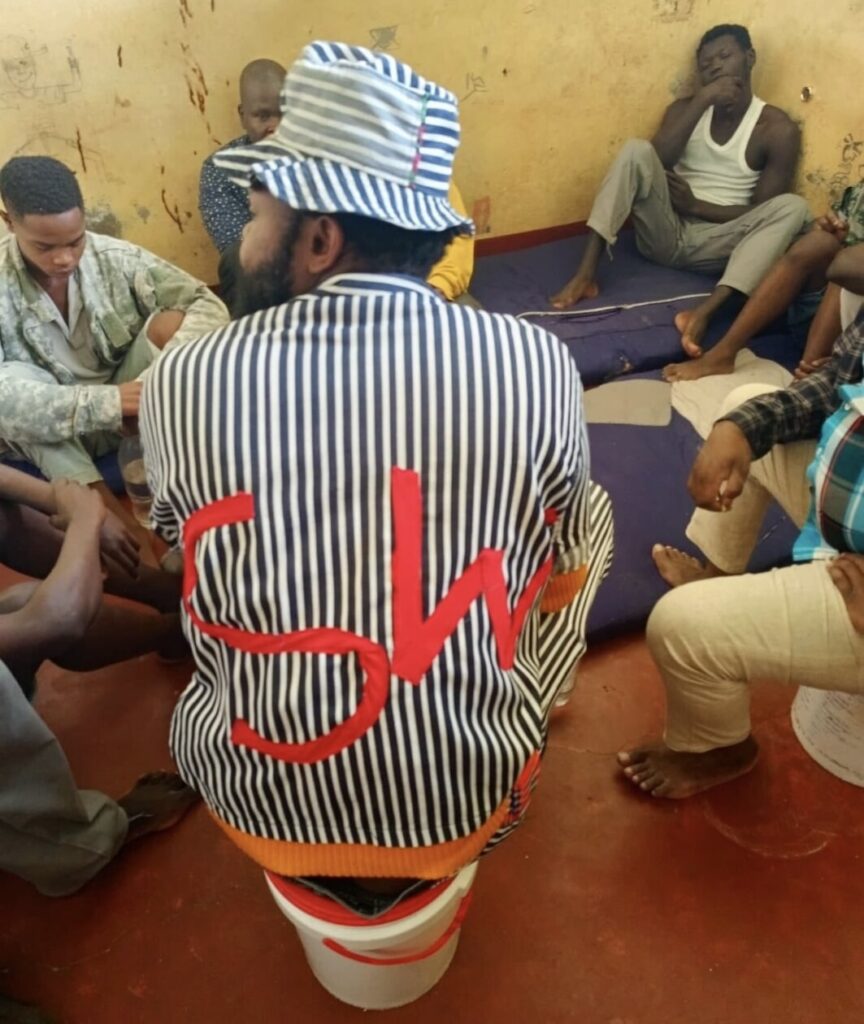
The following day, he was transferred to the “capital remand prison”, in a uniform, scrawled with the red letters “SW”, standing for Special Watch, assigned to those deemed dangerous. His inmates here were charged or convicted with the death penalty, carrying crimes like murder, robbery with violence, etc.​

Booker Omole in prison
Booker Omole in prison. Photo: CPM-K

“We were about 400” held on a floor consisting of what he estimates to be an 8 by 20 meters hall, with rows of 3 by 4 meter cells on either side – 27 prisoners packed in each. Several human rights reports have also documented the overcrowding in Kenyan prisons, requiring inmates to sleep on their sides, facing the same direction to fit in, “packed close to one another like sardines.”

“If a privileged prisoner who could pay the police was brought in, a cell would be emptied for him,” which would further overcrowd other cells, added Omole. “So inmates spend most of their time in the hall.”​

Holding political education sessions for prisoners and wardens

Sitting on the lid over a dustbin in this hall, shuffling between books, Omole can be seen in a video snuck out of prison lecturing the inmates gathered around him about the commonalities between the guerrilla warfare led by Mao in China and the Mau Mau uprising led by Dedan Kimati in Kenya.​

https://www.facebook.com/plugins/video.php?height=476&href=https%3A%2F%2Fwww.facebook.com%2Freel%2F1625557031975745%2F&show_text=false&width=264&t=0

“We had three such sessions at night,” he recalled, observing that the prisoners were readily receptive “to our ideas”. All of them were poor and strongly insisted that it was their instincts to survive poverty that got them into crime.​

“None of them had any regrets for their crimes,” he said, adding that they only swore that if given a second chance, they would not get caught. “This goes to show that the idea of prison as a place to reform criminals and rehabilitate them back into society is a myth.”​

Wealthy criminals, rarely imprisoned, have a relatively comfortable living space and are not crammed in like the rest. They get to “take walks and have a smoke.” Prison authorities, bribed, allow them wholesome meals brought in from outside. The rest, who cannot pay, have to make do with “some soup and corn bread,” perceptible in their bony frames seen in the video. The prisoners were therefore acutely aware of the class contradictions, Omole said.​

This, he said, was “already a firm basis to start the discussion about the capitalist system.” The inmates did not need much explanation to grasp why Kimati, who fought for land, remained criminalized as a terrorist for the most part since independence by the “neo-colonial state”, while the representatives of the wealthier classes were hailed as the heroes of Kenya’s freedom struggle.​

Outside of this floor where the violent criminals were held, there was also the so-called “prison school”, where inmates gather for sort of group therapy sessions, recollecting “what got them into prison” and reiterating “why they must change. I exploited that platform to deliver an agitational lecture.”

Prison wardens live like prisoners themselves

The junior prison wardens took an interest, initially out of simple curiosity about a political prisoner. As it grew, “I also held a session with them,” Omole said. “They needed a public figure to engage with their issues.” Their condition was little better than the prisoners themselves. Their homes were essentially four walls and a roof made of iron sheets, emanating a chilling cold in winters and blistering heat in summers.

​”There are seven gates” between the rows of jails, with two junior prison wardens placed as guards between each. “They are also locked in. They don’t have the keys. If there is a fire outbreak, they can’t escape either. They have to die with the rest of the prisoners. These work conditions,” Omole explained, naturally gravitated them toward the left-wing ideas he was espousing. “We became good friends. They helped us smuggle in political literature.”​

But the political literature was later discovered by the higher authorities. “I was handed another 8 hours in the isolation cell.”

​In the meantime, the police finally provided the court with the pre-bail hearing document, whereupon he was granted bail on March 3 for an amount of 500,000 Kenyan shillings, more than the 320,000 the police had allegedly tried to extort from him.

​The judge also ordered the police to return all the possessions they had seized from Omole and his co-accused. It included “two cars, an iPhone, a laptop, and the 320,000 Kenyan shillings” they found in the apartment. When Omole went with his lawyer to collect them, he said that Mugambi let loose his police to expel him from the station, leading to a scuffle.

Chargesheet unravels

​On March 9, the court issued another order to return them. At the pre-trial hearing that day, Amoth, the complainant and main witness, submitted an affidavit to withdraw from the case, while the Registrar of Firearms also confirmed his gun was legally owned.

​The Department of Public Prosecution then sought leave to amend the chargesheet, to change the accusation of illegal possession of a firearm to misuse of a firearm. However, Amoth said in his affidavit, “At the time the police arrived, the firearm was secured in a safe in the upper bedroom, and the magazine was separated from it.”

So the charge of misusing a firearm will not hold either, Omole said, adding the chargesheet will likely be dropped as “defective and untenable. If that happens, we will file a case for wrongful detention and prosecution, and demand compensation.” 

While confident that the case against him will fall apart, Omole is certain that the “crackdown against our party will only intensify as we grow in strength. The task we face today is to build a revolutionary organization, capable of fighting back.”  

Original article by Pavan Kulkarni republished from peoples dispatch under a Creative Commons Attribution-ShareAlike 4.0 (CC BY-SA) license.

Continue ReadingCase against Kenyan communist leader Booker Omole already unraveling

With War on Iran, Trump Is ‘Flooring the Gas Pedal as He Drives US Economy Over a Cliff’

Spread the love

Original article by Jake Johnson republished from Common Dreams under Creative Commons (CC BY-NC-ND 3.0). 

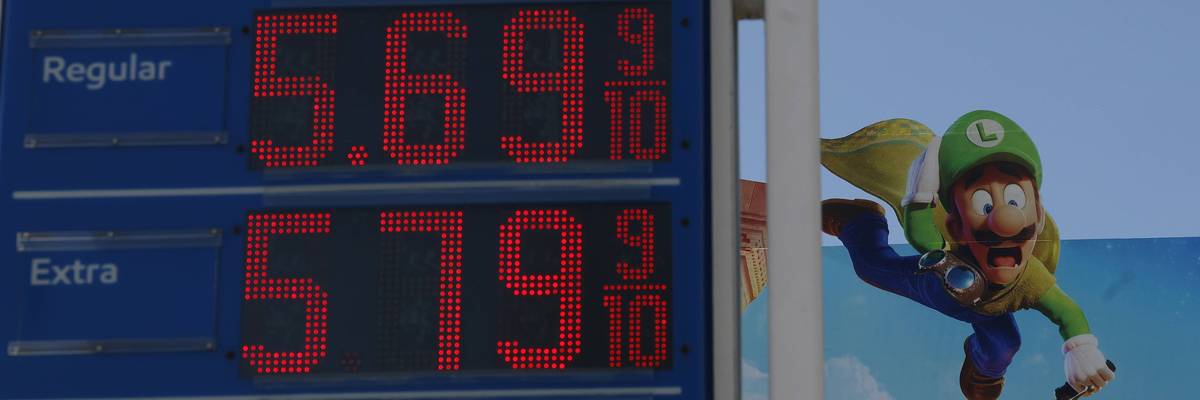
Gas prices over $5 a gallon are displayed at a Mobil station on March 11, 2026 in Los Angeles, California. (Photo by Justin Sullivan/Getty Images)

“If high costs weren’t already bad enough, Donald Trump’s unnecessary war in Iran has sent gas prices through the roof,” said one House Democrat.

Data released Friday showed that US consumer sentiment hit a new low for 2026 and the American economy expanded by just 0.7% in the fourth quarter of last year, indicators that experts said are only going to get worse due to the cascading impacts of President Donald Trump’s deadly, illegal, and expensive war on Iran.

“President Trump is flooring the gas pedal as he drives our economy over a cliff,” Alex Jacquez, chief of policy and advocacy at the Groundwork Collaborative, said in response to the new data, some of which was collected before the US and Israel launched their assault on Iran, sparking a regional conflict, sending oil prices surging, and destabilizing the global economy.

RECOMMENDED…

Protests In Kashmir Following The Killing Of Iranian Supreme Leader Ayatollah Ali Khamenei

‘This Is Madness’: More Talk of Boots on the Ground as Trump Says ‘Today Iran Will Be Hit Very Hard’

image shoes US military planes headed to the midde east

‘The Tankers Just Keep Coming’: US Military Movements Spike Fears of Imminent Attack on Iran

“As bad as this week’s data is,” Jacquez added, “it understates reality for exhausted consumers who have been hit with even more price hikes caused by the president’s intentional turmoil in the weeks since this data was collected. Instead of working to bring down ever-increasing prices at the pump, the grocery store, and the doctor’s office, the president is betraying working families as his illegal war with Iran stokes inflation.”

Figures released Friday by the US Commerce Department’s Bureau of Economic Analysis (BEA) showed that real gross domestic product increased at half the rate predicted by previous government estimates.

Real GDP was revised down 0.7 percentage points from the advance estimate [of 1.4%], reflecting downward revisions to exports, consumer spending, government spending, and investment,” the BEA said in a news release.

NBC News noted that “economists had expected the revision to go the other way—and show stronger growth.”

The BEA also published data showing that the personal consumption expenditures price index, a key inflation reading, rose at an annualized rate of 2.8% in January.

“Families across the United States are struggling to make ends meet in Donald Trump’s economy,” Rep. Brendan Boyle (D-Pa.), the top Democrat on the House Budget Committee, said in a statement. “If high costs weren’t already bad enough, Donald Trump’s unnecessary war in Iran has sent gas prices through the roof.”

A Harris Poll opinion survey conducted for The Guardian and released Friday found that more than 70% of US voters believe Trump’s tariff regime has driven up their costs.

“In the short run, the economic impact of a sustained loss of Gulf oil could be very ugly.”

Consumer sentiment, meanwhile, continued its steady decline in March, falling about 2% compared to last month, according to the University of Michigan’s Surveys of Consumers. Roughly half of the interviews conducted for the consumer sentiment report were completed before the US and Israel began attacking Iran on February 28.

Joanne Hsu, director of the Surveys of Consumers, noted that “interviews completed prior to the military action in Iran showed an improvement in sentiment from last month, but lower readings seen during the nine days thereafter completely erased those initial gains.”

“Gasoline prices have exerted the most immediate impact felt by consumers, though the magnitude of passthrough to other prices remains highly uncertain,” Hsu noted. “A broad swath of consumers across incomes, age, and political affiliation all reported declines in expectations for their personal finances, down 7.5% nationally.”

“Interviews completed after February 28 exhibited higher inflation expectations than those completed before that date,” Hsu added.

The first six days of Trump’s war on Iran cost US taxpayers over $11 billion, and the price tag is set to rise exponentially as the administration deploys thousands of additional troops to the Middle East and continues aggressively bombing Iran, which has retaliated in part by closing the Strait of Hormuz—choking off the flow of oil through the critical trade route and sending prices surging.

The Trump administration has sought to downplay skyrocketing oil prices even as it takes emergency action in an attempt to bring them down. The International Energy Agency said Thursday that the US-Israeli assault on Iran sparked “the largest supply disruption in the history of the global oil market.”

Economist Paul Krugman warned Friday that “oil prices could easily go much higher,” noting, “The US and other major economies are a lot less oil-dependent than they were in the 1970s, and even at $100 a barrel oil prices are not high enough to provoke a major crisis.”

“In the short run, the economic impact of a sustained loss of Gulf oil could be very ugly,” Krugman wrote. “I’ve seen some alarmists warn that a long war in the Gulf could lead to oil at $150 a barrel. That looks low to me.”

Original article by Jake Johnson republished from Common Dreams under Creative Commons (CC BY-NC-ND 3.0). 

Donald Fuhrump says that Amerikkka doesn't bother with crimes or charges anymore, not being 100% Amerikkkan and opposing his real estate intentions is enough.
Donald Fuhrump says that Amerikkka doesn’t bother with crimes or charges anymore, not being 100% Amerikkkan and opposing his real estate intentions is enough.
Orcas discuss how Trump was re-elected and him being an obviously insane, xenophobic Fascist.
Orcas discuss rotting brain. Front Orca says "Wish someone would lock him up".
Orcas discuss rotting brain. Front Orca says “Wish someone would lock him up”.
Continue ReadingWith War on Iran, Trump Is ‘Flooring the Gas Pedal as He Drives US Economy Over a Cliff’