75 years after Kristallnacht: minorities in danger

Spread the love

http://www.opendemocracy.net/ourkingdom/david-rosenberg-and-212-others/75-years-after-kristallnacht-minorities-in-danger

Jews in Britain sound the alarm about rising hostility towards migrants, asylum seekers, Gypsies and travellers.

Image of hisrorical Daily Mail article about Jewish immigration

On 9th/10th November 1938, Nazi stormtroopers led a wave of violent attacks on Jewish people and property throughout Germany and Austria, which the Nazis had annexed. During these pogroms, 91 Jews were killed, thousands were taken from their homes and incarcerated in concentration camps, 267 synagogues were destroyed, and some 7,500 Jewish-owned shops were smashed and looted. The Kristallnacht pogroms presaged attempts to remove Jews from German life completely.

Many Jews left hurriedly to seek refuge in friendly countries, including Britain, but Britain was already in the grip of an “aliens scare”. Newspaper headlines declared: “Alien Jews Pouring In”, and claimed that “Refugees Get Jobs, Britons Get Dole”. The media accused Jewish asylum seekers of “over-running the country”. Despite wide public revulsion at the violence of Kristallnacht, powerful elements in British politics and business continued to admire Hitler and the Nazi regime.

75 years after Kristallnacht, racists and fascists inspired by the Nazis continue to attack minorities in Europe. In Hungary neo-fascists target Gypsies and Jews. In Greece Golden Dawn members and supporters brutally attack migrants and political opponents. Here in Britain, minority communities, especially Muslims, have been targeted in an atmosphere that is increasingly hostile towards migrants and refugees.

As Jewish people mindful of this history, we are equally alarmed at continuing fascist violence and the toxic sentiments expressed by many politicians and much of the media against migrants, asylum seekers, Gypsies and travellers.
We stand shoulder to shoulder with migrants, refugees and asylum seekers in their efforts to live here in freedom and safety, to contribute to society, and be treated as equals. As Jews we stand together with all communities seeking to combat racism and fascism here and elsewhere.

David Rosenberg, Jewish Socialist magazine
Prof Frank Land, 1939 refugee and Kristallnacht witness
Ralph Land CBE, 1939 refugee and Kristallnacht witness
Sheila Melzak, Clinical Director, Baobab Centre for Young Survivors in Exile
Dr Jennifer Langer, Director, Exiled Writers Ink
John Speyer, Director, Music In Detention
Margaret Hodge MP
David Winnick MP
Lord (Alf) Dubs
Edie Friedman, Executive Director, Jewish Council for Racial Equality
Gerry Gable, Editor, Searchlight Magazine
Prof Nira Yuval-Davis, Director, Centre for Research on Migration, Refugees and Belonging, UEL
Prof Jacqueline Rose
Prof Francesca Klug OBE, Director of the Human Rights Futures Project
Rabbi Elizabeth Tikvah Sarah
Rabbi Barbara Borts
Rabbi Howard Cooper
Judge Laurence Brass, Treasurer, Board of Deputies of British Jews
Miriam Margolyes OBE
Moris Farhi MBE
Anne Karpf, journalist
Bernard Kops, playwright and poet
Michael Rosen, broadcaster and poet
Michele Hanson, writer
Dr Ros Merkin, Writer & Director of Suitcase 1938
Benjamin Abeles, rescued by the Kindertransport in 1939
John Abraham
Ruth Abraham
Karen Adler
Rochelle Allebes
Ruth Appleton, Santé Project
Martha Jean Baker
Julia Bard
Zelda Bard
Jacob Bard-Rosenberg
Reuben Bard-Rosenberg
Mark Barnes
Ruth Barnett
George Barratt, Councillor, Barking & Dagenham
Larry Beckreck
N G Benjamin
Sarah Benton
Mike Berlin
Shelley Berlowitz
Jo Bird
Rica Bird
Prof Haim Bresheeth
Lorna Brunstein
Barry Buitekant
Lionel Burman
Mandy Carr
Prof Andrew Coleman
Paul Collins
Ilana Cravitz
Judith Cravitz
Ivor Dembina
Prof Elizabeth Dore
Jack Dove
Norma Dove
Ora Dresner
Kjersti Dybvig
Prof Barbara Einhorn
Maggie Eisner
Antony Ellman
Michael Ellman
Judith Emanuel
Naomi Feldman
Rayah Feldman
Prof Robert Fine
Neil Finer
Sylvia Finzi
Frank Fisher
Nick Foster
Ann Frankel
Raymond Freeman
Melissa Friedberg
Carolyn Gelenter
Mike Gerber
Dr Ben Gidley
Stuart Goodman
Carry Gorney
Dr Claudia Gould Hertzmann
Jeremy Green
Prof Colin Green
Grahame Gross
Sue Gutteridge
Belle Harris
Lisa Hatton
Rosamine Hayeem
Mike Heiser
Ruth Hendrick
Alain Hertzmann
Prof Susan Himmelweit
Dr Deborah Hirshfield
David Hoffman
Justin Hoffman
Claire Jackson
Riva Joffe
Dr Hannah Jones
Dan Judelson
Ann Jungman
Thena Kendall
David King
Susan King
Dr Brian Klug
Tony Klug
Erica Kops
Sarah Kosminsky
Marion Kozak
Stevie Krayer
Caroline Kubilius
Richard Kuper
Vivi Lachs
Jude Lancet
David Landau
Jon Lansman
Sheila Lassman
Antony Lerman
Karl Lewcowicz
Vivien Lichtenstein
Hope Liebersohn
Marian Liebmann
Prof Yosefa Loshitzky
Sue Lukes
Ruth Lukom
Simon Lynn
Ilana Machover
Moshé Machover
Diana Maiden
Paul Mayersberg
Karen Merkel
Jane Merkin, Executive Producer, Suitcase 1938
Paul Morrison
Miriam Moss
Annie Nehmad
Diana Neslen
Esther Neslen
Michael Newman
Paul Oestreicher
Margaret Owen OBE
Dr Daniel Ozarow
Gail Pearce
Helen Pearson
Mike Peters
Rob Porteous
Charlie Pottins
Dr Claudia Prestel
Marsha Ragsdell
Ros Raizada
Roland Rance
Daniel Randall
Norman Randall
Ronne Randall
Jerome Ravetz
Dr Esti Rimmer
Brian Robinson
Ben Rogaly
Prof Jonathan Rosenhead
Leon Rosselson
Michael Sackin
Jenny Salaman Manson
Raf Salkie
Prof Andrew Samuels
Ian Saville
Prof Joy Schaverien
Karel Schling, child of holocaust survivors
Monika Schwartz
Mike Scott, Trustee, Nottingham and Notts Refugee Forum
Amanda Sebestyen
Lynne Segal
Prof Victor Jeleniewski Seidler
Sam Semoff
Barry Semp
Linda Shampan
Myrna Shaw
Polina Shepherd
Nicole Sherrick
Dr Jackie Shimshon
Shireen Wooldridge
Prof Avi Shlaim
Alan Silver
Evelyn Silver
Liz Silver, Notts Disabled People’s Movement
Clifford Singer
Juliet Singer
Laurence Singer
Ray Sirotkin
Barry Smerin
Sue Smith
Ben Soffa
Catharine Claire Stewart
Jennie Stoller
Monica Stoppleman
Judith Suissa
Vivien Sunlight
Inbar Tamari
Ruth Tenne
Gil Toffell
Niki Tragen
Eva Turner, child of holocaust survivors
Lesley Urbach
Dan Usiskin
Dr Nadia Valman
Ida Waksberg
Rafael Waksberg
Adrienne Wallman
Miri Weingarten
Pnina Werbner
Barbara White
Myra Woolfson
Dr Karen Worth
Binnie Yeates
Continue Reading75 years after Kristallnacht: minorities in danger

Tony Blair’s Kazakhstan role has failed to improve human rights, activists say

Spread the love

http://www.theguardian.com/politics/2013/nov/08/tony-blair-kazakhstan-human-rights-role

Situation has deteriorated since former prime minister began advising on good governance, according to Kazakh opposition leader

Tony Blair’s multimillion-pound deal to advise Kazakhstan’s leadership on good governance has produced no change for the better or advance of democratic rights in the authoritarian nation, freedom campaigners say.

At the end of Blair’s two-year contract, which lapsed at the end of October and may yet be renewed, activists said the country had actually experienced heavy reversals in civil liberties and freedom of the press during the time the former prime minister was advising the Kazakh president, Nursultan Nazarbayev.

“Unfortunately, over the two years that Tony Blair’s been a consultant for Astana, we haven’t seen any changes for the better, or signals of movement towards democratisation,” said embattled opposition leader Amirzhan Kosanov, pointing instead to “a deterioration in the human rights and political freedoms situation, a further tightening of the screws”.

Oksana Makushina, a former deputy editor of one closed-down newspaper, said wryly: “If Mr Blair was advising Nazarbayev on something, it definitely wasn’t freedom of speech. Over the last two years the screws have only been tightened on the media.”

Blair’s office maintains his work is a force for good in a country moving in the right direction. Tony Blair Associates said his work “focuses on social and economic reform and is entirely in line with that of the international community”.

A spokesperson said: “Of course the country faces challenges but that is precisely why we should engage and support its efforts to reform. It remains strategically and globally important and it was right that David Cameron chose to visit there earlier this year.”

Blair’s team has also raised human rights, his spokesperson said, adding that speaking publicly last year Blair “was explicit that the status quo was not an option”. Yet his office rejects the notion of a crackdown in Kazakhstan. “We simply do not agree that the situation in this regard has deteriorated.”

Since Tony Blair Associates set up in the glitzy capital, Astana, in October 2011, Kazakhstan has launched a massive crackdown on civil liberties. It began after unrest in the energy-rich west of this sprawling country in December 2011, which left 15 civilians dead when police fired on protesters.

The government blamed the opposition, jailing alleged ringleader Vladimir Kozlov amid an international outcry, closing down his party and shutting dozens of independent media outlets.

Continue ReadingTony Blair’s Kazakhstan role has failed to improve human rights, activists say

Yawn

Spread the love

Questioning of spy agency chiefs ‘wouldn’t have scared a puppy’

UK intelligence chiefs get off scot-free from TV grilling on NSA leaks

They didn’t even bother to prepare for it …

“We don’t spy on  the majority of people” – Just half of them then? 49%?

http://www.bbc.co.uk/news/uk-politics-24847399

Britain’s security services defend – rather than undermine – freedom and democracy, the head of MI5 has said. Well, fancy that.


I’m  firmly of the opinion that there are very few terrorists and that people such as these grossly overexaggerate for their political masters and to keep getting very well paid thank you. I know that it’s bullshit because I am one of many victims of their bullshit.

Some others may believe it but at this level they know fully well what’s going down – they are the heads of UK intelligence agencies after all – they are in charge of thousands upon thousands of spies and tap into transatlantic cables, snoop on mobile phones, bug Angela Merkel’s phone, etc. They know very well and go along with it, play their part in that bullshit.

http://www.bbc.co.uk/news/uk-politics-24847399

They’d walk out. Oh, FO.

The absolute rubbish they come out with …

Continue ReadingYawn

Tim Berners-Lee condemns spy agencies as heads face MPs

Spread the love

http://www.theguardian.com/world/2013/nov/06/tim-berners-lee-encryption-spy-agencies

Inventor of world wide web condemns ‘dysfunctional and unaccountable’ oversight as intelligence chiefs face MPs

 Sir Tim Berners-Lee, the computer scientist who created the world wide web, has called for a “full and frank public debate” over internet surveillance by the National Security Agency and its British counterpart, GCHQ, warning that the system of checks and balances to oversee the agencies has failed.

The damning assessment was given as the heads of GCHQ, MI5 and MI6 prepared to face questioning by MPs in the Commons on Thursday. In an unprecedented hearing in Westminster, questions over the conduct of Britain’s spy agencies will be raised when the heads of the three secret services – MI5, MI6 and GCHQ – go before parliament’s intelligence and security committee.

The 90-minute session will give the nine-strong committee, led by Sir Malcolm Rifkind, a chance to question the agencies about the reach of the mass surveillance programmes that have provoked a global debate about privacy in the internet age. While critics have often despaired of the ISC’s lack of clout, Rifkind has promised to use new powers to provide robust scrutiny of the agencies and restore public confidence in what they have been doing.

As the inventor of the global system of inter-connectivity known as the web, with its now ubiquitous www and http, Berners-Lee is uniquely qualified to comment on the internet spying revealed by the former NSA contractor Edward Snowden.

In an interview with the Guardian, he expressed particular outrage that GCHQ and the NSA had weakened online security by cracking much of the online encryption on which hundreds of millions of users rely to guard data privacy.

He said the agencies’ decision to break the encryption software was appalling and foolish, as it directly contradicted efforts of the US and UK governments to fight cybercrime and cyberwarfare, which they have identified as a national security priority. Berners-Lee also said it was a betrayal of the technology industry.

In contrast to several senior British politicians – including the prime minister, David Cameron – who have called for the Guardian to be investigated over reporting of the Snowden leaks, Berners-Lee sees the news organisation and Snowden as having acted in the public interest.

“Whistleblowers, and responsible media outlets that work with them, play an important role in society. We need powerful agencies to combat criminal activity online – but any powerful agency needs checks and balances and, based on recent revelations, it seems the current system of checks and balances has failed,” he said.

As the director of the World Wide Web Consortium (W3C) that seeks to forward global standards for the web, Berners-Lee is a leading authority on the power and the vulnerabilities of the internet.

He said the Guardian’s coverage of the Snowden leaks had to be seen within the context of the failure of oversight of GCHQ’s and the NSA’s surveillance activities. “Here is where whistleblowing and responsible reporting can step in to protect society’s interests.

“It seems clear that the Guardian’s reporting around the scale and scope of state surveillance has been in the public interest and has uncovered many important issues which now need a full and frank public debate.”

Talking in his office at the Massachusetts Institute of Technology in Cambridge, Massachusetts, Berners-Lee said that though he had anticipated many of the surveillance activities exposed by Snowden, including taps on the internet through the Prism program, he had not been prepared for the scale of the NSA/GCHQ operations. “I didn’t realise it would be so big,” he said.

At worst, such spying could damage the public’s confidence in the intimate privacy of the internet as a free and safe place to interact. “When you take away the safe space, you take away a lot of the power of human problem solving,” he warned.

Berners-Lee will mark the 25th anniversary of his invention of the web next year by campaigning for greater public awareness of threats to the internet and by pushing for a charter that would codify the rights of all its users. As head of the World Wide Web Foundation, on 22 November he will release the 2013 Web Index, which measures the web’s growth, utility and impact across about 80 countries – including indicators on censorship and surveillance.

 Al Gore: Snowden ‘revealed evidence’ of crimes against US constitution

Former US vice-president Al Gore has described the activities of the National Security Agency as “outrageous” and “completely unacceptable” and said whistleblower Edward Snowden has “revealed evidence” of crimes against the US constitution.

Gore, speaking Tuesday night at McGill University in Montreal, said he was in favour of using surveillance to ensure national security, but Snowden’s revelations showed that those measures had gone too far.

“I say that as someone who was a member of the National Security Council working in the White House and getting daily briefings from the CIA,” Gore said, in comments reported by the Canadian Press.

Gore had previously said he believed the practice of the NSA collecting US citizens phone records was unlawful and “not really the American way”, but his comments on Tuesday represent his strongest criticism yet.

Asked about Snowden, the NSA whistleblower whose revelations have been reported extensively by the Guardian, Gore said the leaks had revealed uncovered unconstitutional practices.

“He has revealed evidence of what appears to be crimes against the Constitution of the United States,” Gore said.

Continue ReadingTim Berners-Lee condemns spy agencies as heads face MPs

Chilcot report stalled by row over notes sent from Blair to Bush

Spread the love

http://www.theguardian.com/uk-news/2013/nov/06/chilcot-inquiry-notes-blair-bush

Richard Norton-Taylor

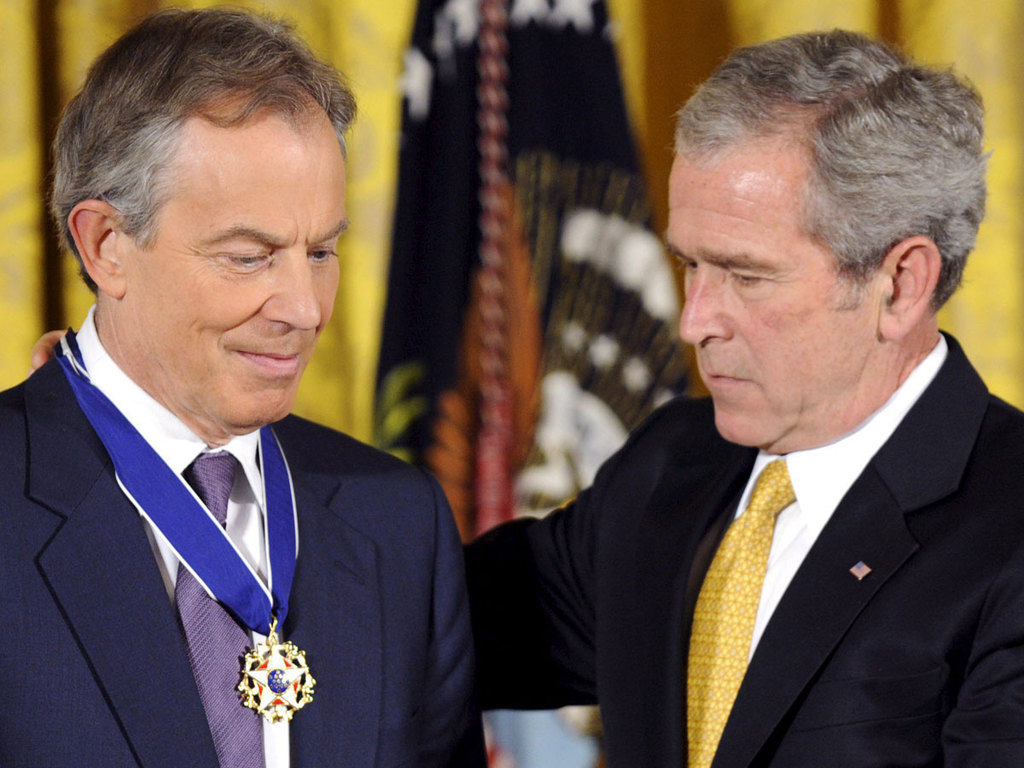
Tony Blair receives the Congressional Gold Medal of Honour from George 'Dubya' Bush
Tony Blair receives the Congressional Gold Medal of Honour from George ‘Dubya’ Bush

Inquiry into Iraq war wants to release notes from Blair to Bush and records of conversations between Blair or Brown and Bush

The government’s persistent refusal to reveal what Tony Blair told George Bush in the runup to the invasion of Iraq in 2003 is blocking any further progress on the long-awaited report of the inquiry into the war, it has emerged.

The inquiry wants to release 25 notes from Blair to President Bush; more than 130 records of conversations between either Blair or Gordon Brown and Bush, and information relating to 200 Cabinet discussions, its chairman, Sir John Chilcot, has told the prime minister.

Chilcot has told David Cameron that without a decision on what he has previously described as documents central to the inquiry, he cannot go ahead with the so-called “Maxwellisation” process.

This is the procedure whereby individuals the inquiry panel intend to criticise are given a chance to respond to the proposed criticisms before the report is finally published.

Blair is one of those most likely to be criticised for his handling of the crisis that led to the US-led invasion of Iraq with British support.

He and others were expected to be handed critical draft passages of the report this summer. But fierce opposition by Whitehall mandarins led by Sir Jeremy Heywood, the cabinet secretary, to the release of the documents has meant that the whole process is stuck in its tracks.

The inquiry panel has agreed the inquiry “should not issue those provisional criticisms without a clear understanding of what supporting evidence will be agreed for publication”, Chilcot has told Cameron.

Continue ReadingChilcot report stalled by row over notes sent from Blair to Bush