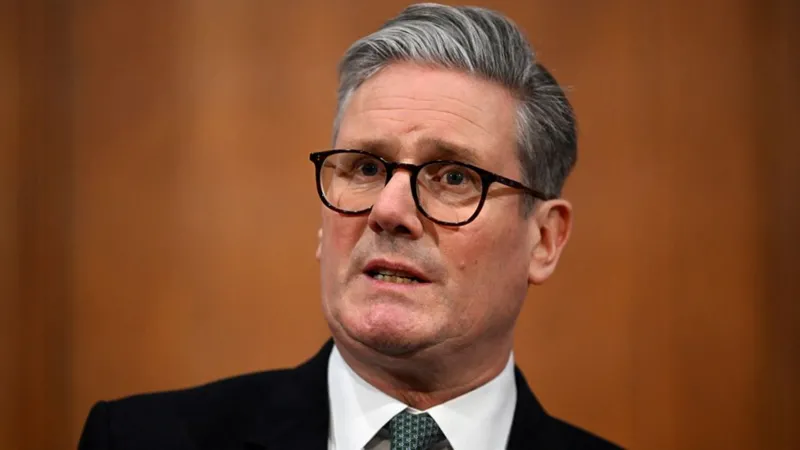
Sir Keir Starmer has called the current benefits system unsustainable, indefensible and unfair, and said the government could not “shrug its shoulders and look away”.
Addressing Labour MPs on Monday evening, the prime minister said the current welfare system was “the worst of all worlds”, discouraging people from working while producing a “spiralling bill”.
The comments come as Work and Pensions Secretary Liz Kendall prepares to set out changes to the welfare system and cut the benefits bill in the coming weeks.
Chancellor Rachel Reeves has earmarked several billion pounds in draft spending cuts to welfare and other government departments ahead of the Spring Statement.
There is unease over the plans within the party, with Labour MP Rachael Maskell warning against “draconian cuts” that risk “pushing disabled people into poverty”.
Maskell told the BBC she had picked up “deep, deep concern” among Labour MPs.
Keir Starmer confirms that he’s proud to be a red Tory continuing austerity and targeting poor and disabled scum.Keir Starmer, Angela Rayner and Rachel Reeves wear the uniform of the rich and powerful. They have all had clothes bought for them by multi-millionaire Labour donor Lord Alli. CORRECTION: It appears that Rachel Reeves clothing was provided by Juliet Rosenfeld.
As we speak, 4.3 million children in the UK are living in relative poverty. Over 350,000 people are homeless in England.
Millions are worried about the cost of heating their home, braced for yet another hike in energy bills. Meanwhile, billionaires are richer than ever.
So what is the government doing?
They could lift children out of poverty, if they wanted to, by scrapping the two-child benefit cap.
Keir Starmer says that a changing world means we have to increase defence spending (Picture: Ministry of Defence)
They could help pensioners with energy bills, if they wanted to, by restoring universal winter fuel allowance.
They could ensure nobody had to sleep rough on the streets, if they wanted to, by launching a massive council-house-building programme.
Instead, they have signed off on a 13.4 billion increase in military spending. With that money, the government could scrap the two-child benefit cap 10 times over.
Now, today, we’re told the government is preparing to cut billions from welfare budgets.
…
Even David Lammy admits Gaza is in ‘rubble’ (Picture: Getty Images)
Put simply: there is never any money for the poor, but always enough money for war. I just wish the government was honest about that.
Keir Starmer says pensioners can freeze to death and poor children can starve and be condemned to failure and misery all their lives.Keir Starmer justifies why he has to travel abroad so much
Austerity is an unusual economic concept. While it is one of the economic terms that attracts the most interest from the public, it remains controversial in policy debates. Advocates argue that reducing government deficits through spending cuts and tax increases restores confidence and stabilises economies. Critics, however, warn that these policies just deepen downturns.
My recent research, using data from 16 countries over several decades, provides new evidence supporting the second view. That is, austerity has significant and persistent negative effects on employment and the size of an economy (measured by GDP), with the damage lasting more than 15 years.
A common defence of austerity is that while it may slow growth in the short term, it ultimately strengthens economies by reducing debt and making room for private-sector expansion. But my findings challenge this assumption.
I analysed episodes of austerity, defined as large fiscal contractions (reduced state spending or large tax increases) across a variety of advanced economies. What I found was the negative impact on GDP remains substantial even after a decade and a half. On average, GDP is more than 5.5% lower 15 years after a large austerity shock than would have been expected if there had been no austerity, based on statistical estimates.
Beyond GDP, austerity has a lasting impact on labour markets (the number of jobs on offer and people available to do them). My research shows that large fiscal contractions lead to a significant drop in the total number of hours worked, which is a key indicator of labour market health.
This is a crucial finding, as policymakers often assume that labour markets will adjust quickly after an economic shock. Instead, results suggest employment levels (which is best measured by the total number of hours worked by everyone in the labour force) remain depressed for more than a decade after major austerity measures.
One reason for this is the connection between investment and employment. When governments cut spending, firms delay investments. This, in turn, lowers productivity growth and reduces job creation.
If businesses anticipate that the economy will remain weak for a long time, they adjust their hiring and investment strategies. This can reinforce a cycle of stagnation. My results suggest that, on average, an austerity shock generates a reduction of 4% in the total worked hours and 6% in the capital stock (the value of physical assets like buildings and machines used to produce goods and services) after 15 years.
The effects of an austerity shock on countries’ GDP:
UK: A case study
Perhaps one of the most striking real-world examples of the long-term effects of austerity is the UK. Following the 2008 global financial crisis, the UK government implemented sweeping austerity measures starting in 2010. These policies were framed as necessary to reduce the budget deficit and restore investor confidence. Spending cuts affected key areas, including welfare, healthcare, education and local government services like social housing, roads and leisure facilities. https://www.youtube.com/embed/Z1g1zGV6vRQ?wmode=transparent&start=0 The 2010 coalition government brought in more than £80 billion of cuts to public spending.
But here’s a conundrum. The UK’s fiscal deficit (the difference between what it spent and what it raised in taxes) after the implementation of these policies was greater than before the austerity cuts. The deficit in 2023/2024 was 5.7% of GDP, while in 2007/2008, it was 2.9%.
What is evident is that these measures are associated with stagnant wages, weakened public services and sluggish GDP growth. Productivity growth has remained weak, and long-term economic damage is evident in underfunded infrastructure and an increasingly fragile NHS.
More than a decade later, real earnings have barely recovered to pre-crisis levels. The past 15 years have been the worst for income growth in generations, with working-age incomes growing by only 6% in real terms from 2007 to 2019, compared to higher growth rates in countries including the US, Germany and Ireland.
My findings contribute to a growing body of research challenging the longstanding view that shocks like austerity have only short-run effects. Traditionally, models assume that economies return to their long-run growth paths after temporary disruptions. But recent evidence, including my research, suggests that demand shocks can have persistent effects on supply by reducing investment and participation in the labour force.
In the wake of the COVID pandemic, many governments responded with generous financial support, temporarily reversing the austerity-driven policies of the previous decade. The strong recovery in some economies suggests that government spending can play a crucial role in sustaining long-run growth. On the other hand, a return to austerity measures could once again lead to prolonged stagnation.
What should policymakers take away from this? First, the assumption that austerity is a path to long-term prosperity needs to be re-evaluated. While reducing excessive public debt might be important, the economic costs of large and rapid cuts to spending can far outweigh the benefits.
Second, policymakers should recognise that timing matters. Gradual adjustments to spending, when really necessary, should be accompanied by measures to support investment and employment in order to reduce the likelihood of causing long-term harm.
Finally, economic policy should prioritise long-term growth over short-term deficit reduction. Governments facing tough spending choices should explore alternative approaches – things like progressive taxation and targeted public investment. And when cuts are needed, they should avoid implementing them during periods of economic recession.
Austerity is often framed as a necessary sacrifice for future prosperity. As governments consider fiscal strategies in an era of rising debt and economic uncertainty, they should take heed of austerity’s long-run costs. The evidence suggests that a more balanced approach – one that prioritises investment and economic stability – may be the wiser path forward.