An investigation by the Guardian published today has revealed that staggering proportions of the public’s water bills are used to service private water firms’ debt. According to the paper’s analysis of financial data over a quarter of some water companies’ revenue goes on servicing debt.
The UK’s largest water firm, Thames Water, uses an astonishing 28 per cent of its revenue to service debt. Southern Water and South East Water both also use more than a quarter of their revenue for the same purpose.
Almost the entirety of water company revenue is made up of customer bills. As of March, the private water firms in England had racked up combined debts of more than £60 billion. Meanwhile, since privatisation of water in England in 1989, private water companies have paid out over £70 billion in dividends to shareholders.
The Guardian notes that Scottish Water, which remains publicly owned, spent just 10 per cent of its revenues financing its debt, less than all of the private water firms in England.
The revelations have led to a furious public backlash and renewed calls for England’s water to be taken back into public ownership.
Labour peer and Left Foot Forward columnist Prem Sikkabranded the situation as ‘daylight robbery’, saying that money had been ‘borrowed to pay dividends, and that ‘companies want more from captive customers’.
Labour ‘won’t turn on spending taps’ leader says in speech to woo big business
AUSTERITY is Labour’s economic agenda, … Keir Starmer announced today in a further lurch to the right.
A Labour government will not “turn on the spending taps,” the Labour leader said in remarks aimed at appeasing the City and the Treasury.
He acknowledged that public services are “on their knees” but offered little prospect of getting them back on their feet again.
… Keir has prioritised bringing down debt and has vowed not to increase taxes on business or the wealthy, leaving himself no room to repair the damage wrought by 15 years of capitalist crisis.
This latest dilution of Labour’s plans for government came just a day after Sir Keir went out of his way to praise former Tory prime minister Margaret Thatcher for shaking Britain out of its “stupor.”
A Momentum spokesperson said today that “these are deeply worrying remarks from Keir Starmer.
“Instead of laying out a popular alternative based on public ownership and public investment, the Labour leadership is adopting the Tories’ failed economic approach.
“Starmer’s stance isn’t just out of touch with Labour members and voters — but with the public too.”
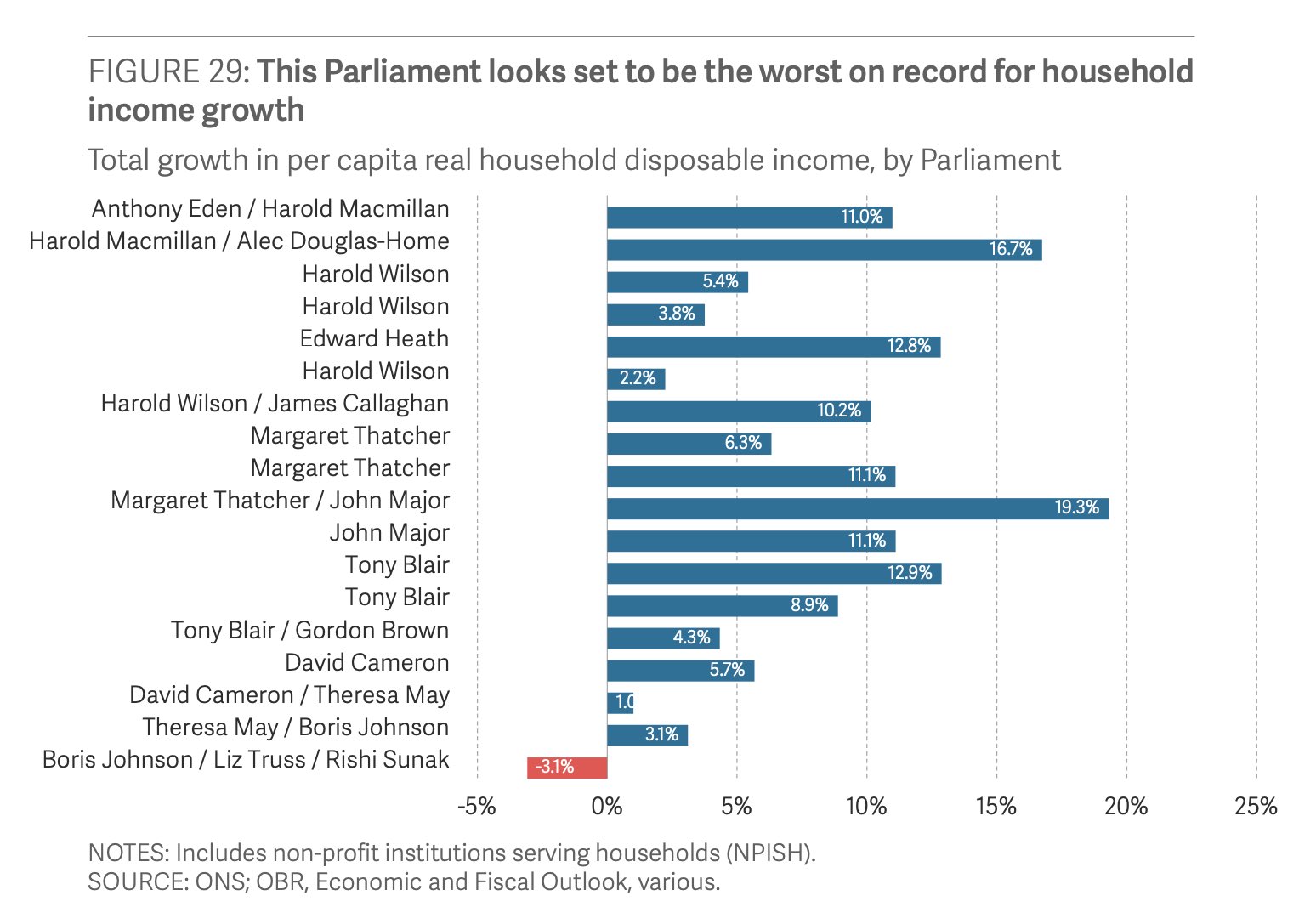
While Jeremy Hunt was keen to portray an optimistic picture of his autumn statement, bragging about tax cuts and how he was ‘growing the economy’, even though the facts show otherwise
…
The below chart illustrates just how bad this Parliament is for household income growth. So much for the Tories being the party of sound finances.
This parliament worst on record for household income growth (Picture credit: Resolution Foundation)
‘Productivity is also down as a result of Brexit, along with a ‘permanent reduction in the willingness to invest’ in the United Kingdom’
Brexit has had a disastrous impact on the UK economy and could leave each person up to £2,300 worse off, new data has suggested.
The decision to leave the EU has had a major impact on UK economic performance, with the
OBR estimating that the economic hit caused by Brexit to the UK economy will mean GDP is reduced by 4%.
Now new data from the National Institute of Economic & Social Research (NIESR), shows that UK GDP is estimated to be 3% lower as a result of Brexit.
Britain’s oldest independent economic research institute, the NIESR, also says that the average British citizen is now £850 worse off as a result of the decision to leave the EU.
The group also highlighted that productivity is also down as a result of Brexit, along with a ‘permanent reduction in the willingness to invest’ in the United Kingdom.
The welfare system has taken another hit today via a ‘benefits crackdown’ in Jeremy Hunt’s autumn statement. Since the ‘welfare reform’ of 2007, disabled people have been on the receiving end of these dehumanising and punishing policies that make people out as ‘undeserving’, prioritise work over people, and make life unlivable.
But we now have evidence the Department for Work and Pensions (DPW) knows its policies kill people. It has been repeatedly warned of this fact and has even confirmed it in its own research.
It took years of campaigning by disabled people to uncover this evidence, which largely comes in the form of DWP reviews into deaths of claimants.
Now it has been brought together as part of the Deaths by Welfare project at Healing Justice London. Since 2021, journalist John Pring and I have been creating a timeline – co-produced with disabled people – showing the links between welfare policy and disabled people’s deaths.
It also shows that not only is there often a delay between the introduction of a policy and the brutal impact it has on people’s lives, but that delay tactics are central to DWP’s weaponisation of time as a strategy to avoid accountability.
To make matters worse, most families of those who have died do not even know if a review has been carried out into their loved one’s death because the DWP has always argued this is private information – an argument found by an Information Rights Tribunal to be an error in law – and can’t be shared, not even with families.
The first family to see an IPR was Philippa Day’s. Philippa, known as Pip, took her own life in 2019 after her disability benefits were stopped.
In January 2021, the coroner at the inquest into Philippa’s death found 28 separate “problems” with the administration of the Personal Independent Payment (PIP) system contributed to her death – concluding these were not individual errors by DWP and its private sector contractor Capita but systemic flaws.
Pip’s sister Imogen told us, in an interview for the Deaths by Welfare podcast, that seeing the IPR “silenced my night-time questions, right before I was going to sleep… It made it incredibly clear that we as a family had done everything that we could have done, and that it was a governmental system that had let her down”.
“I really feel for families that still don’t have answers,” she said.
And Pip is not alone. It would later come to light, after a sustained (and continuing) Freedom of Information battle, that between 2014 and 2022, the DWP carried out approximately 220 of these reviews – formerly called peer reviews, now internal process reviews (IPRs).
After finally obtaining redacted versions of some of these, we found evidence of persistent and systemic issues across welfare policy, and evidence that welfare policy is life-threatening. The reviews also contained hundreds of recommendations, which the DWP has admitted having no system for tracking.
What makes DWP reviews into what it calls the ‘death of a customer’ important is that they are (supposedly) tools through which the DWP investigates the harms of its own policies. And yet, they are designed and carried out in a way that systemically hides any state accountability. And delays in releasing the reviews is another way the department can avoid being held accountable.
What we have discovered has been learnt slowly, largely through a mixture of FOIs, parliamentary questions, queries to the DWP press office and documents released through court cases or inquests. Many of the FOIs have been submitted by Disability News Service over the last nine years.
An investigation by the National Audit Office (NAO) on the information the DWP holds on benefit claimants who ended their lives by suicide, found the DWP does not identify patterns between people’s deaths, meaning that “systemic issues which might be brought to light through these reviews could be missed”.
The NAO also found access to the reports is restricted to the team handling them and the recommendations are not tracked or monitored, meaning the DWP “does not know whether the suggested improvements are implemented”.
These recommendations include repeated warnings that policies to assess people for out-of-work disability benefits were putting the lives of “vulnerable” claimants (likely to be mostly people with mental health conditions or learning difficulties) at risk.
Yes, the DWP’s own investigations were identifying policies as potentially life-threatening. The IPRs also showed a recurring pattern of staff failure to follow DWP’s suicide guidance, which was introduced in 2009.
Tactics used to delay the release of information include claims by the DWP that the time required to collect data, due to lack of centralised record-keeping, was too costly and not in the public interest.
This was used under Thérèse Coffey to block requests about how many inquests relating to benefits claimants who died by suicide her department had submitted evidence to, as well as requests to find out how many inquests had ruled DWP policies were partly responsible for the deceased person’s state of mind. In both of these cases, the information wasn’t shared due to “disproportionate cost”.
These reviews should be publicly available by default, and the DWP should be held publicly accountable to making the changes required.
Yet it may be that the IPR process is by design unable to apprehend government accountability in people’s deaths. IPR findings and recommendations come from within the system that kills people, and therefore may never be enough for full accountability or justice. While some ascribe people’s deaths to flaws in a system that needs reform, others see them as endemic to a system that needs dismantling and creating anew, with disabled people, and the analysis developed through lived experience, at the core.