‘Green’ UK pensions are bankrolling US fossil fuels
Article by Josephine Moulds and Simon Lock republished from The Bureau of Investigative Journalism under a Creative Commons Attribution-NonCommercial-NoDerivs 3.0 Unported License.

Public sector pensions have ploughed billions into opaque investment funds which are financing ruinous gas projects on the US Gulf Coast
In brief
- UK public sector pension schemes are bankrolling rapid expansion of liquefied natural gas production in the US South, posing a major climate threat
- US gas projects are reaping rewards from price shocks caused by Trump’s war in Iran
- Gas terminals are frequently built in poor neighbourhoods, causing health problems in nearby communities
Trump’s war in Iran has boosted the fortunes of US gas companies – and UK savers are unwittingly bankrolling their expansion.
Sixty local government pension funds have invested a total of £8bn into funds paying for the rapid construction of gas infrastructure on the Gulf Coast of the US. Residents say these terminals are already causing health problems in their communities. Experts say they represent one of the biggest threats to the future of the planet.
Over 7 million school staff, civil servants and other public sector workers either save with, or receive their pension from, local government pension schemes. Our revelations have sparked concerns among local councillors, who have urged fund managers to divest from fossil fuels.
While the companies behind these projects are enjoying a boost from the war in Iran, they could tumble in value as the world switches to renewable forms of energy. Councillor Andrew Scopes, who sits on an advisory panel for West Yorkshire Pension Fund, said: “We will still be paying benefits out in 60 years’ time. We need to be looking beyond the possible short-term gains, at the long-term risk.”
Recommended Articles
 UK world’s worst for letting fossil fuel companies drill in nature reserves
- Trump’s blatant oil grab lays bare the violence of a fossil fuel economy
- Cotton grower billed as ‘ethical investment’ linked to land invasions


Members of the scheme were dismayed to find what they were bankrolling. “The UK could be funding a safer, healthier future for all via renewable energy generated in the UK that is cheap, safe, clean and owned by us,” said Jane Thewlis, a retired social worker.
The news comes as the government is making changes to the law governing pension schemes. During a debate in the House of Lords, peers from several parties raised the issue of pension fund investments in climate-wrecking companies.
Baroness Hayman, a crossbench peer, told us: “Many UK pension funds are already reducing their exposure to fossil fuels, recognising the risks these investments pose. But with £3 trillion held in UK pensions, and the climate and nature challenge growing, there is a clear opportunity to better protect savers from rising financial and environmental risks.”
A gas explosion
The giant white orbs containing liquefied natural gas (LNG) look almost alien. Scores of these terminals are popping up along the 1,200km Louisiana and Texas coastline, a building frenzy turbo-charged by Trump’s second term. If all the planned terminals are built, the LNG produced in the US would generate the same amount of greenhouse gases each year as every EU country combined, says Jeremy Symons, a former official at the US environmental regulator.
UK pension funds have supported this expansion for years. In 2019, a little-known infrastructure fund called Stonepeak put up $1.3bn to complete the construction of the Calcasieu Pass gas terminal in the south-west corner of Louisiana. Twenty miles inland, building has started on another terminal also funded by Stonepeak.
 Calcasieu Pass LNG terminalVenture Global
UK savers in 12 local government pension schemes, including West Yorkshire, South Yorkshire and Worcestershire, have invested over £360m in Stonepeak funds that financed these plants, according to figures from council records and data provider Pitchbook.
Since starting operations, Calcasieu Pass has reported hundreds of emissions violations and paid authorities a $245,000 settlement. That’s unlikely to make much difference to its owner, Venture Global, a major Trump donor. Its shares rocketed by more than 80% after the US and Israel started bombing targets in Iran.
Roishetta Ozane, a resident turned activist, lives near both terminals. She told us that pollution from the nearby gas, petrochemicals and oil infrastructure has caused asthma and an increase of cancer in the area – an account borne out by academic research.
“We’re seeing more women develop health issues that are living near these facilities, having pre-term babies or having miscarriages,” she said. “We’re seeing our air quality deteriorate. We have a drinking water crisis.” She said residents had to deal with noise pollution from construction and the flaring of excess gas from the terminals.
 Roishetta Ozane (second left)
Two of her children have asthma. She told us the doctor said pollution may have exacerbated the seizures suffered by her son, who died last year. “When my son passed away, I was like, what are we doing this for?” she said. “We’re fighting for our children, for our future, for our community, but yet they’re dying.”
Further down the coast, a huge fireball at Freeport LNG in June 2022 made the risks of these installations vividly clear. IFM Global Infrastructure Fund – which counts among its investors more than 20 UK pension funds, including Avon, East Sussex and Aberdeen – paid $1.3bn to help build Freeport LNG in 2013. It continues to hold a stake in the project.
Travelling south, the construction boom continues. Right next to the Mexican border, Rio Grande LNG is building a sprawling complex that the NGO Sierra Club estimates will match the emissions of 50 coal-fired power plants every year. Campaigners say the project is already contributing to habitat loss in an area critical for endangered animals such as ocelots, falcons and sea turtles.
French bank Société Générale backed out of funding the controversial project. But it was able to proceed thanks to a $5bn commitment from BlackRock’s Global Infrastructure Partners Fund V – which is supported by nearly £200m of UK savers’ pensions, from Waltham Forest to Greater Manchester.
In total, we found eight US-based LNG terminals backed by UK pension money. Taken together, those terminals would give rise to more CO₂ every year than the entire UK several times over, according to Sierra Club data.
https://flo.uri.sh/visualisation/28573619/embed?auto=1 [“Sorry, this content could not be embedded.”]
A spokesperson for IFM Investors told us that the fund publicly discloses its infrastructure equity assets. They added: “Natural gas is increasingly utilised as a transition fuel for decarbonisation globally … These assets benefit from investment from long-term, trusted capital partners like pension funds, who can reinvest in them and pave the way for carbon emissions reduction.”
LNG is often promoted as a cleaner alternative to traditional fossil fuels. However, a peer-reviewed study found it is 33% worse in terms of planet-heating emissions over a 20-year period compared with coal.
Worcestershire Pension Fund said it invests through structures that mean “exposure to any single asset is indirect, limited, and a very small component of a broader portfolio.” It said the Stonepeak fund in question “publishes detailed annual reports and complies fully with statutory disclosure requirements”.
A greener pension
When it comes to curbing carbon emissions, council pension funds and campaigners have tended to focus on selling their shares in companies like BP and Shell. But a growing portion of pension funds are invested in so-called “private markets”. Typically this involves putting money into a number of big funds, which in turn invest in everything from private equity to property to company loans.
Private markets can offer healthy returns. They’re also something of a black hole for information, which makes following the money much more difficult. And they’re often excluded from the scope of council climate commitments.
The upshot is that even pension schemes that have promised not to invest in fossil fuels have ploughed money into funds that are paying for major gas projects.
Take Waltham Forest Pension Fund, which in 2016 became the first local authority to make such a commitment. Simon Miller, a former councillor who chaired the pension fund committee, said the council already had a number of green goals to improve the lives of residents. “[But] we had a pension fund that was merrily invested in fossil fuels that was absolutely out of lockstep with the political direction and philosophy of the borough.”
The council’s pension fund proceeded to sell its investments in fossil fuel companies over the following five years.
According to its latest report, however, Waltham Forest is still invested in funds managed by Global Infrastructure Partners that have financed Rio Grande LNG and Allete, which owns an 18,000-acre coal mine in North Dakota.
https://frontend.poool.fr/engage/56TXL-DGRM7-IPY34-9YVAW/67b3726b9f79a3dc6ea9504c [“Sorry, this content could not be embedded.”]
Lewisham Pension Fund has also brought down the emissions associated with its investments after committing to sell its holdings in fossil fuel companies. But it remains invested in a huge infrastructure fund operated by JP Morgan Asset Management. While this fund has substantial investments in renewable energy, it continues to hold a 50% stake in Third Coast, which spilled over 1 million gallons of oil into the Gulf of Mexico in 2023.
In February 2024, West Yorkshire Pension Fund said it would no longer lend to the oil, gas and coal sector. According to the new standards set by the authority, councillor Andrew Scopes said, the decision to invest in a Stonepeak fund that bankrolled an LNG plant on Ozane’s doorstep would be “very difficult to justify”.
Jane Thewlis, a campaigner and member of the scheme, said: “We are particularly concerned if [West Yorkshire Pension Fund] is funding LNG infrastructure in the US, which is not compatible with a livable climate. We expect our elected representatives to use our money to fund a safe future – not to hasten the end of humanity.”
West Yorkshire Pension Fund said its environmental, social and governance policy “takes account of the current status and role of gas and oil within the energy transition, particularly with regard to reliability, affordability and coal displacement”. It said LNG is seen as “a bridge between today’s fossil‑fuel‑dominated energy system and a future low or zero‑carbon one”.
JP Morgan, Stonepeak and Waltham Forest council declined to comment on the record. Lewisham council said it cannot comment in a pre-election period. Third Coast, the LNG port operators, Global Infrastructure Partners and other local councils did not respond to requests for comment.
What next?
- We are providing our research to campaigners and pension fund advisory panels so they can challenge decision makers on investments in infrastructure funds
- New rules mean that council pension funds will be combined into pension fund pools, limiting councillors’ power over investment decisions. We will investigate what that means for funds that have committed to invest responsibly
- Parliament is discussing the first of a number of pension reforms, where campaigners are pushing for greater recognition of climate risk
Article by Josephine Moulds and Simon Lock republished from The Bureau of Investigative Journalism under a Creative Commons Attribution-NonCommercial-NoDerivs 3.0 Unported License.


‘No Oil, No War’: Trump’s Attack on Iran Condemned Ahead of Global Climate Summit
Article by Jessica Corbett republished from Common Dreams under Creative Commons (CC BY-NC-ND 3.0).

“Current conflicts prove that moving away from fossil fuels is an urgent necessity for security, well-being, and the climate,” said Greenpeace campaigner.
On the eve of the First Conference on Transitioning Away from Fossil Fuels in Colombia, Greenpeace Spain activists roughly 5,000 miles away unveiled an image of US President Trump vomiting oil into a black-stained fountain in Madrid’s Plaza de Colón with a banner declaring, “No Oil, No War.”
“We are saying no to oil and war!” said Greenpeace Spain climate and energy campaigner Pedro Zorrilla Miras in a Thursday statement. “Current conflicts prove that moving away from fossil fuels is an urgent necessity for security, well-being, and the climate.”
RECOMMENDED…

‘Stop This Lawless War,’ Advocates Say as Trump Warns of Coming Power Plant, Bridge Attacks in Iran

‘Go Get Your Own Oil’: Trump Lashes Out at Europe for Not Backing Unprovoked War on Iran
Since returning to power last year with help from the fossil fuel industry, Trump has spent his second term attacking already inadequate US climate policies and trying to deliver on his promise to “drill, baby, drill,” despite the harm that causes to the planet and its inhabitants.
After sending in US troops to abduct Venezuelan President Nicolás Maduro as part of an effort to take over the country’s nationalized oil industry in January, Trump, alongside Israeli forces, began bombing Iran in February. Although there is now a fragile ceasefire in place, Iran responded to the US-Israeli attack by restricting ship traffic through the Strait of Hormuz, a key trade route, including for fertilizer and fossil fuels.
As fuel prices have soared, green groups—including Greenpeace—have called for a permanent end to the US and Israel’s assault on Iran, a windfall profits tax for fossil fuel giants that have cashed in on the conflict, and making “food and energy secure for all.” They have also argued that the war highlights the need for a just shift away from oil and gas.
“Instead of war, ending our reliance on fossil fuels is our best possible defense,” said Zorrilla Miras. “That is why governments must show leadership at the Santa Marta conference to accelerate a just transition away from fossil fuels. We are calling for clear and ambitious action from Spain that matches its rhetoric and embraces pathways that show Spain can achieve a 99% decarbonization rate by 2040.”
“Fossil fuel dependence is exposing countries to volatile global markets, where conflict, disruption, and political tensions rapidly translate into higher energy, food, and transport prices,” the campaigner continued. “The Santa Marta summit is therefore a key political moment for leaders to progress the delivery of energy systems that are affordable, stable, and resilient in an increasingly uncertain world.”
Colombia and the Netherlands are co-hosting the summit, which is set to run from Friday to Wednesday and is “intended to support practical action by those already prepared to move forward,” according to organizers. “It does not seek to deliver a negotiated outcome, but rather to generate shared understanding and actionable guidance that can help accelerate a just, orderly, and equitable transition away from fossil fuels.”
Standing on top of and around the visual of puking Trump in Madrid, Greenpeace activists carried signs calling for such a transition. The messages included: “Renewables, Power, Peace” in English, “No Oil, No War” in Portuguese, and “For a world free of fossil fuels” in Spanish.
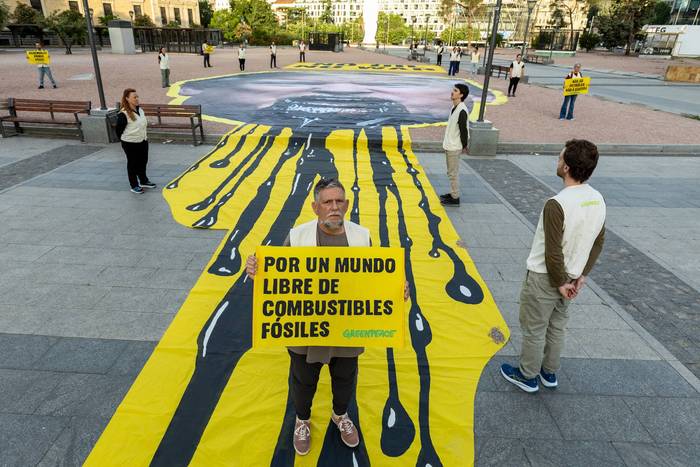
A Greenpeace Spain activist holds a sign that says “For a world free of fossil fuels” in Spanish during a protest in Madrid on April 23, 2026. (Photo by Pablo Blazquez/Greenpeace)
“In the midst of a fossil fuel-driven energy crisis, the Santa Marta meeting offers light on the horizon,” said Greenpeace International climate politics expert Tracy Carty. “Rather than prolonging exposure to volatile and conflict-prone fossil fuels, governments must use this moment to accelerate a just transition to renewable energy that protects people from price shocks and builds long-term stability.”
“The coalition of committed states coming together in Santa Marta has the potential to spark bolder national action and international cooperation,” she noted. “That requires the development of national roadmaps for transitioning away from fossil fuels, including ambitious renewable energy targets, and to scale up predictable, accessible, and affordable climate finance to support developing countries in delivering a just transition.”
Article by Jessica Corbett republished from Common Dreams under Creative Commons (CC BY-NC-ND 3.0).
- Global Energy Report Offers Choice for Humanity: Renewable Transition or ‘Dystopian Future’ Pushed by Trump ›
- ‘Reckless’ Countries to Extract More Than Double the Fossil Fuels Consistent With 1.5°C ›
- Fossil Fuel Production Cannot Expand as Part of a Fair Energy Transition, Urges New International Coalition ›
- ‘Fossil Fuel Exit Strategy’ Shows Transition to Renewable Future Totally Doable ›
- What the First Conference on Transitioning Away From Fossil Fuels Must Achieve – News & Opinion – The Commons ›


‘Time for Half Measures Is Over’: Study Warns of Terrifying Atlantic Ocean Current Collapse
Article by Stephen Prager republished from Common Dreams under Creative Commons (CC BY-NC-ND 3.0).

“We must avoid this collapse at all costs,” said a leading current researcher, who warned that “the stability of the entire planet” is at stake.
The global climate crisis is causing a critical Atlantic Ocean current system to weaken much sooner than previously predicted, according to a study published on Thursday. If it stops, scientists say it could pose catastrophic consequences for Europe, Africa, and the Americas.
The Atlantic Meridional Overturning Circulation (AMOC) is one of the most important current systems in the world for maintaining the delicate balance of the global climate. It helps to keep colder regions like Europe and the Arctic mild by moving warm water northward and pushes large amounts of carbon deep into the ocean, keeping it out of the atmosphere.
RECOMMENDED…

Iran’s Top Diplomat Says Trump Team Sabotaged Talks With Deal ‘Inches Away’

‘Disgusting’: Trump’s Top Economic Adviser Brags About Killing 300,000 ‘High-Paying’ American Jobs
Scientists have feared AMOC’s decline for some time. Previous studies have shown it to be at its weakest point in 1,600 years. But research published this month suggests that a collapse may come much sooner than anticipated.
One study, published Thursday in the journal Science Advances, used climate models and current data to predict the decline in the coming decades.
Researchers found that the system is on course to slow by more than 50% by the end of the century and could pass a significant tipping point by mid-century, at which point its decline would become irreversible.
“We found that the AMOC is declining faster than predicted by the average of all climate models,” said lead researcher Valentin Portmann, of the Inria Research Center of Bordeaux South-West. “This means we are closer to a tipping point than previously thought.”
A major driver of its slowdown has been the rapid melting of Greenland’s freshwater ice sheet into the Atlantic, which has diluted denser saltwater, making it harder to transfer northward.
He explained: “The more rapidly Greenland melts, the more freshwater floods the North Atlantic. This disrupts the sinking process, effectively applying the brakes to the entire system.”
This research followed another study published last week by scientists at the University of Miami, which found that AMOC has been weakening at four latitudes in the Atlantic.
Professor Stefan Rahmstorf, a leading AMOC researcher at the Potsdam Institute for Climate Impact Research, who was not involved in either study, called it “an important and deeply concerning result” that “confirms that the ‘pessimistic’ climate models—those projecting a severe weakening of the AMOC by 2100—are the most accurate.”
“The most dramatic and drastic climate changes we see in the last 100,000 years of Earth history have been when the AMOC switched to a different state,” Rahmstorf explained.
A shutdown of the current system poses what Canadian climate activist and marine conservationist Paul Watson described as a “domino effect of climatic upheavals.”
Scientists have projected that temperatures in northern Europe could plummet dramatically, with winters in London sometimes reaching below -20°C (-4°F) and those in Norway reaching -48°C (-54°F). It also threatens to dramatically shorten growing seasons, putting food security in peril for hundreds of millions of people.
Tropical storms in the North Atlantic would also become more severe. As the current slows, sea levels are expected to rise, and the greater temperature difference between cooling Europe and the warming tropics can fuel more intense hurricanes and increase the risk of flooding in major coastal cities.
“We must avoid this collapse at all costs,” Rahmstorf said. “The stakes are too high; this isn’t just about Europe’s climate, but the stability of the entire planet.”
Such a dramatic change in the flow of global heat could scramble temperature and rainfall patterns worldwide, putting some areas at greater risk of drought and disrupting the monsoon season that fuels agriculture in many regions.
It also risks becoming self-perpetuating, as the large amounts of carbon released from the ocean could further accelerate AMOC’s collapse. Research published last week found that carbon emissions from the Southern Ocean alone could increase global temperature by about 0.2°C.
“The science is clear: The AMOC is teetering on the edge of collapse, and the window to act is closing,” Watson said. “Yet global leaders remain paralyzed by short-term politics and denial.”
The conclusion of the most recent United Nations climate summit, COP30, has been described as woefully insufficient to address the mounting climate emergency. The roadmap for action released by the host nation, Brazil, excluded any mention of the phrase “fossil fuels” after the conference was overrun by industry lobbyists.
“The time for half-measures is over,” Watson said. “The choices we make in the next decade will determine whether future generations inherit a manageable climate or a world plunged into chaos.”
Article by Stephen Prager republished from Common Dreams under Creative Commons (CC BY-NC-ND 3.0).


Climate Defenders Warn GOP Immunity Bill Puts ‘Big Oil Above the Law’
Article by Brett Wilkins republished from Common Dreams under Creative Commons (CC BY-NC-ND 3.0).

“Such corporate impunity would twist the knife of the climate crisis that is already directly harming people across the country,” said one campaigner.
Green groups warned Friday that Big Oil-backed Republican legislation would give fossil fuel companies immunity from laws or lawsuits aimed at holding them accountable for their role in causing the climate emergency.
On Thursday, Sen. Ted Cruz (R-Texas) introduced a bill co-sponsored by Sens. Ted Budd (R-NC), Tom Cotton (R-Ark.), and Mike Lee (R-Utah) that, if passed, would “prohibit liability against those engaged in the mining, extraction, production, refinement, transportation, distribution, marketing, manufacture, or sale of energy for damages or injunctive or other relief from the use of their products, and for other purposes.”
RECOMMENDED…
US Supreme Court Hands Big Oil Major Win in Battle Over Destruction of Louisiana Coast
Iran’s Top Diplomat Says Trump Team Sabotaged Talks With Deal ‘Inches Away’
Congresswoman Harriet Hageman (R-Wyo.) on Friday introduced the House version of the legislation, dubbed the Stop Climate Shakedowns Act of 2026, “to protect American energy from leftist legal crusades punishing lawful activity,” as her office put it.
If passed, the legislation would ban retroactive climate liability lawsuits, dismiss any such litigation pending upon the law’s enactment, void all state energy penalty laws, and affirm that the federal government maintains exclusive authority and jurisdiction over the regulation of greenhouse gas emissions and other interstate environmental standards.
Other Republican-controlled states including Tennesseee and Utah have recently passed such legislation, and others—including Iowa, Louisiana, and Oklahoma—have introduced similar bills.
“This blatant championing of some of the world’s largest polluters shows how far certain elected officials will go to undermine democratic policymaking and deny people and communities access to justice,” Kathy Mulvey, climate accountability campaign director at the Union of Concerned Scientists, said Friday.
“No company should be above the law, especially those that planned, funded, and continue to engage in a coordinated decadeslong campaign to protect their profits by deceiving the public and blocking climate action,” Mulvey continued.
“Such corporate impunity would twist the knife of the climate crisis that is already directly harming people across the country,” she added. “Congress must not capitulate to wealthy special interests. Communities deserve the right to hold polluters accountable for the deadly and costly harms they are causing.”
Former Democratic Washington Gov. Jay Inslee said in a statement that “every elected official who cares about the interests of their constituents more than those of corporate polluters should oppose this disgraceful proposal.”
“Juries are a fundamental bastion of democracy, and it’s beyond dangerous to allow powerful and wealthy corporations to shield themselves from ever having to face jurors’ judgment,” he added.
The Center for Climate Integrity said the bill “would put Big Oil above the law.”
“Big Oil companies have raked in massive profits at the pump while lying to the American people about the catastrophic harm of their products, and now they want to deny Americans their rightful day in court and stick taxpayers with the bill for the mess they made,” Center for Climate Integrity president Richard Wiles said Friday. “If fossil fuel companies have done nothing wrong, why do they need immunity?”
While these and other climate advocates denounced the bill, their congressional sponsors—and those lawmakers’ fossil fuel industry campaign donors—applauded its introduction.
“Energy security is national security, and we will not self-sabotage our critical industries with a cascade of costly lawsuits and extreme penalties that jeopardize American drilling,” Hageman said in a statement. “America’s energy producers should be protected from the dangerous legal precedent that would be set by the retroactive punishment of lawful activity.”
American Fuel & Petrochemical Manufacturers president and CEO Chet Thompson and American Petroleum Institute president and CEO Mike Sommers said in a joint statement, “We thank Sen. Cruz and Rep. Hageman for introducing legislation to stop a growing patchwork of state laws and lawsuits that threaten American energy and risk raising costs for consumers.”
“These efforts to retroactively penalize companies for lawfully meeting consumer demand are misguided and counterproductive,” the lobbyists added. “Congress should act decisively to reaffirm federal authority over national energy policy and end this activist-driven state overreach.”
Eleven states—California, Connecticut, Delaware, Hawaii, Maine, Massachusetts, Michigan, Minnesota, New Jersey, Rhode Island, and Vermont—along with the District of Columbia and dozens of city, county, and tribal governments have ongoing lawsuits seeking to hold fossil fuel companies accountable for lying to the public about their products’ role in causing and worsening climate change.
On Friday, the right-wing US Supreme Court unanimously issued an important procedural ruling that certain environmental damage lawsuits—in this case, one challenging Chevron’s destruction of coastal wetlands in Louisiana—can be moved from state to generally friendlier federal courts. This, after a jury in Plaquemines Parish ordered Chevron and two other companies to pay $744 million in damages for harming coastal wetlands, a verdict that was appealed.
The US Supreme Court’s decision came as its justices prepare to hear Suncor Energy Inc. v. County Commissioners of Boulder County, a case in which the plaintiffs—three Suncor entities and ExxonMobil—are seeking to relocate a climate damages lawsuit from Colorado to federal court.
Big Oil-backed efforts to relocate cases to friendlier forums come amid wins for climate defenders, most notably Held v. Montana, a historic 2024 state court ruling in favor of youth-led plaintiffs based on the Montana Constitution’s right to “a clean and healthful environment.”
Article by Brett Wilkins republished from Common Dreams under Creative Commons (CC BY-NC-ND 3.0).