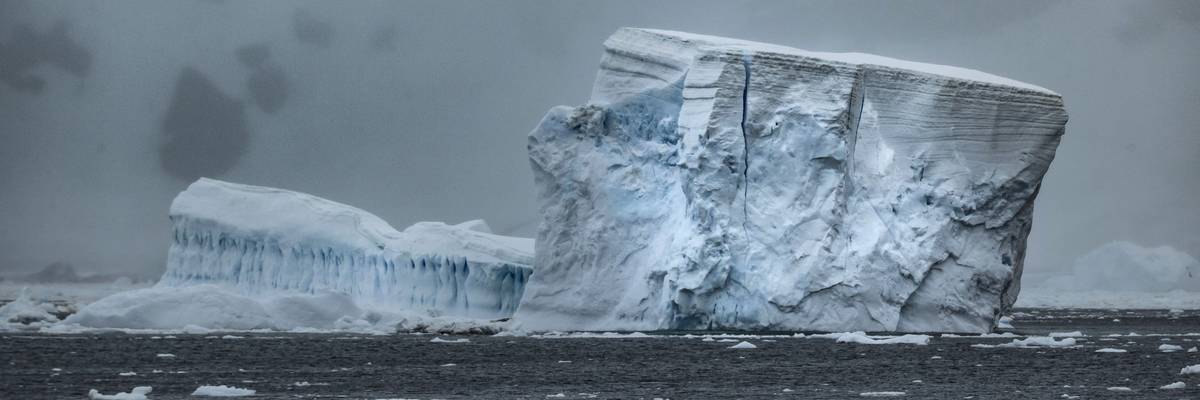
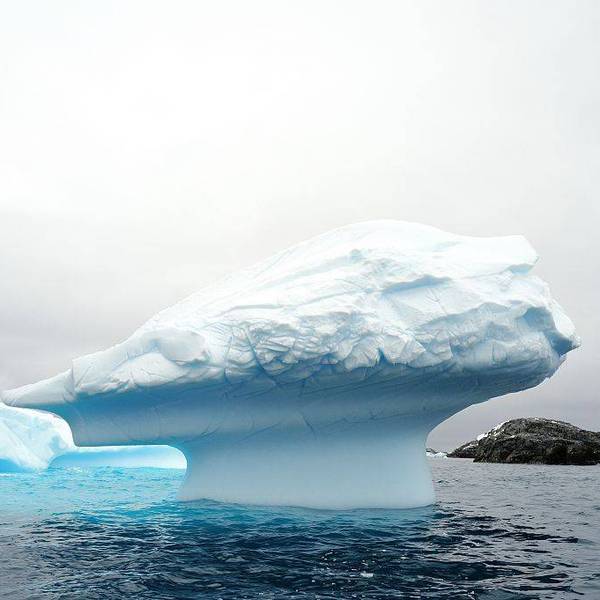
The glaciers are seen as the floes melt due to global climate change in Antarctica on February 07, 2022. Turkish scientists, within the scope of the 6th National Antarctic Science Expedition, monitored the global climate change and followed the glaciers that provide the heat balance of the world and decrease every year. (Photo by Sebnem Coskun/Anadolu Agency via Getty Images)
“This of course reflects Trump administration policy, which counters any focus on climate at international meetings,” said a US researcher and former diplomat.
The Trump administration is under fire over its efforts to have any mention of the climate crisis removed from a scientific report, published this week, aimed at informing nations that are party to a global treaty designed to protect the Antarctic.
Details of the “diplomatic tensions” surrounding the report, which took place during a meeting in May with delegates from around the world focused on the Antarctic Treaty, were detailed by Australian Broadcasting Corporation (ABC) correspondent Jano Gibson.
The report reveals that France took issue with the US’s suggestion not to use broad terms such as “climate change” and instead refer to “specific” environmental changes.
“France … expressed it had strong concern about the gradual disappearance of references to climate change in the work of the Committee [for Environmental Protection],” the report states.
“France emphasized that climate change was a reality affecting all countries, regardless of borders.
Claire Christian, executive director of the Antarctic and Southern Ocean Coalition, told ABC that there’s zero controversy within the scientific community that a changing climate due to global warming is having deep impacts on the Antarctic region.
“The evidence is clear: the Antarctic region is undergoing rapid climate change, and this is already having significant effects on planetary systems,” Christian said. “If we don’t reduce our carbon emissions rapidly, these effects will only become more severe and unpredictable.”
While a France warned that “refusing to even name climate change” would set “a dangerous precedent,” Evan Bloom, a former US diplomat and Antarctic researcher involved in international negotiations on the topic said the position taken by the US at the Antarctic Treaty Consultative Meeting was very much in keeping with the behavior and policies of President Donald Trump.
The US position, said Bloom, “shows how out of step the US is with most of the rest of the world on climate change. Yet, this of course reflects Trump administration policy, which counters any focus on climate at international meetings.”
Donald Trump urges you to be a Climate Science denier like him. He says that he makes millions and millions for destroying the planet, Burn, Baby, Burn and Flood, Baby, Flood.Elon Musk urges you to be a Fascist like him, says that you can ignore facts and reality then.Orcas discuss rotting brain, front Orca says Sundown Syndrome is a dead givaway and he wishes someone would Lock Him Up
Wes Streeting speaking about so-called ‘progressive capitalism’ at No1 Tower Place West, in central London, June 16, 2026
LABOUR leadership pretender Wes Streeting came out fighting today for carbon fuel, the bond market and “progressive capitalism.”
The former health secretary reaffirmed that he will contest any leadership election triggered by Manchester Mayor Andy Burnham’s expected victory in the Makerfield by-election this week.
Mr Streeting, the Blairite candidate in any election, backed plans to drill for oil and gas in the Rosebank and Jackdaw fields in the North Sea.
He said he aimed to “protect the workers in oil and gas, who’ve seen words like ‘just transition’ translate into jobs for someone else, somewhere else. We should be working with the unions on this – not least on making sure that we’re building our clean power future here in Britain, not simply importing it from China.”
He denied that this would forfeit Britain’s “moral leadership” on climate change.
“The best example we can set is to show the world that net zero is compatible with a pro-growth agenda. The worst example would be losing support for the net zero agenda, handing the country to Nigel Farage, and allowing Reform to destroy the renewables industry,” Mr Streeting said.
Green Party deputy leader Rachel Millward said his “call to open up new drilling in the North Sea is environmentally reckless and economically illiterate.
“Rosebank alone contains enough fossil fuel to produce over 200 million tonnes of CO2 if burned – more than the combined annual emissions of 28 low-income countries.”
Uplift director Tess Khan said: “Politicians need to learn the lesson of the last five years – the UK’s dependence on fossil fuels is making a handful of oil and gas companies obscenely rich and the rest of us poorer, while driving inflation, harming the economy and altering our climate.
“Streeting would do better to listen to the millions who are sick of the energy giants loading costs onto the rest of us, and pay less attention to this profiteering industry and its proxies, like Tony Blair and Donald Trump.”
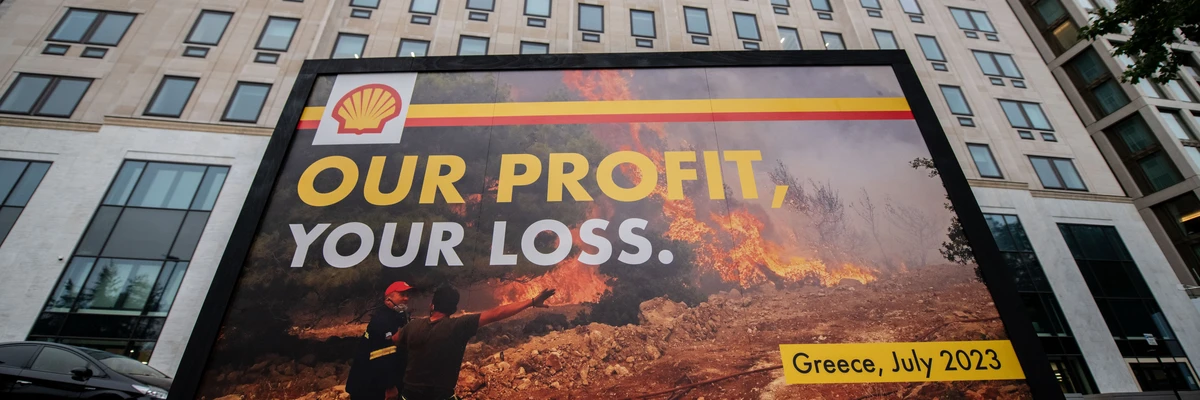
Greenpeace activists display a billboard during a protest outside Shell headquarters on July 27, 2023 in London. (Photo: Handout/Chris J. Ratcliffe for Greenpeace via Getty Images)Donald Trump urges you to be a Climate Science denier like him. He says that he makes millions and millions for destroying the planet, Burn, Baby, Burn and Flood, Baby, Flood.Nigel Farage urges you to ignore facts and reality and be a climate science denier like him and his Deputy Richard Tice. He says that Reform UK has received £Millions and £Millions from the fossil fuel industry to promote climate denial and destroy the planet.
Scientists say a crucial Atlantic system is more likely to collapse than previously thought. But the billionaire death cult that steers humanity’s destiny doesn’t do existential crises
The poor and middle pay taxes, the rich pay accountants, the very rich pay lawyers – and the ultra-rich pay politicians. It’s not an original remark, but it bears repeating until everyone has heard it. The more money billionaires accumulate, the greater their control of the political system – which means they pay less tax, which means they accumulate more, which means their control intensifies.
They reshape the world to suit their demands. One of the symptoms of the pathology known as “billionaire brain” is an inability to see beyond their own short-term gain. They would sack the planet for a few more stones on the pointless mountain of wealth. And we can see it happening. Last week delivered the biggest news of the year so far, perhaps the biggest news of the century. But partly because billionaires own most of the media, most people never heard it. We might find ourselves committed to a civilisation-ending event before we even learn that such a thing is possible.
The news is that the state of a crucial oceanic circulation system has been reassessed by scientists. Some now believe that, as a result of climate breakdown changing the temperature and salinity of seawater, it is more likely than not to collapse. This system – known as the Atlantic meridional overturning circulation (Amoc) – delivers heat from the tropics to the North Atlantic. Recent research suggests that if it shuts down, it could cause both a massive drop in average winter temperatures in northern Europe and drastic changes in the Amazon’s water cycles. This could help tip the rainforest into cascading collapse and trigger further disaster.
Amoc’s shutdown is likely also to cause an acceleration of sea level rise on the east coast of the US, threatening cities. It could also raise Antarctic temperatures by roughly 6C and release a vast pulse of carbon currently stored in the Southern Ocean, accelerating climate catastrophe.
Even when the countervailing effects of generalised global heating are taken into account, a further paper proposes, the net impact in northern Europe would be periods of extreme cold – including events in which temperatures in London fall to -19C, in Edinburgh to -30C and in Oslo to -48C. Sea ice in February would extend as far as Lincolnshire. Our climate would change drastically, with the likelihood of far greater extremes, such as massive winter storms. Rain-fed arable agriculture would become impossible almost everywhere in the UK.
Penny Holliday, Femke de Jong and Sjoerd Groeskamp
…
Several Amoc monitoring initiatives are at a risk of being defunded and could be discontinued at any moment. While we can’t go back in time to do more observations, we can improve our observation strategy for the future.
Instead, the Trump administration has proposed budget cuts to Nasa, NOAA and NSF – agencies that together provide about 50% of the total Amoc monitoring budget. Last week the US announced the descoping of the Ocean Observing Initiative which was part of a programme observing the Amoc.
The recently launched European OceanEye initiative has allocated €50m for ocean observations and is a great incentive to continue Amoc observations. However, before OceanEye is up and running, the research vessels that service the present-day observing systems will already have to be financed, planned and packed.
In short: monitoring, understanding and forecasting the Amoc is at risk. Without sustained Amoc observations, we cannot know what lies ahead. An Amoc collapse may be imminent, a century away, or, if we act boldly to limit climate change, it might be averted altogether.
For too long, understanding and monitoring the Amoc was viewed as an academic pursuit. Instead, it should now be treated as what it truly is: an urgent, global priority. There is an acute and essential need to construct an alternative international funding strategy to secure long-term Amoc monitoring that realises a robust, continuous and open-access Amoc monitoring program to provide the knowledge to build a safer and more resilient world.
The cost of all Amoc monitoring adds up to about €25m a year. Meaning that for five cents per person per year, the EU can maintain one of the world’s most important climate monitoring systems that impacts our everyday lives and improves resilience to the climate crisis.
We therefore urge the EU, the UK and other international partners to step up, make haste, get organised and collaborate to assure long-term continuation of Amoc monitoring before it is lost.
Donald Trump urges you to be a Climate Science denier like him. He says that he makes millions and millions for destroying the planet, Burn, Baby, Burn and Flood, Baby, Flood.Nigel Farage urges you to ignore facts and reality and be a climate science denier like him and his Deputy Richard Tice. He says that Reform UK has received £Millions and £Millions from the fossil fuel industry to promote climate denial and destroy the planet.Elon Musk urges you to be a Fascist like him, says that you can ignore facts and reality then.
Temperatures above 15C ‘very strange’ say scientists, as snow melts and rain falls on glaciers in usually frozen region
On King George Island the landscape has changed from mostly white to brown, grey and green. Photograph: Luis Muñoz
Temperatures in the Antarctic climbed above 15C this month, shattering the previous winter heat record for the usually frozen region and raising concerns about the speed of climate breakdown.
The new winter peak temperature was logged by the Argentinian Esperanza base on the Trinity peninsula on 6 June amid a protracted heatwave, when the maximum daily temperature exceeded zero degrees for three consecutive weeks.
Scientists said the high of 15.4C broke the previous record set at the same station in 1998 by 2C. “This is absolutely crazy,” said Raúl Cordero, an Ecuadorian climate professor at the University of Groningen. “It is also about 20C above normal for this time of the year. That is a huge anomaly.”
Unusually strong warm winds from the north blew across much of the Antarctic peninsula. One Chilean weather station, Boonen Rivera, registered temperatures of close to 13C, Cordero said.
On King George Island, 100 miles (160km) from Esperanza, researchers said the landscape had changed from mostly white to brown, grey and green after temperatures hit 4.6C on 6 June.
“Last weekend was very strange. The temperatures here went very high so everything outside melted,” said Luis Muñoz, a Chilean glaciologist. “Usually there is 20cm of snow and a lot of ice on the ground at this time.”
Nigel Farage urges you to ignore facts and reality and be a climate science denier like him and his Deputy Richard Tice. He says that Reform UK has received £Millions and £Millions from the fossil fuel industry to promote climate denial and destroy the planet.Donald Trump urges you to be a Climate Science denier like him. He says that he makes millions and millions for destroying the planet, Burn, Baby, Burn and Flood, Baby, Flood.Elon Musk urges you to be a Fascist like him, says that you can ignore facts and reality then.
UK barrister Cherie Blair. Credit: The Swift Hour / YouTube
The oil major has provided a significant chunk of the foundation’s income.
A charity set up by Cherie Blair has received more than £3.6 million from U.S. fossil fuel giant ExxonMobil, DeSmog can reveal.
The eponymous Cherie Blair Foundation for Women was founded in 2008 – providing training and resources, including mobile apps, for “women entrepreneurs” in low-income countries to start small businesses, according to its website.
The group has received at least $4.8 million (around £3.6 million) from ExxonMobil’s charitable arm, the ExxonMobil Foundation, since 2015.
The majority of this ($2.8 million, around £2.1 million) was received between 2020 and the ExxonMobil Foundation’s most recent filing in 2024.
The oil and gas giant provided roughly a-fifth of the Cherie Blair Foundation’s total income from 2020 to 2024, according to an analysis of the latter’s accounts.
Blair is a barrister and the wife of former UK Prime Minister Tony Blair, who last month called for the UK to abandon its climate targets and ramp-up North Sea fossil fuel exploration. There is no suggestion that Exxon funded the Cherie Blair Foundation to influence Tony Blair’s work, nor that his views have been swayed by the money provided.
The ExxonMobil Foundation is the primary philanthropic arm of ExxonMobil, the largest U.S.-based oil and gas company.
Internal company reports have revealed that Exxon knew in the 1980s that unrestrained carbon emissions have the potential to cause “great irreversible harm to our planet,” and that it predicted the exact amount of global warming the world is now experiencing. However, instead of warning the public, Exxon internally decided to publicly “emphasize the uncertainty” of climate science.
The Cherie Blair Foundation said that it is “focused on supporting women entrepreneurs in low- and middle-income countries.”
It added: “We receive funding from a range of donors to deliver programmes aligned with our mission. One of these donors is the ExxonMobil Foundation, with whom we have worked since 2015. This support has enabled us to expand access to business skills training for women entrepreneurs in Nigeria and Guyana.”
Africa is disproportionately vulnerable to climate change, with eight of the 10 countries most at risk globally located in central, west, and southern Africa.
The ExxonMobil Foundation’s available tax returns show that it gave the Cherie Blair Foundation $1 million in 2015 and 2016, $600,000 in 2024, 2023, and 2022, and $500,000 in 2021 and 2020.
Exxon’s tax returns for 2017 to 2019 do not list any donation recipients, although the Cherie Blair Foundation’s annual accounts for those years still list Exxon as a donor.
The ExxonMobil Foundation is also listed on the Cherie Blair Foundation’s “donors and partners” list for 2011 to 2014, but details of any money provided are not available in the charity’s reports or the ExxonMobil Foundation’s tax returns.
Cherie Blair is still involved in the foundation, having given an interview to The Standard about its work in March.
The foundation added: “We are not connected to the Tony Blair Institute for Global Change or to Tony Blair’s personal or professional activities, and we operate independently in our governance, strategy and operations. Information relating to funding received is publicly available in our annual report and accounts.”
ExxonMobil was approached for comment.
Tony Blair and Net Zero
In a major intervention in May, Tony Blair called on the Labour government to “use what is left of our North Sea oil and gas resources” and sideline the UK’s net zero emissions targets.
He also said new oil and gas was essential to power the data centres needed for the mass deployment of artificial intelligence (AI), which Blair has championed.
The U.S.-Israeli war with Iran has caused an energy crisis and a spike in the price of oil. Labour has argued the UK needs to deploy clean energy at a faster pace, while the Conservatives and Reform have been calling for the UK’s ban on new North Sea exploration licences to be lifted.
The Cherie Blair Foundation’s ExxonMobil donations are the latest example of fossil fuel interests backing Blair family initiatives.
TBI has been paid to advise the governments of several authoritarian petrostates, including Saudi Arabia, the United Arab Emirates, and Azerbaijan, all of which are heavily reliant on oil and gas exports.
The institute has also championed the deployment of artificial intelligence by the government and in the economy, and has supported the use of gas to power AI data centres.
TBI received $130 million (around £96.5 million) between 2021 and 2023 from billionaire tech entrepreneur Larry Ellison, founder of data software company Oracle and an ally of U.S. President Donald Trump. In total, Ellison has donated or pledged at least £257 million to TBI.
“Neither Tony nor Cherie Blair can be taken seriously when it comes to climate change, energy policy or human rights when their organisations have taken so much money from oil companies and oil dictators,” a spokesperson for the Green Party said.
In a 5,000-word essay published on the TBI website in May, Blair listed “the net-zero acceleration and phasing out of the British oil and gas industry” among Labour’s 2024 manifesto commitments which he considers a mistake.
He wrote that Labour should “remove those parts of the net-zero agenda which prioritise clean energy over cheaper energy”.
Blair, who was prime minister from 1997 to 2007, concluded: “We must prioritise cheaper energy and electrification over net zero and use what is left of our North Sea oil and gas resources. This is essential for our competitiveness and for taking advantage of AI.”
Renewable energy from wind and solar power are consistently the cheapest form of energy. High energy bills are caused by the price of oil and gas, while new North Sea exploration will do little to cut energy bills.
Data centres are currently using six percent of electricity in the UK and U.S., according to a report earlier this month by the International Data Center Authority, an industry body. The average data centre uses enough energy to power roughly 5,000 UK homes, and between 11 million and 19 million litres of water per day, the same as a town of between 30,000 and 50,000 people.
Up to 100 data centres in the UK are reportedly looking to use gas power to meet this demand, threatening emissions reduction targets. The Labour government has yet to state whether it will prevent gas-powered data centres from being built in the UK.
Last month, the government admitted that it had under-estimated the potential carbon emissions of data centres by a factor of more than 100.
Last year, Keir Starmer’s administration – which has close ties to Blair and TBI – signed a ‘Tech Prosperity Deal’ with the U.S. government through which big tech companies pledged to heavily invest in AI development in the UK. While Trump paused the deal in December, it’s unclear to what extent these investments are also on pause.




 Wes Streeting speaking about so-called ‘progressive capitalism’ at No1 Tower Place West, in central London, June 16, 2026