Ocean surface temperatures on 21 June beat records set in 2023 and 2024. Photograph: Richard Ellis/Zuma Press Wire/Shutterstock
European scientists warn of consequences for weather patterns, the global climate and marine life
Temperatures on the ocean surface have hit a record high, raising fears of another burst of extreme heat this summer.
On 21 June, temperatures outside the polar regions exceeded the extraordinary highs observed at the same time in 2023 and 2024, the Copernicus Climate Change Service said on Wednesday.
It warned the new peak would probably bring “consequences for weather patterns, global climate and marine ecosystems”, not least because it would coincide with the earliest phases of an El Niño event they forecast to be the strongest in decades.
When the previous ocean record for June was set in 2023, scientists described the trends as “worrying”, “terrifying” and “bonkers” because they were so far outside their expectations. That presaged an El Niño and a period of devastating global heatwaves, floods and storms.
That 2023 record has now been surpassed and much of the world is once again seeing an alarming rise in temperatures. Last month, the UK and many other countries in Europe sweltered amid new heat records while Antarctica experienced unprecedentedly balmy winter conditions.
Although the focus is usually on land temperatures, oceans give a fuller picture of how much the climate is being pushed out of balance by human-caused warming.
Surface temperatures are affected by solar radiation, water currents and the buildup of heat in the depths.
Oceans absorb more than 90% of the excess energy in the Earth system, which is primarily caused by burning fossil fuels, such as oil, coal and gas. That imbalance hit a record 23 zettajoules last year, more than double the average of the previous two decades.skip past newsletter promotion
As a result, the oceans are warming at an accelerating rate. In 2020, the amount of heat being added to the oceans was equivalent to about five Hiroshima bombs a second. Last year, it was closer to 11 Hiroshima explosions a second. The UN’s secretary general, António Guterres, has warned “Earth is being pushed beyond its limits”.
Scientists said it was too early to say whether the sea surface heating would prove temporary or even worsen because annual peaks are usually registered in July and August.
But Carlo Buontempo, Copernicus director at the European Centre for Medium-Range Weather Forecasts, warned it could indicate the beginning of a new phase, leading, once more, to uncharted territory: “With ocean temperatures at these levels and El Niño on the horizon, we are likely to see more temperature records fall in the coming months.”
Neo-Fascist Climate Science Denier Donald Trump says Burn, Baby, Burn.Nigel Farage urges you to ignore facts and reality and be a climate science denier like him and his Deputy Richard Tice. He says that Reform UK has received £Millions and £Millions from the fossil fuel industry to promote climate denial and destroy the planet.Elon Musk urges you to be a Fascist like him, says that you can ignore facts and reality then.
“With ocean temperatures at these levels and El Niño on the horizon, we are likely to see more temperature records fall in the coming months.”
A new report released Wednesday shows that surface temperatures of the world’s oceans hit a record for June, sparking fresh warnings of grave “consequences for weather patterns, global climate and marine ecosystems” across the globe.
The analysis by the European Union’s Copernicus Marine Service, and confirmed by the Copernicus Climate Change Service (C3S), finds that “record global sea surface temperatures” of 21.0° Celsius (69.8° Fahrenheit) in June of 2026 beat the previous record in the same month broken in 2023 and again in 2024.
C3S director Carlo Buontempo warned that the “current conditions” of the oceans “could indicate the beginning of a new phase, leading, once more, to uncharted territory.”
“With ocean temperatures at these levels and El Niño on the horizon, we are likely to see more temperature records fall in the coming months,” Buontempo warned. “That Copernicus Marine data reaches the same conclusion through independent methods speaks to the strength of European science—and to why open, robust data matters now more than ever.”
According to a statement from Copernicus, warmer oceans have wide-ranging impacts on natural systems and human infrastructure, noting that “higher ocean temperatures keep the atmosphere warm for longer, provide extra energy to storms and increase evaporation, thus enhancing the potential for extreme precipitation and flooding. Ocean warming also contributes to sea level rise and ice melt, and stresses marine ecosystems.”
With the onset of a new El Niño cycle—which tends to trigger more pronounced weather events worldwide—the continued increase of ocean temperatures is a serious concern of scientists.
Wednesday’s report on ocean temperatures also arrives as record-breaking heat waves hit both Europe and North America, offering more evidence of the perils of an ever-hotter world that is being pushed to the brink by the burning of fossil fuels and the failure of governments worldwide to finally act against the fossil fuel industry that is driving the crisis.
Surging ocean surface temperatures are “not unexpected,” Michael Meredith, an ocean scientist at the British Antarctic Survey, told CNN in response to the Copernicus report. “But the pace of warming we are now seeing is alarming.”
Donald Trump urges you to be a Climate Science denier like him. He says that he makes millions and millions for destroying the planet, Burn, Baby, Burn and Flood, Baby, Flood.Nigel Farage urges you to ignore facts and reality and be a climate science denier like him and his Deputy Richard Tice. He says that Reform UK has received £Millions and £Millions from the fossil fuel industry to promote climate denial and destroy the planet.Orcas comment on killer apes destroying the planet by continuing to burn fossil fuels.
UK newspapers have already published 63 editorials this year calling for more oil and gas extraction in the North Sea, according to Carbon Brief analysis.
The national outlets, including the Sun, the Daily Telegraph and the Times, argue that the nation “needs” more North Sea drilling to provide “home-sourced oil and gas” amid a “full-blown energy crisis”.
These newspapers seek to blame energy secretary Ed Miliband’s “net-zero crusade” for curbing UK fossil-fuel production – despite supplies dwindling for decades before he took the role.
The push for North Sea drilling in newspaper editorials – considered a publication’s formal “voice” – is part of a wider rejection of net-zero policies by the UK’s right-leaning press.
Figures ranging from ex-Labour prime minister Tony Blair to hard-right Reform UK leader Nigel Farage have repeated similar arguments that more drilling will “boost” the UK economy.
Even US president Donald Trump has weighed in, attributing, in part, the resignation of Keir Starmer as UK prime minister to him “fail[ing] badly” on North Sea oil.
Despite these claims, experts say trying to extract the last barrels of domestic oil and gas would have no impact on people’s energy bills and very little effect on energy security.
More drilling
North Sea oil and gas production is a highly politically charged issue in the UK, especially under the current Labour government.
When Labour won the general election in 2024, the new government committed to a “phased and responsible” transition away from fossil-fuel extraction in the North Sea.
As part of this pledge, it ruled out issuing new exploration licences for oil and gas. Since then, the government has allowed some “tiebacks”, where new drilling is undertaken close to existing sites.
Roughly 90% of the fossil fuels that are likely to be extracted in the North Sea have already been burned. North Sea oil and gas extraction was, therefore, already on a clear downward trajectory long before Labour came to power, having dropped 75% between 2000 and 2024.
Nevertheless, many newspapers have relentlessly called for more oil and gas production, framing the Labour policy as “self-destructive” and compromised by “green ideology”.
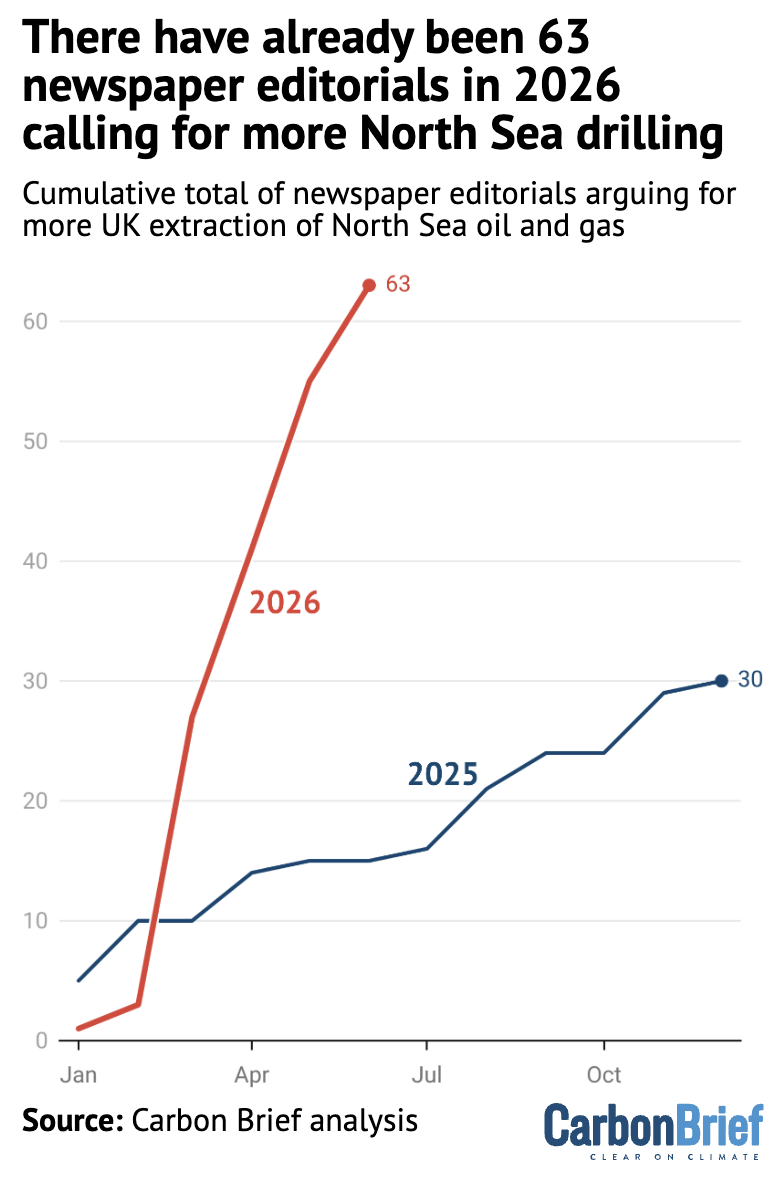
This has ramped up significantly in 2026. Just six months into the year, newspapers have already published 63 pro-North Sea editorials, according to analysis by Carbon Brief. This is more than double the number published in 2025, as shown in the figure below.
Cumulative number of UK newspaper editorials supporting more fossil-fuel extraction in the North Sea in 2025 (blue) and January-June 2026 (red). Source: Carbon Brief analysis.
Right-leaning newspapers have led this campaign, with the Sun alone publishing 25 editorials, while the Daily Telegraph and the Times have published 10 each.
‘Full-blown energy crisis’
The biggest surge in pro-North Sea drilling editorials came in March, as the Iran war escalated and a global energy crisis began to take shape. Newspapers published 24 such editorials that month, despite the crisis largely arising from the world’s reliance on fossil fuels.
The Daily Express said the UK needed more “home-sourced oil and gas” and the Daily Mail highlighted the “perverse limit on domestic fossil-fuel production”.
As the weeks progressed, the Sun lamented price rises and potential fuel shortages, proposing North Sea drilling as a solution to the “full-blown energy crisis”.
Yet, UK oil and gas is sold by private companies on the open market at international rates. This means UK consumers have no particular right to the fuels or control over the prices they are bought for.
The Sun claimed – without evidence – that if the North Sea had been prioritised, the UK “might just have the cheapest electricity in the world”. It also said net-zero “forces us to spend billions” on imports.
In fact, the UK’s high energy prices are primarily the result of its reliance on gas to generate electricity.
The nation is reliant on oil and gas imports, in part, because the North Sea is a “mature basin” that saw its output collapse long before the UK even had a net-zero target.
Renewables and low-carbon technologies – often dismissed by the same newspapers – are expected to have a far greater impact on cutting imports than new drilling ever could.
Miliband’s ‘crusade’
Much of the criticism by these newspapers of Labour’s North Sea stance is tied to their highly personal criticism of Miliband. Of the 63 editorials arguing for more drilling, nearly three-quarters also attacked him as a “net-zero zealot” on a “green crusade”.
The Times said the energy and net-zero secretary was pursuing a “masochistic policy” by not expanding North Sea drilling and that he had “cloaked his zealotry in spurious rationality”.
This all fits with a broader trend that has seen right-leaning newspapers launch frequent, personal attacks on Miliband.
In the roughly two years since Labour won the election, giving the government a clear mandate for its net-zero policies, there have been around 230 editorials criticising Miliband.
(These have redoubled in recent days, amid rumours that he may be made chancellor under Andy Burnham, if the new Makerfield MP becomes the next prime minister, as is widely expected.)
Such attacks have increasingly spilled over into politics. Conservative shadow energy secretary Claire Coutinho has accused Miliband of “fanaticism” and Conservative leader Kemi Badenoch has even likened him to a “Nigerian military dictator”.
The newspapers have also interpreted any support for North Sea drilling as a rebuke of Miliband. Both the Sun and the Daily Telegraph welcomed an essay by Blair, in which he argued that “we must…use what is left of our North Sea oil and gas resources”.
The Sun heralded Blair as Labour’s “most successful election winner” and said he “nailed the chief mistakes” of the current government, including:
“Allowing Ed Miliband free rein on net-zero – especially the banning of North Sea drilling.”
Several of the newspapers have also thrown their support behind the Conservative party, as it frames itself as an anti-net-zero, pro-fossil fuel alternative to Labour.
The Daily Mail described Badenoch’s proposal to drill more in the North Sea as a “concrete plan”, while the Sun – in an echo of Trump’s slogan – has simply urged her to “drill, Kemi, drill”.
Nigel Farage urges you to ignore facts and reality and be a climate science denier like him and his Deputy Richard Tice. He says that Reform UK has received £Millions and £Millions from the fossil fuel industry to promote climate denial and destroy the planet.UK Conservative Party leader Kemi ‘not a genocide’ Badenoch explains her reality that the Earth is flat, the Moon is made of cheese and that she was born from Unicorn horn dustElon Musk urges you to be a Fascist like him, says that you can ignore facts and reality then.
Severe weather has gripped the globe this week, with record-shattering, deadly heat in Western Europe. In the US, heat, wind and drought conditions fueled wildfires in the Southwest, while heavy thunderstorms, wind and floods caused destruction in eastern and central states.
Scientists attribute these extremes to fossil fuel–driven climate change. Europe’s heatwave would have been “virtually impossible to occur at this time of year” 50 years ago, scientists from the World Weather Attribution group reported. The project’s Theodore Keeping of Imperial College London told reporters (EuroNews, 6/26/26):
The science of how climate change is worsening heatwaves is settled…. Continued fossil-fuel emissions are directly responsible for the disruption people are experiencing this week in their homes, schools and workplaces.
With extreme weather events worsening each year, and the world on track to surpass by 2030 the Paris Agreement’s attempt to limit global heating to 1.5°C above pre-industrial levels, connecting these disruptive and deadly events to climate change is a key part of the story.
Yet on the evening of Tuesday, June 23, despite leading their shows with severe weather headlines, nightly news shows on NBC, ABC and CBS failed to mention climate even in passing.
Cropping out climate
NBC Nightly News (6/23/26) had a tight shot of UN Secretary General Antonio Guterres…
Substitute anchor Hallie Jackson began the NBC Nightly News (6/23/26) by describing apocalyptic scenes around the globe:
Tonight, the dangerous triple weather threat with fires, floods and deadly heat affecting millions. The flash flood emergency here at home: Fast-moving waters trapping drivers and washing out roads. Wildfires exploding out West. Plus, overseas, a record-shattering heatwave in Europe leaving dozens dead.
The broadcast covered heavy rains in Oklahoma, wildfires in Utah and Nevada, and heat and fire in Miami disrupting World Cup events. In France, it was so hot, Paris shut down the Eiffel Tower Tuesday, and Wednesday was expected to reach a 102°F record. More than 40 people were believed to have drowned in France’s rivers and beaches while trying to escape the heatwave that began last week.
In London, NBC’s Danielle Hamamdjian reported record highs in the city on Tuesday, with even higher temperatures anticipated to come.
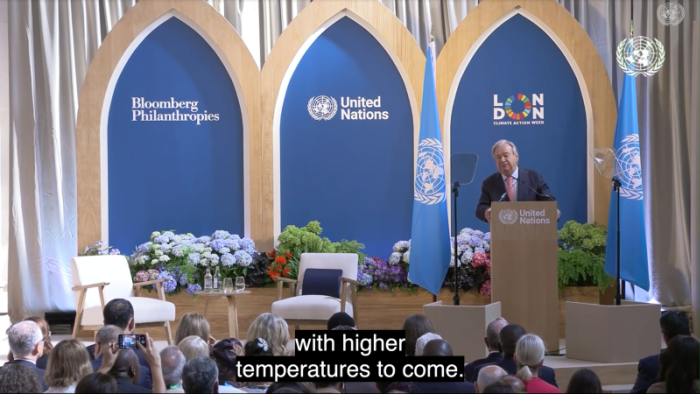
The broadcast then cut to a clip of UN Secretary General Antonio Guterres saying, “And today this city—and far beyond—are experiencing the hottest day of the year—with higher temperatures to come.”
The event that he was speaking at—London Climate Action Week—was not identified. In fact, a banner with the London Climate Action Week logo that was behind Guterres was cropped out of the shot. The soundbite NBC featured was excised from Guterres’ longer remarks about the severity of climate change and the critical necessity of quickly and justly transitioning from fossil fuels:
We have just lived through the 11 hottest years ever recorded. And today this city—and far beyond—are experiencing the hottest day of the year—with higher temperatures to come. London isn’t just calling—it’s cooking. Around the world, climate disasters are becoming more frequent, more destructive and more costly. And the World Meteorological Organization has warned we ain’t seen nothing yet. El Niño is not just knocking on the door. It risks blowing the house down. Turning up the heat. Disrupting food and water systems. And hitting the vulnerable the hardest. Ten years ago, world leaders agreed in Paris to limit global temperature rise to 1.5 degrees Celsius. Now scientists say average annual temperatures will exceed that threshold in the coming years.
Later in the speech, Guterres demanded that AI companies publicly disclose their energy usage and commit to powering data centers with renewables by 2030.
From a speech entirely about climate change and its tangible impacts, NBC Nightly News managed to cherrypick a soundbite of Guterres essentially saying nothing more than “it’s hot.” While the segment linked together these extreme weather events in Europe and the US as a global phenomenon, climate change didn’t even get a passing mention.
Records broken by unknown force
ABC World News Tonight (6/23/26) reported on weather like there was no such thing as climate.
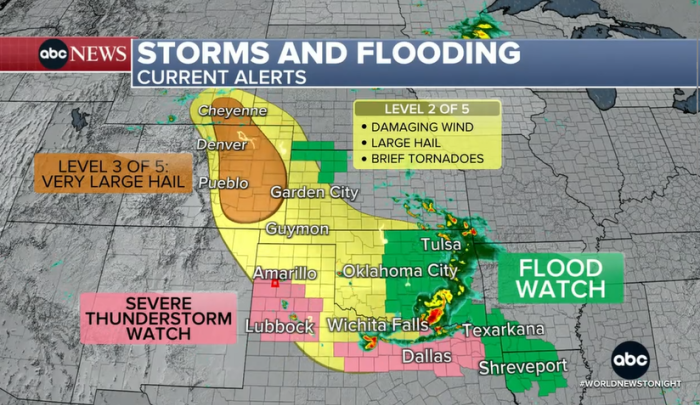
ABC World News Tonight (6/23/26) with David Muir followed suit. Raising the alarm about tornadoes and flood watches in the east, severe storm threats in Texas, Oklahoma, Colorado and Wyoming, extreme heat in the southwest and heatwaves in France, England, Italy and Spain, the broadcast didn’t mention the word “climate” once.
“We’ve lived here for 20 years and I’ve never seen anything like this,” a Fairfax County, Virginia, man said of the winds and storms that sent trees into cars and homes in the area.
CBS Evening News (6/23/26) led with fires, droughts, floods and storms across the US, spotlighting Utah, where one wildfire was the size of San Francisco. “The outbreak follows the state’s warmest winter on record and one of the driest, with just a fifth of normal snowpack,” said host Tony Dokoupil.
In the next segment, correspondent Leigh Kiniry reported from London about record temperatures across Europe. Uniquely among the corporate networks’ evening newscasts, this report alluded vaguely to climate change, noting that “the continent is warming faster than any other.” But viewers were given no clue as to how or why: Direct mentions of climate change were nonexistent throughout the entire broadcast.
‘Not one government is making progress’
PBS NewsHour (6/23/26): “But with the changing climate, what hope is there for family farmers?”
The lone exception to the erasure of climate change on the nightly news broadcasts was PBS NewsHour (6/23/26). While the show didn’t lead headlines with extreme weather, its segment about the European heatwave included a soundbite from a Paris resident expressing dissatisfaction with how governments have ignored climate change. “Paris when temperatures go high is just hell on earth,” she said:
It’s catastrophic. I’m worried for the coming years. We have known about climate change for a while, and not one government is making progress on this issue.
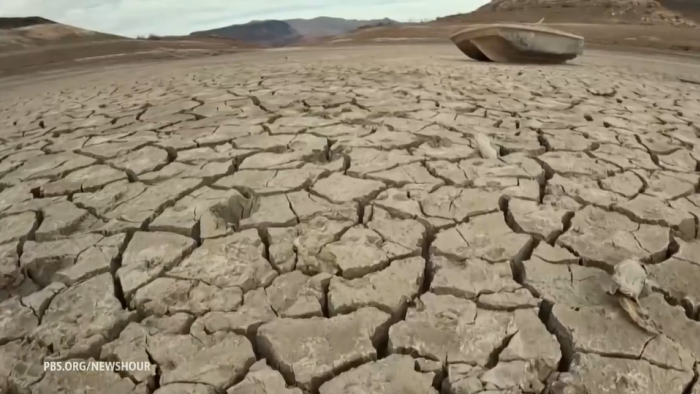
Later in the broadcast, PBS dedicated a segment to droughts in the Southern US affecting farmers in Georgia. The report was part of an ongoing PBS series called Tipping Point, which focuses on the impacts of climate change and communities’ efforts to adapt.
Rachel Cleetus of the Union of Concerned Scientists explained:
Climate change is making these more frequent, both the short-duration kinds of droughts that we’re seeing in some places, but also the longer megadroughts like the Southwest is experiencing. The unpredictability of it, the extremes, both the droughts and then the whiplash with extreme rainfall events, that makes it very difficult to plan for these kinds of conditions.
The report went on to describe precision irrigation systems as a possible mitigation—though noting that their cost is often prohibitive. The segment points to “policy steps worth considering,” like helping farmers obtain these technologies through grants and low-cost loans.
PBS deserves credit as the only nightly broadcast that mentioned climate change at all. But while it addressed the issue of adaptation, it avoided the more fundamental question of causation; the burning of fossil fuels, and its connection to the segment’s weather horror stories, wasn’t mentioned at all.
FAIR (7/18/23) has previously documented that even when TV news connects extreme weather events to climate change, it seldom connects climate change to fossil fuels—but the industry seems to have taken a step backward.
The lack of climate coverage in legacy media follows a trend media analysts have been tracking since President Donald Trump’s second term began. A Media Matters study (3/4/26) found that ABC, CBS and NBC aired 35% less climate coverage in 2025 than in 2024. A FAIR study (4/14/26) found that trend mirrored in online news. But as coverage decreases, climate change’s effects only increase in frequency and severity.
FAIR’s work is sustained by our generous contributors, who allow us to remain independent. Donate today to be a part of this important mission.
Nigel Farage urges you to ignore facts and reality and be a climate science denier like him and his Deputy Richard Tice. He says that Reform UK has received £Millions and £Millions from the fossil fuel industry to promote climate denial and destroy the planet.Donald Trump urges you to be a Climate Science denier like him. He says that he makes millions and millions for destroying the planet, Burn, Baby, Burn and Flood, Baby, Flood.Elon Musk urges you to be a Fascist like him, says that you can ignore facts and reality then.
According to the Times report, Farage has found himself linked with five whole houses since 2020 – the year we officially left the EU:
His main residence – a £1.42m five-bedroom gaff in Surrey (Grade II listed).
His £885,000 Clacton residency – officially owned by his partner Laure Ferrari.
A Kent residency he lived in with his ex-wife (currently occupied by his daughter Isabelle Farage and an unidentified man).
Two beachfront properties owned through his production company, Thorn in the Side Ltd.
As reported:
The Times understands the Tandridge property is the Surrey woodland lodge, and the Folkestone and Hythe property is one of the Kent beachfront homes owned via his company. This means the Kent village property, the second beachfront home and the Essex address are not on the register.
Farage does not have to declare the Essex home because legally it is owned entirely by his partner. However, the case with the other two properties is less clear.
The Times spoke to a number of experts who mostly agreed that Farage should have erred on the side of caution and declared the properties. Does this mean he’ll get in trouble? It’s hard to say given what politicians usually get away with, but it’s certainly another case in which he’s given the impression that he’s on the blag.
…
dizzy: I’d say that Farage is far from open and honest about his affairs …
Nigel Farage reminds you that he’s the man that brought you Brexit and asks what could possibly go wrong.Nigel Farage urges you to ignore facts and reality and be a climate science denier like him and his Deputy Richard Tice. He says that Reform UK has received £Millions and £Millions from the fossil fuel industry to promote climate denial and destroy the planet.Elon Musk urges you to be a Fascist like him, says that you can ignore facts and reality then.