Protesters during a National March for Palestine in central London, January 13, 2024
THE government ignored “overwhelming evidence” that Israel was breaching international human rights laws in Palestine and continued to supply the murderous regime with weapons, including those being used in Gaza, legal documents have revealed.
A Foreign Office assessment unit reviewing UK arms sales to Israel in November raised “serious concerns” with Foreign Secretary David Cameron.
But the former PM recommended that arms sales continue, accepting Israel’s reasoning that it has a different interpretation of its international humanitarian law obligations.
The revelations are contained in a document in a case brought by the Global Legal Action Network (GLAN) and Palestinian human rights group Al Haq over UK arms sales to Israel.
So again: why does this ailing technology enjoy such intense and persistent generosity?
The UK government has for a long time failed even to try to justify support for nuclear power in the kinds of detailed substantive energy terms that were once routine. The last properly rigorous energy white paper was in 2003.
Even before wind and solar costs plummeted, this recognised nuclear as “unattractive”. The delayed 2020 white paper didn’t detail any comparative nuclear and renewable costs, let alone justify why this more expensive option receives such disproportionate funding.
A document published with the latest announcement, Civil Nuclear: Roadmap to 2050, is also more about affirming official support than substantively justifying it. More significant – in this supposedly “civil” strategy – are multiple statements about addressing “civil and military nuclear ambitions” together to “identify opportunities to align the two across government”.
These pressures are acknowledged by other states with nuclear weapons, but were until now treated like a secret in the UK: civil nuclear energy maintains the skills and supply chains needed for military nuclear programmes.
The military has consistently called for civil nuclear
Official UK energy policy documents fail substantively to justify nuclear power, but on the military side the picture is clear.
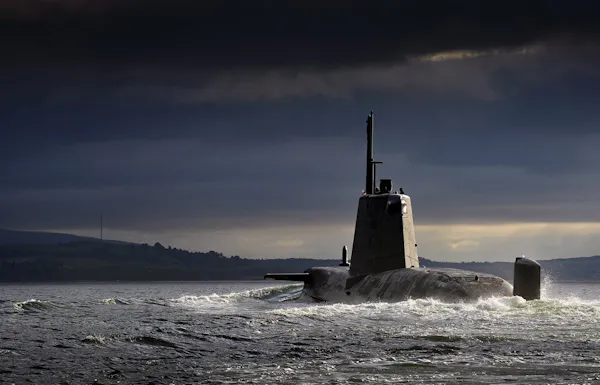
For instance, in 2006 then prime minister Tony Blair performed a U-turn to ignore his own white paper and pledge nuclear power would be “back with a vengeance”. Widely criticised for resting on a “secret” process, this followed a major three volume study by the military-linked RAND Corporation for the Ministry of Defence (MoD) effectively warning that the UK “industrial base” for design, manufacture and maintenance of nuclear submarines would become unaffordable if the country phased out civil nuclear power.
A 2007 report by an executive from submarine-makers BAE Systems called for these military costs to be “masked” behind civil programmes. A secret MoD report in 2014 (later released by freedom of information) showed starkly how declining nuclear power erodes military nuclear skills.
In 2017, submarine reactor manufacturer Rolls Royce even issued a dedicated report, marshalling the case for expensive “small modular reactors” to “relieve the Ministry of Defence of the burden of developing and retaining skills and capability”.
The government itself has remained coy about acknowledging this pressure to “mask” military costs behind civilian programmes. Yet the logic is clear in repeated emphasis on the supposedly self-evident imperative to “keep the nuclear option open” – as if this were an end in itself, no matter what the cost. Energy ministers are occasionally more candid, with one calling civil-military distinctions “artifical” and quietly saying: “I want to include the MoD more in everything we do”.
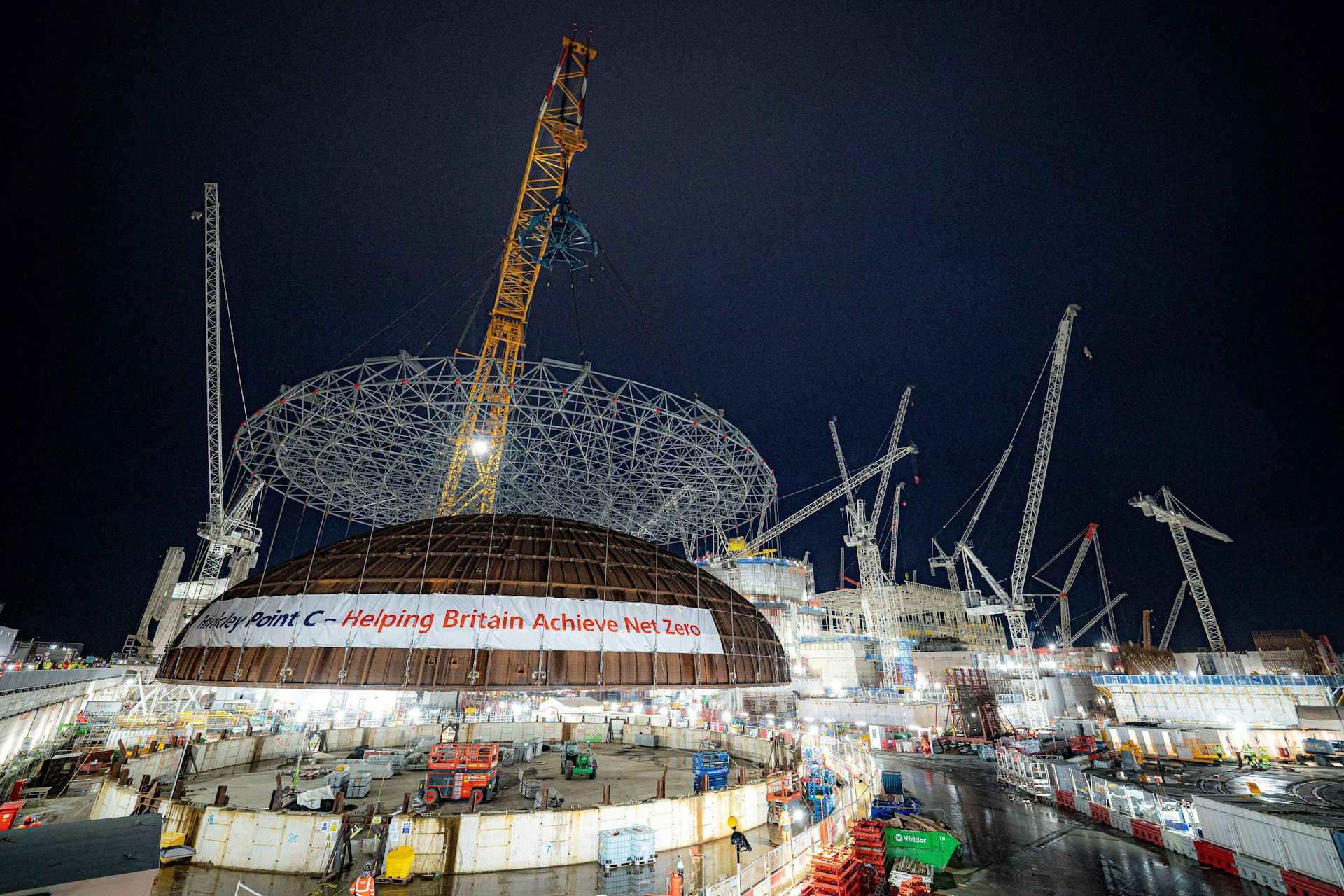
In 2017, we submitted evidence to a parliamentary public accounts committee investigation of the deal to build Hinkley Point C power plant. On the basis of our evidence, the committee asked the then MoD head (who – notably – previously oversaw civil nuclear contract negotiations) about the military nuclear links. His response:
We are completing the build of the nuclear submarines which carry conventional weaponry. We have at some point to renew the warheads, so there is very definitely an opportunity here for the nation to grasp in terms of building up its nuclear skills. I do not think that that is going to happen by accident; it is going to require concerted government action to make it happen.
This is even more evident in actions than words. For instance hundreds of millions of pounds have been prioritised for a nuclear innovation programme and a nuclear sector deal which is “committed to increasing the opportunities for transferability between civil and defense industries”.
An open secret
Despite all this, military pressures for nuclear power are not widely recognised in the UK. On the few occasions when it receives media attention, the link has been officially denied.
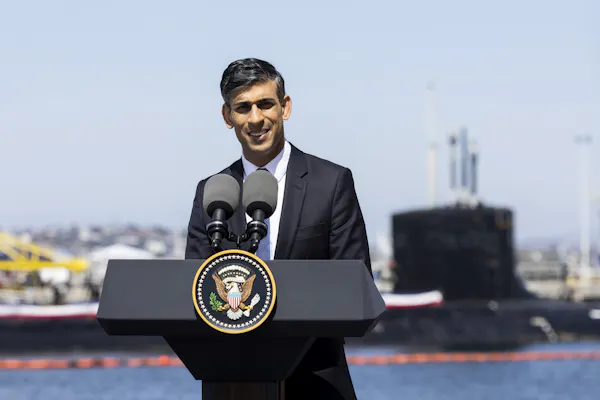
UK prime minister Rishi Sunak announces a US-UK-Australia nuclear submarine deal in March 2023. Etienne Laurent / EPA
Other nuclear-armed states are also striving to maintain expensive military infrastructures (especially around submarine reactors) just when the civilian industry is obsolescing. This is true in the US, France, Russia and China.
Other countries tend to be more open about it, with the interdependence acknowledged at presidential level in the US for instance. French president Emmanuel Macron summarises: “without civil nuclear power, no military nuclear power, without military nuclear, no civil nuclear”.
This is largely why nuclear-armed France is pressing the European Union to support nuclear power. This is why non-nuclear-armed Germany has phased out the nuclear technologies it once lead the world in. This is why other nuclear-armed states are so disproportionately fixated by nuclear power.
Neglect of this picture makes it all the more disturbing. Outside defence budgets, off the public books and away from due scrutiny, expensive support is being lavished on a joint civil-military nuclear industrial base largely to help fund military needs. These concealed subsidies make nuclear submarines look affordable, but electricity and climate action more costly.
The conclusions are not self-evident. Some might argue military rationales justify excessive nuclear costs. But history teaches that policies are more likely to go awry if reasons are concealed. In the UK – where nuclear realities have been strongly officially denied – the issues are not just about energy, or climate, but democracy.
The Conversation asked the UK Department for Energy Security and Net Zero to comment but did not receive a reply before the publication deadline.
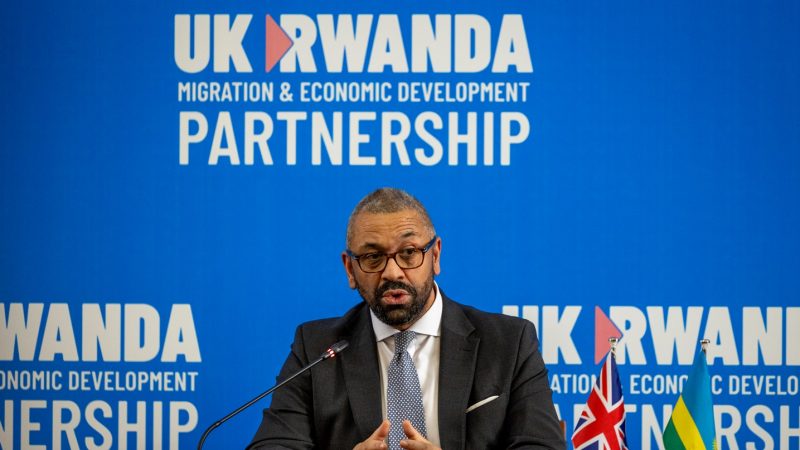
Rishi Sunak has staked his political future on getting the Rwanda scheme off the ground. Under the proposals, asylum seekers who arrive in the UK other than through an existing asylum scheme would be deported to Rwanda where their claim would then be processed.
…
Polling from YouGov found that if Labour were to win the next election, 40% of voters would want Keir Starmer to scrap the plan. That compares to 34% who think it should be kept.
Asking a slightly different question, YouGov more recently found that just one in five voters think the Rwanda scheme should be pushed through in its current form. Again, 40% of the public think it should be scrapped altogether.
“They are dividing a society. They are making us feel like refugees are the scum”
The government’s attempts to get the controversial Rwanda scheme off the ground have been dominating the news cycle this week. As such, it was a major topic of debate on this week’s edition of the BBC‘s flagship political debate show Question Time.
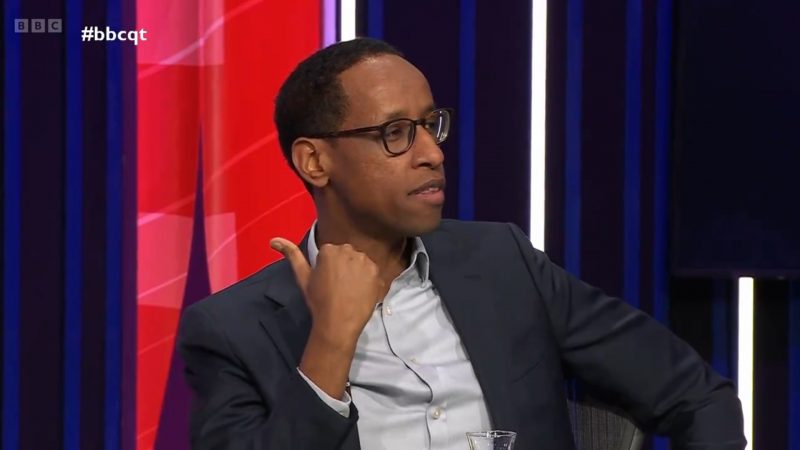
Hashi Mohamed – a barrister and author – appeared on the show, which was broadcast from Peterborough. During the show, he condemned the government’s Rwanda scheme in response to a question from the audience which asked: ‘Is the Rwanda plan worth all the money, time and resignations?’
Mohamed began his response by saying: “First things first, it’s important to acknowledge that people are really concerned about the boat crossings and so many people are dying and something has to be done. I think any rational person agrees on that level.”
He then went on to point out that a similar scheme to that proposed by the Tories has been in place between the Israeli and Rwandan governments, something absent from much of the conversation about the proposed plan.
Mohamed said: “Two years ago, I travelled to Dresden, the German town, and I met an Eritrean man who had been deported from Israel to Rwanda. He’d been paid to go to Rwanda. Rwanda had a reciprocal arrangement with Israel to take refugees.
“When he got there, the Rwandans said: ‘You don’t need to stay. There’s the door.’ And he used the money that he was given to make his way back – that treacherous journey – and he made his way to Dresden where he sought asylum again.
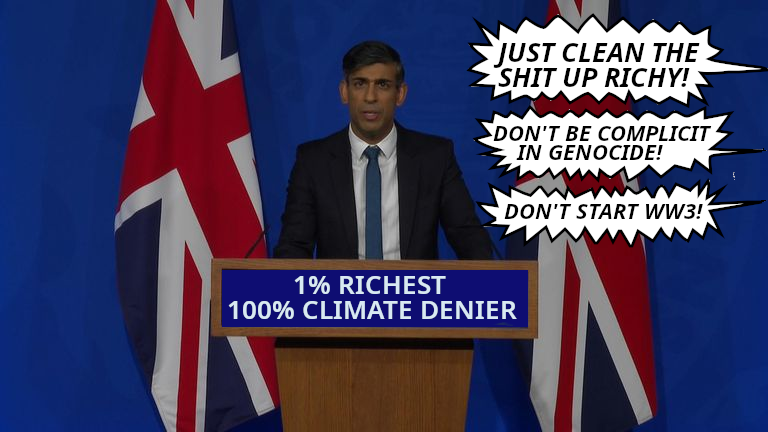
Rishi Sunak is UK’s Prime Minister following the appalling former Tory Prime Ministers Boris Johnson and Liz Truss. Johnson was elected in the 2019 general election despite wide recognition that speaking truth was alien to him. He got kicked out over the Partygate scandal – that he was partying at number 10 and repeatedly denying it during the Covid lockdowns. There is a further scandal still developing about enriching Tories with government contracts for excessively expensive inaquate Personal Protective Equipment (PPE) during Covid. Liz Truss was deposed following her ‘bonkers’ budget* that took from the poor to give to the rich and forced the Bank of England to intervene.
Rishi Sunak, UK’s janitor prime minister.
Rishi Sunak was quickly installed by the Conservatives as a ‘caretaker’, janitor or interim prime minister to replace Liz Truss. Not elected as prime minister he doesn’t have a mandate to do anything. He’s a Neo-Con climate denier providing huge fossil fuel subsidies for foreigners to take North Sea oil and a Zionist actively supporting and therefore very complicit in Israel’s genocide of Gaza.
* It wasn’t called a budget. Liz Truss and her chancellor Kwasi Kwarteng called it a statement to avoid scrutiny by the Office of Budget Responsibility.