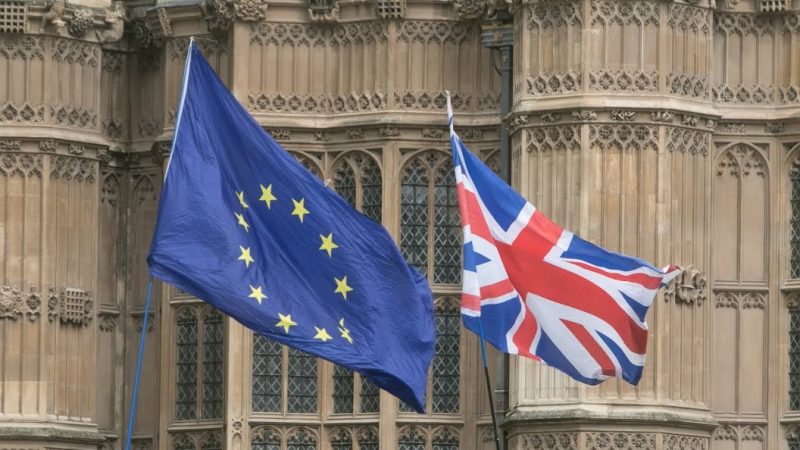
A new ‘Brexit freedom’ has been heralded by the government today as it announced the introduction of pints of wine on Britain’s supermarket shelves.
It has left many bemused, and despairing, at the so called ‘new freedom’ the country has gained from leaving the European Union, with widespread ridicule online.
In the new year, still and sparkling wine can be sold in 568ml pint sizes, with the minister for Enterprise, Makers and Small Business, Kevin Hollinrake, praising the “innovation, freedom and choice” consumers and producers will supposedly gain as a result of the scheme.
Apparently, our exit from the EU was “all about moments just like this” Hollinrake argued, “where we can seize new opportunities and provide a real boost to our great British wineries and further growing the economy”.
The government has claimed introducing the new bottle size could boost the economy, arguing 900 vineyards are set to benefit along with the UK’s wine sector.
However, many people are asking how the new 568ml size bottles are much different from the 500ml ones that are already available at supermarkets, along with 200ml sizes also currently on offer.
…
[dizzy: Since 568ml is the decimal equivalent of an imperial pint, I’m not sure that it is a pint ;]
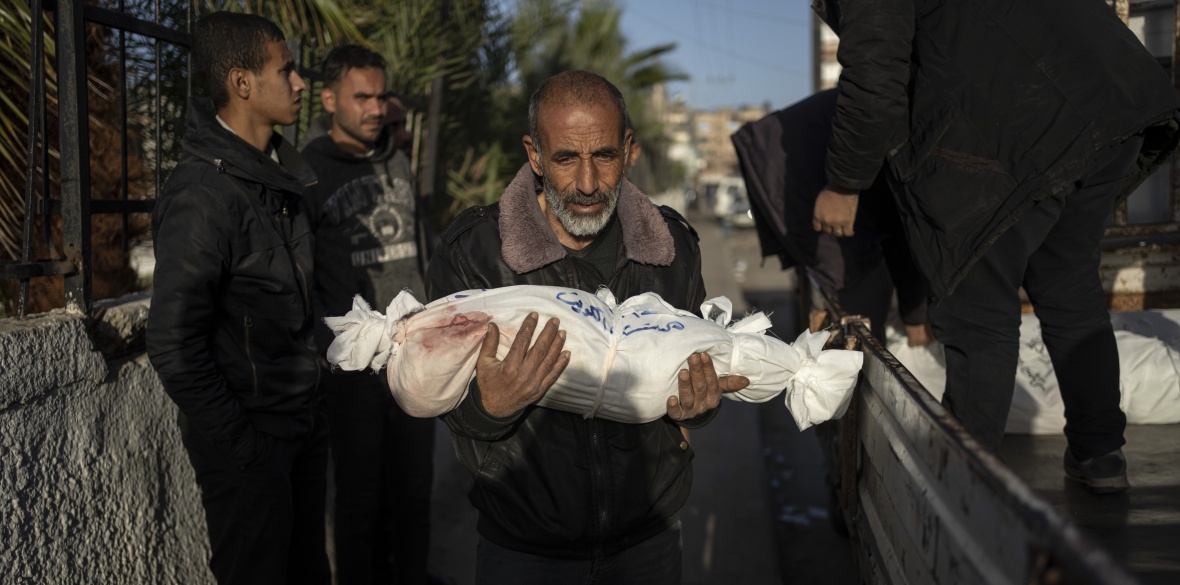
A Palestinian man carries the body of his grandson who was killed in the Israeli bombardment of the Gaza Strip, at the hospital Rafah, southern Gaza, December 22, 2023
NO EVENTUAL US green light to allow aid into Gaza — where a quarter of the population are starving — can disguise its wrecking role throughout the UN process.
The urgency of getting food, water and fuel to more than a million displaced Palestinians has not deterred Washington from delaying a UN resolution repeatedly, insisting on the removal of calls for a ceasefire, watering down the demand that Israel open air, land and sea routes for humanitarian assistance and blocking a proposal for the UN rather than the Israeli military to approve deliveries.
As with the security council ceasefire vote a fortnight ago — which the US alone opposed, with Britain alone abstaining — the mask has slipped.
Everyone in the world can see who facilitates Israel’s murderous assault on Gaza even while crying crocodile tears about civilian victims.
We know that Joe Biden’s reproaches to Benjamin Netanyahu for bombing hospitals and unleashing a wave of settler terror in the West Bank are accompanied by a steady flow of munitions to ensure the Israeli Defence Forces can keep killing.
We know too that the copycat expressions of regret from British leaders are meaningless while we permit the US to resupply Israel from the RAF’s Akrotiri airfield on Cyprus, which we can assume it is doing since ministers won’t answer questions on the flurry of US flights to Israel from that base.
Britain and the US stand isolated and exposed. There will be geopolitical consequences.
The brazen hypocrisy of supporting Israeli war crimes while condemning Russian ones in Ukraine has not gone unnoticed, and will further undermine efforts to convince the global South to abide by US and EU sanctions against Moscow, as European diplomats admit.
Normalisation of Israel’s relations with Arab states, a priority aim of US diplomacy in recent years, lies in tatters. Following the China-brokered Saudi-Iranian rapprochement and the invitation to five Middle East and north African states to join the Brics bloc of developing countries in 2024, this war could be catastrophic for US power in the region, accelerating a shift to Beijing already under way.
We have little influence over such developments. Not so the domestic political fallout. The medics’ vigils for Gaza, the hundreds of local demonstrations and fundraisers, the gigantic national peace marches, have changed British politics.
The British and US governments are not just exposed in the eyes of the world, but before their own peoples. In Britain, the Palestine movement has thrown open doors our whole Establishment have spent the last four years nailing shut — it is again possible to question Britain’s role in the world, its uniquely close alliance with the United States and the sinister character of our military operations and armaments industry.
As we learned in 2017, when Jeremy Corbyn pointed to the links between British foreign policy and terrorism and found a majority agreed with him, there is mass scepticism about our rulers’ claims about the world and an openness to building a different kind of Britain, one that promotes peace and co-operation instead of war and plunder.
The ruling-class response to Corbyn’s popularity was ferocious. The response on Palestine will be no less so.
Human Rights Watch has already pointed to Facebook parent company Meta’s complicity in a global censorship operation targeting Palestine solidarity work.
In Britain, we have seen off one home secretary trying to ban peace marches, but should the movement falter or the numbers dwindle the government will be tempted to revisit this.
Our movement must go on the offensive, ensuring politicians who will not back a ceasefire fear for their seats, and demanding a reversal of all the attacks on Palestine activism of recent years, including the bids to ban the Boycott, Divestment and Sanctions movement.
This Christmas the traditional call for peace on Earth must be turned from an abstract seasonal aspiration to a practical mobilising demand.
Despite trying to avoid Christian preachers as much as I’m able to, I’ve noticed that one technique they use is to focus on a mundane aspect or event in their personal life and then apply if – often inappropriately – to the global stage. I can do that too. Apologies that it is an unsavoury topic.
I’ve had a big stubborn turd blocking my toilet yesterday and overnight, surviving many flushes. In the same way we have big politician turds behaving totally inappropriately hanging about far longer than they should. We have to shift these turds Biden, Sunak and Netanyahu and that cnut Starmer is no better – another nasty Tory pretending to be a Socialist.
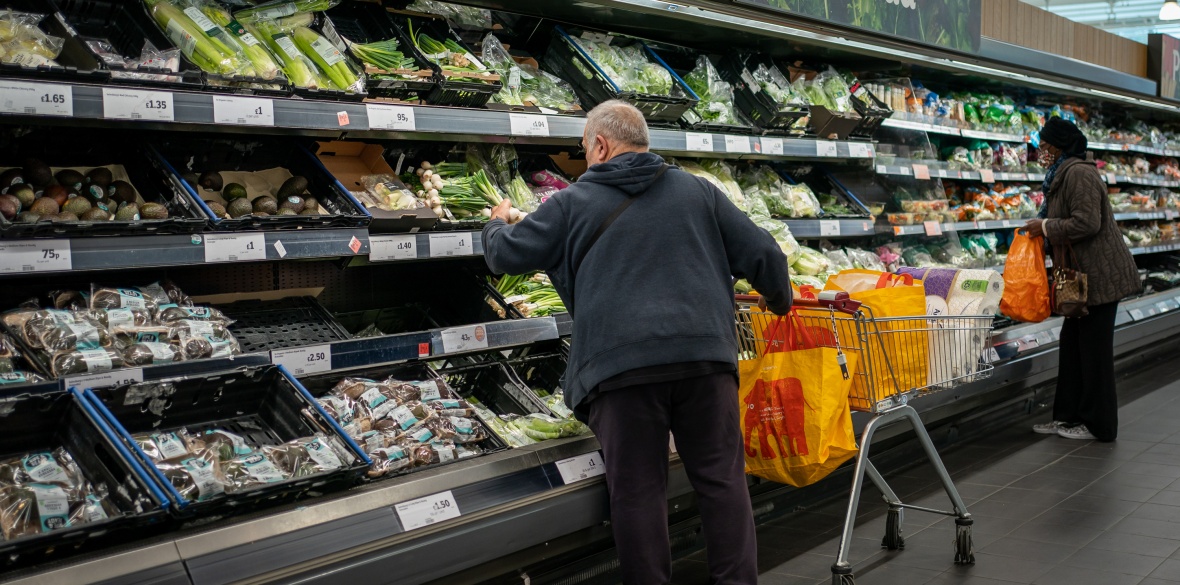
UNIONS called for an end to “rampant profiteering” as official figures showed food inflation remains at a painfully high 9.2 per cent in the run-up to Christmas.
Unite general secretary Sharon Graham said yesterday’s larger-than-expected drop in overall inflation would not offset the real-terms fall in wages this Christmas.
She said: “Headline inflation might be slowing, but workers know their wages aren’t going as far as they did two years ago.
“Even the competition regulator now admits what Unite has said all along: that firms have been exploiting the cost-of-living crisis to raise prices excessively.
“It’s time the government and Bank of England tackled the rampant profiteering in our economy to get inflation under control.”
Responding to the figures showing CPI inflation slowing to 3.9 per cent and RPI inflation to 5.3 per cent, TUC general secretary Paul Nowak added: “Today’s inflation figures will provide scant relief for hard-pressed families. Prices are still going up — just a bit more slowly.
“Household budgets remain under immense pressure. And many families will struggle with the cost of Christmas, with food and energy bills sky high.”
Person sleeping rough in a doorway, February 7, 2017
SHOCKING levels of violence and abuse are being faced by homeless people, a new survey finds.
Rough sleepers are frequently attacked, urinated on, verbally abused and have bricks and beer cans thrown at them, according to homelessness charity Crisis.
The charity spoke to 156 people in late summer who had rough sleeping experience within the last two years.
It found that 90 per cent of them had experienced some form of violence or abuse and 51 per cent had been physically attacked.
Three-quarters cruelly had items stolen, while 72 per cent had suffered verbal abuse or harassment.
More than half (53 per cent) had something thrown at them, examples given included bricks and beer cans.
More than a quarter had been racially abused, harassed or attacked (27 per cent), while almost a fifth (18 per cent) had been urinated on.
Nine of those who responded said they had been sexually assaulted.