A devastating new 44-page report reveals Labour’s cuts will push 400,000 into poverty and cost disabled people up to £10,000 annually, while the government refuses to make savings by cutting spending on war instead, writes Dr DYLAN MURPHY
THE Citizens’ Advice Bureau (CAB) has just issued a hard-hitting report entitled Pathways To Poverty, which condemns the government’s Pathways To Work green paper. This well-researched 44-page report totally undermines the many flimsy arguments put forward by the “red Tories” to justify their killer cuts.
The report goes through the effects of restricting Personal Independence Payment (PIP) eligibility, cutting the universal credit (UC) health element and making PIP daily living the gateway to UC health. As the CAB points out, over 1.6 million people, which is nearly half of those currently receiving the daily living element of PIP, stand to lose out with an average loss of £4,500 a year.
Its opening paragraph blasts Keir Starmer and company for their sham consultation over the £7 billion worth of proposed cuts: “By refusing to properly consult on its plan to cut billions from disability benefits, the government is choosing not to ask questions it doesn’t want the answers to.
“The cuts will have a devastating impact on disabled people (and their children), sending hundreds of thousands into poverty, and many more into deeper poverty. This will result from a series of arbitrary reforms that have been designed around savings targets rather than improving outcomes, inflicting hardship on people in ways that the government doesn’t yet fully understand.”
…
As the CAB report notes: “A DWP survey of disability and incapacity benefit claimants found that 41 per cent of respondents were on a waiting list for treatment for their health problems, and 50 per cent who were currently out of work felt their ability to work was dependent on receiving treatment.”
Finally, the CAB report makes the point that cutting billions from disability benefits is a false economy as it will merely make many disabled people even more ill, dramatically increasing the demands on the NHS, social services, education and voluntary sector. Besides this, there will be a growing number of disabled people made homeless by these cuts, never mind the increase in the suicide rate which will inevitably follow.
The CAB report concludes with a call on Labour to abandon its cuts, which are a devastating attack on some of the most vulnerable people in our society: “The government must reconsider its current approach. We are calling on the government to cancel proposed cuts to disability benefits.
Keir Starmer confirms that he’s proud to be a red Tory continuing austerity and targeting poor and disabled scum.Keir Starmer explains that he feels no shame or guilt benefitting personally from gifts from the rich and powerful while insisting on policies of severe austerity causing suffering and death.
The right-wing multi-millionaire, who also owns The Spectator, called for the public broadcaster to be part-privatised at a Pharos Foundation event.
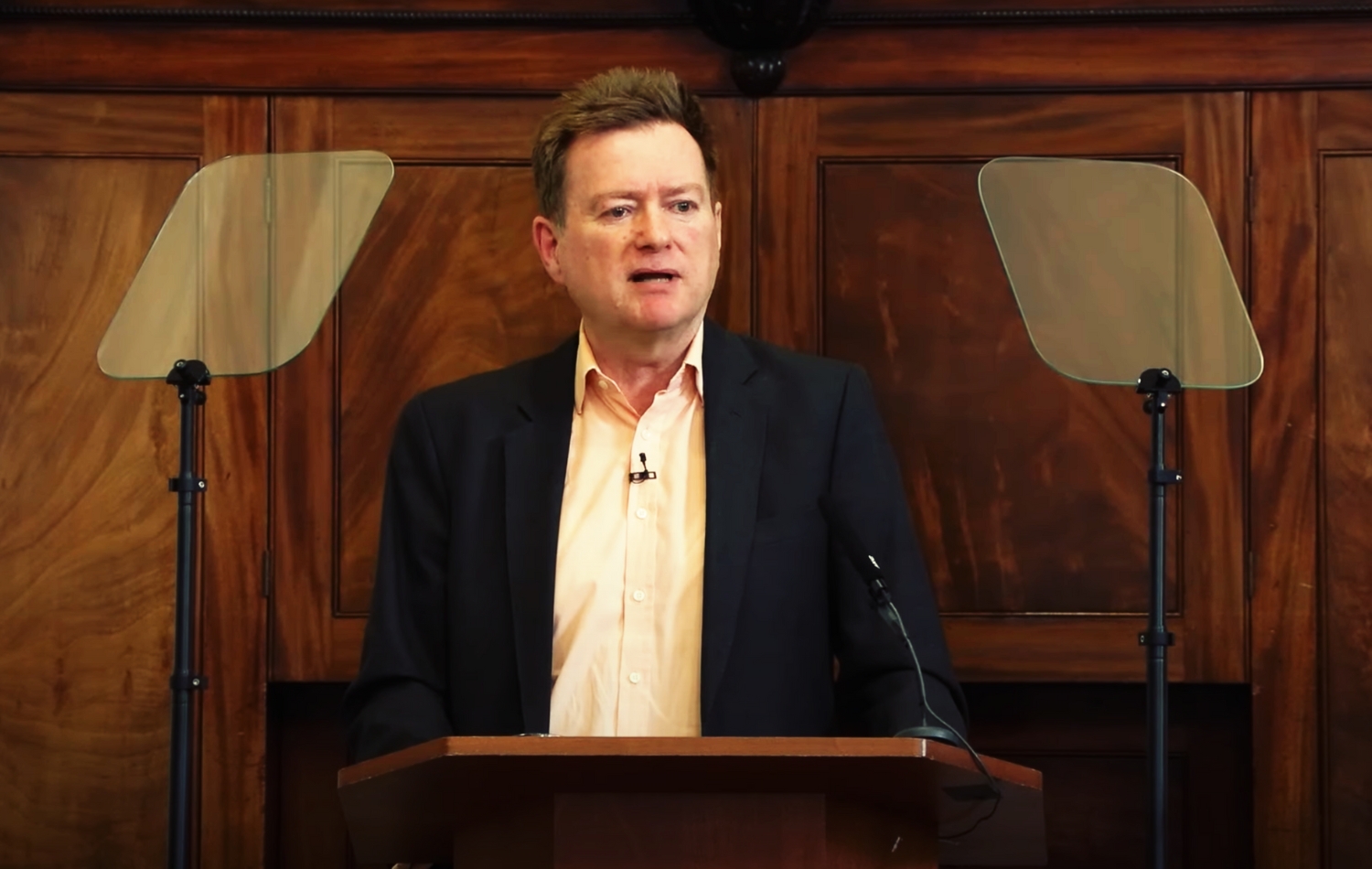
GB News co-owner Paul Marshall speaking at the Pharos Foundation on 20 May 2025. Credit: Pharos Foundation / YouTube
A hedge fund manager who owns three right-wing UK media outlets has called for the BBC to be “broken up” and its fact-checking service “shut down”.
Sir Paul Marshall – proprietor of GB News, The Spectator, and Unherd – was speaking last week (20 May) at the Pharos Foundation, an educational charity that received £350,000 from Marshall’s charity Sequoia Trust in 2023.
Pharos co-founder and director Neil Record, chair of Net Zero Watch, a climate science denial campaign group, is a significant backer of Conservative Party leader Kemi Badenoch.
In his speech, titled ‘Reflections of an Accidental Media Owner’, Marshall said: “the BBC squats like a giant toad in the middle of the UK media landscape”, calling it “a propaganda arm of the state, who [sic] are ultimately its paymasters.”
The multi-millionaire, who runs the hedge fund Marshall Wace, added that “the BBC should be broken up” to separate its “public service elements” like news and documentaries from “entertainment, drama, sport”, adding: “The latter should be privatised and allowed to complete to compete with other entertainment companies.”
Marshall also took aim at BBC Verify, the corporation’s fact-checking service founded in 2023 to cover and debunk online misinformation, calling for the service to be “shut down”.
Marshall accused progressive groups like Stop Funding Hate, HOPE not hate, and Led by Donkeys of acting like “school yard bullies” on social media.
“Unfortunately most of the disinformation agents who seek to track sites or individuals under the misinformation rubric have an explicit or near explicit left-wing agenda,” Marshall said. “This very much includes BBC Verify which is frankly an abuse of taxpayer money and should be shut down.”
GB News has accused of spreading misleading information – includingconspiracy theories – since it launched in June 2021, and has been regularly probed by broadcast regulator Ofcom.
In February 2024, HOPE not hate revealed that Marshall had been liking and retweeting posts on X expressing a wide variety of anti-Muslim views, including a post that called for the “mass expulsions” of refugees. Responding to HOPE not hate, a representative for Marshall said: “He posts on a wide variety of subjects and those cited represent a small and unrepresentative sample of over 5,000 posts. This sample does not represent his views.”
As DeSmog has reported, GB News frequently platforms individuals who deny basic climate science, while its guests and presenters attacked climate action nearly 1,000 times in the immediate run-up and aftermath of the 2024 general election.
BBC Verify has debunked false claims about climate issues, including whether the UK is meeting its net zero targets, on the supposed need for new North Sea oil and gas extraction, and false claims about extreme weather events.
As DeSmog has revealed, Marshall’s hedge fund Marshall Wace had billions invested in fossil fuels as of June 2023. One of its major investors, the private equity giant KKR, which is tipped to buy Thames Water, is itself a significant fossil fuel investor.
Richard Wilson, founder of Stop Funding Hate, told DeSmog: “A fossil fuel magnate is pushing for the break-up of the BBC – and lobbying for its fact-checking service to be shut down – while bankrolling a TV channel that pumps out toxic misinformation on climate change.
“GB News has lost over £100 million as advertisers continue to steer clear. So it’s understandable that the channel’s owner would want to lash out at Stop Funding Hate supporters. But we’re happy to take these attacks as a badge of honour – and another sign that our campaigning is working.”
His attacks on the BBC echo those of Reform UK, whose leader Nigel Farage receives a six-figure salary to host his own show on GB News.
Reform’s manifesto for the 2024 election included a pledge to scrap the BBC licence fee, labelling the broadcaster “institutionally biased” and “wasteful”.
“Marshall and his professional disinfluencers know they’ve utterly lost the fight on facts, and instead of being correct, they’ve started attacking the fact checking referees at the BBC,” said Philip Newell, communications co-chair of the Climate Action Against Disinformation coalition.
“In a healthy democracy, unbiased news is a vital tool of holding the rich accountable – which is exactly why one part of the disinformation playbook is to attack fact checkers and media institutions that speak truth to power. That an oily hedge fund baron has attacked the BBC only further confirms its validity and value.”
More recently, Donald Trump’s administration in the U.S. cut government funding for public broadcasters NPR and PBS, accusing them of bias.
The Pharos Foundation, which offers “Marshall fellowships” in Sir Paul’s honour, is also politically connected.
Pharos director Neil Record donated £10,000 and the use of office space to Kemi Badenoch’s campaign for the Tory leadership last autumn. Badenoch stayed at Record’s Gloucestershire estate in February ahead of a flagship speech attacking net zero targets.
Record is chair of Net Zero Watch, the campaign arm of the Global Warming Policy Foundation (GWPF), which claims carbon dioxide emissions are “not pollution” and could be a “benefit” to the planet.
He is also a life vice president of the Institute of Economic Affairs (IEA), an anti-regulation think tank that has received funding from the oil giant BP.
Pharos was also co-founded by historian Nigel Biggar, who was nominated for a peerage by Badenoch in late 2024.
After purchasing The Spectator in September 2024 for £100 million, Marshall appointed former Conservative Party Cabinet minister Michael Gove as its editor.
Gove is the founder of think tank Policy Exchange, whose head of political economy James Vitali is a current Pharos research fellow. Marshall donated £890,000 to Policy Exchange between 2020 and 2023.
The chair of Pharos’ development committee, Sian Hansen, until recently worked as chief operating officer at CT Group, the lobbying firm that has represented the Prosperity Institute (formerly known as the Legatum Institute), whose funder the Legatum Group co-owns GB News with Paul Marshall.
CT Group has lobbied on behalf of oil and gas companies, and its clients have included the Australian Petroleum Production and Exploration Association and BHP, which has mining and oil assets.
Orcas discuss Donald Trump and the killer apes’ concept of democracy. Front Orca warns that Trump is crashing his country’s economy and that everything he does he does for the fantastically wealthy.
Irish lawmakers during the vote on May 28, 2025. Source: Ireland Palestine Solidarity Campaign/X
On May 28, center-right lawmakers voted down a Sinn Féin proposal to limit the sale of Israeli bonds used to finance the genocide in Gaza
On May 28, representatives of conservative parties Fianna Fáil and Fine Gael, part of the current Irish government, voted down a proposal brought forward by Sinn Féin that would have granted the Minister for Finance the authority to restrict the sale of Israeli bonds. The bill was defeated by a margin of 87 to 75, despite support from opposition parties and independent parliamentarians who vote with the government on other issues.
The debate took place in the context of a broader campaign challenging the role of the Central Bank of Ireland (CBI) in facilitating the sale of Israeli bonds within European financial markets. Under EU law, such bonds cannot be circulated without approval from a central bank in the Union. Activists argue that the CBI’s approval of these bonds – which took place even after the beginning of Israel’s genocide in Gaza – makes Ireland complicit in violations of international law, despite statements by government officials expressing support for the Palestinian cause.
According to earlier reports, by the beginning of this year, Israel had raised nearly USD 19.5 billion through the sale of such bonds. Of this amount, close to USD 4.5 billion was raised with the help of major European players such as BNP Paribas and Deutsche Bank, which helped coordinate and recommend bond sales to investors. Israeli officials have made no effort to conceal the planned usage of the funds that were collected. “Israel doesn’t hide the purpose of these bonds,” Sinn Féin leader Mary Lou McDonald said ahead of the vote. “They emphasize, quote, ‘the crucial role of Israel bonds during this time of conflict and war.’ Israel openly invites people to invest in genocide.”
The actions of the government and the CBI greatly contrast with the will of the Irish public, which has demonstrated strong support for Palestine. “Allowing the Irish Central Bank to continue to deal in Israeli war bonds is an endorsement of genocide. It makes Ireland, in my view, complicit,” McDonald said in another statement. “It flies in the face of the ordinary people of Ireland who have marched, protested, campaigned and, with everything they have, stood up for the right of the Palestinians to live and live free.”
Widespread grassroots pressure and mass mobilizations has contributed to the country’s formal recognition of the State of Palestine in May 2024. Opposition parties argue that this public sentiment makes the gravity of the government’s inaction even worse.“There is something very perverse about saying to a people faced with genocide that you recognize them, that you stand with them, while at the same time playing a big part in funding the very weapons that are being used to slaughter their children,” McDonald noted.
Both the government and CBI leadership have argued that blocking the sale of Israeli bonds would be legally impossible. CBI head Gabriel Makhlouf defended the approval process, claiming that the bond prospectus in question met relevant criteria of “completeness, comprehensibility and consistency.” However, activists, including those from the Ireland Palestine Solidarity Campaign, have provided detailed evidence that Israel’s claims within the approval process obscure the bonds’ direct links to the genocide. The campaign also warned that CBI’s role in this matter represents a breach of both domestic and international law, including the Genocide Convention.
“Those who finance genocide under the mantra ‘it’s only business’ are complicit in genocide,” said David Landy of Jews for Palestine – Ireland. “By selling Israeli war bonds, the CBI is implicating all of us, all Irish people, in Israel’s war crimes.”
Keir Starmer and David Lammy’s remarkable attempts to publicly realign their government’s support for Israel’s genocidal war on Gaza reflect similar shifts recently performed by political leaders in France, Canada, the US and Germany.
On 20 May, Starmer told MPs that innocent children’s suffering in Gaza was “intolerable”, while Lammy called it “abominable”. Lammy condemned Israeli Finance Minister, Bezalel Smotrich’s call to “purify Gaza” by ethnic cleansing as “dangerous, repellent and monstrous”[1].
By 26 May even the GermanChancellor, Friedrich Merz admitted that Israel’s actions in Gaza “can no longer be justified”.
Given such politicians’ unstinting support for Israel’s assault on Gaza, we may be forgiven for questioning whether their latest pronouncements indicate a shift in policy, a rhetorical attempt to placate public opposition to state collusion in genocide, or an insurance policy against being named in future legal proceedings.
In fact, Lammy’s suspension of UK-Israel free trade talks on 20 May in response to Israel’s block on aid to Gaza was swiftly followed on 26 May by an official visit to the port of Haifa by UK Trade Envoy, Lord Ian Austin, who as the UK Embassy to Israel triumphantly tweeted was “witnessing cooperation at every stop”[2].
While President Trump’s recent decision not to visit Israel was a signal to US allies to adjust their foreign policy stance, UK arms exports to Israel have been a consistent focus of sustained, pro-Palestine mass protests in Britain since October 2023.
Alongside an unparalleled mass movement on the streets of British towns and cities a quiet but effective legal challenge was launched against the UK government’s policy of arms exports to Israel. Campaigners took the UK government to court, accusing it of failing to uphold domestic and international legal obligations by supplying weapons and components used in Israel’s genocidal war on Gaza.
Starmer and Lammy’s performed their volte-face in the House of Commons just four days after a landmark High Court challenge by Global Legal Action Network (GLAN)[3] and Palestinian human rights organisation Al-Haq[4] against the UK government’s decision on 2 September 2024 to continue licensing export of F-35 fighter jet components to Israel, while suspending other arms exports due to risk of violations of international law.
The High Court case displays a web of contradictions and the hypocrisy of ministers’ public statements on arms sales to Israel. According to GLAN and Al-Haq, it exposed “structural flaws in accountability” in the UK arms export control regime, which “renders it unfit to ensure respect for fundamental legal and humanitarian obligations”.
Al-Haq points out, “In Parliament, the government maintains it is for the courts to decide whether Britain is complying with its legal obligations. Yet in court, their lawyers argued the opposite — they say that such matters are not for the judiciary to examine.”
Charlotte Andrews-Briscoe, representing GLAN points out, “The government has been telling Parliament that it is unable to answer questions regarding its decision to indirectly arm Israel because that decision is being tested in the courts, and at the same time telling the judiciary that it cannot examine that decision because that is the role of Parliament.”
In the High Court, UK government lawyers rejected Al-Haq’s assertion that there is at least a serious risk that Israel is committing genocide in Gaza and said there is “a tenable view that no genocide has occurred or is occurring”.
Internationally accepted arguments relating to breaches of the Genocide Convention, in the context of the enormous harms suffered by civilians in Gaza, were dismissed by UK government lawyers as “touchy feely”.
The UK government also claimed it had seen “no deliberate targeting of women and children”, and therefore “no serious risk of genocide”. In its own evidence, the government included a report entitled “Research Report: Long-Range Shootings or Shootings of Minors.” This was withheld from GLAN and Al-Haq, despite a duty to disclose and an explicit request for its disclosure.
The UK government also claimed in the High Court that Israel’s targeting policies were as good as the UK’s. Is that even a defence?
That this happened days before Lammy’s statement to MPs on the situation in Israel and the Occupied Palestinian Territories will lead many to suspect that Lammy’s latest windy denunciations of Israeli politicians and a few settlers is a red herring intended to shield UK government ministers from charges of arms exports to Israel in breach of domestic and international law.
Lammy in his statement to MPs on 20 May referred to “a new, extensive ground operation throughout Gaza”, “renewed bombardment, new displacement and new suffering”, and said “we are now entering a dark new phase in this conflict”.
The emphasis on the new level of Israeli atrocities in Gaza is intended create a bogus political and legal distinction between the ‘normal conduct’ of Israel’s war on Gaza, impossible to conduct without arms exports, military intelligence and diplomatic support from Britain, and the latest ‘unacceptable conduct’ of the siege of Gaza by Israel, the starvation and mass displacement of Palestinians, which David Lammy and Keir Starmer condemn so robustly before TV cameras in the House of Commons.
Given the sustained horror of Israel’s genocide of the Palestinians over a period of 20 months and the growing evidence of UK government complicity in immoral and illegal arms sales, it will be a difficult political trick for Starmer and Lammy to pull off.
As Gearóid Ó Cuinn, Director of the Global Legal Action Network says, “The government has now been exposed as being disingenuous in Parliament and in court; this merry-go-round of delay and inaction is facilitating genocide and needs to stop. A decision in our case will come far too late for the people of Gaza who are being starved to death – the government must immediately end arms sales and other forms of military support to Israel and apply sanctions.”
[4] UK’s ‘flawed’ assessment of genocide in Gaza revealed in court that contradicts claims made in Parliament, 20 May 2025 https://www.alhaq.org/advocacy/26458.html
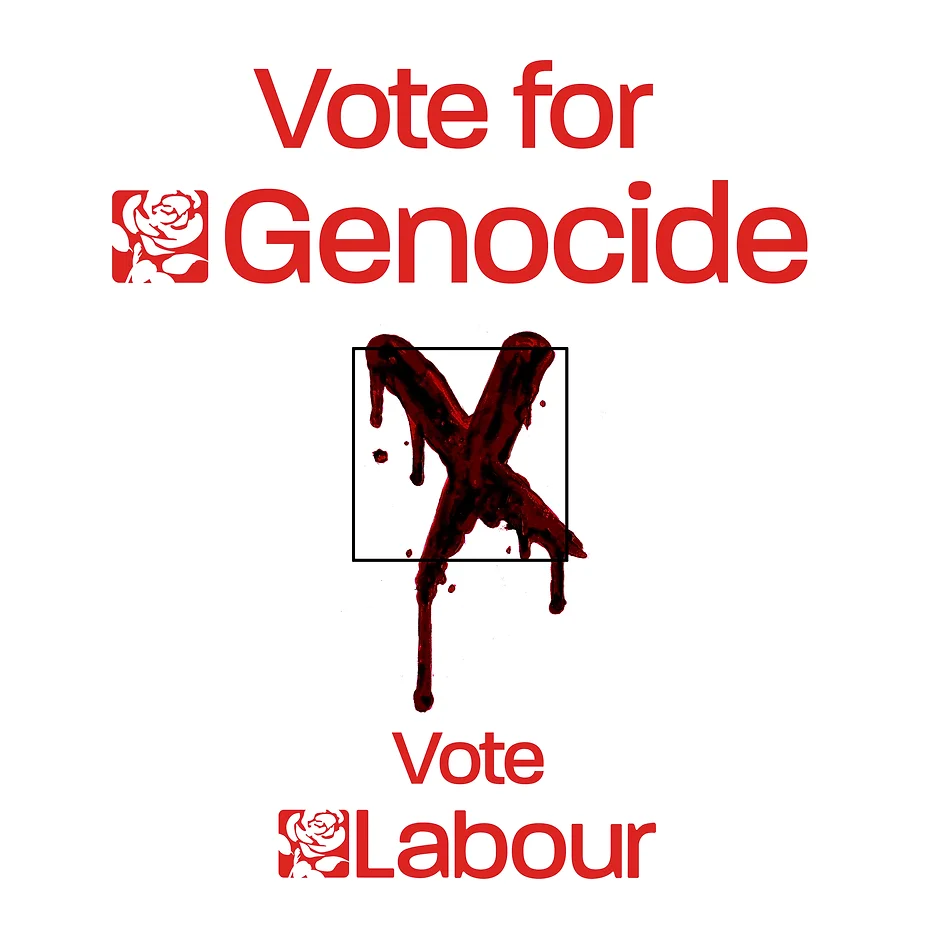
UK Labour Party government ministers Keir Starmer, Angela Rayner and Rachel Reeves explain that they are partners complicit in Israel’s Gaza genocide. The UK has provided Israel with arms, military and air force support. They explain that they don’t do gas chambers but do do forced marches, starvation, destroy hospitals, mass-murders of journalists and healthcare workers.Vote For Genocide Vote Labour.UK Conservative Party leader Kemi ‘not a genocide’ Badenoch explains her reality that the Earth is flat, the Moon is made of cheese and that she was born from Unicorn horn dust
An Israeli airstrike on a school-turned-shelter in Gaza City on Monday is believe to have killed 36 people. Photograph: Mohammed Saber/EPA
[Guardian] Exclusive: Letter to PM signed by retired supreme court justices among others says lack of action will imperil international legal system
The UK must impose sanctions on the Israeli government and its ministers and also consider suspending it from the UN to meet its “fundamental international legal obligations”, more than 800 lawyers, academics and retired senior judges, including former supreme court justices, have said.
In a letter to the prime minister, they welcome Keir Starmer’s joint statement last week with the leaders of France and Canada warning that they were prepared to take “concrete actions” against Israel. But they urge him to act without delay as “urgent and decisive action is required to avert the destruction of the Palestinian people of Gaza”.
The signatories, including the former supreme court justices Lord Sumption and Lord Wilson, court of appeal judges and more than 70 KCs, say that war crimes, crimes against humanity and serious violations of international humanitarian law are being committed in Palestine.
There is mounting evidence of genocide, which is either being perpetrated or at a minimum at serious risk of occurring, the letter states, highlighting recent comments by the Israeli finance minister, Bezalel Smotrich, who said Israel’s army would “wipe out” what remains of Palestinian Gaza.
The signatories tell Starmer: “All states, including the UK, are legally obliged to take all reasonable steps within their power to prevent and punish genocide; to ensure respect for international humanitarian law; and to bring to an end violations of [the right to self-determination]. The UK’s actions to date have failed to meet those standards … The international community’s failure to uphold international law in relation to the occupied Palestinian territory contributes to a deteriorating international climate of lawlessness and impunity and imperils the international legal system itself. Your government must act now, before it is too late.”
UK Labour Party government ministers Keir Starmer, Angela Rayner and Rachel Reeves explain that they are partners complicit in Israel’s Gaza genocide. The UK has provided Israel with arms, military and air force support. They explain that they don’t do gas chambers but do do forced marches, starvation, destroy hospitals, mass-murders of journalists and healthcare workers.Genocide denier and Current UK Prime Minister Keir Starmer is quoted that he supports Zionism without qualification. He also confirms that UK air force support has been essential in Israel’s mass-murdering genocide. Includes URLs https://www.declassifieduk.org/keir-starmers-100-spy-flights-over-gaza-in-support-of-israel/ and https://youtu.be/O74hZCKKdpAUK Conservative Party leader Kemi ‘not a genocide‘ Badenoch explains her reality that the Earth is flat, the Moon is made of cheese and that she was born from Unicorn horn dust