Badenoch (right) will give a welcome address at the conference, with her party under increasing pressure from Farage (left) and Reform UK. Composite: PA
Event co-founded by Jordan Peterson will bring together global rightwing figures including senior US Republicans
Influential rightwingers from around the world are to gather in London from Monday at a major conference to network and build connections with senior US Republicans linked to the Trump administration.
The UK opposition leader, the Conservatives’ Kemi Badenoch, and Nigel Farage of the Reform UK party, her hard-right anti-immigration rival, will compete to present themselves as the torchbearer of British conservatism.
Conservatives from Britain, continental Europe and Australia attending the Alliance for Responsible Citizenship (ARC) conference will seize on the opportunity to meet and hear counterparts from the US, including those with links to the new Trump administration. The House speaker, the Republican Mike Johnson, had been due to attend in person but will now give a keynote address remotely on Monday.
Other Republicans due to speak include the US Energy Secretary Chris Wright and Vivek Ramaswamy – who has worked with Elon Musk on moves to radically reshape the US government – and Kevin Roberts, the president of the US Heritage Foundation, the thinktank behind the controversial “Project 2025” blueprint for Trump’s second term.
The conference, which is intended to be a gathering of influential intellectuals shaping global rightwing thinking, has a distinctly anti-environmental and socially conservative theme. It pledges to build on “our growing movement and continue the vital work of relaying the foundations of our civilisation”.
Original article by Andrew Wasley republished from TBIJ under a Creative Commons Attribution-NonCommercial-NoDerivs 3.0 Unported License.
British consumers were exposed to drug-resistant salmonella because border checks took years to come into force
UK health chiefs privately admitted that a lack of border inspections in the wake of Brexit left British consumers exposed to diseased meat, the Bureau of Investigative Journalism (TBIJ) can reveal.
Delays in implementing checks on imported food meant hundreds of people, including children, were poisoned by imported meat during a series of major salmonella outbreaks.
Previous TBIJ investigations uncovered a host of failings in the government’s handling of outbreaks of drug-resistant salmonella spread by supermarket chicken from Poland. Illnesses connected to the outbreaks – which also affected eggs – peaked at different points between 2020 and 2024, and Poland has since continued to export contaminated meat to the UK.
Documents now reveal that in a series of high-level meetings in late 2023, food safety and health bosses admitted that the UK’s borders could have been allowing infected meat to enter the country unchecked.
Minutes from the meetings attended by the UK Health Security Agency (UKHSA), the Food Standards Agency (FSA) and its devolved partners acknowledge there were “no current border controls in place”, and that paperwork and physical checks on imported goods were not due to start until the following year.
“This could change,” officials noted. “However, [the] FSA have decided that they can’t wait for border controls to come in as a control measure.”
Following the UK’s departure from the EU, Boris Johnson’s government announced that hygiene inspections on meat imports from Europe would begin in 2021. However the checks were repeatedly delayed and weren’t implemented until 2024.
“We didn’t do any checks on EU imports at our border control posts for three years,” said Helen Buckingham, a trade policy expert. She pointed to a recent report published by the National Audit Office that was highly critical of the UK’s post-Brexit border controls. She added: “Delays on introducing a new regime of incoming checks for EU goods [were seen as being] risky for the UK in public and animal health terms, because our borders were weak.”
Although checks on some UK meat and poultry imports – typically between 1% and 30% – are now being carried out, concerns have been raised that funding cuts to inspection staff at some ports could see large volumes of substandard meat coming into the UK, as reported in the Grocer.
Tim Lang, professor emeritus of food policy at City St George’s, University of London, said: “Food flows depend on trust. And that depends on believing that systems are in place to protect us from known harm. Five years from Brexit, we see not fewer, but persistence of problems. We’ve put up borders but haven’t invested in the inspection.”
Following the publication of details of the government’s planned border controls in 2023, the FSA chair Susan Jebb said that border controls were “critical to maintaining the UK’s high food and feed safety standards” and that they “must be a priority”. The FSA had previously raised concerns that food products imported from the EU were not being subjected to inspections.
According to Buckingham, the post-Brexit inspections phased in last year do represent a more stringent system than was previously in place. “Pre-Brexit, we didn’t check EU products of animal origin because […] the principle of ‘free circulation of goods’ applied between member states.”
TBIJ’s revelations come as Parliament’s environment, food and rural affairs select committee prepares to launch an inquiry into animal and plant health next Tuesday. Imported animal products will be a central focus of an initial evidence gathering session that will assess the effectiveness of import controls on biosecurity, food hygiene and public health.
The internal UKHSA records obtained by TBIJ also reveal that while a ban on Polish poultry products was among the measures being considered by the FSA, concerns remained about its potential effects on the meat industry. They included the possibility that the UK could import chicken from other countries with food safety “hazards”. No ban was subsequently implemented.
Although earlier FSA interventions brought about a reduction in reported cases, rates were still “outside of the tolerance that the FSA Board can accept of salmonella entering the UK from the EU”.
Officials were also worried that the salmonella contamination had become more widespread, involving multiple producers from Poland and a greater number of food products, the documents show. While attention had initially focussed on breaded chicken and other highly processed products, testing had revealed that fresh chicken and raw pet food was also implicated.
Richard Griffiths, chief executive of the British Poultry Council, said: “We expect our trading partners to meet their responsibilities with regard to safe food. If they cannot, and their own authorities cannot enforce the appropriate controls, then we want our own regulators to have the powers and resources to stop unsafe meat entering the country.”
The BPC previously called for every consignment of Polish poultry to be checked at UK borders.
Tests revealed that in 2024, at least 138 consignments of exported poultry from Poland contained salmonella, including variants that can be highly harmful to human health, according to EU data. The UK was among the affected countries. The figures were only slightly down from 2023, when there had been 149 recorded cases of contaminated products.
In June 2023, TBIJ reported that some of the salmonella linked to Polish poultry that poisoned UK consumers was resistant to multiple antibiotics, limiting treatment options for those falling seriously ill. The UK government was found to have allowed food companies linked to the outbreak to continue supplying supermarkets even after contaminated meat had been linked to the deaths of four people, and the poisoning of hundreds more.
Investigations also found that even though some of the salmonella was known to be antibiotic resistant, food safety and health officials did not disclose this to frontline health workers, including those treating victims. Nor did they inform the Polish authorities, impeding possible investigations into practices on the farms involved.
Bacteria such as salmonella can easily spread on poultry farms, particularly where there are unhygienic or overcrowded conditions, and go on to infect the wider supply chain.
The use of antibiotics on farms can enable potentially lethal bacteria to develop resistance, meaning the drugs will no longer work to treat infections. Antibiotic use in Polish livestock production has been a cause for concern in recent years, with increases in usage of some types of drugs important for humans.
Anjali Juneja, director of UK and international affairs at the FSA, said it has been working with the Polish authorities on measures to enhance the safety and compliance of imported poultry meat and eggs. These include increased testing and other interventions at the farm and manufacturer level.
“We continue to actively monitor the situation, including through in-country audits of Polish food safety controls and of poultry producers exporting to the UK. If we see any information of concern, we will take the necessary action,” Juneja said.
She added that the FSA welcomed the enhanced border checks implemented last year, which have become “a crucial part of our food safety system” that she said helps uphold the UK’s high standards.
A Defra spokesperson said: “This government will never waver in its duty to support the UK’s biosecurity and preserve our food supply.”
The Polish Veterinary Inspectorate told TBIJ that food safety alerts relating to poultry from Poland decreased from 2020-2024, demonstrating that it had been taking appropriate and effective action.
It said that a thorough investigation is undertaken whenever a salmonella case is detected and, in the event, will withdraw the food in question, as well as taking measures to minimise recurrence. And it said antibiotics are only used on farm animals when prescribed by a vet.
Kath Dalmeny, chief executive of the Sustain food and farming alliance said the latest findings expose “just how vital it is for the government to uphold high food standards in international trade deals, especially for high-risk foods such as Polish chicken”.
“They must also ensure there are enough vets and food hygiene inspectors to check that British and imported meat is fit to eat – health protection roles that have been in worrying decline for several years,” she added.
Ron Spellman, a veteran meat inspector, said the issue ultimately needed to be tackled at source. “The European Commission, as well as the Polish authorities and poultry industry, carry responsibility to protect all consumers who buy Polish poultry products, they must resolve this problem.”
THE top 10 per cent of Britain’s population has more wealth than the other 90 per cent combined, according to TUC analysis of official Office for National Statistics (ONS) figures released today.
The huge inequality between rich and poor has widened under 14 years of Tory rule, which saw an “explosion” in insecure work and a decline in living standards.
Under the Conservatives, real wages grew by just 0.3 per cent a year — compared with 1.5 per cent from 1997 to 2010 under Labour.
The TUC estimates that the average worker would be £117 a week better off had pay increased since 2010 at the same pace as between 1997 and 2010.
Pay growth during Conservative-led governments from 2010-2024 was worse than for any other period of government since the 1920s.
The Tories also oversaw the worst fall in living standards since records began in 1955, the TUC said.
As the Washington Post faces a staff rebellion and plummeting subscription rates, billionaire owner Jeff Bezos has introduced a new mission statement: “Riveting Storytelling for All of America.”
The Washington Post‘s new slogan, “Riveting Storytelling for All of America,” is “meant to be an internal rallying point for employees,” the New York Times (1/16/25) reported.
The new path forward, as introduced in a slide deck to staff by Suzi Watford, the paper’s chief strategy officer, demands that the paper “understand and represent interests across the country,” and “provide a forum for viewpoints, expert perspectives and conversation” (New York Times, 1/16/25). It will do this as “an AI-fueled platform for news” that delivers “vital news, ideas and insights for all Americans where, how and when they want it.”
This appears to mean shifting resources toward opinion, specifically opinions from the right. According to the New York Times report:
Bezos has expressed hopes that the Post would be read by more blue-collar Americans who live outside coastal cities, mentioning people like firefighters in Cleveland. He has also said that he is interested in expanding the Post’s audience among conservatives.
The Post has already begun to consider ways to sharply increase the amount of opinion commentary published on its website, according to two people with knowledge of the talks. An adviser to the Post, Lippe Oosterhof, has conducted brainstorming sessions about a new initiative that would make it easier to receive and publish opinion writing from outside contributors.
How AI is meant to play into this is unclear.
The Post already has more columnists than you can shake a stick at. This new direction sounds like the Foxification of the Washington Post, a move away from any attempt to hold the powerful to account, toward inexpensive clickbait punditry.
‘Make money’
The red area represents the proportion of Jeff Bezos’s total wealth that would be required to cover the Washington Post‘s losses for a year.
Watford’s slide deck presented three pillars of the Post‘s new model: “great journalism,” “happy customers” and “make money.” The Postlost roughly $77 million in 2023. (It also lost some 250,000 subscribers after Bezos killed the paper’s planned endorsement of Kamala Harris—FAIR.org, 10/30/24.)
In order to make money, its new “Big Hairy Audacious Goal” (yes, that’s what the Post slide deck apparently called it) is to reach 200 million “paying users.” The paper currently has about 3 million subscribers, making it an “audacious” goal indeed. As the Times pointed out, even if the Post could achieve the impossible task of monetizing every visit to its website, no major corporate media outlet has been getting more than 100 million monthly unique visits—paying and non-paying—outside of the spike in traffic around the election.
Back in 2019, the Post was claiming 80–90 million unique visitors per month. Those visits peaked in November 2020 at 114 million, but quickly and steadily dropped after Biden’s inauguration. The Post stopped posting its audience numbers online after January 2023, when they were down to 58 million.
Of course, most online corporate media have been struggling. The thing about the Post is that its absurdly wealthy owner, the second-richest person on Earth, can easily afford to lose $77 million a year. That’s 0.03% of Bezos’s current net worth.
‘We are deeply alarmed’
Guardian (1/15/25): “The plea from staff…comes a week after the Post laid off roughly 100 employees…roughly 4% of the publication’s staff.”
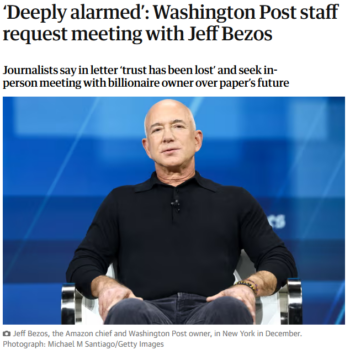
No doubt the Post needs help. Just days before the new mission statement was revealed, over 400 staff members signed a letter to Bezos asking for a meeting (Guardian, 1/15/25). The letter read:
We are deeply alarmed by recent leadership decisions that have led readers to question the integrity of this institution, broken with a tradition of transparency, and prompted some of our most distinguished colleagues to leave, with more departures imminent.
Bezos’s response—a slide deck about “riveting storytelling” on “an AI-driven platform” that prioritizes churning out opinions to draw in conservatives—is hardly likely to ease the mind of any serious journalist at the paper.
Nor is trying to “expand the Post audience among conservatives,” while still paying lip service to “great journalism,” likely to solve the Post‘s problems. As CNN‘s former CEO Chris Licht discovered (FAIR.org, 6/8/23), you can’t do good journalism while trying to appeal to both sides in the context of an increasingly radical right, because that side demands acceptance of lies and conspiracy theories that are incompatible with actual journalism.
When Bezos bought the Post (Extra!, 3/14), he assured the paper’s employees that “the paper’s duty will remain to its readers and not to the private interests of its owners.” That sentiment was repeated in Watford’s slide deck this week. But Bezos’s actions in the past months—including the killing of the Harris endorsement, Amazondonating $1 million donation to Trump’s inaugural fund and paying Melania Trump $40 million for her self-produced documentary, and, most recently, Bezos appearing onstage with other multibillionaires at Trump’s inauguration—make clear that the principle is as meaningless to Bezos as the slogan that debuted after Trump’s first election: “Democracy Dies in Darkness.”
That slogan will continue to adorn the front page for the time being, perhaps in the hope that readers searching for an actual news organization that holds those in power to account will be fooled into subscribing.
ACTION ALERT: You can send a message to the Washington Post at letters@washpost.com.
Please remember that respectful communication is the most effective. Feel free to leave a copy of your message in the comments thread here.
FAIR’s work is sustained by our generous contributors, who allow us to remain independent. Donate today to be a part of this important mission.
The pesticide Cruiser SB has the potential to kill off populations of bees. Photograph: Creative Touch Imaging Ltd/NurPhoto/Rex/Shutterstock
Emergency use of Cruiser SB, a neonicotinoid pesticide highly toxic to bees, to be outlawed in UK in line with EU
Bee-killing pesticides have been banned for emergency use in the UK for the first time in five years after the government rejected an application from the National Farmers’ Union and British Sugar.
The neonicotinoid pesticide Cruiser SB, which is used on sugar beet, is highly toxic to bees and has the potential to kill off populations of the insect. It is banned in the EU but the UK has provisionally agreed to its emergency use every year since leaving the bloc. It combats a plant disease known as virus yellows by killing the aphid that spreads it.
Prof Dave Goulson, a bee expert at the University of Sussex, has warned that one teaspoon of the chemical is enough to kill 1.25bn honeybees. Even at non-fatal doses it can cause cognitive problems that make it hard for bees to forage for nectar and the chemicals can stay in the soil for years.
The previous Conservative government repeatedly agreed to its use against the advice of the Health and Safety Executive (HSE) and the Expert Committee on Pesticides.
This year, ministers say they are refusing the application based on “robust assessments of environmental, health and economic risks and benefits, and advice from Defra’s chief scientific adviser, its economists, the Health and Safety Executive and the UK Expert Committee on Pesticides”.