Osborne– who was chancellor under David Cameron’s government and was instrumental in bringing about austerity – said that the cuts announced by Reeves on Monday were “almost identical in structure and form” to those he made in 2010, when he announced £6.2bn worth of cuts.
…
“I don’t think there was anything she announced that I would have violently disagreed with or not done myself.
“In fact, it was almost identical in structure and form to what I did in the first couple of months that I was Chancellor of the Exchequer.
“So, you know, ‘Continuity Osborne.”
Sharing a clip from the podcast on social media, SNP Westminster leader Stephen Flynn said: “No comment.”
The Conservative candidate has changed his tune on climate action, recently attacking Labour’s net zero policies and arguing for new fossil fuel extraction.
Former Conservative minister Robert Jenrick, who has today entered the race to lead the Tory party, has a growing record of attacks on climate action.
The MP for Newark – who saw a 23.9 percent swing against him in the general election, and served as secretary of state for immigration under former prime minister Rishi Sunak – has attacked what he calls “net zero zealotry”, and has labelled the UK’s net zero target “dangerous fantasy green politics unmoored from reality”.
This is despite Jenrick having hailed the UK’s “world-leading commitment to net zero by 2050” as recently as 2020.
Jenrick has also called for the building of “new gas power stations” and supports new fossil fuel extraction, including North Sea oil and gas, and the opening of new coal mines.
His candidacy follows the Conservative Party losing a landslide election on 4 July against a Labour Party committed to climate action, during which the Tories supported new North Sea oil and gas extraction, and the delaying of key climate reforms.
Almost half of voters (49 percent) believe renewable energy would lower household bills, while only 14 percent say the same for more fossil fuels, according to polling by More in Common.
This week saw what climate scientists believe could be the hottest day on record thanks to climate change. The world’s leading climate science group, the UN’s Intergovernmental Panel on Climate Change (IPCC), has said that there is “a brief and rapidly closing window of opportunity to secure a liveable and sustainable future for all”.
Attacks on Labour’s Climate Agenda
In his response to the announcement of Labour’s legislative agenda in the King’s Speech last week (19 July), Jenrick used an address in the House of Commons to launch an attack on the government’s climate policies, spreading familiar misinformation.
Jenrick said that “despite being only responsible for one percent of global emissions, we find ourselves with a government pursuing for ideological reasons a net zero policy which is going to make it harder for our own consumers to afford their bills, [and] which is further going to erode our industrial base”.
Downplaying a country’s emissions is a “widely deployed” tactic used to delay international climate action, according to academics. Contrary to Jenrick’s claims, the UK’s cost of living crisis has been made worse by its dependence on fossil fuels, according to the International Monetary Fund (IMF).
And rather than “eroding our industrial base”, net zero policies are already creating new jobs and economic development. The UK’s net zero economy grew nine percent in 2023 to £74 billion – equivalent to 3.8 percent of the total UK economy, and supported more than 765,000 jobs, according to the Energy and Climate Intelligence Unit (ECIU).
Jenrick also attacked Labour’s green investment vehicle, Great British Energy – launched today – as a quango “which serves no apparent purpose”, warned that new solar farms would “despoil our countryside”, and claimed that “200,000 jobs in the oil and gas sector have been put in danger”, using a widely debunked figure.
The chief advisor to the National Farmers Union (NFU) has said solar farms “do not in any way present a risk to the UK’s food security”, while NFU president Tom Bradshaw has attacked the claims made by Jenrick and others as “sensationalist”.
On 11 July, when Labour announced its decision not to defend the new proposed coal mine in Cumbria in the High Court, Jenrick posted on X: “First the oil and gas industry, now coking coal for the steel industry. Less than a week in and jobs and economic growth are already being sacrificed on the altar of Labour’s net zero zealotry.”
In 2021, Jenrick decided not to challenge the planning application for the new mine – the UK’s first deep coal mine in more than 30 years, which would extract 2.8 million tonnes of coking coal a year, emitting an estimated 220 millions tonnes of greenhouse gases over its lifetime.
Net Zero U-Turn
Jenrick’s attacks on Labour’s green policies mirror his growing criticism of climate action – despite having previously celebrated the Conservatives Party’s support for net zero.
In February, Jenrick wrote an article for The Telegraph – a newspaper that regularly publishes attacks on climate science and net zero reforms – claiming that voters are sick of the “dishonesty” from politicians about “what net zero entails”.
He said that the UK’s 2050 net zero ambition was decided upon in the summer of 2019, “while the country was occupied by Brexit debates”, and was “nodded through the Commons with fewer than 90 minutes of debate”.
At the time, Jenrick, who was Treasury minister, welcomed the adoption of the target. In 2020, while serving as communities secretary under Boris Johnson, Jenrick praised the UK’s “world-leading commitment to net zero by 2050”. Ahead of the 2019 general election, he said that voters should support the Conservatives on the basis that the UK was the “first advanced economy in the world to pass a net zero target”.
Yet, in the February 2024 Telegraph article, Jenrick wrote that it was obvious to him “at the time” that the costs associated with net zero “were likely to be astronomical.” The article went on to claim that “reaching net zero by 2050 requires us to overhaul the material foundations of our economy in just three decades”, and that the result “is a dangerous fantasy green politics unmoored from reality and that lacks the buy-in of the public”.
Climate Denial Links
Jenrick’s campaign for Tory leader is being run by fellow Conservative MP Danny Kruger.
Kruger is the chair of the New Conservatives faction in Parliament – a group that advocates for more socially conservative, right-wing ideas within the Tory party, campaigning against “woke” culture, and immigration.
It also appears that New Conservative press officer Sam Armstrong is serving as one of Jenrick’s campaign aides, although Armstrong neither confirmed nor denied his role when approached for comment.
As DeSmog has revealed, the New Conservatives received £50,000 in December from the Legatum Institute, a free market think tank that formerly employed Kruger as a senior fellow.
In May of this year, Jenrick gave a speech to the Legatum Institute’s ‘Free Market Roadshow’ event at the group’s London office, where he called for new fossil fuel plants. He said: “We are smothering our ability to build new nuclear power stations, to build new gas power stations, which we’ve got to have to have the base capacity that we need as a country, in this mesh of regulation.”
The Legatum Institute’s parent company is UAE-based investment firm Legatum Group, which co-owns the right-wing broadcaster GB News. The outlet frequently spreads climate denial, both via its presenters and guests.
Kruger is also on the advisory board of another Legatum project, the Alliance for Responsible Citizenship (ARC), alongside some of the world’s most high-profile climate science deniers.
Jenrick has pledged to win back voters who have switched from the Tories to Reform UK, the right-wing populist party led by Nigel Farage, which is bankrolled by climate deniers and polluting interests, and campaigns to “scrap all of net zero”.
Polling from the Conservative Environment Network, a green caucus backed by dozens of Tory MPs, found that only two percent of voters who planned to switch from the Conservative to Reform saw climate change as the most important issue for them in July’s election.
UN Special Rapporteur on Environmental Defenders under the Aarhus Convention Michel Forst attended the trial of five Just Stop Oil supporters at Southwark Crown Court. He attended as an observer because of his serious concerns.
For planning to block a motorway encircling London, five Just Stop Oil activists were recently sentenced to a minimum of four years in prison.
Just Stop Oil wants to end the extraction and burning of coal, oil and gas in the UK by 2030. The group’s demands are consistent with what scientists have said is necessary to limit climate change. The same scientific advice underpins international agreements the UK has signed.
Just Stop Oil’s methods, which include stopping traffic by sitting on roads, are also peaceful. So why are its members facing a long stretch behind bars?
Such a severe sentence for non-violent protest has “no equivalent in modern times” according to Graeme Hayes and Steven Cammiss. Hayes is a reader in political sociology at Aston University while Cammiss teaches law at the University of Birmingham. Both have sat in on several high-profile climate protest cases.
Protesters facing prosecution in England and Wales were once partially protected by what’s known as Hoffman’s bargain. This maintained that the state would show restraint and offer lenient sentences to non-violent protesters deemed to be acting proportionately. Last week’s ruling seems to show that this meagre allowance is now dead.
Just Stop Oil has vowed to continue its campaign of disruptive protest.
The Court of Appeal reaffirmed that Hoffman’s bargain should apply to such cases in 2021 with a ruling that exonerated the Stansted 15, protesters who obstructed a Home Office deportation flight in 2017. However, the court rejected the Stansted 15’s “necessity defence”, the argument that they were obliged to do what they did to avoid a greater harm. This precedent has been upheld in subsequent cases, including climate protest trials.
Conspiracy to cause public nuisance, which the Just Stop Oil five were found guilty of, is a relatively new offence (introduced in the Police, Crime, Sentencing and Courts Act 2022) that carries a maximum prison term of ten years. People who feel compelled to take part in disruptive protest due to the existential threat of climate change risk a decade in jail without being able to explain their actions to a jury.
“The legal philosopher Antony Duff suggests that criminal cases are a means of holding fellow citizens to account for their behaviour,” Hayes and Cammiss say.
“A trial fails in this regard if it doesn’t let defendants account for their behaviour in ways that are meaningful to them.”
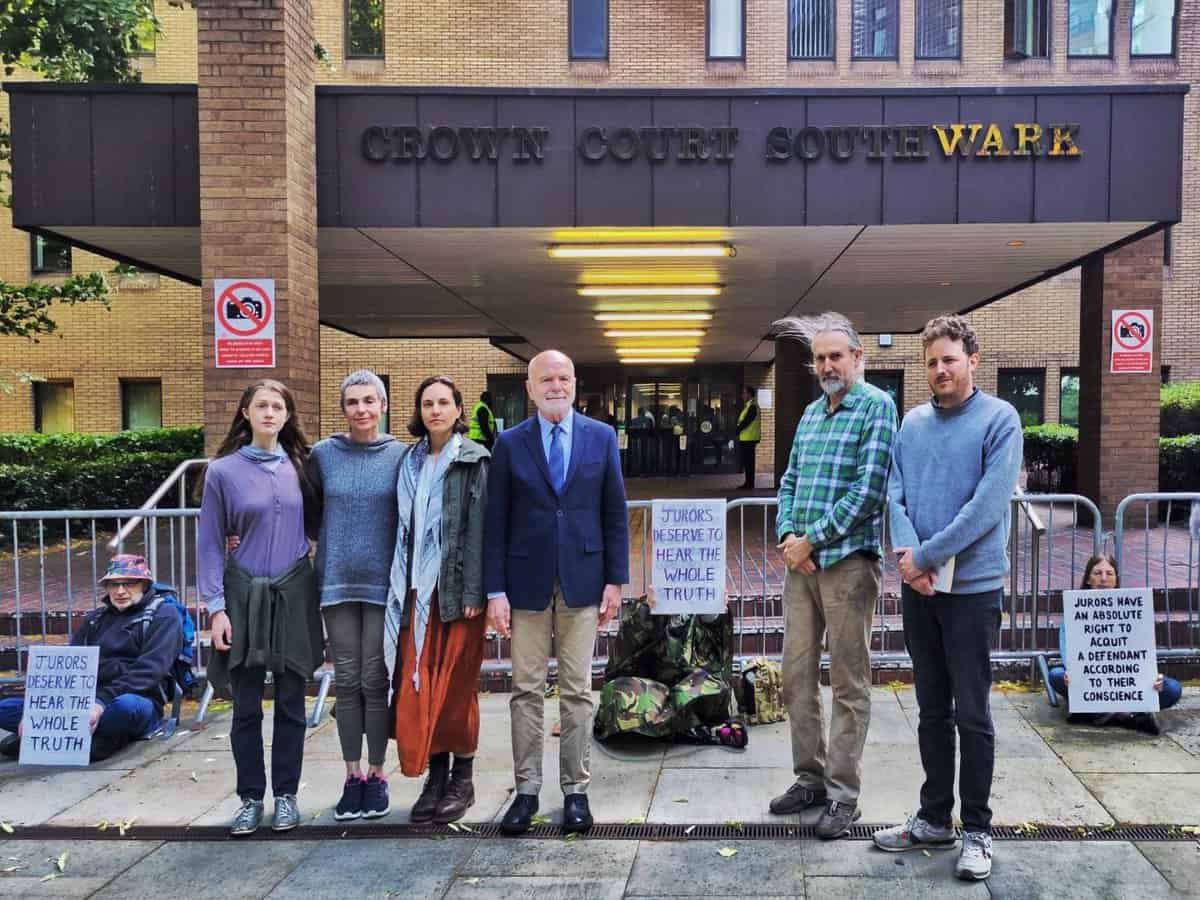
UK anti-protest law is now so restrictive that even minor concessions seem like major victories. Retired social worker Trudi Warner was cleared of contempt of court in April for holding a placard outside London’s Old Bailey, affirming the right of juries to acquit based on their conscience. The result was lauded as a “huge win for democracy” by civil liberty campaigners.
The reality is far from comforting and should in fact trouble everyone, says Emily Barritt, a senior lecturer in environmental law at King’s College London:
“Punishing protesters won’t solve the problems that they are highlighting. Lethal air, filthy rivers, collapsing food chains, the climate crisis – these problems will all continue unabated, and soon become much more inconvenient than having to get off the bus to walk the last mile to work.”
Roads are sacred, the climate less so
Should the right of motorists to travel unimpeded take precedence over a collective demand for a liveable climate? Whatever most people think, the archetypal “angry motorist” is a constituency which Britain’s political elite appear eager to woo.
Labour proclaimed itself the only party “truly on the side of drivers” at the recent election, fending off an accusation from the Conservative party that Keir Starmer had “declared war on motorists across Britain”.
Matthew Paterson, a professor of international politics at the University of Manchester, sees this as a strategy of the political right to remain relevant as the climate crisis unfolds – a bet that the public will baulk at the necessary disruption of decarbonisation.
Yet channelling Britain’s road rage did not prevent an electoral wipeout for Rishi Sunak and the Conservatives. Rebecca Willis, a professor in energy and climate governance at Lancaster University, was unsurprised.
Action on climate change commands broad public support in the UK. Dave Head/Shutterstock
“The Conservatives’ private polling must have confirmed what public opinion research has consistently told us: there are vanishingly few votes to be won through an agenda of delaying action on climate change,” she says.
Hayes and Cammiss also note the result of a snap poll which showed 61% of respondents considered the record jail sentences for the five Just Stop Oil activists too harsh.
Public consent for the UK’s crackdown on peaceful protest cannot be taken for granted. Even so, Oscar Berglund, a researcher in political economy at the University of Bristol, expects more and longer prison sentences for protesters.
“These are political sentences and climate activists [have] become political prisoners,” he wrote via email.
“Removing the politics of climate change from the courtroom doesn’t change that.”
The Conversation would like to thank our readers and subscribers for their continued support after Imagine won best science newsletter of the year at the Publisher Newsletter Awards.
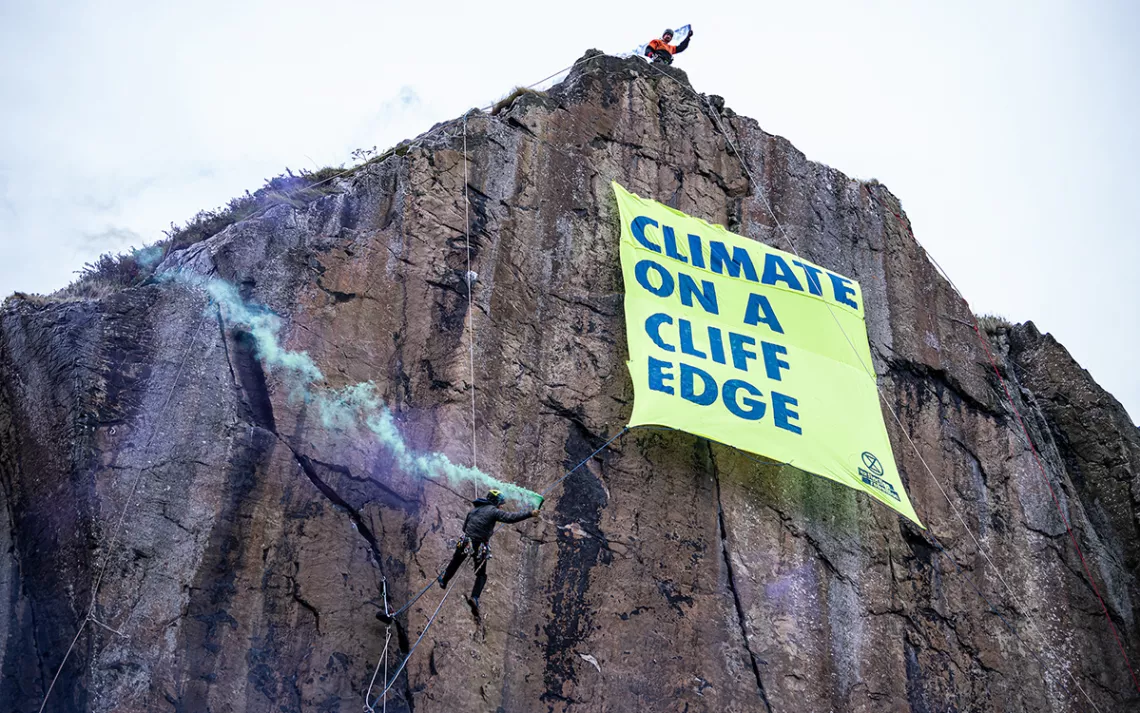
Experienced climbers scale a rock face near the historic Dumbarton castle in Glasgow, releasing a banner that reads “Climate on a Cliff Edge.” One activist, dressed as a globe, symbolically looms near the edge, while another plays the bagpipes on the shores below. | Photo courtesy of Extinction Rebellion and Mark Richards
One of the defining features of contemporary electoral politics in Britain is the age divide. Young people are far more likely to support Labour, and older people to support the Conservatives. This divide is still apparent following the 2024 election – but it hides the complexity of how young people in particular choose to vote.
To the extent that there is a “youth vote” in Britain, it is characterised not by support for a single party, but by a particularly fierce rejection of the Conservatives – alongside greater enthusiasm than their elders for left-wing, socially liberal alternatives to Labour.
YouGov surveyed 2,182 adults of all ages between July 5 and 8 for my research team at the University of Exeter. The sample was selected to be representative of the British adult population.
The data from this survey – published here for the first time – gives a snapshot of how people of different ages say they cast their votes. Five per cent of our respondents under 30 didn’t tell us how they voted so we don’t know how their votes might have changed the overall picture. More research in the coming months may give a fuller account.
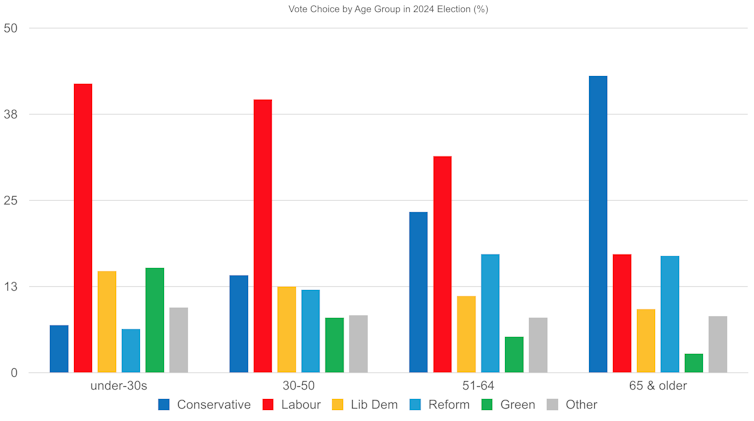
As the graph below shows, it’s only among the over-65s that the Conservatives won more support than Labour (by around 26 percentage points). They trailed Labour by around 8 points among the 51-64 age group, 26 points among 30- to 50-year-olds, and 35 points among the under-30s. Almost incredibly for Britain’s oldest and most successful political party, the Conservatives won barely 7% of the vote of under-30s in the survey.
Parties voted for by age group:
Bar chart showing vote choice by age group. Source: YouGov for University of Exeter, 5-7 July 2024., CC BY-NC-ND
Another key characteristic of the 2024 election is the record-low combined vote share for Labour and the Conservatives, and concurrent record-high vote share for smaller parties. This was not a blip. Voters have been steadily shifting away from the two major parties for years. But in 2024, the extent to which they did so was unprecedented: overall, the combined Labour/Tory vote share was just 57%.
The rejection of the major parties is most profound among young voters. Their support has become fragmented to such an extent that it is not really accurate to speak of a singular “youth vote”. Less than half (49%) of under-30s surveyed voted for Labour or the Conservatives. This compares to 54% of 30- to 50-year-olds, 55% of 51- to 64-year-olds, and 60% of over-65s.
The combined vote share for smaller parties among the under-30s was greater – at 46% – than the 42% who voted for the Labour party. The most successful challengers to the major parties for the youth vote were the Greens and Liberal Democrats, each of whom were backed by 15% of under-30s in the survey.
“Others” – including the Scottish National Party, Plaid Cymru and independents – won a combined 10% of votes from young respondents aged under 30. But the young people surveyed were not simply casting around for any alternative to the major parties. Just 6% of under-30s in the survey said they backed Reform UK (compared with 17% among the over-50s).
Want more politics coverage from academic experts? Every week, we bring you informed analysis of developments in government and fact check the claims being made.
Sign up for our weekly politics newsletter, delivered every Friday throughout the campaign and beyond.
No Reform youthquake
In the closing days of the campaign, there was some suspicion that Reform might achieve a “mini youthquake” in this election or the next. A JLPartners poll found that Reform appealed strongly to soon-to-be-enfranchised 16- and 17-year-old voters, and mock school elections apparently saw Reform winning a great deal of support among schoolchildren across the country.
Our data suggests this did not materialise in 2024. Reform has had some success in appealing to young voters: among under-30s from poorer households, for example, 13% said they supported Reform, compared with 4% for those from wealthier households.
However, similar proportions of under-30s from poorer households also said they voted for the Liberal Democrats (11%) and the Greens (14%). While voters in older age groups who were fed up of Labour and the Conservatives were more likely to switch to Reform and may do so again in future, among the under-30s such voters appeared more likely to switch to the Liberal Democrats, Greens and nationalist parties in Scotland and Wales.
Turnout
Turnout is a crucial issue when considering how young people vote. They have always been less likely to vote than their elders in any particular election. This owes primarily to lower levels of political interest, as well as circumstances associated with early adulthood such as being financially precarious and being less settled in one location. This was true in 2024 as well.
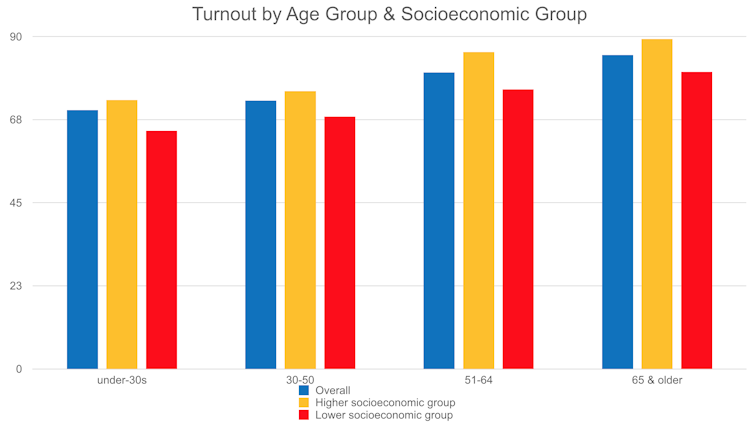
The graph below shows self-reported turnout by age group. The figures are substantially higher than the true turnout numbers, reflecting the long-established tendency of people to exaggerate their voting behaviour in surveys, but they clearly illustrate the age divide: under-30s were the group most likely to say they hadn’t voted.
Turnout by age group:
YouGov for University of Exeter, 5-7 July 2024., CC BY-NC-ND
The graph shows not only was the turnout of under-30s lower than that of older age groups, but that of under-30s from poorer households was particularly low. Young people from poorer backgrounds are less likely to vote than their predecessors were 30 years ago, and so are under-represented in elections to an even greater extent today.
People who vote during early adulthood establish habits that make them likely to vote for the rest of their lives. Those who don’t form such habits by their late 20s are likely to remain serial abstainers.
Younger generations are becoming increasingly unlikely to vote in their first election, leading a greater proportion of them to develop lasting habits of non-voting.
It is this tendency that lies behind one of the major democratic challenges facing the UK: rising levels of disengagement with politics and with voting, as younger people age but continue their youthful pattern of avoiding the ballot box.
Rupert Murdoch supports the Red Tories (UK Labour Party) and needs his nappy changed.Zionist Keir Starmer is quoted “I support Zionism without qualification.” He’s asked whether that means that he supports Zionism under all circumstances, whatever Zionists do.