Trump’s NOAA Will Stop Tracking Costliest Climate Disasters

Spread the love

Original article by Julia Conley republished from Common Dreams under Creative Commons (CC BY-NC-ND 3.0). 
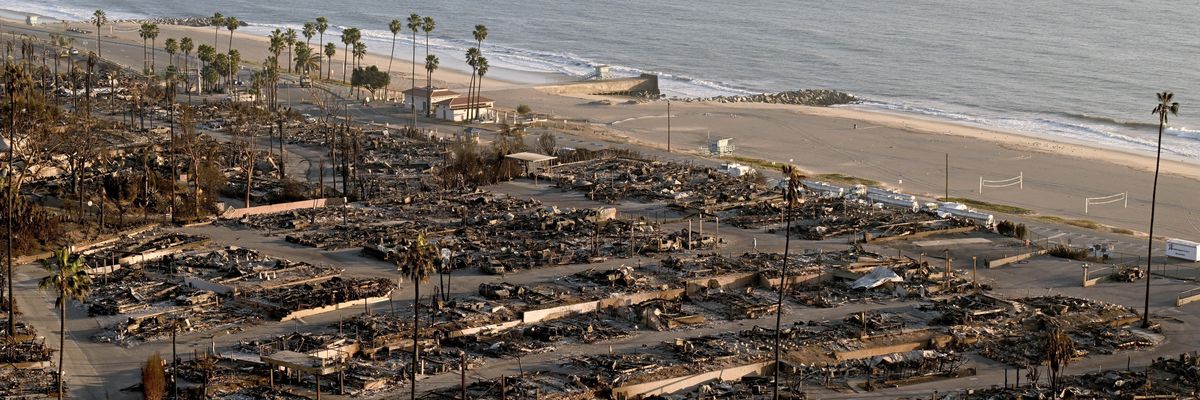
Damaged structures and homes are seen after the Palisades fire in the Pacific Palisades neighborhood of Los Angeles on January 11, 2025.
 (Photo: Axelle/Bauer-Griffin/GC Images)

“Their philosophy is, if we ignore it, it’s not a problem,” said one meteorologist.

On the heels of the news that higher-than-average temperatures continued globally in April, one of the United States’ top science agencies announced Thursday that it will no longer update a database that tracks climate disasters that cause billions of dollars in damage.

As of Thursday, the Billion Dollar Weather and Climate Disasters database on the National Oceanic and Atmospheric Administration’s (NOAA) website was replaced with a message saying there have been no such events in 2025 through April 8.

That flies in the face of an analysis by the National Centers for Environmental Information, which has maintained the database and said before it was taken down that six to eight billion-dollar climate disasters have happened so far this year, including the wildfires that devastated parts of Los Angeles in January and caused an estimated $150 billion in damage.

The World Weather Attribution said in late January that planetary heating, fueled by greenhouse gas emissions, caused weather conditions in Southern California that made the fires 35% more likely.

Hundreds of people have been laid off from NOAA in recent weeks as the so-called Department of Government Efficiency, led by billionaire tech CEO Elon Musk, has pushed to slash government spending, and those who have lost their jobs include scientists who helped maintain the database.

NOAA spokesperson Kim Doster told The Washington Post that in addition to staff changes, “evolving priorities” were also partially behind the retiring of the database, which will now show disasters that occurred only between 1980-2024.

Between 2020-24, the number of billion-dollar disasters averaged 23 per year, compared to just a few per year in the 1980s.

“This Trump administration move is the dumbest magic trick possible: covering their eyes and pretending the problem will go away if they just stop counting the costs. Households across the country already have to count these costs at their kitchen table as they budget for higher insurance costs and home repairs. Families and retirees dipping into their savings or going bankrupt to recover from wildfires and hurricanes know what disasters cost,” said Carly Fabian, senior insurance policy advocate with Public Citizen’s Climate Program. “Hiding the national tallies will only undermine our ability to prepare and respond to the climate crisis. Deleting the data will exacerbate the devastating delays in acting to slow climate change, and the impacts it is having on property insurance and housing costs.”

NOAA’s “evolving priorities” have also included decommissioning other datasets, including one tracking marine environments and one tracking ocean currents.

Without NOAA’s Billion Dollar Weather and Climate Disasters database, Jeremy Porter, co-founder of the climate risk financial modeling firm First Street, told CNN that “replicating or extending damage trend analyses, especially at regional scales or across hazard types, is nearly impossible without significant funding or institutional access to commercial catastrophe models.”

“What makes this resource uniquely valuable is not just its standardized methodology across decades, but the fact that it draws from proprietary and nonpublic data sources (such as reinsurance loss estimates, localized government reports, and private claims databases) that are otherwise inaccessible to most researchers,” he said.

Chris Gloninger, a meteorologist who resigned from an Iowa news station after receiving threats for his frank, science-based coverage of climate disasters, said the retiring of the database suggests the Trump administration is “okay with spending billions of dollars on disasters.”

“Every dollar that we spend on mitigation or adaptation saves $13 in recovery costs,” said Gloninger. “But their philosophy is, if we ignore it, it’s not a problem.”

Original article by Julia Conley republished from Common Dreams under Creative Commons (CC BY-NC-ND 3.0). 

Elon Musk urges you to be a Fascist like him, says that you can ignore facts and reality then.
Neo-Fascist Climate Science Denier Donald Trump says Burn, Baby, Burn.
Orcas discuss how Trump was re-elected and him being an insane, xenophobic Fascist.

Continue ReadingTrump’s NOAA Will Stop Tracking Costliest Climate Disasters

Thames Water’s Prospective New Owner Donated $1 Million to Trump’s Inauguration

Spread the love

Original article by Sam Bright and Adam Barnett republished from DeSmog.

U.S. President Donald Trump next to the Thames Water and KKR logos. DeSmog collage. Credit: Gage Skidmore / Thames Water / KKR

The U.S. private equity firm KKR, which has been selected as the ‘preferred bidder’ for the takeover of Thames Water, gave a seven-figure sum to Donald Trump’s inauguration committee, DeSmog can report.

Official records show that Kohlberg Kravis Roberts Co LP (KKR) donated $1 million to the Trump Vance Inaugural Committee on 7 January. The committee is appointed by the president-elect to arrange the inauguration ceremony, when a U.S. president is formally sworn into office.

The embattled London-based utilities provider Thames Water, in debt to the tune of £20 billion, is attempting to secure new investment to save it from nationalisation. In March, KKR was granted preferred bidder status, giving it a 10-week period to raise the equity to buy the water company.

KKR is reported to have lodged an initial £4 billion bid in exchange for a majority stake in Thames Water, which serves 16 million customers.

However, campaigners have raised concerns about KKR’s suitability to own Thames Water, given its financial ties to Trump.

“KKR recently donated $1 million to the inauguration fund of President Trump, a man who has repeatedly called the climate crisis a hoax,” said Matthew Topham, lead campaigner at the pro-nationalisation campaign group We Own It. “Let’s not kid ourselves that this company will swoop in and clean up our rivers and lakes.

“The government has ducked the issue for too long – special administration to slash the rotten debt, then full public ownership, is the only way to reverse this catastrophe.”

The new Trump administration has initiated a bonfire of clean air and water regulations – rules that were set to save the lives of 200,000 people according to The Guardian. Gina McCarthy, chair of the Environmental Protection Agency (EPA) under former U.S. President Barack Obama, said the announcement of the mass rollbacks was the “most disastrous day in EPA history”. During his first term, from 2017 to 2021, Trump repealed more than 100 environmental regulations.

Since being inaugurated for a second time, Trump has pledged to once again withdraw the U.S. from the flagship 2015 Paris Agreement, which set an international target for limiting global warming, and has declared a “national energy emergency” to allow the U.S. to “drill, baby, drill” for new fossil fuels. 

KKR’s prospective ownership of a vital public utility has also been questioned on the basis of the U.S. firm’s business model. Private equity firms – which buy and restructure companies – are known to cut costs, and increase prices for consumers, in order to maximise their profits.

KKR was infamously dubbed the “Barbarians at the Gate” in the late 1980s for its takeover of U.S. conglomerate RJR Nabisco.

“It beggars belief that anyone could seriously think this is a business model and owner who will truly fix the crisis at Thames Water,” said Mathew Lawrence, director of the think tank Common Wealth. “It is exactly the behaviour of loading Thames Water up with debt, extracting money, and underinvesting that has led us to this point. What is needed is long-term stewardship, patient investment, and putting the public and our water system first for once – not the interests of elite financial firms.”

These sentiments were reflected in Parliament this week, through a House of Lords address by Labour peer Prem Sikka. “Thames Water was put on the road to ruin by private equity,” he said. “Now its shareholders have designated KKR, another private equity group, as their preferred bidder. KKR’s business model is profiteering, high leverage, low investment, asset stripping and high cash extraction. That will inevitably multiply Thames’s problems.”

KKR and Thames Water were approached for comment.

Debt and Donations

Thames Water’s debt ballooned under the ownership of Australian private equity firm Macquarie, increasing from £3.4 billion in 2006 to £10.8 billion when the firm sold its stake in 2017.

During Macquarie’s ownership of Thames Water, the private equity firm extracted roughly £2.7 billion in dividends and a further £2.2 billion in loans. Despite this, Macquarie has recently said that it is “very proud” of its ownership record.

KKR’s preliminary bid proposed a mechanism that would allow the holders of Thames Water debt – including the U.S. hedge fund Elliott Management – to become Thames Water shareholders.

Elliott Management is an activist hedge fund that recently built up a large stake in BP and has urged the British fossil fuel major to ditch a number of its green commitments. BP’s profits recently dropped by 48 percent amid this pivot back to oil and gas. The hedge fund is run by Paul Singer, who also donated $1 million to Trump’s inauguration committee.

Turning around the performance of Thames Water will take considerable investment and business acumen. Thames Water reported a 40 percent increase in pollution incidents in the first half of 2024, while the firm has been allowed to raise customer bills by 35 percent on average over the upcoming years. Senior KKR Europe executive Johannes Huth said last year that water bills must rise to boost investment in ageing infrastructure.

KKR also has a 25 percent stake in Northumbrian Water, which it acquired in 2022.

KKR’s Connections

In addition to its donation to Trump’s inauguration fund, KKR has other ties to fossil fuels and those who oppose climate action.

Analysis by the investigative group Private Equity Climate Risks published in April 2024 reported that KKR has a large fossil fuel portfolio, with 188 assets in 21 countries.

KKR has also created a $50 billion fund with Energy Capital Partners to invest in artificial intelligence (AI) data centre energy infrastructure. Data centres are heavily energy intensive, and DeSmog recently revealed that AI executives have told major polluters that the nascent industry can keep fossil fuels alive.

KKR is also the co-owner of Marshall Wace, a hedge fund co-founded by UK media baron Paul Marshall, holding a 39.9 percent stake as of June 2023. The same month, Marshall Wace reported investments of at least £1.8 billion in fossil fuels companies, including in the oil and gas giants Shell, Chevron, and Equinor.

Marshall is the co-owner of GB News, a broadcaster that has frequently given a platform to climate falsehoods, and is an opponent of policies to reach net zero emissions.

Speaking at a conference in February hosted by the Alliance for Responsible Citizenship (ARC), a group funded by Marshall, he said that the UK’s net zero plans are “leading the way in wrecking our industrial base”, “impoverishing people”, “sacrificing our energy security”, and “sacrificing our ancient rural landscape.”

The UK’s net zero sector is growing at three times the rate of the rest of the economy, according to the Confederation of British Industry (CBI).

DeSmog also revealed that Warren Stephens, Trump’s ambassador to the UK, donated $4 million to the president’s inauguration fund on the day that he was nominated for the diplomatic position.

The inauguration committee raised a record $239 million, including from fossil fuel giants Chevron ($2 million), ExxonMobil ($1 million), the U.S. branches of BP and Shell ($500,000 each), and Valero ($250,000).

Original article by Sam Bright and Adam Barnett republished from DeSmog.

Continue ReadingThames Water’s Prospective New Owner Donated $1 Million to Trump’s Inauguration

Yemen’s Ansar Allah reaches ceasefire deal with US that excludes strikes on Israel

Spread the love

Original article by Aseel Saleh republished from peoples dispatch under a Creative Commons Attribution-ShareAlike 4.0 (CC BY-SA) license.

Ansar Allah Photo: Tehran Times

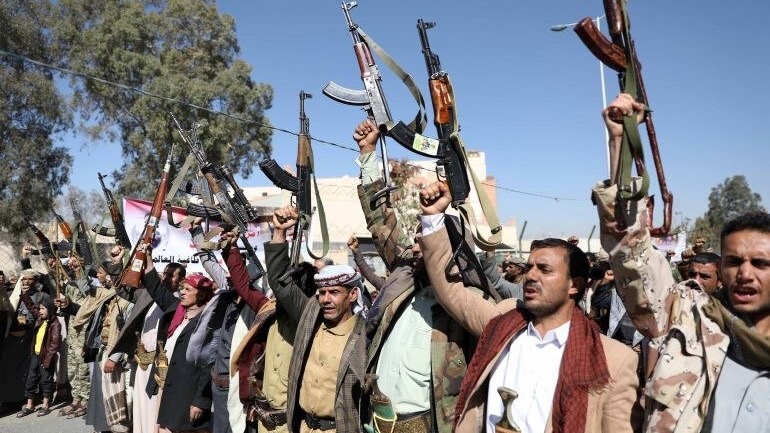
While Trump declared the truce agreement a US victory, Ansar Allah said that Washington contacted them in order to “avoid drowning in the mountains of Yemen”.

Yemen’s Ansar Allah movement reached a ceasefire deal with the United States on Wednesday, May 7, according to Oman, which mediated the negotiations.

The deal stipulates the halt of Ansar Allah’s attacks on US ships in the Red Sea and Bab al-Mandab Strait, and an end to US aggression on Yemen. However, it does not prevent the Yemeni movement from launching attacks on Israel. 

“Following recent discussions and contacts conducted by the Sultanate of Oman with the United States and the relevant authorities in Sana’a, in the Republic of Yemen, with the aim of de-escalation, efforts have resulted in a ceasefire agreement between the two sides,” Omani Foreign Minister, Badr Albusaidi, wrote on X.

“In the future, neither side will target the other, including American vessels, in the Red Sea and Bab al-Mandab Strait, ensuring freedom of navigation and the smooth flow of international commercial shipping,” the minister added.

Peoples Dispatch spokes to a member of the Communist Party of Jordan, Dr. Emad Al-Hatabeh, to discuss the ceasefire, which he described as a “sudden development in the war in the Red Sea.”

Dr. Emad Al-Hatabeh indicated that “both the US and Oman didn’t comment on Ansar Allah’s missiles targeting Israel, especially that this agreement was reached shortly after a Yemeni missile reached Ben Gurion airport, near the occupied city of Lydda (also known as Lod).”

As per Al-Hatabeh’s analysis, “important questions about this agreement are left without answers. Taking into consideration the Omani role in the American – Iranian negotiations, is the ceasefire in the Red Sea part of the deal? Another question will arise from this assumption, did America give up some of Israel’s interests in order to reach an agreement with Iran? Where does this agreement leave Netanyahu’s government, especially after Ansar Allah’s spokesman told Reuters that the agreement doesn’t include Israel.”

Ansar Allah says the US contacted them seeking a truce

One day before Oman announced that the deal was sealed, US President Donald Trump alluded that a ceasefire agreement was about to be reached, claiming that Ansar Allah agreed to stop the fight with the US because they “capitulated”. 

“They just don’t want to fight, and we will honor that and we will stop the bombings, and they have capitulated,” Trump said from the White House on Tuesday, May 6.

“They will not be blowing up ships anymore, and that’s what the purpose of what we were doing. So that’s just news. We just found out about that. So I think that’s very, very positive,” he added.

Although Trump bragged about the deal, presenting it as a US victory, analysts suggest that it was Ansar Allah that forced the world’s greatest military superpower to the negotiating table, after paralyzing US naval traffic off the Yemeni coast. 

Ansar Allah’s chief negotiator, Mohammed Abdulsalam, confirmed during an interview with Almasirah TV channel, that the movement “did not make any request to the Americans to hold ceasefire talks”. Abdulsalam asserted that, on the contrary, the movement recently received US requests and messages seeking a truce, via the Sultanate of Oman.

The Yemeni official pointed out that US endeavors to reach a ceasefire with Ansar Allah were a great disappointment to Israel. “The Israelis have endured great disappointment after the stance of the US, which tried to walk away and avoid drowning in the mountains of Yemen,” he said.

However, Abdulsalam clarified that Ansar Allah is still “assessing this US position so that the facts on the ground do not contradict its statements”. He further warned that in the event that the US “would not abide by the agreement in any way”, the movement “will respond”.

Abdulsalam considered the deal “a success to be added to Yemen’s credit, as it enhances a situation that would leave the “usurper entity” [Israel] in a situation of loneliness, in confrontation with the great popular and military stance led by Yemen on behalf of the Arab and Islamic nation.”

The ceasefire was announced two months after Trump ordered a large-scale aerial campaign against Yemen on the pretext of protecting US shipping, air, and naval assets and to restore “navigation freedom” from Ansar Allah’s attacks. Trump’s order followed Ansar Allah’s decision to resume a ban on Israeli ships due to Israel’s continuous blockade of humanitarian aid to Gaza.

Yemen threatens Israel with a devastating and painful response for attacking Sana’a airport 

While Ansar Allah agreed to a truce with the US, it vowed to escalate its operations against Israel as long as its blockade on humanitarian aid to Gaza is not lifted. 

In response to Israel’s aggression on Sana’a International Airport on Tuesday, that destroyed terminal buildings and caused USD 500 million in damage, Yemen’s Supreme Political Council Chairman, Mahdi al-Mashat, threatened that “Sanaa’s response will be devastating, painful, and beyond what the Israeli enemy can endure.”

“From this moment onward, stay in your shelters or leave for your homelands immediately. Your failed government will no longer be able to protect you,” Al-Mashat warned Israeli people. 

Moreover, the Yemeni senior official reaffirmed that no aggression will deter Yemen from its “rightful decision” to support the people of Palestine “until the genocide ends and the siege on Gaza is lifted.”

The Yemeni Armed Forces’ spokesman, Brigadier General Yahya Saree, also confirmed in a televised statement late Wednesday, that the movement will continue its ban on Israeli ships in the Red Sea and the Arabian Sea, alongside the comprehensive aerial blockade on Israel’s Ben Gurion Airport

Original article by Aseel Saleh republished from peoples dispatch under a Creative Commons Attribution-ShareAlike 4.0 (CC BY-SA) license.

Neo-Fascist Climate Science Denier Donald Trump says Burn, Baby, Burn.
Elon Musk urges you to be a Fascist like him, says that you can ignore facts and reality then.
Continue ReadingYemen’s Ansar Allah reaches ceasefire deal with US that excludes strikes on Israel

Global food prices surge amid Trump’s tariff war

Spread the love

Original article by Abdul Rahman republished from peoples dispatch under a Creative Commons Attribution-ShareAlike 4.0 (CC BY-SA) license.

Photo: UN Food and Agriculture

The United Nations Food and Agriculture Organization’s (FAO) food price index registered a 1% rise in April in comparison to March and a 22% rise compared to the same month last year.

Global food prices recorded an increase in April largely due to the tariff war waged by Donald Trump’s administration in the US, the UN agency Food and Agricultural Organization (FAO) said in a report last week. 

Major food products such as cereals, dairy products, and meat registered a rise in their prices across the globe in April in comparison to March.

Grains and cereals such as wheat, rice, and maize make the largest component of FAO’s food price index. Their prices increased the most, raising its index by 1% month over month. 

The price of dairy products increased by 2.4% month over month while the price of meat soared by 3.2%, making life significantly more difficult for people. Compared to the same month last year, dairy prices rose by 22.9%.

Year over year, the global food prices were higher by 7.6% in comparison to April last year.

The rise in food prices is attributed to several factors, including the seasonal rise in demands. However, the FAO notes that the main driver of the increase is the tariff policies announced by the Trump administration in the US in early April.

“Adjustments to the US’ import tariff policies-including the exemption to Mexico, the leading importer of US maize, and a 90 day pause on import tariffs above 10% for several other trading partners-further contributed to the upward price pressure,” the FAO said.

Fulfilling his threats to impose high tariffs on most of its trade partners Trump announced its “reciprocal tariff” policy in early April. Imports from most of the countries faced tariffs ranging between a minimum 10% to a whopping 145% against China. 

Trump later suspended the imposition of reciprocal tariffs for three months, seeking bilateral agreements with several countries. However, the announcement of the high tariffs has already created uncertainty in the global economy. 

Rise in food prices impacts the poor the most

Though the FAO acknowledged there were several factors impacting the rise in global food prices, such as the reduction in wheat exports from Russia due to sanctions, the war in Ukraine, and a weaker US dollar, the tariff war made the “strongest impact.”

Several economists and experts have already warned of a rise in local food prices, due to the Trump administration’s tariff policies creating a similar or worse impact than the war in Ukraine did in its initial months. 

The global food markets are closely interconnected so major global events may affect prices at the local level – just as they did in the initial days of the war in Ukraine, after European and US sanctions led to a reduction in Russian wheat. 

According to the FAO, its food price index recorded its highest jump in March 2022, immediately after the war in Ukraine started. The rise in prices at the time intensified a cost of living crisis even in relatively richer countries in Europe and intensified food insecurity in the developing and poorest countries.

Increases in food prices affect the poor the most as their share of expenditure on food is higher. It is expected to intensify the existing food crisis situation in most of the developing and poorer countries in Asia and Africa.

If Trump’s tariff war drags on, the prices of fertilizers will also see a jump, affecting agricultural production in the developing world and affecting the prices of food products further, claims Lotanna Emediegwu, who teaches economics at Manchester Metropolitan University. 

US and European sanctions have already negatively affected the global supply of fertilizers from Russia.

Original article by Abdul Rahman republished from peoples dispatch under a Creative Commons Attribution-ShareAlike 4.0 (CC BY-SA) license.

Neo-Fascist Climate Science Denier Donald Trump says Burn, Baby, Burn.
Elon Musk urges you to be a Fascist like him, says that you can ignore facts and reality then.
Continue ReadingGlobal food prices surge amid Trump’s tariff war