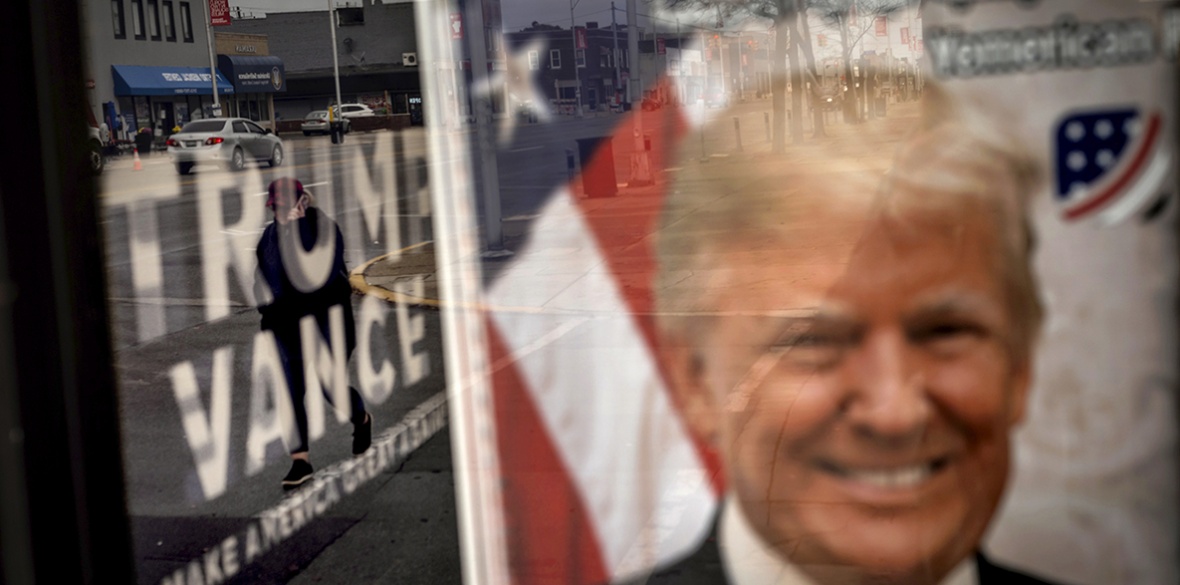
An image of Republican presidential nominee former President Donald Trump hangs in the window of a campaign office in Hamtramck, Michigan, November 4, 2024
TIM YOUNG warns that the president-elect’s record of economic and political interference from his last stint in the White House show dangerous potential for escalated aggression against the Bolivarian government from 2025
THE US election result raises the spectre of Trump renewing the assault on Venezuela that his loss to Biden interrupted in 2020.
In office between 2016 and 2020, Trump’s approach to Latin America showed an implacable hostility towards Venezuela, as well as other governments in the region determined to advance their population’s interests, not those of the US.
Venezuela has been subjected to US extraterritorial intervention and interference for over two decades. From the early days of Hugo Chavez’s election as president in 1998, the US has sought, in conjunction with Venezuela’s economic and political elites, to topple the Venezuelan government and re-establish its control and influence over the country and its oil wealth.
…
While the global situation has changed since 2020, with wars in Ukraine and the Middle East and the US’s developing aggressive strategy towards Russia and China, there is no reason to believe the US’s long-standing desire to destabilise the Venezuelan government and achieve “regime change” is off the table.
For his part, Trump made it plain when campaigning this year in North Carolina what motivated his drive to unseat Maduro: “When I left, Venezuela was ready to collapse. We would have taken it over; we would have gotten all that oil.”
The solidarity movement in Britain must be prepared to defend Venezuela’s sovereignty against any renewed offensive by Trump when he assumes the presidency in 2025 — as well as continuing to campaign for Britain to give Venezuela back its gold.
Israeli Prime Minister Benjamin Netanyahu (R) and Minister of Finance Bezalel Smotrich attend the weekly cabinet meeting in Tel Aviv on 7 January 2024 (Ronen Zvulun/AFP)
Finance minister describes Donald Trump’s election victory as an ‘opportunity’ to extend Israeli ‘sovereignty’ over the entire Palestinian territory
Israeli Finance Minister Bezalel Smotrich has told his department to prepare for the annexation of the occupied West Bank in the wake of Donald Trump’s victory in the US elections.
Speaking at a meeting of his far-right Religious Zionism party, Smotrich said that Trump’s victory provided an “important opportunity” and that “the time has come to apply sovereignty” over the West Bank.
According to a statement from his office, Smotrich said he had instructed Israeli authorities overseeing West Bank settlements “to begin professional and comprehensive staff work to prepare the necessary infrastructure” for extending sovereignty.
As well as finance minister, Smotrich has a role in the defence ministry overseeing illegal settlements in the West Bank and East Jerusalem.
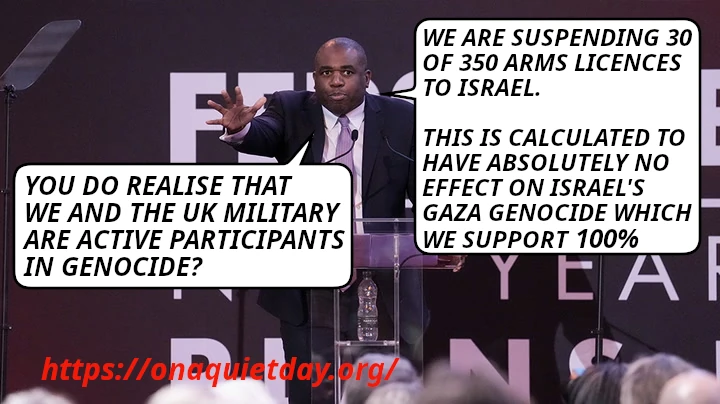
Current UK Prime Minister Keir Starmer is quoted that he supports Zionism without qualification. He also confirms that his active support and that of UK’s air force has been essential in Israel’s mass-murdering genocide. Includes URLs https://www.declassifieduk.org/keir-starmers-100-spy-flights-over-gaza-in-support-of-israel/ and https://youtu.be/O74hZCKKdpAUK Foreign Secretary David Lammy says that UK is suspending 30 of 350 arms licences to Israel. He also confirms the UK government’s support for Israel’s Gaza genocide and the UK government and military’s active participation in genocide.
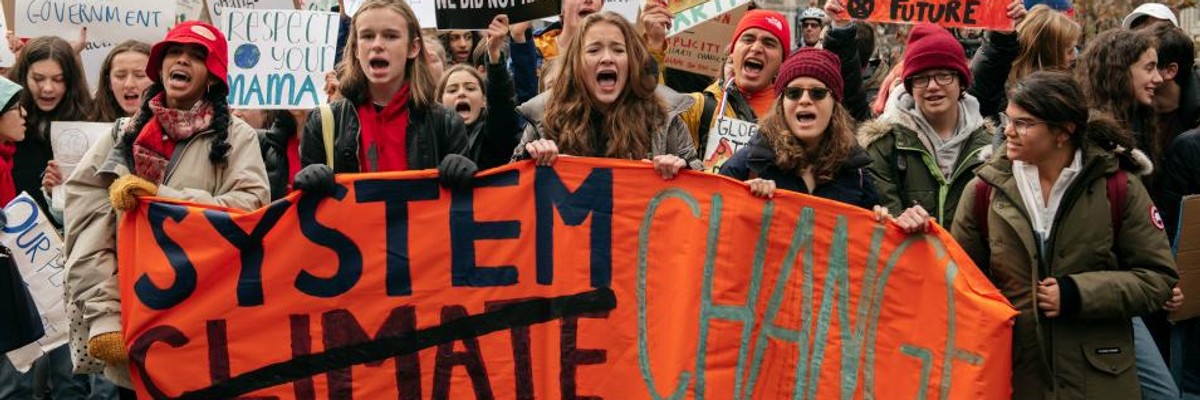
Demonstrators from several environmental groups including Extinction Rebellion and Sunrise Movement demand broad action at a youth-led climate strike near City Hall on December 6, 2019 in New York City. (Photo: Scott Heins/Getty Images)
Youth voices at COP represent the needs of the upcoming generations who will have to either assert our rights to a just climate future or figure out how to survive the catastrophic impacts that accompany a warmer planet.
Donald Trump is once again elected president of the United States only days before more than 30,000 people are expected to attend COP29 in Baku, Azerbaijan to negotiate new global commitments on protecting the planet not only for those inhabiting it today, but also for future generations. Trump’s victory is sounding alarm bells in the climate community as his administration has made their disregard for global climate action abundantly clear across their campaign, but the world recognizes we cannot afford inaction.
When Trump announced his plans in 2017 to withdraw the country from the Paris agreement, an international treaty to limit global temperature rises to 1.5°C, Gebru Jember Endalew, chair of the Least Developed Countries group, which represents 48 countries, stated “global climate momentum will continue with or without the U.S.” China also joined the E.U., Canada, and many more governments to reiterate their commitment to the agreement and global climate action.
Even if the Trump administration chooses to ignore the importance of investing in our planet, climate change will continue to affect our lives.
In 1995, the first Conference of the Parties (COP) was held in Berlin, Germany and subsequent COPs have produced targets to curb emissions, appropriate much-needed funds to tackle climate change, and build transparent reporting processes. The U.S. often sets the tone at COP as the country’s decisions around climate ambitions and climate finance have a global ripple effect. This year’s conference will be the fifth COP I’ve attended. It’s always been clear to me that youth climate activists and frontline communities are a crucial part of the COP process—pushing governments, like the U.S., which is the world’s largest historical polluter, to create and abide by ambitious targets and to address loss and damage so the planet is livable for all. And it’ll be no different this year, especially with a Trump win. Youth voices at COP represent the needs of the upcoming generations who will have to either assert our rights to a just climate future or figure out how to survive the catastrophic impacts that accompany a warmer planet.
We need all the help we can get. U.S. state and local officials are stepping up, as they did in 2017. A coalition of more than two dozen governors committed to achieving “the Paris agreement’s goal of keeping temperature increases below 1.5°C” as did large coalitions of U.S. mayors, county officials, and business leaders. In fact, I had the honor of being present as an intern for the City of San Antonio when my mayor signed a resolution with his commitment. The bipartisan group consists of governors from Washington state all the way to Puerto Rico who are committed to curbing emissions and accelerating climate action. States like California have also been working with other nations, such as China, to promote climate policy. Even if the U.S., at a national level, fails to act once again, it’s encouraging to see local and global communities committed to multilateral action.
My first COP was under the first Trump administration, and I remember feeling disappointed and embarrassed seeing my country failing to step up and lead on climate action. While everyone else had pavilions, announcements, and a large presence, the U.S. had a small office. Because of all the advantages the U.S. has gained by exploiting other communities, cultures, and nature, the U.S. had and still has so much historical and current responsibility to do better. Seeing national and global leaders reiterate their climate commitments gave me hope then and serves as a reminder today—efforts to tackle the climate crisis will continue regardless of the U.S. election results.
Even if the Trump administration chooses to ignore the importance of investing in our planet, climate change will continue to affect our lives. Attribution studies show human-induced climate change is making heatwaves, like the ones in the Southwest, hotter and more likely, while hurricanes and droughts have become more severe and destructive. Climate change is severely costing the environment and the economy. According to the World Economic Forum, “climate change is costing the world $16 million per hour.”
This horrific and costly reality isn’t inevitable. Phasing out fossil fuels, the biggest contributor to climate change, and investing in a greener and cleaner future for all are the antidotes. This is not the time to give up on climate cooperation, but rather strengthen the commitment to it. We cannot be paralyzed by fear. We’ll be at Baku calling for equitable and funded climate solutions, because if climate multilateralism is in jeopardy, so is our future, and we can’t afford to give up on either.
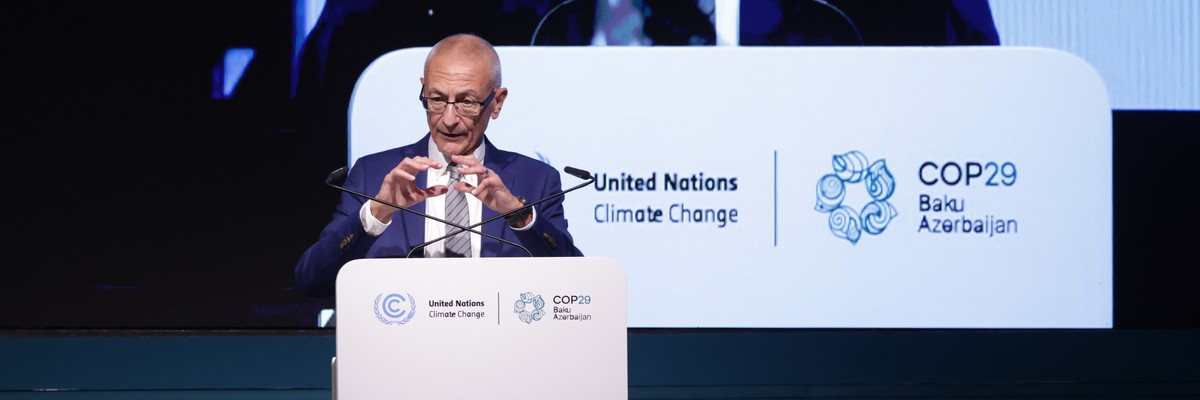
John Podesta, U.S. senior adviser to the president for international climate policy, speaks to the media during a United Nations climate summit on November 11, 2024 in Baku, Azerbaijan. (Photo: Sean Gallup/Getty Images)
“President Joe Biden must reject all pending LNG export permits and stop the expansion of fossil fuels.”
As the U.S. senior adviser to the president for international climate policy addressed the United Nations summit in Azerbaijan on Monday, green groups urged the outgoing Democratic administration to do whatever it can to tackle the global crisis before Republicans seize control of the White House and likely both chambers of Congress.
“I want to address tonight a topic that is on everyone’s mind—the U.S. election,” John Podesta, President Joe Biden’s adviser, told the crowd in Baku on the first day of the United Nations Climate Change Conference (COP29), less than a week after President-elect Donald Trumpdefeated Vice President Kamala Harris.
Although votes are still being counted, Republicans have secured a majority in the U.S. Senate and are on track to retain control of the House of Representatives—paving the way for Trump’s plans to roll back the Biden-Harris administration’s progress on the climate emergency and “drill, baby, drill,” which would lead to a surge in planet-heating pollution.
“Podesta’s speech must be followed by swift action to limit U.S. fossil fuel expansion and achieve a strong COP29 outcome.”
“For those of us dedicated to climate action, last week’s outcome in the United States is obviously bitterly disappointing,” Podesta acknowledged, “particularly because of the unprecedented resources and ambition President Biden and Vice President Harris brought to the climate fight.”
Noting that Biden pledged to halve emissions this decade, rejoined the Paris agreement, signed the Inflation Reduction Act (IRA) and the Bipartisan Infrastructure Law, and promised $11 billion in international climate funds, Podesta warned that “the next administration will try to take a U-turn and reverse much of this progress.”
“As President Biden said in the Rose Garden last week, setbacks are unavoidable, but giving up is unforgivable. This is not the end of our fight for a cleaner, safer planet. Facts are still facts. Science is still science,” he continued. “This fight is bigger than one election, one political cycle, in one country. This fight is bigger still.”
“We can and will make real progress on the backs of our climate-committed states and cities, our innovators, our companies, and our citizens, especially young people, who understand more than most that climate change poses an existential threat that we cannot afford to ignore,” he added. “Failure or apathy is simply not an option.”
Responding to the envoy’s remarks in a Monday statement, Collin Rees, United States program manager at Oil Change International, said that “if John Podesta and President Joe Biden are committed to doing everything possible to continue climate progress despite Donald Trump’s reelection, this moment demands a bold agenda that goes beyond locking in clean energy gains and takes real action toward a just transition off fossil fuels.”
“There is no shortage of critical work to be done before Biden leaves office,” Rees argued. “Here at COP29, the United States must support a new, transformative global finance goal in which rich countries pay their fair share in high-quality, grant-based finance and work to submit a Paris-aligned nationally determined contribution committing to do its fair share of climate action and phase out fossil fuels.”
In the United States, Rees argued, Biden must “finalize studies on the dangerous impacts” of new liquefied natural gas exports, “reject deadly projects like the Dakota Access oil pipeline and pending LNG facilities in the Gulf South,” and urge Congress to block the latest attempt by outgoing Sen. Joe Manchin (I-W.Va.) “to destroy bedrock environmental protections.”
Looking toward next week’s Organization for Economic Cooperation and Development (OECD) meeting, Rees said that “Biden’s administration must support a global agreement to end export credit finance for oil and gas projects, a process which could end tens of billions of dollars in international finance for fossil fuels every year. This agreement would limit the global climate damages Trump and his fossil fuel cronies are able to perpetrate.”
“Podesta’s speech must be followed by swift action to limit U.S. fossil fuel expansion and achieve a strong COP29 outcome,” he stressed. Leaders at other climate organizations—who have often argued that Biden hasn’t gone far enough to tackle the fossil fuel-driven crisis—issued similar demands on Monday.
Emphasizing that “climate diplomacy on a boiling planet doesn’t stop for a climate denier,” Ben Goloff, senior campaigner at the Center for Biological Diversity’s Climate Law Institute, called on Biden officials to “use the next two months to set up a bulwark of protections and secure their climate legacy.”
“Beyond urgently getting IRA money out the door, John Podesta must commit the U.S.’s fair share of global climate finance and announce an ambitious NDC climate target,” Goloff said, referring to nationally determined contributions for the Paris agreement.
Biden, he added, “has to make good on last year’s agreement to transition away from fossil fuels by rejecting pending mega-polluting project,” and “should also act quickly to fill all federal judicial vacancies as a wall of defense to Trump’s rampage of legal attacks.”
Jamie Minden, acting executive director of the youth-led movement Zero Hour, also declared that “before Trump takes office, President Joe Biden must reject all pending LNG export permits and stop the expansion of fossil fuels.”
“Our climate is on the brink of collapse, and it is sheer madness that politicians continue to expand and subsidize deadly fossil fuels,” Minden said. “Young people are fighting for our planet because we are facing the worst consequences of the unrelenting greed of these selfish politicians.”
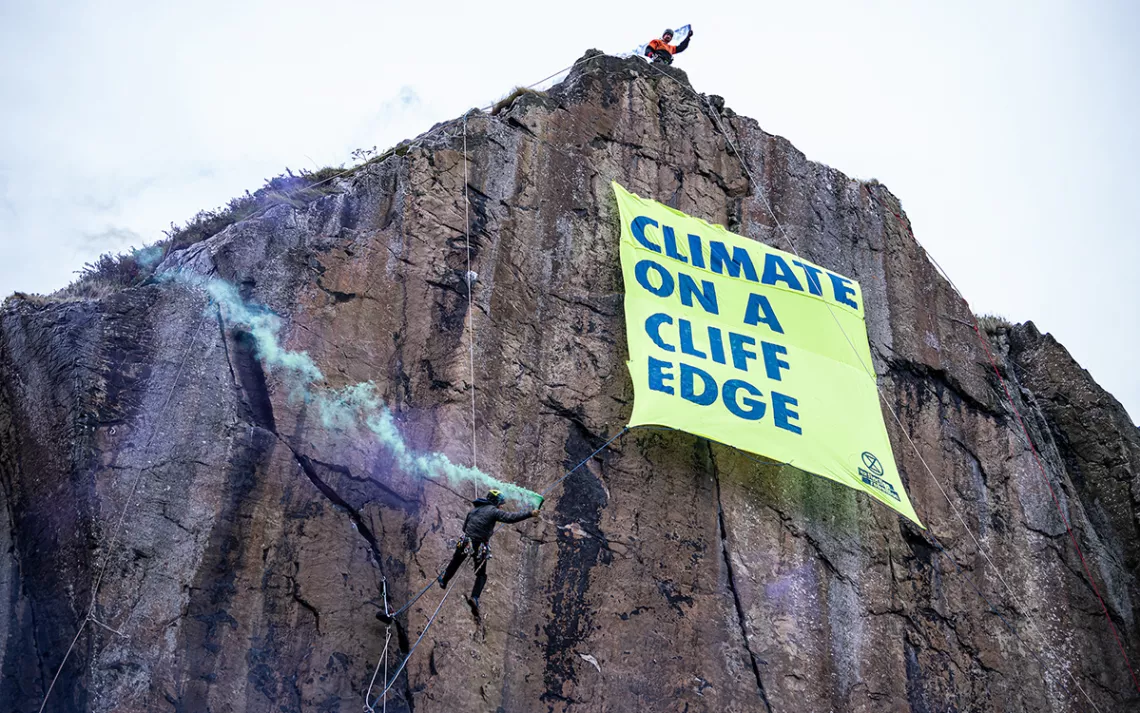
Experienced climbers scale a rock face near the historic Dumbarton castle in Glasgow, releasing a banner that reads “Climate on a Cliff Edge.” One activist, dressed as a globe, symbolically looms near the edge, while another plays the bagpipes on the shores below. | Photo courtesy of Extinction Rebellion and Mark RichardsOrcas comment on killer apes destroying the planet by continuing to burn fossil fuels. Second version, corrected text.
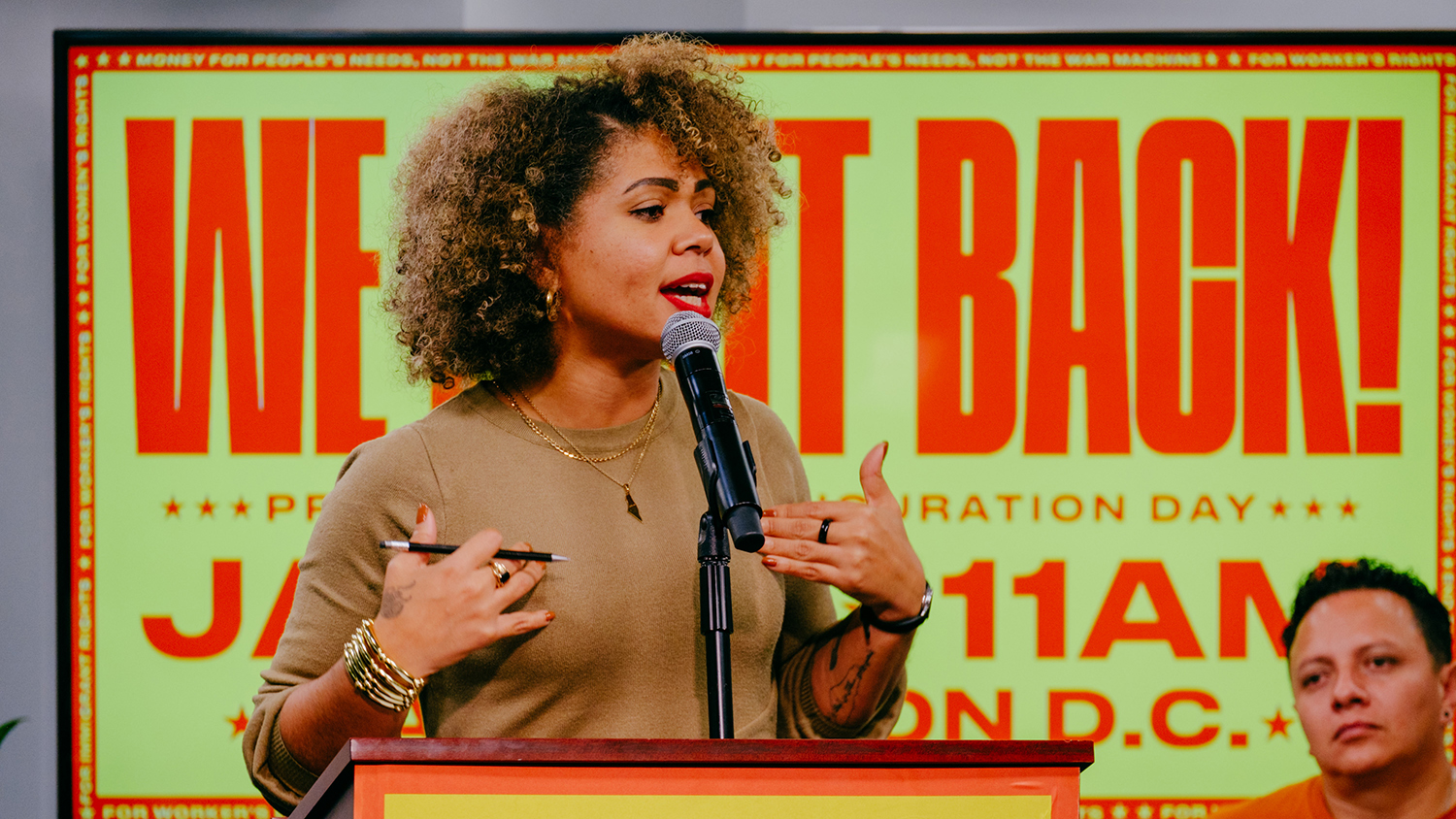
Claudia De la Cruz speaks at “What is to be done?” panel on November 8 (Photo: Wyatt Souers)
US-based movement leaders take up the task of answering the burning question: “What is to be done?”
Just two days after Donald Trump’s landslide victory against Vice President Kamala Harris, US socialists and movement leaders took up the task of answering the burning question: What is to be done following Trump’s win?
Hundreds of people gathered at the People’s Forum in New York City on November 8 for a panel discussion which featured the presidential candidate of the Party for Socialism and Liberation, Claudia De la Cruz, who ran against both Trump and Harris in a explicitly socialist campaign, Brian Becker, executive director of the anti-war organization the ANSWER Coalition, Eugene Puryear, journalist with BreakThrough News, Jorge Torres, part of the National Day Laborer Organizing Network with extensive experience organizing undocumented immigrant workers, and Miriam Osman, leader in the Palestinian Youth Movement, which has played a central role in the Palestine solidarity movement across North America.
Layan Fuleihan, Education Director of the People’s Forum, opened up the discussion. “We, the workers, the social movements, the immigrant families, the young people, the anti-war movement, the working class as a whole, we are faced with many urgent questions,” she said.
“How will we confront this continual rise of the right? Will we be driven by fear and apathy or pessimism? Will we stay home? Or will we organize our forces and chart our own path forward? Will we follow the lead of the Democratic Party and mourn their loss? Or will we assert that we reject the billionaire agenda no matter which party is executing its orders?”
Speakers put the blame for Trump’s win not on a shift to the right by working class people, but on the failures of the Democratic Party. Claudia De la Cruz spoke to what she called the “scapegoating of working class sectors” by the Democrats.
“They are saying we have to blame Black men, that we have to blame Latino men, that we have to blame immigrant communities, that we have to place judgment on those who didn’t go out and vote,” she said.
In reality, according to De la Cruz, “it is the spinelessness of the Democratic Party that has brought us here.”
“While Trump won this election, we cannot pretend that the Democrats have not allowed and conducted attacks against the working class people for decades,” De la Cruz said. “If we think about the last 16 years, the Democratic Party had power for 12 of those years, and they didn’t do anything. Not a single thing to protect or expand our rights. In fact, they sat back and watched how our rights were placed on a chopping block and said, we can’t do anything about it.”
Torres, who himself comes from a migrant background and was undocumented, spoke not only of the fear that exists within immigrant communities of Trump’s anti-migrant policy promises, but also the resolve to fight back. According to Torres, for the past few months, immigrant day laborers within the NDLON network were very scared of what would happen in the event of a Trump win. Trump has promised to deport between 15 to 20 million people in the largest mass deportation in US history, a policy which could result in family separations affecting up to 1 in 3 Latinos in the country.
But this did not paralyze these communities, who instead came together in a renewed resolve to “start organizing for real,” Torres described. Communities began to ask one another, “What does that mean when we say the people save the people?”
“We made a decision that it was about time to organize local communities in popular committees across the country,” Torres said. “We decided to organize popular assemblies across the country. In around one month we organize almost 25 assemblies across the country. And now we have almost 45+ committees led by workers, led by undocumented people, led by people that really are directly impacted.” Torres also mentioned that NDLON is working closely with the Landless Rural Workers’ Movement (MST) in Brazil, speaking to deep ties of international solidarity.
According to Torres, “most of the committees have lost their belief and hope and the Democratic Party or the Republican Party.”
“By now it is time to organize, and we just have us, and we don’t have no one else,” Torres asserted.
According to Eugene Puryear, Trump’s policy promises to round up migrant workers should be a call to action for a mass movement to defend immigrant communities. This movement can find inspiration from the history of the movement for the abolition of slavery in the United States. Puryear recalled the history of the Fugitive Slave Act, which imposed harsh punishments on those who sheltered runaway slaves. But this certainly did not stop abolitionists and anti-slavery activists from protecting slaves anyway.
“Whether or not the law said one thing, there was a higher law: that they had to fight against slavery no matter the risk,” Puryear described.
“So [abolitionists] formed things called vigilance committees, all across the country, that said that when a fugitive slave is brought before the bar into the courthouse, we will go to the courthouse and we will physically resist the imposition of returning them back. That we will physically remove them from the courthouse if we have to, and put them on the Underground Railroad and send them to Canada. And maybe we won’t succeed. Maybe we’ll be beaten. In many cases, these were serious tussles. People were pulling out guns. Maybe we’ll even be killed. But we would rather risk our lives than allow our formerly enslaved brothers and sisters to be taken back.”
There are parallels between the Fugitive Slave Act of 1850 and Trump’s promise to remove tens of millions of migrants from the country by force, Puryear argued. And the historic tasks of the mass movement, therefore, are similar to those shortly before slavery was abolished. “You can say it’s scary, and it is scary. You can say it’s odious, it is odious. But when they start bringing the trucks around to round people up, you can also say, I’m going to step outside of my door and I’m going to link arms with my neighbors. And if you’re going to throw them out, you better throw me out with them because we’re standing together no matter what,” Puryear said.
Brian Becker also echoed this same militant fighting spirit, rooted in the lessons of past movements. Becker drew attention in particular to the movement that arose after 2016 in opposition to Trump’s first election.
“There’s another side to the question of what is to be done, and that is what is to not be done,” Becker said. “Let’s learn the lesson of the first Trump administration when Trump came into office. So many people went to the airports because he said, we’re going to ban Muslims from coming into the country. Massive protests on Inauguration Day. We outnumbered Trump supporters. This was the anti-Trump resistance,” he described.
“But what happened? The Democratic Party completely co-opted that movement, completely took over that movement, because they said you have to resist Trump, the person, which meant that the best and practical way to do it, is to get rid of Trump by electing the Democrats.”
This co-optation marked the end of this mass movement, which because merely a “tail to the Democratic Party,” Becker described.
According to Becker, “the problem isn’t just Trump. The problem is the capitalist system and the ruling class parties. The Democrats and the Republicans are not an opposition to capitalism. They are the voice of capitalism.”
Becker spoke to the need to “build a political program” independent of the two establishment parties, which speaks to the needs of the masses of people.
Miriam Osman of the Palestinian Youth Movement spoke to the way that the movement in solidarity with Palestine has given people in the US renewed political clarity regarding the similarities between both major parties. “Our task is to draw more and more people into our struggle against the shared enemy, the shared enemy of the Palestinian people, the shared enemy of the working people of the world, and the shared enemy of working people in the United States,” which is the US ruling class, Osman articulated. “Our task is to build power. Our task is to unify our efforts, because this is the only thing that’s going to give us the force to transform this system.”