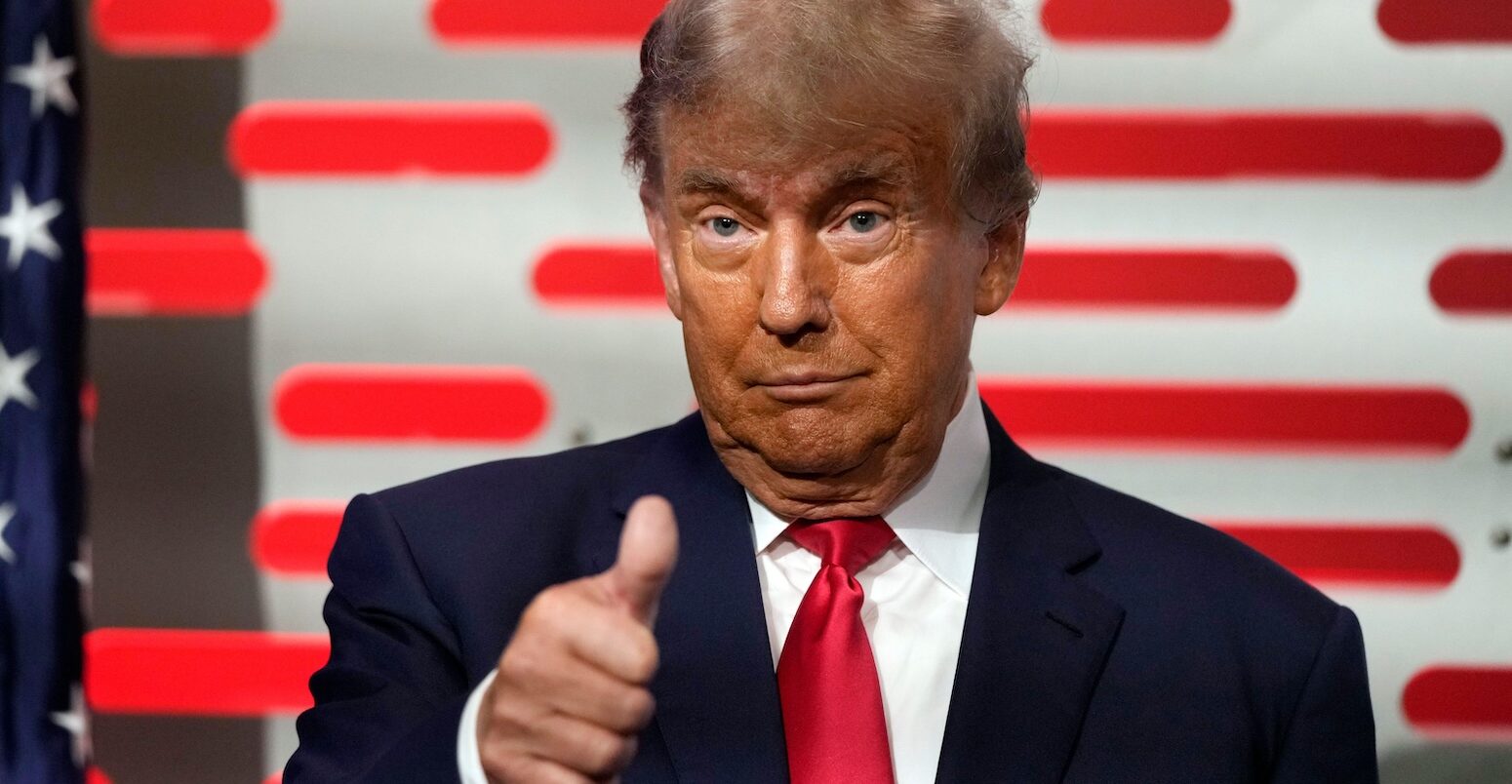
2RY8Y78 Former President Donald Trump gesture to the crowd before his speech at the California Republican Party Convention Friday, Sept. 29, 2023, in Anaheim, Calif. (AP Photo/Jae C. Hong)
BRITAIN must unite with Donald Trump in support of freedom and capitalism, Prime Minister Sir Keir Starmer said today.
Congratulating Mr Trump on his imminent return to the US presidency, Sir Keir said: “As the closest of allies, we stand shoulder to shoulder in defence of our shared values of freedom, democracy and enterprise.”
The generous interpretation of Mr Trump’s outlook appeared to be an attempt by the government to efface the record of unflattering comments made about the president-elect by Labour figures, including Foreign Secretary David Lammy.
Sir Keir was taunted by new Tory leader Kemi Badenoch in the Commons over the fact that the Republican Party is suing the Labour Party over the dispatch of hundreds of activists to the US to assist Kamala Harris’s doomed campaign.
Sir Keir submitted himself to a meal with Mr Trump during a recent visit to New York, which by most accounts went rather well, details including the president-elect personally offering Mr Lammy second helpings. [!]
…
Communist Party general secretary Robert Griffiths said: “In place of grovelling congratulations like those from Prime Minister Starmer, the so-called ‘centre-left’ should learn the lesson from recent US and EU election results: capitulating to big business market forces, racism, militarism and right-wing nationalism will end in their own defeat, sooner or later.”
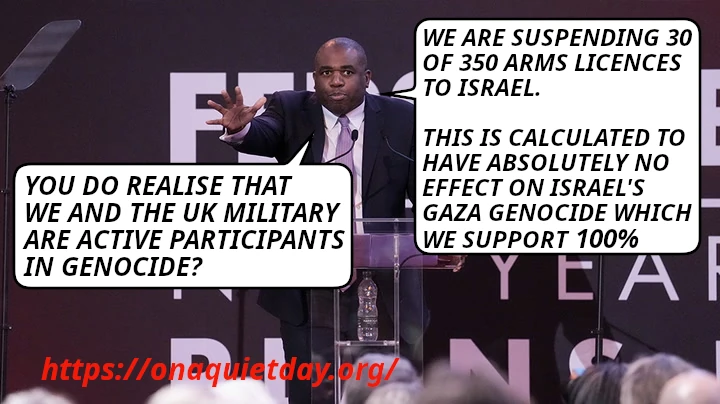
UK Foreign Secretary David Lammy says that UK is suspending 30 of 350 arms licences to Israel. He also confirms the UK government’s support for Israel’s Gaza genocide and the UK government and military’s active participation in genocide.
Ed Davey, the leader of the Liberal Democrats, hit out at the apparent Trump victory, claiming it marks a “dark, dark day for people around the globe.”
He said: “This is a dark, dark day for people around the globe. The world’s largest economy and most powerful military will be led by a dangerous, destructive demagogue.
“The next President of the United States is a man who actively undermines the rule of law, human rights, international trade, climate action and global security. Millions of Americans – especially women and minorities – will be incredibly fearful about what comes next. We stand with them.
…
Sadiq Khan, the mayor of London, struck a similar tone. He said: “I know that many Londoners will be anxious about the outcome of the US Presidential election. Many will be fearful about what it will mean for democracy and for women’s rights, or how the result impacts the situation in the Middle East or the fate of Ukraine. Others will be worried about the future of NATO or tackling the climate crisis.
…
“The lesson of today is that progress is not inevitable. But asserting our progressive values is more important than ever – re-committing to building a world where racism and hatred is rejected, the fundamental rights of women and girls are upheld, and where we continue to tackle the crisis of climate change head on.”
Cuba is in the midst of an ongoing humanitarian crisis, and October’s widespread power outages are only adding to the Cuban people’s troubles. For the last six decades, Cuba has been on the receiving end of myriad sanctions by the United States government. This blockade has proved devastating to human life.
Reporting on Cuba’s blackouts have either omitted or paid brief lip-service to the effects of US sanctions on the Cuban economy, and how those sanctions have created the conditions for the crisis. Instead, media have focused on the inefficient and authoritarian Communist government as the cause of the island’s troubles.
Pulping the economy
Michael Galant (The Hill, 1/5/24): “Businesses and financial institutions, including many from outside the United States, often elect to sever all connections to Cuba rather than risk being sanctioned themselves for association with ‘a sponsor of terror.’”
One of President Donald Trump’s final acts in office was to re-designate Cuba as a State Sponsor of Terrorism, after President Barack Obama had removed them from the list in 2015 as a part of his Cuban thaw. Inclusion on the list subjects a country to restrictions on US foreign aid and financing, but, more importantly, the SSoT list encourages third-party over-compliance with sanctions. “Businesses and financial institutions, including many from outside the United States, often elect to sever all connections to Cuba rather than risk being sanctioned themselves,” The Hill (1/5/24) reported.
Trump reportedly added Cuba to the list for harboring members of FARC and ELN, two left-wing Colombian armed movements. However, Colombian President Gustavo Petro later “noted that Colombia itself, in cooperation with the Obama administration, had asked Cuba to host the FARC and ELN members as part of peace talks,” the Intercept (12/14/23) wrote. Indeed, if Cuba deported the dissidents, they would have been in violation of the protocols of the peace talks, which they were bound to by international law (The Nation, 2/24/23).
President Joe Biden has not begun the process of reviewing Cuba’s inclusion on the list, despite his campaign promises to the contrary.
The terror designation, plus the many other sanctions imposed by Trump and continued by Biden, are no small potatoes. Ed Augustin wrote at Drop Site (10/1/24) that
the terror designation, together with more than 200 sanctions enacted against the island since Obama left office, has pulped the Cuban economy by cutting revenue to the struggling Cuban state…. The combined annual cost of the Trump/Biden sanctions, [economists] say, amounts to billions of dollars a year.
Augustin argued that the economic warfare regime is a root cause of the rolling blackouts, water shortages and mass emigration that have plagued Cuba in recent years. Even imports that are ostensibly exempt from sanctions, like medication, are caught in the dragnet as multinational companies scramble to cut ties with the island. Banks are so reluctant to run afoul of US sanctions, Augustin wrote, “that often, even when the state can find the money to buy, and a provider willing to sell, there’s simply no way of making the payment.”
Cuba’s pariah status as a SSoT has put a stranglehold on its economy, and its government’s ability to administer public services. However, US restrictions on Cuba are almost never mentioned in US coverage, and reporting on the recent blackouts is no exception.
Cash-strapped Communists
Reuters (10/10/19): “Tougher US sanctions against Cuba have led international banks to avoid transactions involving the island, while prospective overseas investors put plans on hold.”
Coverage has emphasized the inability of Cuba’s government to pay for necessary fuel imports. The New York Times (10/19/24) reported “the strapped Communist government could barely afford” to pay for fuel. Elsewhere, the Times (10/18/24) claimed “a severe economic crisis and the cash crunch it produced made it harder for Cuba to pay for those fuel imports.”
The Washington Post (10/18/24) made broadly similar arguments, chalking the blackouts up to “a shortage of imported oil and the cash-strapped government’s insufficient maintenance of the creaky grid.”
The “cash crunch” referenced by the Times is not just the result of an abstract economic crisis, as is implied. Instead, it is a direct effect of US sanctions on financial institutions. During the Obama administration, European banks, including ING and BNP Paribas, were fined to the tune of over $10 billion for transacting with Cuba (Jacobin, 3/27/22). Even before Cuba was choked further as a result of their SSoT designation, reporting by Reuters (10/10/19) showed the extent to which banks were terminating operations with Cuba and Cuban entities:
Many Western banks have long refused Cuba-related business for fear of running afoul of US sanctions and facing hefty fines.… Panama’s Multibank shut down numerous Cuba-related accounts this year and European banks are restricting clients associated with Cuba to their own nationals, if that.…
Businessmen and diplomats said large French banks, including Societe Generale, no longer want anything to do with Cuba, and some are stopping payments to pensioners living on the Caribbean island.… For the first time in years, the island has had problems financing the upcoming sugar harvest. Various joint venture projects, from golf resorts to alternative energy, are finding it nearly impossible to obtain private credit.
This de-risking by financial institutions manufactures a cash-scarce economy. Cuba’s inability to procure cash for imports is not a function of financial mismanagement, or a lack of credit-worthiness. Instead, it is a deliberate effect of American foreign policy. By omitting the actions of the most powerful government on earth, mainstream coverage allows only that only Cuban failures could be the cause of a shortage of cash.
‘Terrorism’ cuts off tourism
Britain’s ambassador to Cuba told the Telegraph (11/6/23), “Those who come are profoundly shocked at what the SSOT designation is doing to the people here.”
Cuba has historically used tourism as a way of bringing money into the economy, but lately the Cuban tourism industry has been severely depressed. The explanation employed by corporate media for the decline of this industry is to blame the extended effects of the pandemic recession (New York Times, 10/19/24; Washington Post, 10/18/24).
This explanation, however, is incomplete. Cuba has indeed had a lackluster rebound in their tourism industry, but the Times and the Post fail to explain why Cuba has faltered while other Caribbean islands have more than re-achieved their pre-pandemic tourist numbers.
Travelers from Britain, Australia, Japan and 37 other countries do not need to procure a visa for travel to the United States. Instead, they can use ESTA, an electronic visa waiver. This greatly reduces the cost and the annoyance of obtaining permission to visit the US. However, since Cuba’s 2021 listing as a SSoT, any visit to the country by an ESTA passport-holder revokes the visa waiver, for life (Telegraph, 11/6/23). In other words, any Brit (or Kiwi, or Korean, and so on) who visits Cuba must, for the rest of their lives, visit a US embassy and pay $180 before being able to enter the United States. US policy, not a Covid hangover, is hamstringing any possibility of a resurgence in tourism to Cuba.
Blame game
During Cuba’s most recent energy crisis, the New York Times published three stories describing the blackouts. Two of these stories mention the US blockade only as something that the Cuban government blames for the crisis.
The New York Times (10/21/24) presented the idea that the US is punishing Cuba’s economy as a Communist allegation: “The Cuban government blames the power crisis on the US trade embargo, and sanctions that were ramped up by the Trump administration.”
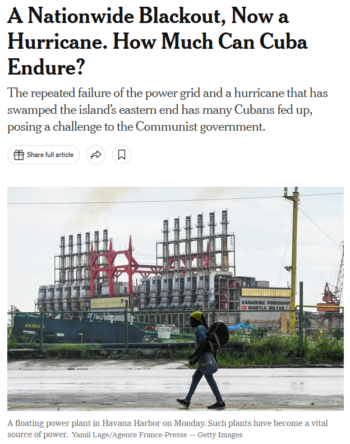
The headline on the Times website (10/21/24) read: “A Nationwide Blackout, Now a Hurricane. How Much Can Cuba Endure?” The paper was right to report on the humanitarian crisis ongoing in Cuba, but it chose to downplay the most important root cause: the decades-long US blockade on Cuba’s economy and its people.
That same story described Cuba as “a Communist country long accustomed to shortages of all kinds and spotty electrical service.” Why is the country so used to shortages? Eleven paragraphs later, the Times gave an explanation, or at least, Cuba’s explanation:
The Cuban government blames the power crisis on the US trade embargo, and sanctions that were ramped up by the Trump administration, which severely restricts the Cuban government’s cash flow. The US Department of the Treasury blocks tankers that have delivered oil to Cuba, which drives up the island’s fuel costs, because Cuba has a limited pool of suppliers available to it.
Earlier coverage by the Times (10/18/24) similarly couched the effects of the blockade as merely a claim by Cuba. The Washington Post (10/22/24) also situated the blockade as something that “the Cuban government and its allies blame” for the ongoing crisis.
To report that Cuban officials blame the US sanctions for the energy crisis is a bit like reporting that fishermen blame the moon for the rising tide. It is of course factual that US trade restrictions–which affect not just US businesses, but also multinational businesses based in other countries–are a blunt weapon, with impact against not just a government, but an entire people.
At the very least, it is incumbent upon journalists to do at least minimal investigation and explanation of the facts concerning the subject of their reporting. None of the coverage in either major paper bothered to investigate whether this was a fair explanation, or even to report generally the effects a 60-year blockade might have on an economy.
Brief—and buried
“Cuban economists and foreign analysts blamed the crisis on several factors,” the New York Times (10/19/24) reported; 18 paragraphs later, the story gets around to mentioning US sanctions.
On October 19, the Times gave its most complete explanation of the relationship between the US sanctions regime and the Cuban blackouts:
Cuba’s economy enjoyed a brief honeymoon with the United States during the Obama administration, which sought to normalize relations after decades of hostility, while keeping a longstanding economic embargo in place. President Donald J. Trump reversed course, leading to renewed restrictions on tourism, visas, remittances, investments and commerce.
This explanation can be found in the 31st paragraph of the 37-paragraph story. Only once the Times has painted a picture of all the ways the Communist government has gone wrong can there be a brief mention of the role of US sanctions. And how brief it is; the Times chose not to detail the extent of blockade against Cuba, nor how Cuba was wrongfully placed on the SSoT list, nor the failure of Biden to reevaluate Cuba’s status as he promised on the campaign trail.
Describing the US starvation of Cuba’s economy in abstract terms like “economic crisis” provides cover for deliberate policy decisions by the US government. By reporting on the embargo only as something that the Cuban government claims, it is easy for readers to dismiss that explanation as simply a Communist excuse. Instead of asking why the United States is choosing to enforce a crippling sanctions regime on another country, outlets like the New York Times find it easier to repeat the line that Cuba’s government has only itself to blame for its problems.
FAIR’s work is sustained by our generous contributors, who allow us to remain independent. Donate today to be a part of this important mission.
According to a report released by Brown University’s Costs of War project, from October 7, 2023 to September 30, 2024, the US sent 17.9 billion dollars in military aid to Israel, which accounts for the largest amount of military funding ever granted to Israel in a single year. Israel’s ongoing genocide against the Palestinian people, as well as its 76-year project of colonization of Palestine would not be possible without the vital military, financial, diplomatic, and political support of the United States.
The US presidential elections, which will see Democrat Kamala Harris face off against far-right Republican Donald Trump, are set to be held on Tuesday, November 5. The elections are being held over a year into Israel’s genocidal war on Gaza, and the result of the elections may cast a shadow on the current situation in particular, and the Palestinian cause in general.
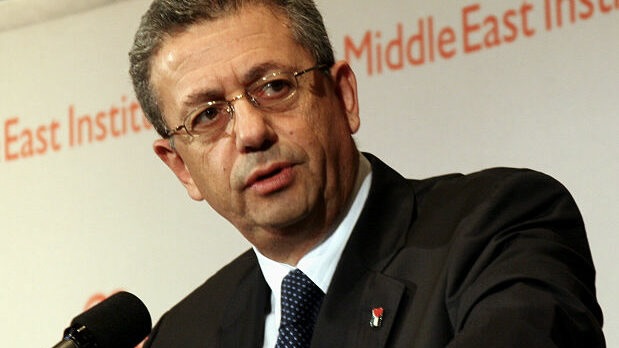
To discuss more about the impact of US policy, and the possible repercussions of the US presidential elections on the Palestinian cause, Peoples Dispatch interviewed prominent Palestinian politician, physician, and activist Dr. Mustafa Barghouthi.
Dr. Mustafa Barghouthi is the Secretary General and co-founder of the Palestinian National Initiative, and member of the Palestinian Legislative Council (PLC).
Peoples Dispatch: What has the last year of Israeli genocide revealed about US policy towards the region?
Dr. Mustafa Barghouthi: It has revealed that the United States can restrain Israel if it wants, but it did not, which makes the United States complicit in the genocide being carried out by Israel against the Palestinian people. A clear example that proves that the US has an influence on Israel, is its ability to restrain the Israeli aggression on Iran.
Peoples Dispatch: Were people expecting more from Democrat Joe Biden?
Dr. Mustafa Barghouthi: The Palestinian people were completely disappointed by Biden and his administration, including his State Secretary, Defense Secretary and National Security Advisor, who all came to take part in Israel’s war cabinet meetings, and gave their blessing to Israel during its genocidal aggression on Gaza. They further sent American fleet, ships, aircrafts to support Israel. Biden has provided Israel with no less than 17.9 billion dollars of military equipment, and more than 50,000 tons of explosives and weapons. All of that was used in committing the genocide against the Palestinian people.
Peoples Dispatch: Are any major changes expected if either Kamala or Trump gets elected? Does the outcome of these elections impact the Palestinian struggle?
Dr. Mustafa Barghouthi: Trump’s election may make the situation even worse, while it is still unclear about Kamala Harris, who maybe will be more sensitive regarding the changes that are happening inside the Democratic Party, where the majority of the younger generation are against the policy of Biden in relation to what has been happening in Gaza and to Palestinians in general.
However, so far she could not make any definite decision or take any definite position to stop the genocide against the Palestinian people. Like Biden, Harris continued with the biased approach towards Israel. This needs to be completely changed, because when it comes to the reputation of the United States it has been negatively affected by the policy of this administration, not only in Palestine but also worldwide. We shouldn’t forget that Kamala Harris was the US vice president during the genocide, she was not outside the administration. Perhaps, she will adopt a different approach in comparison to Biden, but that needs to be proved in reality and in action.
Peoples Dispatch: With regards to the broader region, one of Trump’s pet projects while president was advancing normalization with Israel. What is your view of how Israel’s genocide has impacted the process of normalization? Have there really been major setbacks? Will these setbacks be recovered or is it irreversible?
Dr. Mustafa Barghouthi: The war crimes in Gaza did not affect the existing normalization agreements between three Arab countries and Israel. Unfortunately, it has not changed at all, but the war crimes in Gaza and the genocide have restrained other countries from proceeding in normalization with Israel. Even the countries that maintained normalization agreements with Israel, are very embarrassed about the current situation, because their peoples are against normalization. It is not apparent yet whether the genocide will have further impact on normalization. The largest popular protest against normalization is happening in Morocco, and it is the most important country among the three countries that normalized with Israel”, the prominent Palestinian politician said, referring to Morocco, United Arab Emirates (UAE) and Bahrain, which signed the US-backed normalization agreements with Israel known as “the Abraham Accords” in 2020.
Keep reading Peoples Dispatch for analysis and news on the US elections from a perspective you won’t see on mainstream media.
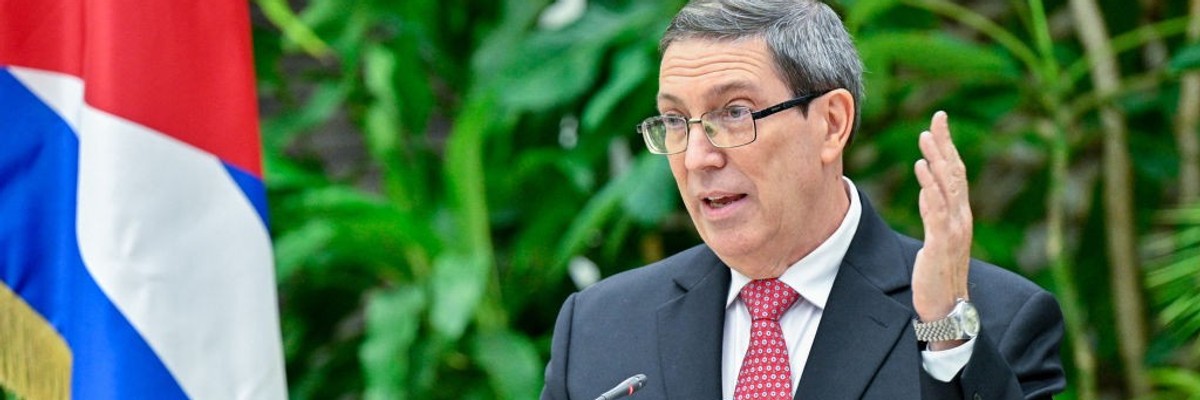
Cuban Foreign Minister Bruno Rodríguez speaks during a press conference on the impact of the U.S. embargo in Havana on September 12, 2024. (Photo: Adalberto Roque/AFP via Getty Images)
“The world has spoken—it’s time for the U.S. to listen and lift the blockade.”
The United Nations General Assembly on Wednesday once again overwhelmingly urged the U.S. government to end its decadeslong blockade on Cuba, with just the United States and Israel voting against the measure and Moldova abstaining.
The UNGA’s other 187 members present voted to adopt the nonbinding resolution on “the necessity of ending the economic, commercial, and financial embargo imposed by the United States” against the Caribbean island.
This is the 32nd straight year that the U.N. body has approved a resolution against the embargo that began in 1962.
“The U.S. and Israel stand isolated as the only two votes against,” Democratic Socialists of America’s International Committee said after the Wednesday vote. “The world has spoken—it’s time for the U.S. to listen and lift the blockade.”
Though a few other nations have opposed the resolution over the years, Michael Galant of Progressive International and the Center for Economic and Policy Research noted that this vote was “two genocidaires v. the world.”
Israel faces a genocide case at the International Court of Justice for its yearlong assault of the Gaza Strip, which has killed at least 43,163 Palestinians and injured another 101,510, according to local officials in the Hamas-governed enclave. The U.S. Congress and Biden administration have given Israel billions of dollars in weapons and opposed U.N. cease-fire resolutions.
CodePink’s Medea Benjamin responded to the Wednesday vote with a video shared on social media, saying that Israel “loves blockades, because it’s doing its own blockade of Gaza,” and “is dependent on the United States to carry out its genocide.”
“Now this is not just some idle vote,” she said of the approved resolution. “This blockade that the U.S. maintains is a form of economic warfare. It’s no exaggeration to say that now, when there is an economic crisis in Cuba, the U.S. blockade, which keeps Cuba from using the financial markets, from having normal trade with countries all over the world, is actually leading to deaths, leading to people going hungry, leading to people lacking food and medicine that are essential for their lives.”
“And that’s why the United States must be condemned for this ongoing horrific, inhumane, and illegal blockade,” Benjamin added.
Cuba’s representative delivered similar remarks to the UNGA on Wednesday. As Reutersreported:
Cuban Foreign Minister Bruno Rodríguez said in a speech before the assembly that what is often referred to as the U.S. trade embargo is a “blockade” because the web of laws and regulations complicate financial transactions and the acquisition of goods and services not just from the United States but internationally.
“The blockade against Cuba is an economic, financial, and trade war which qualifies as genocide,” said Rodriguez, charging the U.S. policies were deliberately aimed at promoting suffering among the Cuban people to force change in the government.
Some international observers praised the countries who did condemn the blockade. Middle East expert Assal Rad declared, “This is the real international community.”
Manolo De Los Santos, a founder of the People’s Forum and a researcher at Tricontinental: Institute for Social Research, said that “this overwhelming consensus is in contrast with the indifference of the United States, which continues to deny any responsibility for sanctions while tightening its stranglehold on Cuba.”
Earlier this month, the People’s Forum published a letter in The New York Times to U.S. President Joe Biden, warning that he has “exactly 90 days to reverse” former Republican President Donald Trump’s “brutal policy on Cuba.”
Biden was vice president a decade ago when then-President Barack Obama “opened a hopeful new chapter in U.S.-Cuba relations by taking the first steps toward normalization,” the letter details. “People in both countries were optimistic that Cuba and the United States could become neighbors rather than Cold War enemies. However, Trump dismantled that policy, imposing pain and suffering on the Cuban people.”
“Removing the state sponsors of terrorism designation would allow Cuba to engage in financial transactions and restore its electrical grid, as well as address shortages of food and medicine to alleviate the immense hardship faced by the Cuban people, who have endured over 62 years of economic strife under the embargo,” the letter adds. “It’s time to act. Let Cuba live!”
Biden faced similar pressure in August, when hundreds of legal experts and groups called on him “to comply with existing international law by ending the use of broad unilateral coercive measures” particularly in “cases such as Cuba, Iran, North Korea, Syria, and Venezuela.”
The U.N. vote comes as early voting is underway for the November 5 election in which Trump is facing Biden’s vice president, Kamala Harris.
Neither campaign provided details on each candidate’s position when contacted by Reuters earlier this week, though Morgan Finkelstein, national security spokesperson for Harris, said that the Democrat “stands with the people of Cuba as they fight for their rights after decades of repression and economic suffering at the hands of the communist regime” and “will stand up to all authoritarians—including the very leaders that Trump has praised and embraced.”