This work by Middle East Monitor is licensed under a Creative Commons Attribution-NonCommercial-ShareAlike 4.0 International License.
A view of the United States Embassy compound in Baghdad, Iraq, where a missile attack was reported to have caused damage on March 14, 2026. [Murtadha Al-Sudani – Anadolu Agency]
The US Embassy in Iraq’s capital Baghdad came under a rocket attack early Saturday, local media reported, citing a security source, Anadolu reports.
The source told Shafaq News Agency that the attack resulted in the destruction of the embassy’s C-RAM air defense system “completely,” which is used to intercept incoming rockets and projectiles.
The news agency quoted another unnamed security source as saying that “a satellite communications system was destroyed as a result of the attack that targeted the US Embassy compound in Baghdad.”
The source explained that the damaged system was designated “to secure and exchange data via satellites for diplomatic staff and employees inside the compound.”
The source added that the US C-RAM air defense system was unable to intercept an “unidentified drone” that carried out the attack, despite its proximity to the targeted location, which led to the satellite communications system being directly hit.
No immediate reports were issued regarding casualties, and US officials have not yet commented on the incident.
Since Israel and the US launched joint attacks on Iran on Feb. 28, killing some 1,200 people, including then-Supreme Leader Ayatollah Ali Khamenei, hostilities have escalated.
Iran has retaliated with drone and missile strikes targeting Israel, Jordan, Iraq, and Gulf countries hosting US military assets.
This work by Middle East Monitor is licensed under a Creative Commons Attribution-NonCommercial-ShareAlike 4.0 International License.
Climate science denier Donald Trump says that more liquid gold is being secured according to his policy of global privateeringDonald Trump explains why he established his Bored of PeaceDonald Trump warns against following the https://onaquietday.org blog, says that it’s easy atm, she only needs to report war crimes supporting Israel’s genocidal expansion.
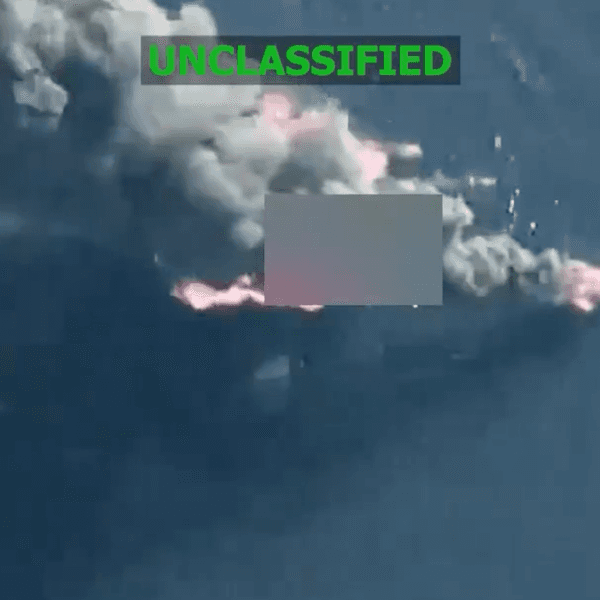
This unclassified US Department of Defense photo shows a boat that was bombed by US forces in the Caribbean Sea on October 3, 2025. (Photo: screenshot/Donald Trump/Truth Social)
“Human life cannot be left to the mercy of a president’s whim.”
“Joint Task Force Southern Spear conducted a lethal kinetic strike on a vessel operated by Designated Terrorist Organizations,” US Southern Command (SOUTHCOM) said Sunday on social media. “Intelligence confirmed the vessel was transiting along known narco-trafficking routes in the Eastern Pacific and was engaged in narco-trafficking operations. Six male narco-terrorists were killed during this action.”
The US has bombed at least 40 vessels in the Caribbean Sea and Pacific Ocean since last September, killing at least 156 people, according to the Trump administration.
“Amnesty International strongly condemns these acts and reiterates that they constitute extrajudicial killings, a form of murder, prohibited under international law, and represent a grave affront to the most basic principles of humanity and legality,” Amnesty said in a statement. “No circumstances justify the arbitrary deprivation of life.”
The boat strikes were fraught from the start. In the first known attack, US forces killed nine people in an initial strike and then two men clinging to the boat’s wreckage in a follow-up bombing. Legal experts have debated whether those strikes were a war crime or simply murder, and many argue that all of the boat bombings violate international law.
“The United States cannot claim the right to blow up boats with people on board based solely on suspicions of drug trafficking or other allegedly illicit activities,” Amnesty International Americas director Ana Piquer said Wednesday. “The rest of the international community cannot normalize these extrajudicial killings, in which the United States military is judge and executioner.”
“No president or military has the right to arbitrarily take life.”
“Human life cannot be left to the mercy of a president’s whim,” Piquer stressed. “No president or military has the right to arbitrarily take life. The level of dehumanization and cynicism reflected in these acts is deeply alarming and should be of global concern.”
“It is urgent to demand accountability and immediately end these types of attacks,” she added. “Due to the current acquiescence of the attorney general’s office, Congress must step in with its oversight power and investigate.”
In addition to bombing boats—and 10 countries—President Donald Trump launched an invasion of Venezuela to abduct its president, Nicolás Maduro, and his wife, who are jailed in the US awaiting trial for dubious narco-trafficking charges.
Earlier this month, Trump also authorized a joint campaign with Ecuador to combat “narco-terrorists” in which US ground troops have been deployed in the Andean nation.
Donald Trump warns against following the https://onaquietday.org blog, says that he’s heard that she’s a witch with a dragon’s tongue, a black cat and a dangerous kitchen.Donald Fuhrump says that Amerikkka doesn’t bother with crimes or charges anymore, not being 100% Amerikkkan and opposing his real estate intentions is enough.Orcas discuss how Trump was re-elected and him being an obviously insane, xenophobic Fascist.
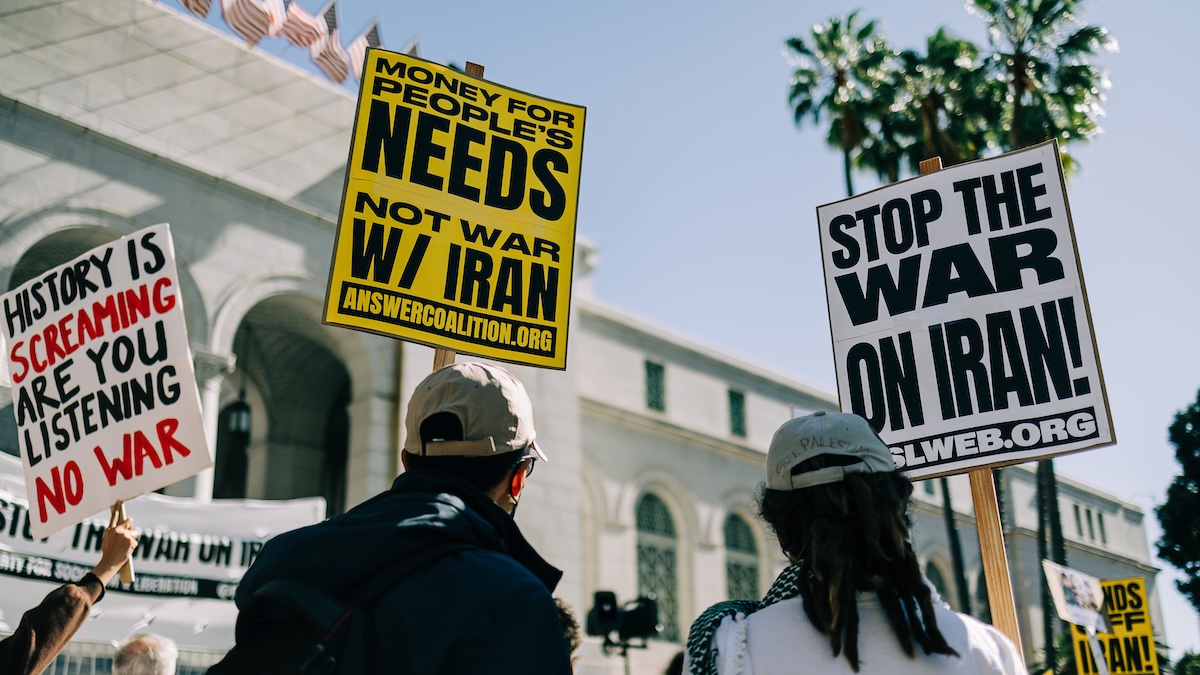
Rally against the war on Iran in Los Angeles. Photo: PSL LA
As the US-Israeli war on Iran reaches its third week, polls, protests, and congressional pushback suggest opposition in the United States is deepening to historic levels.
Over 1,400 people have been killed and 18,000 injured in Iran since the start of the US-Israeli war against the country on February 28. Major civilian casualties have been reported, including 160 school girls killed in an attack on their elementary school. As the conflict reaches its third week, the vast majority of people in the US are flatly rejecting another war launched in their name.
It may also be one of the most expensive wars in modern history. In the first six days, US taxpayers had already spent an estimated 11.3 billion USD. This number doesn’t factor in major costs like troop deployments, aircraft operations and maintenance, equipment losses, long-term care for wounded troops, rebuilding munitions stockpiles, and more. The total cost is much higher. The Pentagon reportedly burned through 5.6 billion USD worth of munitions in just the first 48 hours.
Gas prices in the North American country have also soared about 60 cents a gallon so far, after the Islamic Republic shut down the world’s most critical maritime energy chokepoint, the Strait of Hormuz. About 20-30% of the world’s oil supply has been jammed in the region, lowering its availability and raising its price. A barrel of oil sold for 60 USD before Washington launched the war on Iran. Today the price has reached 100 USD per barrel. A spokesperson for Iran’s military command, Ebrahim Zolfaqari, warned this week: “Get ready for oil to be $200 a barrel, because the oil price depends on regional security, which you have destabilized.”
As the economic and humanitarian effects accelerate, polls, protests, strikes, and even pushback in the US Congress are reflecting a population that is increasingly opposed to funding this war.
Trump officials: “Death and destruction from the sky”
Despite the opposition across the country, the White House has resolved to continue the war “until the mission is complete”. The question circulating within the US government, however, remains: what exactly is the mission?
US officials have offered a range of different answers, including: preventing Iran from acquiring nuclear weapons, destroying Iran’s missile capabilities, weakening the Iranian government, and even regime change.
In a Pentagon update on March 4, Secretary of Defense Pete Hegseth described the strategy this way: “Every minute of every day until we decide it’s over … Death and destruction from the sky all day long.”
“No one is putting us in danger. We’re putting the other guys in danger. The only people who need to be worried right now are Iranians who think they are going to live,” he said, a few days later in a 60 Minutes interview.
On Fox News on March 8, Senator Lindsey Graham said: “We’re gonna blow the hell out of these people. This regime is in a death row now. It is gonna be on its knees. It’s going to fall.”
While several officials have commented about defeating the regime in Iran, in an early press conference about the war, Hegseth said that this was not a “regime-change war” – the mission was to “destroy Iran’s missiles, navy and deny Tehran nuclear weapons”.
When asked why Washington is waging war on Iran, White House Press Secretary Karoline Leavitt said, “Well look, Iran chants ‘death to America,’ so you tell me if that’s a threat”.
From declarations of total destruction to casual boasts about civilian casualties, the administration’s rhetoric has been as extreme as it is inconsistent.
Despite the brazenness of Trump officials, there are signs that confidence may be shakier behind closed doors. The Guardian recently reported that Iranian officials have rejected multiple ceasefire requests. Instead, Iranian leaders “believe there can be no end to the conflict until it believes Trump has been shown the economic, political and military cost is so high that it is not worth repeating.”
The contrast between public bravado and private negotiation highlights the administration’s lack of a clear strategy.
Congressional pushback: No endgame, no strategy
With objectives unclear and costs reaching the tens of billions, opposition within Congress surfaced quickly. Senate Democrats and lawmakers expressed genuine frustration with the administration’s war justifications and oversight in general.
Key lawmakers emerged from a series of classified briefings earlier this week visibly alarmed and dismayed at what they had just been told about the strategy and goals of the conflict.
Senator Chris Murphy was among the most outspoken. He described the administration’s war plans as “totally incoherent” and lacking any clear endgame. He claimed that neither destroying Iran’s nuclear program nor regime change were listed as goals, raising serious questions about what possible objectives this military aggression was meant to achieve. The senator also noted that congressional authorization for the war would almost certainly fail because “the American people would demand their members of Congress vote no”.
The classified briefings left Senator Richard Blumenthal “dissatisfied and angry”. He said it was one of the most frustrating security briefings of his career, highlighting that there appears to be no endgame. “We seem to be on a path toward deploying American troops on the ground in Iran to accomplish any of the potential objectives here”, a prospect the senator says Congress and the public deserve much clearer explanations for.
A bloc of Senate Democrats, including Elizabeth Warren, and Chris Van Hollen, has pressed for more public accountability, demanding not just better strategic information but accountability for strikes that have caused severe harm, such as the confirmed US strike on a girls elementary school in Minab, Iran.
Meanwhile, congressional efforts to pass war-powers resolutions to force the president to seek formal authorization have so far failed.
The people of the US, on the other hand, are asserting that there is no justification for the war at all. Instead of seeking an explanation or even congressional authorization, a new anti-war movement is demanding an immediate end to the aggression. People have continued to mobilize since the first bombs fell on Tehran.
Anti-war movement builds in the streets
In the days immediately after the initial US-Israeli airstrikes on Iran, emergency protests broke out across the country. Following this first wave of demonstrations, actions have continued and are gaining momentum as the war escalates.
A coalition of organizations, including ANSWER, The Peoples Forum NYC, the Palestinian Youth Movement, and the Party for Socialism and Liberation, held a national day of action on March 7 against the war on Iran. Protests and rallies were seen in cities both large and small chanting “Stop bombing Iran now!” and “Money for jobs and education!”
Anti-war veterans were particularly outspoken at these actions, especially after veteran and anti-war activist Brian McGinnis was assaulted by Capital police in Washington DC for protesting the war on Iran. Several men broke his arm in the assault as he yelled “No one wants to fight for Israel!” during a US Senate Subcommittee meeting.
“To all those who are not yet deployed: Now is the time to resist!”
The very next day, International Women’s Day, various cities held yet another wave of protests against the war on Iran. The demonstrations highlighted how women and children are increasingly the direct victims of wars and among the first to suffer from displacement and economic devastation. Iranian-American women in particular spoke out at many of these rallies, highlighting the cost to US taxpayers.
“This war is costing us about one billion dollars a day. That is insane,” said Hanieyh, a protestor in the Bay Area.
Protestors have vowed to continue mobilizing on US streets until the human and economic cost of the war abroad becomes impossible to ignore.
Civilian casualties, black rain, and disaster: the toll of a war without limits
War crimes and violations of international law have been alleged since the opening days of the war. In one instance, a US submarine torpedoed and sank a defenseless Iranian frigate, “IRIS Dena”, in the Indian Ocean as it was returning from participating as a guest in the multinational naval exercise MILAN, hosted by India. The vast majority of the crew (160 sailors) were killed in the strike. In another horrific attack, US-Israeli airstrikes targeted fuel depots near Tehran, triggering massive oil fires that raged for days. Eyewitnesses reported giant black clouds covering the capital and “oily rain” falling on a city of 10 million civilians. Scientists say burning oil at this scale releases massive amounts of hydrocarbons, sulfur dioxide, nitrogen oxides, heavy metals, and soot into the atmosphere. When rain forms in such a polluted environment, it falls as toxic and oily “black rain”.
When one of the opening strikes killed Supreme Leader Ayatollah Seyed Ali Khamenei, Iran responded in the way it had long warned the United States and the region it would if attacked. The Islamic Republic targeted Israel, US bases across West Asia, and allied military installations in Qatar, Bahrain, Kuwait, Iraq, Jordan, Saudi Arabia, and others. Iran is currently launching its 40th wave of retaliatory strikes under “Operation True Promise 4”, according to the Iranian Revolutionary Guard Corps (IRGC).
After Reuters reported 150 US soldiers had been wounded from these attacks, the Pentagon revised its initial report of fewer than a dozen wounded US service members, now acknowledging about 140 injuries.
Western media has claimed 7 US soldiers have been killed so far in Iran’s retaliatory attacks. Although, some critics and analysts question that total, suggesting casualties are likely higher based on the scale of the war. Trump himself famously said about the first dead soldiers, “Sadly, there will likely be more before it ends. That’s the way it is.”
Escalation abroad, opposition at home
As the war enters its third week, the gap between the White House’s policy and public opinion continues to widen. While the Trump administration insists the bombing will continue “until the mission is complete,” it remains unclear what that mission actually is and how many lives, billions of dollars, and devastated cities it will take to achieve it.
For millions of people in the United States, the answer is increasingly simple: there is no justification for the war at all.
Between the staggering financial cost, the mounting civilian casualties (many of them children), and the absence of a coherent strategy, opposition to the war has spread far beyond traditional anti-war circles. Polls show overwhelming public disapproval, members of Congress are openly questioning the administration’s objectives, and a growing movement in the streets is demanding an immediate end to the bombing.
Whether Washington chooses to search for an exit to the war it started remains to be seen. But one fact is clear: the vast majority of people in the US are unwilling to support another endless war fought in their name.
Trump and Netanyahu have a problem of their own making in Iran | Joe Raedle/Getty Images
The US president’s claim that the war is ‘very complete’ was little more than wishful thinking
“I think the war is very complete, pretty much,” was Donald Trump’s assessment of the Israeli-American war in Iran earlier this week, after nearly a fortnight of death and destruction.
“[Iran has] no navy, no communications, they’ve got no air force,” the US president continued. “Their missiles are down to a scatter. Their drones are being blown up all over the place, including their manufacturing of drones.”
Iran thinks otherwise: it struck three merchant ships near the Strait of Hormuz days later.
The US military’s recent actions are also in contradiction with Trump’s boasts of success. Having depleted its stocks of missiles and anti-drone weapons, the Pentagon is making plans to move reserves from South Korea, to the evident concern of the government in Seoul. In a further unexpected twist, the US is even turning to Ukraine to supply it with cheap anti-drone defences made locally and costing a tiny fraction of the commercial systems.
For Israel and the US, which began the war with surprise airstrikes on Iran on 28 February, Tehran’s ability to survive is proving far greater than expected. More than 1,000 Iranians have been killed, including the former supreme leader, but the regime is still able to respond to attacks.
As the war intensifies with no end in sight, two key elements are emerging.
The first is that Binyamin Netanyahu, in particular, has fallen into a trap of his own making.
Israel’s prime minister likely imagined Israel and the US would be able to quickly declare victory after assassinating Iran’s supreme leader, bolstering his approval ratings ahead of this year’s Israeli general election.
But with the supreme leader’s son now appointed as his successor, a victory for Israel can only involve completely destroying Iran’s ability to resurrect a nuclear weapon programme. Anything short of this, and its resurrection will be the first aim of any surviving regime – leaving Israel in an even less secure position than before it attacked Tehran.
This total destruction is proving harder than expected, not least because of Iran’s extensive network of tunnels, which I noted in openDemocracy last week. Footage released by Iran’s Islamic Revolutionary Guard Corps last year, which purportedly shows a tunnel full of naval drones, anti-ship missiles, and sea mines, resurfaced this week after the attacks on the merchant ships.
The second issue is more surprising and has emerged only in the past few days.
Having failed to terminate the Iranian regime in the first leadership assassination, Israel and the US are falling back on the Dahiya Doctrine, an Israeli military tactic rooted in wrecking a neighbourhood, a city or even a country to undermine public support for a recalcitrant leadership. In theory, it forces the enemy leadership to give up and thereby lose the war.
The two nations have embarked on an expanded bombing campaign that increasingly targets Iran’s civilian population. As well as the spiralling death toll, thousands of residential properties have been destroyed, displacing more than a million people from their homes.
Civil infrastructure has also been targeted, including banks needed to pay wages. There are numerous reports of hospitals and health centres being hit.
Israel and the US’s use of the Dahiya Doctrine is unsurprising; Israel first used the tactic to attack Hezbollah’s stronghold district of Dahiya in southern Beirut in 2006, and it has since become a valuable tool in its arsenal. Despite Hezbollah’s survival – indeed, 20 years on, Israel is again pummelling Dahiya – Israel used the same approach in four assaults on Hamas in Gaza between 2007 and 2021, and it has been its main policy in the devastating war in Gaza since 2023.
In Iran, expect many more attacks from Israel and the US, killing or maiming many thousands more. Yet a remarkable sting in the tail is emerging that is already changing everything.
Put bluntly, Iran is using Israel’s Dahiya Doctrine against Israel itself.
Iran cannot defeat the combined military power of the US and Israel, but what it can do, and is already doing, is engage in economic warfare on a global scale by targeting the 20% of the world’s oil and gas that originates in the Persian Gulf and passes through the Strait of Hormuz.
Its aim is simple: cause such problems in world energy markets that, in a matter of weeks, there will be huge pressure on Trump and his people to force a pause in the fighting, whatever Netanyahu says.
And the International Energy Agency has already described the situation as one of “dire straits’, warning that “the war in the Middle East is creating the largest supply disruption in the history of the global oil market”.
It continued: “With crude and oil product flows through the Strait of Hormuz plunging from around 20 mb/d before the war to a trickle currently, limited capacity available to bypass the crucial waterway, and storage filling up, Gulf countries have cut total oil production by at least 10 mb/d. In the absence of a rapid resumption of shipping flows, supply losses are set to increase.”
The implication is that a very difficult time of global energy shortages lies ahead.
So while Trump may say the war is “very complete”, it’s far from it.
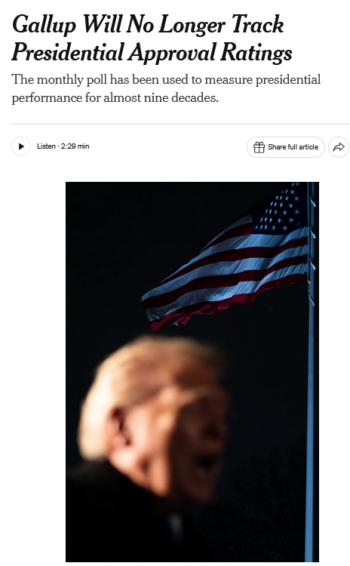
The Gallup Poll announced this month it would no longer measure presidential approval or other national leadership ratings. It was a surprise to pollsters and journalists who report on public opinion, because George Gallup was the pollster who initiated presidential approval ratings in the 1930s. Over the past nine decades, the organization has developed the most extensive database available, allowing journalists to compare approval ratings among all presidents since Franklin D. Roosevelt at various stages of their tenure.
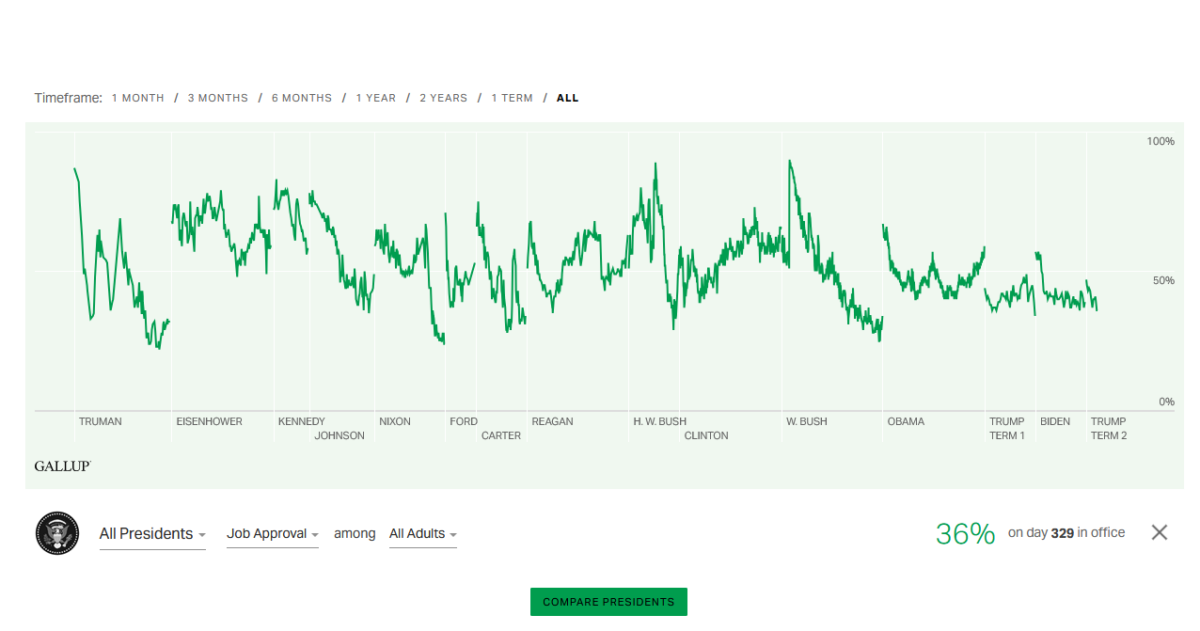
In fact, that very ability may have been the catalyst for Gallup dropping the ratings. Last November, Gallup (11/28/25) reported President Donald Trump’s approval rating as the lowest in his second term (36%), just barely above his lowest rating ever in January 2021, after he fomented the insurrection in an effort to avoid leaving office. His average approval rating in his first term was the lowest of any president since such polling began.
The November report also noted that Trump’s net approval ratings had dropped significantly on several items since the previous February/March: immigration (-9 points), situation in the Middle East (-7), economy (-6), federal budget (-12) and the situation in Ukraine (-10).
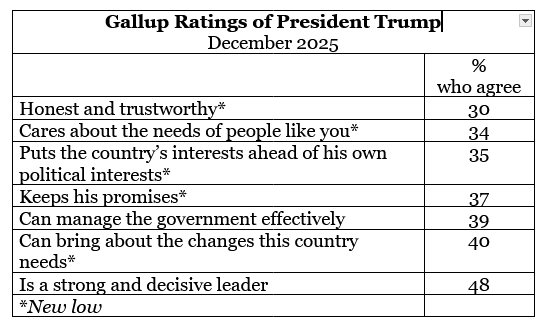
The December report (12/22/25) was not any better. Trump’s approval rating remained at 36%, while ratings on seven other personal characteristics were at a new low or near a new low:
Also problematic for Gallup was that its approval ratings consistently showed numbers below the average of other polls. Across ten approval ratings Gallup published in 2025, the net rating averaged 8.7 points lower than the average that Nate Silver (formerly of 538 and now of Silver Bulletin) compiled from other polls.
These are especially bad numbers. Trump doesn’t like bad numbers. He still has a lawsuit against an Iowa pollster whose pre-election numbers he didn’t like. And Gallup has extensive contracts with the federal government. It’s a no-brainer to infer that Gallup’s polling results may have caused the Gallup organization to re-evaluate the utility of continuing to report numbers that Trump hates.
No one knows if the White House let its dissatisfaction be known, or if the leaders at Gallup evaluated the zeitgeist on their own and took steps to mitigate possible financial problems with the US government. When asked by the Hill (2/11/26) “if Gallup had received any feedback from the White House or anyone in the current administration before making the decision,” the organization’s spokesperson apparently did not deny such an intervention, but said, “this is a strategic shift solely based on Gallup’s research goals and priorities.” Sounds like a yes to me.
The decision feels like the exclamation point marking the end of the Gallup Poll as envisioned by its founder.
The rise of Gallup
The Literary Digest (10/31/1936) predicted that Alf Landon would get 370 electoral votes and defeat Franklin Roosevelt in the 1936 election. He won eight, and did not.
On October 20, 1935, the Washington Post published a new column, “America Speaks!” by Dr. George Gallup, who had recently founded the American Institute for Public Opinion. (See Chapter 2, “America Speaks,” in David W. Moore, The Superpollsters, 1995.) It would report on the first “scientific” measurement of the voters’ minds. And, Gallup guaranteed, he would predict the outcome of the 1936 election between Alf Landon and President Franklin Roosevelt closer than the famed, and highly respected, Literary Digest poll.
While the latter poll based its results on responses from 10 to 20 million ballots it had sent to voters across the country, those voters had been targeted because their names were on a “tel-auto” list—a marketing list of people who owned cars and telephones. Gallup surmised that those voters would be disproportionately of the upper socioeconomic strata, potentially biasing the results in favor of Republicans. The “scientific” sampling he used was intended to identify voters all across the socioeconomic spectrum, to obtain a truly representative sample of the whole population. Based on his knowledge of statistics, he recognized that such a sample need not be as gargantuan as the Literary Digest sample.
As it turned out, Gallup’s prediction was indeed closer than that of the Literary Digest poll. As were the results of two other “scientific” pollsters—Elmo “Bud” Roper and Archibald Crossley. The Literary Digest poll predicted a landslide victory for Alf Landon, while the three upstarts all correctly predicted a landslide victory for Roosevelt. The “scientific” method of sampling had shown that relatively small samples of voters, chosen carefully to include all varieties of voters, could accurately represent the larger population.
All three pollsters had their own organizations, but Gallup was the most aggressive advocate for this new way of polling. More so than the others, he engaged in frequent polling on policy matters, and thus became the leader of the new public opinion polling industry. Newspapers subscribed to his columns, and for four decades, his polling results were the most significant influences in defining what the public was thinking on major issues.
Of course, he continued his election polling as well, because he believed that accurate election predictions were essential to developing public confidence that polls could represent public opinion more generally. And he developed ratings of political leaders, initiated in 1938 with his presidential approval rating question: “Do you approve or disapprove today of Franklin Roosevelt’s job as president?”
Election polling, public policy polling and leadership ratings were the three signature aspects of the Gallup Poll.
New owner, new strategy
In the mid-1970s, the three major broadcast networks began to develop their own polls, each partnering with a major newspaper—ABC with the Washington Post, CBS with the New York Times and NBC with the Wall Street Journal. In the ensuing decade, other national polls emerged as well, such as the Los Angeles Times poll, and occasional polls by Time and Newsweek.
By the late 1980s, the Gallup Poll had all but disappeared from national news stories. Few major newspapers continued to subscribe to Gallup’s polling service, because most newspapers got their poll results for free, recycled from the newspapers and television networks that conducted their own polls. George Gallup had died in 1984, and his two sons—Alec and George, Jr.—did not have the charisma or business acumen of their father. They waited until their mother had passed, in 1987, and then put the Gallup Poll up for sale.
The company that eventually bought Gallup was founded by Donald O. Clifton, a psychology professor at the University of Nebraska in Lincoln, who designed questions that would help match people with specific types of jobs. Based on his research, he eventually founded Selection Research Inc. (SRI) to help companies hire employees. (See pp. 19-21, David W. Moore, The Opinion Makers, 2008.)
Among Clifton’s four children there was one son, Jim, who became president and CEO of the new Gallup Organization. One of his most brilliant moves came shortly after he assumed his new position. He was able to persuade Ted Turner, owner of CNN, to have the network join in a one-year polling partnership with Gallup for the 1992 election. The agreement included USA Today, which had been an occasional CNN partner.
It was an ideal arrangement for all three organizations. Gallup was finally back in the news, because its poll results were immediately published by both partners. And the two media organizations benefited from the credibility of the Gallup Poll. The arrangement worked well during the campaign, and subsequently was renewed in a multi-year contract.
(It was at this point, March 1993, that I joined Gallup as a vice president and managing editor of the Gallup Poll. My immediate supervisor was Frank Newport, editor-in-chief of the Gallup Poll. I remained with Gallup until April 2006.)
With Gallup back in the news, the company’s marketing business took off. When SRI acquired Gallup, it was like one guppy eating another—the annual revenues from SRI were only slightly larger than the annual revenues from Gallup (in the $12–15 million range). A decade later, SRI-Gallup’s revenues were estimated to exceed $200 million.
The strategy was clear: The “Gallup Poll” part of the company—the part that conducted opinion polls, as opposed to the marketing business of the new Gallup Organization—was the advertising that helped bring in clients. If the “Poll” were to lose credibility, that could hurt the business. And, slowly, the “Poll” did begin to lose credibility.
‘Gallup vs. the World’
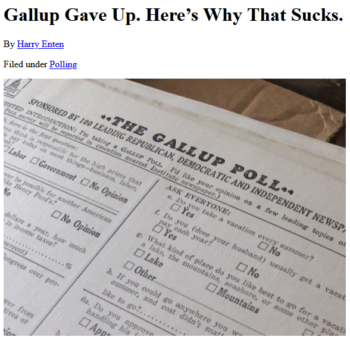
Harry Enten (538, 10/17/15) noted that when Gallup stopped doing electoral polling in 2015, it took away the best tool for judging the accuracy of its opinion polling.
Despite the extensive public policy polling and widespread dissemination of Gallup’s results, its election polling was often controversial. In 2012, Nate Silver wrote an analysis, “Gallup vs. the World” (New York Times, 10/18/12), describing numerous times when CNN/USA Today/Gallup’s results significantly diverged from the average of other polls, and even from final election results. From the beginning of the partnership, the election polling was erratic, he noted, with results showing “implausibly large swings in the race.” As he wrote, “In 1996, Gallup had Bill Clinton’s margin over Bob Dole increasing to 25 points from nine points over the course of four days.”
Then in 2000, it found “a 26-point swing toward Mr. Gore over the course of a month and a half. No other polling firm showed a swing remotely that large.” Silver pointed out that Gallup’s polling swung again, back toward Bush, putting him 13 points ahead on October 27―”just 10 days before an election that ended in a virtual tie.”
The problems continued. In 2015, 538‘s Harry Enten (10/7/15) wrote that Gallup had suffered
two consecutive elections in which its results were way off. Gallup’s final generic congressional ballot in 2010 had Republicans winning by 15 percentage points; they won by 7 points.
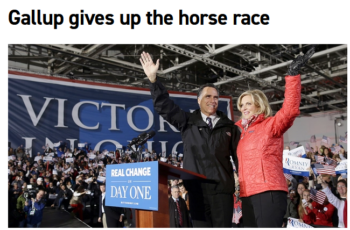
He also noted that in 2012, Gallup’s final poll showed Romney winning by one point. Obama won by four.
The partnership had begun to break apart in 2006, when Gallup dropped CNN. USA Today and Gallup continued working together, but in 2008, 2010 and 2012, the final elections polls on Real Clear Politics list results under Gallup’s name alone, despite earlier polls in those years when the results were listed as USA Today/Gallup. The official breakup came in early 2013, when Politico (1/18/13) announced that “USA Today and Gallup, the polling organization, have announced a mutual decision to end their 20-year partnership.”
Gallup’s decline
“We believe to put our time and money and brainpower into understanding the issues and priorities is where we can most have an impact,” Gallup editor-in-chief Frank Newport told Politico (10/7/15) in 2015.
That wasn’t the only bad news. In 2012, the Gallup Organization was sued by the federal government for bilking it out of millions of dollars, and for violating the Procurement Integrity Act by agreeing to hire a federal employee only if he could first increase the size of a government contract for Gallup.
In July 2013, the suit resulted in Gallup having to pay a $10.5 million fine for its transgressions, and—according to the Omaha World Herald (8/17/13)—removed Clifton from “authority over the company’s government division” as part of an agreement that allowed the company to “continue to compete for federal contracts.” It’s ironic that after such success in reviving the Gallup brand, Clifton was the one to tarnish it so profoundly.
After a bad election year in polling and the overbilling and procurement scandal, Gallup ultimately decided to give up election polling altogether. As Politico (10/7/15) wrote:
After a bruising 2012 cycle, in which its polls were farther off than most of its competitors, Gallup told Politico it isn’t planning any polls for the presidential primary horse race this cycle. And, even following an internal probe into what went wrong last time around, Gallup won’t commit to tracking the general election next year.
And it didn’t.
With no media partner, Gallup’s public policy polling also declined. It’s rare these days when Gallup conducts a poll that gets cited about some current national issue.
But Gallup did continue with regular polls on presidential approval and favorability ratings of political leaders. Until now. With the recent announcement, it no longer does regular election polling, public policy polling or leadership ratings—the three signature characteristics of George Gallup’s original vision of “American Speaks.” America continues to speak, but with respect to voter preferences, citizens’ views on controversial public policy issues, and how they view their leaders—Gallup is no longer listening.
The Gallup Poll still functions, of course. Its extensive data base is still available to journalists. It continues to conduct polls of Americans related to its Social Series, started in 2000. The surveys track attitudes in a variety of areas over time, but they do not focus on current controversial public policy issues.
No questions, for example, about Epstein, tariffs, immigration enforcement and ICE, war with Iran, the capture of Venezuela’s president, vaccine mandates, housing policy, the war in Gaza, ways to address “affordability,” the use of presidential pardons, healthcare subsidies, Ukraine, crypto currency, and other policies that ask respondents to take a position in favor or opposed. Gallup apparently doesn’t want to offend, so virtually all of its questions are general in nature. It has become a shadow of its former self.
‘A big deal’?
“Gallup’s…88 years of data give historical context to what amounts to a monthly snapshot of Americans’ views,” wrote the New York Times (2/11/26). “Political and news media analysts have come to rely on the poll to understand shifting trends in the country over time.”
Does it matter?
Some media observers think so. The Washington Post (2/11/26) called it “a big deal,” with the paper’s polling director saying Gallup is “leaving Americans with a dimmer view into our politics.” Ruth Igielnik of the New York Times (2/11/26) bemoaned the loss of Gallup’s “high-quality surveys” and “record of accuracy.” Both cite Gallup’s long history and its use of telephone, rather than online, surveys.
But telephone surveys’ primacy is no longer undisputed (Data for Progress, 3/11/21; Pew, 4/19/23). Indeed, while the Gallup Poll is still a high-quality polling organization, it is not the leader in the industry. Nate Silver rates polls by comparing their predictions with actual election results; Gallup gets a B+, better than average, but Silver finds at least 25 pollsters to be more accurate.
Despite their disappointment with the Gallup announcement, both Clement and Igielnik note that the New York Times tracked 51 polls measuring Trump’s approval rating in January—so many, Clement concludes, “that poll watchers may not have noticed the absence of Gallup’s monthly figures.”
When Gallup announced it would no longer conduct pre-election polls in 2015, Harry Enten (538,10/7/15) gave a similar reaction:
There are still plenty of good polls, and Gallup’s decision, by itself, doesn’t change the overall polling landscape that much…. ABC News, CBS News, CNN, Fox News and NBC News have all published live-interview primary polls in the past couple of months. (They all have a better track record than Gallup, according to our ratings.)
The Gallup Organization is a highly successful business, with an estimated annual revenue of $500 million, employing over 2,000 employees. The Gallup Poll was always, as Silver notes, a “loss-leader,” essentially the organization’s advertising for its business. After SRI bought the Gallup name and its reputation, the Poll—focusing on George Gallup’s vision of election polls, public policy polls, and leadership ratings—was instrumental in stimulating business. Over the years, the controversies surrounding the Poll’s performance and results seemed to have hurt the business more than help it. Abandoning Gallup’s vision of “American Speaks” was a logical business decision.
The truth is, with all the other polls that exist today, hardly anyone seems to notice. Except, perhaps, the president of the United States. The “big deal” about Gallup’s announcement, then, has much less to do with the loss of one poll than with the pressure a US president is apparently exerting on the polling industry.
Orcas discuss how Trump was re-elected and him being an obviously insane, xenophobic Fascist.Climate science denier Donald Trump says that more liquid gold is being secured according to his policy of global privateeringDonald Trump warns against following the https://onaquietday.org blog, says that it’s easy atm, she only needs to report war crimes supporting Israel’s genocidal expansion.