

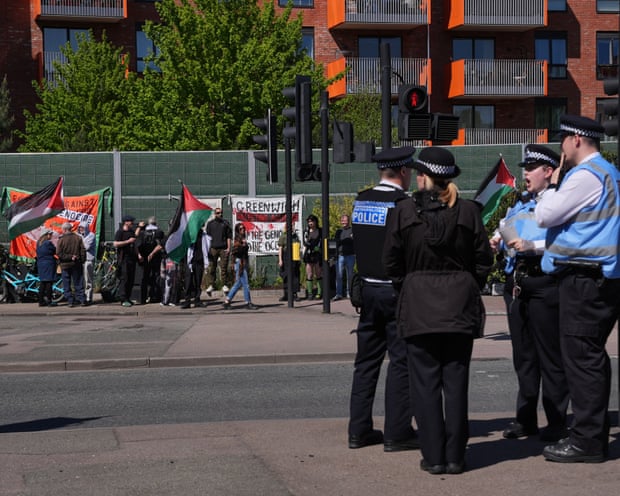
Yvette Cooper wrote a newspaper column about Palestine Action despite prosecutors warning it could prejudice criminal proceedings against six activists from the group, it can be revealed.
The then-home secretary wrote the column justifying Palestine Action’s proscription even though the Crown Prosecution Service advised it might unfairly impact a trial concerning a 2024 break-in at an Israeli arms manufacturer’s factory.
After a retrial, four of the defendants were convicted last week in relation to the raid on the Elbit Systems UK site near Bristol. It can now be reported that defence lawyers sought to halt the proceedings for alleged abuse of process, claiming Cooper’s column for the Observer was “an egregious example of contemptuous reporting which directly interferes with the court process”.
The article, on 17 August, said that charges against Palestine Action activists included a “terrorism connection” and also referred to violence, intimidation and “disturbing information” about future attacks.
…

This work by Middle East Monitor is licensed under a Creative Commons Attribution-NonCommercial-ShareAlike 4.0 International License.

Spanish actor Javier Bardem said the Nakba “never ended,” describing Israel’s actions in Gaza as “genocide” and its policies in the occupied West Bank as “ethnic cleansing and apartheid” in a message marking the anniversary of the 1948 mass displacement of Palestinians, Anadolu reports.
The US social media company X account of the Permanent Observer Mission of Palestine to the United Nations on Friday shared Bardem’s recorded remarks during a screening for UN representatives of the Palestinian-themed film All That’s Left Of You.
In his message, Bardem stressed that the Palestinian people have long struggled against what he described as Israel’s policies of genocide and ethnic cleansing.
“We understand that the Nakba never ended. It is playing out today in Gaza as genocide and in the West Bank as ethnic cleansing and apartheid,” Bardem said.
READ: Palestinians mark 78th Nakba anniversary amid war, ongoing displacement
The Spanish actor also praised the Palestinians’ century-long “determination to remain on their land and to thrive as a people with a rich culture who deserve to be free and to return home,” describing their struggle against erasure as one defined by extraordinary resilience, courage, and steadfast resolve.
The film, which portrays the trauma and search for hope experienced by three generations of a Palestinian family following the 1948 Nakba, was selected by Jordan as its submission for the 98th Academy Awards for Best International Feature Film.
Palestinians commemorate May 15 as the “Nakba” (“Great Catastrophe”) following Israel’s declaration of independence on May 14, 1948, and the subsequent forced displacement of Palestinians from their homes.
During the Nakba, Israel expelled nearly 1 million Palestinians from their homes and destroyed 675 Palestinian towns and villages. More than 70 massacres were carried out by Zionist militias, killing over 15,000 Palestinians.
While Israel continues what Palestinians and rights groups describe as genocide in Gaza, Israeli forces have also intensified raids, violence, and repression against Palestinians in the occupied West Bank.
READ: ‘No to war, and free Palestine’ says Javier Bardem at the Oscars
This work by Middle East Monitor is licensed under a Creative Commons Attribution-NonCommercial-ShareAlike 4.0 International License.
This work by Middle East Monitor is licensed under a Creative Commons Attribution-NonCommercial-ShareAlike 4.0 International License.

Iran “remains committed to diplomacy and peaceful solutions,” the country’s President Masoud Pezeshkian said in a message to Pope Leo XIV, Iranian state media reported on Saturday, Anadolu reports.
Pezeshkian also expressed Tehran’s appreciation for the Catholic leader’s “moral and logical stance on the recent military aggressions against Iran,” according to the IRNA news agency.
Iran targeted the goals of the US and Israel “within the framework of legitimate defense,” the president said, calling on the international community to “act responsibly against America’s illegal actions.”
Regional tensions have escalated since the US and Israel launched strikes against Iran on Feb. 28. In response, Tehran retaliated with strikes targeting Israel as well as US allies in the Gulf, along with the closure of the Strait of Hormuz.
A ceasefire took effect on April 8 through Pakistani mediation, but talks in Islamabad failed to produce a lasting agreement. US President Donald Trump later extended the truce indefinitely.
READ: FBI offers $200,000 reward for former Air Force operative who defected to Iran
This work by Middle East Monitor is licensed under a Creative Commons Attribution-NonCommercial-ShareAlike 4.0 International License.
This work by Middle East Monitor is licensed under a Creative Commons Attribution-NonCommercial-ShareAlike 4.0 International License.

Hezbollah said Friday that it had carried out 33 attacks targeting Israeli forces, military positions, and vehicles in southern Lebanon over the past 24 hours, Anadolu reports.
The group said the attacks were carried out in response to continued Israeli violations of the ceasefire agreement and attacks on civilians and areas in southern Lebanon.
In separate statements, Hezbollah said the attacks targeted Israeli troop and vehicle gatherings in the towns of Rashaf, Qouzah, and Hadatha.
It said military bulldozers and troop gatherings in Rashaf were targeted with attack drones, rocket barrages, and artillery shelling.
Hezbollah also said Liman barracks and Kiryat Shmona barracks were targeted with drone attacks, while rocket barrages and artillery shelling targeted Israeli positions in Qouzah and Hadatha.
The group claimed “confirmed hits” in several attacks.
Earlier Friday, the Israeli army declared the northern areas of Rosh Hanikra and Achziv a closed military zone over what it described as the “security situation,” following repeated air raid sirens triggered by drone infiltrations and rocket launches from southern Lebanon.
In recent weeks, Hezbollah’s fiber-optic drones, which are harder to detect, have become a growing concern for Israel
In late April, Israeli Prime Minister Benjamin Netanyahu acknowledged that Hezbollah missiles and drones represented “two major threats” facing Israel and urged the military to develop solutions.
READ: Lebanese Red Cross says Israel killed more than 100 paramedics despite ceasefire
This work by Middle East Monitor is licensed under a Creative Commons Attribution-NonCommercial-ShareAlike 4.0 International License.