Palestinians inspect the damage after an Israeli airstrike early this morning on Yaffa School, in Gaza City, April 23, 2025
MEDIA workers will gather outside the National Union of Journalists (NUJ) conference in Blackpool tomorrow to show support for their Palestinian colleagues and call on Israel to stop its troops targeting journalists.
Union members from across Britain and Ireland will read out the names of the more than 200 media workers killed in Palestine in the past 18 months, highlighting that journalists have been the “eyes and ears of the world as the tragic events there have unfolded daily.”
They are also calling for greater solidarity with workers “still putting their lives on the line every day to bring the world the news” from Gaza.The demonstration will also highlight journalists’ opposition to the ban on international media from entering Gaza to bear witness to the events there, “which is contributing to the suppression of information about what is happening.”
ISRAEL’S killing spree continued across Gaza today as a deadly air attack killed at least 28 people, mostly women and children, said the territory’s Health Ministry.
The attack came a day after a far-right Israeli minister claimed lawmakers in the United States supported Israel’s targeting of “food and aid depots” in Gaza.
In Thursday’s attacks at least nine people were killed in a strike on a police station in the northern Jabaliya area, the ministry said. The Israeli military claimed without evidence that it had targeted a command and control centre for Hamas and the smaller Islamic Jihad militant group.
At least seven people were killed, including a mother and her two children, and another two children, in three strikes on the southern city of Khan Younis. Strikes in central Gaza killed six people, including two women and two children. An air strike on a home in Gaza City reportedly killed four children and their parents.
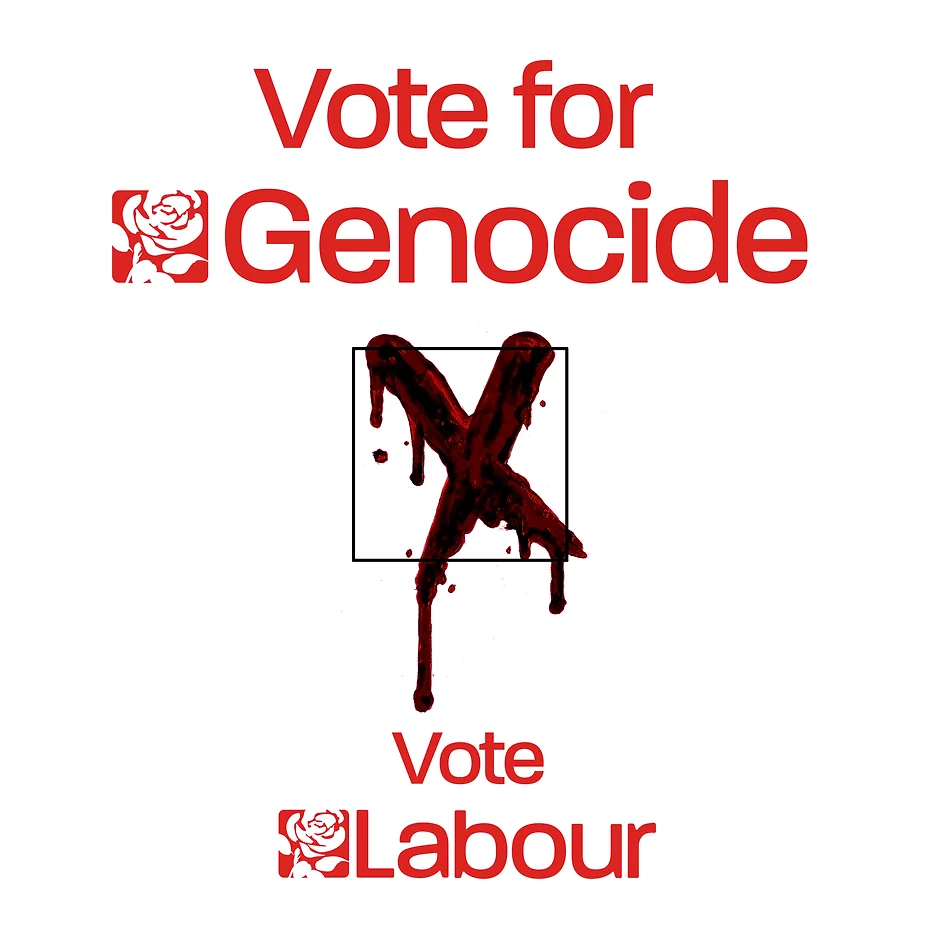
Genocide denier and Current UK Prime Minister Keir Starmer is quoted that he supports Zionism without qualification. He also confirms that UK air force support has been essential in Israel’s mass-murdering genocide. Includes URLs https://www.declassifieduk.org/keir-starmers-100-spy-flights-over-gaza-in-support-of-israel/ and https://youtu.be/O74hZCKKdpAUK Foreign Minister David Lammy confirms that UK government and military are active participants in Israel’s genocides and that the F-35 parts that they suspended from supplying to Israel are instead simply diverted via the United States. He says see https://youtu.be/QILgUHrdWREVote For Genocide Vote Labour.
Genocide denier and Current UK Prime Minister Keir Starmer is quoted that he supports Zionism without qualification. He also confirms that UK air force support has been essential in Israel’s mass-murdering genocide. Includes URLs https://www.declassifieduk.org/keir-starmers-100-spy-flights-over-gaza-in-support-of-israel/ and https://youtu.be/O74hZCKKdpAUK Foreign Minister David Lammy confirms that UK government and military are active participants in Israel’s genocides and that the F-35 parts that they suspended from supplying to Israel are instead simply diverted via the United States. He says see https://youtu.be/QILgUHrdWRE
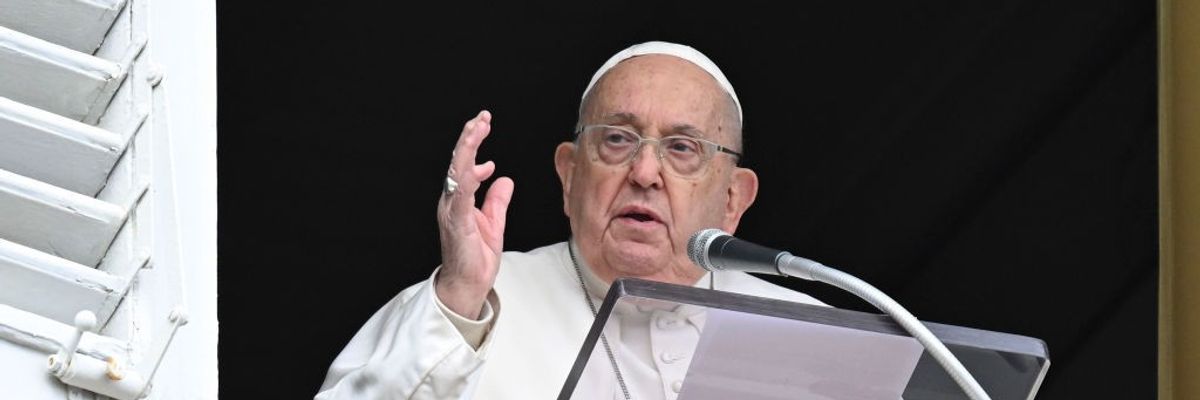
Pope Francis delivered a Sunday Angelus blessing from the window of his studio overlooking St. Peter’s Square on January 12, 2025 in Vatican City. (Photo: Vatican Media via Vatican Pool/Getty Images)
“Will the millions who will mourn his death these coming days respect this wish of his? Will they care for Gazans and Palestinians the way he did?”
The Vatican announced Monday that Pope Francis has died at the age of 88, hours after he appeared at an Easter mass and appealed for an end to Israel’s war on the Gaza Strip.
The pope’s Easter address, read aloud by Archbishop Diego Ravelli, decried the “terrible conflict” in Gaza that “continues to cause death and destruction and to create a dramatic and deplorable humanitarian situation.”
“I appeal to the warring parties: call a cease-fire, release the hostages, and come to the aid of a starving people that aspires to a future of peace!” said the message from the pope, an outspoken opponent of military conflict and war profiteers, climate destruction, and runaway economic inequality.
“In the face of the cruelty of conflicts that involve defenceless civilians and attack schools, hospitals, and humanitarian workers, we cannot allow ourselves to forget that it is not targets that are struck, but persons, each possessed of a soul and human dignity,” the pope’s address continued.
News of Pope Francis’ death came after a bout with double pneumonia left him hospitalized for more than a month. The Vatican did not specify a cause of death in its announcement.
The Nation‘s John Nichols wrote Sunday that Pope Francis’ calls for peace have made him “arguably the most consistent high-profile defender of the humanity of the Palestinian people during a period when the Israeli assault on Gaza has been pursued with relentless violence.”
Nichols continued:
With a boldness and specificity that has often sparked controversy, this pope has challenged economic injustice, racism, environmental neglect, militarism, and the abuses of new technologies that increase inequality. He has faced his share of criticism, not just from conservatives who disapprove of his views but also from reformers who sincerely wish that he would do more to modernize the church. Yet, in a time of too much indifference and impunity, this pope has remained uniquely engaged with the embattled regions that political and media elites neglect or abandon.
That’s been especially true when it comes to Gaza, where Pope Francis has long argued for cease-fires, arms blockades, aid convoys, and a diplomatic urgency that recognizes that Palestinians and Israelis are “fraternal peoples [who] have the right to live in peace.”
In a tribute to Pope Francis, Palestinian theologian Munther Isaac wrote Monday that “he conveyed true compassion to Palestinians, most notably to those in Gaza during this genocide.”
“The pope left our world today, and the occupation and the wall remained. Even worse, he left our world while a genocide continues to unfold,” Isaac wrote, pointing to the pontiff’s call for a thorough international investigation of Israel’s assault on Gaza.
“Today I wonder: Will the millions who will mourn his death these coming days respect this wish of his?” Isaac asked. “Will they care for Gazans and Palestinians the way he did?”
What makes Pope Francis and his 183-page encyclical so radical isn’t just his call to urgently tackle climate change. It’s the fact he openly and unashamedly goes against the grain of dominant social, economic and environment policies.
While the Argentina-born pope is a very humble person whose vision is of a “poor church for the poor”, he seems increasingly determined to play a central role on the world stage. Untainted by the realities of government and the greed of big business, he is perhaps the only major figure who can legitimately confront the world’s economic and political elites in the way he has.
However his radical message potentially puts him on a confrontation course with global powerbrokers and leaders of national governments, international institutions and multinational corporations.
The backlash has begun even before the encyclical has been officially published. US presidential candidate Jeb Bush, a Catholic, feels the pope should stay out of the climate debate, joining other Republicans, fossil fuel lobbyists and climate denier think-tanks in seeking to discredit Pope Francis’s intervention.
What makes the pope so radical?
There are several meanings of the word “radical” that can be applied to the Pope and in particular his forthcoming encyclical.
First, radical can be understood as going back to the roots (from Latin radix, root). The majority of Catholics live in the Global South; in Latin America and sub-Saharan Africa. Francis is the first pope from the Global South, and naming himself in honour of Saint Francis of Assisi, “a man of poverty and peace who loved nature and animals”, signalled to the world a commitment to going back to the roots of human existence.
The pope knows the plight of the majority world. Before he became Archbishop of Buenos Aires, he was a priest in the vast, poor neighbourhoods, the villas miserias or slums, of Argentina’s capital.
Improving the lives of slum dwellers and addressing climate change is, for Pope Francis, one and the same thing. Both require tackling the structural, root causes of inequality, injustice, poverty and environmental degradation.
Even as the quality of available water is constantly diminishing, in some places there is a growing tendency, despite its scarcity, to privatize this resource, turning it into a commodity subject to the laws of the market. Yet access to safe drink- able water is a basic and universal human right, since it is essential to human survival and, as such, is a condition for the exercise of other human rights. (p. 23)
This stands in stark contrast to, for example, Peter Brabeck-Letmathe, the chairman of Nestlé, the world’s largest food and bottled water company, who thinks water is a normal commodity with a market value, and not a human right. Nestlé is far from unusual. Its stance is backed up by the official water privatisation policies of the World Bank, IMF and other international institutions.
In fact, the encyclical is a radical – for a pope and international leader, unprecedented – attack on the logic of the market and consumerism, which has been expanded into all spheres of life.
The document states:
Since the market tends to promote extreme consumerism in an effort to sell its products, people can easily get caught up in a whirlwind of needless buying and spending. Compulsive consumerism … leads people to believe that they are free as long as they have the supposed freedom to consume. But those really free are the minority who wield economic and financial power. (p. 149-150)
The pope rejects market fundamentalism, instead arguing that “the market alone does not ensure human development and social inclusion.”
The strategy of buying and selling “carbon credits” can lead to a new form of speculation which would not help reduce the emission of polluting gases worldwide. This system seems to provide a quick and easy solution under the guise of a certain commitment to the environment, but in no way does it allow for the radical change which present circumstances require. Rather, it may simply become a ploy which permits maintaining the excessive consumption of some countries and sectors. (p. 126)
The pope’s right. The same criticisms of carbon markets have been made by myself and others.
Climate change is a global problem with grave implications: environmental, social, economic, political and for the distribution of goods. It represents one of the principal challenges facing humanity in our day. (p. 20)
While the pope is not a politician – or maybe precisely because he is not one – he commands high moral and ethical authority that goes beyond traditional partisan lines. His encyclical speaks truth to power, and he might be the only person with both the clout and the desire to meaningfully deliver a message like this:
Many of those who possess more resources and economic or political power seem mostly to be concerned with masking the problems or concealing their symptoms, simply making efforts to reduce some of the negative impacts of climate change. However, many of these symptoms indicate that such effects will continue to worsen if we continue with current models of production and consumption. There is an urgent need to develop policies so that, in the next few years, the emission of carbon dioxide and other highly polluting gases can be drastically reduced, for example, substituting for fossil fuels and developing sources of renewable energy. (p. 21)
The bosses of Shell, ExxonMobil and other fossil fuel companies will not like this message, as it threatens their fundamental business model, and it also stands in contrast to the underwhelming ambitions of the G7 leaders who recently pledged to phase out fossil fuels only by 2100.
The time for bold, radical action on the environment as well as poverty eradication has come. This seems to be Pope Francis’ message: “The same mindset which stands in the way of making radical decisions to reverse the trend of global warming also stands in the way of achieving the goal of eliminating poverty.” (p. 128)
We need to think beyond the current, taken-for-granted logic that believes only markets and consumerism can solve the world’s social and environmental problems. The pope himself believes the situation is so grave that only a new, “true world political authority” will be able to address these problems.
This article was updated on 18 June to include quotes from the final encyclical rather than the earlier draft leaked to L’Espresso magazine.

 Palestinians inspect the damage after an Israeli airstrike early this morning on Yaffa School, in Gaza City, April 23, 2025