1 in 3 children under 2 years of age are today acutely malnourished in the north, according to nutrition screenings conducted by UNICEF and partners
NEW YORK, 15 MARCH 2024 –31 per cent – or 1 in 3 children under 2 years of age – in the Northern Gaza Strip suffer from acute malnutrition, a staggering escalation from 15.6 per cent in January.
Malnutrition among children is spreading fast and reaching devastating and unprecedented levels in the Gaza Strip due to the wide-reaching impacts of the war and ongoing restrictions on aid delivery.
At least 23 children in Northern Gaza Strip have reportedly died from malnutrition and dehydration in recent weeks, adding to the mounting toll of children killed in the Strip in this current conflict – about 13,450 reported by the Palestinian Ministry of Health.
Nutrition screenings conducted by UNICEF and partners in the north in February found that 4.5 per cent of the children in shelters and health centers suffer from severe wasting, the most life-threatening form of malnutrition, which puts children at highest risk of medical complications and death unless they receive urgent therapeutic feeding and treatment, which is not available. The prevalence of acute malnutrition among children under 5 years of age in the north has increased from 13 per cent to as high as 25 per cent.
“The speed at which this catastrophic child malnutrition crisis in Gaza has unfolded is shocking, especially when desperately needed assistance has been at the ready just a few miles away,” said Catherine Russell, UNICEF Executive Director. “We have repeatedly attempted to deliver additional aid and we have repeatedly called for the access challenges we have faced for months to be addressed. Instead, the situation for children is getting worse by each passing day. Our efforts in providing life-saving aid are being hampered by unnecessary restrictions, and those are costing children their lives.”
Screenings conducted for the first time in Khan Younis, in the middle area of the Gaza Strip, found 28 per cent of children under 2 years have acute malnutrition, more than 10 per cent of which have severe wasting.
Even in Rafah, the southern enclave with the most access to aid, the results from screenings among children under 2 years doubled from 5 per cent who were acutely malnourished in January to about 10 per cent by the end of February, with severe wasting rising fourfold from 1 per cent to more than 4 per cent over the month.
UN agencies have been warning of the risk of a famine in the Gaza Strip since December. In January, the emergency thresholds for acute malnutrition in children were exceeded. Acute malnutrition among children has continued to rise rapidly and at scale and there is a high risk it will continue to increase across the Gaza Strip, costing more lives, in the absence of more humanitarian assistance and the restoration of essential services.
UNICEF has reached children with treatment for acute malnutrition, including the use of Ready to Use Therapeutic Food (RUTF), Ready to Use Infant Formula and preventative micronutrients supplements containing iron and other essential nutrients for pregnant women. More supplies are due to arrive this week, but this is still not enough to address the needs.
“We are doing everything we can to avert a worsening of the humanitarian crisis in Gaza, but it is not enough,” said Russell. “An immediate humanitarian ceasefire continues to provide the only chance to save children’s lives and end their suffering. We also need multiple land border crossings that allow aid to be reliably delivered at scale, including to northern Gaza, along with the security assurances and unimpeded passage needed to distribute that aid, without delays or access impediments.”
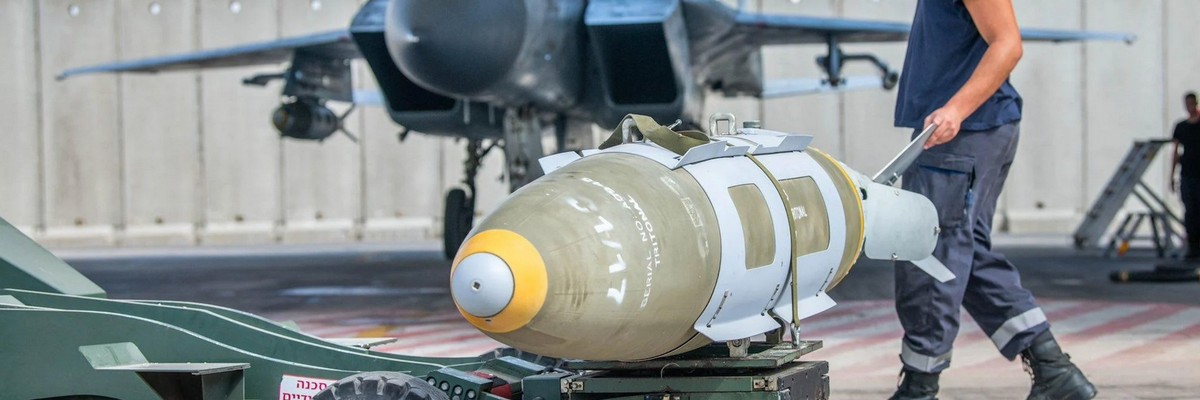
A U.S.-supplied guided munition is prepared to be loaded onto an American-made Israeli Air Force F-15 in this undated photo. (Photo: Israeli Air Force)
“U.S. weapons, security assistance, and blanket political support have contributed to an unparalleled humanitarian crisis and possible war crimes in Gaza,” the NGOs wrote.
More than two dozen human rights groups on Tuesday implored U.S. President Joe Biden “urgently comply” with domestic law by suspending arms sales to Israel and pressuring its far-right government to end its genocidal policy of blocking aid to starving Palestinians in Gaza.
In a joint letter to Biden, the 25 organizations asserted that his administration’s “unconditional arms transfers and other security assistance” to Israel apparently “violate Section 620I of the Foreign Assistance Act (22 U.S.C. § 2378-1), which prohibits the United States from providing security assistance or arms sales to any country when the president is made aware that the government ‘prohibits or otherwise restricts, directly or indirectly, the transport or delivery of United States humanitarian assistance.'”
“U.S. weapons, security assistance, and blanket political support have contributed to an unparalleled humanitarian crisis and possible war crimes in Gaza,” the groups wrote. “We demand that you urgently comply with U.S. law, end U.S. support for catastrophic human suffering in Gaza, and use your leverage to protect civilians and ensure the impartial provision of humanitarian assistance.”
We joined 24 other organizations to urge @POTUS to comply with U.S. law and stop military assistance to #Israel. Biden must use his leverage to protect civilians in #Gaza and ensure the provision of humanitarian aid.
Gaza’s Health Ministry reports that more than 30,000 Palestinians—at least two-thirds of them women and children—have been killed in Gaza and over 70,000 wounded, with thousands more estimated to be buried under the rubble. Over 90% of people in Gaza are acutely food insecure, with a growing number of children dying of starvation and dehydration. Over 75% of Gaza’s population is already displaced, and the level of damage to shelter and infrastructure means people increasingly have nowhere safe to go nor reliable provisions if and when they move. As civilians face bombardment, disease, and starvation, lifesaving healthcare is increasingly inaccessible.
The letter acknowledges the Biden administration’s efforts at providing very limited humanitarian relief to Gazans, as well as its public admission that “Israel is obstructing the delivery of humanitarian aid to starving Palestinians.”
“But since October 7, the government of Israel has failed to facilitate the entry of sufficient humanitarian aid, including through additional border crossings into Gaza and northern Gaza in particular; blocked the entry of many humanitarian aid trucks; denied humanitarian access requests; enforced arbitrarycustoms restrictions on humanitarian goods; and attacked humanitarian workers and their facilities as well as civilians seeking aid,” the groups said.
The letter points out that these acts are part of a stated Israeli policy of “complete siege” on Gaza, which experts say constitutes an act of genocide. In January, the International Court of Justice issued a preliminary ruling in a South Africa-led case that found Israel was “plausibly” committing genocide. The ICJ ordered Israel to “take all measures within its power” to prevent genocidal acts, an order that rights groups say it has failed to obey.
On Tuesday, a group of U.S. senators led by Bernie Sanders (I-Vt.), Chris Van Hollen (D-Md.), and Jeff Merkley (D-Ore.) also wrote a letter to Biden stressing that his administration is compelled by law to end arms sales to Israel if it keeps blocking aid to Gaza.
The U.S. provides Israel with around $4 billion in annual military aid. Since October 7, the Biden administration has requested an additional $14.3 billion in assistance for Israel, while repeatedly circumventing Congress to fast-track emergency armed aid.
The groups’ letter urges Biden to “use your leverage” with Israel “to protect civilians and ensure the impartial provision of humanitarian assistance.”
Biden administration officials have dubiously insisted that they have no such leverage.
Ireland’s SDLP confirms full Washington boycott for St Patrick’s week in Gaza protest
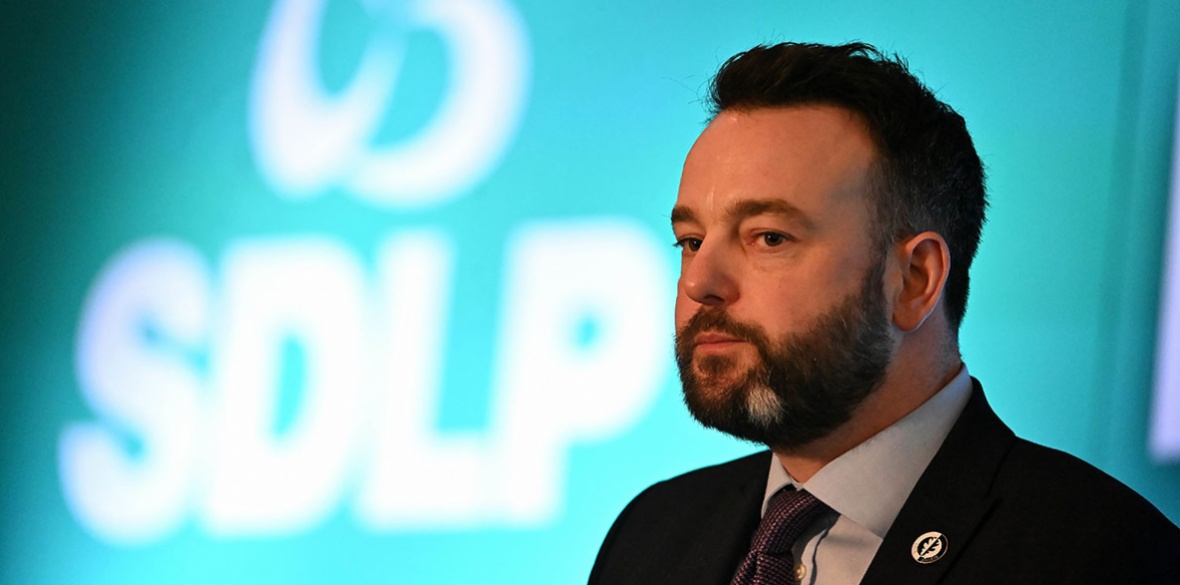
SDLP leader Colum Eastwood speaking during the Social Democrat and Labour Party (SDLP) spring conference at St. Columb’s Hall in Derry, March 25, 2023
THE Social Democratic and Labour Party (SDLP) has said it would not be sending any representatives to Washington DC for St Patrick’s Day due to the conflict in Gaza.
The party had already announced a boycott of celebratory St Patrick’s events at the White House, in protest against the situation in Palestine and the Biden administration’s support for Israel, but it was still planning to send a delegation to Washington to raise its concerns.
Announcing the plan in January, the party said its delegation would “engage with senior lawmakers, Irish Americans and Palestinian Americans to make the case for an end to violence.”
However, party leader Colum Eastwood has confirmed the party is no longer planning to send a delegation.
“The situation in Gaza has continued to deteriorate,” he said.
“More children have been killed, communities obliterated and thousands of people displaced as a result of this horrifying conflict. And now, during the holy month of Ramadan, we have clear warnings that starvation is being used as a weapon of war against the Palestinian people.
With over 17 million subscribers, the Morning, the New York Times’ flagship newsletter, is by far the most popular newsletter in the English-speaking world. (It has almost three times as many subscribers as the next most popular newsletter.)
Since October 7, as Israel has waged an unprecedented war on Palestinian children, journalists, hospitals and schools, the New York Times’ highly influential newsletter has bent over backwards to blame everyone but Israel for the carnage.
Waging a legitimate war
According to the Morning—led by head writer David Leonhardt—Israel’s war on Gaza is a targeted operation designed to eliminate Hamas. The Morning propagates this narrative despite well-documented declarations of collective punishment and even genocidal intent by high-ranking Israeli officials—a tendency that South Africa has forcefully documented in their case before the ICJ (UN, 12/29/23). Israeli President Isaac Herzog’s comments on October 12, 2023, are typical: “It’s an entire nation out there that is responsible. It’s not true, this rhetoric about civilians not aware, not involved.”
This sentiment has been echoed by Prime Minister Benjamin Netanyahu, multiple cabinet-level ministers and senior military officials. Speaking from a devastated northern Gaza, one top Israeli army official said (UN, 12/29/23): “Whoever returns here, if they return here after, will find scorched earth. No houses, no agriculture, no nothing. They have no future.”
The Morning (10/13/23) expresses what it sees as the main problem with mass death in Gaza: “The widespread killing of Palestinian civilians would damage Israel’s global reputation.”
Despite these statements and the body of supporting evidence, the Morning has consistently portrayed the war on Gaza as a focused campaign targeting the military infrastructure of Hamas.
For instance, in one October edition (10/13/23), Leonhardt and co-writer Lauren Jackson explained, “Israel’s goals are to prevent Hamas from being able to conduct more attacks and to reestablish the country’s military credibility.”
In similar fashion, in a late January edition (1/28/24), the Morning argued that Israel’s 17-year-long blockade of Gaza is primarily designed to debilitate Hamas—rather than to collectively punish Gazan civilians, as many analysts and human rights groups have argued:
For years, Israel has limited the flow of goods into Gaza, largely to prevent Hamas from gaining access to military supplies.
The Morning did, in the same edition (1/28/24), quote Israeli Defense Minister Yoav Gallant’s comments in the immediate aftermath of October 7:
After the Hamas-led October 7 terrorist attacks, Israel ordered what its defense minister called a “complete siege” of Gaza. The goal was both to weaken Hamas fighters and to ensure that no military supplies could enter.
This is, however, a downright fictional interpretation of Gallant’s quote (Al Jazeera, 10/9/23), given that the Morning failed to quote the next words out of his mouth:
There will be no electricity, no food, no water, no fuel, everything will be closed. We are fighting against human animals, and we are acting accordingly.
Blame the terrorists
The Morning (10/30/23) insists that “Hamas is responsible for many of the civilian deaths” caused by Israel—a division of responsibility it would never apply to civilians killed by Hamas on October 7.
The Morning consistently has argued that Hamas makes densely populated civilian areas legitimate targets for Israeli attacks by conducting military operations nearby. This deflects blame from Israel and frames civilian casualties as a necessary evil, as in the October 30 edition of the newsletter:
Hamas has hidden many weapons under hospitals, schools and mosques so that Israel risks killing civilians, and facing an international backlash, when it fights. Hamas fighters also slip above and below ground, blending with civilians.
These practices mean that Hamas is responsible for many of the civilian deaths, according to international law.
Similar rhetoric was deployed in this December edition (12/20/23):
Hamas has long hidden its fighters and weapons in and under populated civilian areas, such as hospitals and mosques. It does so partly to force Israel to make a gruesome calculation: To fight Hamas, Israel often must also harm civilians.
The Morning has not yet found it pertinent to report on, for instance, the Israeli soldiers who dressed as doctors to gain access to the Ibn Sina Hospital in the West Bank, and proceeded to assassinate three Palestinian militants in their hospital beds.
To the Morning (11/14/23), Israel’s mass slaughter of civilians is unavoidable:
The battle over Al-Shifa Hospital in Gaza highlights a tension that often goes unmentioned in the debate over the war between Israel and Hamas: There may be no way for Israel both to minimize civilian casualties and to eliminate Hamas.
It repeats this line again in a late January edition (1/22/24), once again framing the mass murder of civilians as a “difficult decision”:
The Israeli military faces a difficult decision about how to proceed in southern Gaza…. Israel will not easily be able to eliminate the fighters without killing innocent civilians.
Longer term, there will be more difficult choices. Many steps that Israel could take to reduce civilian casualties in Gaza, such as advance warnings of attacks, would also weaken its attempts to destroy Hamas’s control.
These themes are repeated across all editions of the Morning, and echo throughout the New York Times’ reporting on Israel. Israel’s motivations in the war (beyond eliminating Hamas) go unquestioned, while the openly genocidal statements made by high-ranking politicians and military leaders go unacknowledged.
And when Israeli mass murder of Palestinian civilians is mentioned, it is constantly qualified by the line that Hamas is fully or partially to blame.
‘Civilian death toll in Gaza’
David Leonhardt assures readers of the Morning (12/7/23) that “military experts say that there is probably no way for Israel to topple Hamas without a substantial civilian toll.” The possibility that this means that Israel should therefore not try to “topple Hamas” is not addressed.
Let’s break down one emblematic newsletter (12/7/23) written by Leonhardt in December, in which he “puts the [civilian death] toll in context and explains the reason for it.”
Leonhardt began by qualifying the Palestinian death toll—around 17,000 at time of writing in early December. First, he delegitimized the Gaza Health Ministry, which, he wrote, “seems to have spread false information during the war.” Though he acknowledged that “many international observers believe that the overall death toll is accurate…as do some top Israeli officials,” he wrote that “there is more debate about the breakdown between civilian and combatant deaths.” Leonhardt went on:
A senior Israeli military official told my colleague Isabel Kershner this week that about a third of the dead were likely Hamas-allied fighters, rather than civilians. Gazan officials have suggested that the combatant toll is lower, and the civilian toll higher, based on their breakdown of deaths among men, women and children.
Leonhardt only informs readers that Hamas has spread false information, while neglecting to mention Israel’s documented history of lying to the press (IMEU, 10/17/23; Intercept, 2/27/24). He also declined to investigate the implausibility of his source’s figure: At this point in the war, about 30% of Palestinian fatalities were adult men, meaning the Israeli figure implies that essentially every adult man killed by Israel was a Hamas fighter—all civilian men being miraculously spared.
Next, Leonhardt attempted to explain “who is most responsible for the high civilian death toll”—concluding, even before describing them, that “different people obviously put different amounts of blame on each.”
First he named Israel, and contextualized and rationalized Israel’s war crimes:
After the October 7 attacks—in which Hamas fighters killed more than 1,200 people, while committing sexual assault and torture, sometimes on video—Israeli leaders promised to eliminate Hamas. Israel is seeking to kill Hamas fighters, destroy their weapons stockpiles and collapse their network of tunnels. To do so, Israel has dropped 2,000-pound bombs on Gaza’s densely populated neighborhoods.
Note that Leonhardt framed the war as a campaign only to “kill Hamas fighters, destroy their weapons stockpiles and collapse their network of tunnels,” despite the evidence that Israel has targeted civilian infrastructure, journalists, healthcare workers and aid workers—actions backed by the aforementioned statements of genocidal intent.
Though Leonhardt briefly mentioned that Israel’s war has drawn international criticism, he made no mention of international law and concluded with his refrain that Israel can hardly avoid causing the deaths of “substantial” numbers of civilians:
Nonetheless, military experts say that there is probably no way for Israel to topple Hamas without a substantial civilian toll. The question is whether the toll could be lower than it has been.
Next, Leonhardt turned to his condemnation of Hamas:
The second responsible party is Hamas. It hides weapons in schools, mosques and hospitals, and its fighters disguise themselves as civilians, all of which are violations of international law.
This approach both helps Hamas to survive against a more powerful enemy — the Israeli military—and contributes to Hamas’s efforts to delegitimize Israel. The group has vowed to repeat the October 7 attacks and ultimately destroy Israel. Hamas’s strategy involves forcing Israel to choose between allowing Hamas to exist and killing Palestinian civilians.
Hamas is simply not prioritizing Palestinian lives.
It is notable that—unlike with Israel—Leonhardt did not attempt to contextualize Hamas’ actions by noting the horrifying conditions that Israel has imposed on Gaza for years, or the over 900 Palestinian children killed by Israel in the decade preceding October 7. To Leonhardt, history is only relevant when it justifies Israeli aggression.
While Leonhardt states unequivocally that Hamas is violating international law, he does not find it worthwhile to investigate Israel’s flagrant and abundantlydocumented violations of international law. He also does not mention the Palestinian right to resist occupation, a right enshrined under international law.
This unequal treatment leads straight to the jarringly contrasting conclusions, in which he essentially excuses Israel’s genocidal war as unavoidable, while he condemns Hamas for “simply not prioritizing Palestinian lives.”
Leonhardt’s December 7 piece is not an aberration: It is emblematic of the language, selective contextualization and framing that the Times‘ Morning newsletter wields to provide ideological cover for Israel’s crimes.
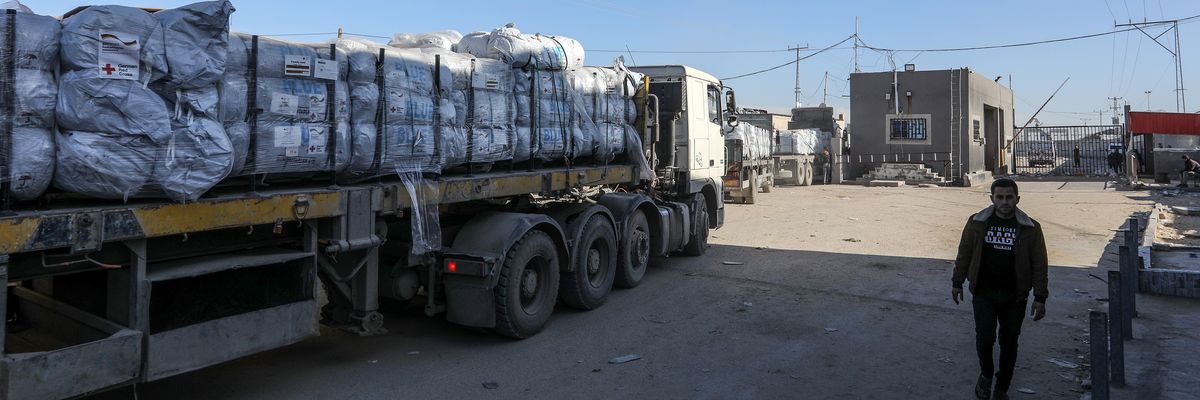
Trucks carrying aid supplies to Gaza are seen at the Karem Abu Salem border crossing on February 17, 2024. (Photo: Abed Rahim Khatib/Anadolu via Getty Images)
The decision demonstrates “why there can be no end to the genocide of Palestinians without an end of Israel’s control over Gaza,” said one human rights lawyer.
With the level of humanitarian aid reaching Gaza residents perilously low and creating what one group last week called “famine-like conditions” throughout the enclave, the United Nations’ top official overseeing relief for Palestinians on Tuesday condemned Israel’s latest reason for blocking a shipment: It included medical scissors for caring for children.
Israel flagged the scissors as a so-called “dual-use” item, suggesting the government feared medical workers in Gaza—where more than 600 attacks on hospitals have pushed the healthcare system toward collapse—would use the scissors as weapons instead of to care for people who have been injured in relentless bombings.
“Medical scissors are now added to a long list of banned items the Israeli authorities classify as ‘for dual use,'” said Philippe Lazzarini, commissioner-general of the U.N. Relief and Works Agency for Palestine Refugees in the Near East (UNRWA). “The list includes basic and lifesaving items: from anesthetics, solar lights, oxygen cylinders, and ventilators, to water cleaning tablets, cancer medicines, and maternity kits.”
#Gaza: an entire population depends on humanitarian assistance for survival. Very little comes in & restrictions increase.
A truck loaded with aid has just been turned back because it had scissors used in children’s medical kits.
The truck carrying the medical kits and other items was turned back a day after 12 Israeli human rights groups condemned the right-wing government of Prime Minister Benjamin Netanyahu for openly violating an order from the International Court of Justice (ICJ) by continuing to obstruct humanitarian aid.
The ICJ issued an interim ruling in January saying that Israel was “plausibly” committing a genocide in Gaza and ordering the government to ensure the delivery of aid.
Mai El-Sadany, executive director of the Tahrir Institute for Middle East Policy in Washington, D.C., said Israel’s latest move to block relief from reaching starving Gaza residents should eliminate any doubt that the government is flouting the ICJ’s order.
If you're somehow still wondering whether Israel is a reliable partner in aid delivery into Gaza + whether it's violating @CIJ_ICJ order on aid delivery, read this:
"A truck loaded with aid has just been turned back because it had scissors used in children’s medical kits." https://t.co/qSVYHrWk7r
The death toll from starvation in Gaza has now reached at least 25 people, mostly children. In what the International Rescue Committee called a “conservative” estimate late last month, at least 1 in 4 households—more than half a million people—are now facing “catastrophic or famine conditions.”
Juliette Touma, director of communications for UNRWA, told Al Jazeera Monday that a minimum of 500 aid trucks daily—the number that entered Gaza each day before the war—are needed to meet the needs of the civilian population. An average of 90 trucks entered the enclave per day in February, with the number as low as seven or nine on some days.
The World Health Organization said Monday that it had reached Al-Ahil Arab Hospital and Al-Sahaba Hospital in northern Gaza with trauma supplies to serve 150 patients over the weekend.
Medical teams there, however, still lack basic necessities to care for people, including “food, fuel, specialized staff, anesthetic drugs, antibiotics, and internal fixation devices,” WHO chief Tedros Adhanom Ghebreyesus said.
George Washington University professor William Lafi Youmans condemned the blocking of the aid truck carrying medical kits as “deplorable” and “nonsensical.”
Human rights lawyer Zaha Hassan of the Carnegie Endowment for International Peace said Israel’s decision underscores the need for an immediate, permanent cease-fire in Gaza and an end to Israel’s occupation of Palestinian territory including Gaza and the West Bank.
“Returning an entire truckload of humanitarian assistance because children’s scissors were part of a medical kit,” said Hassan, “is why there can be no end to the genocide of Palestinians without an end of Israel’s control over Gaza.”