Sanders Rips Trump-Netanyahu for ‘Unraveling International Law’ With War on Iran

Spread the love

Original article by Jessica Corbett republished from Common Dreams under Creative Commons (CC BY-NC-ND 3.0). 

Sen. Bernie Sanders (I-Vt.) speaks at a town hall event on February 20, 2026 in Stanford, California. (Photo by Benjamin Fanjoy/Getty Images)

As evidence of US war crimes mounts, critics around the world argue that “Trump and Hegseth should be sent straight to The Hague to face prosecution.”

As President Donald Trump on Tuesday made what one critic called “the most blasé admission of a war crime by a US president in history,” claiming the Navy sunk an Iranian ship and killed over 100 sailors because it was “more fun” than capturing both, Sen. Bernie Sanders tore into him and Israeli Prime Minister Benjamin Netanyahu over their illegal war on Iran.

“The attacks on Iran by the United States and Israel are unraveling international law, the Geneva Conventions, and the legitimacy of the United Nations. This is extremely dangerous for the future of the planet and humanity,” Sanders (I-Vt.) said in a statement.

RECOMMENDED…

President Donald Trump oversees Iran assault

Experts Pillory Trump Case for War on Iran: ‘Flimsiest Excuse for Initiating a Major Attack’ in Decades

War on Iran ticker

‘The Behavior of Rogue States’: Global Revulsion as US and Israel Launch War on Iran

While both the Republican-controlled Senate and House of Representatives have refused to pass a war powers resolution to stop the assault, experts worldwide have argued the assault violates the US Constitution, which gives Congress the authority to declare war, and UN Charter, which prohibits the use of force against another state unless it is a “necessary and proportionate” act of self-defense or is authorized by the Security Council.

“If the United States and Israel have the right to launch a unilateral attack against Iran, what is the moral or legal argument against China invading Taiwan, Russia attacking Poland, or North Korea launching missiles into South Korea? There is none,” warned Sanders, who has supported war powers resolutions on Iran, Venezuela, and the president’s boat bombing campaign. “In Trump’s world, any nation has the ‘right’ to go to war against any other nation for any reason.”

“After the horrors of World War II, the international community came together to establish international law—a system of rules designed to prevent aggressive wars and hold nations accountable for violating basic human rights,” said the senator, whose father lost relatives in the Holocaust. “Trump and Netanyahu are destroying that effort and are pushing the global community back into international anarchy—a world that produced 10 million dead in World War I and 50 million dead in World War II.”

Sanders argued that “we cannot go back to a world where might makes right—where any nation can invade, bomb, or destabilize another country for any reason they choose. That mentality leaves all of us, and future generations, increasingly unsafe.”

In addition to opposing Trump’s violence at home and abroad, the senator has railed against US complicity in Netanyahu’s genocidal assault on the Gaza Strip, where the death toll continues to rise despite an October ceasefire deal. He even forced multiple unsuccessful Senate votes to cut off some US weapons to Israel over the bloodshed in the Palestinian territory.

Netanyahu not only bombed and starved the Palestinians of Gaza after the Hamas-led October 2023 attack on Israel, he also bombarded Lebanon, claiming to target Hezbollah. While a ceasefire agreement to protect the Lebanese people was reached in November 2024, Israel has returned to attacking the country since launching the assault on Iran last month.

More than 1,300 Iranians are now dead, including multiple political leaders as well as around 175 people, mostly children, killed in what increasingly appears to have been a US strike on a girls’ elementary school in Minab. US Defense Secretary Pete Hegseth told reporters that Tuesday would “be yet again our most intense day of strikes inside Iran.”

Meanwhile, Jostein Hauge, an assistant professor at the UK’s University of Cambridge, noted on social media Tuesday that “the Minab school massacre in Iran—carried out by the US government—is one of the deadliest school massacres in modern history.”

He put the US president and Pentagon chief in a class with not only Netanyahu but also former Israeli Defense Minister Yoav Gallant, Russian President Vladimir Putin, and former Sudanese President Omar al-Bashir, who are all wanted by the Hague-based International Criminal Court.

“Trump and Hegseth should be sent straight to The Hague to face prosecution for war crimes, alongside Netanyahu, Gallant, Putin, and al-Bashir,” Hauge said.

While the American public is already enduring some economic fallout of Trump’s war on Iran, at least seven US troops have paid with their lives. Eight more “remain listed as severely injured,” according to chief Pentagon spokesperson Sean Parnell. “Since the start of Operation Epic Fury, approximately 140 US service members have been wounded over 10 days of sustained attacks.”

Democratic Sens. Tammy Baldwin (Wis.), Cory Booker (NJ), Tammy Duckworth (Ill.), Tim Kaine (Va.), Chris Murphy (Conn.), and Adam Schiff (Calif.)—with whom Sanders caucuses—have launched a renewed effort to force new votes on war powers resolutions if Senate Majority Leader John Thune (R-SD) refuses to hold committee hearings on Iran.

“Now is the time for Democrats to use all the leverage we have to try to stop this unnecessary war,” they said Monday in a joint statement to Semafor. The senators added that Hegseth and Secretary of State Marco Rubio “must immediately come before Congress for a public hearing and explain why we’re in this war, how it will end, and why they are prioritizing billions of dollars on an open-ended war instead of lowering costs for American families.”

Original article by Jessica Corbett republished from Common Dreams under Creative Commons (CC BY-NC-ND 3.0). 

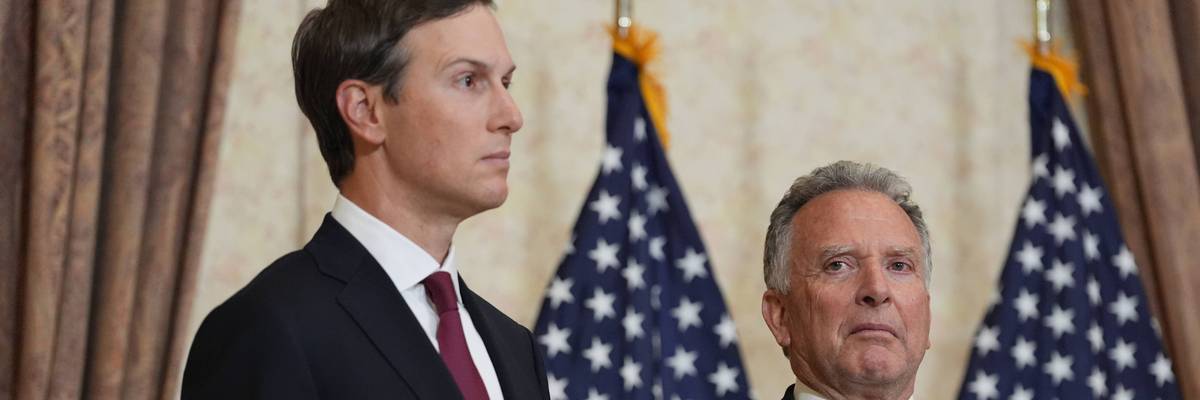
Keir Starmer explains that UK is participating defensively in Trump and Israel's criminal war for Israel's genocidal expansion in Iran and states that he supports Zionism "without qualification".
Keir Starmer explains that UK is participating defensively in Trump and Israel’s criminal war for Israel’s genocidal expansion in Iran and states that he supports Zionism “without qualification”. Starmer said it here:  https://www.jewishnews.co.uk/keir-starmer-interview-i-will-work-to-eradicate-antisemitism-from-day-one/
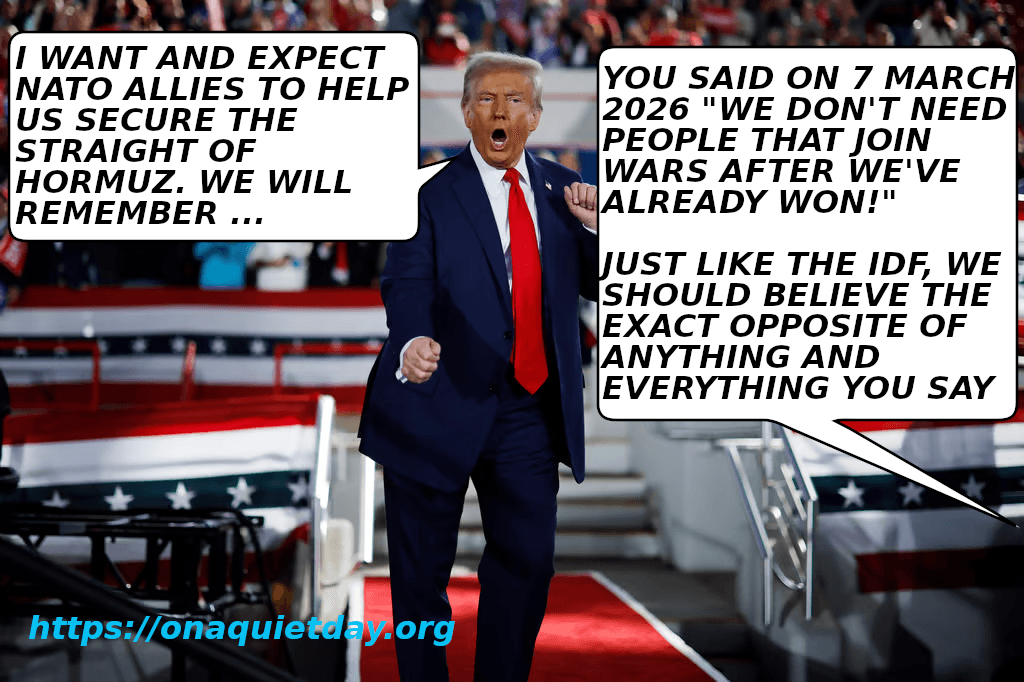
Donald Trump explains why he established his Bored of Peace
Orcas discuss rotting brain. Front Orca says "Wish someone would lock him up".
Orcas discuss rotting brain. Front Orca says “Wish someone would lock him up”.

From Your Site Articles

Continue ReadingSanders Rips Trump-Netanyahu for ‘Unraveling International Law’ With War on Iran

Trump: War with Iran is ‘very complete’, says he has someone in mind to replace Mojtaba Khamenei

Spread the love

This work by Middle East Monitor is licensed under a Creative Commons Attribution-NonCommercial-ShareAlike 4.0 International License

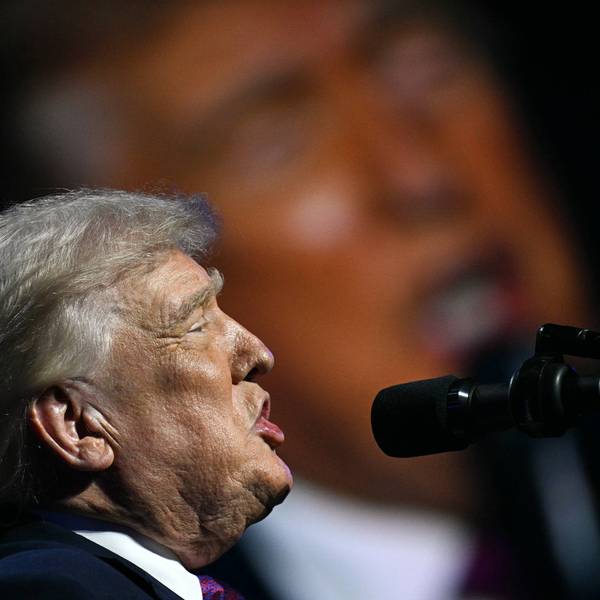
U.S. President Donald Trump gives a speech in Washington, United States, on March 02, 2026. [Kyle Mazza – Anadolu Agency]

US President Donald Trump said the war with Iran is “very complete”, claiming that the country’s naval, air and communications capabilities have been destroyed, and revealing that he has someone in mind to replace the new Supreme Leader Mojtaba Khamenei if he is assassinated.

Speaking in remarks reported by US media, Trump said: “I think the war is very complete, pretty much. They have no navy, no communications, no air force.”

He added that he has “somebody in mind to replace Mojtaba Khamenei”, but did not reveal the person’s identity.

Separately, Western media reported that Trump had told his advisers he would be ready to support the assassination of the new Iranian Supreme Leader if he refuses to meet US demands.

According to The Wall Street Journal, citing US officials on Monday, Trump told aides he would back the killing of Khamenei if he declined to comply with American demands, including ending Iran’s nuclear programme.

However, the newspaper said that Israel — not the United States — would be expected to carry out any direct assassination of the Iranian leader.

READ: Iran’s Assembly of Experts selects Mojtaba Khamenei as new Supreme Leader

This work by Middle East Monitor is licensed under a Creative Commons Attribution-NonCommercial-ShareAlike 4.0 International License

Keir Starmer explains that UK is participating defensively in Trump and Israel's criminal war for Israel's genocidal expansion in Iran and states that he supports Zionism "without qualification".
Keir Starmer explains that UK is participating defensively in Trump and Israel’s criminal war for Israel’s genocidal expansion in Iran and states that he supports Zionism “without qualification”.
Orcas discuss rotting brain. Front Orca says "Wish someone would lock him up".
Orcas discuss rotting brain. Front Orca says “Wish someone would lock him up”.
Donald Trump warns against following the https://onaquietday.org blog, says that it's easy atm, she only needs to report war crimes supporting Israel's genocidal expansion.
Donald Trump warns against following the https://onaquietday.org blog, says that it’s easy atm, she only needs to report war crimes supporting Israel’s genocidal expansion.

Continue ReadingTrump: War with Iran is ‘very complete’, says he has someone in mind to replace Mojtaba Khamenei

Minab school bombing: what evidence is there that the US was responsible?

Spread the love

https://www.theguardian.com/global-development/2026/mar/10/iran-minab-school-bombing-shajareh-tayyebeh-primary-what-evidence-us-responsible

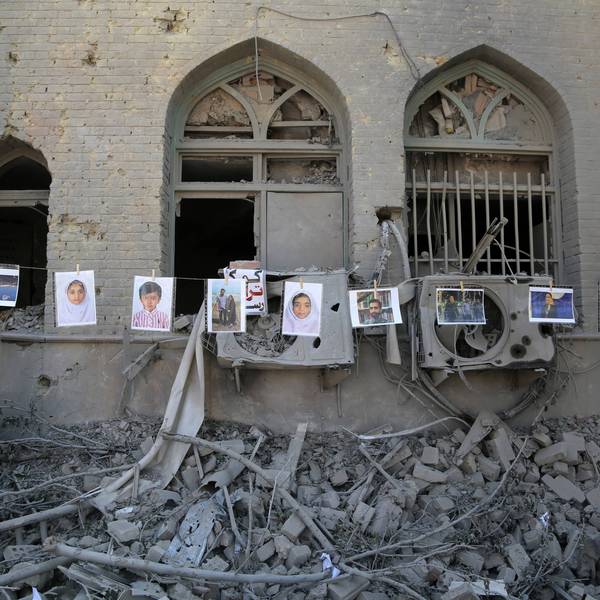
Rescue workers and residents search through the rubble in the aftermath of the strike on Shajareh Tayyebeh primary school. Photograph: AP

Trump has blamed Iran for the mass killing at Shajareh Tayyebeh primary school but geolocation, videos and satellite imagery indicate otherwise

The bombing of a primary school in Minab on 28 February killed scores of people, most of them seven- to 12-year-old girls. The strike is the worst mass killing of the US and Israel’s war on Iran so far – and has been described by Unesco as a “grave violation” of international law.

On Saturday, the US president, Donald Trump, declared that Iran was responsible for the school bombing. “In my opinion, based on what I’ve seen, that was done by Iran … they’re very inaccurate, as you know, with their munitions. They have no accuracy whatsoever. It was done by Iran.”

The president presented no evidence for his claim. His assertion has not been repeated by spokespeople for the US military, who have said only that they are “investigating” the bombing.

But a growing body of evidence indicates that the strike on the Shajareh Tayyebeh primary school was carried out by the US. Here is what we know – and why it points to the US being responsible.

Original article continues at https://www.theguardian.com/global-development/2026/mar/10/iran-minab-school-bombing-shajareh-tayyebeh-primary-what-evidence-us-responsible

Donald Trump warns against following the https://onaquietday.org blog, says that it's easy atm, she only needs to report war crimes supporting Israel's genocidal expansion.
Donald Trump warns against following the https://onaquietday.org blog, says that it’s easy atm, she only needs to report war crimes supporting Israel’s genocidal expansion.
Orcas discuss rotting brain. Front Orca says "Wish someone would lock him up".
Orcas discuss rotting brain. Front Orca says “Wish someone would lock him up”.
Keir Starmer explains that UK is participating defensively in Trump and Israel's criminal war for Israel's genocidal expansion in Iran and states that he supports Zionism "without qualification".
Keir Starmer explains that UK is participating defensively in Trump and Israel’s criminal war for Israel’s genocidal expansion in Iran and states that he supports Zionism “without qualification”.

Continue ReadingMinab school bombing: what evidence is there that the US was responsible?

When Tel Aviv decides, Washington fights

Spread the love

This work by Middle East Monitor is licensed under a Creative Commons Attribution-NonCommercial-ShareAlike 4.0 International License

U.S. Navy warplane takes off from the aircraft carrier USS Abraham Lincoln during Operation Epic Fury targeting Iran in the Gulf of Oman, on March 01, 2026. [U.S. Navy / Handout – Anadolu Agency]

by Jamal Kanj  jamalkk

American taxpayers are still hemorrhaging from the made-for-Israel war in Iraq, a war audaciously offered as one that would “pay for itself.” Instead, it was paid in Iraqi and American blood, ruins and financed by American debt. The promised democracy was a broken state, regional chaos, and the afterbirth of terror and resistance that continues to metastasize across the Arab world. Marketed as a short, decisive campaign, Iraq became a two-decade-long disaster with no exit in sight. Trillions were burned on lies manufactured by Israel-first Zionists in Washington, while generations of Americans—many not even born when the invasion began—were conscripted into inheriting the debt, the interest, and the moral stain. 

The real balance sheet of that war is etched into nearly 5,000 American tombstones and the endless corridors of veterans’ hospitals. Before that blood-soaked bill is even paid, the very same architect, using the same lies, has succeeded again in dragging the U. S. into another made-for-Israel war, this time against Iran. Iraq was not an aberration; it was a rehearsal. Yet, Iran doesn’t appear to be the final act on the Israeli menu. In recent weeks, former Israeli prime minister Naftali Bennett declared that Turkey is next. And it is the U.S., not Israel, that is expected to keep paying for wars, America neither needed nor chose.

The evidence of who set the clock of this war is unmistakable. The most revealing admission did not come from Tehran, Moscow, or Beijing, but from the U.S. State Department. In an unguarded moment, the U.S. Secretary of State admitted that the timing of this war was not an American choice. This became painfully clear when the State Department was caught unprepared to help evacuate tens of thousands of Americans from the war zone.

As U.S. ambassadors hurried to evacuate their staff and families, desperate citizens were told their government could not assist and were advised to arrange their own departures, after airports had already closed. 

This is not a minor detail. It’s a government that is willing to sacrifice the well-being and security of its citizens by joining a war decided by someone else. It goes to the heart of sovereignty and democratic accountability. A nation that chooses to go to war prepares its people, its diplomacy, and its logistics. A nation that is dragged into war improvises and hopes for the best.

READ: Iran: If attacks on infrastructure do not stop, we will take similar measures

Iran, for its part, is not the caricature often presented by the American Secretary of War and Donald Trump. It is a country prepared for drawn-out conflict and strategic patience. During the nearly eight-year Iran-Iraq War, Tehran fought a grinding, no-win war against a better-armed adversary. Against the expectations of Western military analysts, Iran endured. In a grim irony, it even committed the greatest of all sins: purchasing weapons from Israel, falling into Tel Aviv’s cynical strategy to weaken both Baghdad and Tehran simultaneously. Israel was willing to arm its supposed arch-enemy as part of its broader calculus of exhaustion and division. 

That history matters today. Iran has demonstrated, repeatedly, a willingness to absorb punishment, and extend conflicts over time. At the end of the day, and by all means necessary, Iran is unlikely to surrender. In a protracted war of attrition to bleed the world economy, Tehran could move to close the Strait of Hormuz, an oil blood line for world economies. Iran may be economically battered, and it has been for decades under severe sanctions, but that very weakness reduces its restraint. A country with little left to lose is more inclined to impose pain on others, including Western and neighboring welfare oil economies dependent on uninterrupted energy exports.

Meanwhile, regional instability in the Gulf and prolonged American entanglement create the perfect parasitic symbiosis for Israel: a state that flourishes in the shadows of regional chaos like a scavenger thriving on the scrap of a landfill. 

President Trump has suggested escorting oil shipments in the Strait to keep the oil flowing. The macho bravado may play well on television or for the stock market, but history, old and recent, offers daunting realities. The same was attempted during the Iraq-Iran war in the 1980s but failed. More recently, the U.S., the EU, and Israel combined failed to force a much smaller and poorer country—Yemen—to open the Red Sea. After months of bombardment, siege and naval pressure, Washington was forced into negotiations, and even then, Yemeni forces continued to block vessels linked to Israel until Gaza ceasefire.

The comparison is useful. The shorelines area under the Houthi control of the Red Sea (green map in the link) in the north of Yemen, is a much wider maritime passage. The Strait of Hormuz, by contrast, is so narrow in a clear day each shore is visible from the other. To borrow a simple image, in the Houthi area the width of the Red Sea is an Amazon River and where Hormuz is a stream. The narrowness of the Hormuz Strait makes control easier for Iran and exposes the vulnerability of U.S. naval ships. Before promising to escort commercial shipping, a responsible administration should ask a basic question: if a small, impoverished Yemen could not be subdued by the world’s most powerful militaries, how exactly will American warships be safer under the reach of fire in the narrower Strait?

There is another question Washington refuses to entertain: How will Americans feel when they realize they are risking lives, ships, and economic stability largely to advance Israel’s sole strategic objectives?

This is not an abstract question. It is a political and economic reckoning, purposefully delayed. Especially since Americans are still reeling from the cost of previous Israeli wars, and now, they are asked to take on a new national debt—$200 billion—to bankroll yet another war, especially made for Israel.

READ: Iran’s Assembly of Experts selects Mojtaba Khamenei as new Supreme Leader

The made-for-Israel wars may have begun in Iraq but will not end with Iran. Israeli false flags are poised to provoke further escalations designed to entrap even states traditionally friendly to Tehran, such as Oman. For Israel, victory remains incomplete unless it drags Gulf Arab states into open confrontation with Iran, hardening divisions that may last generations. Iranian mistrust of the Gulf Arabs would likely endure even in the event of regime change. In this calculus, Israel “wins” not only on the battlefield, but by entrenching lasting hostility between Iran and the Arab world, ensuring a permanently fragmented region.

More than two decades ago, the illegal war against Iraq was cooked in the dens of the Pentagon by Israel-first ideologues and sold to the American public through the managed media, ruse and weapons of mass deception. The current war is, in some ways, even more brazen. It was exclusively designed in the war ministry offices of Tel Aviv, and Trump obliged

This is not America’s war. The decision was made elsewhere, and timed elsewhere, fought on behalf of someone else to serve the strategic objectives of a foreign country. Washington has subordinated the American national interest to the tribal agenda of Israeli-firsters inside the Beltway. Simply put: Tel Aviv chooses the war, and Washington pays the bill.

OPINION: India–Israel: An Unholy Alliance and Iran as Act One in the Greater Israel Scheme

The views expressed in this article belong to the author and do not necessarily reflect the editorial policy of Middle East Monitor.

This work by Middle East Monitor is licensed under a Creative Commons Attribution-NonCommercial-ShareAlike 4.0 International License

Keir Starmer explains that UK is participating defensively in Trump and Israel's criminal war for Israel's genocidal expansion in Iran and states that he supports Zionism "without qualification".
Keir Starmer explains that UK is participating defensively in Trump and Israel’s criminal war for Israel’s genocidal expansion in Iran and states that he supports Zionism “without qualification”.
Orcas discuss rotting brain. Front Orca says "Wish someone would lock him up".
Orcas discuss rotting brain. Front Orca says “Wish someone would lock him up”.
Donald Trump warns against following the https://onaquietday.org blog, says that it's easy atm, she only needs to report war crimes supporting Israel's genocidal expansion.
Donald Trump warns against following the https://onaquietday.org blog, says that it’s easy atm, she only needs to report war crimes supporting Israel’s genocidal expansion.

Continue ReadingWhen Tel Aviv decides, Washington fights

Hormuz: The world’s energy fuse

Spread the love

This work by Middle East Monitor is licensed under a Creative Commons Attribution-NonCommercial-ShareAlike 4.0 International License

Commercial ships anchor off the coast of the United Arab Emirates due to navigation disruptions in the Strait of Hormuz, Dubai on March 2, 2026. [Stringer – Anadolu Agency]

by Alice Johnson  ImAliceJohnson

Off the coast of Fujairah, the scene is not dramatic so much as unsettlingly ordinary: tankers waiting, crews watching, port agents reworking schedules that were meant to be routine. The Strait of Hormuz does not need to be fully “closed” to become a global problem. It only needs to feel unsafe for long enough that insurers raise premiums, shippers hesitate and traders price in panic. When that happens, the shock travels faster than any warship: it reaches supermarket shelves, factory orders and household bills.

That is why the current escalation involving the United States and Israel matters far beyond the Gulf. Policy in Washington and Tel Aviv is repeatedly framed as calibrated and limited. Hormuz is the place where that claim collapses. Around this chokepoint, local military decisions convert almost immediately into global inflation.

The chokepoint that keeps the world running

Hormuz is narrow enough to be vulnerable. At its tightest, it is about 33 kilometres wide, and the safe shipping lanes are much tighter than the map suggests. In practical terms, it is a corridor where miscalculation, drones, mines or missile exchanges can disrupt traffic without any actor formally declaring a blockade.

Its importance is measurable in volumes, not slogans. The US Energy Information Administration (EIA) estimates that in 2024, oil flows through Hormuz averaged about 20 million barrels per day—roughly one-fifth of global petroleum liquids consumption. The same assessment notes that these flows accounted for more than one-quarter of global seaborne oil trade. That is the scale at which “regional” becomes “global”.

Liquefied natural gas is also exposed. EIA estimates that about 20 per cent of global LNG trade transited Hormuz in 2024, with Qatar’s exports forming the core of that flow. If crude is the bloodstream of transport and industry, LNG is increasingly the bloodstream of electricity generation and heating.

The usual reassurance is that pipelines can bypass the strait. They can, but only partially. EIA estimates that only about 2.6 million barrels per day of Saudi and UAE pipeline capacity may be available to bypass Hormuz in a disruption. That is not a substitute for 20 million barrels per day moving by sea. It is a bandage on an arterial wound.

READ: Bangladesh shuts educational institutions to conserve fuel and electricity

“Limited” strikes, unlimited spillover

The most honest way to describe escalation around Hormuz is that it turns risk into a tax on everyone. When shipping slows, energy prices rise; when energy prices rise, everything rises.

Reuters reported that the crisis pushed oil prices sharply higher and drove European gas prices up as much as 40 per cent, while shipping disruption fed into price spikes for widely traded commodities.

A jump like that is not a trader’s story. It becomes a public health story when hospitals face higher power costs, and a household story when families weigh rent against heating. It becomes a political story when governments scramble for energy security, often by making bad deals quickly.

Even countries that do not import Gulf crude directly are pulled in through pricing. Energy is a benchmark input: it sets transport costs, fertiliser production costs and industrial margins. When war-risk premiums rise and routes lengthen, shipping is no longer just a logistics detail; it becomes a brake on the global economy.

This is where US and Israeli policy choices deserve harder scrutiny. When leaders describe operations as “contained” while markets, insurers and shipping lanes treat them as existential risk, the public is being asked to accept two incompatible realities: that escalation is manageable, and that the world must pay to manage it.

Washington’s response has leaned toward managing symptoms rather than removing the cause. The Trump administration considered using US government-backed insurance and financial guarantees to support maritime trade, and floated the prospect of US Navy escorts through Hormuz. That is not de-escalation. It is the normalisation of a war economy around a chokepoint: more escorts, more guarantees, more implicit commitments that increase the chance of an incident spiralling.

It also exports costs. The heaviest exposure to Hormuz flows falls on Asian and European consumers, not on the decision-makers who set the tempo. If policy imposes inflation abroad while insulating itself from the worst effects, the incentive to take risks becomes dangerously distorted.

Strategic recklessness and the erosion of restraints

Hormuz also exposes how quickly legal and democratic constraints weaken under the pressure of “urgent” military narratives.

In the United States, the War Powers framework exists to stop a president from sliding into war on momentum alone. Yet congressional oversight has repeatedly lagged behind events. A war powers resolution in the House failed, even as the War Powers law sets a sixty-day clock unless Congress authorises continued hostilities. That pattern matters because it removes a key restraint: the requirement to define objectives, limits and an exit.

READ: Iran: If attacks on infrastructure do not stop, we will take similar measures

International law is strained in parallel. If major powers treat the UN Charter’s limits on the use of force as optional, the precedent does not remain in the Gulf; it becomes a template others will use. Reuters’ legal explainer captured the core critique: that the strikes test presidential authority and raise serious questions under international law’s standards for lawful force.

This is not a morality lecture. It is a practical warning. When norms erode, chokepoints become leverage. The world moves closer to a system where shipping lanes are “secure” only for those with the power to enforce their interpretation of security. That is a recipe for permanent instability.

Hormuz as a symbol of fragile interdependence

Hormuz is more than a place. It is a symbol of how modern life is built: just-in-time supply chains, tightly priced energy, global freight networks that assume predictable routes.

When tankers stall, they are not only carrying crude. They are carrying electricity supply for power plants, feedstock for medicines and plastics, fertiliser inputs that show up later in food prices. When war-risk premiums surge, it is not only oil majors who pay. It is the commuter, the small business and the family already budgeting against inflation.

That is why the language of “limited action” is so misleading here. Hormuz does not allow a clean separation between military aims and civilian consequences. Even brief escalation can produce months of economic pain, and economic pain is never evenly distributed.

The responsible course is not to militarise the strait further and hope deterrence holds. It is to lower the temperature: restore meaningful congressional oversight over the use of force, recommit to international legal constraints and treat maritime security as a shared international interest rather than a stage for unilateral power.

Hormuz is a test of responsible policy and global governance. It asks a simple question that leaders rarely answer directly: who is allowed to gamble with the world’s economic stability, and who pays when the gamble goes wrong?

OPINION: Freedom does not arrive on a cruise missile

The views expressed in this article belong to the author and do not necessarily reflect the editorial policy of Middle East Monitor.

This work by Middle East Monitor is licensed under a Creative Commons Attribution-NonCommercial-ShareAlike 4.0 International License

Keir Starmer explains that UK is participating defensively in Trump and Israel's criminal war for Israel's genocidal expansion in Iran and states that he supports Zionism "without qualification".
Keir Starmer explains that UK is participating defensively in Trump and Israel’s criminal war for Israel’s genocidal expansion in Iran and states that he supports Zionism “without qualification”.
Orcas discuss rotting brain. Front Orca says "Wish someone would lock him up".
Orcas discuss rotting brain. Front Orca says “Wish someone would lock him up”.
Donald Trump warns against following the https://onaquietday.org blog, says that it's easy atm, she only needs to report war crimes supporting Israel's genocidal expansion.
Donald Trump warns against following the https://onaquietday.org blog, says that it’s easy atm, she only needs to report war crimes supporting Israel’s genocidal expansion.

Continue ReadingHormuz: The world’s energy fuse