Green party leader Zack Polanski stands with party members at King’s Place in London, after he was picked as the Green Party candidate for the Holborn and St Pancras by-election, Friday September 11, 2026
GREEN Party leader Zack Polanski accused Labour today of “running scared,” following reports that Prime Minister Andy Burnham will delay announcing his decision on drilling in the Jackdaw gas field until after the Holborn and St Pancras by-election.
Mr Polanski, who was announced today as his party’s candidate in the election on October 8, said that Labour had “started the campaign with an act of dishonesty and betrayal.”
He argued: “They are clearly going to allow new drilling in the North Sea but want to keep it under wraps during a byelection where they know the public want tougher action on climate, not backsliding.
“Labour talks about change, but this is change for the worse. We have a climate crisis, but Labour is taking the side of fossil fuel corporations….”
UK Prime Minister Andy Burnham says that he’s going to permit the Jackdaw and Rosebank North Sea fossil fuel projects. He urges you to ignore facts and reality and be a climate science denier like himNigel Farage urges you to ignore facts and reality and be a climate science denier like him and his Deputy Richard Tice. He says that Reform UK has received £Millions and £Millions from the fossil fuel industry to promote climate denial and destroy the planet.Donald Trump urges you to be a Climate Science denier like him. He says that he makes millions and millions for destroying the planet, Burn, Baby, Burn and Flood, Baby, Flood.
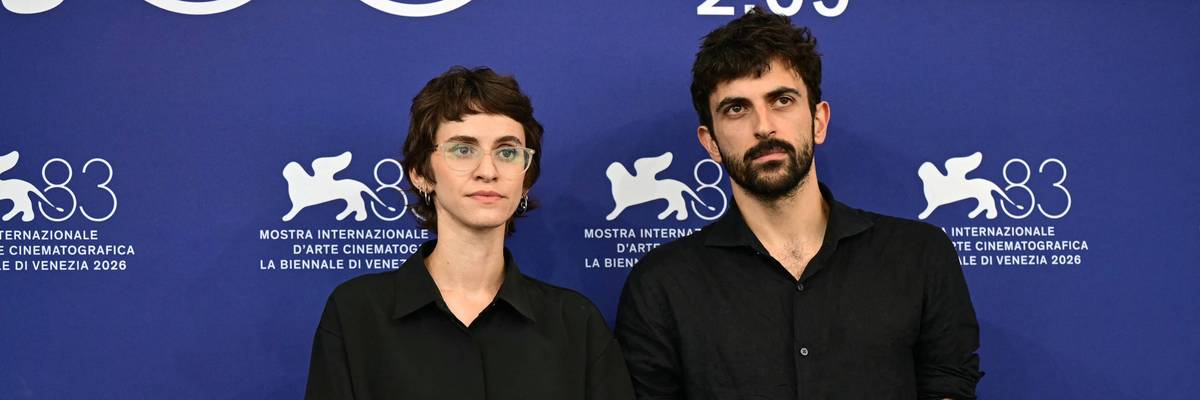
NAZA co-directors Rachel Szor and Yuval Abraham attend the photo call for their documentary at the 83rd International Venice Film Festival, at Venice Lido on September 10, 2026. (Photo by Stefano Rellandini/AFP via Getty Images)
The directors of the film—which premiered at the Venice Film Festival—said they “felt the responsibility” to expose insider testimony about Israel’s systematic mass killing of Palestinians.
“We really are looking at… a system of killing, which is mass killing [and] relies on mass surveillance,” Abraham told reporters in Venice on Thursday. “We felt the responsibility as Israelis to use our position… to bring insider testimony into how the system looks like from the inside… And this is the film that we made.”
Szor said that “a lot of these things are also, it’s important to say… known because they’ve been documented by journalists, Palestinian journalists, in Gaza. It’s footage that has been out there.”
“But I think that we felt that there is still some sort of an importance to take those testimonies and put it in a film in a way that, of course, first of all, it’s different to hear,” she added. “The people who designed and operated those systems talk about it in front of a camera.”
According to the film, one former member bluntly said that the unit’s mission was to “thwart peace.”
However, Abraham and Szor said their purpose was not to expose a handful of rogue soldiers, but to examine the machinery and policies behind the violence.
The documentary’s title refers to an Israeli military acronym used to quantify the civilians expected to be killed in an attack—a chilling bureaucratic shorthand for people often referred to as collateral damage, or, in the so-called “War on Terror” still being waged by the United States 25 years after the September 11, 2001 attacks, “bugsplat.”
The film’s sources describe artificial intelligence-assisted targeting, mass surveillance, and the hacking of mobile phones to identify alleged Hamas operatives, sometimes despite the known presence of family members and other civilians.
Israeli forces have operated under loosened rules of engagement that effectively permit the killing of an unlimited number of civilians when targeting even a single low-ranking Hamas member. The Israel Defense Forces utilizes cutting-edge AI technology to select targets at a far faster rate than humans alone could, and destroys them with weapons including 1,000- and 2,000-pound bombs—many supplied by the US.
The result has been the killing and wounding of more than 250,000 Palestinians since the Hamas-led attack of October 7, 2023. Most of the victims have been civilians, including more than 21,500 children killed and tens of thousands more disabled or wounded.
Netanyahu and former Israeli Defense Minister Yoav Gallant are wanted by the International Criminal Court in The Hague for alleged crimes against humanity and war crimes in Gaza, including murder and forced starvation. Israel is facing an ongoing genocide case filed by South Africa at the International Court of Justice—also in The Hague—and formally supported by nearly 20 nations.
Abraham and Szor are best known internationally for co-directing with two others the film No Other Land, which chronicled ethnic cleansing of Palestinians from the illegally occupied West Bank by Israeli settlers and soldiers. The film won the 2025 Academy Award for best documentary feature.
NAZA—which reportedly received a 25-minute standing ovation at its Venice premiere—is the sole documentary among the films competing for the festival’s famed Golden Lion. It joins a growing body of recent films about the Gaza genocide.
American Doctor, directed by Poh Si Teng, follows US physicians working inside Gaza hospitals amid Israel’s deliberate destruction of the strip’s medical and healthcare systems.
Last year’s The Voice of Hind Rajab offered a harrowing mix of acted scenes and the actual 70-minute audio recording of a 5-year-old Palestinian girl’s desperate final phone call to Palestine Red Crescent Society personnel amid an Israeli massacre of her family as they were trapped in a car under tank fire.
Keir Starmer objects to criticism of the IDF. He asks how could anyone object to them starving people to death, forced marches like the Nazis did, bombing Gaza’s hospitals and universities, mass-murdering journalists, healthworkers and starving people queuing for food, killing and raping prisoners and murdering children. He calls for people to stop obstructing his genocide for Israel. New Labour UK Prime Minister Andy Burnham continues Labour party policy of active support and complicity in Israel’s genocide.
The change in policy is a direct result of sustained pressure from activists and organisers across the Palestine movement. But what comes next?
…
We can certainly retain our anger at the government’s complicity. No sanction can offset the foreign policy decisions made by the former prime minister Keir Starmer and former foreign secretary David Lammy, the repression of domestic pro-Palestine advocacy, or the sheer loss of life. But we must balance this with cautious optimism that the political tide is turning.
…
The necessary next step is a full arms embargo and an end to cooperation with Israeli security forces – to truly have teeth, these sanctions must not take with one hand and then give with another. Miliband has said that “we’ve already suspended over 30 arms licences used by the IDF in Gaza. That suspension remains fully in place”, and that the government will “now also refuse all licence applications for arms and other exports that materially contribute to the occupation”. But components of F-35 jets continue to be exported to Israel and used for operations in Gaza, as are surveillance technologies such as drones and radar made in the UK by Elbit Systems. This is a total dereliction of duty by the British government.
Miliband’s announcements were a necessary reminder that a just political future is possible and, within it, a reckoning with past crimes. As a campaigner, I have borne witness to Israel’s most egregious human rights violations: I have documented Israeli settlers committing pogroms against the community of Al-Mufaqara, sat in Palestinian villages threatened with home demolitions and army raids, and witnessed the ongoing daily misery of Israel’s apartheid policies. This has all strengthened my motivation to see the end of the Israeli occupation.
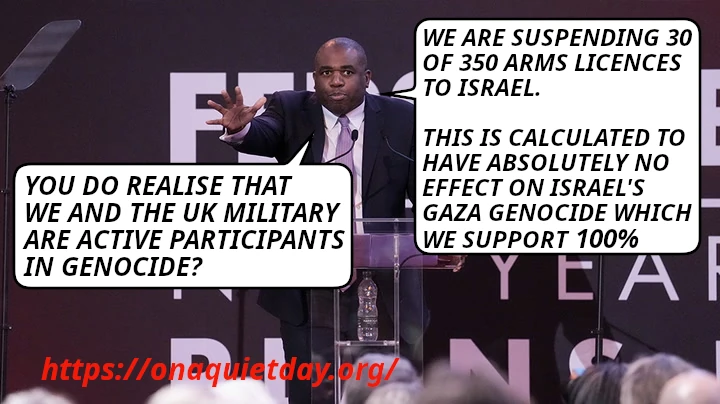
Genocide denier and Current UK Prime Minister Keir Starmer is quoted that he supports Zionism without qualification. He also confirms that UK air force support has been essential in Israel’s mass-murdering genocide. Includes URLs https://www.declassifieduk.org/keir-starmers-100-spy-flights-over-gaza-in-support-of-israel/ and https://youtu.be/O74hZCKKdpAKeir Starmer objects to criticism of the IDF. He asks how could anyone object to them starving people to death, forced marches like the Nazis did, bombing Gaza’s hospitals and universities, mass-murdering journalists, healthworkers and starving people queuing for food, killing and raping prisoners and murdering children. He calls for people to stop obstructing his genocide for Israel. New Labour UK Prime Minister Andy Burnham continues Labour party policy of active support and complicity in Israel’s genocide.Genocide denying UK Foreign Secretary David Lammy says that UK is suspending 30 of 350 arms licences to Israel. He also confirms the UK government’s support for Israel’s Gaza genocide and the UK government and military’s active participation in genocide.
This work by Middle East Monitor is licensed under a Creative Commons Attribution-NonCommercial-ShareAlike 4.0 International License.
U.S. Ambassador to Israel Mike Huckabee delivers a press statement during his visit to the town of Turmus Ayya, northeast of Ramallah in West Bank, Palestine, on September 5, 2026. [Issam Rimawi – Anadolu Agency]
US Ambassador to Israel Mike Huckabee has warned that British trade measures against products from Israeli settlements in the occupied West Bank could backfire and harm economic ties between the two countries.
Speaking to reporters on Tuesday, Huckabee said the British measures were likely to have “repercussions”, which he described as “very negative”, and argued that they would not achieve London’s intended goal.
The US ambassador said several US states, including Florida, have laws that could restrict trade with entities that take similar measures against Israel.
He warned that British restrictions on a US ally such as Israel could affect British companies, saying the measures could prompt US countermeasures that would limit some British companies’ ability to operate commercially in US states.
Huckabee also questioned the motives behind Britain’s policy towards Israel, asking why London puts this kind of pressure on Israel rather than other countries.
“Is the UK also putting the same kind of “very strong sanctions” on North Korea, China or Russia?” he said, adding: “I don’t know why Israel is being singled out for this kind of attention.”
Donald Trump calls for help from NATO allies in securing the Strait of Hormuz despite saying on 7 March 2026 that they don’t need people to join wars after they’ve already won. He’s challenged with the claim that he lies as much as the IDF.Climate science denier Donald Trump confirms that he knows nothing about democracy and that more liquid gold is being secured according to his policy of policy of global privateering.
Prime Minister Andy Burnham departs 10 Downing Street, London, to attend his first Prime Minister’s Questions at the Houses of Parliament, September 9, 2026
BRITAIN is proud to be leading the way in challenging the Israeli occupation of Palestine, Prime Minister Andy Burnham told MPs today.
Speaking in the Commons a day after Foreign Secretary Ed Miliband had announced sweeping sanctions against Israeli settlements and denounced terrorist “ethnic cleansing” in Palestine, Mr Burnham said: “Britain is showing leadership.
“Words from any politician about a two-state solution will be only words if it’s not backed with action. And leadership is about taking action.
“Britain has to stand for something. Britain has to show leadership. Britain has to stand for fairness against injustice.
“Where people are being bullied out of their homes, intimidated, we will always stand with the underdog and take what action we can to support them.
“That is leadership on the world stage, Britain being true to what it’s always been about.”
Mr Miliband himself, basking in broad approval for his measures from Labour MPs for both his commitment to the new policy and for assembling support from France, Canada and elsewhere for it, brushed aside overwrought criticism of the sanctions from chief rabbi Ephraim Mirvis, who had claimed they were “a dark day for British Jews.”
The Foreign Secretary said: “I’m a proud British Jew, and I don’t agree with the chief rabbi.
“I believe that it must be possible to do what we did, which is to stand up for British values of the rule of law, of dignity for people, of the prevention of injustice, and do so in a way, as I did yesterday, to say to anyone in our country who holds British Jews responsible for the actions of the Israeli government, that is antisemitism, pure and simple.”
He made it clear that British firms and potentially Israeli banks involved in the construction or financing of illegal West Bank settlements would be hit by the sanctions.
“We are seeking to cut off the supply of the supply lines of British finance, British construction, for settlement expansion,” Mr Miliband said.
“This is about a clear purpose, which is to draw a line in the sand and to stop this infinite, ever-expanding settlement expansion.”
He also shrugged off as “regrettable” counter-measures announced by the Netanyahu government, including the closing of the British consulate in Jerusalem and the banning of 11 MPs from visiting Israel.
“I would prefer that Israel hadn’t announced what it did, but overall, I strongly believe that what we did, along with other international allies, was absolutely the right thing to do,” the Foreign Secretary said.
The MPs sanctioned stressed it would change nothing in their attitudes and actions.
Your Party parliamentary leader Jeremy Corbyn said in a statement: “I have visited all parts of Palestine on several occasions, where I have witnessed the horrors of occupation, as well as the resilience and humanity of the Palestinian people.
“They are the ones who suffer from Israel’s apartheid.
“Israel doesn’t want the world to see what it is doing — but we can never give up in our attempts to expose the truth.
“That is the real scandal. Israel’s genocide cannot go unpunished — and I will keep speaking up for peace, freedom and justice for the Palestinian people.”
Fellow Your Party MP Zarah Sultana said: “Israel has just banned me from entering.
“Given that this is a fascist government presiding over genocide, apartheid and an illegal occupation, I’ll wear it as a badge of honour.
“I will not be intimidated into silence. I will continue to speak out against Israel’s genocide and against the UK’s complicity. If anything, this ban only strengthens my resolve to keep speaking out.”
She added: “One day, I look forward to visiting Jerusalem not as an occupied city, but as part of a free and liberated Palestine.”
Bradford West MP Naz Shah called the list “rather random and, frankly, bizarre” and said she was “proud of the UK government’s actions today, taken in line with our international legal obligations.”
She pledged to continue to campaign for a two-state solution in Palestine.
Labour MPs John McDonnell, Diane Abbott and Richard Burgon were also on the list and all five Green MPs were sanctioned by Israel.
The Green Party said: “We will not be bullied into silence by the Israeli government.
“We are proud of our MPs for standing up for Palestinian rights and demanding an end to British complicity in genocide and illegal occupation.
“Banning our representatives only strengthens our resolve. The British government must stand firm and follow these overdue restrictions with a full arms embargo and wide-ranging sanctions.”

 Green party leader Zack Polanski stands with party members at King’s Place in London, after he was picked as the Green Party candidate for the Holborn and St Pancras by-election, Friday September 11, 2026