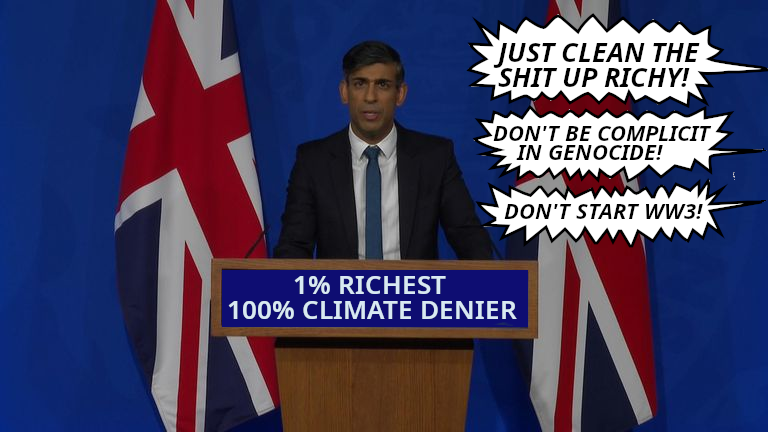
Rishi Sunak is UK’s Prime Minister following the appalling former Tory Prime Ministers Boris Johnson and Liz Truss. Johnson was elected in the 2019 general election despite wide recognition that speaking truth was alien to him. He got kicked out over the Partygate scandal – that he was partying at number 10 and repeatedly denying it during the Covid lockdowns. There is a further scandal still developing about enriching Tories with government contracts for excessively expensive inaquate Personal Protective Equipment (PPE) during Covid. Liz Truss was deposed following her ‘bonkers’ budget* that took from the poor to give to the rich and forced the Bank of England to intervene.
Rishi Sunak, UK’s janitor prime minister.
Rishi Sunak was quickly installed by the Conservatives as a ‘caretaker’, janitor or interim prime minister to replace Liz Truss. Not elected as prime minister he doesn’t have a mandate to do anything. He’s a Neo-Con climate denier providing huge fossil fuel subsidies for foreigners to take North Sea oil and a Zionist actively supporting and therefore very complicit in Israel’s genocide of Gaza.
* It wasn’t called a budget. Liz Truss and her chancellor Kwasi Kwarteng called it a statement to avoid scrutiny by the Office of Budget Responsibility.
Keir Starmer gives a keynote speech marking the four-year anniversary of the 2019 election, at Silverstone Technology Park, near Milton Keynes, Buckinghamshire, December 12, 2023
LABOUR will recognise a Palestinian state when it gets permission from Israel to do so, Sir Keir Starmer has announced in his latest abandonment of progressive international commitments.
Ditching a policy dating back a decade to Ed Miliband’s leadership, the Labour leader has announced that the party in government will no longer join nearly 140 other countries around the world in recognising the state of Palestine.
According to a report in the Jewish Chronicle, Sir Keir said at the weekend that “recognition has to be part of a process, and an appropriate part of the process.”
What that meant was spelt out by shadow foreign office minister Wayne David, who said Labour would “recognise the state of Palestine at a point which will help the peace process once negotiations between Israel and Palestine and the others are taking place.”
Calling Labour’s previous position of recognition of Palestine independently of any supposed peace process “T-shirt politics,” Mr David elaborated that recognition had to come to “fruition in a way which is acceptable to the state of Israel.
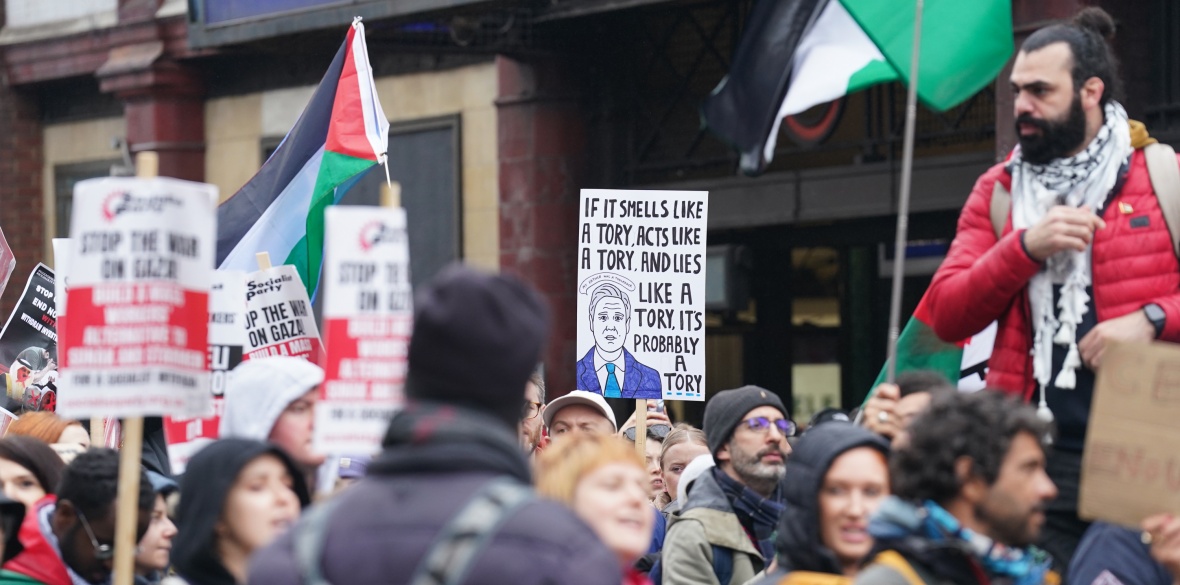
People demonstrate outside the constituency office of Labour Party leader Keir Starmer, in north west London, during a Palestine Day of Action demonstration, November 18, 2023
THAT there is a sense of inevitability about Keir Starmer’s abandonment of Labour’s commitment to recognise a Palestinian state should not diminish outrage at the move.
Ditching the pledge, first made under Ed Miliband’s leadership of Labour, is all of a piece with the party’s unequivocal support for imperialism under Starmer’s leadership.
It comes as other policies — to stop arms sales to Saudi Arabia or to give MPs a vote before Britain undertakes military action — are also junked in a bonfire of progressive demands.
But the abandonment of a commitment to join 139 other countries around the world in recognising the state of Palestine is particularly brutal and cynical.
…
In this situation to abandon a policy Labour has championed for a decade is not to assist the cause of peace, it is to green-light Israeli aggression.
The IDF carries out raids to destroy tunnels in Central Gaza, killing dozens. Hamas fires rockets back into Israel. A ground invasion follows aerial bombardments, civilian targets are struck, the number killed climbs into the thousands. This is not a description of the Israel-Hamas war we’re witnessing now, in 2024 – but a near-identical one almost 15 years ago.
In December 2008, the Gaza War (also known as Operation Cast Lead) erupted. On 9 January 2009, the UN Security Council debated a resolution which called for “an immediate, durable and fully respected ceasefire”. The UK voted for it, successfully shifting the US position from opposition to abstention, and the vote was reinforced at the UN General Assembly on January 16. Two days later, Israel declared a unilateral ceasefire, and the war was over. Bold and creative diplomacy by the UK, which whilst they didn’t follow up in a similar vein, nonetheless made a significant difference on the international stage.
Fast forward to today, 100 days since the October 7 Hamas terror atrocities in Israel, and that diplomacy is sorely lacking. In early December, the UK Government committed a grave error by abstaining on a ceasefire motion at the UN Security Council – the lesson of history wasted. It then abstained again a week later in a UN General Assembly vote – making the UK just one of 33 countries to oppose or abstain on the ceasefire motion, while 153 countries voted in favour.
These past 15 years have witnessed five wars – consigning the people of Gaza to ever deteriorating living conditions with barely enough supplies and aid allowed in; the stalemate continues, undermining still further the security of Israel. But with violence spreading through the region into Lebanon, for example, and now the UK and US escalating tensions with their bombing of Yemen, we must make it inconceivable to slip back permanently into endless cycles of violence.
Listening to experts on all sides, there seem to be four key principles that might just start a conversation about how to build the kind of peace which only a fair and lasting political resolution to this crisis can deliver for the people of the region.
Securing a bilateral ceasefire is clearly a critical first principle – ending the current bloodshed and freeing the remaining Israeli hostages is a pre-requisite for peace. As the UN repeatedly states, the bombs and missiles being dropped aren’t just killing people in their tens of thousands; they are also destroying roads, warehouses, hospitals, schools and other so-called safe places.
No wonder so many aid agencies on the ground have gone beyond calling for humanitarian corridors, pauses or safe zones. The size and population density of Gaza mean there is nowhere safe for civilians, and no safe means for aid workers to reach people who urgently need help. The only way to ensure men women and children can escape the bombs is to stop them from being dropped.
The humanitarian case for a ceasefire is overwhelming, but there is a judicial one too – which brings me to the second principle of accountability. Both the Israeli Government and Hamas have responsibilities under international law – above all to minimise civilian casualties, but also only a ceasefire will enable the ICC to conduct investigations into potential war crimes and other human rights violations by both parties, and to establish an Independent Commission of Inquiry.
The UK Government says the right things about adherence to international law, yet very little has changed, and accountability has not been delivered.
Fundamental to this principle is that international law forms the foundations on which all policies must rest both about the conduct of the hostilities and the necessary foundations of a lasting settlement. All parties to this conflict must fulfil the requirements of international law and face the full force of censure and other sanctions if they refuse to do so. The UK’s actions are badly out of step with its legal and moral obligations – it must consistently uphold the international rule of law and make sure Benjamin Netanyahu’s government faces the full consequences of violating international law. Nor should it be involved in any further military action in the region, when this can and will be interpreted as condoning and siding with Israel’s attacks on Gaza.
Thirdly, there has to be dialogue. I understand the rationale behind states refusing to negotiate with terrorist groups. But ensuring lines of communication with Hamas are kept open – along with every back and front channel accessible via the other players in this region, such as Qatar – is the only way to bring the remaining Israeli hostages home to their families and enduring peace.
Clearly the US has the greatest influence over Israel, but the UK can play a critical role too, as the 2009 UN vote demonstrated – our links with Qatar and Egypt should be used to pull every lever possible in support of a consensus on Israel’s right to exist and a Palestinian state. Conversations must happen for peace to be on the table.
It takes courage to start a dialogue – especially when even a shared goal feels unattainable, let alone a peaceful outcome, and murderous regimes like Iran are also involved. But from Northern Ireland and Colombia, talking has secured positive and lasting outcomes. No dialogue is the death of peace. We must believe in it and shake hands for it, as Nurit Cooper, one of the Israeli hostages, so memorably did on her release.
Finally, we must directly confront the complexities that have made peace so elusive to date. My inbox is bursting with different versions of what has brought us to this point – the facts and the feelings. Nuance and debate have been lacking in an era of judgment and condemnation. Those marching for peace are decried as hateful, places of worship are attacked, and our streets have become places where too many people feel afraid.
Laying the groundwork for peace requires acknowledging how people truly feel. A truth and reconciliation process might be one model. Every Palestinian and Israeli has their own story, their own hurt and their own hopes. Here in the UK, this conflict awakens strong feelings too – so we must weigh the impact of our words, as well as the arms we are still supplying to the region, the bombs we are now ourselves dropping on war ravaged Yemen. The UK must stop repeating the same mistakes and instead bring the alternatives to life.
Decades of suffering and Western backed military intervention have acted as potential recruiting sergeant for the likes of Hamas and the Houthis.
Hunger, isolation and hopelessness are among the conditions in which conflicts thrive. So achieving peace demands that the world address these challenges – and only in the context of a settlement that embodies justice, above all the end to occupation.
An ideology cannot be destroyed by guns and bombs. It can only be destroyed by giving people food and medicine, alongside justice and a more hopeful future in which they are treated with dignity – guaranteeing them freedom and a voice.
The eyes of the world may well be on this narrow strip of land right now, but they’ve been largely absent as Gazans have been forced to live in an open prison, systematically stripped of their dignity and freedom, by both the Israeli authorities and by Hamas. We mustn’t let our gaze turn away again.
It’s often said that waging peace is far more difficult than waging war. But we have no choice if we’re to build a safer and more secure world for every child, no matter which side of a border they are born.
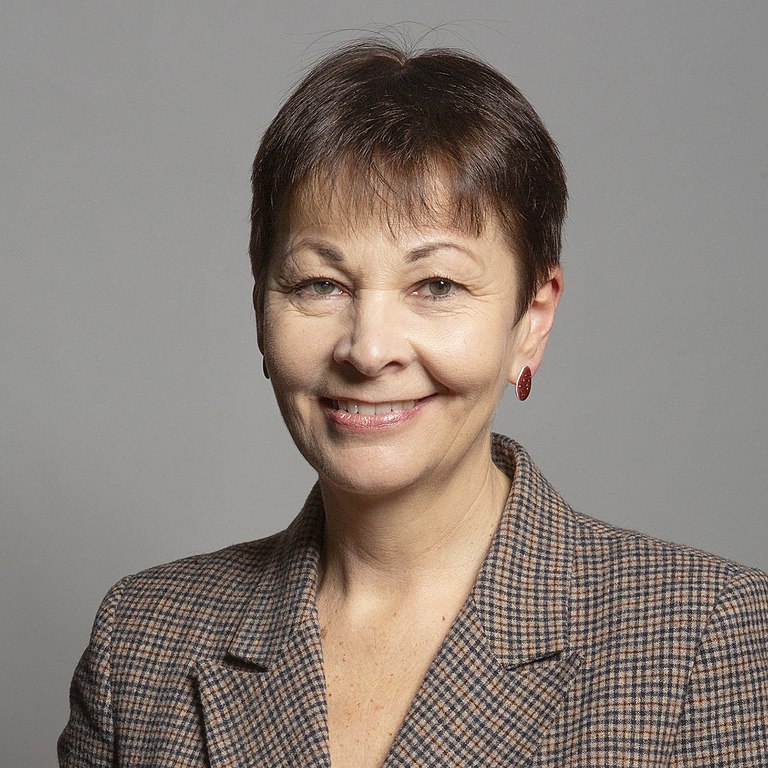
Caroline Lucas Green Party MP for Brighton Pavilion. Official image by David Woolfall Creative Commons Attribution 3.0 Unported license.
Caroline Lucas is the Green Party MP for Brighton Pavilion
I’ve quoted all Caroline Lucas’s article, hope that nobody objects. Authors: It’s likely that you are able to use a Creative Commons licence despite being published by others.
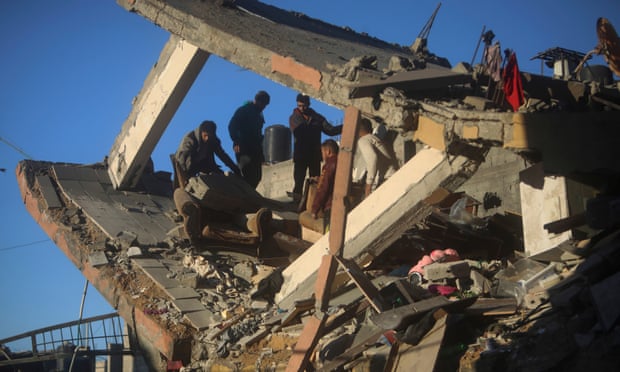
Palestinians inspect the damage caused by an Israeli airstrike on Khan Younis on 7 January. Photograph: Mohammed Dahman/AP
Experts say submission to international court of justice on Myanmar six weeks ago makes stance ‘wholly disingenuous’
The UK is facing accusations of double standards after formally submitting detailed legal arguments to the international court of justice in The Hague six weeks ago to support claims that Myanmar committed genocide against the Rohingya ethnic group through its mass mistreatment of children and systematically depriving people of their homes and food.
…
Tayab Ali, the head of international law at Bindmans, said the significance of the UK’s submission on Myanmar “lay in showing the importance the UK attaches to adherence to the [UN] Genocide Convention and in showing the UK took a wide, and not a narrow, definition of acts of genocide, and the intent to commit genocide. It also made clear that the court should take into account risks to life after a ceasefire caused by disabilities, inability to reside in their homes and wider injustices.
“It would be wholly disingenuous if the UK, six week after advancing such a significant and broad definition of genocide in the case of Myanmar, now adopts a narrow one in the case of Israel.”
South Africa is likely to highlight the UK’s arguments about Myanmar, submitted in conjunction with Canada, Germany, Denmark, France and the Netherlands, when it makes its high-stakes accusation of genocide against Israel.
Victim of repeated smears and even a discredited prosecution is planning a bid at the next Ilford North parliamentary election, say locals
Syed Siddiqi, the former Labour member repeatedly abused, harassed and smeared by right-wing Labour figures in Ilford in north London, is planning to stand against right-winger Wes Streeting in the next Ilford North parliamentary election, according to local sources.
In 2018, Streeting also launched a ‘disgraceful’ and ‘disgusting’ tirade in the face of Diane Abbott, Britain’s first Black woman MP, leaving Abbott ‘shell-shocked’. If he stands, Syed Siddiqi can expect considerable support from outraged former Labour supporters around the country who would be delighted to see Streeting ejected.