No wonder England’s water needs cleaning up – most sewage discharges aren’t even classified as pollution incidents
Spread the love
oneSHUTTER oneMEMORY/Shutterstock

Alex Ford, University of Portsmouth

England’s privatised water industry may one day be considered a textbook case study of failed corporate responsibility, regulation and governance. The Cunliffe review, the recent report into England’s privatised water industry, concluded that the financial regulator, OfWat, needs to be disbanded and a new water regulator will be introduced.

For that to work effectively, better pollution monitoring and more clearly defined pollution incident criteria are essential. While politicians and water companies have claimed to be reducing pollution incidences, they might not strictly be tackling sources of pollution, so communications must be carefully scrutinised for disinformation.

The UK’s environment minister Steve Reed MP has described the water industry as “broken”. The public have rising water bills. Water companies owe over £60 billion in debts and have left the country with uncertain water security in the face of climate change.

The Environment Agency (EA) in England recently announced that serious pollution incidents in 2024 rose by 60% to 75 from 47 in the previous year. The EA classifies pollution incidents using a four-point scale called the common incident classification scheme. Trained EA officers consider the evidence reported via their incident hotline to assess its credibility and severity.


Get your news from actual experts, straight to your inbox. Sign up to our daily newsletter to receive all The Conversation UK’s latest coverage of news and research, from politics and business to the arts and sciences.


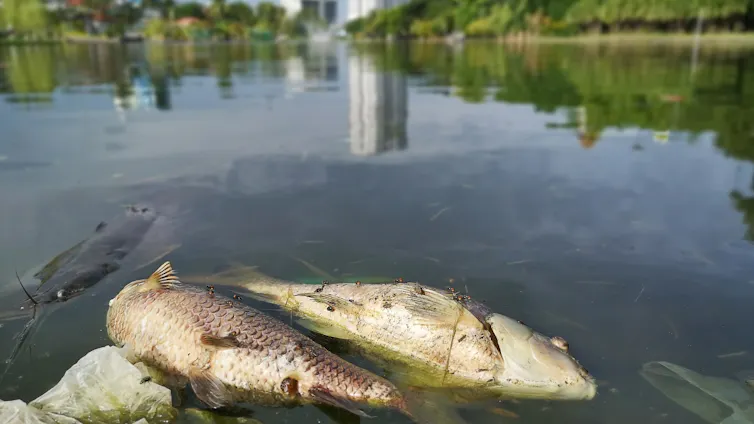
Category 1 is for major incidents, 2 for significant, 3 for minor incidents and 4 for no impact. Category 1 and 2 typically involve visible signs of dead fish floating. For salmon, if more than 10 adult or 100 young fish are dead, this is category 1. With fewer than ten adult and 100 young fish dead, it’s category 2.

No dead fish, no serious problem? The EA can also record damage on protected habitats as “pollution incidents” but these are harder to substantiate without investigative research that takes time and money.

Last year, more than 450,000 sewage discharges were recorded by event duration monitors. These are devices fitted to the end of overflow pipes that indicate when and for how long they have been discharging.

These discharges represent 3.6 million hours of untreated sewage going into our rivers and coasts. These contain chemical contaminants including pharmaceuticals, detergents and human pathogens. Only 75 incidents were recorded as serious or significant in 2024. Another 2,726 were classed as minor.

So lots of sewage discharges are not being classified as pollution incidents, despite containing pollutants. The EA advises its investigating officers to “record substantiated incidents that result in no environmental impact, or where the impact cannot be confirmed, as a category 4”.

The EA has been criticised for turning up late to 74% of category 1 and 2 pollution incidents and for being pressured to ignore low-level pollution – all claims that they have denied. However, they admit they are constrained by finances. Any new regulator must be adequately resourced and independent.

pollution from pipe out into environment
Pollution isn’t always classified as an official pollution incident. YueStock/Shutterstock

In their recent report into pollution incidences, the EA states that they respond to all category 1 and 2 (serious and significant) water industry incidents and will be increasing their attendance at category 3 (minor) incidents. They highlight that more inspections will identify more issues. This shows some acceptance that the more incidents they attend, the more would be substantiated or recorded appropriately.

Most sewage discharges would not have been reported to, or recorded by, the EA as pollution incidents because they were permitted discharges from combined stormwater overflows. Water companies are allowed to discharge untreated wastewater under exceptional rainfall or snowfall conditions to prevent sewage backing up through the pipes.

Extra water flow in rivers from rainfall is meant to dilute chemical contaminants in wastewater. However, some discharges can last days or weeks. The EA is currently investigating whether water companies have been breaching their permits and discharging untreated wastewater when there is low or even no rainfall.

What counts as pollution?

The UN classifies pollution as “presence of substances and energy (for example, light and heat) in environmental media (air, water, land) whose nature, location, or quantity produces undesirable environmental effects”. This definition differs markedly from the EA’s working definition of pollution incidents.

Many sewage discharges containing low concentrations of pollutants won’t kill fish but might still be harmful to fish larvae or small insects, for example.

However, the broad picture from EA data is that invertebrate communities at least are in a better state than they were three decades ago before wastewater treatment plants were upgraded following the EU’s Urban Wastewater Directive.

Some pollutants bioaccumulate through the food chain, so they become concentrated in top predators such as orcas. Some chemicals mimic reproductive hormones even in low concentrations and can feminise fish, for example. High levels of nutrients from agriculture and sewage in rivers can cause fungal diseases in seagrass meadows.

Other families of chemicals build up in wildlife and people, such as persistent “forever chemicals”, much of which comes from wastewater discharges. Continued discharges of antibiotics into waterways might not be classified as pollution incidents but still pose a substantial risk to human and ecosystem health through bacteria developing antibiotic resistance.

The government has just committed to cut sewage pollution by 50% by December 2029 based on 2024 data. But it’s not yet clear whether these involve cutting the frequency of discharges, the duration or both.

This data could also be manipulated so that a large number of small discharges can be consolidated into one official discharge event. Currently, the volume of discharges from stormwater overflows isn’t known. Without this vital data we can’t ascertain the risk posed by their contaminants.


Don’t have time to read about climate change as much as you’d like?
Get a weekly roundup in your inbox instead. Every Wednesday, The Conversation’s environment editor writes Imagine, a short email that goes a little deeper into just one climate issue. Join the 45,000+ readers who’ve subscribed so far.


Alex Ford, Professor of Biology, University of Portsmouth

This article is republished from The Conversation under a Creative Commons license. Read the original article.

Continue ReadingNo wonder England’s water needs cleaning up – most sewage discharges aren’t even classified as pollution incidents

Scientists for XR occupy the Bank of England lobby

Spread the love

https://morningstaronline.co.uk/article/scientists-xr-occupy-bank-england-lobby

 Scientists occupy the lobby of the Prudential Regulation Authority (PRA), part of the Bank of England, July 23, 2025

FIVE scientists occupied the Bank of England today, demanding that fossil fuel investments be treated as high-risk in the banking and insurance sectors through the implementation of regulatory standards known as capital requirements.

The Extinction Rebellion action saw scientists occupy the lobby of the Prudential Regulation Authority (PRA) as employees filed into the building to start their day.

Protesters held signs reading: “Climate tipping points = economic risk” and “Ecosystem collapse is financial collapse, capital requirements for fossil fuels now.”

The protest took place during the PRA’s public consultation on climate risk in insurance and banking.

https://morningstaronline.co.uk/article/scientists-xr-occupy-bank-england-lobby

Donald Trump urges you to be a Climate Science denier like him. He says that he makes millions and millions for destroying the planet, Burn, Baby, Burn and Flood, Baby, Flood.
Nigel Farage urges you to ignore facts and reality and be a climate science denier like him. He says that Reform UK has received millions and millions from the fossil fuel industry to promote climate denial and destroy the planet.
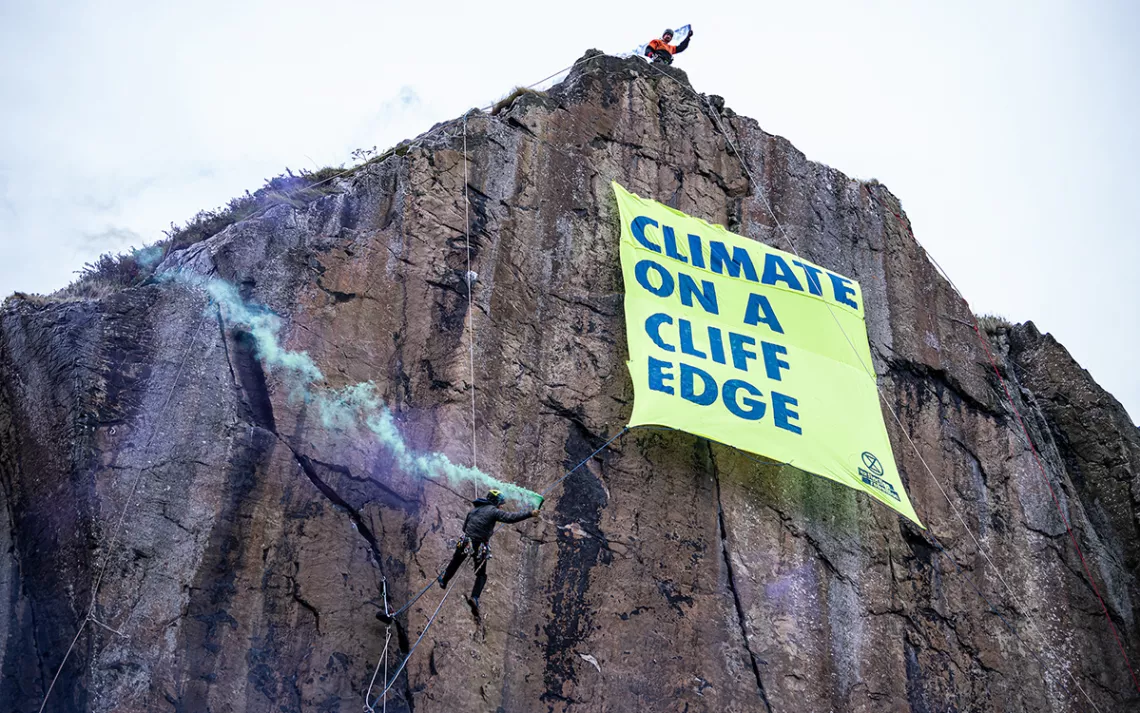
Experienced climbers scale a rock face near the historic Dumbarton castle in Glasgow, releasing a banner that reads “Climate on a Cliff Edge.” One activist, dressed as a globe, symbolically looms near the edge, while another plays the bagpipes on the shores below. | Photo courtesy of Extinction Rebellion and Mark Richards
Continue ReadingScientists for XR occupy the Bank of England lobby

Green Party reaction to water review

Spread the love
Green Party Co-leader Adrian Ramsay. Wikipedia CC.

Responding to the Jon Cunliffe review into the water sector in England and Wales which calls for Ofwat to be replaced by a single regulatory body, co-leader of the Green Party, Adrian Ramsay MP, said:

“Expecting a different form of regulation to fix the water industry is, frankly, rearranging the deck chairs on the Titanic. Not only that but the majority of the public are going to be expected to pay more in bills, as we watch the industry continue to sink under the failed model of privatisation.

“The government deliberately left out the option of public ownership from the review, but that’s the only real way to get the water industry to clean up its act, end millions being siphoned off for huge CEO salaries and shareholder dividends and instead see this money invested into ending sewage dumping and fixing leaks.”

Continue ReadingGreen Party reaction to water review

The US Environmental Protection Agency’s retreat from science endangers the health of people and the planet

Spread the love
Andromeda stock/Shutterstock

Scott Glaberman, University of Birmingham; H. Christopher Frey, North Carolina State University, and Tamara Tal, Helmholtz Centre for Environmental Research-UFZ

Pollution causes more illness and early death than any other environmental threat, accounting for one in six deaths worldwide. For decades, the US Environmental Protection Agency’s (EPA) Office of Research and Development (ORD) has driven many of the biggest advances for safeguarding human health and ecosystems from chemicals. Now, this scientific research office is being closed down by the US government

Earlier this year, the Trump administration began dismantling the office by terminating programmes, cutting staff, closing laboratories and moving remaining scientists into regulatory offices. Legal challenges temporarily blocked mass government layoffs.

But that changed when a recent Supreme Court ruling gave the Trump administration the green light to proceed with widespread redundancies and the total elimination of ORD.


Get your news from actual experts, straight to your inbox. Sign up to our daily newsletter to receive all The Conversation UK’s latest coverage of news and research, from politics and business to the arts and sciences.


Now, in so doing, the US is not just gutting its own scientific foundation. It’s also putting decades of global progress in chemical safety, pollution control and public health at risk.

ORD is the EPA’s independent science arm, conducting research that supports clean air, water and land. From detecting pollutants and assessing health risks to guiding environmental cleanup, it ensures EPA decisions are grounded in credible, evidence-based research. ORD develops this science under intense scientific, policy, political and legal scrutiny, which means it produces the best available science that is credible and robust.

ORD doesn’t just study pollution, it uncovers threats before they become crises. Take North Carolina’s Cape Fear River, which supplies drinking water to an estimated 2 million people.

While most scientists focused on known pollutants, ORD used advanced screening tools to detect GenX, a little-known synthetic “forever chemical”. Despite evidence that GenX was contaminating the river basin since the 1980s, not much was known about its potential to harm living systems.

waterfront by cape fear river, sunny blue skies
Forever chemicals were found to be polluting North Carolina’s Cape Fear River in the US. Kosoff/Shutterstock, CC BY-NC-ND

ORD rapidly filled this void, linking GenX to decreased birth weight and increased mortality in newborn rats, prompting swift regulatory action against the manufacturer to ensure cleaner, safer water for local communities. No other government agency in the world delivers this kind of rapid, science-led response.

It’s not just the strength of ORD’s science that sets it apart, but also its visionary thinking. Among ORD’s most influential ideas is a model that maps out how a chemical is causing harm.

This works like a chain of building blocks, linking tiny effects (like a chemical disrupting a hormone) to much bigger problems, such as cancer or even extinction. Each step shows how one change leads to another until it reaches something we truly care about. This approach helps scientists detect danger early, before it leads to irreversible damage.

Then there’s the EPA’s groundbreaking work in computational toxicology. Nearly two decades ago, leading scientists warned that chemical safety testing relied too heavily on outdated methods and animal experiments.

In response, ORD built ToxCast, a system that uses tiny cells and computer models to screen thousands of chemicals for effects like endocrine disruption or cell damage. It’s faster, cheaper and more humane, and helps scientists predict which substances may pose serious risks.

These scientific breakthroughs don’t come from policy offices. They require researchers with the independence to explore and innovate.

Beyond the US

Europe has bold goals to phase out animal testing. Much of the science driving this shift comes from ORD.

Tools like Ecotox (the world’s largest chemical toxicity database) and the CompTox dashboard (a platform that links predictive models and non-animal test data for over a million substances) are widely used across the EU and UK. Without ORD, these vital resources, hosted by EPA, could disappear, stalling global progress toward safer, more ethical chemical testing.

EPA also collaborates closely with European partners. It maintains formal agreements and joint programmes with the European Chemicals Agency and the UK’s Department for Environment, Food and Rural Affairs. Areas of focus include air quality, computational toxicology and chemical risk assessment.

ORD has been a leading scientific institution with global reach. Its tools and ideas have shaped how governments detect hazardous chemicals, understand their effects, and protect people and the planet. From toxicity databases to modern, non-animal testing methods, ORD has underpinned how we respond to pollution. Eliminating it could create a dangerous void, just as chemical and climate threats are accelerating.

Don’t have time to read about climate change as much as you’d like?
Get a weekly roundup in your inbox instead. Every Wednesday, The Conversation’s environment editor writes Imagine, a short email that goes a little deeper into just one climate issue. Join the 45,000+ readers who’ve subscribed so far.


Scott Glaberman, Associate Professor of Comparative Toxicology, University of Birmingham; H. Christopher Frey, Glenn E. Futrell Distinguished University Professor of Environmental Engineering, North Carolina State University, and Tamara Tal, Mechanistic Toxicology Group Leader, Helmholtz Centre for Environmental Research UFZ and Professor of Integrated Systems Toxicology, Helmholtz Centre for Environmental Research-UFZ

This article is republished from The Conversation under a Creative Commons license. Read the original article.

Donald Trump urges you to be a Climate Science denier like him. He says that he makes millions and millions for destroying the planet, Burn, Baby, Burn and Flood, Baby, Flood.
Nigel Farage urges you to ignore facts and reality and be a climate science denier like him. He says that Reform UK has received millions and millions from the fossil fuel industry to promote climate denial and destroy the planet.
Neo-Fascist Climate Science Denier Donald Trump says Burn, Baby, Burn.
Continue ReadingThe US Environmental Protection Agency’s retreat from science endangers the health of people and the planet

Pollution figures ‘the latest indicator of a water sector in total chaos’

Spread the love

https://morningstaronline.co.uk/article/pollution-figures-latest-indicator-water-sector-total-chaos

 A tanker pumps out excess sewage from the Lightlands Lane sewage pumping station in Cookham, Berskhire

CALLS to nationalise the water sector intensified yesterday after it emerged that serious pollution incidents in England jumped by 60 per cent last year.

The Environment Agency reported 75 major incidents that fell under categories one and two, which can severely harm the environment and human health.

Serious incidents doubled from 14 to 33 at crisis-hit Thames Water, the watchdog found.

Southern Water was responsible for 15 of the incidents and Yorkshire Water for 13.

Pollution incidents across all categories had increased by 29 per cent, with 2,801 recorded last year. 

Thames Water recorded the most incidents again at 523, followed by Anglian Water (482) and United Utilities (376).

The rise was attributed to underinvestment in new infrastructure, poor asset maintenance and reduced resilience due to the impacts of climate change. 

We Own It founder Cat Hobbs said the figures “are the latest indicator of a water sector in total chaos.

“The roots of this chaos extend all the way back to when Thatcher privatised water in the 1980s — effectively flogging the family silver for a quick buck.

“Since then, private shareholders have stuffed their pockets with gold, amassing £80 billion in payouts. 

“They’ve killed our rivers and let the infrastructure crumble, while bill-payers pick up the tab.

“Recent research shows that the cost of public ownership could be close to zero. This solution could also save the public £3-5bn a year, making publicly owned water a source of income for the Treasury.”

Article continues

Continue ReadingPollution figures ‘the latest indicator of a water sector in total chaos’