Labour’s disability benefit cuts will impact an estimated 800,000 people, of whom half will lose their PIP entirely
More than half of disabled people with daily living needs in parts of England and Wales could lose their benefits under the government’s welfare cuts, the Big Issue can reveal.
Analysis of data from the Department for Work and Pensions (DWP), which was published in response to a written parliamentary question from Liberal Democrat work and pensions spokesman Steve Darling, shows that at least half of all current claimants of the personal independence payment (PIP) daily living allowance in ten constituencies could lose this benefit under the government’s plans, which MPs are set to vote on next month.
These include highly deprived Labour seats such as Tipton and Wednesbury and Wolverhampton South East – the constituency of senior cabinet minister Pat McFadden. Meanwhile the least affected constituencies tend to be those with much lower deprivation levels such as Guildford – although even here, more than a third of PIP daily living claimants are at risk from the cuts.
The most exposed constituency is Boston and Skegness, where 52% of claimants are at risk. The seat is represented in parliament by Reform UK’s deputy leader Richard Tice. Polling for the Big Issue recently found that 68% of Reform voters believe Labour is failing on poverty.
…
The DWP’s dataset is detailed, showing what proportion of current PIP daily living claimants with each type of disability scored under four points in all daily living assessment categories, putting them at risk from Labour’s plans:
There are 97 seats where at least 80% of PIP daily living claimants with arthritis are at risk, peaking at 87% in Derbyshire Dales
Almost three-quarters of claimants with cardiovascular disease in North Cotswolds could lose out under the cuts
More than 70% of claimants with multiple sclerosis and neuropathic diseases in Lewisham East and Sheffield Heeley are exposed to the rule change
The Joseph Rowntree Foundation has published an interactive breakdown of the figures by constituency, though not including figures for the overall PIP caseload in each seat.
Global yields of wheat are around 10% lower now than they would have been without the influence of climate change, according to a new study.
The research, published in the Proceedings of the National Academy of Sciences, looks at data on climate change and growing conditions for wheat and other major crops around the world over the past 50 years.
It comes as heat and drought have this year been putting wheat supplies at risk in key grain-producing regions, including parts of Europe, China and Russia.
The study finds that increasingly hot and dry conditions negatively impacted yields of three of the five key crops examined.
Overall, global grain yields soared during the study period due to technological advancements, improved seeds and access to synthetic fertilisers.
But these yield setbacks have “important ramifications for prices and food security”, the study authors write.
Grain impacts
Most parts of the world have experienced “significant” yield increases in staple crops since the mid-20th century.
The new study notes that, in the past 50 years, yields increased by 69-123% for the five staple crops included in the research – wheat, maize, barley, soya beans and rice.
But crop production is increasingly threatened by climate change and extreme weather. A 2021 study projected “major shifts” in global crop productivity due to climate change within the next two decades.
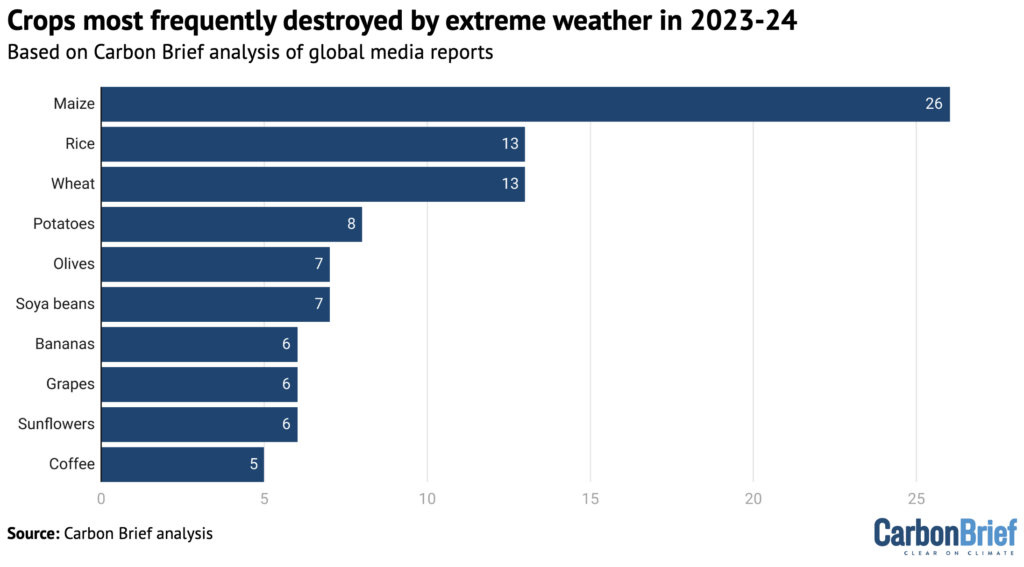
Earlier this year, Carbon Brief mapped out news stories of crops being destroyed around the world by heat, drought, floods and other weather extremes in 2023-24. Maize and wheat were the crops that appeared most frequently in these reports.
The crops that appeared most frequently in media reports of extreme weather impacts analysed by Carbon Brief, ranked in order of most to least frequent: maize, wheat, rice, potatoes, soya beans, olives, bananas, grapes, sunflowers and coffee. Credit: Carbon Brief.
Hot and dry weather is currently threatening wheat crops in parts of China, the world’s largest wheat producer, Reuters reported this month.
In the UK, wheat crops are struggling amid the “driest start to spring in England for almost 70 years”, the Times recently reported. Farm groups say some crops are already failing, the Guardian said.
As a result, global wheat supplies are “tight”, according to Bloomberg, with price rises possible depending on weather conditions in parts of Europe, China and Russia.
Food security and prices
The study uses climate datasets, modelling and national crop statistics from the UN Food and Agriculture Organization to assess crop production and climate trends in key grain-producing countries over 1974-2023, including Argentina, Brazil, Canada, China, the EU, Russia and the US.
The researchers assess climate observations and then use crop models to calculate what yields would have been with and without these climate changes.
For example, “if it has warmed 1C over 50 years and the model says that 1C leads to 5% yield loss, we’d calculate that the warming trend caused a loss of 5%”, Prof David Lobell, the lead study author and a professor at Stanford University, tells Carbon Brief.
The study looks at two reanalysis climate datasets that include information on temperature and rainfall over the past 50 years: TerraClimate (TC) and ERA5-Land. (Reanalysis data combines observations with a modern forecasting model.)
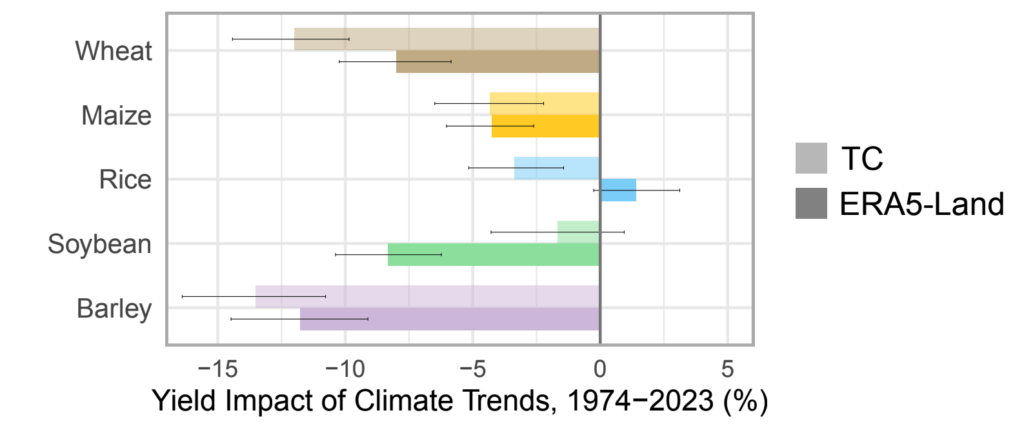
The researchers find that yields of three of the five crops are lower than they would have been without warmer temperatures and other climate impacts in the past 50 years.
Yields were lower than they otherwise would have been by 12-14% for barley, 8-12% for wheat and 4% for maize.
The impacts on soya beans were less clear as there were “significant differences” between data sources. But both datasets show a negative impact on yields, ranging from 2% to 8%.
The effects on rice yields were inconclusive, with one dataset showing a positive effect of around 1% while the other showed a negative effect of about 3%.
The chart below shows the estimated yield impacts for each crop based on the calculations from the two climate datasets.
The estimated percentage impact of climate factors on yields of wheat (brown), maize (yellow), rice (blue), soya bean (green) and barley (purple) from 1974-2023, using two different historical climate datasets. Source: Lobell et al. (2025).
Given soaring overall crop yields during this time, impacts of 4-13% “may seem trivial”, the researchers write. But, they say, it can have “important ramifications for prices and food security” given growing food demand, noting:
“The overall picture of the past half-century is that climate trends have led to a deterioration of growing conditions for many of the main grain-producing regions of the world.”
Water stress and heat
The study also assesses the impacts that warming and vapour pressure deficit – a key driver of plant water stress – have on crop yields.
Vapour pressure deficit is the difference between the amount of water vapour in the air and the point at which water vapour in the air becomes saturated. As air becomes warmer, it can hold more water vapour.
A high deficit can reduce plant growth and increase water stress. The models show that these effects may be the main driver of losses in grain yield, with heat having a more “indirect effect”, as higher temperatures drive water stress.
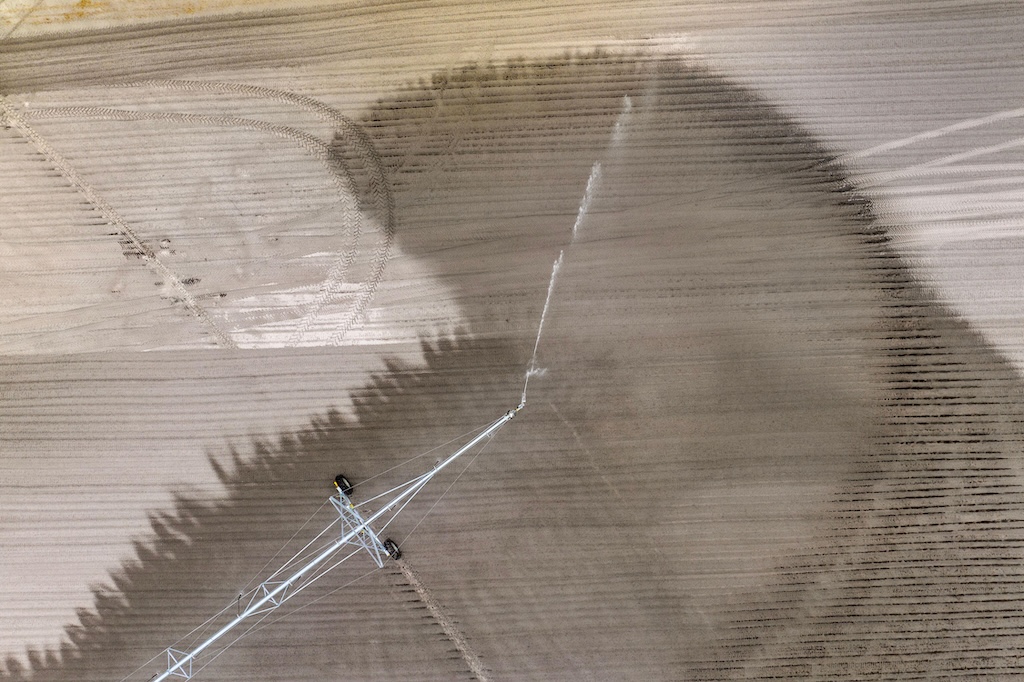
Agricultural irrigation system watering dry soil on a crop field in the US. Credit: Andrii Biletskyi / Alamy Stock Photo.
The study finds that vapour pressure deficit increased in most temperate regions in the past 50 years.
The researchers compare their data to climate modelling simulations covering the past 50 years. They find largely similar results, but notice a “significant underestimation” of vapour pressure deficit increases in temperate regions in most climate models.
Many maize-growing areas in the EU, China, Argentina and much of Africa have vapour deficit trends that “exceed even the highest trend in models”, they write.
The researchers also find that most regions experienced “rapid warming” during the study period, with the average crop-growing season now warmer than more than 80% of growing seasons 50 years ago.
The findings indicate that, in some areas, “even the coolest growing season in the present day is warmer than the warmest season that would have occurred 50 years ago”.
An exception to this is in the US and Canada, they find, with most maize and soya bean crop areas in the US experiencing lower levels of warming than other parts of the world and a “slight cooling” in wheat-growing areas of the northern Great Plains and central Canada.
(The central US has experienced a cooling trend in summer daytime temperatures since the middle of the 20th century, according to the National Oceanic and Atmospheric Administration. There are many theories behind this “warming hole”, which has continued despite climate change.)
CO2 greening
Dr Corey Lesk, a postdoctoral researcher at Dartmouth College who studies the impacts of climate on crops, says these findings are in line with other recent estimates. He tells Carbon Brief:
“There are some uncertainties and sensitivity to model specification here – but it’s somewhat likely climate change has already reduced crop yields in the global mean.”
The study’s “main limitation” is that it is “behind” on including certain advances in understanding how soil moisture impacts crops, Lesk adds:
“Moisture changes and CO2 [carbon dioxide] effects are the largest present uncertainties in past and future crop impacts of climate change. This paper is somewhat limited in advancing understanding on those aspects, but it’s illuminating to pause and take stock.”
The research looks at whether the benefits of CO2 increases during the past 50 years exceed the negative effects of higher levels of the greenhouse gas.
Rising CO2 levels can boost plant growth in some areas in a process called “CO2 fertilisation”. However, a 2019 study found that this “global greening” could be stalled by growing water stress.
Yield losses for wheat, maize and barley “likely exceeded” any benefits of CO2 increases in the past 50 years, the study finds.
The opposite is true for soya beans and rice, they find, with a net-positive impact of more than 4% on yields.
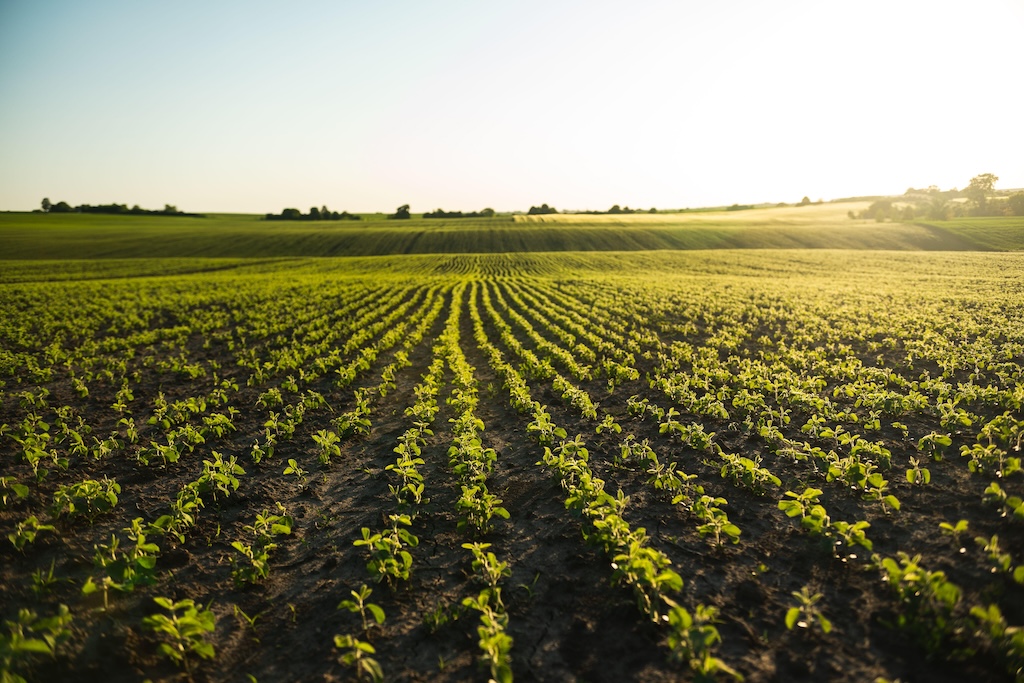
Soya beans growing in a field. Credit: Volodymyr Shtun / Alamy Stock Photo.
Climate science has “done a remarkable job of anticipating global impacts on the main grains and we should continue to rely on this science to guide policy decisions”, Lobell, the lead study author, says in a press release.
He adds that there may be “blind spots” on specialised crops, such as coffee, cocoa, oranges and olives, which “don’t have as much modelling” as key commodity crops, noting:
“All these have been seeing supply challenges and price increases. These matter less for food security, but may be more eye-catching for consumers who might not otherwise care about climate change.”
Lobell et al. (2025), A half-century of climate change in major agricultural regions: Trends, impacts, and surprises, Proceedings of the National Academy of Sciences, doi:10.1073/pnas.2502789122
Neo-Fascist Climate Science Denier Donald Trump says Burn, Baby, Burn.Orcas discuss Donald Trump and the killer apes’ concept of democracy. Front Orca warns that Trump is crashing his country’s economy and that everything he does he does for the fantastically wealthy.
Keir Starmer (left) and Rachel Reeves. The decision to push back the strategy comes amid Treasury cost concerns. Photograph: Jonathan Brady/Reuters
[Guardian] Exclusive: Flagship policy put back until at least autumn amid fears cost of removing two-child benefit cap will outweigh political benefit
Labour’s flagship child poverty strategy has been delayed until at least the autumn, the Guardian has learned, even though tens of thousands more children will fall into poverty as a result.
The decision to push back the strategy comes amid Treasury concerns about the cost implications of ending the two-child limit on universal credit and questions inside No 10 over the political benefits of scrapping it.
The policy, which is being led jointly by Liz Kendall, the work and pensions secretary, and Bridget Phillipson, the education secretary, was due to be published in the spring and had been expected to include a recommendation to scrap the controversial cap.
Keir Starmer has said privately that he wants the option of scrapping the two-child limit kept on the table, and is understood to regard it as a personal priority, as well as a way of demonstrating Labour’s commitment to tackling child poverty and reassuring his backbenchers before a difficult vote on welfare cuts next month. [dizzy: Is there any logic there? How can it be a personal priority if it’s maintained for so long? It’s a fake, manufactured negotiating pawn, something to mollify backbenchers when needed.]
As British prime minister Keir Starmer vowed to “finally take back control of our borders” in a landmark speech on immigration on May 12, it felt a little like déjà vu.
Some nine years earlier, we had heard those exact words repeated over and over in the build-up to the Brexit referendum from former prime minister Boris Johnson and the Leave campaign. It was a refrain also used by Nigel Farage and UKIP.
Of course, this direct reference was the point. Starmer used it to claim that the Labour government’s white paper on immigration was finally going to deliver on what had been promised and desired for many years.
In these opening lines, the tone was set. And as the speech went on, there were echoes of far-right language and ideas reverberating throughout. Starmer lamented the “squalid” state of contemporary politics, the “forces” pulling the country apart, and the previous government’s so-called “experiment in open borders”.
This speech and the white paper that it unveiled are but the latest indication of the rightward direction of travel within UK politics, led by mainstream and far-right parties alike – as exemplified in recent months by the footage released of immigration raids and deportations.
Some will argue this is Labour’s response to the rising threat of Reform UK, with results in the recent local elections seen as evidence of the far right’s growing popularity. So the story goes, Labour is proving that they can be tough on immigration, showing would-be Reform defectors that they can be trusted after all.
This familiar narrative seems to follow a prevailing wisdom which is parroted in political, media and public debates – that appeasing the far right is the way to defeat it. Rather than beating the far right at their own game, however, research shows that these techniques simply legitimise their key talking points and further normalise exclusionary politics.
Starmer’s speech is a case in point. In using “take back control” from the outset, there was no hiding the intended audience or message. Starmer claimed that this project would “close the book on a squalid chapter for our politics, our economy, and our country”, implying that excessive immigration has directly caused these problems and that stopping it solves them. This chimes with classic far-right narratives where migration is framed as the root of all societal ills.
When these kinds of ideas are pushed by those in government, with great authority and influence, they are given greater credence and weight. A strikingly clear example of this came in the summer of 2024 when participants in racist riots waved posters containing the slogan “stop the boats” (a phrase popularised by the previous Tory government).
Another component of the speech that was reminiscent of far-right tropes was the idea that increased immigration was a deliberate tactic by the previous government. Starmer suggested that the Conservatives were actively pursuing a “one-nation experiment in open borders” while deceiving the British public of their intentions.
Far-right conspiracies are often premised on the idea that elites are deliberately encouraging mass immigration. It’s not hard to see how Starmer’s words could act as a dog whistle in this scenario.
These claims are especially damaging when we think about the draconian measures introduced under former Conservative governments, such as the Rwanda policy. Labour is now indicating that these proposals didn’t go far enough.
To justify bringing far stricter immigration rules, Starmer stated that “for the vast majority of people in this country, that is what they have long wanted to see”. As far-right parties so often do, Labour suggests that they are delivering on “people’s priorities”. Yet are they really a priority for people, or are we told that they are a priority which then makes them more of a priority?
Research by Aurelien Mondon, senior lecturer in politics at the University of Bath, illustrates how people’s personal and national priorities differ dramatically. When people in the UK were asked to name the two most important issues facing them personally, immigration didn’t even make it into the top ten.
However, when asked the same question about the issues facing their country, immigration topped the list. How can something that doesn’t affect you in your day-to-day life suddenly become a top priority for your country? We need to challenge the narrative that the government is simply acting on people’s wishes and acknowledge its own capacity to set the agenda.
Other priorities
Some will say that harsher anti-immigration policies are a necessary evil to defeat the far right. However, if people’s personal priorities are really the cost of living, housing and education, why is the government not focusing more of its energy on these things rather than scapegoating migrants?
What’s more, research shows that even based on these terms, these strategies are ineffective and can actually boost the success of the far right electorally. After all, its ideas are being repeatedly normalised.
In all this tactical talk, we lose sight of the fact that people are living the consequences of this rhetoric and policies right now. Rather than focus on Reform’s potential performance in a general election that is probably years away, we should recognise the immediate consequences of the rhetoric that has accompanied this white paper. Even if this did put a dent in Reform’s prospects, what is the meaning of defeating them if the policies they promote become part of the mainstream in the process?
The bottom line is that you do not beat the far right by becoming them. It doesn’t work electorally or ideologically, and even if it did, minoritised communities suffer the consequences regardless. The far right is not some threat lying waiting in the future – its normalisation is happening now.
Elon Musk urges you to be a Fascist like him, says that you can ignore facts and reality then.Keir Starmer says that the Labour Party under his leadership all feel a small part of Scunthorpe.
By pandering to racist representations of immigration and failing to explain it as the inevitable consequence of colonialism, empire and the neoliberal global order, Starmer now shares an ideological position with Nigel Farage.
The plan to end licensed immigration by people contracted to work in the care sector will intensify the crisis in the NHS and make life miserable for people in care.
Care sector employers are upset because it hits their supply of cheap labour and thus their profits.
This illustrates a feature of 21st century immigration into capitalist countries that disrupts both Farage’s narrative and Labour’s imitation of the same.
A migration-enlarged labour force increases precisely those profits — the unpaid wages that employers retain — that would be diminished if they were compelled to train locals and pay them enough to attract a sufficient supply of labour.
A sensible strategy would be to attack Farage for his support for privatisation, his opposition to employment rights, his fawning over Trump and his works, his willingness to flog off the NHS to US corporations.
The most productive approach would be to stand up for what most Reform UK voters want and which they share with most people in our country — public ownership, higher taxes on the rich and an end to the privileges of the plutocracy.