Cutting welfare goes against Labour’s core values – that’s the point
Spread the love
House of Commons/Flickr, CC BY-ND

Tim Bale, Queen Mary University of London

“It’s one thing to say the economy is not doing well and we’ve got a fiscal challenge … but cutting the benefits of the most vulnerable in our society who can’t work, to pay for that, is not going to work. And it’s not a Labour thing to do.”

So says former Labour big beast turned centrist-dad podcaster Ed Balls about the government’s welfare reform proposals. Cue furious nods from all those who were hoping and expecting better – or at least not this – from Keir Starmer and Rachel Reeves.

Reactions like these are wholly understandable. After all, the Labour party has long viewed support for the welfare state as both a flag around which the party can rally, and a stick with which to beat the Conservatives.

But while that may have been the case in opposition, in office things have been a little more complicated.

Going all the way back to the MacDonald and Attlee governments, through the Wilson era, and into the Blair and Brown years, Labour governments have often seen fit to talk and act tough to prove to voters, the media and the markets that they have a head as well as a heart. And if that means upsetting some of their MPs, their grassroots members and their core supporters in the electorate, then so be it.


Want more politics coverage from academic experts? Every week, we bring you informed analysis of developments in government and fact check the claims being made.

Sign up for our weekly politics newsletter, delivered every Friday.


Welfare encompasses a raft of policies that are as much symbolic as they are substantive. Choosing between them has tangible implications for those directly affected. But those choices also say something – and are intended to say something – about those politicians and parties making that choice.

For Labour governments – and in particular Labour chancellors – cuts in provision, even (indeed perhaps especially) if they involve backtracking on previous commitments, have always been a means of communicating their determination to deal with the world as it supposedly is, not as some of their more radical colleagues would like it to be.

Think of Philip Snowden insisting on cuts to unemployment benefits in 1931 in an eventually vain attempt to retain the gold standard. Or Hugh Gaitskell insisting on charges for NHS “teeth and specs” to pay for the Korean war in 1951. Or Roy Jenkins reimposing NHS prescription charges in 1968 to calm the markets after devaluation. Or Dennis Healey committing to spending cuts to secure a loan from the IMF (and to save sterling again) in 1976. Or Gordon Brown insisting on cutting single parent benefits in 1997.

On every occasion, those decisions have provoked outrage: a full-scale split in the 1930s, the resignation of three ministers (including Harold Wilson and leftwing titan Nye Bevan) in the 50s, parliamentary rebellions and membership resignations in the 60s, more generalised despair in Labour and trade union ranks the 70s, and yet another Commons rebellion in the 90s.

But what we need to appreciate is that the fallout is never merely accidental. Rather, it is a vital part of the drama. For the measures to have any chance of convincing sceptical markets and media outlets (as well as, perhaps, ordinary voters) their authors have to be seen to be committing symbolic violence against their party’s own cherished principles.

The proof that sacred cows really are being sacrificed is the anger (ideally impotent anger) of those who cherish them most – Labour’s left wingers. Their reaction is not merely predictable (and expect, by the way, to see Labour’s right wingers employ that term pejoratively in the coming days), it is also functional.

The cruelty is the point

Away from the Labour party itself, both those directly affected by the changes to sickness and disability benefits and those who campaign on their behalf, are – rightly or wrongly – already labelling those changes as cruel. But, likewise (and to put it at its most extreme) the cruelty, to coin a phrase, is the point.

The government will naturally be hoping that, in reality, as few people as possible will be significantly hurt by what it is doing. But the impression that it is prepared to run that risk in pursuit of its wider aim is, in many ways, vital to its success.

As to what that wider aim is? Labour’s essential problem is that, for all its social democratic values, it understandably aspires to become the natural party of government in what is an overwhelmingly liberal capitalist political economy.

It has all too often sought to achieve that, not so much by creating expectations among certain key groups and then rewarding them, as it has by aiming to demonstrate a world-as-it-is governing competence.

That, in the view of its leaders (if not necessarily its followers), is the master key to the prolonged success experienced by the Conservative party – a party which has traditionally enjoyed the additional advantage of being culturally attuned to the market and media environment in which governing in the UK has to be done.

So, no, Ed Balls, you’re wrong: for good or ill, this week’s announcement is very much “a Labour thing to do”.

Tim Bale, Professor of Politics, Queen Mary University of London

This article is republished from The Conversation under a Creative Commons license. Read the original article.

Keir Starmer commits to play the caretaker role for Capitalism through the "hard times".
Keir Starmer commits to play the caretaker role for Capitalism through the “hard times”.
Keir Starmer confirms that he's proud to be a red Tory continuing austerity and targeting poor and disabled scum.
Keir Starmer confirms that he’s proud to be a red Tory continuing austerity and targeting poor and disabled scum.

[21/3/25 dizzy: I had better say that I disagree with “… what is an overwhelmingly liberal capitalist political economy”. It’s only that way because the left is denied opportunity. Consider Corbyn’s popularity for example and the many forces that attacked him.]


Continue ReadingCutting welfare goes against Labour’s core values – that’s the point

Cuts and caps to benefits have always harmed people, not helped them into work

Spread the love
fizkes/Shutterstock

Ruth Patrick, University of York and Aaron Reeves, London School of Economics and Political Science

Keir Starmer’s government is expected to announce a host of cuts to sickness and disability support in the coming days. The UK’s ageing and increasingly unwell population has led to what has been described as “unsustainable” and “indefensible” spending on benefits.

As researchers of poverty and welfare reform, we find it both shocking and sadly unsurprising that, after more than a decade of cuts to social security, the government seems to have once again decided that austerity is the answer to the economic pressures they are facing.

We have spent many years documenting the real harms created by reforms to social security. It was disappointing to hear Starmer describe Britain’s social security system as an expensive way to “trap” people on welfare, rather than helping them find work.

The expected proposals are intended to incentivise people into work, by reducing the generosity of support offered to people claiming disability-related benefits. But in reality, many of the measures already implemented to reduce spending by cutting or capping benefits have pushed people further away from the labour market.

The relationship between welfare and work is more complex than it first appears. Around 37% of people on universal credit are currently in work.

Approximately 23% of those out of work are engaging with advisers whose job is to support them back into the labour market. The majority of the rest of universal credit claimants are people who are not expected to be in work – often people who have health challenges that make it difficult for them to work most jobs.

The UK’s social security payments cover a much smaller proportion of the average wage than most other countries in Europe.

A single person’s allowance on universal credit is £393.45 per month if they are 25 or over, while under-25s receive £311.68. This averages out at less than £100 a week to meet all essential living costs, bar support with housing.

Disabled people received additional support in the form of personal independence payments (Pip) or disability living allowance if you live in England, Wales or Northern Ireland, and adult or child disability payments in Scotland.

This support is designed to help people meet the additional costs that come with disabilities and long-term health conditions. It is not means-tested, and is available to people in employment as well as those not currently working.

Ministers are expected to make it more difficult to access Pip, freezing its value so this does not rise with inflation, and to reduce the amount of universal credit received by those judged unable to work. These proposals are likely to face strong opposition from many Labour MPs.


Want more politics coverage from academic experts? Every week, we bring you informed analysis of developments in government and fact check the claims being made.

Sign up for our weekly politics newsletter, delivered every Friday.


Currently, if people are not able to engage in paid work for long periods, they are entitled to an additional payment through universal credit. This amount – equivalent to approximately £400 a month – could go down. The problem is that this is already not enough to live on, and often necessitates going without essentials, such as food or electricity.

Families with dependent children receive additional support through child elements of universal credit, and through child benefit. But this support is subject to caps – the controversial and poverty-producing two-child limit, and the benefit cap, which restricts the support any household can receive where no one is working or claiming disability benefits.

Our research has shown that these restrictions do not work. The two-child limit is not helping families get into work, and nor is it affecting whether families have more children.

The benefit cap harms mental health, pushes people deep into poverty, and increases economic inactivity. Both policies are punitive and, in our view, need to be removed.

Other reforms to disability-related social security have left people hungry, pushed people into economic inactivity, increased depression, and may have even raised the suicide rate.

Getting Britain working?

The government is trying to solve the wrong problem. They are focusing on those who are out of work, when it is increasingly clear that one big reason people with disabilities are not in employment is because work environments have fewer roles they can fill.

While spending on disability-related support has gone up in recent years, the overall welfare bill has not. On top of that, the proportion of people who are not in work and who are claiming disability-related social security is actually about the same as it has been for the last 40 years. Indeed, the fact it is so low, given population ageing, could be read as good news.

A man and small child walking into a job centre
Research shows cutting access to benefits does not necessarily get people into work. Shutterstock

There have also been wider changes in the labour market. There has been a rapid decline in “light work”, like lift attendants, cinema ushers, or low-physical exertion roles in factories. As work environments have become more intense, people with disabilities have found it increasingly difficult to stay in work.

So, what would work to entice more people into work? The truth is we know far more about what does not work than what does.

The best evidence we have right now suggests that making it more difficult to claim social security and placing more strenuous work-search requirements on claimants will simply push people with poor health (particularly mental ill-health) further away from the labour market.

The welfare narrative

Behind the cuts currently being trailed is a popular but ill-founded logic which views social security as the cause of the country’s economic woes. Welfare itself is seen as the problem, with whole generations supposedly left parked on what is depicted as too-easy-to-claim and too-generous support.

But this narrative grossly misrepresents what it’s actually like to try and claim social security. It is, in fact, notoriously complex. Often, this complexity is intentional.

Making accessing social security difficult is not necessarily (or always) about meanness, but this “nasty strategy” is a product of a system that assumes that many people are not eligible for the support they claim.

The system has always assessed eligibility for benefits, but the way these assessments have been done in recent years has often been experienced as degrading and dehumanising. On the flip side, some have claimed that people are not being assessed regularly enough, and suggest that some people who have claimed benefits in the past may now be fit to work.

Where this is true is unclear, but the failure to reassess is also a product of cuts to this system – so taking more money out will not address this problem either.

Britain’s social security system has been stripped to the bones: it provides neither security nor enough support to those who receive it, and is ripe for reform. But the reform required is not of the type Labour is proposing, which will succeed only in further decimating what little remains of our social security safety net.

This article was co-published with LSE Blogs at the London School of Economics.

Ruth Patrick, Professor in Social Policy, University of York and Aaron Reeves, Associate Professorial Research Fellow in Poverty and Inequality, London School of Economics and Political Science

This article is republished from The Conversation under a Creative Commons license. Read the original article.

Keir Starmer, Angela Rayner and Rachel Reeves wear the uniform of the rich and powerful. They have all had clothes bought for them by multi-millionaire Labour donor Lord Alli. CORRECTION: It appears that Rachel Reeves clothing was provided by Juliet Rosenfeld.
Keir Starmer says pensioners can freeze to death and poor children can starve and be condemned to failure and misery all their lives.

Continue ReadingCuts and caps to benefits have always harmed people, not helped them into work

Venezuela demands the immediate repatriation of migrants detained in El Salvador

Spread the love

Original article by Pablo Meriguet republished from peoples dispatch under a Creative Commons Attribution-ShareAlike 4.0 (CC BY-SA) license.

Venezuelans rally against deportations. Photo: Francisco Trias

The Venezuelan government has promised that it will “fight until it frees all its compatriots” who have been imprisoned and deported without evidence thanks to an 18th-century US law.

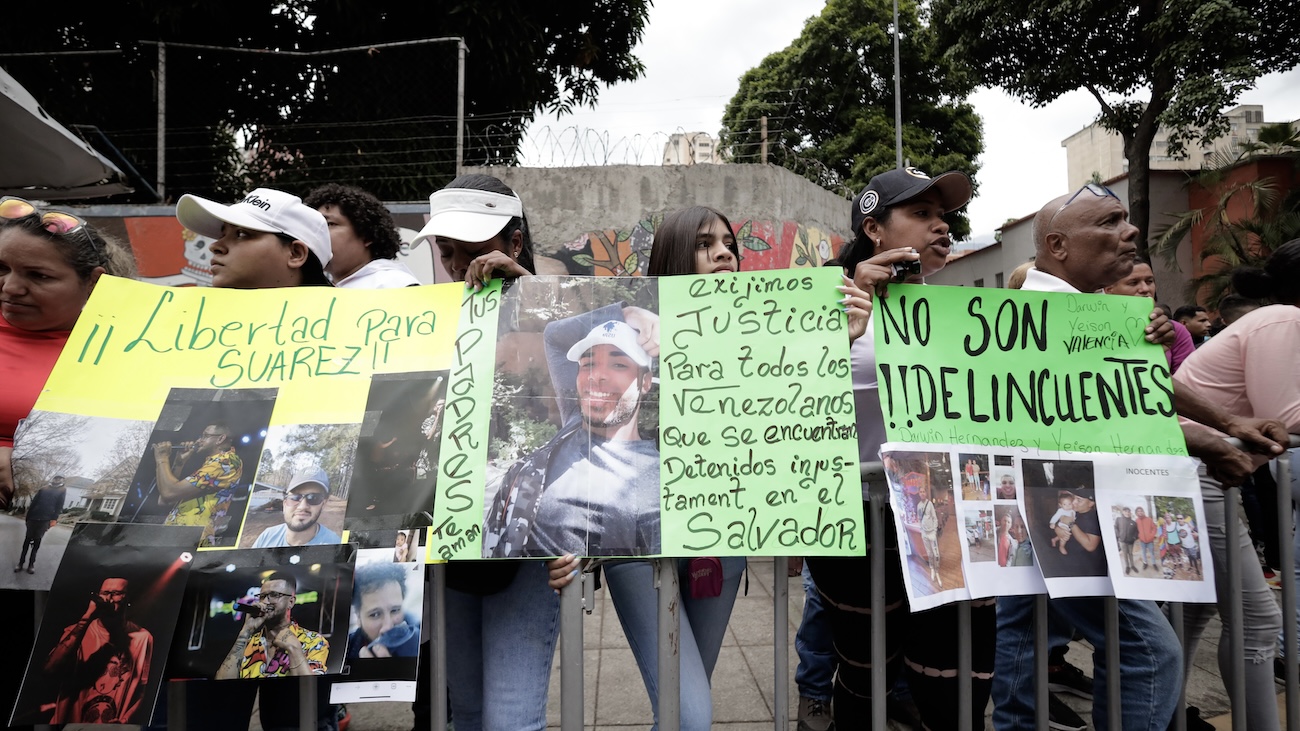
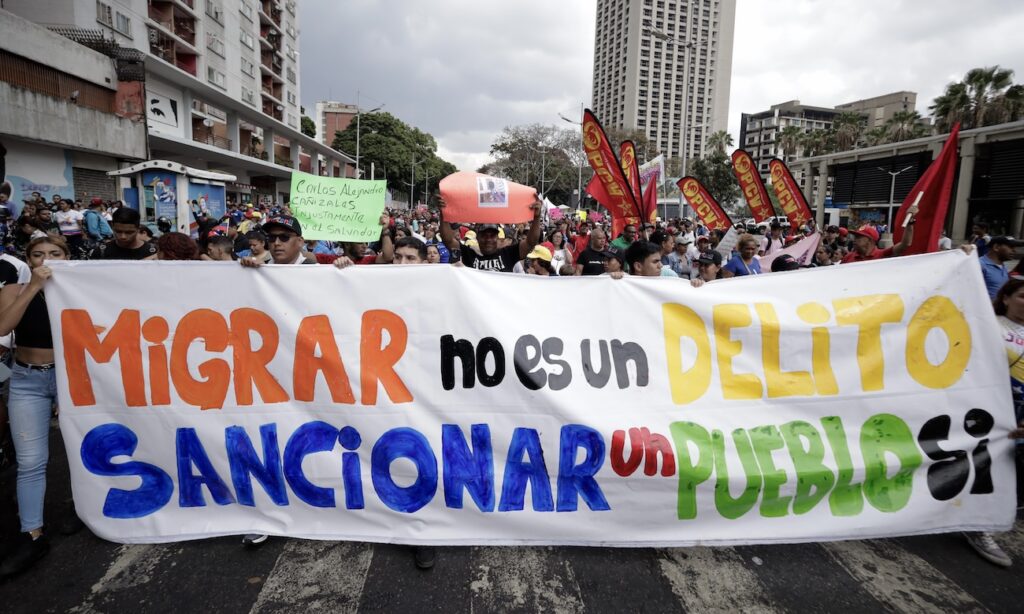
Thousands of Venezuelans rallied in Caracas on Tuesday, March 18, to protest the deportation of Venezuelan migrants from the United States to a high security prison in El Salvador. Family members of the deported migrants addressed Venezuelan officials and fellow citizens to demand the immediate return of their loved ones, with many insisting that their relatives are not criminals or members of the infamous Tren de Aragua as Donald Trump claims.

The mobilization occurred days after the deportation of over 200 migrants to El Salvador in one of the most controversial acts by the administration of Donald Trump during his two months in office. In January, shortly after Trump’s swearing in, Salvadoran President Nayib Bukele had offered up his country’s prisons to take in deported migrants or even the US’ national incarcerated population. It appears that this discussion advanced, and El Salvador, like several other countries in the region, will now provide detention centers for deported migrants, with no clarity of the criteria for who gets sent, how long they stay there, and under what jurisdiction they are. According to the US government, the Venezuelan migrants deported on Saturday all belong to the criminal group called Tren de Aragua (Aragua Train).

The Trump administration has yet to show evidence to back up its accusation.

“It is a massive violation of human rights,” says the Venezuelan government.

For its part, the Venezuelan government has condemned the US-Salvadoran decision as a violation of human rights. Jorge Rodríguez, president of Venezuela’s National Assembly, said in a press conference, “How do the Dantesque images we saw [of the deported Venezuelan migrants] differ from those of the Warsaw ghetto? How does Mr. Bukele’s barbarity when he said that he had bought slave labor differ from the memory of forced labor in the concentration camps of Auschwitz?”

In this sense, the Venezuelan government informed the families of the detainees that it would do everything possible to repatriate the migrants that were deported and now are being indefinitely held in a high security prison in El Salvador with no due process.

Read more: Trump defies courts and deports 250 Venezuelan migrants to El Salvador

In addition, the Secretary of the Interior, Diosdado Cabello questioned the Trump administration’s assertion that the Venezuelans who were deported were part of the “Tren de Aragua” criminal gang. In this regard, Cabello said, “It is a lie that those [deported] to El Salvador are from the Tren de Aragua.”

Maduro accuses Bukele of exercising fascist tactics against Venezuelan migrants

For his part, Venezuelan President Nicolás Maduro publicly rebuked Bukele for the treatment Venezuelans have received in El Salvador, and accused his government of fascist practices: “Are you going to protect this cruelty, this injustice, without [the detainees having] the right to any [judicial process], of creating concentration camps and putting noble working migrants in jails without a [due] trial, without having committed crimes in El Salvador, without having any sentence issued by a court in El Salvador? Is this legal, is this fair, Nayib Bukele?”

In addition, Maduro denounced the treatment suffered by the Venezuelan deportees: “They put them in handcuffs by hands and legs without telling them where they were going, and when they arrived in El Salvador, they made them get off the plane beating them with sticks and clubs; they humiliated them, threw them on the floor, shaved their hair. Is that called justice? Is that called international law? Is that called human rights? That is called fascism, Nazism, and Venezuela is ready and willing to denounce this massive violation of human rights against the hard-working and noble migrants in the United States!”

Migration is not a crime, sanctioning a people is. Photo: Francisco Trias

An 18th-century law to imprison migrants

According to the US Executive, its decision is based on an 18th-century law (1789) called the “Alien Enemies Act,” which states that the President of the nation has the power to order the detention and expulsion of foreign citizens from countries with which the United States is at war.

The bicentennial law was passed during the administration of John Adams, during a potential war with France, to prevent espionage and sabotage by foreigners in the United States. This law was applied again in 1812 during the war between the United States and the United Kingdom, and during the two world wars, during which US authorities imprisoned tens of thousands of foreigners in concentration camps for several years.

The law permits the imprisonment and deportation of foreign nationals without proper defense or normal judicial process, expediting the process under the pretext of national security.

Trump claimed that the law could be applied today because the Tren de Aragua is “perpetrating, attempting, and threatening a predatory invasion or incursion against US territory.” However, a judge in the District of Columbia named James Boasberg stated that there was no legal justification for enforcing the law, and asked that it be stayed. However, in another unprecedented move, Trump ignored the judge and did not reverse the action, allowing for the deportation of hundreds of Venezuelans to Salvadoran territory.

ALBA Movimientos rejects the deportation and imprisonment of Venezuelan migrants

In a statement, the Social Movements of ALBA, a platform of social movements in Latin America and the Caribbean, condemned Trump and Bukele’s decision as a violation of international law and human rights, and called it a kidnapping of migrants.

“This constitutes a barbaric action, demonstrative of the fascist, racist and defiant character of the basic human rights conventions, by the government of Donald Trump, who invoking a law of 1798 (three centuries ago) attributes to himself the power to kidnap, deport and imprison people only for being Venezuelans and the presumption of belonging to the ‘Tren de Aragua’, without any evidence and the right to defense,” states the communiqué.

In addition, the international organization that brings together people’s movements in the region, argues that Trump’s decision could bring dire consequences for Venezuelans in the United States:

“One of the most serious consequences of the application of this law is the criminalization of migration and in particular of Venezuelan migration, giving rise to the possibility that any Venezuelan migrant over the age of 14 could be qualified as an ‘invader’, ‘enemy of the US’ or ‘terrorist’ member of the so-called ‘Tren de Aragua’ and immediately could be deprived of his freedom, confiscating his goods, bank accounts and any kind of belongings.”

Finally, the communiqué demands the unity of the peoples of the world to stop this type of action that could have dangerous consequences for world peace, while supporting the actions of Maduro’s government in its crusade to repatriate the detained migrants:

“These dangerous expressions of neo-fascism that the global right wing under Trump’s leadership are wanting to naturalize and intensify, besieging countries, generating migration, promoting armed groups and then using those same groups to justify policies of criminalization against migrants and to top it off there are countries that commodify this imprisonment.”

“We therefore call for an international campaign to repudiate and denounce this dangerous escalation of criminalization of migration and the Venezuelan people. We accompany and support the actions of the Venezuelan Government before international organizations to rescue the kidnapped Venezuelan citizens and to take the necessary actions within the framework of public international law to prevent this neo-Nazi policy from continuing or spreading.”

Original article by Pablo Meriguet republished from peoples dispatch under a Creative Commons Attribution-ShareAlike 4.0 (CC BY-SA) license.

Donald Fuhrump says that Amerikkka doesn't bother with crimes or charges anymore, not being 100% Amerikkkan and opposing his real estate intentions is enough.
Donald Fuhrump says that Amerikkka doesn’t bother with crimes or charges anymore, not being 100% Amerikkkan and opposing his real estate intentions is enough.
Elon Musk urges you to be a Fascist like him, says that you can ignore facts and reality then.
Continue ReadingVenezuela demands the immediate repatriation of migrants detained in El Salvador

‘There is nothing moral about cutting benefits’

Spread the love
Keir Starmer explainst the moral case for cutting disability benefits. He says work will set you free.
Keir Starmer explains the moral case for cutting disability benefits. He says work will set you free.

https://morningstaronline.co.uk/article/there-is-nothing-moral-about-cutting-benefits

Starmer under pressure over cruel plan to slash welfare budget

KEIR STARMER came under pressure from MPs across the Commons over his cruel plan to cut benefits today.

Labour announced on Tuesday that it will slash £5 billion from the welfare budget by the end of the decade.

In the Commons, Labour’s Diane Abbott told Sir Keir to stop pretending his cuts were moral.

“There is nothing moral about cutting benefits for what may be up to a million people,” she said.

“This is not about morality, this is about the Treasury’s wish to balance the country’s books on the back of the most vulnerable and poor people in this society.”

Colum Eastwood from the SDLP told the prime minister of a constituent “who needed help, she had a disability. It meant that her children have to cut up her food, they have to help her wash between the waist, they have to supervise her when she goes to the toilet.

“Under the Tory welfare system we were able to get that lady on PIP. Under the Prime Minister’s new proposed system she will get zero, nothing.

“And after 14 years of the Tory government — and many of us wanted to see the back of them — can the Prime Minister answer one question – what was the point if Labour are going to do this?”

Green co-leader Carla Denyer urged a wealth tax instead of cuts, a policy quietly supported by many Labour MPs.

“We have a deeply unfair, unequal economic system where vast numbers of people are struggling yet billionaires are getting richer and richer,” she told Sir Keir.

“Does the Prime Minister really think that the way to tackle this is to put the onus onto older people, children and now sick and disabled people rather than on the shoulders of the super-rich with a wealth tax, those people who could most easily afford to pay?”

Article continues at https://morningstaronline.co.uk/article/there-is-nothing-moral-about-cutting-benefits

Keir Starmer confirms that he's proud to be a red Tory continuing austerity and targeting poor and disabled scum.
Keir Starmer confirms that he’s proud to be a red Tory continuing austerity and targeting poor and disabled scum.
Keir Starmer says pensioners can freeze to death and poor children can starve and be condemned to failure and misery all their lives.
Continue Reading‘There is nothing moral about cutting benefits’

How can you vote Labour after this?

Spread the love

Cruelty is the Point

Keir Starmer confirms that he's proud to be a red Tory continuing austerity and targeting poor and disabled scum.
Keir Starmer confirms that he’s proud to be a red Tory continuing austerity and targeting poor and disabled scum.
Keir Starmer says pensioners can freeze to death and poor children can starve and be condemned to failure and misery all their lives.
Continue ReadingHow can you vote Labour after this?