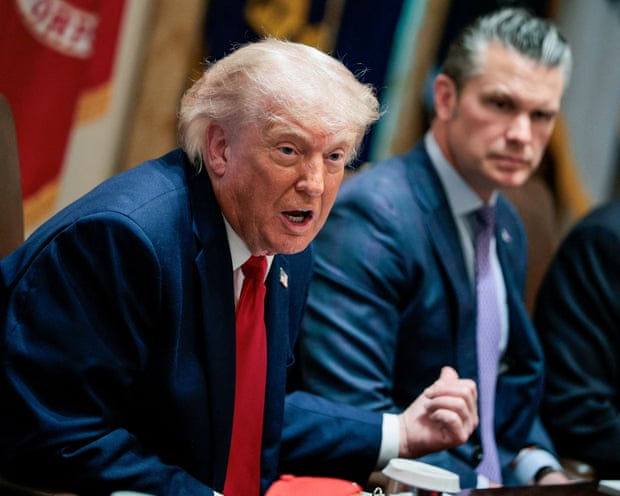
‘Transparency about the president’s health should be the rule, not the exception.’ Photograph: Evan Vucci/Reuters
The public is concerned. Fewer than half of US adults believe that Trump now possesses the mental acuity or physical health to be an effective president
…
A few days ago, Trump made his fourth visit to Walter Reed hospital in his second term as president; it raised eyebrows since so much of the president’s healthcare and testing can be done at the White House.
So, we must take with a hefty block of salt the declarations that followed that hospital visit.
“Everything checked out PERFECTLY,” Trump posted on social media.
Sure, and the strait of Hormuz is wide open because he said so.
Given what’s obvious to the naked eye, and what’s logical given his advanced age, the Trump White House owes the American public – and the world – quite a bit more than the usual bombast and bragging.
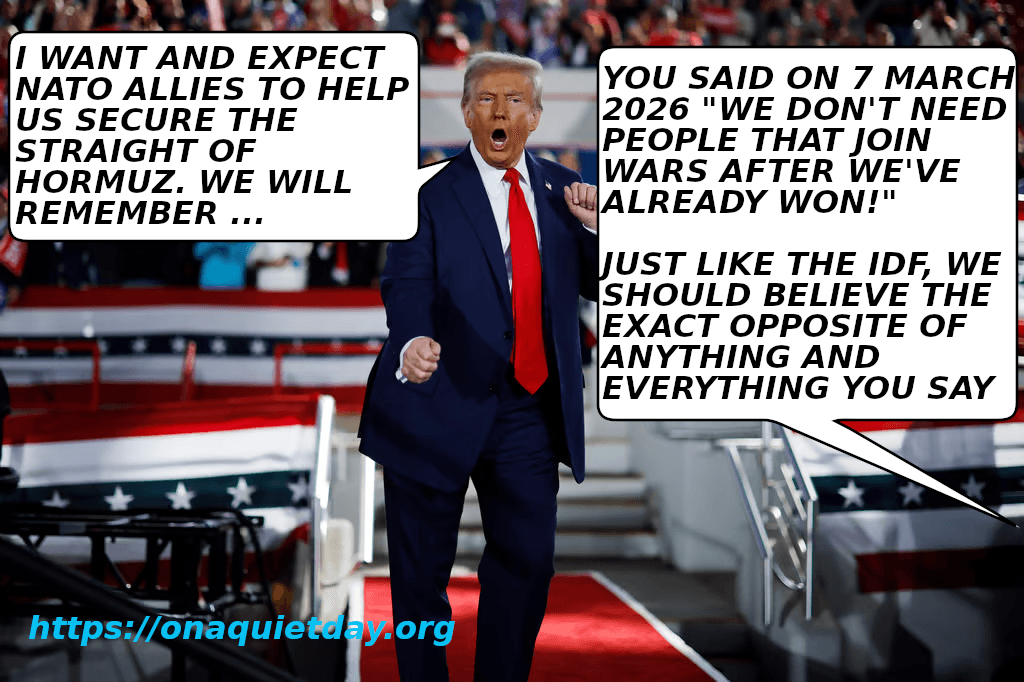
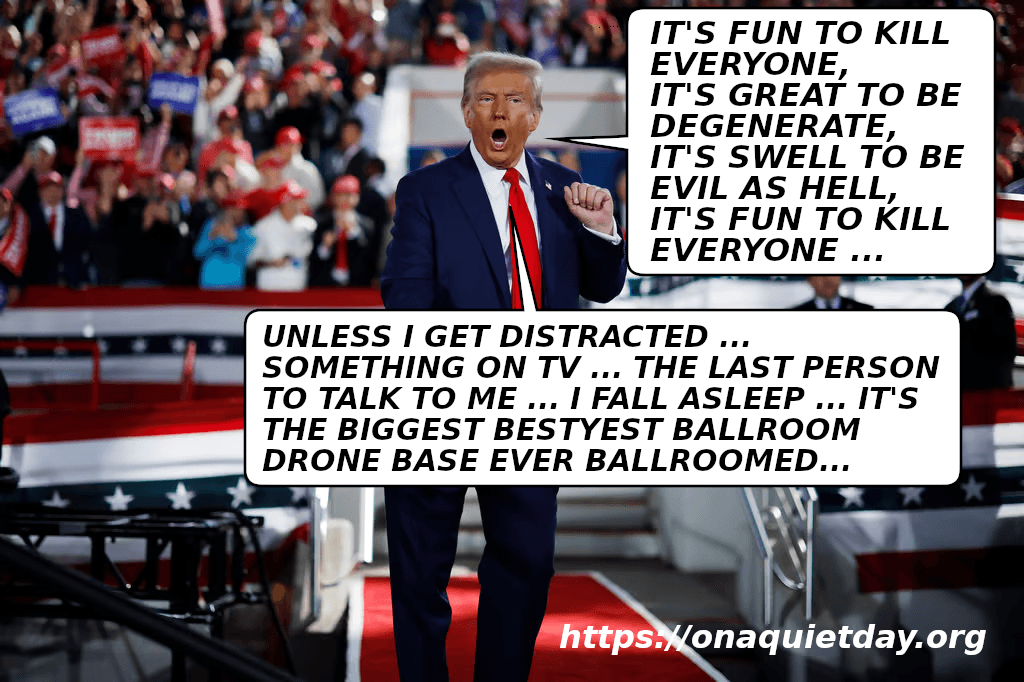
Donald Trump calls for help from NATO allies in securing the Strait of Hormuz despite saying on 7 March 2026 that they don’t need people to join wars after they’ve already won. He’s challenged with the claim that he lies as much as the IDF.Donald Trump sings and dances, says that it’s fun to kill everyone … unless he gets distracted or falls asleep.Orcas discuss rotting brain, front Orca says Sundown Syndrome is a dead givaway and he wishes someone would Lock Him Up
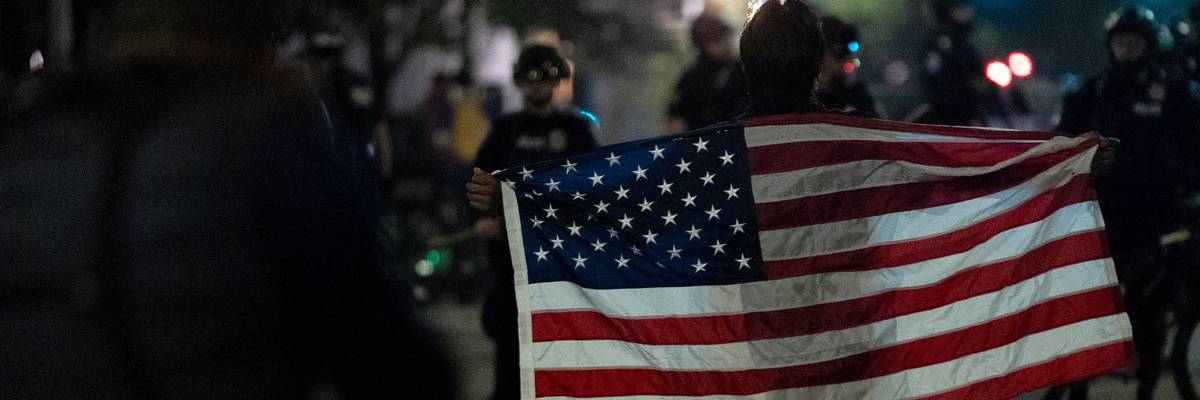
A protestor with an American flag walks towards a police line during a protest against federal immigration arrests, on June 11, 2025 in Seattle, Washington. Protests against ICE raids have spread to cities across the nation after beginning in Los Angeles last weekend. (Photo by Rio Giancarlo/Getty Images)
“We were guinea pigs,” said the father of one of the convicted protesters. “They brought the swamp of Washington, DC, into our area to stop American citizens from exercising our rights that are guaranteed.”
With the conviction of three anti-ICE protesters in Spokane, Washington on federal “conspiracy” charges Thursday, civil rights advocates and legal experts fear that the Trump administration may have just been handed a powerful tool to criminalize dissent.
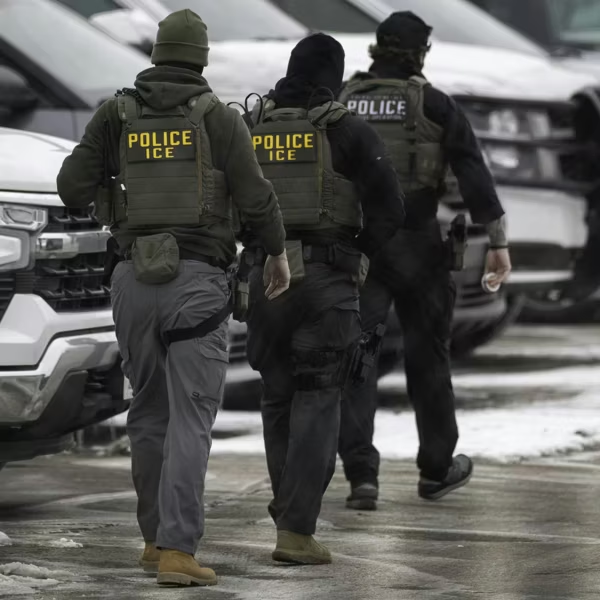
Jac Archer, Justice Forral, and Bajun Mavalwalla II, nicknamed the “Spokane 3,” were indicted last year for their actions at a protest in June 2025, where they attempted to physically obstruct ICE agents from transporting two Venezuelan immigrants to an ICE processing facility in Tacoma.
Both of the men reportedly entered the US legally under a humanitarian parole program that had been terminated by the Trump administration, leading advocates to protest their detention.
As Spokesman-Review, a Spokane newspaper, described:
Protesters that day eventually began linking arms around vans and in front of agents’ cars. The event grew chaotic. ICE agents entered a crowd of people standing outside the facility’s parking lot gate and began grabbing people by the necks and arms, pushing them to the ground. Protesters also slashed tires of vans meant to transport the detainees.
But where such activity would usually lead to charges against specific protesters for discrete illegal actions like trespassing, property damage, or other public order offenses, the Department of Justice (DOJ)—as part of a nationwide effort to crack down on protests against ICE—charged nine protesters with “conspiracy to impede or injure officers,” even though no officers were actually injured during the protest.
— Buffalo Brian Breen News (@MCUBuff) May 29, 2026
Legal experts described it as a novel approach that wrapped many people involved in the protest into a single “conspiracy” regardless of whether they committed specific criminal acts.
“Usually if a protest gets out of hand and people are hurt or property is hurt, you see charges based on that,” Mary Fan, a former federal prosecutor and a University of Washington law professor, told The New York Times earlier this month. “They’re not going after people based on specific harm done. They’re stretching conspiracy charges to target protesters and people who organize protests.”
Facing pressure from the federal government to bring the case following a national memo sent from the DOJ to prioritize and publicize cases against ICE agents, then-acting US Attorney for Eastern Washington Richard Barker resigned last year rather than bring charges against the protesters.
He said at the time he was grateful he “never had to sign an indictment or file a brief that [he] didn’t believe in.” His successor, Stephanie Van Marter, however, did sign the order.
Six of the defendants pleaded guilty to the charges to avoid federal prison time. But Archer, Forral, and Mavalwalla chose to fight them, believing the case was part of an unjust attempt to criminalize their right to protest.
After a trial that lasted seven days, a jury found the three defendants guilty of conspiracy. But the defense has argued that the trial was marred by problems that rendered the verdict faulty.
In February, a federal judge ordered the release of a Venezuelan migrant whose transportation for deportation the protesters sought to block, ruling his arrest violated the constitution.
But the jury, drawn from conservative eastern Washington state, did not hear those facts at trial, thanks to rulings by Judge [Rebecca] Pennell. Pennell, a former federal public defender and appointee of the Democratic president Joe Biden, also ruled the protesters on trial could not use the First Amendment as a defense, though they were allowed to state their reasons for demonstrating.
Instead, the jury watched hours of law enforcement body camera video and heard from a parade of ICE agents… Jeremy Burlingame, an ICE agent who testified, had authored social media posts that called Black politicians “lying ghetto garbage” and transgender people “mentally ill.” He boosted a post showing ICE arresting a pregnant woman at gunpoint that called her a “pregnant invader.”
Federal prosecutors deemed the posts troubling enough to recall Burlingame to impeach him, despite the fact that he was their witness…
But Burlingame’s online posts, the lack of injury to ICE officers, and the absence of evidence showing communication between the three defendants prior to the protest were not enough to sway the jury.
The defendants now face potential sentences of up to six years in prison and a $250,000 fine. However, they are expected to appeal the verdict and have filed a rarely used motion allowing their attorneys to argue that no rational juror could find their clients guilty.
“I question whether justice truly was served by today’s verdict,” Barker told the Spokesman-Review. “This was the first conspiracy prosecution in Eastern Washington history under… a Civil War-era law dusted off to punish members of the Spokane community who stood up for two young men who were unlawfully detained by ICE.”
Video by KREM 2 News/Youtube
Looking beyond the details of the trial itself, many observers questioned the very premise of the DOJ’s prosecution.
Spokane Mayor Lisa Brown said from the start of the trial she believed it was “politically motivated.”
“It was meant to make an example out of people who disagreed with federal immigration policy,” she said.
City council member Sarah Dixit, who said she took part in the protest, said: “Based on the evidence that was shown, I personally didn’t see evidence of what they were accused of. Conspiracy is a charge that feels complicated to prove, and I don’t believe that the government made a strong case for that.”
Others expressed fear for the precedent that had been set. La Rond Baker, the legal director of the Washington ACLU, said the Trump administration “has a demonstrable history of using the Department of Justice to silence and punish its critics.”
The administration has pursued similar sweeping conspiracy charges against other groups of anti-ICE protesters around the country—including in Los Angeles, Broadview, Illinois, and North Texas.
“The verdict was painfully disappointing,” said Archer’s attorney, Carl Oreskovich. “I think it was an extraordinarily aggressive approach to prosecution of protests. And it certainly is going to chill people who want to utilize their First Amendment right to dissent against government actions that they don’t agree with.”
In a comment to The Guardian, Robert Chang, a law professor at the University of California, Irvine School of Law and executive director of its Fred T. Korematsu Center for Law and Equality, said the verdict was “frightening.”
“By this logic, any protest could be a conspiracy,” he said. “The goal posts keep moving.”
BREAKING: All three defendants in the Spokane Three Trial were found guilty. There is a press conference being held outside the federal courthouse building right now. @kxly4newspic.twitter.com/AfTkIa4vzj
Bajun Mavalwalla Sr., a retired US Army intelligence officer who served in Afghanistan, said his son—also a veteran of the same war—and the other two defendants were standing for “the freedoms that separate this country from the dictatorships.”
“People in Spokane and people in Eastern Washington need to understand that we were guinea pigs. That they brought the swamp of Washington, DC, into our area to stop American citizens from exercising our rights that are guaranteed,” the elder Mavalwalla said after his son was convicted.
“It was the whole point of the Constitution, the right to protest, the right to dissent, the right to assemble, all of those things are now in question because of this case,” he said. “My son has taken the brunt of the entire weight of the United States government onto their shoulders.”
Donald Fuhrump says that Amerikkka doesn’t bother with crimes or charges anymore, not being 100% Amerikkkan and opposing his real estate intentions is enough.
This work by Middle East Monitor is licensed under a Creative Commons Attribution-NonCommercial-ShareAlike 4.0 International License.
A view of streets as daily life continues amid fragile ceasefire in Tehran, Iran on May 12, 2026. [Fatemeh Bahrami – Anadolu Agency.
Saeed Ajorlou, a member of Iran’s negotiating team’s media committee, said Saturday that Tehran has yet to approve the final draft of a proposed agreement with the United States and could withdraw from the deal if the other side fails to uphold its commitments, Anadolu reports.
Ajorlou told Iranian state television that, to his knowledge, the final text had not been approved as of Friday night, although only limited differences remained between the parties.
“If the final text is approved, we will enter a 60-day process of discussions on the details,” he said, adding that each of the agreement’s 14 articles contains annexes requiring further negotiations.
Ajorlou stressed that implementation mechanisms would be more important than the text itself, particularly regarding access to Iranian assets and the fulfillment of commitments by the other side.
According to Ajorlou, the proposed agreement includes provisions allowing Iran to withdraw if commitments are not met.
He said Tehran could exit the deal if violations occur, including breaches of the ceasefire, failure to provide access to Iranian funds, or failure to lift a maritime blockade.
“If they do not lift the maritime blockade, we can leave the agreement. If they do not make those funds available to us, we can leave the agreement,” he said.
Ajorlou described the mechanism as a new form of “snapback” provision that would operate in Iran’s favor if the other side fails to uphold its obligations.
He added that any failure to implement commitments during the initial phase would prompt Tehran to reconsider participation in the planned 60-day talks.
“The agreement is entirely based on implementation and objective guarantees,” he said.
Tensions in the Middle East have escalated since the US and Israel launched strikes against Iran in late February. Tehran retaliated with attacks targeting Israel and US allies in the Gulf while closing the Strait of Hormuz.
A ceasefire took effect on April 8 through Pakistani mediation, but subsequent talks in Islamabad failed to produce a lasting agreement. US President Donald Trump later extended the truce indefinitely.
The two sides have since continued exchanging proposals and counterproposals in an effort to resume direct talks and end the conflict. US officials have said a proposed framework could include a 60-day extension of the ceasefire and a roadmap for further negotiations.
Donald Trump sings and dances, says that it’s fun to kill everyone … unless he gets distracted or falls asleep.Orcas discuss rotting brain, front Orca says Sundown Syndrome is a dead givaway and he wishes someone would Lock Him Up
This work by Middle East Monitor is licensed under a Creative Commons Attribution-NonCommercial-ShareAlike 4.0 International License.
A view of the vessels passing through Strait of Hormuz following the two-week temporary ceasefire reached between the United States and Iran on the condition that the strait be reopened, seen in Oman on April 08, 2026. [Shadi J. H. Alassar – Anadolu Agency]
Iran’s parliament is set to vote on a bill that would formalize the country’s management of the Strait of Hormuz, a senior lawmaker said Saturday.
Alaeddin Salimi, a member of the parliament’s presiding board, said lawmakers had made a “definitive decision” to codify the management of the strategic waterway.
“The parliament’s decision to legislate the management of the Strait of Hormuz is final, and this plan will become law,” Salimi told Iran’s semi-official Tasnim News Agency.
He said the parliament would not allow foreign powers to dictate policy regarding the strait.
“Those who say the Strait of Hormuz must remain open should know that this issue concerns us. We will not allow others to decide for us,” he said.
Salimi said all aspects of the proposed legislation would be reviewed and approved by the parliament before taking effect.
According to the lawmaker, the bill will soon be presented in a public parliamentary session for debate and a vote.
The Strait of Hormuz, located between Iran and Oman, is one of the world’s most important energy transit routes, handling a significant share of global oil and gas shipments.
Regional tensions have escalated since the US and Israel launched strikes against Iran in February. Tehran retaliated with attacks targeting Israel and US allies in the Gulf, as well as by closing the Strait of Hormuz.
A ceasefire took effect on April 8 through Pakistani mediation and was later extended indefinitely by US President Donald Trump.
Following stalled negotiations mediated by Islamabad, the US imposed a blockade on Iranian ports on April 13, including those located along the strategic Strait of Hormuz.
Mediation efforts are ongoing to end the conflict and reach a broader agreement between the parties.
Donald Trump sings and dances, says that it’s fun to kill everyone … unless he gets distracted or falls asleep.Orcas discuss rotting brain, front Orca says Sundown Syndrome is a dead givaway and he wishes someone would Lock Him Up
This work by Middle East Monitor is licensed under a Creative Commons Attribution-NonCommercial-ShareAlike 4.0 International License.
Smoke rises after the Israeli attack on the Dimashkiyye, Hirdali, and Mahmudiye areas along the banks of the Litani River in southern Lebanon, on July 31, 2025. [Ramiz Dallah – Anadolu Agency]
The Israeli army has advanced into villages located north of the Litani River and reached the outskirts of Nabatieh city in southern Lebanon, a senior Lebanese military source told Anadolu on Saturday.
The Israeli forces “have reached villages and towns north of the Litani River, including Zawtar al-Sharqiyah and Shqif Arnoun, and have reached the outskirts of the city of Nabatieh,” said the source.
This was accompanied by an increase in Israeli attacks and incursions into more southern villages and towns, it added.
“The Lebanese army has evacuated its positions from villages and towns that have come under Israeli control” in order to ensure the safety of Lebanese soldiers, the source stated, noting that the Israeli army attacks caused casualties among the Lebanese soldiers.
“There is no presence of the Lebanese army in areas where the occupation is present in southern Lebanon,” the source added.
The Lebanese army’s priority at this stage is to strengthen internal stability, the source noted, stating that the ongoing Israeli escalation preceded the US-hosted military meetings with Israel on Friday.
Israel has continued its attacks on Lebanon despite a ceasefire that took effect on April 17 and was extended for 45 days beginning May 17 following indirect talks mediated by the US.
According to the Lebanese Health Ministry, Israeli attacks since March 2 have killed over 3,350 victims across the country.
Donald Trump sings and dances, says that it’s fun to kill everyone … unless he gets distracted or falls asleep.Orcas discuss rotting brain, front Orca says Sundown Syndrome is a dead givaway and he wishes someone would Lock Him Up