On Heels of Helene, Milton Explodes Into Category 5 Hurricane

Spread the love

Original article by Julia Conley republished from Common Dreams under Creative Commons (CC BY-NC-ND 3.0).
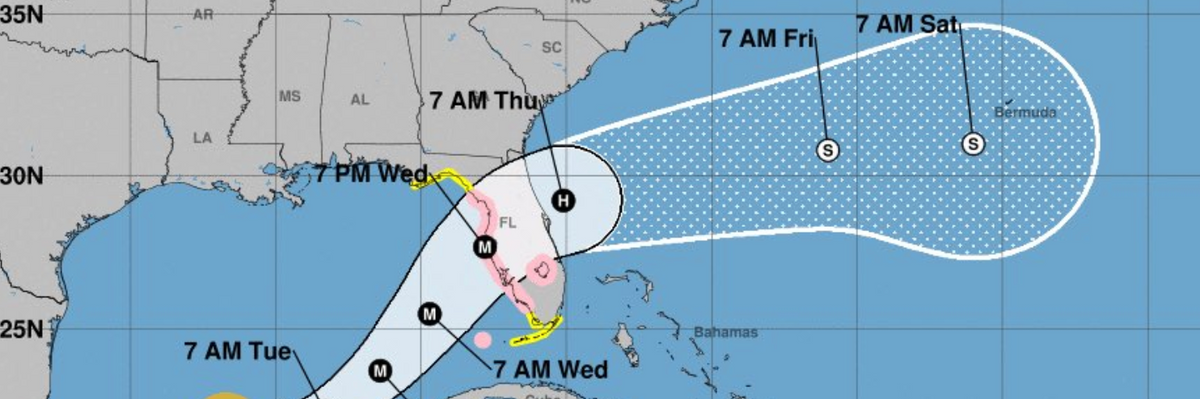
The expected path of Hurricane Milton is seen in a graphic released on October 7, 2024.(Photo: National Hurricane Center)

“The Gulf of Mexico is so warm that the models couldn’t predict how strong Milton has gotten so quickly,” said the Sunrise Movement. “This is a climate emergency.”

“This is not normal,” said climate advocates Monday as they expressed the same shock as weather experts who were reporting on the rapid strengthening of Hurricane Milton, whose winds sped up to 175 miles per hour as Florida residents struggled to recover from last month’s devastating storm, Helene.

Milton was classified as a Category 5 hurricane Monday afternoon—just five hours after it had been designated a Category 2 storm with 100 mile-per-hour winds and 48 hours after it became a tropical storm churning eastward over the Gulf of Mexico.

The winds “explosively” intensified over a matter of hours, according to the National Hurricane Center.

As the hurricane gathered strength, weather analyst Colin McCarthy of U.S. Stormwatch said that “not a single weather model predicted the storm would strengthen this quickly.”

The storm was expected to make landfall on Florida’s Gulf Coast on Wednesday, and Republican Gov. Ron DeSantis—who vehemently denies scientists’ consensus that human-caused climate change is causing more extreme weather—called for widespread evacuations ahead of “life-threatening” hazards.

“If we knew exactly where it’s going to hit, we probably would evacuate fewer people,” DeSantis said Monday morning. “But we don’t know that.”

President Joe Biden declared an emergency in Florida Monday afternoon and ordered federal assistance to the state.

The New York Times reported that Milton could weaken before Wednesday as it makes its way through the Gulf, but that could be accompanied by a widening of the hurricane’s size, threatening a greater portion of the vulnerable state.

“The entire peninsula, the entire west coast, has potential to have major, major impact because of the storm surge,” said DeSantis on Sunday.

Milton is expected to be the second hurricane to hit Florida in two weeks, with parts of the state still reeling from the damage left by Helene.

DeSantis said Monday that emergency workers had picked up 180,000 cubic yards of debris across the state, and said, “There’s still a lot of it.”

The Tampa Bay area, where residents were warned by National Weather Service meteorologist Rick Davis on Monday that Milton could be “the worst hurricane in their lifetime,” was inundated last month with record-high storm surges.

Barrier islands were damaged by Helene, and the destruction of sand dunes has left the area especially exposed to hazards, Davis told The New York Times.

“Just after our latest hurricane, we are extremely vulnerable, especially to surge,” said Davis. “Our ground is extremely saturated from several hurricanes already this year, and we’re going to have river flooding. So people that may be 20 miles inland from the coast won’t get storm surge, but they could get rainfall flooding, river flooding, retention ponds could flood creeks.”

Climatologists have warned that warmer oceans and bodies of water including the Gulf of Mexico are likely to cause more intense hurricane seasons. The Gulf has reached an average surface temperature of nearly 90°F—the hottest it’s been since modern records have been kept, Brian McNoldy, a climate researcher at the University of Miami, toldVox in August.

“The Gulf of Mexico is so warm that the models couldn’t predict how strong Milton has gotten so quickly,” said national climate advocacy group Sunrise Movement.

Officials called on residents to evacuate Monday rather than waiting for the hurricane to get closer to making its expected landfall. More than a dozen school districts in the state announced they were closing ahead of the storm.

But as pro-labor media group More Perfect Union reported, workers on Monday were already sharing stories online of how companies are planning to stay open until at least Tuesday night, making it impossible for people to obey evacuation orders.

One person working in retail management said that “after waiting all weekend to see if the corporate overlords would say we’re closed until further notice, I got notice today that we’re business as usual until Tuesday night… This gives me no time to evacuate or prepare accordingly.”

“Workers died during Hurricane Helene because they weren’t given time to evacuate,” said More Perfect Union. “This must stop.”

Original article by Julia Conley republished from Common Dreams under Creative Commons (CC BY-NC-ND 3.0).

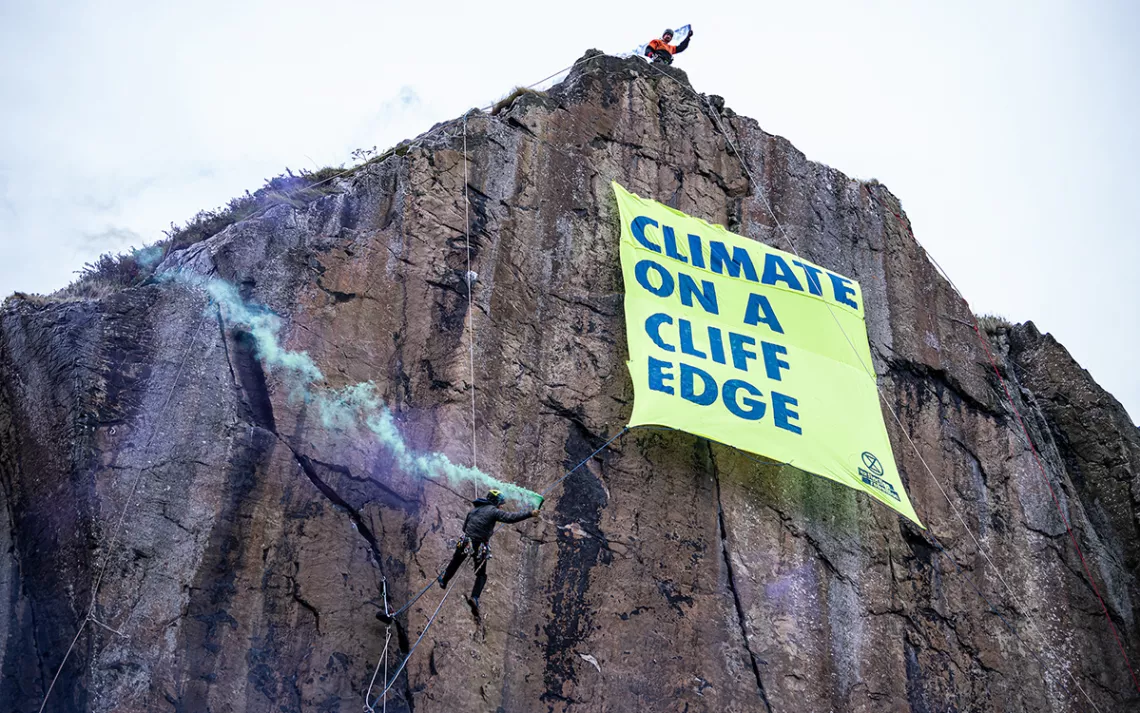
Experienced climbers scale a rock face near the historic Dumbarton castle in Glasgow, releasing a banner that reads “Climate on a Cliff Edge.” One activist, dressed as a globe, symbolically looms near the edge, while another plays the bagpipes on the shores below. | Photo courtesy of Extinction Rebellion and Mark Richards
Continue ReadingOn Heels of Helene, Milton Explodes Into Category 5 Hurricane

Florida Meteorologist Breaks Down Reporting on Milton’s Growing Strength

Spread the love

Original article by Julia Conley republished from Common Dreams under Creative Commons (CC BY-NC-ND 3.0). 

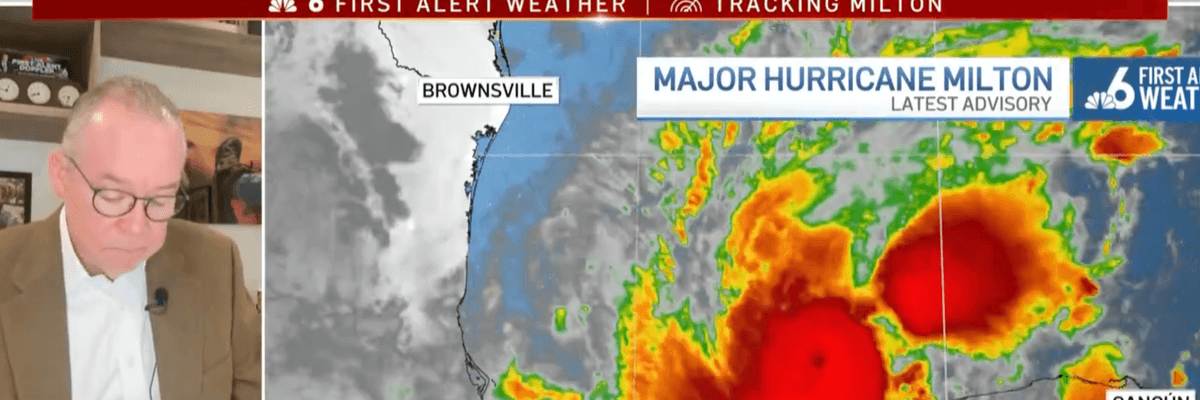
Florida meteorologist John Morales warns residents to evacuate and says the rapid intensifying of Hurricane Milton is due to the climate crisis and planetary heating in a news report on October 7, 2024. (Image: NBC6)

“The warming world has forcibly shifted my manner from calm concern to agitated dismay,” said John Morales. “Now I look at storms differently. And I communicate differently.”

As NBC6 hurricane specialist John Morales in Miami reported on the rapid drop in barometric pressure as Hurricane Milton gained strength in the Gulf of Mexico on Monday, the veteran meteorologist’s voice broke.

“It has dropped 50 millibars in 10 hours,” Morales said, becoming visibly emotional. “I apologize, this is just horrific.”

The storm is expected to make landfall on the west coast of Florida on Wednesday as the state struggles to recover from Hurricane Helene.

Morales spoke as the hurricane’s winds reached 160 miles per hour and climate experts noted that the Gulf of Mexico and Atlantic Ocean’s waters have been abnormally warm.

“The seas are just incredibly, incredibly hot, record hot, as you might imagine,” said Morales. “You know what’s driving that. I don’t need to tell you. Global warming, climate change [are] leading to this and becoming an increasing threat.”

Morales posted the clip on social media later, saying he “debated whether to share” the emotional moment in which he reported on what is likely to be further catastrophic damage to his home state as well as parts of Mexico.

“Frankly, you should be shaken too, and demand climate action now,” said Morales.

A week ago, the meteorologist wrote in the Bulletin of Atomic Scientists that Hurricane Helene, which killed more than 230 people across six states, was “a harbinger of the future.”

“For decades I had felt in control. Not in control of the weather, of course. But in control of the message that, if my audience was prepared and well informed, I could confidently guide them through any weather threat, and we’d all make it through safely,” wrote Morales. “Today as a result of so many compounding climate-driven factors, the warming world has forcibly shifted my manner from calm concern to agitated dismay. Now I look at storms differently. And I communicate differently.”

“No one can hide from the truth,” he added. “Extreme weather events, including hurricanes, are becoming more extreme. I must communicate the growing threats from the climate crisis come hell or high water—pun intended.”

Former U.S. Rep. Debbie Mucarsel-Powell (D-Fla.), who is running for Senate, was among those who applauded Morales’ frank assessment of the crisis facing his state and the country.

“I’ve never seen someone like John Morales get emotional about a storm before. He understands these systems better than most and it should be a warning for all of us to get ready now,” said Mucarsel-Powell. “We MUST have the courage to stand up to climate denialists and take action before it is too late.”

Original article by Julia Conley republished from Common Dreams under Creative Commons (CC BY-NC-ND 3.0). 

Experienced climbers scale a rock face near the historic Dumbarton castle in Glasgow, releasing a banner that reads “Climate on a Cliff Edge.” One activist, dressed as a globe, symbolically looms near the edge, while another plays the bagpipes on the shores below. | Photo courtesy of Extinction Rebellion and Mark Richards
Continue ReadingFlorida Meteorologist Breaks Down Reporting on Milton’s Growing Strength

Greta Thunberg Detained at Brussels Climate Protest Against Fossil Fuel Subsidies

Spread the love

Original article by Edward Carver republished from Common Dreams under Creative Commons (CC BY-NC-ND 3.0). 

Swedish activist Greta Thunberg is detained during a climate protests against fossil fuel subsidies in Brussels on October 5, 2024. (Photo: John Thys/AFP via Getty Images)

Renowned activist Greta Thunberg was detained on Saturday at a climate protest in Brussels aimed at ending European Union fossil fuel subsidies.

The protest included hundreds of campaigners from Extinction Rebellion and other groups; they came together under the name United for Climate Justice (UCJ). One group of them marched in an area near the European Parliament, while another group that included Thunberg blocked a section of the Boulevard du Jardin Botanique.

“Our politicians have failed us,” Paolo Destilo, a UCJ spokesperson, told Politico. “European leaders’ continued support for the fossil fuel industry raises serious questions about their commitment to effective climate action.”

Another UCJ spokesperson, Angela Huston Gold, pointed to devastating floods that recently hit Europe and Africa as a warning sign for the planet.

“Increasingly frequent and extreme natural disasters are likely to claim a billion victims by the end of the century, mainly due to the use of fossil fuels,” Huston Gold said in a statement, citing a 2023 study in Energies, a journal. “To avoid ecological and social collapse, fossil fuel subsidies must end now.”

The European Commission published a report last year showing that the EU spent 123 billion euros ($135 billion) on fossil fuel subsidies in 2022, an increase on previous years that was caused by policy decisions following Russia’s invasion of Ukraine. (2022 was the last year included in the report.) The Organization for Economic Co-operation and Development listed still higher figures for 2022.

EU’s Eighth Environment Action Program, which entered into force in May 2022, calls for a phaseout of fossil fuel subsidies, but national governments haven’t taken action, so progress is “uncertain,” according to the European Environment Agency, which is part of the EU.

Thunberg on Saturday told Politico that European Commission President Ursula von der Leyen, who’s been in office since 2019, was not a green champion.

UCJ on Tuesday sent an open letter to von der Leyen and other EU institutional leaders calling for a phaseout of fossil fuel subsidies by 2025. “The EU should provide technical and financial assistance to member states facing challenges in meeting phaseout deadlines and offer incentives for achieving milestones ahead of schedule,” it says.

Staffers at the European Commission were in fact among the demonstrators in Brussels on Saturday, Politico reported.

“There’s a lot of tools the institutions have now to fight climate change, but since the [European Parliament elections in June] there’s been a lot of backtracking,” one commission staffer told Politico, given anonymity in order to speak freely.

“It’s now all about competitiveness and the ‘clean industrial deal,’ whatever that means,” the staffer added. “The urgency has been lost—the Parliament has shifted to the right, the commission in many ways has shifted to the right—and discussion of the climate has faded into the background.”

Thunberg, who’s now 21, came to fame as a 15-year-old activist in Sweden who helped form the global school strikes for climate movement. She’s been arrested numerous times, including at a pro-Palestinian demonstration in Denmark earlier this month.

Thunberg and other activists who sat with interlocked arms on the Boulevard du Jardin Botanique were arrested and taken to the police station, according to The Brussels Times.

Original article by Edward Carver republished from Common Dreams under Creative Commons (CC BY-NC-ND 3.0). 

Continue ReadingGreta Thunberg Detained at Brussels Climate Protest Against Fossil Fuel Subsidies

Carbon capture: a decarbonisation pipe dream

Spread the love

Relearning lessons of the past

1 September 2022 (IEEFA): Underperforming carbon capture projects considerably outnumber successful projects globally, and by large margins, with both the technology and regulatory framework found wanting, finds a new report by the Institute for Energy Economics and Financial Analysis (IEEFA).

The report, The Carbon Capture Crux – Lessons Learned, studies 13 flagship large-scale carbon capture and storage (CCS)/carbon capture utilisation and storage (CCUS) projects in the natural gas, industrial and power sectors in terms of their history, economics and performance. These projects account for around 55% of the total current operational capacity worldwide.

Author Bruce Robertson says seven of the thirteen projects underperformed, two failed, and one was mothballed

“CCS technology has been going for 50 years and many projects have failed and continued to fail, with only a handful working.

“Many international bodies and national governments are relying on carbon capture in the fossil fuel sector to get to Net Zero, and it simply won’t work.

“Although some indication it might have a role to play in hard-to-abate sectors such as cement, fertilisers and steel, overall results indicate a financial, technical and emissions-reduction framework that continues to overstate and underperform.”

IEEFA’s study found that Shute Creek in the U.S. underperformed its carbon capture capacity by around 36% over its lifetime, Boundary Dam in Canada by about 50%, and the Gorgon project off the coast of Western Australia by about 50% over its first five-year period.

“The two most successful projects are in the gas processing sector – Sleipner and Snøhvit in Norway. This is mostly due to the country’s unique regulatory environment for oil and gas companies,” says co-author Milad Mousavian.

“Governments globally are looking for quick solutions to the current energy and ongoing climate crisis, but unwittingly latching onto CCS as a fix is problematic.”

Last week the Australian government approved two new massive offshore greenhouse gas storage areas, saying CCS “has a vital role to play to help Australia meet its net zero targets. Australia is ideally placed to become a world leader in this emerging industry”.

However, Robertson says, carbon capture technology is not new and is not a climate solution.

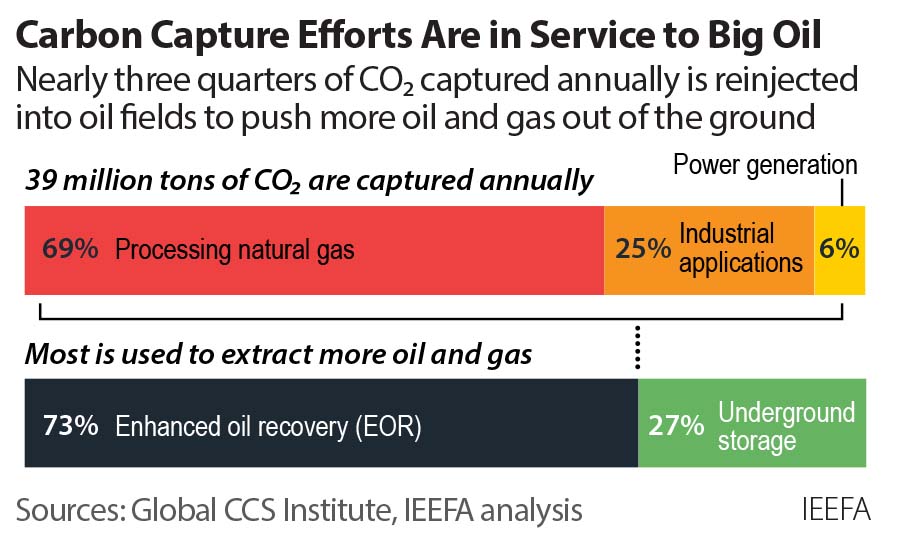
“As our report shows, CCS has been around for decades, mostly serving the oil industry through enhanced oil recovery (EOR). Around 80–90% of all captured carbon in the gas sector is used for EOR, which itself leads to more CO2 emissions.”

About three-quarters of the CO2 captured annually by multi-billion-dollar CCUS facilities, roughly 28 million tonnes (MT) out of 39MT total capture capacity globally, is reinjected and sequestered in oil fields to push more oil out of the ground.

The International Energy Agency says annual carbon capture capacity needs to increase to 1.6 billion tonnes of CO2 by 2030 to align with a net zero by 2050 pathway.

“In addition to being wildly unrealistic as a climate solution, based on historical trajectories, much of this captured carbon will be used for enhanced oil recovery,” says Robertson.

History shows CCS projects have major financial and technological risks. Close to 90% of proposed CCS capacity in the power sector has failed at implementation stage or was suspended early — including Petra Nova and the Kemper coal gasification power plant in the U.S. Further, most projects have failed to operate at their theoretically designed capturing rates. As a result, the 90% emission reduction target generally claimed by the industry has been unreachable in practice.

Finding suitable storage sites and keeping it there is also a major challenge—the trapped CO2 underground needs monitoring for centuries to ensure it does not come back to the atmosphere.

The report identifies interim considerations for CCS projects if no alternative solutions to emissions reduction are found.

  • Safe storage locations must be identified, and a long-term monitoring plan and compensation mechanism in case of failure developed.
  • The CCS project must not promote enhanced oil recovery.
  • To avoid project liability being handed over to taxpayers, as is currently the situation with Gorgon, large oil and gas companies mainly benefiting from CCS at their gas developments must be liable for any failure/leakage and monitoring costs of CCS projects, specifically if they get subsidies, grants and tax credits for capturing the carbon.
  • It must not be used by governments to greenlight or extend the life of any type of fossil fuel asset as a climate solution.

Robertson says more research could be done on CCS applications in industries where emissions are hard to abate such as, cement, as an interim partial solution to meeting net zero targets.

“As a solution to tackling catastrophic rising emissions in its current framework however, CCS is not a climate solution.”

The reportThe Carbon Capture Crux – Lessons Learned

Continue ReadingCarbon capture: a decarbonisation pipe dream

Coming Soon

Spread the love
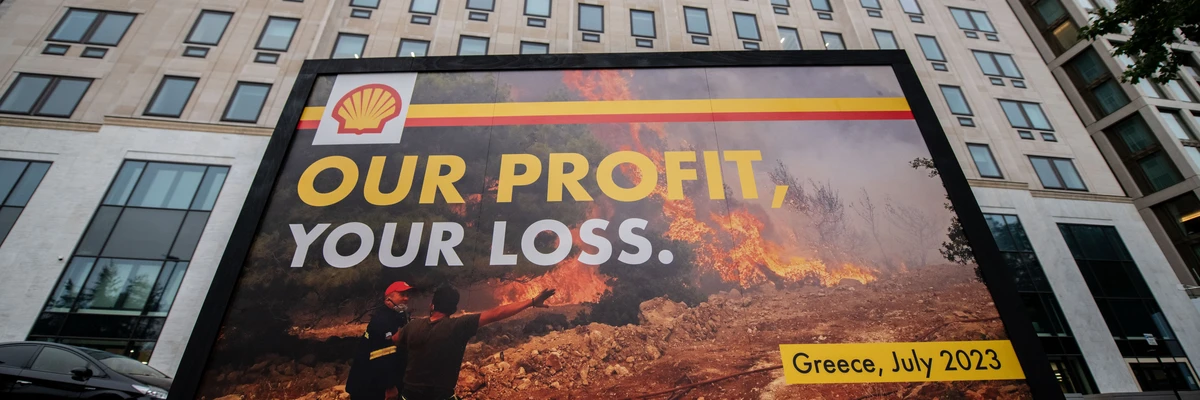
Greenpeace activists display a billboard during a protest outside Shell headquarters on July 27, 2023 in London.
Greenpeace activists display a billboard during a protest outside Shell headquarters on July 27, 2023 in London. (Photo: Handout/Chris J. Ratcliffe for Greenpeace via Getty Images)

I need to do an article about the UK government’s insane pursuit of Carbon Capture and Storage, accepting fossil fuel industry lies and continuing to subsidise the fossil fuel industry to destroy the climate.

Continue ReadingComing Soon