Bank of England gives yet another £50B to bankers

Spread the love

“…quantitative easing – printing money by another name – is the last resort of desperate governments when all other policies have failed.”

George Osborne, speech January 9 2009

The Bank of England announced today that it intends to do a further £50billion round of Quantitative Easing. Quantitative Easing involves pumping money into the economy in an apparently futile – it hasn’t yet been shown to work – attempt to stimulate the economy. There is a problem that there is very little to show for so many billions after billions that have already been squandered on Q.E.

It appears that it’s austerity for the vast majority and rolling in lolly for the rich elite. No money for the NHS for the plebs, plenty of billions to stimulate the markets for rich multi-millionaire traders and bankers to get yet richer.

There is an argument that the poor would stimulate the economy far more – since they would have to spend the money.


 10/2/12:

Quantitative Easing is stimulating commodity trading, not the real economy

As the economy slides towards recession, the Bank of England today announced today it was creating a further £50bn worth of ‘quantitative easing’ (QE).

If you read articles on the topic in the media, you will see statements like “the Bank is ‘printing’ money” or the Bank  will “pump a further £50 billion in to the economy”.  Both these statements are misleading.

QE actually involves the Bank of England buying financial assets – usually government bonds – belonging to institutional investors and sitting in Banks. The Bank buys these assets with newly created central bank reserves.  These reserves can only be held by banks – they do not and cannot go to businesses the real economy.

As explained in nef’s Where Does Money Come From?, central bank reserves are used by commercial banks to settle payments with each other.

By ‘pumping’ more reserves in to the intra-bank clearing system the idea is that banks will feel more confident about making loans to the real economy because they will know that other banks are in a stronger position to settle with them.

In addition, by buying up ultra-safe government bonds in vast quantities and thus pushing down the yield (the interest received on holding) on these assets, the central bank hopes to encourage investors to buy higher yielding corporate bonds – which again provides money for real businesses.

QE may reduce long-term interest rates, but there is little evidence it has stimulated commercial banks to start lending more to businesses, in particular small businesses, or soften the conditions banks are attaching to loans.

In fact the most recent figures published by the Bank show that net lending – the amount of loans minus the amount repaid – to small businesses has contracted by six per cent in the year to November 2011. And this despite the banks being given small business lending targets by the government through ‘Project Merlin’.  Not much wizardry there then.

The hard truth is that commercial banks are still in a process of ‘de-leveraging’, more keen on getting their loans repaid and building up their capital base than making new loans to productive businesses in what is perceived to be a risky real economy.

Evidence suggests the additional funds provided by QE are more likely to be used by banks to create more speculative credit, not least commodity speculation,  that provides shorter term returns.  As a result, the money supply in the real economy is contracting just at the point where new investment is most needed.


Continue ReadingBank of England gives yet another £50B to bankers

NHS news review: Lansley responds to criticism

Spread the love

Conservative election poster 2010

A few recent news articles about the UK’s Conservative and Liberal-Democrat (Conservative) coalition government – the ConDem’s – brutal attack on the National Health Service.

Health Secretary Andrew Lansley responds to criticism by a committee of MPs by calling their brand new report “out of date” and “unfair”.

MPs criticise Lansley over viability of health cuts / Britain / Home – Morning Star

The government’s controversial NHS shake-up is hindering efforts to find ways of slashing health spending without cutting vital services, MPs warned yesterday.

In a highly critical report, the health select committee said hospitals were resorting to short-term “salami slicing” as they try to find £20 billion in efficiency savings by 2014/15.

But in a stinging criticism of Health Secretary Andrew Lansley’s reorganisation, it said the process “continues to complicate the push for efficiency gains.”

There was a “marked disconnect between the concerns expressed by those responsible for delivering services and the relative optimism of the government” over achieving cuts, the committee noted.

The attack is especially wounding as the committee is chaired by former Tory health minister Stephen Dorrell and is dominated by Conservative and Lib Dem MPs.

It comes days after all the major health unions – representing doctors, nurses and midwives – expressed their “outright opposition” to the Health and Social Care Bill.

The British Medical Association, the Royal College of Nursing and the Academy of Medical Royal Colleges are also holding a summit on Thursday evening to discuss the Bill.

RCN concerns echoed by MPs – RCN

The Royal College of Nursing has today (24 January) responded to a Health Select Committee report into public expenditure saying it agrees that forging ahead with reforms has caused disruption and distraction at a time of austerity within the NHS.

“We concur with the report findings,” said RCN Chief Executive & General Secretary Dr Peter Carter. “We feel that the dual impact of the reform process and the full extent of the efficiency savings is now seriously destabilising the NHS. Indeed, in our opinion the bill has created such turmoil that it should be stopped. Now is the time for the Government to get a grip of the situation and work with organisations such as the RCN to stabilise the health service.”

The findings of the Health Select Committee chime with many of the concerns nursing staff have raised about efficiency savings. RCN research has shown that some NHS trusts are making short-term cuts to services and nursing posts in an attempt to make savings, rather than engaging in intelligent service redesign. The RCN says that in England alone, 48,000 NHS posts are earmarked to go.

“This will undoubtedly have a deep and potentially dangerous impact on patient care,” added Dr Carter. “As the report acknowledged, long-term planning and more integrated health and social care services could provide huge benefits for patient care.

Andrew Lansley: criticism of NHS reforms is ‘out of date and unfair’ – Telegraph

Andrew Lansley, the Health Secretary, has defended his NHS reforms, describing a highly critical report by MPs as “out of date” and “unfair” to the health service.

Mr Lansley insisted that the NHS was delivering efficiency savings and improvements for patients following a warning from MPs that the overhaul of the NHS is hindering efforts to slash health spending without cutting vital services.

“I think the select committee’s report is not only out of date but it is also, I think, unfair to the NHS, because people in the NHS, in hospitals and in the community services are very focused on ensuring that they deliver the best care to patients and that they live within the financial challenges that clearly all of us have at the moment,” Mr Lansley told ITV Daybreak.

“I am afraid the evidence points to the fact that they are doing that extremely well.”

His remarks follow a highly critical report from the Commons Health Select Committee which said hospitals were resorting to short-term “salami slicing” as they try to find £20 billion in efficiency savings by 2014/15.

In a stinging criticism of Mr Lansley’s reorganisation, it said the process “continues to complicate the push for efficiency gains”.

Continue ReadingNHS news review: Lansley responds to criticism

NHS news review: Cameron confirms that the intention is to privatise the NHS

Spread the love

Best wishes for the new year.

Seven former presidents of the Faculty of Public Health accuse the Prime Minister of ploughing ahead with an “unprecedented marketisation” of services, which poses a “major threat” to the integrity of the NHS.

David Cameron confirms that the intention is to “… drive the NHS to be a fantastic business“. How is that anything other that the privatisation of the NHS?

Watch the video here VIDEO BLOG: Cameron wants the NHS “to be a fantastic business” « sturdyblog

Drop perilous NHS reforms, say leading health professionals – Health News – Health & Families – The Independent

David Cameron faces fresh calls to abandon his NHS reforms, as a group of leading public-health experts predicts that the changes will “exacerbate inequalities” in the health of the nation.

Seven former presidents of the Faculty of Public Health accuse the Prime Minister of ploughing ahead with an “unprecedented marketisation” of services, which poses a “major threat” to the integrity of the NHS.

In a letter to Mr Cameron, the group warns: “The Bill is likely to produce a ‘patchwork quilt’ health system that will vary hugely across the country, failing to meet the diverse needs of the population and undermining the health of vulnerable, minority groups.”

27/11/13 Having received a takedown notice from the Independent newspaper for a different posting, I have reviewed this article which links to an article at the Independent’s website in order to attempt to ensure conformance with copyright laws.

I consider this posting to comply with copyright laws since
a. Only a small portion of the original article has been quoted satisfying the fair use criteria, and / or
b. This posting satisfies the requirements of a derivative work.

Please be assured that this blog is a non-commercial blog (weblog) which does not feature advertising and has not ever produced any income.

dizzy

Continue ReadingNHS news review: Cameron confirms that the intention is to privatise the NHS

NHS news review

Spread the love

40 health care experts warn that the Destroy the NHS / Health and Social Care Bill will “[usher in] a significantly heightened degree of commercialisation and marketisation that will lead to the harmful fragmentation of patient care; aggravate risks to individual patient safety; erode medical ethics and trust within the healthcare system; widen health inequalities; waste much money on attempts to regulate and manage competition; and undermine the ability of the health system to respond effectively and efficiently to communicate disease outbreaks and other public health emergencies”.

David Cameron responds: “Of course there are doctors and others within the NHS that are wary about parts of our proposals, about greater choice for patients, about greater competition with the NHS.

“There have always been opponents to that, but the point of the exercise we held in the summer, when we paused and restarted the reforms, was to bring more of the health service on board, and many GPs, many doctors and many in the health service recognise that change is necessary if we are going to drive up standards in the health service, in which we invest and care about so much.”

He added: “I think the reforms are right, I think they will improve patient care. Above all, they will be good for patients. They are going to give you more power and control over the care you get, a greater choice too, which I think patients will welcome.”

It appears that there is a choice between 40 accomplished health professionals and a former Bullingdon Clubber with a track record of lying and broken promises to get elected.

Professor Norman Williams, head of the Royal College of Surgeons warns that rationing operations in the short term will cost more in the long term.

Andrew Lansley to address the NHS-destroying Conservative Party Conference today.

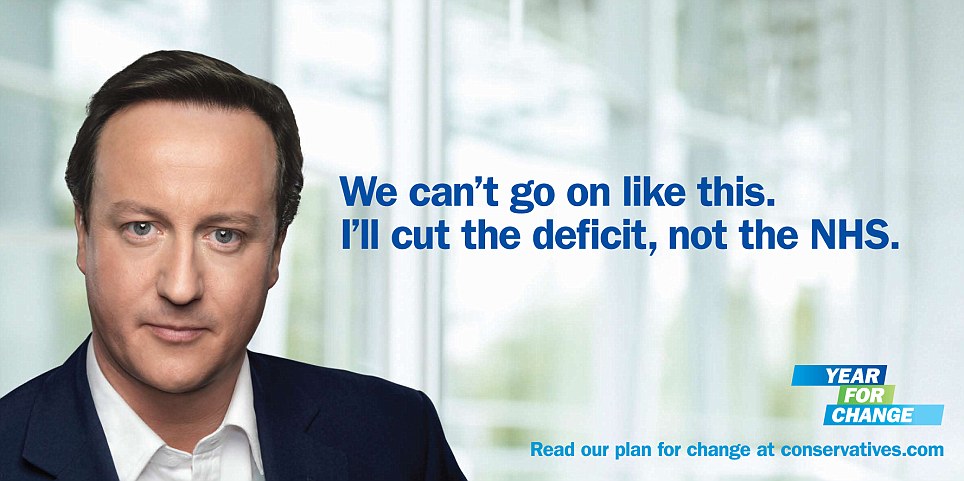
Conservative election poster 2010

A few recent news articles about the UK’s Conservative and Liberal-Democrat coalition government – the ConDem’s – brutal attack on the National Health Service.

Scrap NHS reforms, doctors tell Lords | Society | The Guardian

Experts including 40 directors of public health say government’s health and social care bill will cause ‘irreparable harm’

Sarah Boseley

More than 400 senior doctors and public health experts are calling on the House of Lords to throw out the government’s health and social care bill, saying it will do “irreparable harm to the NHS, to individual patients and to society as a whole”.

The signatories include Professor Sir Michael Marmot, the author of several reports on the links between wealth and health that suggest children born into poverty are penalised for life.

Marmot has until now not been openly critical of the coalition’s approach, and instead has offered encouragement for David Cameron and Andrew Lansley’s apparent enthusiasm for public health.

But Marmot and others in senior positions have now concluded the bill will damage all aspects of the health service.

“While we welcome the emphasis placed on establishing a closer working relationship between public health and local government, the proposed reforms as a whole will disrupt, fragment and weaken the country’s public health capabilities,” says the letter.

“The government claims that the reforms have the backing of the health professions. They do not. Neither do they have the general support of the public.”

The letter details the harms the experts believe the health reform bill will do.

“It ushers in a significantly heightened degree of commercialisation and marketisation that will lead to the harmful fragmentation of patient care; aggravate risks to individual patient safety; erode medical ethics and trust within the healthcare system; widen health inequalities; waste much money on attempts to regulate and manage competition; and undermine the ability of the health system to respond effectively and efficiently to communicate disease outbreaks and other public health emergencies,” the letter says.

In their judgment, the signatories say, the bill “will erode the NHS’s ethical and co-operative foundations” and “will not deliver efficiency, quality, fairness or choice”.

The signatories include around 40 directors of public health from around the country who have taken the difficult decision to go public with their concerns. There are also two senior members of the Faculty of Public Health, one of whom, Dr John Middleton, is a vice-president. Other well-known names include Professor John Ashton, director of public health in Cumbria, and Professor Michel Coleman from the London School of Hygiene and Tropical Medicine.

Dr David McCoy, consultant in public health medicine at the Inner North West London primary care trust, one of the organisers of the letter, said he was surprised at the number of people prepared to sign. “I think if we had continued to collect signatures, I’m quite sure we would have collected another 200 It is having a snowball effect,” he said. “I think the feeling is incredibly strong.”

There was a lot of debate about whether we should call for outright rejection or amendments, but there is a feeling the whole package of reforms is harmful and we need to express our position in the strongest terms. I think there was a feeling the forthcoming reading in the House of Lords is the last chance of minimising the harm and damage.”

The public health community has not spoken out in this way before. “I think there has been an attempt to work with the reforms and work behind the scenes to optimise the proposed reforms,” said Dr McCoy.

Dr Middleton said there was no great opposition to the planned move to place public health services such as smoking cessation within local authorities. “But the letter is a recognition from the public health community that the reforms proposed around the NHS are deeply damaging to the public health in themselves,” he said. There was concern that they would lead to inequalities in healthcare and less access for the poorest and most deprived to the services they need.

Cameron defends coalition NHS reforms – UK Politics, UK – The Independent


Mr Cameron told ITV1’s Daybreak: “Of course there are doctors and others within the NHS that are wary about parts of our proposals, about greater choice for patients, about greater competition with the NHS.

“There have always been opponents to that, but the point of the exercise we held in the summer, when we paused and restarted the reforms, was to bring more of the health service on board, and many GPs, many doctors and many in the health service recognise that change is necessary if we are going to drive up standards in the health service, in which we invest and care about so much.”

He added: “I think the reforms are right, I think they will improve patient care. Above all, they will be good for patients. They are going to give you more power and control over the care you get, a greater choice too, which I think patients will welcome.”

Commentary: these reforms will leave NHS a poorer service – Telegraph

* Dr David McCoy is a Consultant in Public Health Medicine in Inner North West London and Senior Clinical Research Fellow at the Centre for International Health and Development, University College London

[snipped a long but interesting section on the health service in Apartheid South Africa]

Now in the midst of the NHS’s transformation, I am struck by the contrasts to South Africa. Instead of strengthening the functional integrity of the health system, the reforms have created chaos and disorganisation.

Instead of protecting the public and patients from the corrosive effects of commercialisation, competition, private capital and the financial motive is being encouraged. And instead of directing more money towards benefiting patients, a rising proportion of expenditure will be siphoned out of the NHS as surplus value for private profit or on the infrastructure required to“manage competition”.

The NHS may remain publicly funded and mostly free at the point of service. But it will become a poorer service; and it will stop being a single, comprehensive and universal system for all. It will become a more fragmented and uneven collection of service points operating in parallel to systems of private insurance and with multiple tiers of care.

As for public health, when the reforms were first announced, many professionals saw the glint of a silver lining. The government was proposing to elevate the profile of public health by creating a dedicated public health agency and ringfencing public health budgets.

The proposal to move certain functions to local government was welcomed as a means of placing greater emphasis on ‘upstream’ determinants of health such as education, housing, diet, leisure and exercise. Even the ‘Big Society’ chimed with the evidence that social empowerment and solidarity underpin good health.

However, there are a many threats to public health. Organisational disruption has resulted in huge amounts of money, time and energy being diverted from real work, including the sustained development of shared knowledge, understanding and trust across the different elements of the health care system, local government and communities – vital for the building of participatory and integrated responses to rising unemployment, youth alienation, fuel poverty, social inequality and homelessness.

Public health will also be downsized and subjected to competition and commercialisation, including a ‘reductionism’ in which it will be broken up into discrete interventions, some of which will be commoditised and outsourced.

The direct involvement of businesses in the formulation of public health policy, contrary to professional advice and evidence,also signals a backward step in the urgent need to regulate the food, alcohol, sugar and tobacco industries.

The relationship between public health and clinical care may also become more distant. At the moment, local public health and clinical budgets are mostly held together within Primary Care Trusts.

But in the future, public health and clinical budgets will be spread across different organisations, potentially undermining the public health function of bridging clinical medicine with the social context and physical environment of families and patients. Cancer screening, immunisations and communicable disease control will become harder and more costly to deliver.

Critics of the reforms are frequently labelled as being ‘anti-privatisation’. But it is commercialisation, the intrinsic tendency for health care markets to fail and the damage that competition does to patient care, trust and ethical practice that lie at the heart of most objections.

Health is a lottery in out-of-control NHS, warns top surgeon – Health News, Health & Families – The Independent

A postcode lottery has returned to the NHS with “a vengeance”, the leader of Britain’s surgeons warned yesterday, as hospitals look to secretly cut costs without consulting doctors or patients.

Professor Norman Williams, the new head of the Royal College of Surgeons, said some hospitals were now rationing operations that would have otherwise saved the NHS money in the long term, because of a short-term desire to cut costs.

“We are back at the moment to a postcode lottery with a vengeance,” he told a fringe meeting at the Conservative party conference. “This is happening without any transparency of public debate and often without clinical involvement.”

Today Andrew Lansley, the Health Secretary, will address the conference and highlight some of the progress the NHS has made in investing in frontline services by taking away “bureaucracy” from the NHS. He will also announce new mandatory language checks for NHS doctors to ensure only those who can speak “a good level of English” are allowed to practise.

Highlighting some of the problems thrown up by the Government’s reorganisation of the NHS, Professor Williams said some health authorities were now unilaterally restricting operations which had significant clinical benefit.

Some were refusing to give gastric bands to morbidly obese patients while others who needed hip or hernia operations were also being denied them.


27/11/13 Having received a takedown notice from the Independent newspaper for a different posting, I have reviewed this article which links to an article at the Independent’s website in order to attempt to ensure conformance with copyright laws.

I consider this posting to comply with copyright laws since
a. Only a small portion of the original article has been quoted satisfying the fair use criteria, and / or
b. This posting satisfies the requirements of a derivative work.

Please be assured that this blog is a non-commercial blog (weblog) which does not feature advertising and has not ever produced any income.

dizzy
Continue ReadingNHS news review

Voting Lib-Dem and police issues

Spread the love
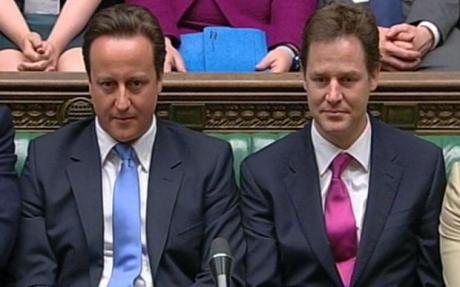
Cleggeron

The Liberal-Democrats are engaging in allsorts of illiberal and anti-democratic gymnastics to avoid a vote on abolishing the NHS.

I’m sorry to admit that I actually voted(1) Liberal-Democrat at the last general election. I could never vote Tory and I couldn’t bring myself to vote Labour even though it was no longer hijacked by Blair & Co. I’m going to have real problems ever voting Labour. They willingly allowed themselves to be hijacked by a Fascist, psychopathic nutter totally divorced from reality and any concept of truth who quite clearly pursued an alien agenda for so many years. Unison and Unite were so supportive of Him. Is it so important to remain in power that you prostitute all your values? Today, the Liberal Democrats may be following the same path.

Back to voting Liberal-Democat at the last general election. It was a tactical vote but I’m pleased to say that it had no effect since my constituency is certain to return a Labour MP.

As I’m sure that you’re aware – while there was no overall winning party at the General Election the Conservatives and the Liberal-Democrats formed a coalition government, the ConDems. I was pleased that New Labour was eventually defeated and out of power and initially hoped that the Liberal-Democrats would restrain the Tories. No such luck. It turns out that Clegg is a Tory in everything except political party. A European Tory, immensely rich and privilleged and – although exactly the type that are repeatedly appointed – entirely the wrong person to hold any political office. Why oh why did they listen to the press and dump Campbell?

The ConDem coalition – essentially a Tory government – shit on the electorate. Tuition fees, the Education Maintenance Allowance that was so important to poor families and now the NHS. “No top down reorganisation”. What a Blair-faced lie that one was. “We’re not privatisng the NHS”. Well, you’re not selling shares but in every other sense the NHS is getting privatised. Foreign and UK companies running hospitals, the profitable bits getting cherry-picked and a cash-starved shell of an NHS having to pick up the pieces. Health insurance, pay or go without – isn’t that privatisation?. Opposed by all major healthcare associations and yet they continue in destroying the NHS.

“No top-down reorganisation”. There is quite obviously no mandate for change.

The Lib-Dems will and are getting blamed for this. Without them it would not be happening. The toxic comments they get on newspaper articles are instructive. Will it be fatal for them? I expect to be campaigning against the Lib-Dems with anti-Blair vigour unless they change their ways pretty quickly.

(1) To be continued.

19/9/11

DRAFT: to be expanded – particularly murders by police, the role of ACPO.

There are many issues.

I am regarded by oppressive state authorities as an anarchist and potential violent terrorist. This is really quite strange since I consider it important to vote and participate in the democratic process. There is something quite clearly wrong here.

It is clear that I regularly vote as some simple searches will demonstrate. Why then am I regarded as an anarchist? How can the official assessment be so absurdly wrong? Similarly, it is clear that I participate in the democratic process and that I have always participated within the discourse of politics. Why then am I regarded as a potential terrorist – a potential violent extremist? Again, how can the official assessment be so absurdly wrong?

I consider that a huge proportion of it is to do with my perspective and activity. As somebody who rejects fake, manufactured terrorism I have been cast as the enemy. As somebody who recognises and is able to identify the real terrorists, I am the enemy of those terrorists.

Accusations of terrorism used to involve issues such as making bombs and using bombs and the threats of such things. We have seen – particularly over the last decade – that terrorism is used by strong vested interests to promote and pursue a particular agenda. Accusations of terrorism are now cheapened and directed at those that oppose such strong vested interests.

Oppressive state authorities promote the official ideology of fake, manufactured terrorism while the true anti-terrorist is cast as the terrorist. Accusations of terrorism have come to be directed at percieved opponents of some powerful interest group.

The official assessment is so absurdly wrong because the world has been turned on its head. Those that should be concerned with fighting terrorism are the terrorists and those that are accused of being terrorists are the anti-terrorists.

20/9/11 Still in Draft: may be altered and to be expanded

The question remains: Why is the official police assessment of me so absurdly wrong despite clear and obvious evidence to the contrary?

While it is accepted that the police are capable of staggering incompetence, there is more than that. I think that the answer is harassment – it is obvious that suspected terrorists can be violently killed by police with complete impunity at any time. This is a continuation of the harassment I endured from Ian Blair and John Reid. The same bullshit is involved – homegrown terrorists, liquid explosives, etc.

I think that many murders by police that are similar to me are intended to reinforce this point i.e. we can kill people similar to you so we can kill you. The police involved and their superiors are responsible for these murders by police and they are likely to continue until they are held to account.


Continue ReadingVoting Lib-Dem and police issues