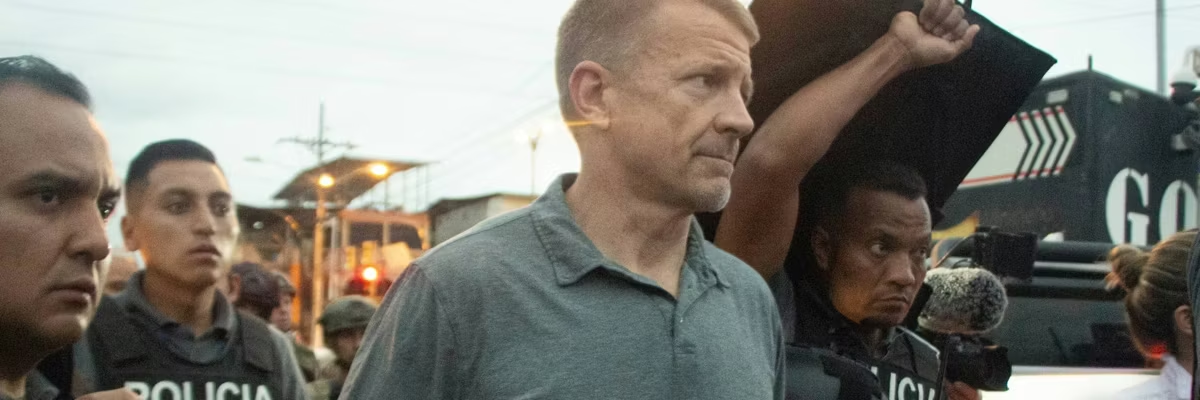
Blackwater founder Erik Prince walks with police on April 5, 2025 in Guayaquil, Ecuador. (Photo by Agencia Press South/Getty Images)
Erik Prince, the notorious founder of Blackwater, has reportedly been floated as a possible option as the Trump administration seeks help securing and exploiting Venezuela’s oil operations.
The Trump administration is reportedly planning to hire private military contractors—including possibly the notorious mercenary Erik Prince—to provide security as the US works to plunder Venezuela’s massive oil reserves.
CNNreported Thursday that “multiple private security companies are already jockeying to get involved in the US presence in Venezuela” as American oil giants push for physical security guarantees before they back President Donald Trump’s push for $100 billion in investment in the country.
“Interest is high given the potential payday; during the Iraq War, the US spent some $138 billion on private security, logistics, and reconstruction contractors,” the outlet noted. “One source suggested that Erik Prince, the former Blackwater founder and controversial Trump ally, could also be tapped for help. Prince’s Blackwater played an outsized role in Iraq after the 2003 US invasion, providing security, logistics, and support for oil infrastructure. But the firm came under intense scrutiny following the 2007 deadly shooting of Iraqi civilians.”
News of the Trump administration’s potential use of private mercenaries in Venezuela came after the US officially completed its first sale of Venezuelan oil. The sale, valued at $500 million, came days after Trump met with top oil executives at the White House to discuss efforts to exploit Venezuela’s oil reserves following the illegal US abduction of President Nicolás Maduro earlier this month.
Darren Woods, the CEO of Exxon Mobil, said his company would need “durable investment protections” before making any commitments in Venezuela.
CNN reported Thursday that the Pentagon has “put out a Request for Information to contractors about their ability to support possible US military operations in Venezuela.”
“Contractors are also in touch with the State Department’s overseas building operations office to cite interest in providing security if and when the US embassy in Venezuela reopens,” according to CNN.
Elon Musk urges you to be a Fascist like him, says that you can ignore facts and reality then.Donald Fuhrump says that Amerikkka doesn’t bother with crimes or charges anymore, not being 100% Amerikkkan and opposing his real estate intentions is enough.Orcas discuss how Trump was re-elected and him being an obviously insane, xenophobic Fascist.
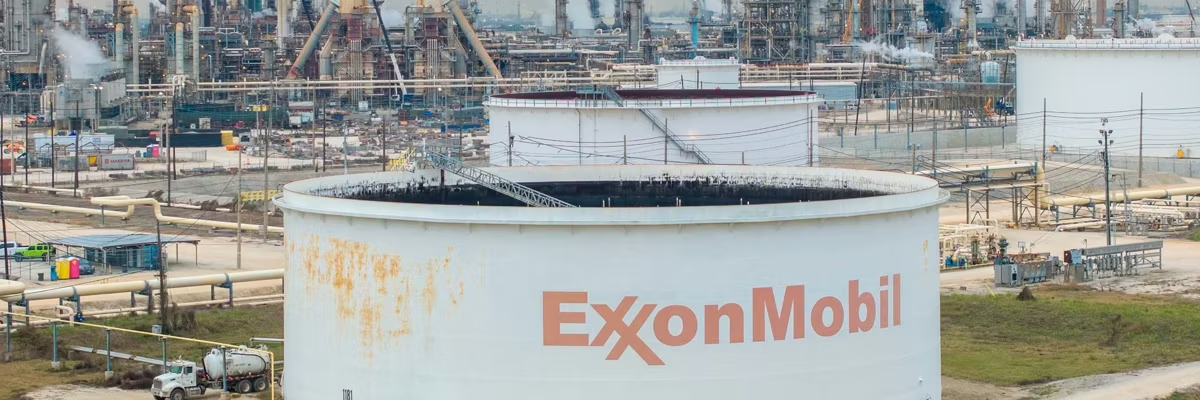
In an aerial view, the ExxonMobil Baytown Refinery is seen on January 13, 2026, in Baytown, Texas. (Photo by Brandon Bell/Getty Images)
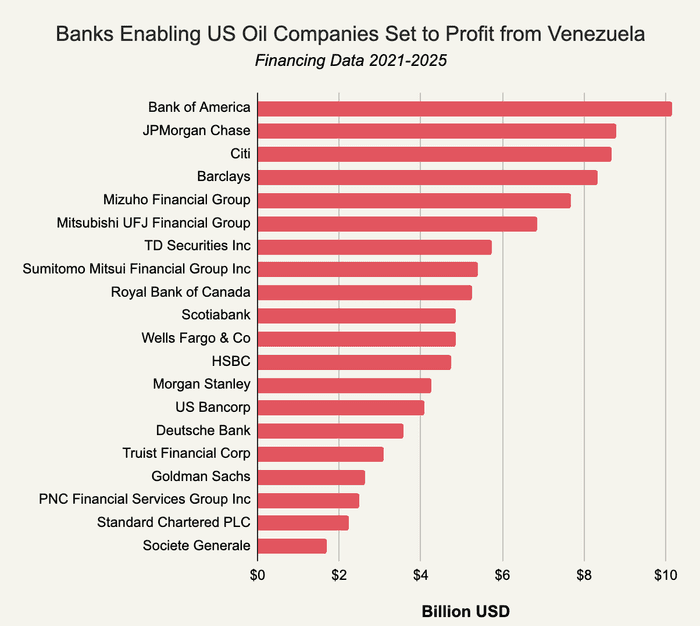
Since 2021, top Wall Street banks have committed more than $124 billion in investments to the nine companies set to profit most from the toppling of Venezuela’s government.
As oil industry giants are being set up to profit from President Donald Trump’s invasion of Venezuela, a new analysis shows the ample backing those companies have received from Wall Street’s top financial institutions.
Last week, Bloombergreported that stock traders and tycoons were “pouncing” after Trump’s kidnapping of President Nicolás Maduro earlier this month, after having pressured the Trump administration to “create a more favorable business environment in Venezuela.”
A dataset compiled by the international environmental advocacy group Stand.earth shows the extent to which these interests are intertwined.
Stand.earth found that since 2021, banks—including JPMorgan Chase, HSBC, TD, RBC, Citigroup, Wells Fargo, and Bank of America—have committed more than $124 billion in investments to the nine companies set to profit most from the toppling of Venezuela’s government.
More than a third of that financing, $42 billion, came in 2025 alone, when Trump launched his aggressive campaign against Venezuela.
Among the companies expected to profit most immediately are refiners like Valero, PBF Energy, Citgo, and Phillips 66, which have large operations on the Gulf Coast that can process the heavy crude Venezuela is known to produce. These four companies have received $41 billion from major banks over the past five years.
Chevron, which also operates many heavy-crude facilities, benefits from being the only US company that operated in Venezuela under the Maduro regime, where it exported more than 140,000 barrels of oil per day last quarter.
At a White House gathering with top oil executives on Friday, the company’s vice chair, Mark Nelson, told Trump the company could double its exports “effective immediately.”
According to Jason Gabelman, an analyst at TD Cowen, the company could increase its annual cash flow by $400 million to $700 million as a result of Trump’s takeover of Venezuelan oil resources.
Chevron was also by far the number-one recipient of investments in 2025, with more than $11 billion in total coming from the banks listed in the report—including $1.78 billion from Barclays, another $1.78 billion from Bank of America, and $1.32 billion from Citigroup.
According to Bloomberg, just weeks before Maduro’s removal, analysts at Citigroup predicted 60% gains on the nation’s more than $60 billion in bonds if he were replaced.
Even ExxonMobil, whose CEO Darren Woods dumped cold water on Trump’s calls to set up operations in Venezuela on Friday, calling the nation “uninvestable,” potentially has something major to gain from Maduro’s overthrow.
Exxon and ConocoPhillips each have outstanding arbitration cases against Venezuela over the government’s 2007 nationalization of oil assets, which could award them $20 billion and $12 billion, respectively.
The report found that in 2025, ExxonMobil and ConocoPhillips received a combined total of more than $12.8 billion in investment from major financial institutions, which vastly exceeded that from previous years.
Data on these staggering investments comes as oil companies face increased scrutiny surrounding possible foreknowledge of Trump’s attack on Venezuela.
Last week, US Senate Democrats launched a formal investigation into “communications between major US oil and oilfield services companies and the Trump administration surrounding last week’s military action in Venezuela and efforts to exploit Venezuelan oil resources.”
Richard Brooks, Stand.earth’s climate finance director, said the role of the financial institutions underwriting those oil companies should not be overlooked either.
“Without financial support from big banks and investors, the likes of Chevron, Exxon, ConocoPhillips, and Valero would not have the power that they do to start wars, overthrow governments, or slow the pace of climate action,” he said. “Banks and investors need to choose if they are on the side of peace, or of warmongering oil companies.”
Elon Musk urges you to be a Fascist like him, says that you can ignore facts and reality then.Donald Fuhrump says that Amerikkka doesn’t bother with crimes or charges anymore, not being 100% Amerikkkan and opposing his real estate intentions is enough.Orcas discuss how Trump was re-elected and him being an obviously insane, xenophobic Fascist.
Donald Trump holds a press conference after US forces captured Venezuelan leader Nicolas Maduro and launched a ‘large-scale strike’ on the Latin American country | Jim Watson / AFP via Getty Images)
The US has a long history of military intervention in Latin America, but never before has it been so brazen
As the days pass, shock subsides over the kidnapping of Venezuelan president Nicolás Maduro and his wife, Cilia Flores, which was ordered by Donald Trump and carried out by the US military. That the victim is a dictator has helped to justify the illegal use of brute force.
There is a long history of US military intervention in Latin America. It’s been the expression of the most enduring principle that has governed relations in the American continent.
Everything Trump did in the first year of his second presidential term was old news: tariff wars, interventions in the internal affairs of other countries, threats, extortion and the revival of the old Monroe Doctrine.
What is new is the brazenness, the absence of even the slightest legal justification, or even the effort to frame actions within some interpretation of international law, however twisted it may be. There is no talk of democracy, freedom or human rights for millions of Venezuelans.
This is an unexplained and uncontested exercise of power. “What’s next, Mr President, Colombia?” journalists asked Trump like subjects asking their emperor. “It sounds good to me,” he replied. Mexico, Colombia, Cuba, Greenland… “American dominance in the Western Hemisphere will never be questioned again.”
The threat is material – Maduro in handcuffs, the naval deployment in the Caribbean, the boats bombed for months – and at the same time diffuse. No one knows what the logic or the alleged motive for the next action will be.
The effect of Trump’s actions, already tested with the so-called “peace deal” for Palestine in the aftermath of the Israeli genocide in Gaza, is to sow confusion and division, and paralysis. The era of this new power has begun with little to oppose it, and with international laws useless like broken toys. And we are all warned.
Maduro was extracted from his bunker in eight minutes, which was enough time to kill 32 Cuban guards who were protecting him. The rest of the regime remains intact, now as the executive arm of Trump’s designs, which have articulated only one priority: oil.
When asked about elections, democracy or the release of some 800 political prisoners, Trump and his secretary of state, Marco Rubio, reply that all this “is premature”. The nature of the events indicates the coup was orchestrated with a part of the regime whose head was Maduro.
Nothing remains of Venezuela’s Bolivarian revolution, not even dignity. Delcy Rodríguez, Maduro’s vice-president and one of the most vocal figures in his administration, has been appointed interim president, with Trump’s acquiescence. She and her brother Jorge, the president of the National Assembly, Diosdado Cabello, the minister of the interior, and Vladimir Padrino López, the head of the armed forces, have become administrators of a Trump protectorate – a new, perhaps provisional, status quo that sets Venezuela and all of Latin America sailing into uncharted waters.
The eternal misunderstanding
In a speech to the US Congress 202 years ago, US president James Monroe laid the foundations for his new country’s relationship with the other republics emerging across the American continent amid struggles against the European colonial powers.
That relationship would be one of US dominance and Latin American subordination, although the Monroe Doctrine was presented as a warning against new European colonial adventures in America.
“America for Americans” – Monroe’s phrase that coined the eternal misunderstanding – postulated that America, the continent, was for them, who called themselves “Americans”. In that single remark, the rest of the American peoples were left in an inferior category, confined to their nationalities or to a subordinate belonging to the same single continent (Latin Americans, South Americans, Central Americans or Caribbeans). Never simply Americans.
Other US presidents followed Monroe’s lead. More than five decades after his doctrine came Rutherford Hayes’s corollary of 1880, on the need for the US to have exclusive control in Central America and the Caribbean, and therefore of any interoceanic canal, followed by Theodore Roosevelt’s corollary of 1904, which postulated the freedom of the US to intervene by force in any country on the continent if it considered that its interests were affected.
Just a few weeks ago, on the anniversary of the Monroe Doctrine, Trump published his own corollary, which contains nothing new, though the foreign power to keep away now is no longer Europe but China. The novelty lies in what began in Venezuela.
The question of democracy
In December, the UN reported that Venezuela’s human rights situation was continuing to deteriorate. In 2021, the International Criminal Court’s prosecutor opened a formal investigation into crimes against humanity, such as torture, disappearances and executions at the hands of the state.
Like Delcy Rodríguez now, Maduro became interim president in 2013 after the death of leader Hugo Chávez. Shortly afterwards, he won the elections by a narrow margin and, from 2015 onwards, took an openly authoritarian turn when he refused to recognise the result of parliamentary elections that left him without a majority in the National Assembly.
Opponents of the regime tried different approaches to overthrow it. To name just a few: peaceful demonstrations, violent actions, calls for a military uprising, attempts to get neighbouring governments to blockade the country, support for economic sanctions by the US and the European Union, complaints to international organisations, boycotts of elections they considered rigged, negotiations with the regime mediated by third countries, and massive participation in elections. None of this moved the needle.
Despite the opposition’s victory in the 2024 presidential elections, Maduro was once again proclaimed president, through fraud.
Then Trump reappeared, with a military deployment unseen in decades, indiscriminate bombing of ships in the Caribbean and the Pacific, and persecution and stigmatisation of Venezuelan migrants as terrible criminals and mentally ill people ravaging US cities.
The main opposition leader, María Corina Machado, who recently won the Nobel Peace Prize, clung to this strategy like a lifeline in the storm. She argued that the military siege, the accusations of narco-terrorism against Maduro and his circle, and the imminent military action by Washington would bring down the regime and open the door to a transition. Shortly after Maduro’s kidnapping, Machado proclaimed: “Today we are prepared to assert our mandate and take power.”
Trump’s response could not have been colder. He removed her from the scene, claiming she lacked the necessary “respect” and “support” for the moment.
In an interview with Fox News on Monday, Machado tried again to court Trump and said she wanted to give him her Nobel Peace Prize, which the US president has long coveted and considers himself deserving of. Days later, Trump indicated to Fox News that he might meet with her in Washington, saying: “I understand she’s coming in next week sometime, and I look forward to saying hello to her.” The Norwegian Nobel Institute was forced to clarify that its peace prizes cannot be transferred to third parties.
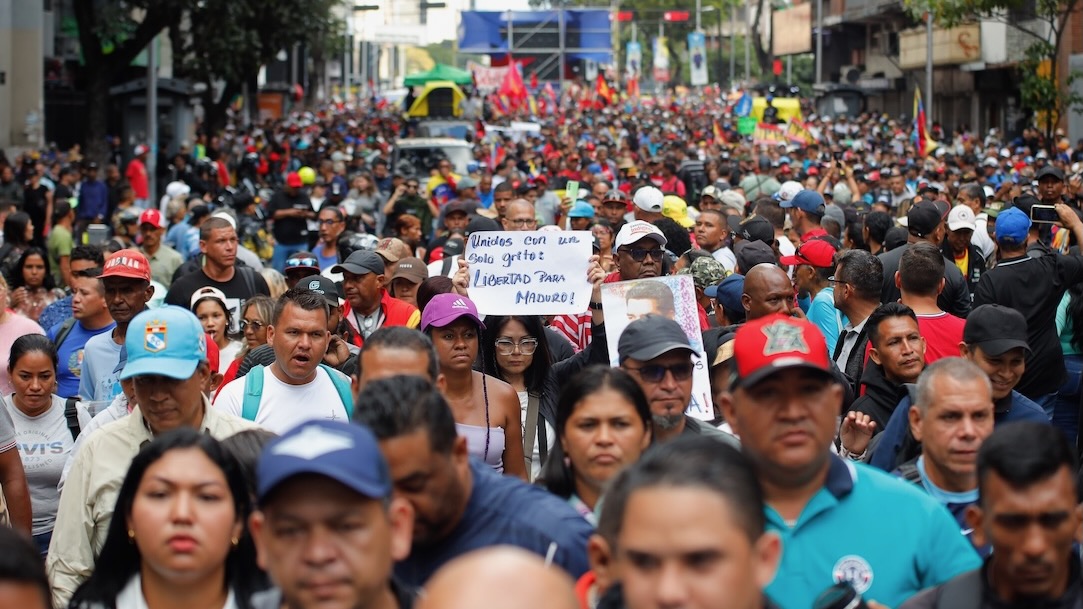
There were celebrations by Venezuelans in exile in cities across the western hemisphere when Maduro’s overthrow was announced, but not within Venezuela. Maduro no longer governs there, but the same regime does, under Trump’s shadow.
Mobilization in Venezuela for the return of President Nicolás Maduro from US captivity. Photo: Francisco Trias
The US has essentially declared that sovereignty itself for any nation that refuses subordination to US imperialism, holds no weight.
On January 3, 2026, the United States did not merely bomb a sovereign country and capture its president. It displayed, in the most unambiguous terms, a total defiance of the post-War international order that it helped create. When US special forces captured Venezuelan President Nicolás Maduro and his wife and National Assembly deputy Cilia Flores from Caracas and transported them to a Brooklyn jail, they did not simply violate Venezuelan sovereignty. They declared that sovereignty itself, for any nation that refuses subordination to US imperialism, holds no weight.
As Nicolás Maduro Guerra, the president’s son, stated before Venezuela’s National Assembly: “If we normalize the kidnapping of a head of state, no country is safe. Today it’s Venezuela. Tomorrow, it could be any nation that refuses to submit.”
The response to this act, regardless of one’s political orientation or views on the Maduro government, will determine whether the concepts of international law, multilateralism, and the self-determination of peoples retain any meaning in the twenty-first century. This is not a question for the left alone. It is a question for every nation, every government, and every citizen who believes that the world should not be governed by the principle that might makes right.
The logic of hyper-imperialism unveiled
What distinguishes the current phase of US foreign policy from earlier periods of intervention is its brazenness. When the CIA orchestrated the overthrow of Guatemalan President Jacobo Árbenz in 1954, Washington maintained the pretense of responding to communist subversion. When American forces invaded Panama in 1989 to capture Manuel Noriega, the justification was framed within a discourse of law enforcement. The history of US intervention in Latin America spans over forty successful regime changes in slightly less than a century, according to Harvard scholar John Coatsworth.
But Trump’s announcement that the United States would “run” Venezuela represents something qualitatively different. Here there is no pretense. When asked about the operation, Trump invoked the Monroe Doctrine and said that these are called “Donroe Doctrine”, signaling that the Western Hemisphere remains a zone of US dominion – an assertion clearly made in the National Security Strategy launched in November 2025. Secretary of State Marco Rubio’s subsequent clarification that the US would merely extract policy changes and oil access did nothing to soften the nakedness of the imperial project.
This represents what we at the Tricontinental: Institute for Social Research have identified as “hyper-imperialism”, a dangerous and decadent stage of imperialism. Facing the erosion of its economic and political dominance and the rise of alternative centers of power (mainly in Asia) US imperialism increasingly relies on its uncontested military strength. The Chatham House analysis is unequivocal: this constitutes a significant violation of Venezuelan sovereignty and the UN Charter. There was no Security Council mandate, nor any claims to self-defense.
The post-1945 international order established the formal principle that states possess sovereign equality and that force against another state’s territorial integrity is prohibited. Article 2(4) of the UN Charter was designed precisely to prevent the powerful from treating the world as their domain, which the US has now blatantly ignored.
The test for Global South solidarity
The kidnapping of President Maduro poses an existential question to the discourse of “multipolarity”. While the seeds of a multipolar world order may exist (China’s economic rise, the increasing political assertiveness of Global South countries, BRICS and its expansion, the increasing trade in local currencies) they have proven to be extremely limited in the face of the US unilateral use of force. This is an uncomfortable truth.
The initial responses from governments suggest the difficulty of moving from rhetorical condemnation to material constraint. Brazilian President Lula correctly identified the stakes when he condemned the capture as crossing “an unacceptable line” and warned that “attacking countries, in flagrant violation of international law, is the first step toward a world of violence, chaos, and instability”. Colombian President Petro rejected “the aggression against the sovereignty of Venezuela and of Latin America.” Mexico’s President Sheinbaum declared that “the Americas do not belong to any doctrine or any power.” China’s Foreign Minister Wang Yi condemned US military intervention and called for the release of President Maduro, saying that, “We don’t believe that any country can act as the world’s police.”
The groundswell of opposition confronts a structural problem: the institutions designed to prevent such actions are incapable of constraining the permanent members of the Security Council. The United States can veto any resolution condemning its behavior. The emergency Security Council meeting convened at the request of Venezuela and Colombia produced denunciations but no enforcement mechanism.
Every government that has sought to develop independently, that has attempted to control its own natural resources, that has resisted subordination to Washington, must recognize that what has happened in Venezuela could happen to them. Trump’s threats against Cuba and Colombia underscore this point.
Sovereignty, resources, and the right to self-determination
The pattern is well established with the successive overthrowing of heads of states when they tried to implement land reform like Árbenz in Guatemala, nationalize national resources under Allende in Chile and Mosaddegh in Iran. The thread continues to the present situation in Venezuela.
Venezuela possesses the world’s largest proven oil reserves, estimated at 303 billion barrels. Trump made no effort to disguise the centrality of oil, announcing that American companies would rebuild Venezuela’s oil industry and the US would be “selling oil, probably in much larger doses”. The maritime blockade preceding the military operation served the explicit purpose of strangling the country economically.
Yet the entire trajectory of the US Venezuela policy since 2001, from funding opposition groups to the 2002 coup attempt, to Operation Gideon in 2020, to the “maximum pressure” sanctions, has been designed to prevent Venezuela from making free choices. The assault accelerated after Venezuela enacted its 2001 Hydrocarbons Law asserting sovereign control over oil resources.
Conclusion
The kidnapping of Nicolás Maduro and National Assembly deputy Cilia Flores should compel a fundamental reassessment of the state of the international order. The formal institutions and legal frameworks that were supposed to prevent great power aggression have failed to constrain Washington’s imperialist aggressions. This places an enormous responsibility on the governments and peoples of the Global South. The debates around multipolarity, BRICS, South-South cooperation, and de-dollarization are rendered academic if they do not translate into the practical capacity to impose costs on actions like the invasion of Venezuela. Ultimately, the imperialist aggression against Venezuela has repercussions for governments and peoples around the world, regardless of their ideological orientation or views on the Maduro government. While the real limits of “multipolarity” in this stage of US hyper-imperialism have been laid bare, we must continue building our collective capacity to resist. The defense of Venezuelan people’s sovereignty, after all, is a defense of the sovereignty of all our nations.
Elon Musk urges you to be a Fascist like him, says that you can ignore facts and reality then.Donald Fuhrump says that Amerikkka doesn’t bother with crimes or charges anymore, not being 100% Amerikkkan and opposing his real estate intentions is enough.Orcas discuss how Trump was re-elected and him being an obviously insane, xenophobic Fascist.
The year 2025 saw the return to power of Donald Trump, a jewellery heist at the Louvre museum in Paris and an engagement that “broke the internet”.
Amid the biggest stories of the year, climate change research continued to feature prominently in news and social media feeds.
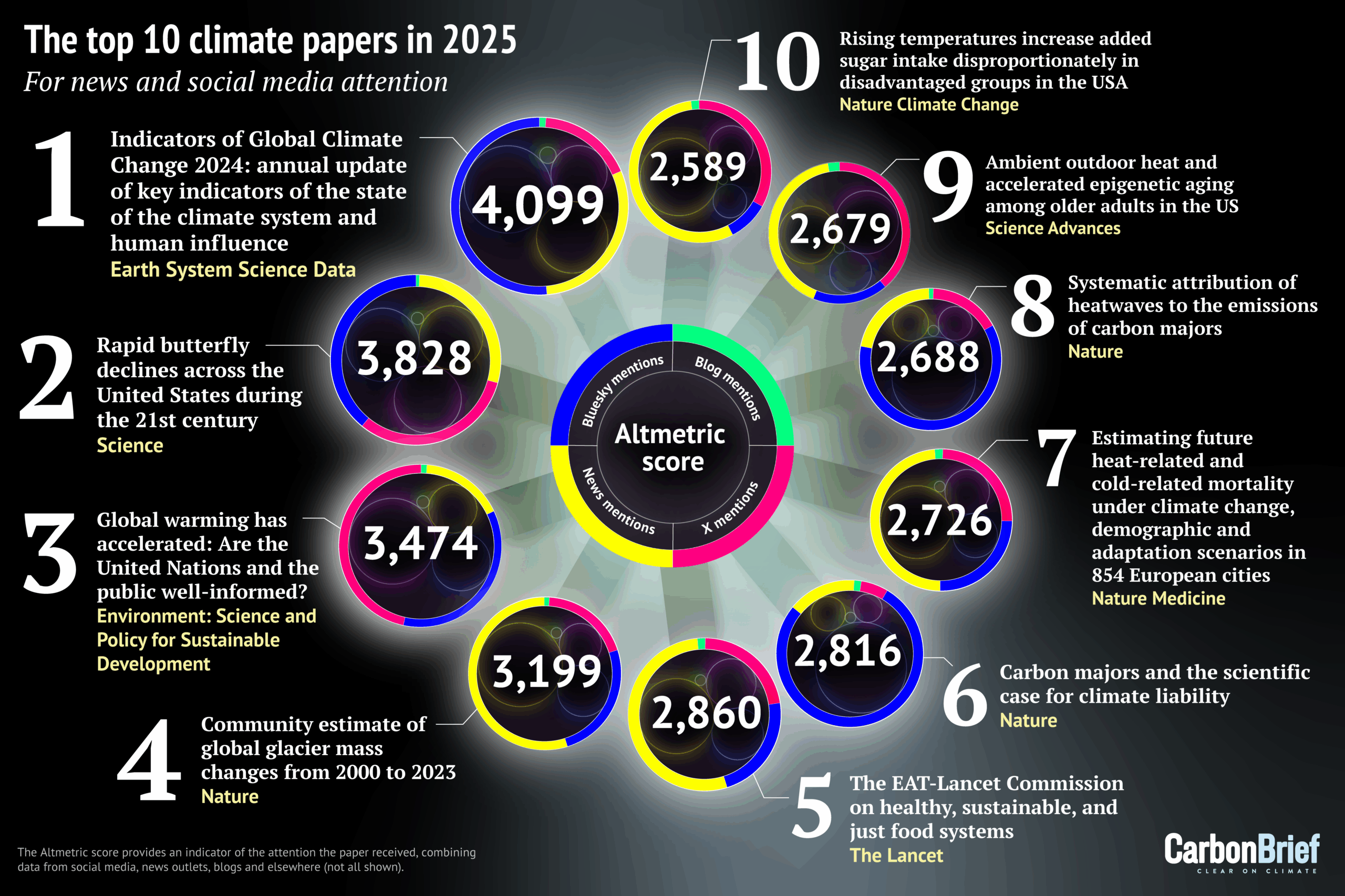
Using data from Altmetric, which scores research papers according to the attention they receive online, Carbon Brief has compiled its annual list of the 25 most talked-about climate-related studies of the past year.
The top 10 – shown in the infographic above and list below – include research into declining butterflies, heat-related deaths, sugar intake and the massive loss of ice from the world’s glaciers:
Later in this article, Carbon Brief looks at the rest of the top 25 and provides analysis of the most featured journals, as well as the gender diversity and country of origin of authors.
New for this year is the inclusion of Altmetric’s new “sentiment analysis”, which scores how positive or negative a paper’s social media attention has been.
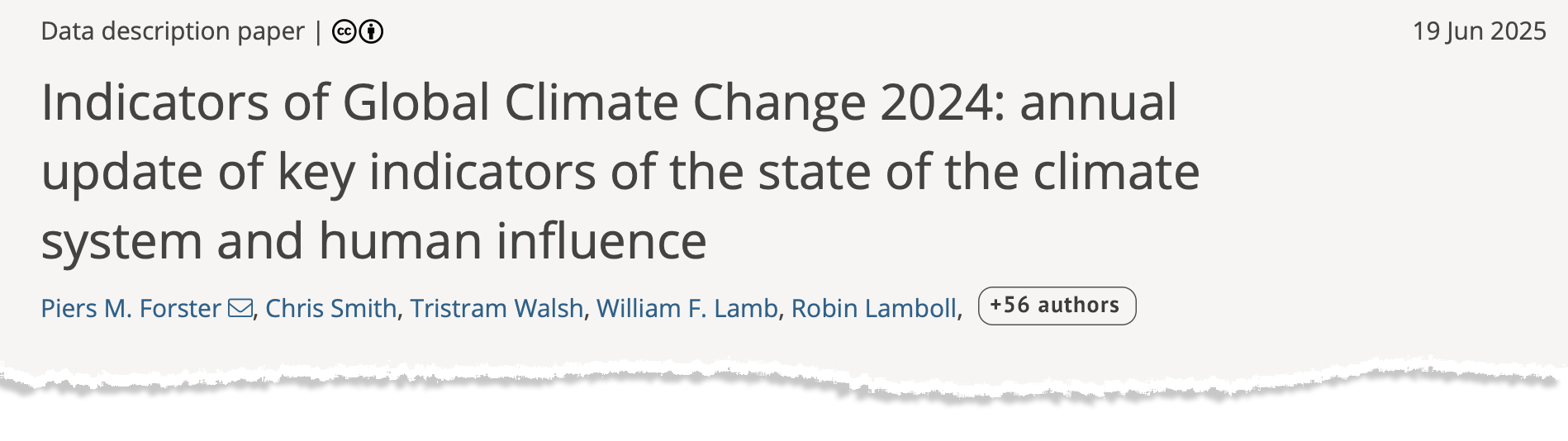
The top-scoring climate paper of 2025, ranking 24th of any research paper on any topic, is the annual update of the “Indicators of Global Climate Change” (IGCC) report.
The report was established in 2023 to help fill the gap in climate information between assessments of the Intergovernmental Panel on Climate Change (IPCC), which can take up to seven years to complete. It includes the latest data on global temperatures, the remaining carbon budget, greenhouse gas emissions and – for the first time – sea level rise.
The paper, published in Earth System Science Data, has an Altmetric score of 4,099. This makes it the lowest top-scoring climate paper in Carbon Brief’s list since 2017.
(An Altmetric score combines the mentions that published peer-reviewed research has received from online news articles, blogs, Wikipedia and on social media platforms such as Facebook, Reddit, Twitter and Bluesky. See an earlier Carbon Brief article for more on how Altmetric’s scoring system works.)
Previous editions of the IGCC have also appeared in Carbon Brief’s list – the 2024 and 2023 iterations ranked 17th and 18th, respectively.
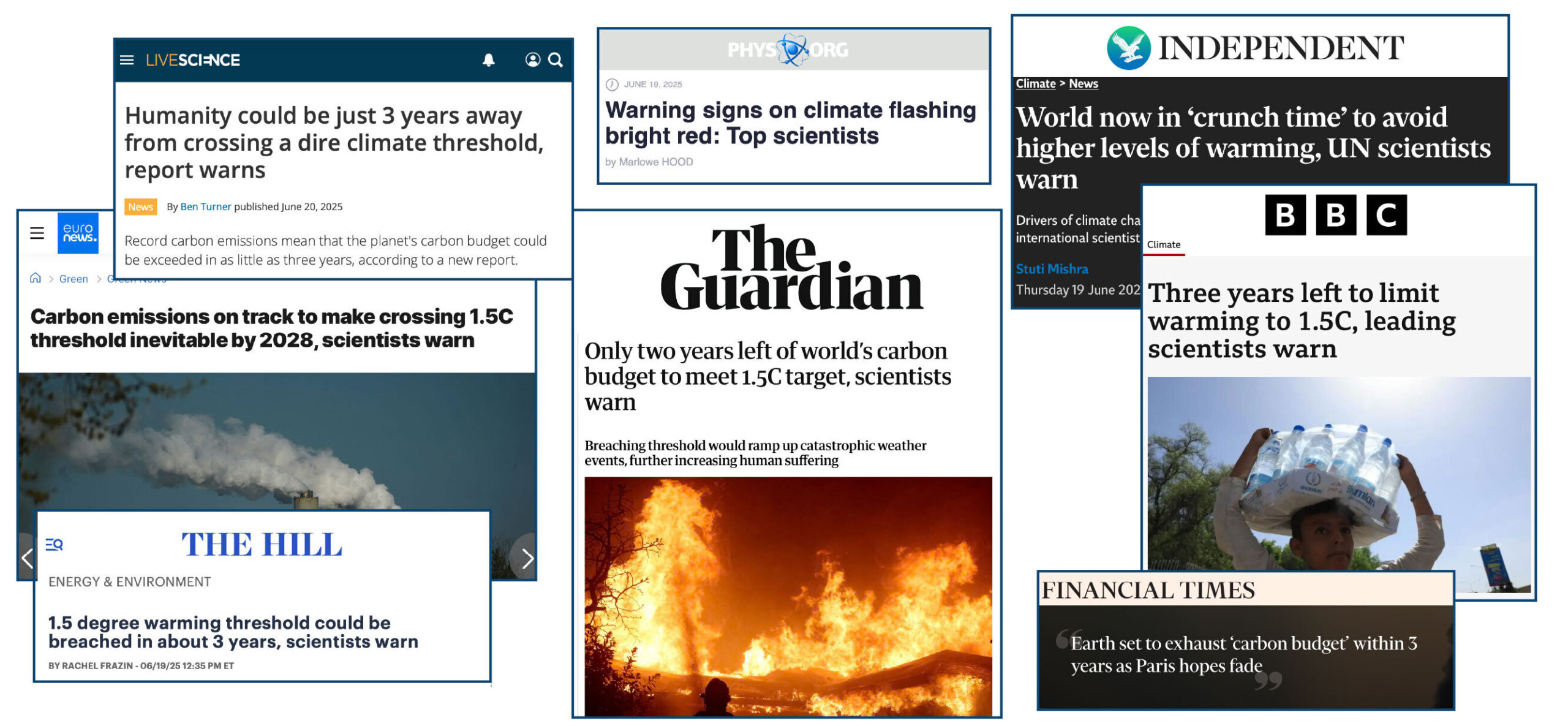
Many outlets led their coverage with the study’s findings on the global “carbon budget”. This warned that the remaining carbon budget to limit warming to 1.5C will be exhausted in just three years if global emissions continue at their current rate.
“It is also now inevitable that global temperatures will reach 1.5C of long-term warming in the next few years unless society takes drastic, transformative action…Every year of delay brings reaching 1.5C – or even higher temperatures – closer.”
Forster, who was awarded a CBE in the 2026 new year honours list, tells Carbon Brief that media coverage of the study was “great” at “putting recent extreme weather in the context of rapid long-term rates of global warming”.
However, he adds:
“Climate stories are not getting the coverage they deserve or need at the moment so the community needs to get all the help we can for getting clear consistent messages out there.”
The paper was tweeted more than 300 times and posted on Bluesky more than 950 times. It also appeared in 22 blogs.
Using AI, Altmetric now analyses the “sentiment” of this social media attention. As the summary figure below shows, the posts about this paper were largely positive, with an approximate 3:1 split of positive and negative attention.
Altmetric’s AI-generated summary of the sentiment of social media posts regarding the Forster et al. (2025) paper. Totals may add up to more than 100% because of rounding. Source: Altmetric
Butterfly decline
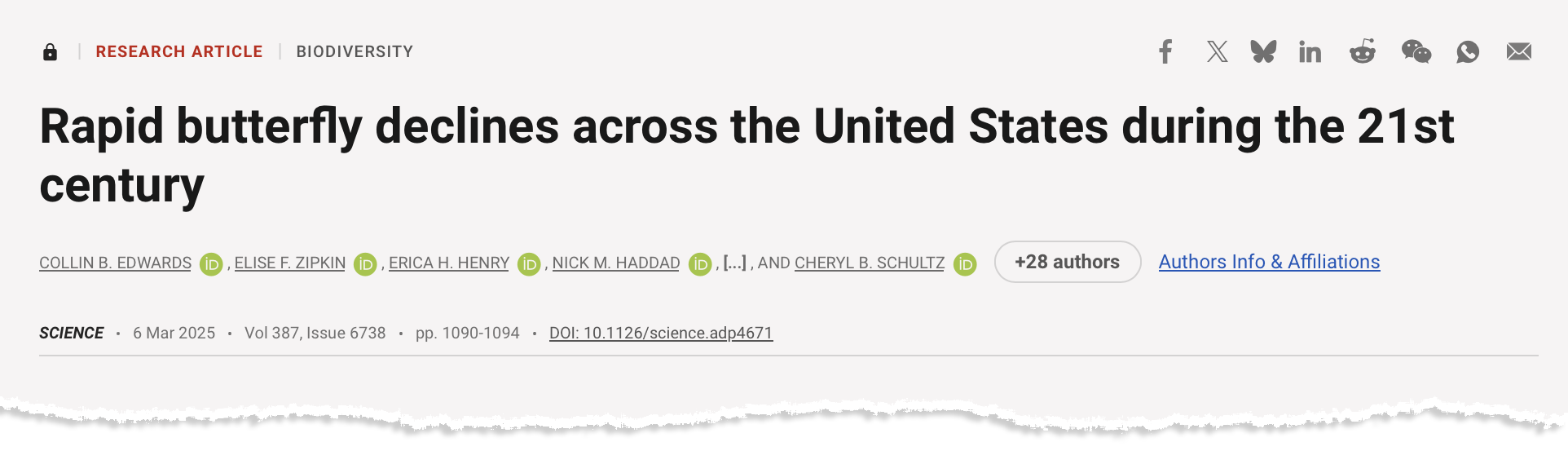
With an Altmetric score of 3,828, the second-highest scoring climate paper warns of “widespread” declines in butterfly numbers across the US since the turn of the century.
The paper, titled “Rapid butterfly declines across the US during the 21st century” and published in Science, identifies a 22% fall in butterfly numbers across more than 500 species between 2000 and 2020.
(There is a higher-scoring paper, “The 2025 state of the climate report: a planet on the brink”, in the journal BioScience, but it is a “special report” and was not formally peer reviewed.)
The scale of the decline suggests “multiple and broadly acting threats, including habitat loss, climate change and pesticide use”, the paper says. The authors find that “species generally had stronger declines in more southerly parts of their ranges”, with some of the most negative trends in the driest and “most rapidly warming” US states.
The paper was also mentioned in 13 blogs, more than 750 Bluesky posts and more than 600 tweets.
The sentiment analysis reveals that social media posts about the paper were largely negative. However, closer inspection reveals that this negativity is predominantly towards the findings of the paper, not the research itself.
For example, a Bluesky post on the “distressing” findings by one of the study’s authors is designated as “neutral negative” by Altmetric’s AI analysis.
In a response to a query from Carbon Brief, Altmetric explains that the “goal is to measure how people feel about the research paper itself, not the topic it discusses”. However, in some cases the line can be “blurred” as the AI “sometimes struggles to separate the subject matter from the critique”. The organisation adds that it is “continuously working on improving our models to better distinguish between the post’s content and the research output”.
Altmetric’s AI-generated summary of the sentiment of social media posts regarding the Forster et al. (2025) paper. Totals may add up to more than 100% because of rounding. Source: Altmetric
On the attention that the paper received, lead author Dr Collin Edwards of the Washington Department of Fish & Wildlife says that “first and foremost, people care about butterflies and our results are broad-reaching, unequivocal and, unfortunately, very concerning”.
Edwards tells Carbon Brief he hopes the clarity of the writing made the paper accessible to readers, noting that he and his co-authors “sweat[ed] over every word”.
The resulting news coverage “accurately captured the science”, Edwards says:
“Much as I wish our results were less consistently grim, the consistency and simplicity of our findings mean that even if a news story only provides the highest level summary, it isn’t misleading readers by skipping some key caveat or nuance that changes the interpretation.”
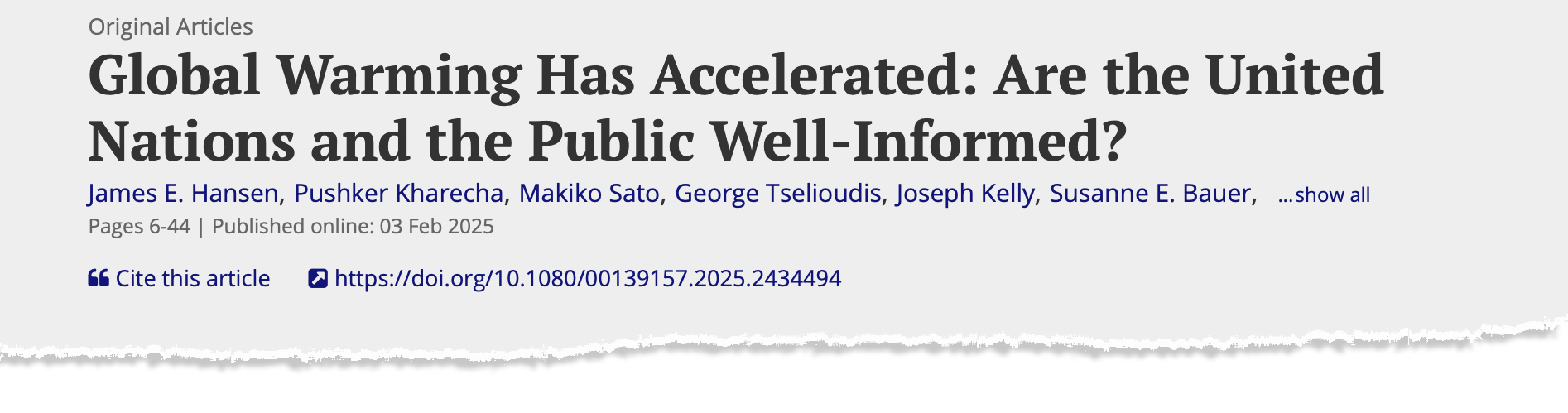
The findings suggest that the cooling effect of aerosols – tiny, light‑scattering particles produced mainly by burning fossil fuels – has masked more of the warming driven by greenhouse gases than previously estimated by the IPCC.
As efforts to tackle air pollution continue to reduce aerosol emissions, warming will accelerate further – reaching 2C by 2045, according to the research.
The paper was covered by almost 400 news stories – driven, in part, by Hansen’s comments in a press briefing that the Paris Agreement’s 2C warming limit was already “dead”.
Hansen’s analysis received a sceptical response from some scientists. For example, Dr Valerie Masson-Delmotte, an IPCC co-chair for its most recent assessment report on climate science, told Agence France-Presse the research “is not published in a climate science journal and it formulates a certain number of hypotheses that are not consistent with all the available observations”.
In addition, other estimates, including by Carbon Brief, suggest new shipping regulations have made a smaller contribution to warming than estimated by Hansen.
Hansen tells Carbon Brief that the paper “did ok” in terms of media coverage, although notes “it’s on [scientists] to do a better job of making clear what the core issues are in the physics of climate change”.
With more than 1,000 tweets, the paper scored highest in the top 25 for posts on Twitter. It was also mentioned in more than 800 Bluesky posts and on 27 blogs.
The sentiment analysis suggests that these posts were largely positive, with just a small percentage of negative comments.
Altmetric’s AI-generated summary of the sentiment of social media posts regarding the Hansen et al. (2025) paper. Totals may add up to more than 100% because of rounding. Source: Altmetric
Making the top 10
Ranking fourth in Carbon Brief’s analysis is a Nature paper calculating changes in global glacier mass over 2000-23. The study finds glaciers worldwide lost 273bn tonnes of ice annually over that time – with losses increasing by 36% between 2000-11 and 2012-23.
The study has an Altmetric score of 3,199. It received more news coverage than any other paper in this year’s top 25, amassing 1,187 mentions. with outlets including the Guardian, Associated Press and Economic Times.
Carbon Brief’s coverage of the report highlights that “a global shift towards ‘healthier’ diets could cut non-CO2 greenhouse gas emissions, such as methane, from agriculture by 15% by 2050”. It adds:
“The findings build on the widely cited 2019 report from the EAT-Lancet Commission – a group of leading experts in nutrition, climate, economics, health, social sciences and agriculture from around the world.”
Also making the top 10 – ranking sixth and eighth – are a pair of papers published in Nature, which both link extreme heat to the emissions of specific “carbon majors” – large producers of fossil fuels, such as ExxonMobil, Shell and Saudi Aramco,.
The first is a perspective, titled “Carbon majors and the scientific case for climate liability”, published in April. It begins:
“Will it ever be possible to sue anyone for damaging the climate? Twenty years after this question was first posed, we argue that the scientific case for climate liability is closed. Here we detail the scientific and legal implications of an ‘end-to-end’ attribution that links fossil fuel producers to specific damages from warming.”
The authors find “trillions (of US$) in economic losses attributable to the extreme heat caused by emissions from individual companies”.
The paper was mentioned 1,329 times on Bluesky – the highest in this year’s top 25. It was also mentioned in around 270 news stories.
Published four months later, the second paper uses extreme event attribution to assess the impact of climate change on more than 200 heatwaves recorded since the year 2000.
The authors find one-quarter of the heatwaves would have been “virtually impossible” without human-caused global warming. They add that the heatwaves were, on average, 1.7C hotter due to climate change, with half of this increase due to emissions stemming from the operations and production of carbon majors.
This study was mentioned in almost 300 news stories – including by Carbon Brief – as well as 222 tweets and 823 posts on Bluesky.
In seventh place is a Nature Medicine study, which quantifies how heat-related and cold-related deaths will change over the coming century as the climate warms.
A related research briefing explains the main findings of the paper:
“Heat-related deaths are estimated to increase more rapidly than cold-related deaths are estimated to decrease under future climate change scenarios across European cities. An unrealistic degree of adaptation to heat would be required to revert this trend, indicating the need for strong policies to reduce greenhouse gases emissions.”
The paper in ninth place also analyses the health impacts of extreme heat. The study, published in Science Advances, finds that extreme heat can speed up biological ageing in older people.
Rounding out the top 10 is a Nature Climate Change study, titled “Rising temperatures increase added sugar intake disproportionately in disadvantaged groups in the US”.
The study finds that at higher temperatures, people in the US consume more sugar – mainly due to “higher consumption of sugar-sweetened beverages and frozen desserts”. The authors project that warming of 5C would drive additional sugar consumption of around 3 grams per day, “with vulnerable groups at an even higher risk”.
In 13th place is a Nature Climate Change study that finds the wealthiest 10% of people – defined as those who earn at least €42,980 (£36,605) per year – contributed seven times more to the rise in monthly heat extremes around the world than the global average.
The authors also explore country-level emissions, finding that the wealthiest 10% in the US produced the emissions that caused a doubling in heat extremes across “vulnerable regions” globally.
In 15th place is the annual Lancet Countdown on health and climate change – a lengthy report with more than 120 authors.
The study warns that “climate change is increasingly destabilising the planetary systems and environmental conditions on which human life depends”.
This annual analysis from the Lancet often features in Carbon Brief’s top 25 analysis. After three years in the Carbon Brief’s top 10 over 2020-23, the report landed in 20th place in 2023 and missed out on a spot in the top 25 altogether in 2024.
In 16th place is a Science Advances study, titled “Increasing rat numbers in cities are linked to climate warming, urbanisation and human population”. The study uses public complaint and inspection data from 16 cities around the world to estimate changes in rat populations.
It finds that “warming temperatures and more people living in cities may be expanding the seasonal activity periods and food availability for urban rats”.
In 21st place is a Nature Climate Change paper, titled “Peak glacier extinction in the mid-21st century”. The study authors “project a sharp rise in the number of glaciers disappearing worldwide, peaking between 2041 and 2055 with up to ~4,000 glaciers vanishing annually”.
Completing the top 25 is a Nature study on the “prudent planetary limit for geological carbon storage” – where captured CO2 is injected deep underground, where it can stay trapped for thousands of years.
In a Carbon Brief guest post, study authors Dr Matthew Gidden and Prof Joeri Rogelj explain that carbon dioxide removal will only be effective at limiting global temperature rise if captured CO2 is injected “deep underground, where it can stay trapped for thousands of years”.
The guest post warns that “geological carbon storage is not limitless”. It states that “if all available safe carbon storage capacity were used for CO2 removal, this would contribute to only a 0.7C reduction in global warming”.
Top journals
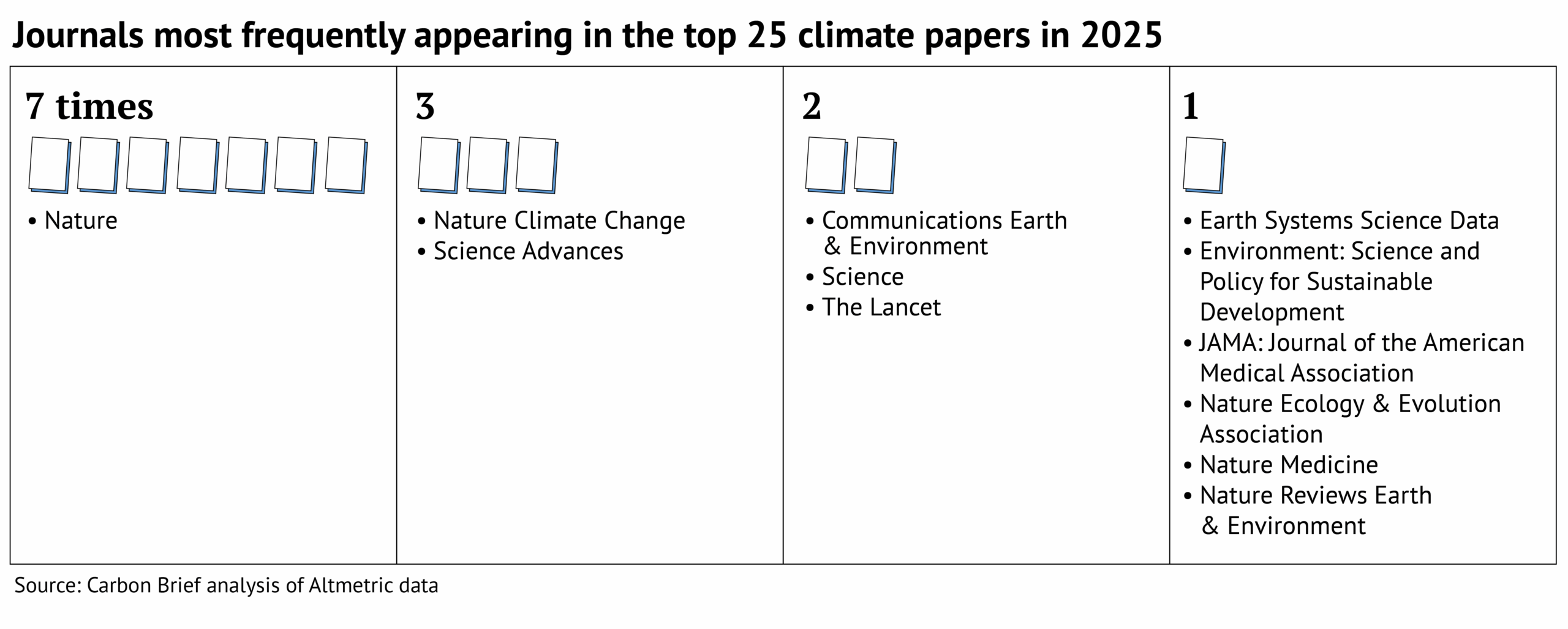
The journal Nature dominates Carbon Brief’s top 25, with seven papers featured.
Many other journals in the Springer Nature stable also feature, including Nature Climate Change (three), Communications Earth & Environment (two), as well as Nature Ecology & Evolution, Nature Medicine and Nature Reviews Earth & Environment (one each).
Also appearing more than once in the top 25 are Science Advances (three), Science (two) and the Lancet (two).
This is shown in the graphic below.
All the final scores for 2025 can be found in this spreadsheet.
Diversity in the top 25
The top 25 climate papers of 2025 cover a huge range of topics and scope. However, analysis of their authors reveals a distinct lack of diversity.
In total, the top 25 includes more than 650 authors – the highest number since Carbon Brief began this analysis in 2022.
This is largely due to a few publications with an exceptionally high number of authors. For example, the 2025 report of the Lancet Countdown on health and climate change has almost 130 authors alone, accounting for almost one-fifth of authors in this analysis.
Carbon Brief recorded the gender and country of affiliation for each of these authors. (The methodology used was developed by Carbon Brief for analysis presented in a special 2021 series on climate justice.)
The analysis reveals that 88% of the authors of the climate papers most featured in the media in 2025 are from institutions in the global north.
Global South: The “global south” is a term used to broadly describe lower-income countries in regions such as Africa, Asia and Latin America. It is often used to denote nations that are either in… Read More
Carbon Brief defines the global north as North America, Europe, Japan, Australia and New Zealand. It defines the global south as Asia (excluding Japan), Africa, Oceania (excluding Australia and New Zealand), Latin America and the Caribbean.
The analysis shows that 53% of authors are from European institutions, while only 1% of authors are from institutions in Africa.
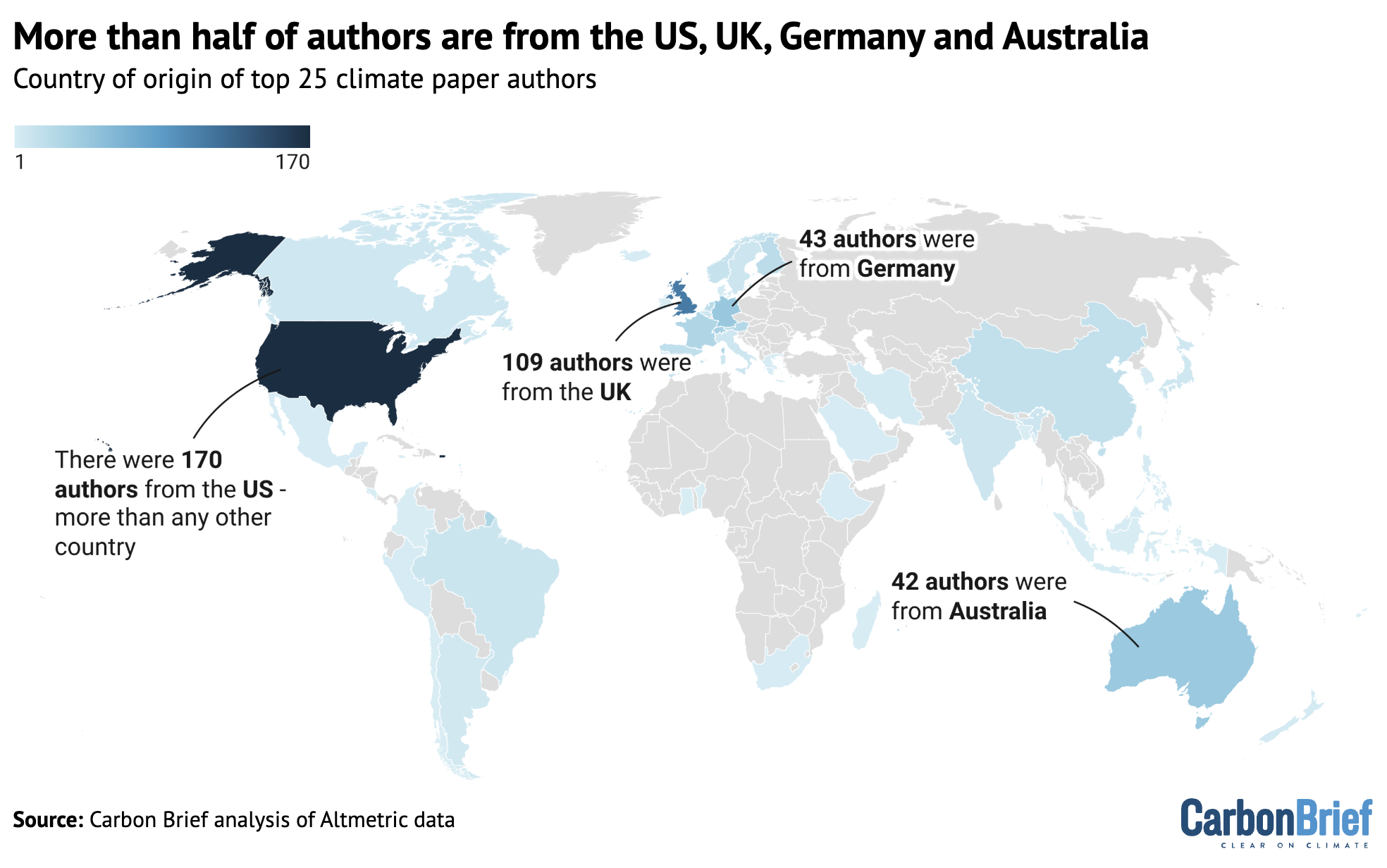
Further data analysis shows that there are also inequalities within continents. The map below shows the percentage of authors from each country, where dark blue indicates a higher percentage. Countries that are not represented by any authors in the analysis are shown in grey.
The number of all authors from the climate papers most featured in the media in 2025. The designations employed and the presentation of the material on this map do not imply the expression of any opinion whatsoever on the part of Carbon Brief concerning the legal status of any country, territory, city or area or of its authorities, or concerning the delimitation of its frontiers or boundaries. Map by Carbon Brief using Datawrapper.
The top-ranking countries on this map are the US and the UK, which account for 26% and 16% of the authors, respectively.
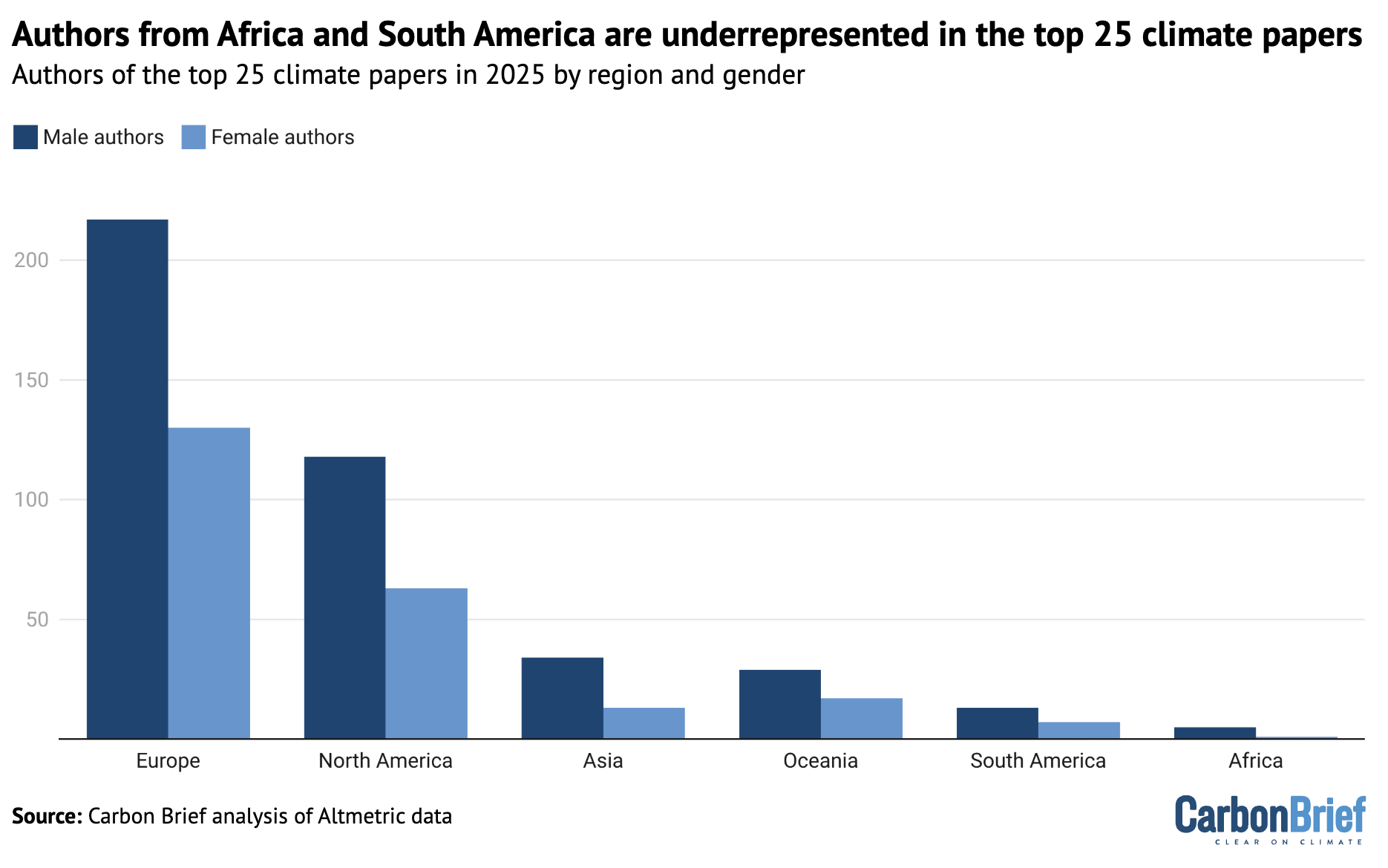
Carbon Brief also analysed the gender of the authors.
Only one-third of authors from the top 25 climate papers of 2025 are women and only five of the 25 papers list a woman as lead author.
The plot below shows the number of authors from each continent, separated into men (dark blue) and women (light blue).
The number of men (dark blue) and women (light blue) listed as authors in the climate papers most featured in the media in 2025, shown by continent. Chart by Carbon Brief using Datawrapper.
The full spreadsheet showing the results of this data analysis can be found here. For more on the biases in climate publishing, see Carbon Brief’s article on the lack of diversity in climate-science research.
Elon Musk urges you to be a Fascist like him, says that you can ignore facts and reality then.Donald Trump urges you to be a Climate Science denier like him. He says that he makes millions and millions for destroying the planet, Burn, Baby, Burn and Flood, Baby, Flood.Orcas discuss Donald Trump and the killer apes’ concept of democracy. Front Orca warns that Trump is crashing his country’s economy and that everything he does he does for the fantastically wealthy.