Rep. Ilhan Omar (D-Minn.) is seen before President Donald Trump’s address to a joint session of Congress in the House Chamber of the US Capitol on March 4, 2025. (Photo by Tom Williams/CQ-Roll Call, Inc. via Getty Images)
“His obsession with me is creepy,” said Rep. Ilhan Omar, the first Somali American ever elected to the US Congress.
Rep. Ilhan Omar, the first Somali American ever elected to the US Congress, said Tuesday that she hopes President Donald Trump “gets the help he needs” after he ended a Cabinet meeting with a bigoted tirade against Somali immigrants.
Trump specifically attacked Minnesota’s Somali community—falsely claiming that “they contribute nothing”—and singled out Omar (D-Minn) by name, calling her “garbage” and a “terrible person.”
Omar hit back in a brief social media post, characterizing the president’s remarks as clear evidence that he’s unwell.
Trump’s comments came as his administration prepared to target Somali immigrants with Immigration and Customs Enforcement (ICE) raids in the Minneapolis-St. Paul region. Around 80,000 Somalis live in Minnesota.
The New York Timesreported Tuesday that the directive for ICE raids in Minnesota “came immediately after” Trump used his social media platform to launch an appalling attack on Somalis and others in the wake of the shooting of two National Guard members. The man charged with the shooting is an Afghan national who worked as a member of a CIA-backed “Zero Unit” during the war in Afghanistan before resettling in the US.
Kristi Noem, head of the US Department of Homeland Security, has exploited the shooting to ramp up the administration’s anti-immigrant agenda, proposing what she called “a full travel ban on every damn country that’s been flooding our nation with killers, leeches, and entitlement junkies,” echoing Trump’s white nationalist rhetoric.
Following Trump’s latest attack on Somalis, Minnesota Attorney General Keith Ellisonsaid in a statement that the president’s “disgraceful attacks on Minnesota’s Somali community are injecting more of his poisonous racism into our beloved home state.”
“Hearing him single out our people based solely on their race and country of origin is downright disgusting,” Ellison said. “Minnesotans stand up for our neighbors when they’re under attack. And as Minnesota’s attorney general, I will use every tool I have to protect all our neighbors, including our vibrant Somali community, from these dangerous, racist threats. Our neighbors deserve no less.”
Starmer with Trump at his golf course in Scotland. (Photo: Chris Furlong / Alamy)
Lawyers for Huda Ammori, co-founder of Palestine Action, have questioned if the US president influenced the crackdown on the group.
…
In July, Declassified issued a Freedom of Information (FOI) request to the Cabinet Office regarding Starmer’s two calls with Trump, specifically asking for “all references to Palestine Action”.
In response, the Cabinet Office said it could “neither confirm nor deny if the specific information requested [regarding Palestine Action] is held”, relying on an international relations exemption in the FOI Act.
This exemption allows the government to withhold “confidential information obtained from” a foreign state.
In September, the Cabinet Office upheld its initial decision following a request for an internal review.
The department said: “The information sought relates to sensitive diplomatic communications between the UK and US at the very highest level in the form of direct exchanges between the Prime Minister and President”.
Additional reporting adds weight to the suspicion that the US president may have been lobbying or seeking to influence the UK government with regards to law enforcement of Palestine Action.
On 14 September, The Telegraphreported that: “After Trump Turnberry was vandalised with red paint by pro-Gaza protesters in March, the Prime Minister was asked for updates on those arrested from Police Scotland and briefed Trump personally on developments”.
Palestine Action joke that appeared in the UK satirical magazine ‘Private Eye’.Keir Starmer objects to criticism of the IDF. He asks how could anyone object to them starving people to death, forced marches like the Nazis did, bombing Gaza’s hospitals and universities, mass-murdering journalists, healthworkers and starving people queuing for food, killing and raping prisoners and murdering children. He calls for people to stop obstructing his genocide for Israel.Orcas discuss Genocide-supporting and complicit Zionists. Donald Trump, Keith Starmer, David Lammy, Rachel Reeves, Angela Rayner and Wes Streeting are acknowledged as evil genocide-complicit and supporting cnuts.
Jeff Bezos’s superyacht ‘Koru’ often travels accompanied by a smaller ‘support’ superyacht. Image by Conmat13 under the Creative Commons Attribution-Share Alike 4.0 International license via wikimedia.
In response to the UNEP Emissions Gap Report published 4th November 2025, Nafkote Dabi, Climate Policy Lead at Oxfam, said:
“Just days before global leaders arrive in Brazil for COP30, this report is a blaring siren calling for greater climate action.
“Since the Paris Agreement, the richest 1% have used up more than twice the carbon budget of the poorest half of humanity. This inequality is more than unjust—it’s deadly. The extreme emissions of the richest people and countries are burning through the little remaining the amount of CO2 that can be emitted while avoiding climate disaster. Meanwhile, the poorest communities suffer the most devastating impacts.
“Governments cannot close the emissions gap without slashing the carbon footprint of the super-rich and addressing extreme inequality. COP30 must be a turning point. Global leaders must cut the emissions of the richest, tax rich polluters and their profits, and deliver a just transition—one that creates decent green jobs, builds resilient economies, and puts people and planet before profit.”
Image of a private jet by Andrew Thomas from Shrewsbury, UK.
Oxfam’s recent report, “Climate Plunder: How a powerful few are locking the world into disaster”, presents new data which finds that a person from the richest 0.1% produces more carbon pollution in a day than the poorest 50% emit all year. If everyone emitted like the richest 0.1%, the carbon budget would be used up in less than 3 weeks.
The “UN Emissions Gap report: Off Target” finds that global warming projections over this century, based on full implementation of updated government climate pledges, are 2.3-2.5°C, while those based on current policies are 2.8°C.
Elon Musk urges you to be a Fascist like him, says that you can ignore facts and reality then.Donald Trump urges you to be a Climate Science denier like him. He says that he makes millions and millions for destroying the planet, Burn, Baby, Burn and Flood, Baby, Flood.Nigel Farage urges you to ignore facts and reality and be a climate science denier like him and his Deputy Richard Tice. He says that Reform UK has received £Millions and £Millions from the fossil fuel industry to promote climate denial and destroy the planet.
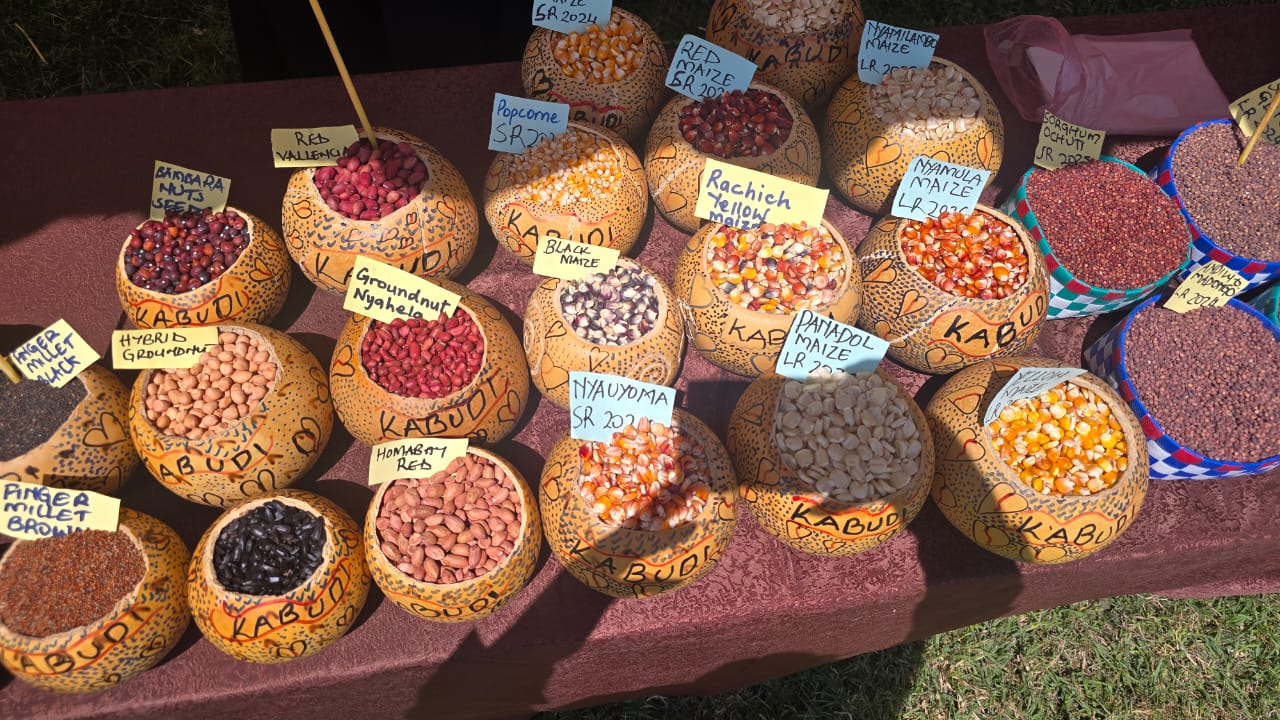
Indigenous seed exchange. Photo: Seed Savers Kenya
The landmark ruling secures farmers’ right to save, share, and exchange indigenous seeds, by decriminalizing it and safeguarding traditional farming heritage.
In a historic judgment, Kenya’s High Court on November 27, 2025, declared the Seed and Plant Varieties Act unconstitutional, delivering a significant victory for smallholder farmers and advocates of food sovereignty across the country. The case, filed in 2022 by fifteen smallholder farmers from various regions of Kenya, challenged provisions in the law that criminalized the long-standing tradition of saving, sharing, and exchanging indigenous seeds, practices at the heart of Kenyan agriculture for generations.
The lawsuit was supported by civil society organizations, including Greenpeace Africa, the Seed Savers Network, and the Biodiversity and Biosafety Association of Kenya (BIBA). It was argued that the Act imposed unfair restrictions on informal seed systems, which form the backbone of smallholder farming, and disproportionately penalized farmers who rely on indigenous seeds for sustenance and livelihood.
Under the law, farmers risked fines of up to KSh 1 million (USD 7,734) or two years in prison for participating in informal seed exchanges. The legislation also granted breeders exclusive economic rights over seed production, sale, and exchange, effectively restricting farmers to commercial seed markets and increasing their vulnerability to corporate control. Legal experts and activists argued that such provisions violated constitutional guarantees, including the rights to culture, non-discrimination, food security, and fair administrative action.
Hamisi Omolo, an ecological farming activist, described the ruling to Peoples Dispatch as “a wake-up call for farmers and grassroots activists to organize and strengthen structures that advance the struggle for land, food, and freedom.” Omolo reiterated the importance of indigenous seeds, noting that “the culture of sharing seeds must continue, not only to preserve biodiversity but also to support herbal medicine and traditional knowledge that benefit entire communities.”
The decision is a relief and expected to have an impact for food sovereignty and agricultural sustainability in Kenya. Smallholder farmers, who account for over 70% of agricultural production in the country, often rely on farmer-saved seeds adapted to local climates and conditions. By affirming their right to maintain and exchange these seeds, the court has reinforced the role of farmers as custodians of biodiversity and protectors of sustainable agricultural practices.
Grassroots and organizations fighting for food sovereignty welcomed the ruling, calling it a major step toward protecting farmers’ rights and resisting corporate monopolies over seeds.
This decision empowers farmers to safeguard their seeds, culture, and livelihoods,” Omolo added. “While it’s only the start, it is a reminder that food sovereignty is not just about growing crops, it is about protecting our way of life, our traditions, and our future.”
And the need for active engagement and organized campaign to ensure that future policies support, rather than undermine, the agricultural practices that sustain the livelihoods of so many Kenyans.
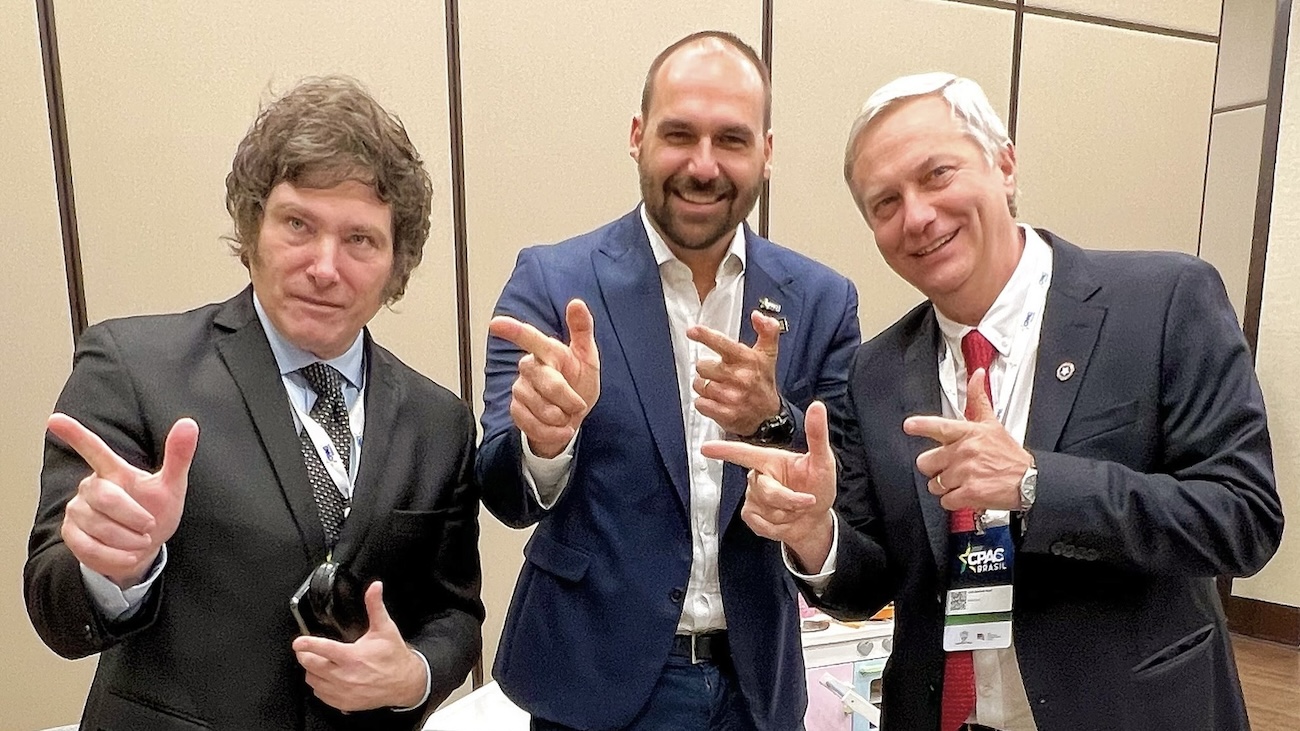
Argentine President Javier Milei, Brazilian legislator Eduardo Bolsonaro, and Chilean far-right presidential candidate José Antonio Kast at CPAC Conference in 2022. Photo: Eduardo Bolsonaro / X
The far right in Latin America is angry. Brazil’s Jair Bolsonaro and Argentina’s Javier Milei always look furious, and they always speak loudly and aggressively. Testosterone leaks from their pores, a toxic sweat that has spread across the region. It would be easy to say that this is the impact of Donald Trump’s own brand of neo-fascism, but this is not true. The far right has much deeper pedigrees, linked to the defense of the oligarchical families that have roots in the colonial era across the virreinatos (viceroyalties) from New Spain to Rio de la Plata. Certainly, these far right men and women are inspired by Trump’s aggressiveness and by the entry of Marco Rubio, a furious defender of the far right in Latin America, to the position of US Secretary of State. This inspiration and support are important but not the reason for the return of the far right, an angry tide that has been growing across Latin America.
On the surface, it looks as if the far right has suffered some defeats. Jair Bolsonaro is in prison for a very long time because of his role in the failed coup d’état on January 8, 2023 (inspired by Trump’s own failed coup attempt on January 6, 2021). In the first round of the presidential election in Chile, the candidate of the Communist Party, Jeannette Jara won the most votes and will lead the center-left bloc into the second round (December 14). Despite every attempt to overthrow the government of Venezuela, President Nicolás Maduro remains in charge and has mobilized large sections of the population to defend the Bolivarian Revolution against any threats. And, in late October 2025, most of the world’s countries voted for a UN General Assembly resolution that demands an end to the blockade on Cuba. These indicators – from Bolsonaro’s imprisonment to the vote on Cuba – suggest that the far right has not been able to move its agenda in every place and through every channel.
However, beneath the surface, there are indications that Latin America is not seeing the resurgence of what had been called the Pink Tide (after the election of Hugo Chávez in Venezuela in 1998) but is experiencing the emergence of an angry tide that slowly has begun to sweep the region from Central America down to the Southern Cone.
Elections in South America
The first round of the Chilean presidential election produced a worrying result. While Jara of the Communist Party won 26.85% of an 85.26% turnout, the far right’s José Antonio Kast came in second with 23.92%. Evelyn Matthei of the traditional Right won 12.5%, while the extreme right candidate who was once with Kast and now to his right, Johannes Kaiser, won 14%. It is likely that Jara will pick up some of the votes of the center, but not enough to overcome the advantage of the far right which looks to have at least more than 50% of the voters on its side. The so-called social liberal, Franco Parisi, who came in third, endorsed Kast in 2021 and will likely endorse him again. That means that in Chile, the presidency will be in the hands of a man of the far right whose ancestry is rooted in German Nazism (Kast’s father was a member of the Nazi Party who escaped justice through the intercession of the Vatican) and who believes that the dictatorship in Chile from 1973 to 1990 was on balance a good idea.
North of Chile, in Bolivia, the new president Rodrigo Paz Pereria, son of a former president, beat the far right’s Jorge Tuto Quiroga (a former president) in the second round of the election. This round had no candidate of the left, after the Movement for Socialism governed Bolivia continuously from 2006 to 2025. Paz’s own party has a minority position in the legislature and he will therefore have to align himself with the Quiroga’s Libre coalition and he will likely adopt a pro-US foreign policy and a libertarian economic policy. Peru will have its own election in April, where the former mayor of Lima – Rafael López Aliaga – is expected to win. He rejects the label far right but adopts all the generic policies of the far right (ultra-conservative Catholic, advocate for harsh security measures, and favors a libertarian economic agenda). Iván Cepeda of Colombia is the left’s likely candidate in their presidential election in May 2026, since Colombia does not permit second terms (so President Gustavo Petro cannot run again). Cepeda will face strong opposition from Colombia’s oligarchy which will want to return the country to their rule. It is too early to say who Cepeda will face, but it might be journalist Vicky Dávila, whose far right opposition to Petro is finding traction in unexpected parts of Colombian society. It is likely that by the middle of 2026, most of the states along the western edge of South America (from Chile to Colombia) will be governed by the far right.
Even as Bolsonaro is in prison, his party, the PL (or Liberal Party), is the largest bloc in Brazil’s National Congress. It is likely that Lula will be re-elected to the presidency next year due to his immense personal connection with the electorate. The far right’s candidate – who could be possibly Tarcísio de Freitas, the governor of São Paulo state, or one of the Bolsonaro’s (wife Michelle or son Flavio) – will struggle against him. But the PL will make inroads into the Senate. Their control over the legislature has already tightened the reins on the government (at COP30, Lula’s representative made no proposals to confront the climate catastrophe), and a Senate win will further their control over the country.
Common agenda of the angry tide
The Angry Tide politicians who are making waves have many things in common. Most of them are now in their fifties – Kast (born 1966), Paz (born 1967), Venezuelan politician María Corina Machado (born 1967), and Milei (born 1970). They came of age in the post-dictatorship period in Latin America (the last dictatorship to end was in Chile in 1990). The decade of the 1990s continued the economic stagnation that characterized the 1980s: the Lost Decade (La Década Perdida) that convulsed these countries with low growth rates and with poorly developed comparative advantages forced into globalization. It was in this context that these politicians of the Angry Tide developed their common agenda:
Anti-Communism. The far right in Latin America is shaped by an anti-left agenda that it inherits from the Cold War, which means that its political formations typically endorse the era of US-backed military dictatorships. The ideas of the left, whether from the Cuban Revolution (1959) or from the era of the Pink Tide (after 1998), are anathema to these political forces; these ideas include agrarian reform, state-led finance for industrialization, state sovereignty, and the importance of trade unions for all workers and peasants. The anti-communism of this Angry Tide is rudimentary, mother’s milk to the politicians and used cleverly to turn sections of society against others.
Libertarian Economic policies. The economic ideas of the Angry Tide are shaped by the Chilean “Chicago Boys” (including Kast’s brother Miguel who was the head of General Augusto Pinochet’s Planning Commission, his Minister of Labor, and his head of the Central Bank). They directly take their tradition from the libertarian Austrian School (Friedrich Hayek, Ludwig von Mises, and Murray Rothbard as well as Milton Friedman). The ideas were cultivated in well-funded think tanks, such as the Centro de Estudios Macroeconómicos de Argentina (founded in 1978) and the Chilean Centro de Estudios Públicos (founded in 1980). They believe the State should be a force to discipline the workers and citizens, and that the economy must be in the hands of private interests. Milei’s famous antics with a chainsaw illuminate this politics not only of cutting social welfare (the work of neoliberalism) but of destroying the capacity of the State itself.
Culture Wars. Drawing on the wave of anti-gender ideology and anti-migration rhetoric, the Angry Tide has been able to appeal to conservative evangelical Christians and to large sections of the working class that has been disoriented by changes seen to come from above. The far right argues that the violence in working class neighborhoods created by the drug industry is fostered by “liberalism” and that only tough violence (as demonstrated by El Salvador’s president Nayib Bukele) can be the solution; for this reason, they want to strengthen the military and police and set aside constitutional limitations on use of force (on October 28, the government of Bolsonaro ally Cláudio Castro in Rio de Janeiro sent in the police who killed at least 121 people in Operation Containment). It helps the far right that it adopted various conspiracy theories about how the “elites” have spread “globalized” ideas to damage and destroy the “culture” of their nations. This is a ludicrous idea coming from far right and traditional right political forces that champion full-scale entry of US corporations into their society and culture, and that have no respect for the histories of struggle of the working class and peasantry to build their own national and regional cultural worlds. But the Angry Tide has been able to construct the idea that they are cultural warriors out to defend their heritage against the malignancies of “globalization”. Part of this culture war is the promotion of the individual entrepreneur as the subject of history and the denigration of the necessity of social reproduction.
It is these three elements (anti-communism, libertarian economic policies, and the culture wars) that brings together the far right across Latin America. It provides them with a robust ideological framework to galvanize sections of the population to believe that they are the saviours of the hemisphere. This Latin American far right is backed by Trump and the international network of the Spanish far right (the Foro Madrid, created in 2020 by Fundación Disenso, the think tank of the far right Vox party). It is heavily funded by the old elite social classes, who have slowly abandoned the traditional Right for these new, aggressive far right parties.
Crisis of the Left
The Left is yet to develop a proper assessment of the emergence of these parties and has not been able to drive an agenda that sparkles with vitality. A deep ideological crisis grips the Left, which cannot properly decide whether to build a united front with the traditional right and with liberals to contest elections or to build a popular front across the working class and peasantry to build social power as a prelude to a proper electoral push. The example of the former strategy (the electoral alliance) comes from Chile, where first the Concertación de Partidos por la Democracia (Concertación) formed in 1988 to keep out the parties of the dictatorship from power and second the Apruebo Dignidad formed in 2021 that brought Gabriel Boric of the centrist Broad Front to the presidency. But outside Chile, there is little evidence that this strategy works. The latter has become harder as unionization rates have collapsed, and as uberization individualizes the working class to erode working class culture.
It is telling that Bolivia’s former socialist Vice President Álvaro García Linera looked northwards to New York City for inspiration. When Zohran Mamdani won the mayor’s race, García Linera said, “Mamdani’s victory shows that the left must commit to boldness and a new future.” It is hard to disagree with this statement; although, Mamdani’s own proposed agenda is mostly to salvage a worn-out New York infrastructure rather than to advance the city to socialism. García Linera did not mention his own time in Bolivia, when he tried with former president Evo Morales to build a socialist alternative. The left will have to be bold, and it will have to articulate a new future, but it will have to be one that emerges from its own histories of building struggles and building socialism.
Donald Fuhrump says that Amerikkka doesn’t bother with crimes or charges anymore, not being 100% Amerikkkan and opposing his real estate intentions is enough.