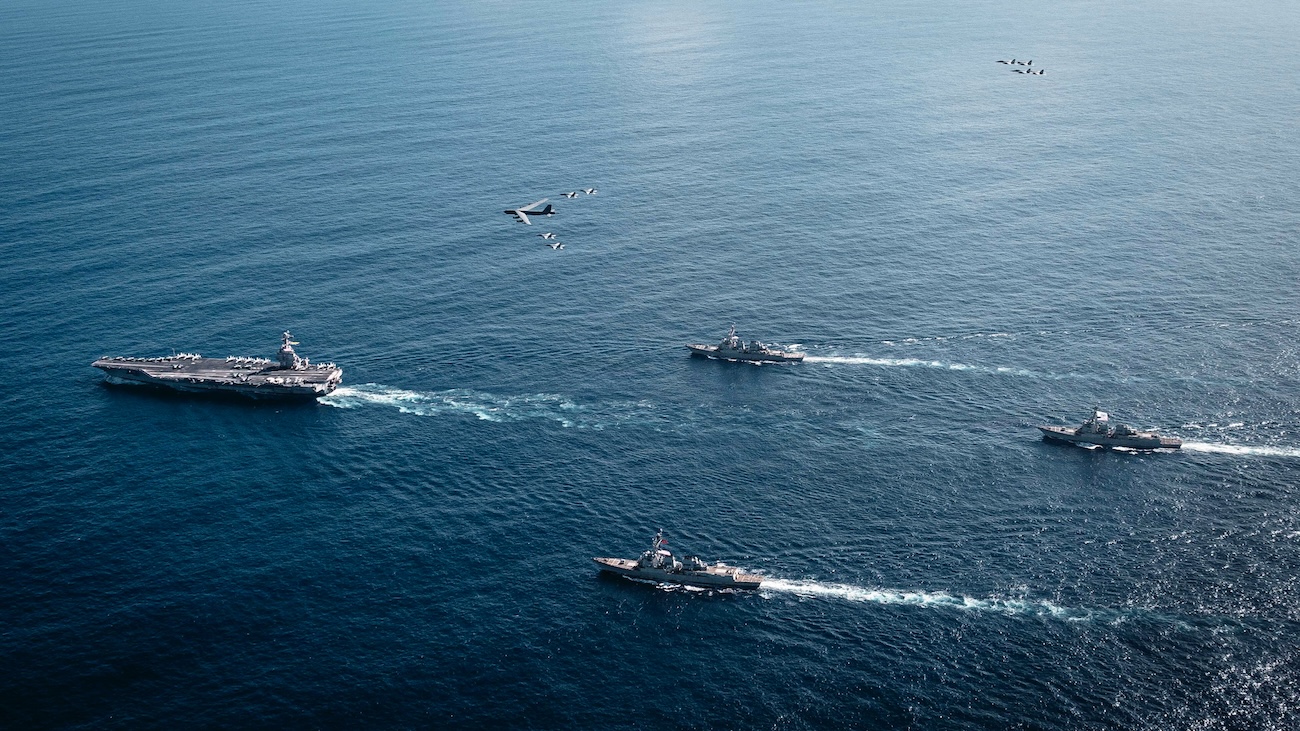
US war ships in the Caribbean. Photo: US Secretary of Defense/War
The US aggression against Venezuela has fomented divisions within the Caribbean, with many calling on countries like Trinidad and Tobago to refuse cooperation with the US in its military endeavors against the peoples of the region
US President Donald Trump has authorized the USS Gerald R. Ford to enter the Caribbean. It now floats north of Puerto Rico, joining the USS Iwo Jima and other US navy assets to threaten Venezuela with an attack. Tensions are high in the Caribbean, with various theories floating about regarding the possibility of what seems to be an inevitable assault by the US and regarding the social catastrophe that such an attack will occasion. CARICOM, the regional body of the Caribbean countries, released a statement affirming its view that the region must be a “zone of peace” and that disputes must be resolved peacefully. Ten former heads of government from Caribbean states published a letter demanding that “our region must never become a pawn in the rivalries of others”.
Former Trinidad and Tobago Prime Minister Stuart Young said on August 21, “CARICOM and our region is a recognized zone of peace, and it is critical that this be maintained”. Trinidad and Tobago, he said, has “respected and upheld the principles of non-intervention and non-interference in the internal affairs of other countries and for good reason”. On the surface, it appears as if no one in the Caribbean wants the United States to attack Venezuela.
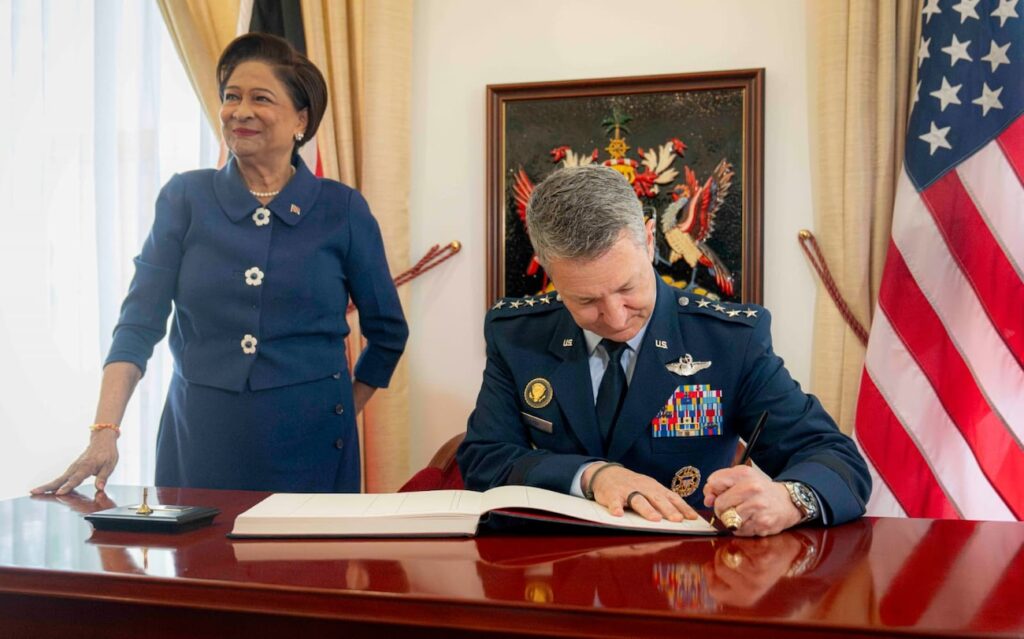
However, the current Prime Minister of Trinidad and Tobago, Kamla Persad-Bissessar (known by her initials as KPB), has openly said that she supports the US actions in the Caribbean. This includes the illegal murder of eighty-three people in twenty-one strikes since September 2, 2025. In fact, when CARICOM released its declaration on the region being a zone of peace, Trinidad and Tobago withdrew from the statement. Why has the Prime Minister of Trinidad and Tobago gone against the entire CARICOM leadership and supported the Trump administration’s military adventure in the Caribbean?
Backyard
Since the Monroe Doctrine (1823), the United States has treated all Latin America and the Caribbean as its “backyard”. The United States has intervened in at least thirty of the thirty-three countries in Latin America and the Caribbean (90 percent of the countries, in other words) – from the US attack on Argentina’s Malvinas Islands (1831-32) to the current threats against Venezuela.
The idea of the “zone of peace” emerged in 1971 when the UN General Assembly voted for the Indian Ocean to be a “zone of peace”. In the next two decades, when CARICOM debated this concept for the Caribbean, the United States intervened in, at least, the Dominican Republic (after 1965), Jamaica (1972-1976), Guyana (1974-1976), Barbados (1976-1978), Grenada (1979-1983), Nicaragua (1981-1988), Suriname (1982-1988), and Haiti (1986).
In 1986, at the CARICOM summit in Guyana, the Prime Minister of Barbados, Errol Barrow, said “My position remains clear that the Caribbean must be recognized and respected as a zone of peace… I have said, and I repeat, that while I am prime minister of Barbados, our territory will not be used to intimidate any of our neighbors be that neighbor Cuba or the USA.” Since Barrow made that comment, Caribbean leaders have punctually affirmed, against the United States, that they are nobody’s backyard and that their waters are a zone of peace. In 2014, in Havana, all members of the Community of Latin American and Caribbean States (CELAC) approved a “zone of peace” proclamation with the aim “of uprooting forever [the] threat or use of force” in the region.
Persad-Bissessar or KPB has rejected this important consensus across political traditions in the Caribbean. Why is this so?
Betrayals
In 1989, trade union leader Basdeo Panday formed the United National Congress (UNC), a centre-left formation (whose former name was the Caucus for Love, Unity, and Brotherhood). KPB joined Panday’s party and has remained in the UNC since then. Throughout her career till recently, KPB stayed at the center of the UNC, arguing for social democratic and pro-welfare policies whether as opposition leader or in her first term as Prime Minister (2010-2015). But even in her first term, KPB showed that she would not remain within the bounds of the centre-left but would tack Far-Right on one issue: crime.
In 2011, KPB declared a State of Emergency for a “war on crime”. At her home in Phillipine, San Fernando, KPB told the press, “The nation must not be held to ransom by groups of thugs bent on creating havoc in our society”, “We have to take very strong action”, she said, “very decisive action”. The government arrested seven thousand people, most of them released for lack of evidence against them, and the government’s Anti-Gang Law could not be passed: this was a policy that mimicked the anti-poor campaigns in the Global North. Already, in this State of Emergency, KPB betrayed the legacy of the UNC, which she dragged further to the Right.
When KPB returned to power in 2025, she began to mimic Trump with “Trinidad and Tobago First” rhetoric and with even harsher language against suspected drug dealers. After the first US strike on a small boat, KPB made a strong statement in support of it: “I have no sympathy for traffickers, the US military should kill them all violently”. Pennelope Beckles, who is the opposition leader in Trinidad and Tobago, said that while her party (the People’s National Movement) supports strong action against drug trafficking, such action must be “lawful” and that KPB’s “reckless statement” must be retracted. Instead, KPB has furthered her support of the US militarization of the Caribbean.
Trinidad and Tobago PM Kamla Persad-Bissessar with US Joint Chief of Staff General Dan Caine on November 25, 2025. Photo: US Embassy / X
Problems
Certainly, Trinidad and Tobago faces a tight knot of economic vulnerability (oil and gas dependence, foreign exchange shortages, slow diversification) and social crises (crime, inequality, migration, youth exclusion). All of this is compounded by the weakness of State institutions to help overcome these challenges. The weakness of regionalism further isolates small countries such as Trinidad and Tobago, which are vulnerable to pressure from powerful countries. But KPB is not only acting due to pressure from Trump; she has made a political decision to use US force to try and solve her country’s problems.
What could be her strategy? First, get the United States to bomb small boats that are perhaps involved in the centuries-old Caribbean smuggling operations. If the US bombs enough of these little boats, then the small smugglers would rethink their transit of drugs, weapons, and basic consumer commodities. Second, use the goodwill generated with Trump to encourage investment into Trinidad and Tobago’s essential but stagnant oil industry. There might be short-term gain for KPB. Trinidad and Tobago requires at least USD 300 million if not USD 700 million a year for maintenance and for upgrading its petrochemical and Liquified Natural Gas plants (and then it needs USD 5 billion for offshore field development and building new infrastructure). ExxonMobil’s massive investment in Guyana (rumored to be over USD 10 billion) has attracted attention across the Caribbean, where other countries would like to bring in this kind of money. Would companies such as ExxonMobil invest in Trinidad and Tobago? If Trump wanted to reward KPB for her unctuousness, he would tell ExxonMobil CEO Darren Woods to expand on the deepwater blocks investment his company has already made in Trinidad and Tobago. Perhaps KPB’s calculation to set aside the zone of peace ideas will get her some more money from the oil giants.
But what does this betrayal break? It certainly disrupts further any attempt to build Caribbean unity, and it isolates Trinidad and Tobago from the broader Caribbean sensibility against the use of the waters for US military confrontations. There are real problems in Trinidad and Tobago: rising gun-related violence, transnational trafficking, and irregular migration across the Gulf of Paria. These problems require real solutions, not the fantasies of US military intervention. US military interventions do not resolve problems, but deepen dependency, escalate tensions, and erode every country’s sovereignty. An attack on Venezuela is not going to solve Trinidad and Tobago’s problems but might indeed amplify them.
The Caribbean has a choice between two futures. One path leads toward deeper militarization, dependency, and incorporation into the US security apparatus. The other leads toward the revitalization of regional autonomy, South-South cooperation, and the anti-imperialist traditions that have long sustained the Caribbean’s political imagination.
Donald Fuhrump says that Amerikkka doesn’t bother with crimes or charges anymore, not being 100% Amerikkkan and opposing his real estate intentions is enough.Elon Musk urges you to be a Fascist like him, says that you can ignore facts and reality then.
A crowd of people watching the setting sun from a hill in Ealing, west London
POLITICIANS, business leaders and celebrities were urged to “listen to the science” at Britain’s first “national emergency briefing” on the climate and nature crisis today.
The event, held at Westminster Hall, was called by National Emergency Briefing, a group of experts in the field backed by organisations as diverse as the Royal Meteorological Society, the National Trust, the University of Reading and teaching union NEU.
Lancaster University’s Professor Mike Berners-Lee, panel chair, said: “Business as usual means normalising catastrophe — homes destroyed by flood and wildfire in Britain, price shocks, food shortages and a destabilised economy.
“We are drowning in fossil fuel misinformation, and it is no accident. Fossil fuel companies are spreading messages in the media and in Westminster designed to stall action.”
In the day’s keynote address, broadcaster and naturalist Chris Packham challenged attendees: “Why are we unbelievably pulling back on rapidly and forthrightly addressing the greatest crisis to ever threaten our species, climate breakdown and biodiversity loss?
“Climate denialism has been a mainstream thing again, thanks to the well-oiled machines of the rich, powerful and influential lobbyists from the fossil fuel and other industries.
“A dangerous wave of misinformation and lies fill our lives, but worse, it fills the lives of our decision makers and these are the people who shape policy.”
Calling on politicians to stand up to fossil fuel lobbyist who remain “significant contributors” to some parties’ coffers, he urged them to “listen to the science,” warning: “If you don’t, things go wrong and lives are lost.”
Nigel Farage urges you to ignore facts and reality and be a climate science denier like him and his Deputy Richard Tice. He says that Reform UK has received £Millions and £Millions from the fossil fuel industry to promote climate denial and destroy the planet.Donald Trump urges you to be a Climate Science denier like him. He says that he makes millions and millions for destroying the planet, Burn, Baby, Burn and Flood, Baby, Flood.
Original article republished from Mint Press News under a Creative Commons Attribution-NonCommercial-ShareAlike 3.0 International License.
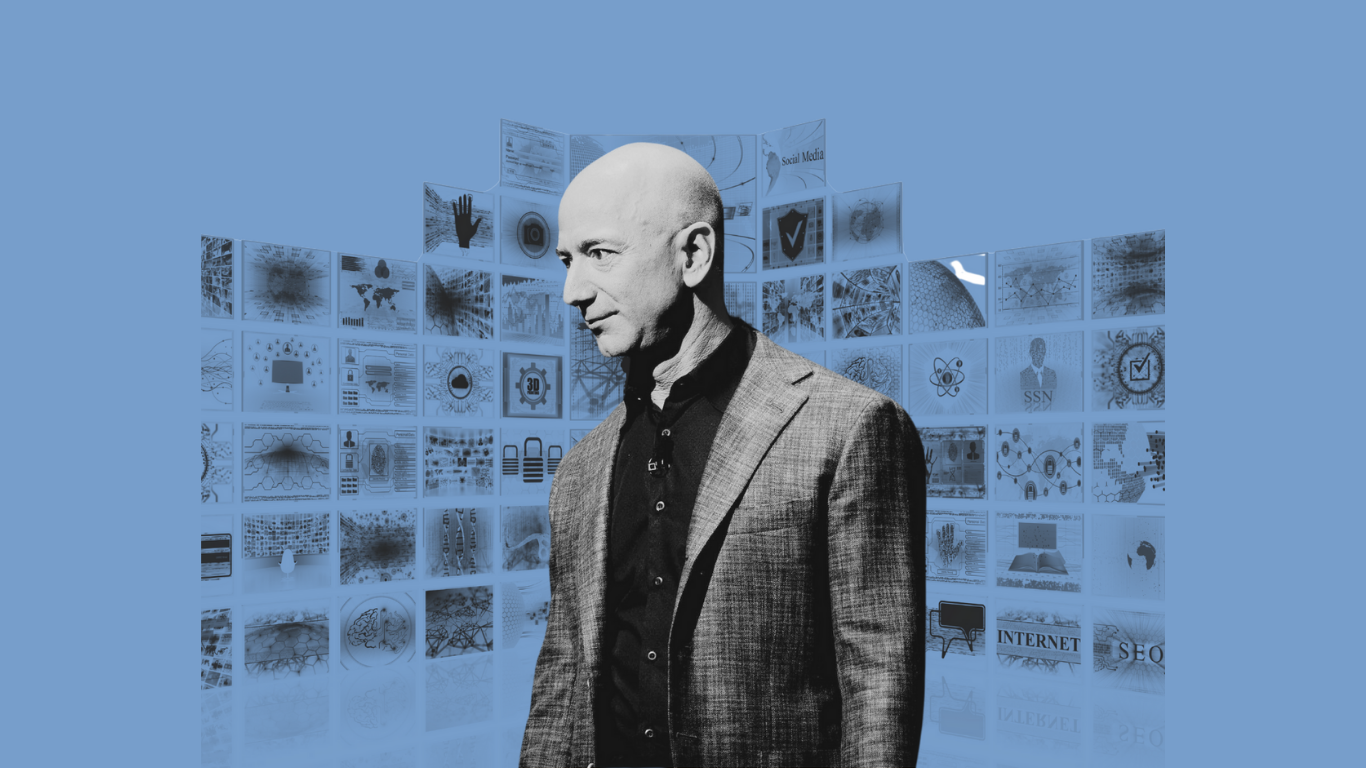
Trump loyalist and CIA contractor Larry Ellison’s purchase of CNN appears imminent, and marks the latest venture into media for the world’s second-richest individual. But Ellison is not alone. Indeed, the world’s seven richest individuals are all now powerful media barons, controlling what the world sees, reads, and hears, marking a new chapter in oligarchical control over society and striking another blow at a free, independent press and diversity of opinion.
Media Monopoly
Paramount Skydance– an Ellison-owned company– is in pole position to purchase Warner Brothers Discovery, a conglomerate that controls gigantic film and television studios, streaming services like HBO Max and Discovery+, franchises like DC Comics, and TV networks such as HBO, TNT, Discovery Channel, TLC, Food Network, and CNN. This lead is largely due to Ellison’s proximity to President Trump, who will ultimately have to sign off on such a deal.
Ellison has already spoken to senior White House officials about axing CNN hosts and content that Trump is said to dislike, including anchors, Erin Burnett and Brianna Keilar. It is this willingness to completely reorientate the network’s political direction that has made him the White House’s preferred purchaser of Warner Brothers Discovery. He is reportedly so wealthy that he can afford to pay in cash.
Ellison, whose net worth stands at a staggering $278 billion, has been on a media spending spree of late. Earlier this year, he provided the funds for Skydance to purchase Paramount Global, another gigantic conglomerate that controls such products as CBS, BET, MTV, Comedy Central, Nickelodeon, Paramount Streaming, and Showtime.
Immediately upon being appointed CEO of CBS News, Larry’s son, David, began drastically reorientating the network’s political outlook, firing staff, pushing it to become pro-Trump, and appointing self-described “Zionist fanatic” Bari Weiss as its editor-in-chief.
The Ellison family, however, is far from finished. In September, President Trump signed an executive order approving a proposal to force through the sale of social media platform TikTok to an American consortium led by Ellison-owned tech company, Oracle.
Under the planned arrangement, Oracle will oversee the platform’s security and operations, giving the world’s second-richest man effective control over the platform that more than 60% of Americans under thirty years of age use for news and entertainment. Trump himself stated that he was extremely pleased that Oracle would be controlling the platform. “It’s owned by Americans, and very sophisticated Americans,” he said.
Billionaire David Ellison just bought CBS with Trump’s blessing. His father, Larry Ellison—the top US funder of the Israeli military—backs the move. Bari Weiss is set to reshape the newsroom. Media independence is on life support.
The Ellison family’s sudden venture into the realm of media and communications has shocked many, with senior media figures sounding the alarm. Longtime CBS News anchor, Dan Rather, warned that “we all have to be concerned about the consolidation of huge billionaires getting control of nearly all of the major news outlets.” “It is a particularly tough time for anybody working at CBS News,” he stated, citing pressure to change coverage to be more pro-Trump. “I think if [the Ellisons] were to buy CNN, it would change CNN forever, and it might be another very serious wound to CBS News,” he concluded.
Billionaire Capture
Rather is correct. No other period in history has seen such a rapid and overwhelming buy up of our means of communications by the billionaire class – a fact that raises tough questions about freedom of speech and diversity of opinion. Today, the world’s seven richest individuals are all major media barons, giving them extraordinary control over our media and public square, allowing them to set agendas, and suppress forms of speech they do not approve of. This includes criticisms of them and their holdings, the economic system we live under, and the actions of the United States and Israeli governments.
Sitting on a fortune of over $480 billion, Elon Musk is the wealthiest person in world history, and is projected to, within the next decade, become the planet’s first trillionaire. In 2022, Musk purchased Twitter, in a deal worth around $44 billion. The South-African born tech magnate quickly set about turning the platform into a vehicle for advancing his own far-right politics. In 2024, for example, he was a key figure in promoting an attempt to topple Venezuelan president, Nicolás Maduro, spreading misinformation about the country’s election, and even threatening Maduro with a future in the notorious Guantánamo Bay prison camp.
He has also very publicly rewritten his generative AI chatbot, Grok, on multiple occasions, so it would produce more conservative responses to users’ questions. One result of this was that Grok began to praise Adolf Hitler.
Musk overtook Jeff Bezos last year to become the world’s richest man. And like Musk, the Amazon founder and CEO has made several moves into the world of media. In 2013, he bought The Washington Post for $250 million, and quickly began exerting his influence on the newspaper, firing anti-establishment writers and hiring pro-war columnists. This came just months after he bought a minority stake in Business Insider (now rebranded to Insider).
One year later, in 2014, Amazon paid nearly a billion dollars to purchase Twitch, a streaming platform which hosts around 7 million monthly broadcasters. Amazon also owns a wide range of other media ventures, including movie studio MGM, audiobook platform, Audible, and movie database website, IMDB.
French billionaire, Bernard Arnault, meanwhile, has been buying up large swaths of his country’s media outlets. The chairman of luxury conglomerate, Louis Vuitton Moët Hennessy (LVMH) and the world’s seventh-richest man now sits on a media empire that includes daily newspapers such as Le Parisien and Les Echoes, magazines such as Paris Match and Challenges, as well as Radio Classique.
The remaining three individuals rounding out the top seven list all owe their wealth primarily to their media empires. Google co-founders Sergey Brin and Larry Page are collectively worth over half a trillion dollars. Google has become the dominant force in today’s hi-tech economy, and is also a major player in social media, having bought YouTube in 2006 for $1.65 billion. Thirty-five percent of Americans use the video platform as a primary source of news.
Mark Zuckerberg, meanwhile, owes his $203 billion fortune to his social media and tech ventures, including Facebook, Instagram, and WhatsApp. Like YouTube, Zuckerberg’s companies are major players in the modern news landscape, with 38%, 20% and 5% of Americans relying on Facebook, Instagram, and WhatsApp for their news and views.
MAGA Mouthpieces
Many of these wealthy individuals have joined forces with President Trump, in an effort to support Republican policies and push a conservative worldview. Chief among these is the Ellison family, who quickly announced significant changes as CBS News, promising “unbiased” coverage and more “varied ideological perspectives”– widely understood as a shift towards right-wing, pro-Trump coverage.
Larry Ellison holds deeply conservative views, and became a top donor and fundraiser for the Republican Party, and a close Trump confident. Indeed, one Trump insider, noting his influence, went so far as to call Ellison as the “shadow President of the United States.”
Musk, of course, very publicly turned Twitter into a conservative-dominated platform, and was an unofficial member of Trump’s cabinet, becoming de facto head of the Department of Government Efficiency.
Zuckerberg has also taken a number of steps to align his platforms with the MAGA movement, including firing his fact-checking team (widely associated with liberal politics) and prioritizing what he calls “free speech.” Content moderation teams, the Meta CEO said, would be moved from California to Texas, “where there is less concern about the bias of our teams.”
Zuckerberg replaced Meta’s president of global affairs, the former Liberal Democrat deputy prime minister of the United Kingdom, Nick Clegg, with prominent Republican Joel Kaplan, who was George W. Bush’s chief of staff. He also appointed Dana White, the chief executive of the Ultimate Fighting Championship and a close Trump ally, to Meta’s board, despite his complete lack of relevant experience.
Many of these moves were likely made in response to Trump’s threat to imprison Zuckerberg “for the rest of his life” if he did anything to “cheat” him out of a 2024 presidential election victory. Zuckerberg subsequently met with Trump at Mar-a-Lago, and, alongside Bezos and other tech moguls, donated $1 million to Trump’s inaugural fund.
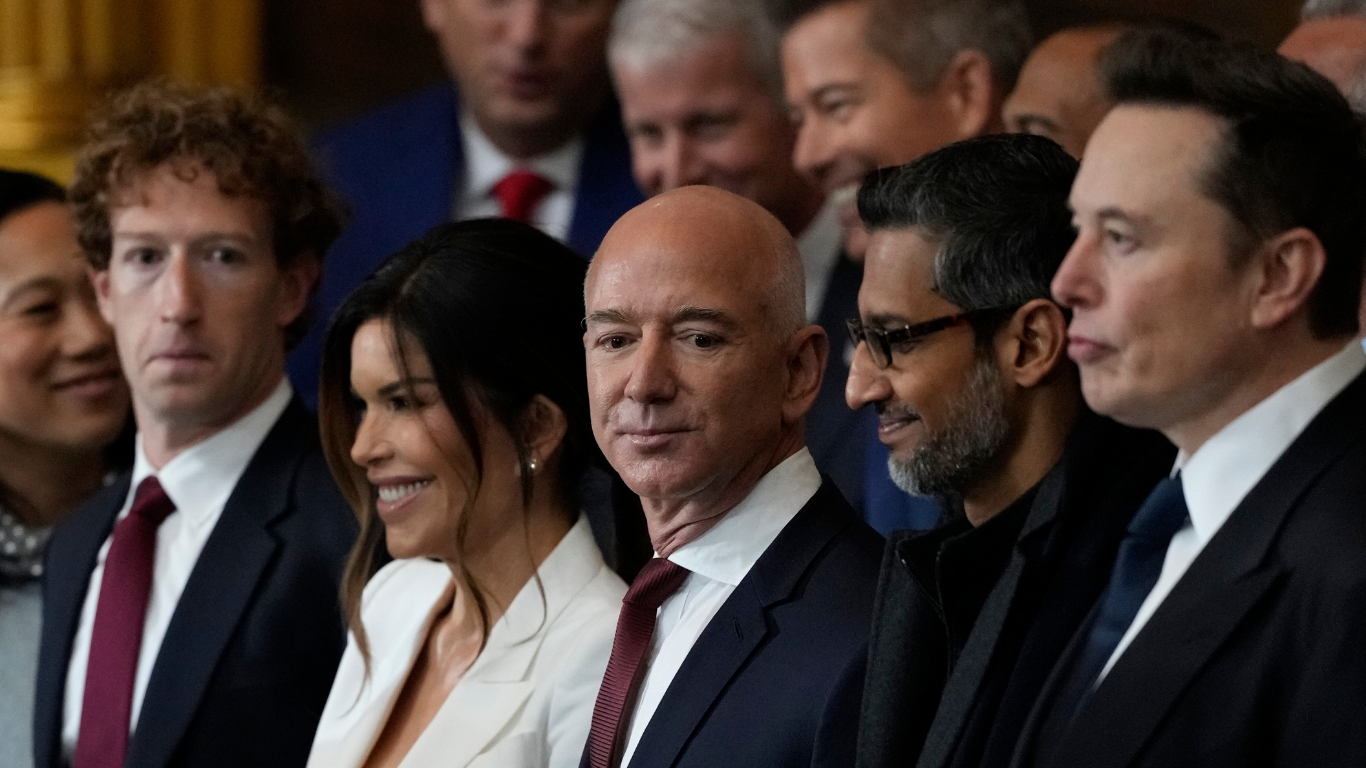
Zuckerberg, Bezos, Pichai and Musk at Trump’s inauguration, the new guardians of the media empire. Photo | AP
Bezos, meanwhile, pursued similar measures at The Washington Post, announcing that the newspaper would no longer publish opinions skeptical of capitalism. “We are going to be writing every day in support of defense of two pillars: personal liberties and free markets,” Bezos wrote, noting that readers wishing to see alternative viewpoints can find them on “the internet.”
The decision was widely seen as a major shakeup, and provoked public opposition from Post employees. “Massive encroachment by Jeff Bezos into The Washington Post’s opinion section today,” said the newspaper’s lead economics journalist Jeff Stein. “[It] makes clear dissenting views will not be published or tolerated there.”
The move was quite the reversal for Bezos, who had once called Trump a “threat to democracy.” Yet, by January 2025, he was sitting with Zuckerberg, Musk, and Arnault in prominent positions behind Trump at his inauguration.
Considering his nationality, Arnault has a surprisingly close relationship with Trump. In 2019, the French billionaire opened a new Louis Vuitton factory in Alvarado, Texas, a move that some have suggested was an attempt to please the president. Trump attended the facility’s opening, calling Arnault an “artist” and a “visionary.”
Due to their relationship with the Trumps, the Arnault family have become unofficial intermediaries between the French and U.S. governments. They were hosted by the Trumps at Mar-a-Lago in 2023, and, during an escalating trade war earlier this year, Bernard visited the White House to dampen down tensions between the U.S. and France.
Pentagon Contractors
A key factor in the rise of many of the world’s top seven richest individuals is their proximity to the U.S. national security state, with many of their companies growing wealthy in part due to feeding from the trough of Pentagon contracts. Today’s wars and espionage rely as much on hi-tech computing equipment as tanks and guns, and in 2022, the Department of Defense awarded Amazon, Google, Microsoft, and Oracle a $9 billion cloud computing contract.
Bezos’ Amazon has long enjoyed a close relationship with the CIA, having signed a $600 million contract with the agency in 2014. Yet both Google and Musk’s aerospace company, SpaceX, have been intertwined with Langley since their inception.
The CIA bankrolled and oversaw Brin’s PhD research at Stanford University, work which would later form the basis of Google. As one investigation noted, “senior U.S. intelligence representatives including a CIA official oversaw the evolution of Google in this pre-launch phase, all the way until the company was ready to be officially founded.”
As late as 2005, In-Q-Tel, the CIA’s venture capitalist arm, was a major shareholder in Google. These shares were a result of Google’s acquisition of Keyhole, Inc., a CIA-backed surveillance firm whose software eventually became Google Earth. By 2007, the government was using enhanced versions of Google Earth to surveil and target enemies in Iraq and beyond, according to The Washington Post. By this time, the Post also notes, Google was partnering with Lockheed Martin to produce futuristic technology for the military. There also exists a revolving door of employment between Google and various branches of Federal government.
It would be no stretch, meanwhile, to state that Elon Musk owes his largesse in no small part to his intimate relationship with the CIA. In-Q-Tel chief Mike Griffin helped birth SpaceX, providing support and advice from the beginning, and even accompanied Musk to Russia in 2002, where the pair attempted to purchase cheap intercontinental ballistic missiles to start the company.
Griffin repeatedly championed Musk at the CIA, describing him as the “Henry Ford” of the space industry, and worthy of the government’s full support. Still, by 2008, SpaceX was in dire straits, with Musk unable to make payroll and believing both SpaceX and Tesla Motors would be liquidated. But he was saved by an unexpected $1.6 billion NASA contract that Griffin had helped secure.
Today, SpaceX is a powerhouse. But its primary customers continue to be U.S. government agencies, such as the Air Force, Space Development Agency, and the National Reconnaissance Office. And recently, the Pentagon has recruited him to help it win a nuclear war. A new SpaceX spinoff company, Castelion, is working on building a network of armed satellites circling North America, designed to shoot down enemy nuclear missiles. A successful operation would give the United States an impervious shield, and allow it to act as it wants around the world, without threat of retaliation, effectively ending the era of mutually assured destruction, and plunging the planet into a dangerous new epoch.
Six of the seven members of Castelion’s leadership team and two of its four senior advisors are ex-Space X employees. The other two advisors are former high officials from the CIA, including Griffin himself. Elon named his oldest child Griffin Musk. Another of his sons, X Æ A-12, is named after a CIA spy plane.
With billions in defense contracts, Musk’s SpaceX is helping turn Trump’s nuclear vision into reality, threatening to dismantle decades of global nuclear deterrence., AI hypersonic missiles, Castelion SpaceX connection, Elon Musk military contracts, Musk nuclear war plans, Pentagon missile defense, SpaceX Pentagon contracts, Starlink military applications, Trump AI warfare, Trump nuclear defense plan, U.S.
No billionaire, however, is more intimately connected to the CIA than Larry Ellison. Ellison began his career by working with the CIA on a database system called Project Oracle. In 1977, he would co-found tech giant Oracle (named after his previous project). The CIA was Oracle’s only customer for some time, before Ellison branched out and began to win contracts with other branches of the national security state, including Navy Intelligence, Air Force Intelligence, and the NSA.
That close partnership continues to this day. In 2020, the company won a 15-year contract with the CIA and 16 other U.S. intelligence agencies worth tens of billions of dollars. And today, its upper ranks are filled with former CIA executives. One example of this is Leon Panetta, former CIA Director and Secretary of Defense, who sits on its board of directors.
Arming and Supporting Israel
Another key attribute that many of the world’s richest individuals share is their passionate support for Israel and its expansionist project.
Nowhere is this more evident than with Ellison, who has made it his life’s goal to advance the Jewish State’s interests, both at home and abroad. Ellison is an enthusiastic supporter of Prime Minister Benjamin Netanyahu, with whom he vacationed with on his private island in Hawaii. So impressed was he with the embattled prime minister that he offered him a seat on Oracle’s board, replete with a yearly salary of $450,000.
Ellison is the largest single donor to the Israeli Defense Forces (IDF). In 2017 alone, he pledged $16.6 million to build a new training facility for IDF soldiers, whom he described as defending “our home.” At a fundraiser, he explained that:
Through all of the perilous times since Israel’s founding, we have called on the brave men and women of the IDF to defend our home. In my mind, there is no greater honor than supporting some of the bravest people in the world, and I thank Friends of the IDF for allowing us to celebrate and support these soldiers year after year. We should do all we can to show these heroic soldiers that they are not alone.”
David Ellison is no less ardent a Zionist, and even met with a top Israeli general in order to aid a project spying on American citizens, according to an investigation by The Grayzone. The scheme was aimed at attacking American citizens participating in pro-Palestine activism in the face of Israel’s attack on Gaza. The documents also mention Brin’s name as a potential collaborator in the plan.
Oracle’s Israeli CEO, Safra Catz, is also a close friend of Netanyahu’s, and describes the corporation as on a “mission” to support Israel. Together, Catz and Ellison have enforced a strict pro-Israel stance across the company. In the wake of the October 2023 violence, Catz instructed that the words “Oracle stands with Israel” must be printed on company screens across the world in more than 180 countries.
Unsurprisingly, the support and collaboration with Israel has led to significant pushback among employees. Catz’s response to their concerns was blunt. “We are not flexible regarding our mission, and our commitment to Israel is second to none,” she said, adding:
This is a free world and I love my employees, and if they don’t agree with our mission to support the State of Israel, then maybe we aren’t the right company for them. Larry and I are publicly committed to Israel and devote personal time to the country, and no one should be surprised by that.”
It has been widely reported, even in the corporate media, that the Ellison family’s foray into the world of media was triggered by their desire to help Israel in its public relations battle, something Tel Aviv is keenly aware that they are losing. As Jonathan Greenblatt, director of the pro-Israel Anti-Defamation League said, “We really have a TikTok problem, a Gen Z problem,” explaining that young people around the world are being exposed daily to videos of Israeli aggression, leading to a PR disaster.
Former congressman Mike Gallagher, a leader in the attempts to ban TikTok, explained how his bill had failed, but, after October 7, 2023, and the worldwide outrage at Israeli actions, it found new life on Capitol Hill, and was passed into law, forcing its imminent sale to a consortium led by Oracle.
This pro-Israel sea change has already occurred at CBS News, with the hiring of Bari Weiss as editor-in-chief. Weiss first came to public attention while still at college, founding an organization that attempted to have Muslim and Arab professors fired for their pro-Palestine views. As The Financial Times noted, “Weiss has won over Ellison partly by taking a pro-Israel stance, according to people familiar with the matter.” Last week, at the Jewish Leadership Conference, she stated that she sees her mission at CBS as “redraw[ing] the lines of what falls in the 40 yards of acceptable debate” in America by sidelining voices like Hassan Piker and Tucker Carlson, and elevate “charismatic” leaders like Alan Dershowitz, who represents “the vast majority of Americans.”
Kit Klarenberg uncovers how Israel’s grip on U.S. policy threatens online expression with the TikTok ban bill, challenging the narrative of Chinese control and highlighting the real danger to free speech.
Zuckerberg’s platforms – Facebook, Instagram, and WhatsApp – have displayed a no less concerted bias in favor of Israel. As far back as 2016, Facebook was collaborating with the Israeli government on matters of censorship, with Justice Minister Ayelet Shaked revealing that the social media platform complied with 95% of her requests for pro-Palestine content to be removed.
The Facebook/Israel partnership was deepened in 2020 when the company appointed Emi Palmor, the former Director General of the Ministry of Justice of Israel and an ex-spy with IDF intelligence group Unit 8200, to its oversight board, a 21-person committee ultimately in charge of the political direction of the site.
Zuckerberg’s platforms have long shut down Palestinian voices on dubious “hate speech” grounds. However, the censorship was drastically increased after the October 7 attacks. Human Rights Watch released a report detailing the “systemic censorship of Palestinian content on Instagram and Facebook.” noting how they reviewed 1050 cases of censorship of Palestinian voices, including those documenting human rights abuses against themselves. 1049 of them, the study concluded, were entirely peaceful utterances of support for Palestine, and did not break any of Meta’s terms of service.
In 2023, Instagram also inserted the word “terrorist” into the bios of thousands of users who mentioned they were Palestinian. When challenged on this, they claimed it was an auto-translation bug.
Internally, Meta staff have complained about systematic suppression of their voices and the creation of a “hostile and unsafe work environment” for Palestinian and Muslim employees.
WhatsApp, meanwhile, is a battleground in more than one sense. The Israeli military is using Palestinians’ WhatsApp data in order to track and target tens of thousands of people in Gaza. It is unclear how or whether Meta is collaborating with the Israeli military in this endeavor. However, it has been suggested that some of the dozens of former Israeli spies now working in top jobs at Meta could be producing backdoors in the software, or simply passing the data onto their former colleagues. A 2022 MintPress investigation found hundreds of former Unit 8200 operatives working at Meta, Google, Amazon, and Microsoft.
Zuckerberg himself is known to be a strong supporter of Israel, and has numerous familial connections to the state. After the October 2023 attacks, he released a statement denouncing Hamas and other resistance forces as “pure evil,” an action that earned him an official thank you from the State of Israel.
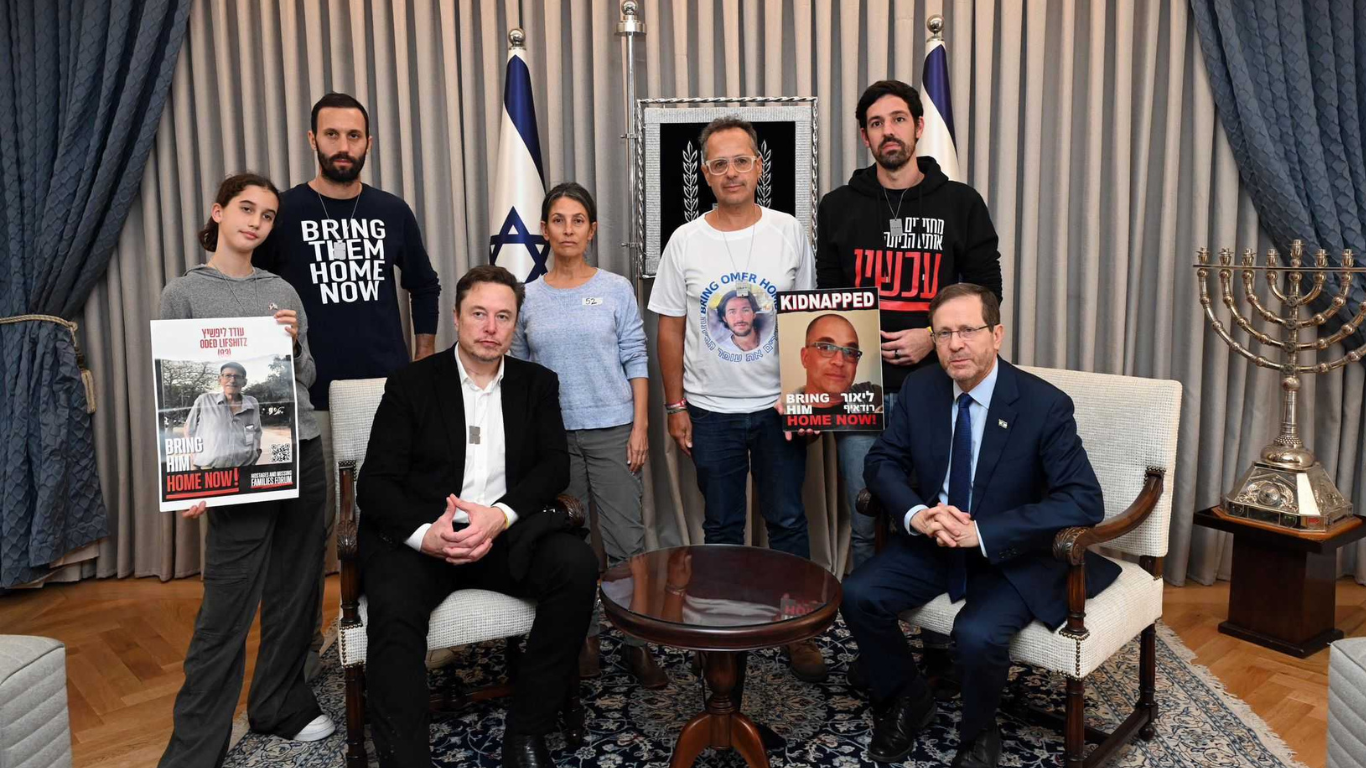
Musk has also put himself and his vehicles in the service of Israel. In November 2023, he traveled to Israel to meet with both Netanyahu and President Isaac Herzog and offer his unqualified support to their attack on Gaza. Describing Hamas as “evil” and “revel[ing] in the joy of killing civilians,” Musk attempted to publicly whitewash Israeli violence, stating unequivocally that the IDF goes out of its way “to avoid killing civilians.” At the time of his visit, Israeli strikes had killed at least 20,000 people in four weeks of bombings.
During his 2023 Israel trip, Musk pledged support for the IDF’s Gaza campaign. Photo | Israel GPO
Netanyahu has stated that Twitter is among Israel’s “most important weapons” in the war, and defended Musk from accusations of fascism, after he gave a Nazi salute at the Conservative Political Action Conference.
During his visit, Musk also signed a deal with the government of Israel, giving the latter effective control and oversight over Starlink communications portals operating in Israel and Gaza.
Google and Amazon, too, are key players facilitating the hi-tech genocide in Gaza. In 2021, the pair signed a $1.2 billion contract with the Israeli government to provide cloud computing and AI infrastructure to the IDF – technology that has been used to target the civilian population of the densely-populated strip. The deal has sparked a rebellion among employees, who organized sit-ins and other protests against their collaboration.
Many other Google employees, however, are intimately linked with the State of Israel. There are at least 99 former Unit 8200 spies working in key positions at the Silicon Valley giant. One prominent example is Gavriel Goidel, who was a longtime commander and head of learning at Unit 8200, before being hired by Google to become the company’s head of strategy and operations.
Google has also collaborated in disseminating Israeli government propaganda to tens of millions of Europeans, despite the content breaking its own terms of service.
Part of this may be down to the disposition of Brin himself. Normally avoiding the limelight and refraining from making political statements, the Russian-born magnate bitterly condemned the United Nations as “transparently antisemitic” after it released a report detailing his company’s participation in the Gaza genocide. “Throwing around the term genocide in relation to Gaza is deeply offensive to many Jewish people who have suffered actual genocides,” he added.
Arnault has remained quiet on Gaza. He has, however, invested heavily in Israel. Diamonds and other precious stones are a mainstay of the Israeli economy, and the Frenchman’s luxury brands disseminate the stones globally. Activists have called for Israeli diamonds to be labeled conflict minerals and boycotted by ethical consumers. He also invested in Israeli tech and security firm, Wiz, a company recently purchased by Google for $32 billion. Earlier this month, LVMH signed a $55 million deal with Israeli actress and former IDF soldier, Gal Gadot, making her the the face of their brand.
We are living in an era of unprecedented global inequality. Together, these seven individuals– Musk, Ellison, Page, Brin, Bezos, Zuckerberg and Arnault– control more wealth than the bottom 50% of humanity (over 4 billion people) combined. Sitting on heretofore unimaginable fortunes, they have begun buying up assets, including media outlets, at record pace.
For billionaires, the utility of capturing the press is threefold: firstly, it shields them and their class from press scrutiny and criticism. Second, it gives them a mouthpiece to push the public debate towards even more business-friendly laws and regulations. And third, they can use their outlets to champion any causes and promote any other agendas they have.
We have seen all three play out here, as, collectively, our press is rapidly moving towards more conservative, pro-Trump, pro-Israel positions, shutting out any dissenting voices from their ranks.
The effect on democracy, a free society, and the public’s right to a diversity of opinions has been highly deleterious. When it comes to media, we already suffered from an illusion of choice. However, the supercharged concentration of ownership of American and global media in the hands of just a handful of individuals has only exacerbated this problem. There once was a time that individuals looking for alternative viewpoints would simply go online to find them. But with censorship of dissenting opinions – particularly on Israel/Palestine – growing, this is becoming increasingly unviable.
In short, then, what the planet’s mega-rich capture of our media system shows is that billionaires are not only a serious drain on resources, but an existential threat to an open society and the free flow of information.
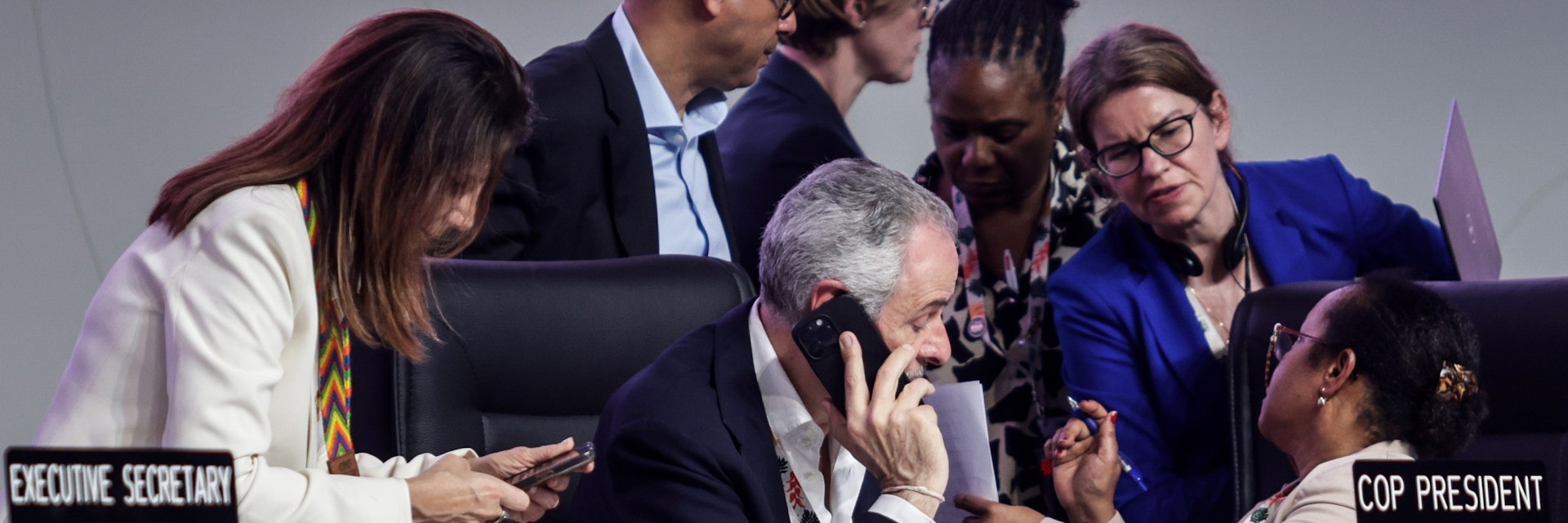
As the sun set on the Amazon, the promise of a “people’s Cop” faded with it. The latest UN climate summit – known as Cop30, hosted in the Brazilian city of Belém – came with the usual geopolitics and the added excitement of a flood and a fire.
The summit saw Indigenous protests on an unprecedented scale, but the final negotiations were once again dominated by fossil fuel interests and delaying tactics. After ten years of climate (in)action since the Paris agreement, Brazil promised Cop30 would be an “implementation Cop”. But the summit failed to deliver, even as the world recorded a devastating 1.6˚C of global warming last year.
Here are our five key observations:
1. Indigenous groups were present – but not involved
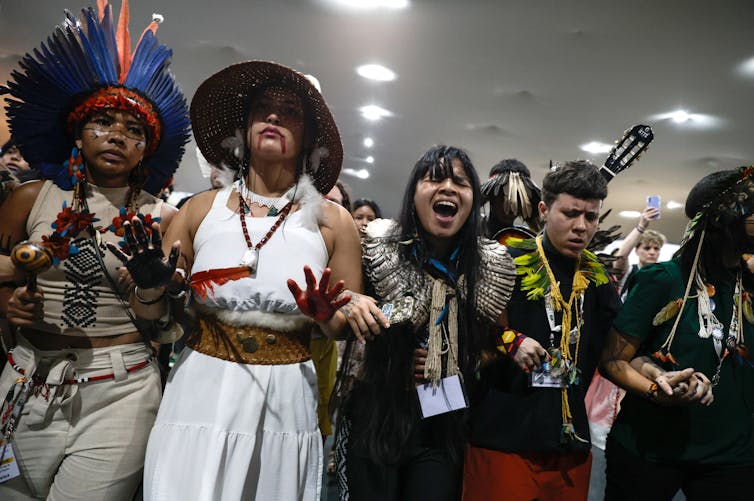
Located in Amazonia, this was branded the summit for those on the frontlines of climate change. Over 5,000 Indigenous people were there, and they certainly made their voices heard.
However, only 360 secured passes to the main negotiating “blue zone”, compared to 1,600 delegates linked to the fossil fuel industry. Inside the negotiating rooms it was business as usual, with Indigenous groups remaining as observers, unable to vote or attend closed-door meetings.
The choice of location was nicely symbolic but logistically tough. Hosting the conference in the Amazon cost hundreds of millions of dollars in a region where many still lack basic amenities.
A stark image of this inequality: with hotel rooms full, the Brazilian government even docked two cruise ships for delegates, which per head can have eight times the emissions of a five star hotel.
2. The power of protests
But this was the second largest UN climate summit ever, and the first since Glasgow Cop26 in 2021 to take place in a country that permits real public protest. That mattered. Protests of various sizes happened every day during the two-week conference, most notably an Indigenous-led “great people’s march” on the middle Saturday.
Indigenous protesters scored some small wins – but weren’t involved in the main talks. Fraga Alves / EPA
The visible pressure helped obtain recognition of four new Indigenous territories in Brazil. It showed that when civil society has a voice it can secure wins, even outside of the main emissions negotiations.
3. US absence creates a vacuum – and an opportunity
In Donald Trump’s first turn as president, the US sent at least a skeletal group of negotiators. This time, in a historic first, America did not send an official delegation at all.
Trump recently described climate change as “the greatest con job ever perpetrated on the world”, and since returning to power the US has slowed renewables and expanded oil and gas. It even helped scuttle plans for a net zero framework for global shipping last month.
As the US is rolling back its ambition, it is allowing other oil producing countries like Saudi Arabia to ignore their own climate pledges and to try and undermine others.
China has stepped into the void and become one of the loudest voices in the room. As the world’s largest supplier of green technology, Beijing used Cop30 to promote its solar, wind and electric vehicle industries and court countries looking to invest.
But for many delegates, the absence of America came as a relief. Without the distraction of the US attempting to “burn the house down” as it did at the shipping negotiations, the conference was able to get on with the business at hand: negotiating texts and agreements that will limit global warming.
4. ‘Implementation’ through side deals – not the main stage
So what was actually implemented? This year, the main action happened through voluntary pledges, not the binding global agreement.
The Belém pledge, backed by countries including Japan, India and Brazil, committed signatories to quadruple sustainable fuels production and use by 2035.
Brazil also launched a major trust fund for forests, with around US$6 billion (£4.6 billion) already pledged for communities working to protect rainforests. The EU followed by pledging new funds for the Congo Basin, the world’s second largest rainforest.
These are useful steps, but they highlight how the biggest advances at UN climate summits now often happen in the margins, rather than in the main talks.
The outcome of those main talks at Cop30 – the Belém package – is weak, and will get us nowhere near the Paris agreement’s target of limiting global warming to 1.5˚C. Most striking is the absence of the words “fossil fuels” from the final text even though they were central to the Glasgow climate pact (2021) and the UAE consensus (2023) – and of course they represent the main cause of climate change.
5. The Global Mutirão text: a missed opportunity
One potential breakthrough did emerge in negotiating rooms: the Global Mutirão text, a proposed roadmap to “transition away” from fossil fuels. More than 80 countries signed it, from EU members to climate-vulnerable Pacific island states.
Tina Stege, climate envoy for one of those vulnerable states, the Marshall Islands, urged delegates: “Let’s get behind the idea of a fossil fuel roadmap, let’s work together and make it a plan.”
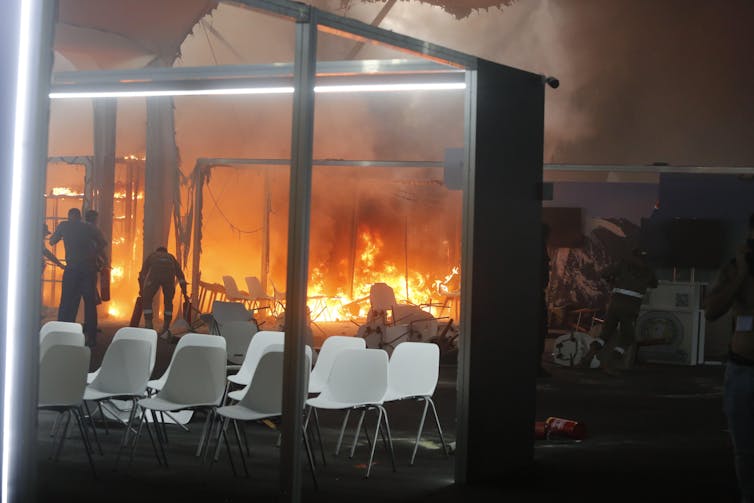
On the final Thursday, a small fire broke out in the pavilion area of the summit. Brazil Photo Press / Alamy
But opposition from Saudi Arabia, India and other major fossil fuel producers watered it down. Negotiations stretched into overtime, not helped by a fire that postponed discussions for a day.
When the final deal was agreed, key references to a fossil fuel phase-out were missing. There was a backlash from Colombia, due to the lack of inclusion of transition away from fossil fuels, which forced the Cop presidency to offer a six-month review as an olive branch.
This was hugely disappointing, as earlier in the summit there seemed to be huge momentum.
A widening gulf
So this was another divisive climate summit. The gulf between oil-producing countries (in particular in the Middle East) and the rest of the world has never been wider.
One positive to come out of the summit was the power of organised people: Indigenous groups and civil society made their voices heard, even if they weren’t translated into the final text.
With next year’s summit to be held in Turkey, these annual climate summits are increasingly migrating to nations with authoritarian leanings where protests are not welcome or completely banned. Our leaders keep stating that time is running out, yet negotiations themselves remain stuck in never ending circles of delays.
Simon Chin-Yee, Lecturer in International Development, UCL; Mark Maslin, UCL Professor of Earth System Science and UNU Lead for Climate, Health and Security, UCL, and Priti Parikh, Professor of Infrastructure Engineering and International Development, UCL
Donald Trump urges you to be a Climate Science denier like him. He says that he makes millions and millions for destroying the planet, Burn, Baby, Burn and Flood, Baby, Flood.Nigel Farage urges you to ignore facts and reality and be a climate science denier like him and his Deputy Richard Tice. He says that Reform UK has received £Millions and £Millions from the fossil fuel industry to promote climate denial and destroy the planet.Orcas comment on killer apes destroying the planet by continuing to burn fossil fuels.


 A crowd of people watching the setting sun from a hill in Ealing, west London