New government statistics released today show the reach of the two-child limit. There are 1,665,540 children in England, Scotland and Wales living in households affected by the two-child limit, an increase of over 35,000 from the same time in 2024.
The two-child limit restricts means-tested child benefits to the first two children in a household, subject to some exceptions.
Its sister policy, the benefit cap, affects over 115,000 households, including 300,000 children. It routinely pushes families into deep poverty, far below the standard poverty line of 60% of median income.
The benefit cap places a limit on the total amount a household can receive if no-one in the household earns a minimum amount, again subject to some exceptions linked to receipt of disability benefits.
Get your news from actual experts, straight to your inbox.Sign up to our daily newsletter to receive all The Conversation UK’s latest coverage of news and research, from politics and business to the arts and sciences.
Over the past five years, we have been part of a team of academic researchers investigating the impact of both policies on families with three or more children. We’ve found that these policies drive up poverty, creating deprivation and hardship. This in turn causes sustained and severe harm to children and their families.
The two-child limit and benefit cap leave many families living with extreme financial insecurity. They harm parental mental health, as mothers and fathers struggle to try and make an inadequate income stretch to meet the needs of their children.
In addition, these policies do not fall evenly across the population when looking at ethnicity. Overall, 70% of the families affected by the two-child limit are white, as are 66% affected by the benefit cap. But our new analysis shows that children from an ethnic minority are up to three times as likely as white children to be affected by the two-child limit. They are also up to four times as likely to be affected by the benefit cap.
Alongside administrative statistics, we have analysed household survey data, published today as a policy brief. We find that one in five children from Pakistani families and one in four children from Bangladeshi families are now affected by the two-child limit.
Rising poverty
Our analysis also indicates that these policies are contributing to very high and rising levels of poverty. We estimate that 66% of Bangladeshi children, 60% of Pakistani children, and nearly half (48%) of black children live in poverty. This compares to one in four (24%) white children living below the poverty line – still far too many.
This new analysis provides us with better understanding of where the damage done by both policies is falling. It’s an important reminder of how the two-child limit and benefit cap directly conflict with ambitions not only to act on child poverty, but also to reduce systematic inequalities linked to ethnicity.
Scrapping the two-child limit would give larger families access to benefits they currently miss out on – but it would not have any effect on smaller families living in poverty, so isn’t the only policy solution needed.
Nonetheless, analysis by the Resolution Foundation has shown that getting rid of the two-child limit – which would cost £1.4 billion – is by far the most cost-effective way to reduce the number of children living in poverty. Spending £1.4 billion in other ways – for example by increasing benefits for all families – would make less difference to child poverty than if the two-child limit were ended.
It’s also important to keep in mind the impact on the depth of poverty. Larger families tend to be living further below the poverty line. Scrapping the two-child limit will make a big difference in many households, even if they are not lifted out of poverty as a result.
Labour came into government on a manifesto of “change”, and Keir Starmer has promised to be “laser-focused” in his commitment to drive down poverty.
Labour have already said that they want to get rid of the two-child limit, arguing that they just need to find the money to do so. The government has established a child poverty taskforce, due to report in the autumn, and made a first concrete policy commitment with the extension of free school meals provision for families in England. But there is no alternative to serious action on social security benefits if significant progress is to be made.
Keir Starmer says that the Labour Party under his leadership all feel a small part of Scunthorpe.Keir Starmer explains that he feels no shame or guilt benefitting personally from gifts from the rich and powerful while insisting on policies of severe austerity causing suffering and death.
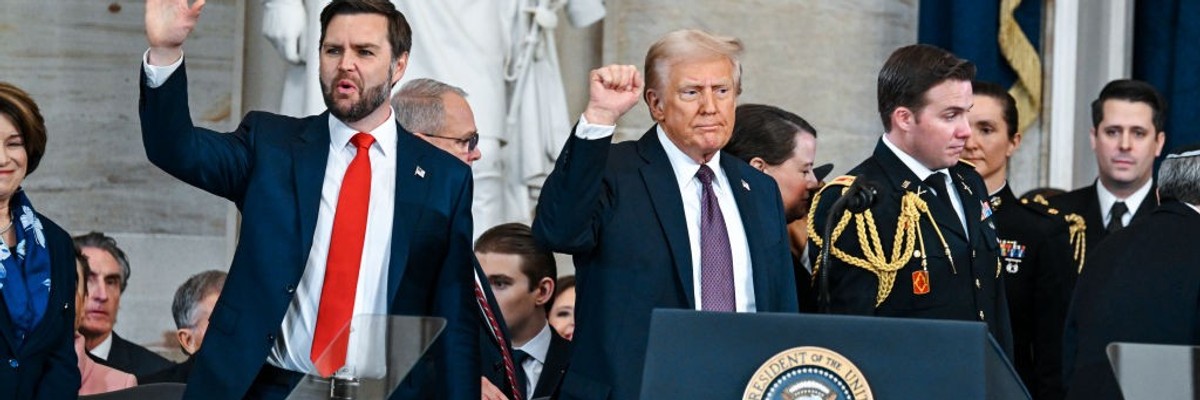
U.S. President Donald Trump and Vice President JD Vance acknowledge the crowd after Trump’s second inauguration in the U.S. Capitol Rotunda on January 20, 2025 in Washington, D.C. (Photo: Kenny Holston/Pool/Getty Images)
“Every month that Donald Trump has been in power, we’ve seen a raft of anti-climate measures come out which are music to the fossil fuel industry’s ears,” said one investigator.
Oil, gas, and coal companies and individuals linked to the climate-wrecking fossil fuel industry contributed more than $19 million to U.S. President Donald Trump’s second inaugural fund, an analysis by a leading international environmental and human rights group revealed Wednesday.
Scouring itemized U.S Federal Election Commission data, Global Witness identified 47 individual donations to the Trump-Vance Inaugural Committee between November 2024 and January 2025 totaling $19,151,933. Using an artificial intelligence tool developed by Global Witness to identify corporate lobbyists, the group’s researchers were able to automatically determine each donor’s ties to the fossil fuel industry.
SUBSCRIBE TO OUR FREE NEWSLETTER
Quality journalism. Progressive values. Direct to your inbox.
Global Witness said the $19.15 million figure “is likely an underestimate, as we did not count donations from diversified investors and businesses who couldn’t be said to primarily represent the fossil fuel industry,” and individuals with common names that couldn’t be identified were not included in the final report.
According to the analysis:
The list of donors includes individuals who were given ambassadorships or key positions in the Trump Cabinet.
For example, billionaire Warren Stephens donated $4 million on December 2, 2024, the same day Trump nominated him to be U.S. ambassador to the U.K. Stephens has extensive links to the oil and gas industry but also invests in other sectors and wasn’t included in our calculations of fossil fuel industry donors.
Trump also nominated Melinda Hildebrand—who donated $500,000 to the president’s inaugural fund—to be U.S. ambassador to Costa Rica.
Hildebrand is the vice president of Hilcorp Ventures, which claims to be of the largest privately owned oil and gas producers in the U.S. Her husband, founder and chairman of Hilcorp, donated another $500,000.
Among fossil fuel corporations, Chevron was by far the largest contributor to Trump’s inauguration fund, giving $2 million. Other companies including ExxonMobil, ConocoPhillips, and Occidental Petroleum each donated $1 million.
Overall, Big Oil gave $445 million to Trump and other Republican candidates during the 2024 election cycle.
Trump accepted over $23 million from Fossil Fuel Lobby & Big Oil independently spent $445 million in 2024 elections.
In return Trump eroded our environmental regulations, hired a Fossil Fuel Executive as his Energy Secretary & let Musk defund FEMA. He is responsible for this ⤵️ https://t.co/wZuqUUbf9hpic.twitter.com/rKoRPTnive
Trump, who ran on a “drill, baby, drill” energy policy, has signed a series of executive orders aimed at boosting fossil fuel production, including by declaring a fake “energy emergency” in a push to fast-track permit approvals. He also tapped former fossil fuel executives to head the Department of Energy and Interior Department, which have pursued a policy of opening up more public lands and waters for fossil fuel development.
At the same time, the Trump administration dropped out of the Paris climate agreement for the second time and moved to roll back the modest climate progress achieved under former President Joe Biden.
“It’s no surprise the oil and gas industry handed millions to Donald Trump for his inauguration, and they seem to have reaped a huge return on their investment,” Global Witness senior data investigator Nicu Calcea said in a statement Wednesday.
“Every month that Donald Trump has been in power, we’ve seen a raft of anti-climate measures come out which are music to the fossil fuel industry’s ears,” Calcea continued. “From plans to steamroll through dirty new coal plants, to the attempted quashing of ‘polluter pays’ laws that would hold oil giants accountable, it’s clear where his political priorities lie.”
“While Trump sides with his friends in oil and gas, we must keep up the fight for a fair, green future—that means pushing for wind and solar where we live, backing polluters pay bills, and resisting the development of oil, gas and coal projects across the country,” he added.
Donald Trump urges you to be a Climate Science denier like him. He says that he makes millions and millions for destroying the planet, Burn, Baby, Burn and Flood, Baby, Flood.Nigel Farage urges you to ignore facts and reality and be a climate science denier like him. He says that Reform UK has received millions and millions from the fossil fuel industry to promote climate denial and destroy the planet.Neo-Fascist Climate Science Denier Donald Trump says Burn, Baby, Burn.
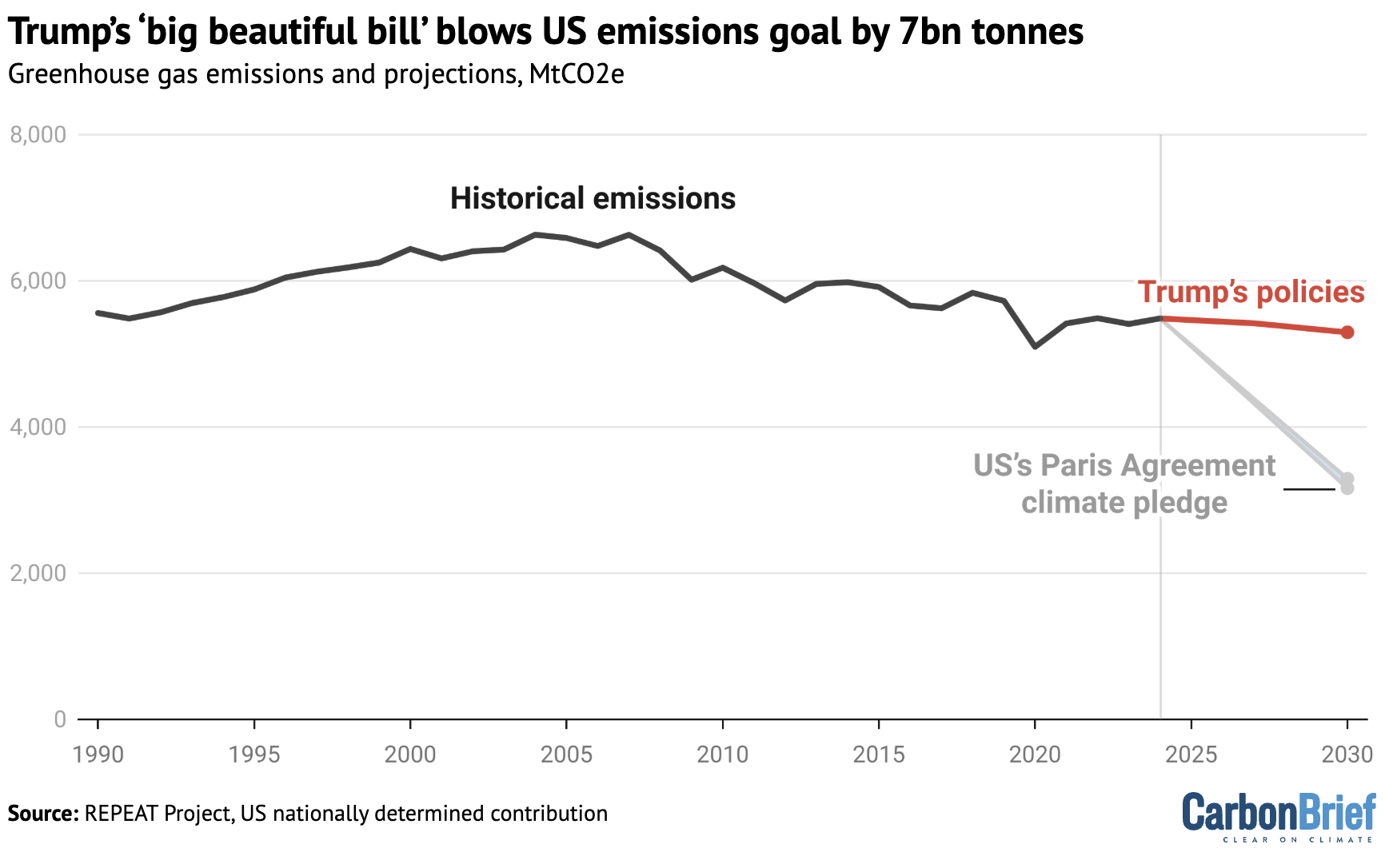
President Donald Trump’s dismantling of climate policy means the US will add an extra 7bn tonnes of emissions to the atmosphere from now until 2030, compared to meeting its former climate pledge under the Paris Agreement.
Since winning office last November, he has issued a series of executive orders and is poised to sign his “big beautiful bill” that effectively terminates Biden-era climate policies.
Carbon Brief’s analysis of modelling from the Princeton University REPEAT Project shows that this means US emissions are now set to drop to just 3% below current levels by 2030 – effectively flatlining – rather than falling 40% as required to hit the now-defunct target.
This would leave the US around 2bn tonnes short of its greenhouse-gas emissions target for that year, adding emissions equivalent to around 4% of the current global total each year
To put this in context, it is roughly the annual output of Indonesia, the world’s sixth-largest emitter.
Trump is already withdrawing his nation from its international climate obligations under the Paris Agreement.
The passage of the new Republican-backed “megabill” means that US climate targets pursued by Trump’s predecessor now appear firmly out of reach.
7bn tonnes
Trump is due to sign the so-called “big beautiful bill” into law after it was approved by the Republican-controlled US Congress on 3 July.
This “megabill” removes virtually all of the tax credits for renewable energy, electric vehicles and clean manufacturing that were at the core of Biden’s landmark Inflation Reduction Act (IRA).
(Ahead of the US presidential election last year, Carbon Brief estimated that, by reversing the IRA and other key policies, a Trump administration would add 4bn tonnes of emissions by 2030, compared to a continued Biden administration.)
Since his return to the White House, Trump has moved to strip away his predecessor’s climate policies, including via a series of executive actions. This includes targeting vehicle fuel-efficiency standards and power sector emissions standards.
The passage of the new bill means US solar and wind power expansion will likely slow down, as will sales of electric vehicles and energy efficiency improvements. The combined effect of these policy rollbacks can be seen in the chart below, based on modelling by the REPEAT Project.
Carbon Brief has compared the impact of Trump’s policies, including the megabill, to a pathway on which the US meets its former target, under the Paris Agreement, to cut greenhouse gas emissions by 50-52% from 2005 levels by 2030.
The cumulative gap between this pathway and the Trump administration’s trajectory amounts to 7bn tonnes of emissions over the next five years.
Based on the most recent central estimate of the “social cost of carbon” in 2030 from the US Environmental Protection Agency (EPA), published under the Biden administration, those 7bn tonnes of extra emissions would cause global climate damages worth more than $1.6tn.
Under this new set of US policies, emissions are only expected to be 20% lower than 2005 levels by 2030, rather than 50-52%, meaning the nation would be 2bn tonnes short of its goal.
This amounts to just a 3% drop from 2024 levels by 2030, meaning emissions are effectively flatlining.
Renewables down, prices up
Among the hundreds of provisions in the new Republican-backed bill are several key rollbacks that are expected to affect US emissions.
Under the IRA, wind and solar projects could receive tax credits up to 2034. Following the Republican bill, most projects would need to start construction within the next year to qualify.
Without federal support, the pipeline of new renewable-energy projects is expected to contract.
The REPEAT analysts estimate that cumulative new solar capacity additions will drop by 29 gigawatts (GW) by 2030 and around 140GW by 2035. For wind power, the decrease is set to be 43GW by 2030 and 160GW by 2035.
Some renewable projects will likely be built without support, but developers will need to contend with other Trump administration policies, such as stopping federal windfarm approvals.
The lost renewable capacity is unlikely to be entirely replaced by fossil fuels, due to a multi-year backlog in the construction of gas-fired power plants.
Tax credits for nuclear and geothermal power have been retained until 2036 in the bill. While these projects generate clean electricity, they can also take a long time to build.
Other key policies in the new bill include the removal of tax credits worth up to $7,500 to purchase electric vehicles, which could result in tens of millions fewer such cars and vans being sold. Ending tax credits for low-carbon manufacturing is also expected to undo progress in building clean technologies, such as solar panels and electric cars, domestically.
Beyond its effect on US emissions, various early analyses have suggested the Republican-backed bill is likely to increase energy prices and lead to job losses.
REPEAT estimates household energy costs are likely to be $165 higher in 2030 and more than $280 higher by 2035, following the passing of the bill.
Some of this increase can be attributed to fewer electric vehicles on the road, leading to higher petrol and diesel consumption and prices. Slowing construction of solar and wind projects as power demand increases will also likely affect the cost of electricity.
Without tax credits to boost the construction of new generation capacity, residential electricity prices are set to increase by 7% – or $110 – by 2026, for the average US customer, according to analysis conducted for trade body the Clean Energy Buyers Association.
In the state of Wyoming, the same analysis found that electricity prices may rise by as much as 30% over the next year. Other firmly Republican states, such as North Carolina and Tennessee, are also expected to see near-term price rises in the double digits.
The project has assessed the emissions impact of the executive actions that the Trump administration has already taken to unwind Biden-era policies, as well as the bill itself.
Carbon Brief compared this trajectory out to 2030 with a straight-line pathway towards the official US climate target for 2030. This is set out in the US’ nationally determined contribution (NDC) under the Paris Agreement. It is worth noting that the Trump administration is withdrawing the US from the Paris Agreement.
Donald Trump urges you to be a Climate Science denier like him. He says that he makes millions and millions for destroying the planet, Burn, Baby, Burn and Flood, Baby, Flood.Nigel Farage urges you to ignore facts and reality and be a climate science denier like him. He says that Reform UK has received millions and millions from the fossil fuel industry to promote climate denial and destroy the planet.Orcas discuss Donald Trump and the killer apes’ concept of democracy. Front Orca warns that Trump is crashing his country’s economy and that everything he does he does for the fantastically wealthy.
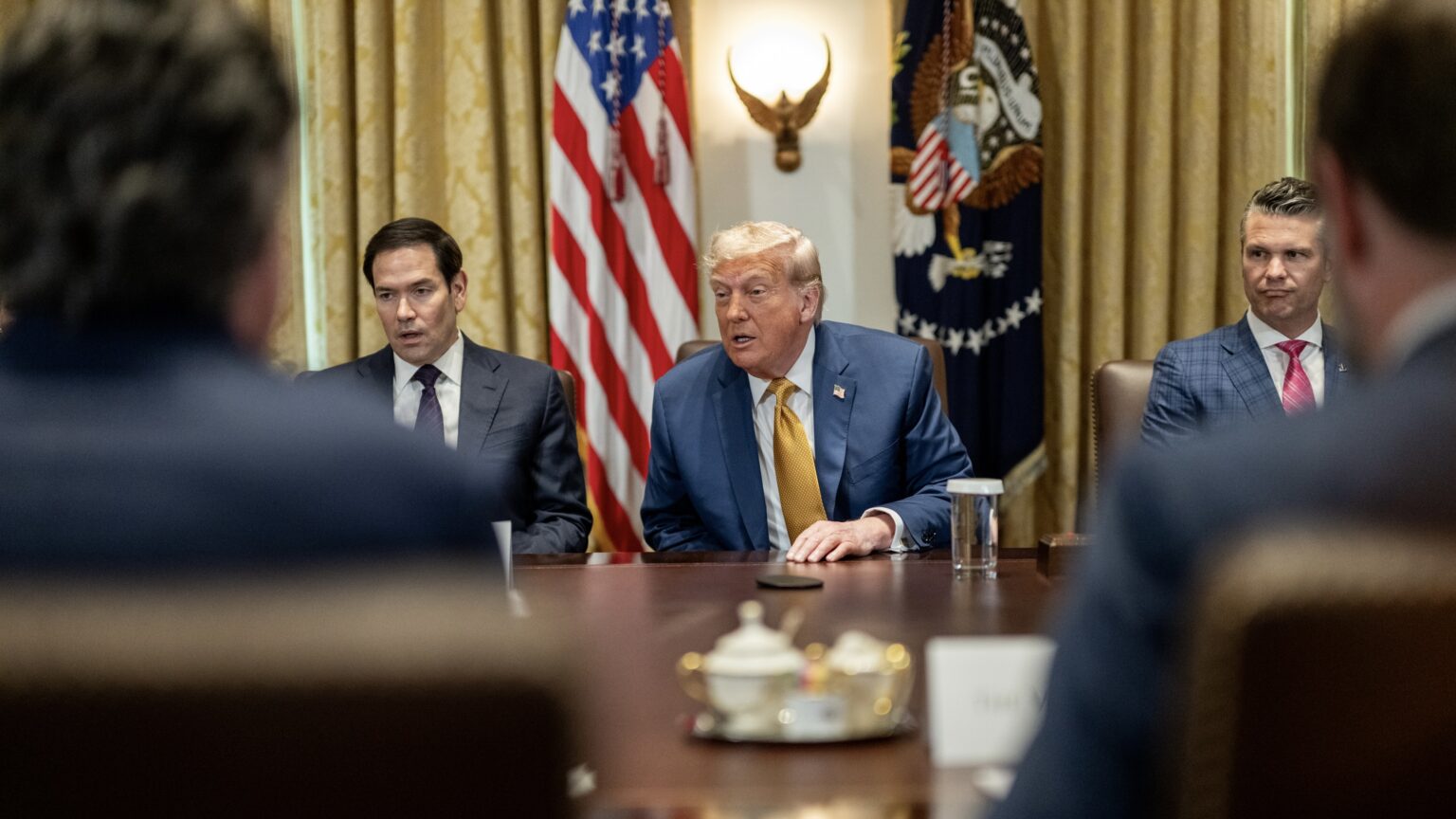
US Secretary of State Marco Rubio, US President Donald Trump, and US Secretary of Defense Pete Hegseth in a Cabinet Meeting. Photo: White House
The billionaire president claimed that trade relations with Brazil are unfair to the US. Lula has called a meeting to discuss a response.
US President Donald Trump has announced that products imported from Brazil will be subject to 50% tariffs starting in August. The application of the tariffs was announced in a letter published on Wednesday, July 9, on social media.
Addressed to the President of the Republic, Luiz Inácio Lula da Silva, the message begins with a direct defense of Jair Bolsonaro and criticism of “the way Brazil has been treating the former president”, which he classified as an “international disgrace”.
Referring to the case against Bolsonaro in the Supreme Court (STF), Trump emphasizes: “This trial should not be happening. It is a witch hunt that must end IMMEDIATELY!”
It is worth noting that the US president has no authority over the decisions of the Brazilian judiciary.
In his letter to Lula, he states that the decision on tariffs is based on attacks on free elections and freedom of expression in Brazil.
“(As lately illustrated by the Brazilian Supreme Court, which has issued hundreds of SECRET and UNLAWFUL Censorship Orders to US Social Media platforms, threatening them with Millions of Dollars in Fines and Eviction from the Brazilian Social Media market),” Trump declares.
After the political justification, he adds that trade relations with Brazil are unfair to the United States. However, the trade balance between the two nations has been in surplus for the US for more than ten years.
The percentage announced by Trump for Brazilian products is the highest among those most recently defined by the US government. In the letter, the US president argues that the country should distance itself from its trade relationship with Brazil.
He goes so far as to say that the 50% rate “is far too low” to bring about a level playing field between the two nations. According to Trump, the US Trade Representative’s Office (USTR) will launch an investigation into Brazil under the US Trade Act.
The intention of this type of approach is to determine whether there has been any violation of trade agreements. If irregularities are found, the US may take action through the World Trade Organization (WTO).
In a threatening tone, Trump states that if Brazil decides to take similar measures in response to the new tariff, the US will raise the rate by another 50%. He ends the letter by saying that the decision may be modified upward or downward depending on Brazil’s relationship with the US.
“If you wish to open your heretofore closed Trading Markets to the United States, and eliminate your Tariff, and Non-Tariff, Policies and Trade Barriers, we will, perhaps, consider an adjustment to this letter,” he writes.
Reaction
After the letter was released, President Lula called an emergency meeting to discuss Brazil’s response to Trump. According to information released in the press, Vice President Geraldo Alckmin, also minister of Development, Industry, Trade, and Services, Fernando Haddad (Finance), Mauro Vieira (International Relations), and Rui Costa (Chief of Staff) are participating in the meeting.
On social media, Workers’ Party senator and leader of the Senate, Jaques Wagner called for respect for Brazil and criticized the measure, which he attributed to a “request from the Bolsonaro family”.
“At the request of the Bolsonaro family, Donald Trump has announced a 50% tax on all Brazilian products, in an authoritarian and unilateral manner. The US president is confusing who he is addressing. Brazil will not be anyone’s backyard. We are the ones who decide our own lives. Let this be clear: Brazil belongs to Brazilians, not to lackeys!” he posted.
This was first published in Portuguese at Brasil de Fato.
Salon (7/3/25): “The funds going towards deportation would…be enough to fully fund the program to end world hunger for four years.”
And so it has come to pass: US President Donald Trump’s “big, beautiful bill” has set the stage for tax cuts for the rich, slashed services for the poor, and a host of other things that qualify as “beautiful” in the present dystopia. Some cuts, like those to Medicaid, have been heavily covered by the corporate media. But one key piece of the bill has gotten much less media scrutiny: The preposterous sum of $175 billion has been allocated to fund Trump’s signature mass deportation campaign, which, as a Salon article (7/3/25) points out, exceeds the military budget for every single country in the world aside from the US and China.
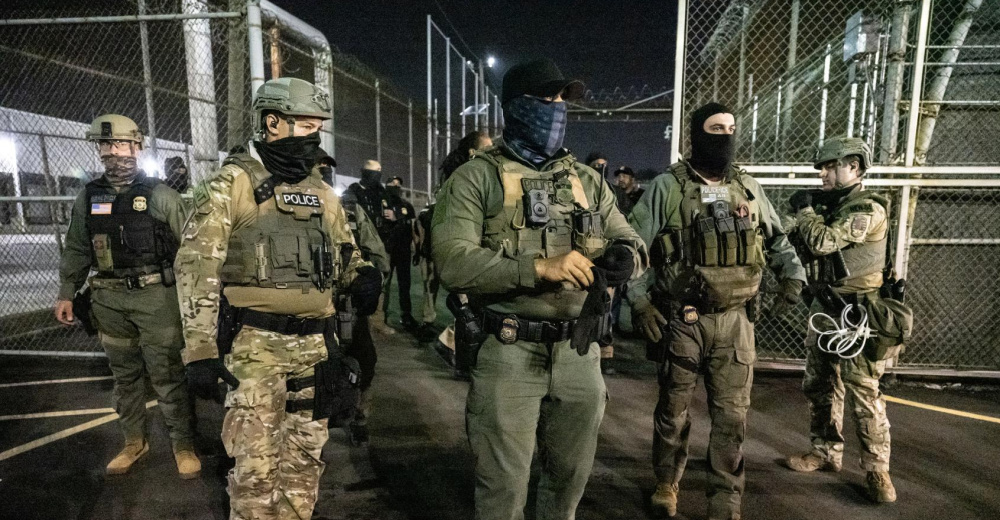
Approximately $30 billion of that is destined directly for US Immigration and Customs Enforcement (ICE), the goons who have recently made a name for themselves by going around in masks and kidnapping people. This constitutes a threefold increase over ICE’s previous budget, and propels the outfit to the position of the largest US federal law enforcement agency in history. $45 billion will go toward building new ICE detention centers, including family detention centers.
Prior to the signing into law of the sweeping bill on July 4, US Vice President JD Vance took to X to highlight what really mattered in the legislation:
Everything else—the CBO [Congressional Budget Office] score, the proper baseline, the minutiae of the Medicaid policy—is immaterial compared to the ICE money and immigration enforcement provisions.
Scant attention to ICE expansion
“What happens if we spend more than the military budget of Russia on deportation?” was not a question the New York Times (7/3/25) thought needed answering.
And yet many US corporate media outlets have paid scant attention to this aspect of the bill and refrained from delving too deeply into the matter of what exactly this massive ramping up of ICE portends for American society. According to a search of the Nexis news database, while half (50%) of newspaper articles and news transcripts mentioning the reconciliation bill from its first passage in the House (May 20) to its signing into law (July 4) also mentioned Medicaid, less than 6% named Immigration and Customs Enforcement or ICE.
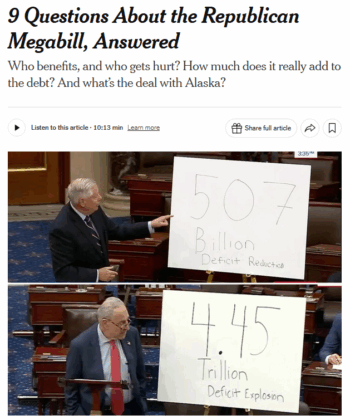
Even many of those that did mention ICE barely gave it any attention. On July 3, for example, the New York Times presented readers with “Nine Questions About the Republican Megabill, Answered,” which in response to the first question—“Why is it being called a megabill?”—did manage to mention “a 150% boost to the Immigration and Customs Enforcement budget over the next five years.” However, there was no further discussion in the article’s remaining 1,500-plus words of potential ramifications of this boost—although there was a section devoted to the “tax break for Native Alaskan subsistence whaling captains.”
That was more than CNN’s intervention managed, also published on July 3, and headlined “Here’s Who Stands to Gain From the ‘Big, Beautiful Bill.’ And Who May Struggle.” The article aced a couple of no-brainers, including that “corporate America” would be “better off” thanks to the bill, while “low-income Americans” would be “worse off.” But there was not a single reference to the ICE budget—or who might “struggle” because of it.
‘Detention blitz’
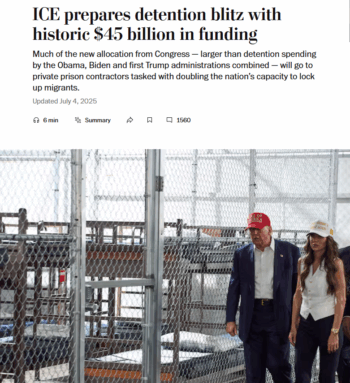
Washington Post (7/4/25): “Immigrant rights advocates are imploring the government not to award more contracts to…companies they say have failed to provide safe accommodations and adequate medical care to detainees.”
This is not to imply, of course, that there are no articles detailing what ICE has been up to in terms of persecuting refuge seekers, visa holders, legal US residents and even US citizens—who supposedly have greater protections under the law—and how all of this stands to get worse, in accordance with the impending deluge of anti-immigration funds.
In its report on ICE’s looming “detention blitz,” the Washington Post (7/4/25) noted that “at least 10 immigrants died while in ICE’s custody during the first half of this year,” and cited the finding that ICE is “now arresting people with no criminal charges at a higher rate than people charged with crimes.”
The Post article also contained sufficiently thought-provoking details to enable the conscientious reader to draw their own conclusions regarding the ultimate purpose of manic detention schemes. (Hint: it’s not to keep America “safe.”) For instance, we learn that the share prices of GEO Group and CoreCivic—the two largest detention companies contracted by ICE, which have notoriousreputations for detainee mistreatment—“each rose about 3%… as investors cheered the passage of congressional funding likely to result in a flurry of new contracts.”
Lest there remain any doubt as to the centrality of profit flows to the immigration crackdown, the article specifies that GEO Group and CoreCivic “each gave $500,000 to President Donald Trump’s inauguration, according to Federal Election Commission data.”
This article, however, came after the legislation was passed.
A Post opinion piece (6/30/25), meanwhile, put a human face on some of ICE’s victims, such as Jermaine Thomas, born to a US soldier on a military base in Germany. Following an incident of “suspected trespassing” in Texas, Thomas was deported by ICE to Jamaica, a country he had never set foot in. Other victims spotlighted by the Post include 64-year-old Iranian immigrant Madonna Kashanian, nabbed while gardening at her house in New Orleans, and a six-year-old Honduran boy with leukemia who was arrested at an immigration court in California while pursuing his asylum case with his family.
It was also possible, if one sought it out, to find reporting on what the cash infusion entails from a logistical perspective: more agents, more arrests, more racial profiling, increased detention capacity, and a deportation system that runs “like Amazon, trying to get your product delivered in 24 hours,” as ICE’s acting director Todd Lyons charmingly put it.
‘Police state first’
Aaron Reichlin-Melnick (Jacobin, 7/3/25): “Mass deportation wouldn’t only reshape American society and cause the economy to go into a tailspin. It would also lead to a very different relationship between the US populace and law enforcement.”
Gutting Medicaid is certainly an angle on the reconciliation bill that deserved the media attention it got, and will devastate millions in this country. But the massive infusion of money and power to ICE will likewise devastate millions with a ballooning police state that unleashes terror, rips apart families and creates a network of concentration camps across the country. Given ICE’s contemporary track record and de facto exemption from the constraints of due process, the public desperately needs a media that will connect the dots in order to convey a bigger-picture look of what America is up against.
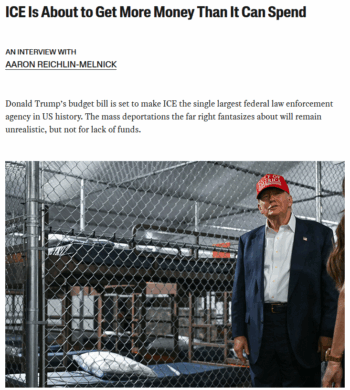
In an interview with Jacobin magazine (7/3/25) on how “ICE Is About to Get More Money Than It Can Spend,” Aaron Reichlin-Melnick—a senior fellow at the American Immigration Council—made the crucial observation: “You don’t build the mass deportation machine without building the police state first.”
This is precisely the analysis that is missing from corporate media coverage of the bill. Beyond making life hell for the undocumented workers on whose very labor the US economy depends, ICE has become a tool for political repression as well—as evidenced by a slew of recent episodes involving the abduction and disappearance of international scholars whose political opinions did not coincide with those of the commander in chief of our, um, democracy.
Take the case of 30-year-old Rümeysa Öztürk, a Turkish doctoral student and Fulbright scholar studying childhood development at Tufts University in Massachusetts. While walking to an iftar dinner in March, Öztürk was accosted by six plainclothes officers, some of them masked, and forced into an unmarked van, after which she was flown halfway across the country to an ICE detention center in Louisiana. Her crime, apparently, was to have co-written an opinion piece last year for the Tufts Daily (3/26/24), in which she and her co-authors encouraged the university to accede to demands by the Tufts Community Union Senate by recognizing the Israeli genocide in the Gaza Strip and divesting from companies with ties to Israel.
Öztürk’s case is hardly an isolated one. There’s Badar Khan Suri, a postdoctoral researcher at Georgetown University who was seized by masked agents outside his Virginia home and swept off to an ICE facility in Texas. There’s Momodou Taal, a British-Gambian former PhD student at Cornell who sued the Trump administration over the crackdown on Palestine solidarity and then self-deported, explaining that he had “lost faith [he] could walk the streets without being abducted.” And the list goes on (Al Jazeera, 5/15/25).
‘Homegrowns are next’
Supreme Court Justice Sonia Sotomayor (NPR, 4/15/25): The Trump administration believes it “could deport and incarcerate any person, including US citizens, without legal consequence, so long as it does so before a court can intervene.”
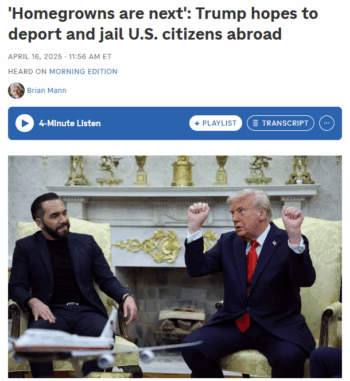
In the twisted view of the US government, of course, opposing the US-backed genocide of Palestinians equals support for “terrorism”—and in Trump’s view, basically anything that goes against his own thinking and policies potentially constitutes a criminal offense. It follows that Öztürk-style politically motivated kidnappings by the state are presumably merely the top of a very slippery slope that US citizens, too, will soon find themselves careening down—especially as Trump has already exhibited enthusiasm at the prospect of outsourcing the incarceration of US citizens to El Salvador: “The homegrowns are next,” he told Salvadoran autocrat Nayib Bukele.
The line between citizens and residents has been intentionally blurred, with the Trump Justice Department announcing it was “Prioritizing Denaturalization”—that is, stripping citizenship from foreign-born citizens. This draconian punishment has been proposed for Trump’s political enemies, from New York mayoral candidate Zohran Mamdani to former BFF Elon Musk. Trump has also taken aim at the constitutional right of birthright citizenship, potentially turning millions of other Americans into ICE targets.
Somehow, the elite media have not deemed it necessary to dwell even superficially on the implications of super-funding a rogue agency that has essentially been given carte blanche to indiscriminately round people up—be they undocumented workers, political dissidents, or just somebody who “looks like somebody we are looking for.” As for CNN’s write-up on “who stands to gain from the ‘big, beautiful bill,’” it’s definitely not all the folks currently living in a permanent state of fear, deprived of basic freedoms like movement, speech and thought.
Donald Fuhrump says that Amerikkka doesn’t bother with crimes or charges anymore, not being 100% Amerikkkan and opposing his real estate intentions is enough.