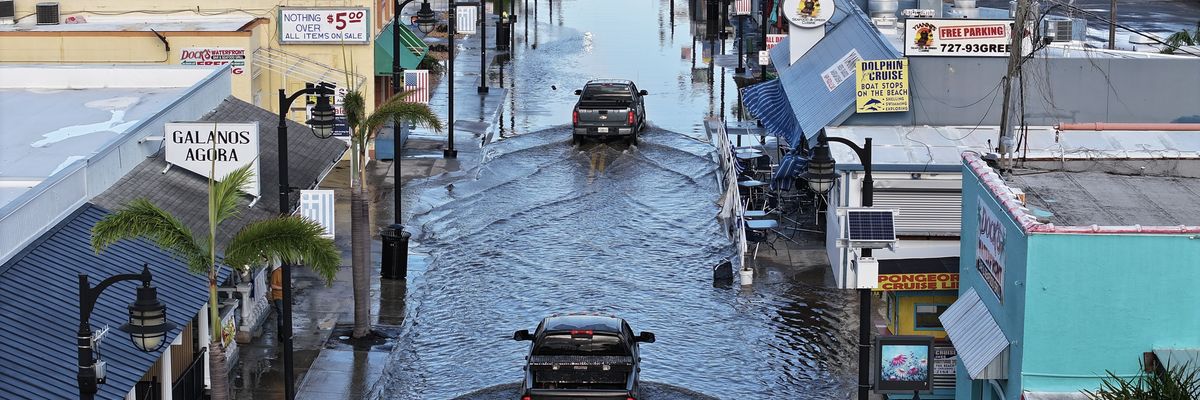
Flood waters inundate the main street after Hurricane Helene passed offshore on September 27, 2024 in Tarpon Springs, Florida. (Photo: Joe Raedle/Getty Images)
“It’s only a matter of time before Trump and Musk’s reckless assault on disaster response and preparedness kills people in the United States,” said a researcher with government watchdog The Revolving Door Project.
President Donald Trump has openly stated his desire to dismantle the Federal Emergency Management Agency—a move that has left some experts fearful about how the United States will handle natural disasters such as hurricanes in the coming months.
The Revolving Door Project, a government watchdog group, has now put together a tracking tool to keep tabs on how much the administration’s attacks on both FEMA and the National Oceanic and Atmospheric Administration have worsened the nation’s disaster preparedness.
The tool has two components: An interactive map showing all of the state disaster aid requests that the Trump administration has outright denied or only partially approved and an interactive timeline documenting all of the times that the administration has undermined the functionality of America’s disaster preparedness agencies through actions such as placing agency employees on administrative leave and disbanding key bodies such as FEMA’s National Advisory Council and its National Dam Safety Review Board.
All of these disruptions and cuts, argued Revolving Door Project senior researcher Kenny Stancil, are likely to come back to bite America in a big way when another natural disaster strikes.
“It’s only a matter of time before Trump and Musk’s reckless assault on disaster response and preparedness kills people in the United States,” he said in explaining the need for the initiative. “It nearly happened in mid-May in Kentucky, where a DOGE-damaged NWS forecast office had to scramble for staff before a tornado. Amid last week’s heatwave, low-income households across the country were missing the federal support they need to keep the air conditioning on. And when a major hurricane arrives, Trump, Musk, OMB Director Russell Vought, Commerce Secretary Howard Lutnick, and DHS Secretary Kristi Noem will almost certainly have blood on their hands.”
Revolving Door Project executive director Jeff Hauser issued a similarly dire warning about the administration’s actions on U.S. disaster preparedness and he described the actions being taken by the administration as “a matter of life-and-death.” He also accused the administration of “preventing forecasters and emergency managers at all levels from doing what is necessary to prepare for and respond to disasters.”
Trump in the past has tried to use federal disaster relief money as a cudgel against his political opponents, such as when he threatened to withhold funding from California during catastrophic wildfires unless the state did a better job of “raking” its forests.
Neo-Fascist Climate Science Denier Donald Trump says Burn, Baby, Burn.Elon Musk urges you to be a Fascist like him, says that you can ignore facts and reality then.
People watch the smoke and flames from the Palisades Fire in the Pacific Palisades neighborhood on January 7, 2025 in Los Angeles, California. (Photo: Tiffany Rose/Getty Images)
“This is the modern version of book burning,” said one scientist.
Amidst an ever-worsening climate emergency, the Trump administration this week took down the website hosting the U.S. government’s preeminent climate assessment, sparking outcry from experts who have worked previous versions of the report.
Considered the definitive body of research about how planetary warming is transforming the nation, the National Climate Assessment—which is required by Congress to be published every few years—gives a rundown of how global warming is impacting different sectors of the economy, ecosystems, and communities.
The five assessments that have been published so far were previously available through the website globalchange.gov, but the address stopped working Monday afternoon, according to The New York Times. As of Wednesday morning the website was still down.
However, it is still possible to access some of the climate research. The fifth assessment is available through the National Oceanic and Atmospheric Administration. An archived version of the fifth assessment is also available via Internet Archive’s Wayback Machine. According to a NASA spokesperson who spoke to NPR, all five editions of the assessment will also be available on NASA’s website, though it’s not clear when.
“It’s critical for decision-makers across the country to know what the science in the National Climate Assessment is. That is the most reliable and well-reviewed source of information about climate that exists for the United States,” Kathy Jacobs, a University of Arizona climate scientist who coordinated the 2014 version of the assessment, toldThe Associated Press.
“This is evidence of serious tampering with the facts and with people’s access to information, and it actually may increase the risk of people being harmed by climate-related impacts,” she added.
“They’re public documents. It’s scientific censorship at its worst,” said Peter Gleick, a California water and climate scientist who worked on the version of the assessment published in 2000, toldThe Los Angeles Times. “This is the modern version of book burning.”
Howard Crystal, legal director of the Center for Biological Diversity’s energy justice program, said in a statement on Tuesday that “it’s downright Orwellian for the Trump administration to take the nation’s premier climate reports and just yank them offline.”
“Hiding these congressionally mandated reports won’t make climate change go away, but it will leave Americans uninformed and unprepared,” he said.
Earlier in April, the Trump administration enacted cuts to the U.S. Global Change Research Program, which oversees the production of the National Climate Assessment, and later that month dismissed hundreds of scientists and experts working on the next version of the report, the 6th National Climate Assessment.
Meanwhile, a new budget document outlining fiscal year 2026 spending for the National Oceanic and Atmospheric Administration (NOAA) details deep cuts to climate research at the agency, including the elimination of the Office of Oceanic and Atmospheric Research, though some of its activities would be transferred to the National Ocean Service and the National Weather Service.
The budget proposal “eliminates all funding for climate, weather, and ocean Laboratories and Cooperative Institutes. It also does not fund Regional Climate Data and Information, Climate Competitive Research, the National Sea Grant College Program, Sea Grant Aquaculture Research, or the National Oceanographic Partnership Program,” according to the document.
With the termination of Climate Competitive Research, which funds academic institutions to do climate-related research, “NOAA will no longer support climate research grants,” the document also states.
“That’s it—with that statement, the administration signals its intent to have NOAA, arguably the world’s leading oceanic and atmospheric governmental organization, completely abandon climate science,” wrote Alan Gerard, a meteorologist who previously worked for NOAA.
Neo-Fascist Climate Science Denier Donald Trump says Burn, Baby, Burn.Elon Musk urges you to be a Fascist like him, says that you can ignore facts and reality then.
Demonstrators arrested in the Russell Senate Office Building (Photo via Debt Collective/X)
Protesters denounce cuts to Medicaid, which could kick 16 million off of nation’s largest public insure
On Wednesday, US Capitol police arrested 33 demonstrators who were part of a larger protest of over 60 people in the Russell Senate Office Building, denouncing the proposed cuts to Medicaid within the Trump-backed “One Big Beautiful Bill.” Some protesters were restrained and arrested while in wheelchairs.
The demonstration was organized by the Debt Collective, Popular Democracy, and the disability rights group ADAPT. Protesters wore shirts with the text “healthcare cuts will kill” and were arrested while unfurling a banner that read “Senate Republicans, don’t kill us, save Medicaid.” The bill is currently moving through the Senate after passing in the House of Representatives.
Medicaid is the nation’s largest public insurance program, which currently insures 71 million people in the US. According to analysis by the Center for Budget and Policy Priorities, the Senate version of the bill would cause roughly 16 million of those people to lose health insurance by 2034. This analysis predicts that the Senate bill would lead to more losses of coverage than the version of the bill which passed in the House. Public health researchers at Yale and the University of Pennsylvania have warned that certain provisions in the House bill could lead to more than 51,000 deaths each year.
Some Republican lawmakers have been callous regarding constituent concerns over Medicaid cuts. Notably, Republican Iowa Senator Joni Ersnt faced nationwide backlash after defending the proposed cuts at a town hall meeting in late May. When one of her constituents shouted that people would die without Medicaid healthcare coverage, Ersnt replied “well, we all are going to die.
Neo-Fascist Climate Science Denier Donald Trump says Burn, Baby, Burn.Elon Musk urges you to be a Fascist like him, says that you can ignore facts and reality then.
People take part in a protest against the deportation of alleged Venezuelan criminals from the USA to a high-security prison in El Salvador in Caracas, Venezuela on April 9, 2025. (Photo: Jesus Vargas/picture alliance via Getty Images)
By permitting the U.S. government to deport asylum-seekers and noncriminal undocumented immigrants to random third countries, the six Republicans on the bench handed a dangerous tool to a man most inclined to abuse it.
The American people just got a taste of authoritarianism wrapped in judicial robes. In a stunning 6-3 ruling this week, the Supreme Court green-lit the mass deportation of immigrants, not to their home countries but to third nations where they have no legal status, no family, and often no hope.
In her dissent, Justice Sonja Sotomayor, calling the shadow docket ruling “inexcusable,” pointed out how destructive this is to the rule of law (both U.S. and international law largely prohibit this) and to the lives of the people who may be deported without due process:
The Government has made clear in word and deed that it feels itself unconstrained by law, free to deport anyone anywhere without notice or an opportunity to be heard. The episodes of noncompliance in this very case illustrate the risks.
The Due Process Clause represents “the principle that ours is a government of laws, not of men, and that we submit ourselves to rulers only if under rules.” By rewarding lawlessness, the court once again undermines that foundational principle.
In matters of life and death, it is best to proceed with caution. In this case, the government took the opposite approach. It wrongfully deported one plaintiff to Guatemala, even though an Immigration judge found he was likely to face torture there. Then, in clear violation of a court order, it deported six more to South Sudan, a nation the State Department considers too unsafe for all but its most critical personnel.
This ruling by six corrupt Republican justices allows Donald Trump or any future president to designate any country they choose as a “safe third country” and deport people there without meaningful review, even if they’ve committed no crime and have a valid asylum claim.
If that sounds familiar, it should. It echoes one of the most cold-blooded decisions made by Adolf Hitler’s Nazi regime: to locate their extermination camps not within Germany, but in the foreign lands of occupied Poland.
Let’s be clear: Deportation is not genocide. But both decisions—then and now—are grounded in the same logic of moral evasion through geographic displacement.
When regimes want to commit acts that would stir conscience or provoke backlash at home, they find ways to outsource the cruelty.
The decision wasn’t just about deportation. It was about moral laundering, washing the blood off our hands by putting it on someone else’s tarmac.
The Nazi leadership understood that while Germany’s public had been bombarded with antisemitic propaganda for years, they still might balk at the wholesale slaughter of millions of people inside German borders. So they built Auschwitz, Treblinka, Sobibor, and Belzec far away, deep in Poland, where there were no German newspapers, no prying eyes, and no courts to second-guess their machinery of death.
As Raul Hilberg and other Holocaust historians have documented, Nazi leaders like Heinrich Himmler and Reinhard Heydrich made this decision deliberately to preserve the illusion of “moral cleanliness” at home while carrying out genocide abroad.
Today’s Trump version of this practice is more sanitized, but no less cynical.
By permitting the U.S. government to deport asylum-seekers and noncriminal undocumented immigrants to random third countries—often places they’ve never even set foot in—the Supreme Court has granted the executive branch a license to erase moral responsibility.
As long as the suffering happens somewhere else, we’re told, it’s not our fault. It’s not our soil. Not our responsibility.
That kind of logic is the death of democracy, human rights, and the rule of law. As Federal Judge Patricia Millett said of Trump’s deportation of Venezuelan prisoners to a concentration camp in El Salvador, compared with FDR’s actions in WWII, “Nazis got better treatment under the Alien Enemies Act.”
A future president with dictatorial ambitions could cite this ruling to round up political dissidents, journalists, or whistleblowers and ship them off to “safe third countries” that are anything but.
The Trump administration argued—and the court’s on-the-take, Republican-appointed majority agreed—that migrants have no right to American judicial processes once they’re transferred elsewhere. In other words, we can dodge our legal obligations under both U.S. and international law simply by putting someone on a plane.
This is the same loophole thinking that allowed George W. Bush’s administration to kidnap terror suspects and ship them to places like Egypt and Syria, where they were tortured out of view. That policy was called “extraordinary rendition.” Today, we might call this new policy extraordinary rejection: a way to deny asylum without confronting its human cost.
And here’s the truly chilling part: Once someone has been deported to a third country, they are functionally outside the U.S. legal system. They can’t sue. They can’t appeal. They may not even survive. And, to Trump’s delight, it’ll all be outside the reach of American courts and U.S. media.
This obscene policy isn’t about safety, it’s about displacement as punishment and the creation of a pseudo-legal infrastructure of indifference to the humanity of the people we’re “processing.”
Whether it’s a camp outside Kraków or a deportation center in Guatemala, the strategy is the same: create a zone of moral invisibility. A legal no-man’s-land where acts that would outrage decent people become routine, because they happen far away, beyond the reach of media, law, and conscience.
That’s not how democracies behave: That’s how authoritarian regimes insulate themselves from dissent.
And like all authoritarian tools, once it exists, it will be used again.
You may think this only affects immigrants. But consider: The legal precedent now exists for the government to forcibly remove someone from U.S. soil and drop them in another country without due process. Today it’s asylum-seekers. Tomorrow, who knows?
A future president with dictatorial ambitions could cite this ruling to round up political dissidents, journalists, or whistleblowers and ship them off to “safe third countries” that are anything but.
You think that’s paranoid? So did people in 1932 Berlin.
The genius of the American system—at least in theory—is that it puts checks on state power. The executive cannot act like a king. The courts must protect the vulnerable. And the public must have visibility into the actions done in our name.
This week, though, the Supreme Court abdicated that role. And in doing so, the six Republicans on the bench handed a dangerous tool to a man most inclined to abuse it.
Let’s not kid ourselves. The decision wasn’t just about deportation. It was about moral laundering, washing the blood off our hands by putting it on someone else’s tarmac.
The Nazis did it. So did the Bush administration. Now Trump’s backers on the court have opened the door once more.
History doesn’t repeat, but, as Mark Twain said, it rhymes. And if we’re not careful, we may soon find that rhyme turning into a full verse we’ve heard before.
The original Fascists Mussolini and HitlerElon Musk urges you to be a Fascist like him, says that you can ignore facts and reality then. (and responsibility).Neo-Fascist Climate Science Denier Donald Trump says Burn, Baby, Burn.
While campaigners take to the streets, fossil fuel interests lobby governments directly, and often without scrutiny, a new report has found | Vuk Valcic/SOPA Images/LightRocket via Getty Images)
Oil and gas firms were able to water down or change Conservative policies without scrutiny, new report finds
The British government weakened key climate policies after fossil fuel giants lobbied ministers and used legal loopholes to avoid public scrutiny, a new report has found.
Climate-focused think tank InfluenceMap has uncovered that industry influence appears to have led to the delay and dilution of UK policies on the roll-out of heat pumps, the development of ‘sustainable’ aviation fuel and the granting of new oil and gas licenses.
In each case, it found that lobbyists representing fossil fuel actors that stood to lose billions from progressive climate regulations were able to influence the Conservative government’s policy without scrutiny.
While InfluenceMap’s report looks at policies relating to the UK’s net-zero ambitions, its findings on the way the UK’s lax laws allow lobbying to be conducted in secret can be applied across sectors. The think tank is calling for reforms to address this and close the “major transparency gap”.
The secrecy around lobbying, which has been at the heart of many government scandals in recent years, is a major driver of the disillusionment in British politics.
InfluenceMap’s findings illustrate “how inadequate and opaque lobbying rules undermine effective policymaking”, said Alastair McCapra, the CEO of the UK lobbying industry body.
He added: “Business engagement should help to build sounder policy with better outcomes for the public, but unaccountable lobbying breeds public mistrust. This important report removes the guesswork needed to piece together what kind of lobbying is taking place.”
Weak lobbying laws
openDemocracy has previously reported extensively on the ways that the UK’s weak lobbying laws allow corporate influence to secretly shape policy.
Our investigations have now been backed up by InfluenceMap, which has found a huge gap exists between the lobbying that takes place and that which is disclosed. This means the British public often has no way of knowing who is swaying policy.
Comparing transparency rules in the UK, the European Parliament, the US, Canada and France, InfluenceMap found that the UK has by far the worst system.
Of the five, only the UK exempts lobbyists who work in-house for a company, rather than for an agency or consultancy, from registering with a statutory lobbying watchdog. Less than 15% of lobbyists working in the UK need to register because of this rule.
The firms on the register must publish a list of clients on whose behalf they have lobbied each quarter. But they do not have to publish any details about the lobbying, including whether it involved written correspondence or a meeting and what legislation or policy was discussed.
Registered lobbyists also only need to declare clients for whom they lobbied government ministers and senior officials. There is no requirement to name clients when they approached other MPs and peers, including those on select committees, or influential government advisers.
The Committee for Standards in Public Life, an independent public body that advises the prime minister on lobbying and other aspects of public office, has consistently recommended the government publish a single, searchable database of all meetings with lobbyists.
Its recommendations would expand the scope of the current register considerably, requiring lobbyists to disclose the specific policies or legislation they discussed at meetings with government ministers and special advisers.
InfluenceMap has also called on the government to take up this recommendation and address the fundamental flaws in the lobbying act by including in-house lobbyists and publishing all responses to government policy consultants as standard.
Susan Hawley, executive director of Spotlight on Corruption, said the report “starkly demonstrates how major transparency gaps in the UK’s lobbying regime are undermining the development of good climate policy.”
“We fully support their recommendations to make lobbying much more transparent and bring the UK in line with international best practice. These reforms would support more participatory and open decision-making to help rebuild public trust and ensure better decision-making, widening the evidence base for policy making and reducing risks of policy capture by vested interests,” she said.
Oil and gas licensing
In 2022, the UK government quietly dropped two criteria from its ‘Climate Compatibility Checkpoint’ after lobbying from the fossil fuel industry. The checkpoint is used to assess whether proposed oil and gas licenses align with the UK’s climate change goals.
Oil giants BP and Shell and their industry association, Offshore Energies UK (OEUK), responded to a consultation on the checkpoint by objecting to the inclusion of two key metrics for measuring the impact of fossil fuels, according to InfluenceMap’s analysis of consultation responses obtained via Freedom of Information requests.
The measures they opposed would have required the government to consider ‘Scope 3 emissions’ and the ‘global production gap’ when issuing new oil and gas licences.
Scope 3 emissions are produced during end-use and contribute the largest share of all emissions from oil and gas production, while the production gap tracks the discrepancy between planned fossil fuel production and what’s needed to limit global warming to 1.5°C or 2°C.
The government dropped both criteria from the final checkpoint, which instead focuses solely on operational emissions, which represent only a fraction of total emissions from oil and gas projects.
This outcome, InfluenceMap’s report notes, strongly aligns with the positions advocated for by BP, Shell, and OEUK, suggesting their lobbying efforts were successful.
The following year, the government approved 100 new North Sea oil and gas licences, which had a potential emissions footprint equivalent to Denmark’s annual output.
InfluenceMap’s report also highlights the issues around government consultations on proposed policies, pointing out that, as in this case, lobbyists typically use these to suggest amendments in favour of their clients, but their responses are not published as standard.
Similarly, unlike in the other four Parliaments InfluenceMap looked at, corporations in the UK are not required to declare their engagement on policies, how much they spend on lobbying, or which legislation or decisions they are targeting.
It highlights that this can lead to a situation in which companies make voluntary corporate disclosures that fail to capture the true extent of this advocacy. In this case, InfluenceMap found BP published a summary of its response to the checkpoint that omitted key lines of its opposition, which were only revealed later through Freedom of Information requests.
Rachel Davies, advocacy director at Transparency International UK, said: “This report highlights, yet again, the glaring gaps in our lobbying transparency regime and the potential risks of favouring a small group of vested interests at the public’s expense.
“The UK needs to catch up to other comparable democracies and act swiftly to introduce a comprehensive lobbying register with meaningful disclosures.”
Domestic hydrogen
It is broadly agreed that, in the UK, hydrogen is not a viable solution for decarbonising domestic heating and is an especially bad alternative to heat pumps. Much of our hydrogen comes from burning gas or coal and it cannot be transported through our existing pipelines without massive and costly infrastructure changes.
This reality has been set out by different independent bodies advising the UK government.
In 2021, the Climate Change Committee warned that hydrogen had “not yet been proven at scale and should not be a cause to delay other options” such as the roll-out of heat pumps or low-carbon heat networks. Two years later, the National Infrastructure Commission said the government “should not support the roll-out of hydrogen heating” because there is “no public policy case” for its use.
As InfluenceMap’s report notes, this has not prevented the gas industry from waging a successful lobbying campaign in a bid to shore up its market position – with a clear impact on government policy.
The think tank found the industry pursued its cause in a number of ways, including setting up Hello Hydrogen, a campaign fronted by TV star Rachel Riley, to make the case for using hydrogen in homes to the public in 2022. While the campaign did not declare its funders, its director was also a director of Cadent Gas, the UK’s largest gas distribution network.
Cadent is one of the funders of the All-Party Parliamentary Group (APPG) on Hydrogen, which has publicly called for hydrogen to play a part in domestic heating. The APPG’s other funders include Equinor, Shell and the Energy and Utilities Alliance, a lobbying body run by Mike Foster, the former Labour MP for Worcester (home to Worcester Bosch, a major manufacturer of gas boilers).
Other fossil fuel firms and industry lobbying bodies have also consistently pushed for the use of hydrogen in domestic heating in letters to parliamentary select committees and responses to government consultations.
Ahead of last year’s general election, Centrica (formerly British Gas) wrote to the Public Accounts Committee, which examines the value for money of government projects, to call for further public investment in hydrogen for home heating. The firm had written to the Energy Security and Net Zero Committee in support of the technology less than 12 months earlier.
This industry lobbying has led to indecision and disruption on government plans. A February 2023 report by the House of Lords Committee blamed mixed messages on the effectiveness of hydrogen from the government and industry for the poor uptake of a publicly subsidised scheme for heat pumps, which would reduce greenhouse gas emissions and create many jobs.
The lords’ report concluded: “Hydrogen is not a serious option for home heating for the short to medium-term and misleading messages, including from the government, are negatively affecting take-up of established low-carbon home heating technologies like heat pumps.”
The UK’s heat pump roll-outs have lagged behind those of its neighbours. Just 55,000 heat pumps were installed in the UK in 2019, compared to 600,000 in France, according to a study cited in the InfluenceMap report.
In the UK, this reportedly created around 2,000 jobs and reduced emissions of CO₂ by 0.08 million tonnes (MT); in France 30,000 jobs were created and 0.84 MT of CO₂ emissions avoided.
‘Sustainable’ aviation fuel
InfluenceMap also uncovered how industry significantly influenced the government’s so-called ‘Jet Zero’ strategy for cutting emissions in the UK’s aviation industry, which is heavily reliant on fossil fuels.
Biofuels, largely made up of used cooking oils, are often suggested as an option for producing Sustainable Aviation Fuel (SAF), although they are generally accepted to be worse in terms of scalability than other, more advanced fuels, and much worse than just reducing the number of flights.
The government initially proposed limiting the use of used cooking oil for SAF to alleviate competition on the resource – which is increasingly in demand for other uses, such as producing biodiesel for cars – and to encourage investment in new technologies for the aviation industry.
The proposals included two options; either banning the use of used cooking oil for SAF altogether, or rapidly phasing down its use so that it would make up just 8.5% of total sustainable aviation fuel by 2040.
But the government’s final SAF policy was more closely aligned with industry preferences than scientific warnings, InfluenceMap found. It allows used cooking oil to make up 100% of SAF uptake in 2025 and 2026, 71% in 2030, and 35% in 2040.
InfluenceMap’s analysis reveals the weakened SAF mandate came after pressure from Shell, BP, the International Airlines Group (which owns several airlines), Airlines UK (the trade body for UK-registered airlines) and Virgin Atlantic airline.
It also found that business interests were overrepresented in parliamentary meetings on SAF while the policy was being shaped.
This can be seen in the make-up of Parliament’s Jet Zero Council, “a partnership between industry academia and government”, which was run by Heathrow’s chief operating officer, while the International Airlines Group chaired the Sustainable Aviation Fuel Delivery Group.
The council comprised 24 members from industry, three from academia and one from civil society. Ministers were also directly involved with the council, with then-prime minister Boris Johnson attending the group’s first meeting along with four ministers.
Transparency failures again played a key role. Not a single ministerial meeting on SAF referenced the weakening of the cooking oil cap in official records, and industry responses to consultations were only obtained through Freedom of Information.
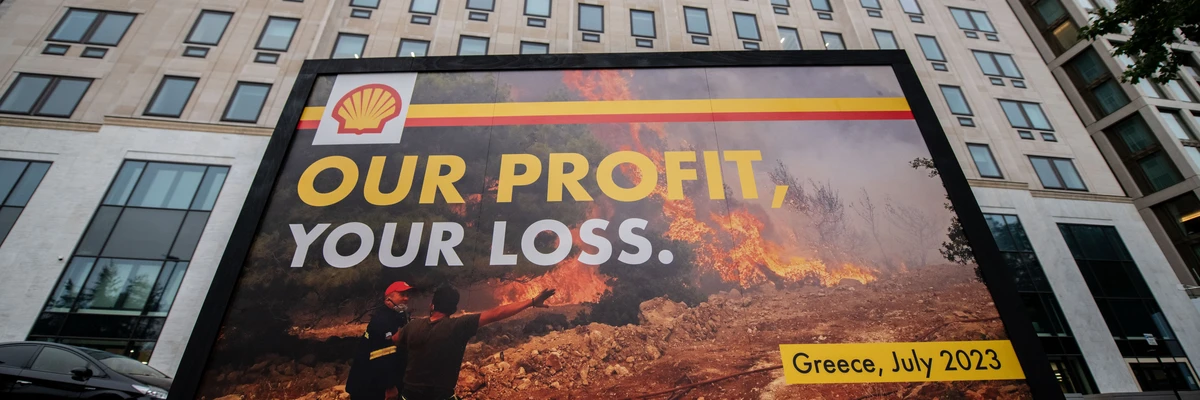
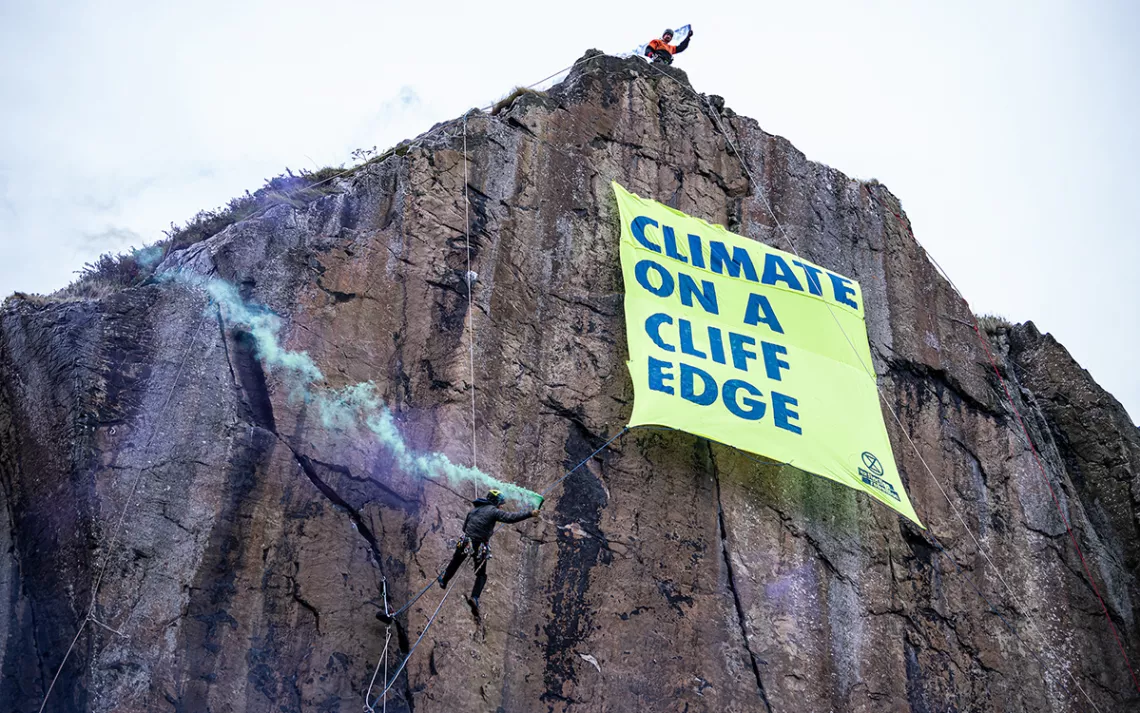
Greenpeace activists display a billboard during a protest outside Shell headquarters on July 27, 2023 in London. (Photo: Handout/Chris J. Ratcliffe for Greenpeace via Getty Images)Experienced climbers scale a rock face near the historic Dumbarton castle in Glasgow, releasing a banner that reads “Climate on a Cliff Edge.” One activist, dressed as a globe, symbolically looms near the edge, while another plays the bagpipes on the shores below. | Photo courtesy of Extinction Rebellion and Mark Richards