Net-zero scenario is ‘cheapest option’ for UK, says energy system operator

Spread the love

Original article by Simon Evans republished from Carbon Brief under a CC license

Wind mills along the A9 trunk road in Caithness, Scotland. Credit: Vincent Lowe / Alamy Stock Photo

A scenario that meets the “net-zero by 2050” goal would be the “cheapest” option for the UK, according to modelling by the National Energy System Operator (NESO).

In a new report, the organisation that manages the UK’s energy infrastructure says its “holistic transition” scenario would have the lowest cost over the next 25 years, saving £36bn a year – some 1% of GDP – compared to an alternative scenario that slows climate action.

These savings are from lower fuel costs and reduced climate damages, relative to a scenario where the UK fails to meet its climate goals, known as “falling behind”.

The UK will need to make significant investments to reach net-zero, NESO says, but this would cut fossil-fuel imports, support jobs and boost health, as well as contributing to a safer climate.

Slowing down these efforts would reduce the scale of investments needed, but overall costs would be higher unless the damages from worsening climate change are “ignored”, the report says.

In an illusory world where climate damages do not exist, slowing the UK’s efforts to cut emissions would generate “savings” of £14bn per year on average – some 0.4% of GDP.

NESO says that much of this £14bn could be avoided by reaching net-zero more cheaply and that it includes costs unrelated to climate action, such as a faster rollout of data centres.

Notably, the report appears to include efforts to avoid the widespread misreporting of a previous edition, including in the election manifesto of the hard-right, climate-sceptic Reform UK party.

Overall, NESO warns that, as well as ignoring climate damages, the £14bn figure “does not represent the cost of achieving net-zero” and cannot be compared with comprehensive estimates of this, such as the 0.2% of GDP total from the UK’s Climate Change Committee (CCC).

Net-zero is the ‘cheapest option’

Every year, NESO publishes its “future energy scenarios”, a set of four pathways designed to explore how the nation’s energy system might change over the coming decades.

(Technically the scenarios apply to the island of Great Britain, rather than the whole UK, as Northern Ireland’s electricity system is part of a separate network covering the island of Ireland.)

Published in July, the scenarios test a series of questions, such as what it would mean for the UK to meet its climate goals, whether it is possible to do so while relying heavily on hydrogen and what would happen if the nation was to slow down its efforts to cut emissions.

The scenarios have a broad focus and do not only consider the UK’s climate goals. In addition, they also explore the implications of a rapid growth in electricity demand from data centres, the potential for autonomous driving and many other issues.

With so many questions to explore, the scenarios are not designed to keep costs to a minimum. In fact, NESO does not publish related cost estimates in most years.

This year, however, NESO has published an “economics annex” to the future energy scenarios. It last published a similar exercise in 2020, with the results being widely misreported.

In the new annex, NESO says that the UK currently spends around 10% of GDP on its energy system. This includes investments in new infrastructure and equipment – such as cars, boilers or power plants – as well as fuel, running and maintenance costs.

This figure is expected to decline to around 5% of GDP by 2050 under all four scenarios, NESO says, whether they meet the UK’s net-zero target or not.

For each scenario, the annex adds up the total of all investments and ongoing costs in every year out to 2050. It then adds an estimate of the economic damages from the greenhouse gas emissions that primarily come from burning fossil fuels, using the Treasury’s “green book”.

When all of these costs are taken into account, NESO says that the “cheapest” option is a pathway that meets the UK’s climate goals, including all of the targets on the way to net-zero by 2050.

It says this pathway, known as “holistic transition”, would bring average savings of £36bn per year out to 2050, relative to a pathway where the UK slows its efforts on climate change.

The overall savings, illustrated by the dashed line in the figure below, stem primarily from lower fuel costs (orange bars) and reduced climate damages (white bars).
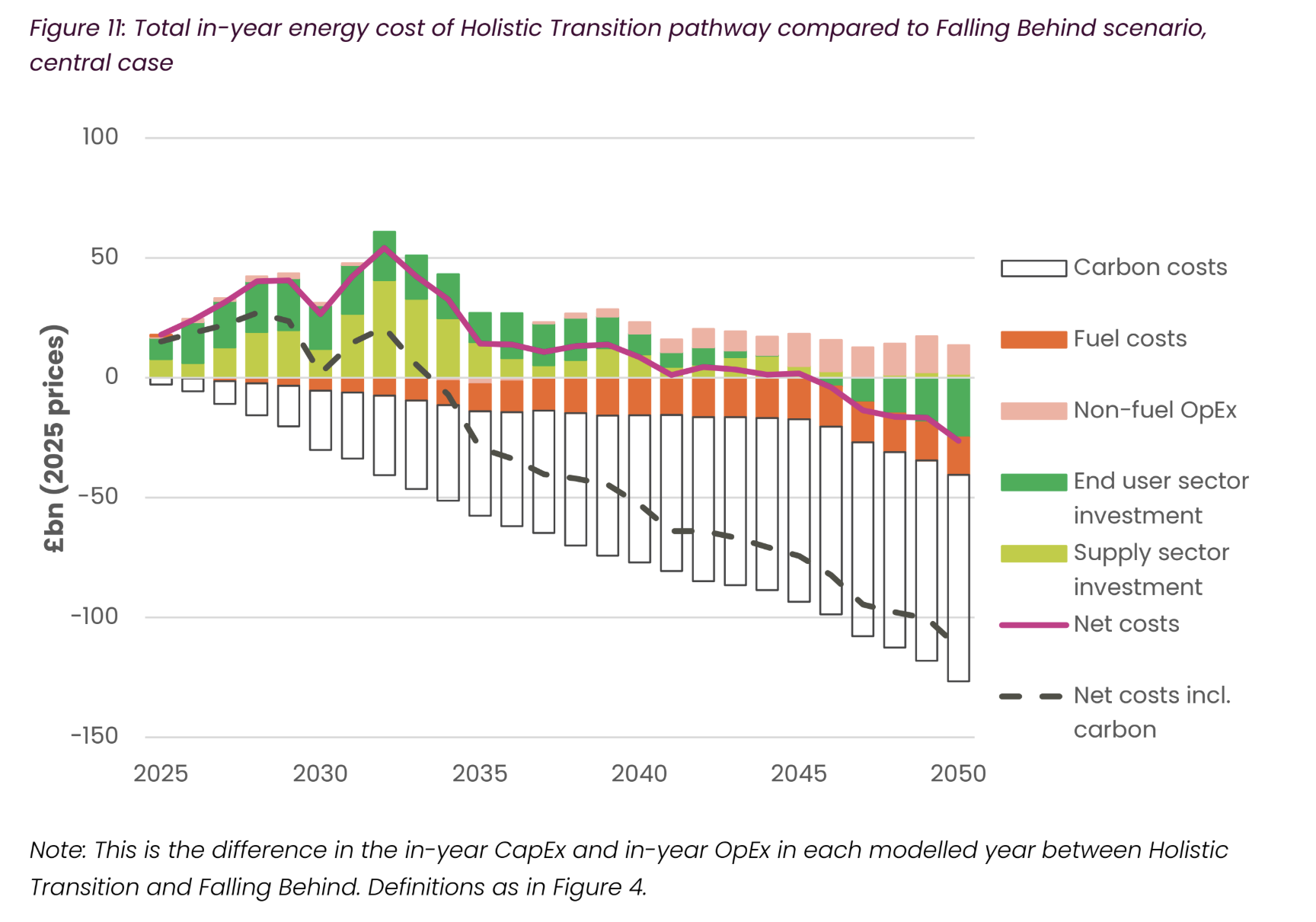
In-year energy costs of the “holistic transition” pathway relative to “falling behind”
In-year energy costs of the “holistic transition” pathway relative to “falling behind”, £bn in 2025 prices and assuming central estimates for future fossil-fuel prices. Credit: NESO.

Note that the carbon pricing that is already applied to power plants and other heavy industry under the UK’s emissions trading system (ETS) is excluded from running costs in the annex, appearing instead within the wider “carbon costs” category. 

This makes the running costs of fossil-fuel energy sources seem cheaper than they really are, when including the ETS price.

Net-zero requires significant investment

While NESO says that its net-zero compliant “holistic transition” pathway is the cheapest option for the UK, it does require significant upfront investments.

The scale of the additional investments needed to stay on track for the UK’s climate goals, beyond a pathway where those targets are not met, is illustrated in the figure below.

This shows that the largest extra investments would need to be made in the power sector, such as by building new windfarms (shown by the dark yellow bars). This is followed by investment needs for homes, such as to install electric heat pumps instead of gas boilers (dark red bars).

These additional investments would amount to around £30bn per year out to 2050, but with a peak of as much as £60bn over the next decade.

These investments would be offset by lower fuel bills, including reduced gas use in homes (pale red) and lower oil use in transport (mid green).

Notably, NESO says it expects EVs to be cheaper to buy than petrol cars from 2027, meaning there are also significant savings in transport capital expenditure (“CapEx”, dark green).

Detailed breakdown of in-year energy costs of the “holistic transition” pathway relative to “falling behind”
Detailed breakdown of in-year energy costs of the “holistic transition” pathway relative to “falling behind”, £bn in 2025 prices and assuming central estimates for future fossil-fuel prices. Credit: NESO.

Again, the biggest savings in “holistic transition” relative to “falling behind” would come from avoided climate damages – described by NESO as “carbon costs”.

Net-zero cuts fossil-fuel imports

In addition to avoided climate damages, NESO says that reaching the UK’s net-zero target would bring wider benefits to the economy, including lower fuel imports.

Specifically, it says that climate efforts would “materially reduce” the UK’s dependency on overseas gas, with imports falling to 78% below current levels by 2050 in “holistic transition”. Under the  “falling behind” scenario, imports rise by 35%”, despite higher domestic production.

This finding, shown in the figure below, is the opposite of what has been argued by many of those that oppose the UK’s net-zero target.

Annual gas imports to the UK
Annual gas imports to the UK, billion cubic metres (bcm) 2024-2050, under different NESO scenarios. Credit: NESO.

NESO goes on to argue that the shift to net-zero would have wider economic benefits. These include a shift from buying imported fossil fuels to investing money domestically instead, which “could bring local economic benefits and support future employment”.

The operator says that there is the “potential for more jobs to be created than lost in the transition to net-zero” and that there would be risks to UK trade if it fails to cut emissions, given exports to the EU – the UK’s main trading partner – would be subject to the bloc’s new carbon border tax.

Beyond the economy, NESO points to studies finding that the transition to net-zero would have other benefits, including for human health and the environment.

It does not attempt to quantify these benefits, but points to analysis from the CCC finding that health benefits alone could be worth £2.4-8.2bn per year by 2050.

Investment is higher for net-zero than for ‘not-zero’

It is clear from the NESO annex that its net-zero compliant “holistic transition” pathway would entail significantly more upfront investment than if climate action is slowed under “falling behind”.

This idea, in effect, is the launchpad for politicians arguing that the UK should walk away from its climate commitments and stop building new low-carbon infrastructure.

As already noted, the NESO analysis shows that this would increase costs to the UK overall.

Still, NESO’s new report adds that “falling behind” would “save” £14bn a year – relative to meeting the UK’s net-zero target – as long as carbon costs are “ignored”.

Specifically, it says that ignoring carbon costs, “holistic transition” would cost an average of £14bn a year more out to 2050 than “falling behind”, which misses the net-zero target. This is equivalent to 0.4% of the UK’s GDP and is illustrated by the solid pink line in the figure below.

In-year energy costs of the “holistic transition” pathway relative to “falling behind”
In-year energy costs of the “holistic transition” pathway relative to “falling behind”, £bn in 2025 prices and assuming central estimates for future fossil-fuel prices. Credit: NESO.

Some politicians are indeed now willing to ignore the problem of climate change and the damages caused by ongoing greenhouse gas emissions. These politicians may therefore be tempted to argue that the UK could “save” £14bn a year by scrapping net-zero.

However, NESO’s report cautions against this, stating explicitly that the “costs discussed here do not represent the cost of achieving net-zero emissions”. It says:

“Our pathways cannot provide firm conclusions over the relative costs attached to the choices between pathways…We reiterate that the costs discussed here do not represent the cost of achieving net-zero emissions.”

It says that the scenarios have not been designed to minimise costs and that it would be possible to reach net-zero more cheaply, for example by focusing more heavily on EVs and renewables instead of hydrogen and nuclear.

Moreover, it says that some of the difference in costs between “holistic transitions” and “falling behind” is unrelated to climate action. Specifically, it says that electricity demand from data centres is around twice as high in “holistic transitions”, adding some £5bn a year in costs in 2050.

In addition, NESO says that most of the “saving” in “falling behind” would be wiped out if fossil fuel prices are higher than expected – falling from £14bn per year to just £5bn a year – even before considering climate damages and wider benefits, such as for health.

Finally, NESO says that failing to make the transition to net-zero would leave the UK more exposed to fossil-fuel price shocks, such as the global energy crisis that added 1.8% to the nation’s energy costs in 2022. It says a similar shock would only cost 0.3% of GDP in 2050 if the country has reached net-zero – as in “holistic transition” – whereas costs would remain high in “falling behind”.

Original article by Simon Evans republished from Carbon Brief under a CC license

Nigel Farage urges you to ignore facts and reality and be a climate science denier like him and his Deputy Richard Tice. He says that Reform UK has received £Millions and £Millions from the fossil fuel industry to promote climate denial and destroy the planet.
Donald Trump urges you to be a Climate Science denier like him. He says that he makes millions and millions for destroying the planet, Burn, Baby, Burn and Flood, Baby, Flood.
Elon Musk urges you to be a Fascist like him, says that you can ignore facts and reality then.
Continue ReadingNet-zero scenario is ‘cheapest option’ for UK, says energy system operator

Limiting jury trials will harm minority ethnic victims and defendants, research shows

Spread the love

Tara Lai Quinlan, University of Birmingham and Katharina Karcher, University of Birmingham

The right to trial by jury dates back to at least the 12th century. The government’s proposals to limit it in England and Wales, many argue, run counter to the UK’s core democratic principles. And as others have pointed out, scrapping jury trials for some crimes is unlikely to solve the massive backlog in the crown courts.

Our research suggests that there is another reason why it is a bad idea to scrap jury trials. They can play a vital role in reducing racial discrimination in the criminal justice system.

The proposals laid out by justice secretary David Lammy would have a disproportionately negative impact on people of colour – both defendants and victims – for whom jury trials give a glimmer of hope in a criminal justice system where “ethnic minorities (excluding white minorities) appear to be over-represented”.

Government data repeatedly shows black, Asian and minority ethnic defendants are less likely to plead guilty than white defendants, and more likely to take their cases to trial. Lammy’s own 2017 review of racial inequality in the justice system suggests this is driven by a perception that the plea-bargaining process is unfair to defendants of colour, and that only a jury of peers will give them a fair trial.

Once black defendants choose a jury trial, research shows they are “more likely … to obtain acquittals or reductions in charges as a result”, compared to black defendants who plead guilty without opting for a trial.

A jury of 12 people brings a broader array of diverse perspectives and opinions which enhance the quality of discussions in deliberations, particularly in cases involving an ethnic minority defendant. Defendants should have their fate decided by people who might better understand their experiences, backgrounds and motivations.

Lammy’s 2017 review emphasised the importance of juries in making the criminal justice system more legitimate, particularly for people of colour: “Juries deliberate as a group through open discussion. This both deters and exposes prejudice or unintended bias: judgements must be justified to others.”

Sentencing is also disproportionate for defendants of colour when compared to white defendants, following both jury trials and plea agreements. Research has found that explicit or implicit judicial biases – whether judges stereotype the defendant, how they interpret sentencing recommendations from prosecutors and defence counsel, or how they apply aggravating and mitigating factors – may all contribute to these disparities.

Empirical evidence from other jurisdictions shows that more diverse juries are fairer to black defendants. Indeed, studies repeatedly show that all-white juries much more readily convict black defendants. Juries with even one black member are less likely to do so.

The UK’s Contempt of Court Act limits this type of research with live juries. But there is enough evidence from other jurisdictions to suggest that retaining juries, and ensuring those juries are diverse, is essential for protecting the fair trial rights of people of colour generally, and black people in particular.

Justice for victims

Jury trials are also essential for black victims and their families. Since 2022, we have worked with the family and friends of Dea-John Reid, a 14-year-old black boy who was racially abused and chased through the streets of Birmingham by a group of white boys and men who fatally stabbed him in broad daylight.

In their 2022 trial, the perpetrators were acquitted of racially aggravated murder, with only the principal offender found guilty of manslaughter by a jury of one Asian and 11 white members. Dea-John’s family felt that the lack of diversity on the jury, which did not have a single black member, could have meant they were less likely to see Dea-John as a worthy victim. Research shows that black men and boys are stereotyped as suspects – even when they are victims of crime.

Since 2022, we have worked with the family’s campaign, which supports retaining jury trials, but wants them to be more ethnically diverse, particularly in cases involving black victims. Our research has documented the campaign and is addressing critical gaps in UK research on jury diversity.

Diversity in the judiciary

Lammy’s proposals for reform include expanding the use of bench trials. This means that more cases would be heard by a single judge alone.

The judiciary in England and Wales is neither sufficiently diverse nor representative of the population. While black, Asian or minority ethnic people make up around 22% of the population, as of 2025, they make up only 11% of all court judges.

Lammy’s proposal also goes against what the public wants. In 2024, we surveyed 1,000 members of the public, 75% of whom stated explicitly that they believed the UK should have jury trials.

While most of our respondents believed that jury trials were fair (51%) and trustworthy (60%), they also felt strongly that more diverse juries were fairer (61%). Around half of people (51%) believed juries should look like the communities they serve. We found that for people of colour, taking part in jury service was viewed as even more important than for white respondents.

When it comes to perceptions of fairness and trust in the courts, we found important racial differences. Our research found that people of colour trust judges and the courts at lower rates than white people. People of colour in our survey were also more likely than white people to believe that judges treat them more unfairly compared to white people. And most of our respondents believed that more diversity in the judiciary is needed.

If Lammy remains committed to reducing inequality in the criminal justice system for people of colour, rather than reducing jury trials, he should be increasing them, and the diversity on them, to ensure justice for all.

Tara Lai Quinlan, Associate Professor in Law and Criminal Justice, University of Birmingham and Katharina Karcher, Senior Lecturer, Department of Modern Languages, University of Birmingham

This article is republished from The Conversation under a Creative Commons license. Read the original article.

UK Labour Party Foreign Secretary David Lammy repeatedly heckled at a speech to the Fabian Society over his and the Labour Party's support for and complicity in Israel's genocide of Gaza.
UK Labour Party Foreign Secretary David Lammy repeatedly heckled at a speech to the Fabian Society over his and the Labour Party’s support for and complicity in Israel’s genocide of Gaza.

Richard Tice refuses to condemn Reform mayoral candidate’s comments about David Lammy

Continue ReadingLimiting jury trials will harm minority ethnic victims and defendants, research shows

Former Dulwich pupil says Farage told him: ‘That’s the way back to Africa’

Spread the love

https://www.theguardian.com/politics/2025/dec/05/nigel-farage-former-dulwich-college-pupil-alleges-said-thats-the-way-back-to-africa

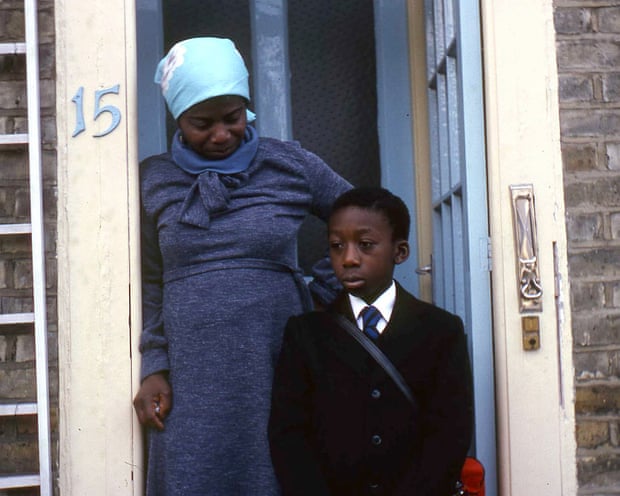
Yinka Bankole in uniform, with his mother – Oluremi A Bankole – before going to Dulwich college in south-east London. Photograph: Yinka Bankole

[Guardian] Exclusive: Yinka Bankole says he felt compelled to speak out after Reform leader’s attempts to ‘dismiss’ hurt of alleged targets

A former Dulwich college pupil who claims a teenage Nigel Farage told him “that’s the way back to Africa” has said he felt compelled to speak out after the Reform leader’s attempt at “denying or dismissing” the hurt of his alleged targets.

Yinka Bankole, who claims he had just started at the school when a 17-year-old Farage singled him out for abuse, said he had decided to tell his story in full after watching the Reform leader’s press conference on Thursday.

Farage told reporters that he had never been racist or antisemitic with “malice”. Instead, he launched a tirade aimed at the BBC and ITV for questioning him about an ongoing Guardian investigation into allegations of past antisemitism and racism.

Citing television shows including Are You Being Served? and It Ain’t Half Hot Mum, Farage accused the BBC, which he suggested he would boycott, of “double standards and hypocrisy”, and claimed ITV had a case to answer for airing the comedian Bernard Manning in the 1970s.

Bankole continues, describing Farage’s behaviour when he was 9 and Farage would have been near 17 years of age. The story of this and repeated articles on this topic is that Farage was a nasty racist bully.

“It took him a while, I recall, but one day Farage, and at least one other, spotted me in the lower-school playground. He was about 17 years old.

“He towered over me. ‘Where are you from?’ he asked. Within seconds of offering my rather confused and sputtering answers, he had a clear response: ‘That’s the way back to Africa,’ with an accompanying hand gesture pointing towards a place far away.”

Bankole, 54, an engineer, said that once his “existence as a target was established”, Farage “would wait at the lower-school gate, where I was dropped off for school, so as to repeat the vulgarity”.

https://www.theguardian.com/politics/2025/dec/05/nigel-farage-former-dulwich-college-pupil-alleges-said-thats-the-way-back-to-africa

Continue ReadingFormer Dulwich pupil says Farage told him: ‘That’s the way back to Africa’

Greens responds to Reform’s £9 million donation

Spread the love
Green party leader Zack Polanski (Green Party of England and Wales). Image: Bristol Green Party Creative Commons CC0 1.0 Universal Public Domain Dedication.

Responding to news that Nigel Farage’s Reform UK party has received a £9 million donation from a single donor, Green Party leader Zack Polanski said

“Reform hoovering up vast sums of private donations isn’t a sign of political strength, but a sign of a weakness in the foundations of our democracy. When a single party can be bankrolled by a handful of wealthy individuals, it drowns out the voices of ordinary people and tilts the entire system towards the interests of those elites. 

“This is exactly why we need a cap on political donations. Democracy should never be for sale. Every party should compete on ideas, not on the size of their donor spreadsheet.

“While Reform pockets eye-watering cheques, Greens are building a movement powered and funded by people through thousands of new members. 

“When we win elections, it will be because of the tens of thousands of people volunteered, not the people who donated tens of thousands. If we want a politics that serves the public, not billionaire backers, then capping donations is essential. Let’s end the influence of big money and put democracy back where it belongs: in the hands of voters.”

Nigel Farage reminds you that he's the man that brought you Brexit and asks what could possibly go wrong.
Nigel Farage reminds you that he’s the man that brought you Brexit and asks what could possibly go wrong.

Continue ReadingGreens responds to Reform’s £9 million donation