We’ve now had 11 record-breaking months of heat in a row and sea surface temperatures in the North Atlantic have soared to their highest in at least 40 years.
So you can see why forecasts have warned that the continent could be in for another unusually hot summer – possibly even the hottest on record.
…
Europe has been warming at twice the global average since 1991, according to recent data from the World Meteorological Organisation (WMO) and EU climate agency Copernicus (C3S). The continent is “no exception” when it comes to the consequences of climate change with both agencies warning that Europe needs to do more to cut its emissions and transition away from fossil fuels.
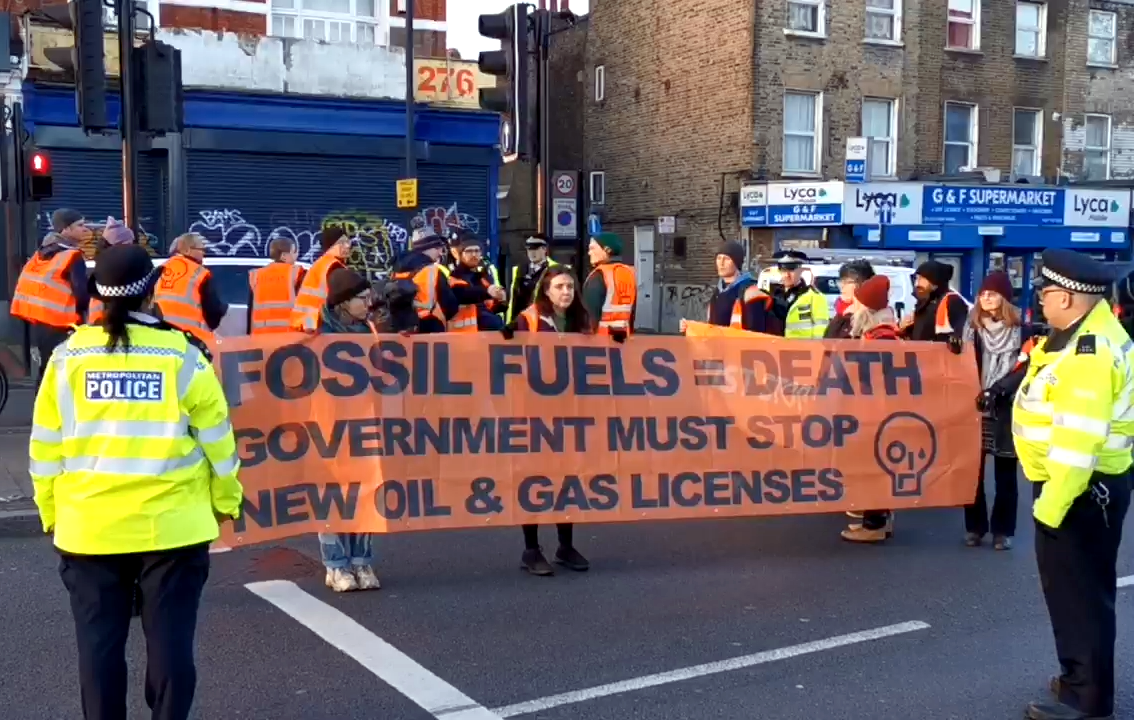
dizzy: Moving away from fossil fuels is the appropriate way to address the climate crisis. Anything else is not addressing the problem.In the UK that’s no more oil or gas licences and stopping Rosebank i.e no new fossil fuels.
I’m not concerned with the headline topic but Miliband makes claims that need to be fact checked:
“If every country in the world adopted Labour’s position [on deciding not to issue new oil and gas licences] it would have a transformative effect on the debate,” he said.
Is it Labour’s position not to issue new oil and gas licences? If it is, are they likely to abandon that position since the Labour Party seems to abandon every policy to be more Tory? Why position instead of policy? Because position can be abandoned easier?
Miliband said the party’s plans to ban new oil and gas licences are “the most progressive position of any major country in the world” but that the transition in the North Sea has to be properly managed to protect those working in existing fields.
So, it’s already qualified by Miliband in the very next paragraph? “… the transition in the North Sea has to be properly managed to protect those working in existing fields.” sounds like you and the Labour party are full of shit Ed.
later edit: What about Rosebank? Are the Labour party going to stop Rosebank? The Labour party are definately full of shit on climate if they’re going to let Rosebank continue.
Rishi Sunak on stopping Rosebank says that any chancellor can stop his huge 91% subsidy to build Rosebank, that Keir Starmer is as bad as him for sucking up to Murdoch and other plutocrats and that we (the plebs) need to get organised to elect MPs that will stop Rosebank.
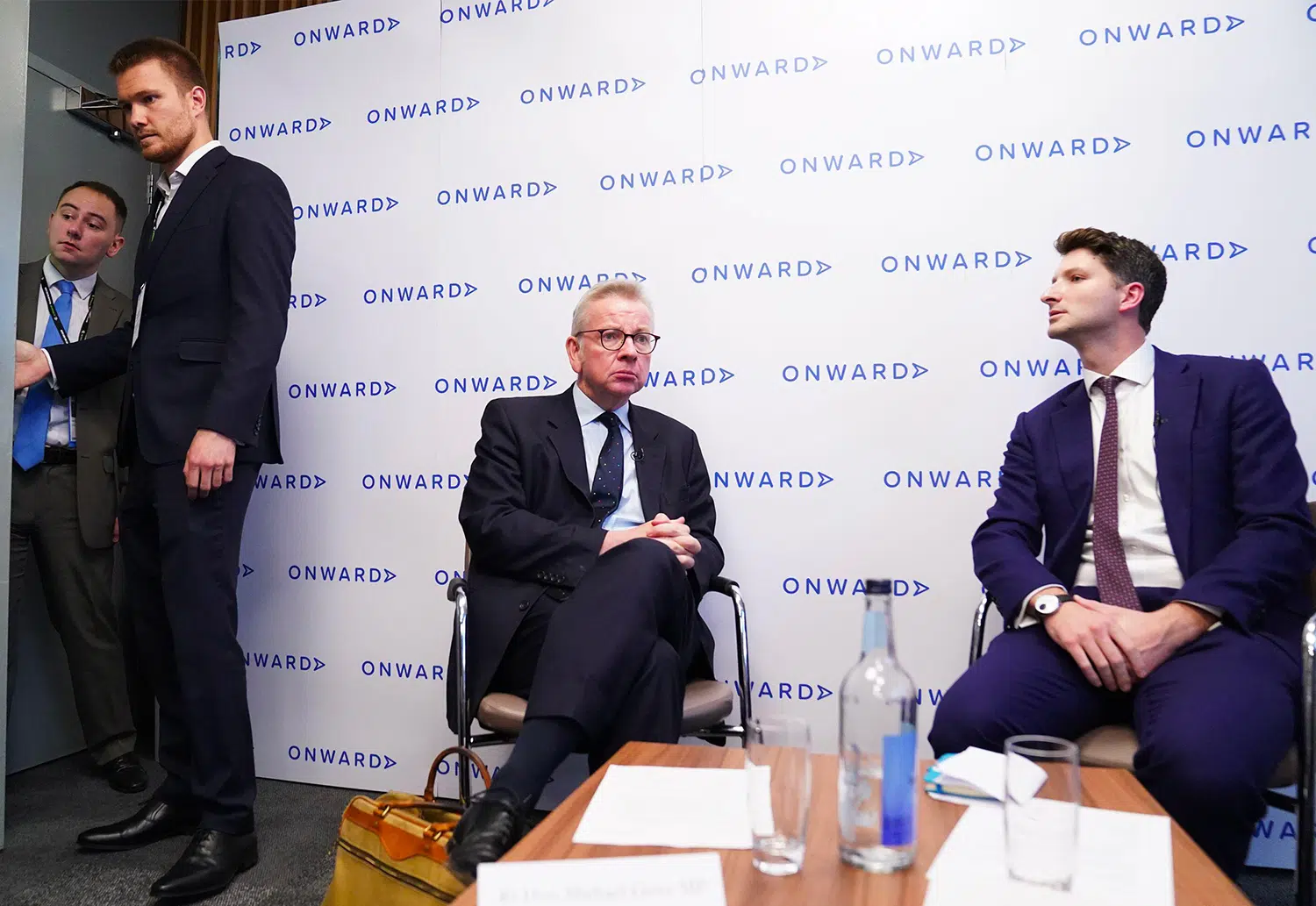
An Onward event at the 2022 Conservative Party conference featuring Cabinet minister Michael Gove. Credit: PA Images / Alamy
Ministers met with Onward, accused of being “a fossil fuel dinosaur in new clothing”, more than any other think tank last year.
An oil and gas funded group had the most registered meetings with government ministers among all think tanks last year, DeSmog can reveal.
Onward describes itself as a think tank bringing “bold and practical ideas for the centre right”. Since its launch in 2018 it has gone through a meteoric rise, quickly becoming one of Westminster’s most influential think tanks.
DeSmog analysed the meetings of every government department in 2023 and found that ministers met with the group on 17 occasions across the year, an average of well over once a month and more than any other think tank.
Onward doesn’t disclose full details of its funding but unlike many think tanks it publicly shares the list of organisations that have donated “more than £5,000 twice a year” to the group.
Its list of funders in the first half of 2023 included several oil and gas giants, including Shell, BP, and Equinor. These three companies are also listed as members of Onward’s ‘Business Network’, which is open to those who donate £12,000 a year. In exchange, Onward says that it offers its members quarterly “invitations to private roundtables with senior policymakers and opinion formers”.
Onward offers other perks to its Business Network members, including the opportunity to see its reports before they are published, though it insists that donors are precluded from influencing the contents of its publications.
In the second half of the year, Onward also received funding from Lord Michael Spencer, a Tory mega-donor and former party treasurer who holds shares in oil and gas companies.
Onward’s corporate supporters included Drax, the UK’s largest single source of CO2 emissions. Drax is the operator of a major wood pellet burning power station in Yorkshire that receives billions of pounds in government environmental subsidies despite producing millions of tonnes of carbon emissions a year while burning trees from historic woodlands.
“Onward might sound progressive, but it looks suspiciously like a fossil fuel dinosaur in new clothing,” Green Party co-leader Carla Denyer told DeSmog.
“With so much fossil fuel money oiling the wheels of Westminster it is small wonder the Tories are maxing out oil and gas licences and have granted approval for Rosebank, the largest undeveloped oilfield in the North Sea.
“It’s time to break the links between government and fossil fuel funded think tanks and engage instead in a bit of blue sky thinking.”
Onward’s meetings in 2023 included two with ministers from the Department for Energy Security and Net Zero (DESNZ), which is responsible for the government’s climate policies.
One of those meetings, held in June with Net Zero Minister Andrew Bowie, was to discuss the role of hydrogen in the transition to net zero.
Though it’s widely acknowledged that hydrogen will have a role in decarbonising some industrial processes, it has become the subject of growing controversy. Experts have warned that exaggerating the potential of the technology risks delaying climate action by distracting from the transition to renewable energies. Hydrogen is favoured by gas companies, as it is often made using natural gas and deploys existing infrastructure.
As a result, hydrogen continues to be the subject of a major lobbying effort in Westminster.
Vested interests, including oil and gas companies, have spent hundreds of thousands of pounds in recent years sponsoring political party conferences and parliamentary advocacy groups, advocating for the role of hydrogen in the clean energy transition.
UK gas infrastructure operator National Gas hosted an Onward event at the 2023 Conservative conference on the UK’s “need” for hydrogen, entitled “Gassed up”.
An Onward spokesperson said that as a not-for-profit organisation the group relies “entirely on the generosity of our network to support our research programme”, which allows the group to “routinely meet and share our research with government and shadow ministers”.
They stressed that they “do not take commissions from companies or government for specific pieces of research” giving the group “complete editorial control over our priorities and conclusions”.
Onward and Tufton Street
Onward is currently led by former Financial Times journalist Sebastian Payne, who is attempting to become a Conservative parliamentary candidate.
The think tank’s advisory board and board of directors are manned by Conservative MPs and peers, former Conservative Party treasurers, and business figures. Current Net Zero Secretary Claire Coutinho was a member of the Onward advisory board prior to her appointment to the Cabinet.
When Rishi Sunak became prime minister in October 2022, it was reported that Onward alumni had taken up several advisory posts in his government – the second highest number of any think tank. Sunak’s deputy chief of staff Will Tanner, who leads on policy, is the co-founder and former director of Onward.
Onward alumni were only outnumbered by former staff members of Policy Exchange, a right-wing think tank that formerly employed Sunak. Policy Exchange has received funding from fossil fuel giant ExxonMobil, and has been credited by Sunak for helping to draft laws that have cracked down on climate protests. DeSmog has also revealed that Shell and BP were allowed “ample opportunity” to shape a Policy Exchange report on carbon taxes that was later endorsed by Sunak’s government.
Over the last year, the prime minister has also overseen a row-back of several key climate pledges. In July, Sunak confirmed that his government planned to issue hundreds of new oil and gas licences, a move condemned by opposition MPs and charities. Oxfam’s climate policy adviser Lyndsay Walsh said the move “will send a wrecking ball through the UK’s climate commitments”.
Sunak has said his government intends to “max out” the UK’s oil and gas reserves, and has legislated to introduce annual North Sea licensing rounds. This is despite the International Energy Agency stating that new fossil fuel exploration is “incompatible” with the Paris Agreement target of limiting global heating to 1.5C.
Regulators also approved government plans for the development of the controversial Rosebank oil field, operated by Equinor, even though the project has been dubbed a “carbon bomb” by environmental law charity ClientEarth.
In September, the government scrapped a number of net zero pledges, including pushing back a ban on the sale of combustion engine vehicles, and weakening plans to phase out gas boilers.
Sunak’s predecessor Liz Truss had close ties to a number of “free market” think tanks based in and around 55 Tufton Street, Westminster. This included the Institute for Economic Affairs (IEA), a think tank that was funded by BP for at least 50 years. Former IEA director general Mark Littlewood said that Truss had spoken at IEA events more than “any other politician over the past 12 years”, and the pair have now launched the group Popular Conservatism to lobby for more libertarian policies.
DeSmog found that the IEA met with ministers on nine occasions in 2023, almost half as many as Onward.
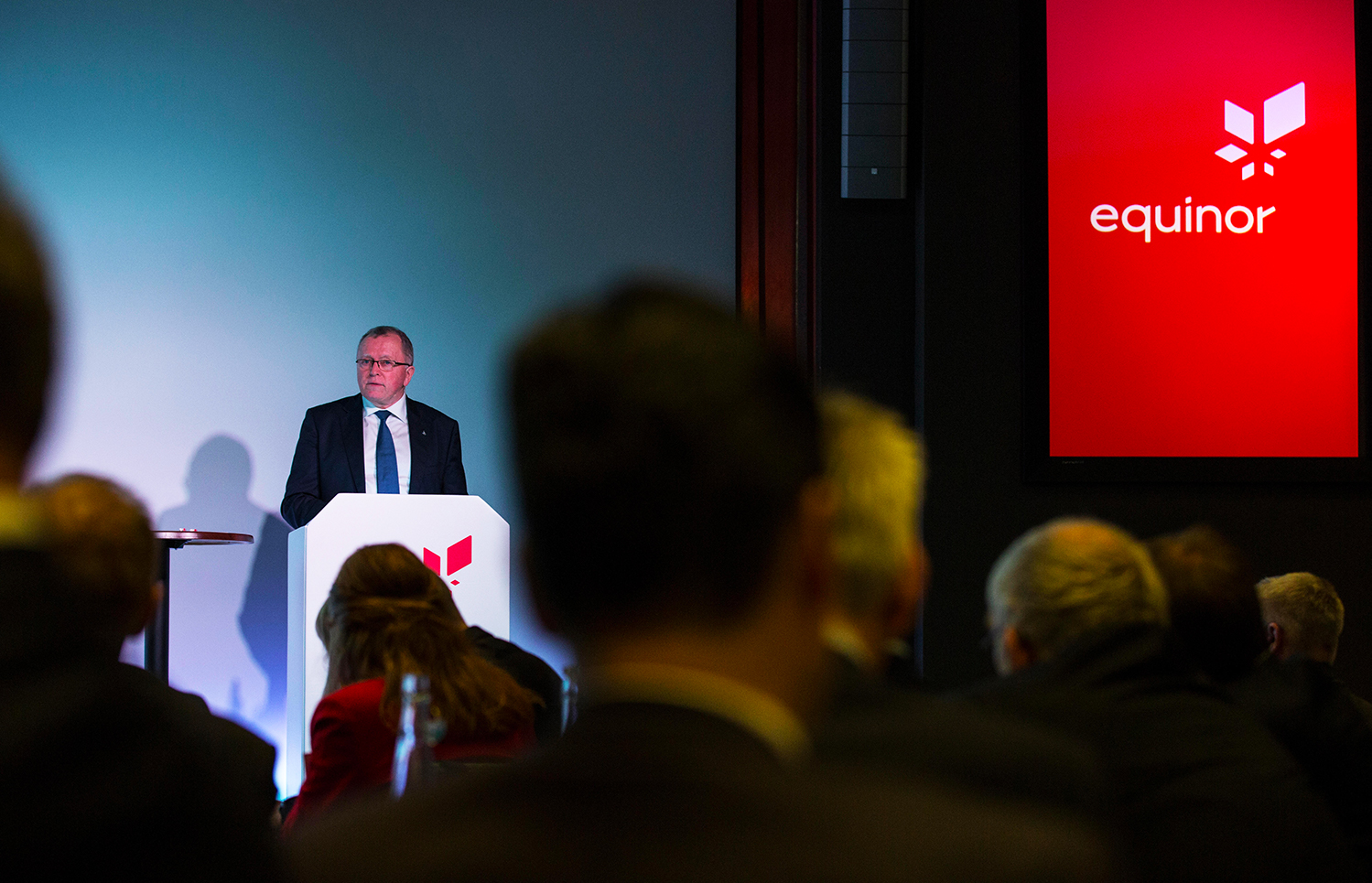
Eldar Saetre, CEO of Equinor. Credit: Jeff Gilbert / Alamy
Campaigners likened the fossil fuel company’s patronage of climate events to letting an “arsonist sponsor a fire safety conference”.
Major media companies have sparked a wave of criticism after allowing a Norwegian oil and gas company behind the UK’s largest new North Sea project to sponsor events on climate change.
Equinor was an official sponsor of two conferences on climate and energy this week, one run by the New Statesman magazine, and one run by Politico. Both saw MPs pull out over the sponsorship, while the first was interrupted by a climate activist.
The Norwegian state-owned company has a majority stake in the Rosebank North Sea oil field, which has been dubbed a “carbon bomb” by environmental law charity ClientEarth.
Equinor claims it supplies 27 percent of the UK’s energy from oil and gas, and is currently investing $6 billion (£4.8 billion) a year in fossil fuel exploration and drilling.
“Allowing fossil fuel companies like Equinor to sponsor and speak at climate conferences is as absurd as allowing an arsonist to sponsor and participate in fire safety conferences,” said Carys Boughton of the Fossil Free Parliament campaign. “At this critical time for climate and energy policy-making, we can’t afford this absurdity.”
Equinor’s sponsorship of these events is the latest example of fossil fuel companies using media partnerships to greenwash their polluting activities.
An investigation by DeSmog and Drilled in December detailed how oil and gas companies are using media deals – including partnerships with Politico, the Economist, the Financial Times, Reuters, and the Washington Post – to present a climate-friendly image.
DeSmog also revealed this week, based on documents released by a powerful U.S. congressional committee, that fossil fuel companies believe these media partnerships help to protect their “social licence to operate”.
Michelle Amazeen, a mass communications researcher at Boston University, said that oil and gas sponsorship is “a strategic move by fossil fuel companies to compromise the integrity of events intended to foster dialogue and action around climate issues”.
She added that, “While the sponsorship gives the impression of caring about the environment, it’s a veneer that’s like an oil slick obscuring the actual conduct of the fossil fuel industry.”
This week, a cross-party group of 50 MPs, including three Conservatives, wrote to Prime Minister Rishi Sunak urging him to end the licensing of new oil and gas fields, appoint a climate envoy, and back the Beyond Oil and Gas Alliance, an international coalition working to facilitate a global phase-out of oil and gas production.
Alice Baxter, Equinor’s UK spokesperson, said: “At Equinor we believe in openness and the importance of engaging in the complex conversations around the energy transition. We respect everyone’s right to protest and encourage robust debate.”
New Statesman Event
Equinor was one of the sponsors of the New Statesman’s Energy and Climate Change Conference on 14 May at the Leonardo Royal Hotel in south London.
Green Party MP Caroline Lucas pulled out of the event last week due to Equinor’s sponsorship.
Was due to speak at @NewStatesman conference on Energy & Climate Change. Then it turns out it's sponsored by @Equinor_UK – the company backing giant Rosebank oil field. That's me out. #StopRosebank
At the event, attended by DeSmog, the second panel discussion featured Equinor’s UK country manager Alex Grant. The session was entitled “How can the UK lead the world in the green transition?”
When it was Grant’s turn to speak, a Fossil Free London activist in the audience stood up and gave a speech criticising Equinor and its sponsorship of the event.
The activist said climate scientists “are warning us that we are headed towards a catastrophic 2.5C of global warming. Yet staggeringly, Equinor, that’s sponsoring this event, is opening the largest undeveloped oil field in the North Sea.”
Labour MP Meg Hillier, who chairs the Public Accounts Committee and was on the panel, interjected: “Why don’t you let us talk about it, because I’m actually here to be pretty critical of the government, I’d quite like to get my points across.”
The protester continued her speech, and was removed by security. Her comments received a round of applause from the audience.
Grant replied by saying that Equinor takes a “pragmatic approach” to the energy transition, as opposed to one that “costs more than it needs to”. He also defended the Rosebank project, saying it would reduce carbon emissions over the long term.
Rosebank could produce around 300 million barrels of oil over its lifetime, emitting 200 million tonnes of carbon dioxide.
Questions at the New Statesman event were submitted online, rather than asked in person by the audience.
During the event’s final session with Chris Stark, the former chief executive of the Climate Change Committee, which advises the government on its climate policies, DeSmog submitted a question about Equinor and Rosebank’s impact on the climate. The question was not posed to the panel.
The latest issue of the New Statesman magazine, which features an interview with climate scientist and author Michael Mann, includes advertorials from biomass company Drax, which is the UK’s largest single source of CO2 emissions, and Calor Gas, one of the UK’s largest suppliers of liquefied petroleum gas.
The New Statesman hosted a number of events at the 2023 Labour Party conference sponsored by fossil fuel companies and lobbying groups, including Cadent, National Gas, and Offshore Energies UK.
The New Statesman did not respond to DeSmog’s request for comment.
Politico Event
On 16 May, Politico held its own Energy and Climate Summit, also sponsored by Equinor.
Labour MP Alex Sobel, who chairs the All-Party Parliamentary Group on Net Zero, last week pulled out of the event due to Equinor’s sponsorship.
I have decided to withdraw from the Politico Energy and Climate Summit next week, due to the involvement of Equinor. It was unclear that they were sponsors and I would not have accepted the invitation had their sponsorship been known.
— Alex Sobel MP for Leeds Central and Headingley (@alexsobel) May 8, 2024
At the event, attended by DeSmog, a panel on Carbon Capture and Storage (CCS) featured David Cairns, a former British ambassador to Sweden and now Equinor’s vice president of political and public affairs.
When questioned by the Politico chair, Cairns confirmed that the company had no plans to set targets for phasing out oil and gas.
He also said it was “debatable” whether the oil and gas industry was making large profits. Equinor reported £28 billion in profits in 2023. Cairns added that it was “really misplaced” to think that the oil and gas industry is an “easy business in which it’s easy to make money”.
A Politico spokesperson said: “This multi-sponsored Energy and Climate UK Summit is an extension of Politico’s ongoing and robust coverage of climate policy in the United Kingdom.
“There is a clear division between Politico’s newsroom and our commercial operations. With critical milestones and a general election on the horizon, we continue to cover climate each day through our dedicated reporting.”
Politico’s influential London Playbook newsletter has this week been sponsored by the oil and gas giant BP.
Michelle Amazeen said that fossil fuel sponsorship of media companies “has delegitimised their journalistic content, opened their journalists up for attack, and has even led to the resignation of journalists who are trying to write about climate issues”.
Equinor’s AGM
Equinor also faced further public criticism this week, when on Tuesday the company was confronted by a climate activist at its annual general meeting (AGM).
Lauren MacDonald of the environmental group Uplift delivered a four minute speech about the company’s impact on the planet, and promised that campaigners would not stop opposing Rosebank or the company’s other fossil fuel projects.
I just confronted the CEO of @equinor and it’s majority shareholder, the Norwegian government, at their AGM.
The people in this room are responsible for the UK’s biggest undeveloped oil field – Rosebank.
— Lauren MacDonald🌻 #StopRosebank (@laurensunfl0wer) May 14, 2024
At the meeting, shareholders rejected a resolution calling on the company to align its strategy and spending with climate goals.
“We invest in the energy the world needs now. That is oil and gas,” Equinor’s chief executive Anders Opedal said.
Tessa Khan, executive director at Uplift, told DeSmog: “Try as it might, Equinor can no longer ignore the scale of opposition to its climate-wrecking business model – it’s not just campaigners who are calling out its harmful mission, it’s also politicians pulling out of Equinor-sponsored events and shareholders demanding it ditch its plans of endless oil and gas expansion.
“Even if Equinor wants to stay silent, these demands for accountability will only get louder. Governments in the UK and Norway – who can’t afford to ignore this chorus of voices – must reject Equinor’s delay tactics and insist that their activities don’t further endanger our climate. As a first step, this means rejecting new oil and gas fields, and pulling the plug on disastrous projects like Rosebank.”
All-Energy and Dcarbonise
Equinor was not the only fossil fuel company to sponsor climate events this week.
On Wednesday, climate protesters disrupted the All-Energy and Dcarbonise event in Glasgow, which describes itself as “The meeting place for the renewable and low carbon energy community”, yet featured paid exhibitions from oil and gas majors BP and Shell.
Protesters from Stop Polluting Politics, and Fuel Poverty Action interrupted a speech by Scotland’s Net Zero and Energy Secretary Màiri McAllan, and a pre-recorded video of UK Energy and Net Zero Secretary Claire Coutinho. Both appeared alongside Louise Kingham, a senior vice president at BP.
“As the lethal reality of climate breakdown becomes unmissable, the PR strategies of big fossil fuel companies like Equinor and Shell reveal their growing isolation, and an increasingly desperate attempt to buy friends,” said Andrew Simms, a director of the New Weather Institute and a co-founder of the Badvertising campaign.
“They are the unwelcome guests at the party with everyone waiting for them to leave, but who keep buying rounds for anyone willing to drink with them in order to stay.”
Rishi Sunak on stopping Rosebank says that any chancellor can stop his huge 91% subsidy to build Rosebank, that Keir Starmer is as bad as him for sucking up to Murdoch and other plutocrats and that we (the plebs) need to get organised to elect MPs that will stop Rosebank.Image of InBedWithBigOil by Not Here To Be Liked + Hex Prints from Just Stop Oil’s You May Find Yourself… art auction. Featuring Rishi Sunak, Fossil Fuels and Rupert Murdoch.
Rishi Sunak on stopping Rosebank says that any chancellor can stop his huge 91% subsidy to build Rosebank, that Keir Starmer is as bad as him for sucking up to Murdoch and other plutocrats and that we (the plebs) need to get organised to elect MPs that will stop Rosebank.