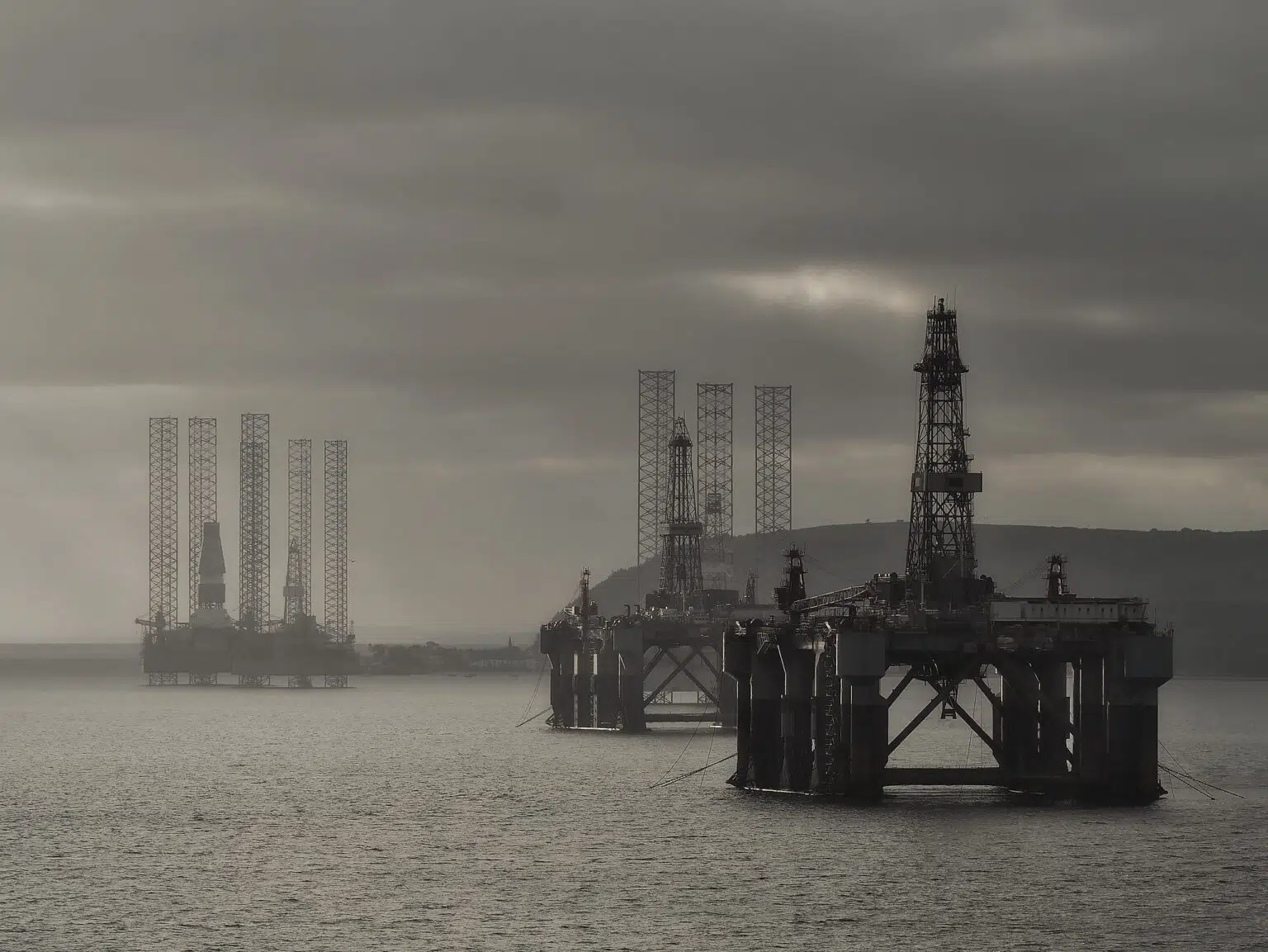
The UK government is facing two separate legal challenges over its approval of the massive Rosebank oil project in the North Sea.
Both Greenpeace UK and climate group Uplift argue the approval of the oil field breaks the Government’s net zero pledges and fails to acknowledge the project’s environmental harm and emissions impact.
Uplift claims the Energy Secretary failed to prove how the oil field was consistent with the UK’s legally binding net zero emissions target and argues, the government did not provide a good enough assessment of the environmental impact of Rosebank on marine life.
In Greenpeace UK’s application, it argues the Environmental Impact Assessment used to approve the oil field did not consider downstream emissions, and is therefore invalid. The campaign group also argues that there is no evidence Scottish Ministers were consulted on the impacts of Rosebank, which it claims breaches Conservation of Offshore Marine Habitats and Species Regulations.
Greenpeace also argue oil contamination could affect whales and wild birds, while the drilling and cable laying under the sea could destroy habitats for species that live on the seabed.
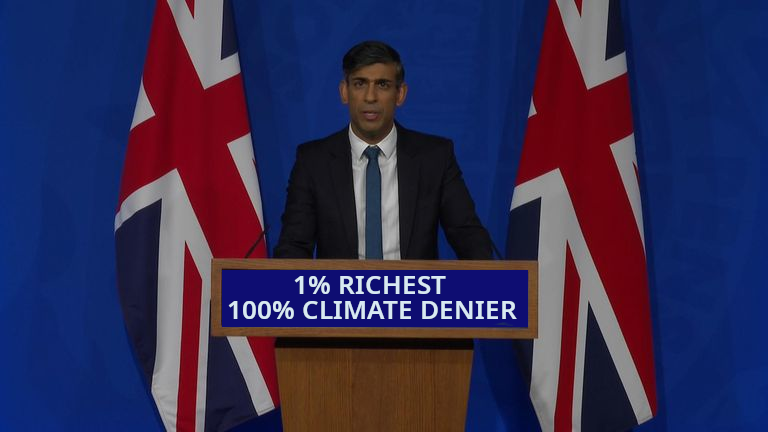
Rishi Sunak gave the go-ahead for the controversial undeveloped oil field in September, set to be the UK’s largest untapped oil field containing an estimated 500 million barrels of oil. With Norwegian owner Equinor set to receive £3 billion in tax breaks.
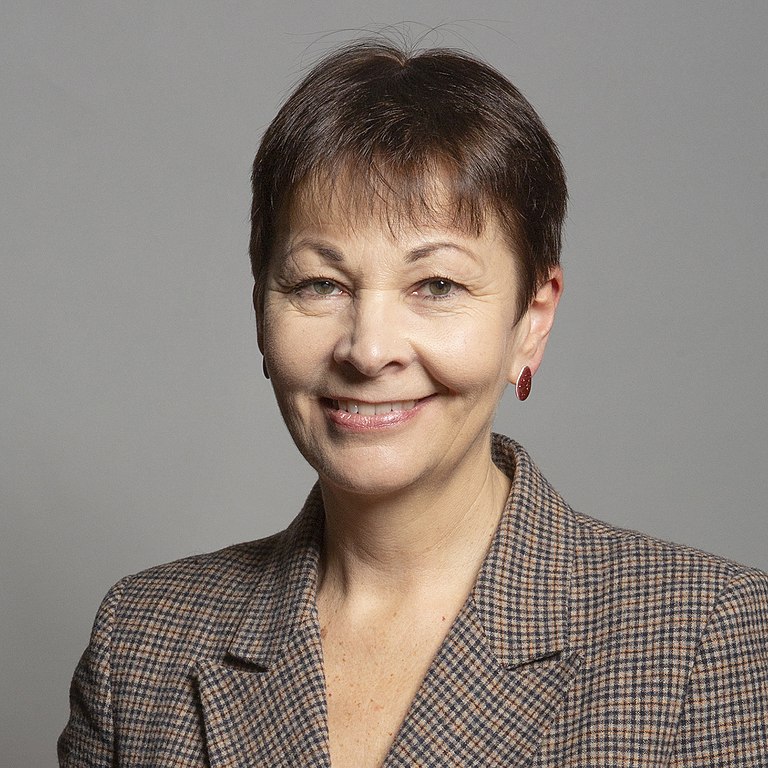
Left Foot Forward has an exclusive with Caroline Lucas. She is set to resign as an MP at the next general election.
Caroline Lucas Green Party MP for Brighton Pavilion. Official image by David Woolfall Creative Commons Attribution 3.0 Unported license.
…
While she is unsurprisingly damning about the prime ministers who have been in office over her 13 years in the House of Commons, Lucas has had to work closely with MPs from other parties. By virtue of being the only MP for her party, working cross-party has been central to much of her work. As a result, she offers strong praise for MPs on the opposition benches who she has worked with over the years.
She tells Left Foot Forward: “I work really closely with people like Nadia Whittome and Clive Lewis on the Green New Deal, and we have an all party group on the Green New Deal and we work very closely together on that. I enjoy working with Barry Gardiner actually on the Environmental Audit Committee just because he’s such a terrier when it comes to cross-questioning ministers. From the Liberal Democrats I work very closely with Wera Hobhouse on environmental issues, green issues. Plaid [Cymru] are very good on social issues and I’m probably closest to them of all the parties in Westminster.”
However, such praise is definitely absent from her assessment of the likely next prime minister – the Labour leader Keir Starmer. She starts by acknowledging that she and the Green Party would “prefer to see a Labour government than a Tory government”, but goes on to ask “what kind of Labour government” we are likely to get.
“I think there are real concerns over the U-turns that Keir Starmer has been performing – whether that is on what was originally a £28 billion commitment for green investment, he was going to scrap tuition fees, things like the two child benefit cap which is a really, really obscene policy and his own frontbench have said its obscene yet he has now said that he is not going to reverse that.
“He’s better on oil and gas to the extent that he’s said he won’t give licenses to new oil and gas. But then there’s a totally incoherent position of saying that he will allow Rosebank to go ahead. Whereas if he had said were he to get into government he would have tried to roll back that decision it would never have been taken in the first place, because the signal that would have given to Equinor, the Norwegian investor who is going to go ahead with Rosebank would have thought twice. So on oil and gas, there’s a problem there.”
Lucas says that on the economy and other issues, Starmer is operating with a “lack of ambition” which is “so desperately disappointing because he seems to think that if he just plays it incredibly safe, then he can tip-toe into Downing Street”, before going on to say “I think he needs to worry as well about the number of people he simply won’t be inspiring to get off their chairs and down to the polling station at all – and right now it is incredibly hard to say what Keir Starmer stands for”.
Given that Lucas spoke to Left Foot Forward the day after the major vote in parliament on whether the government should call for a ceasefire in Gaza, she also criticises Labour for failing to vote to support a ceasefire. “I think it was incredibly disappointing that Labour is on the wrong side of history on this”, she says.
New areas for oil and gas development on the UK’s North Sea continental shelf are to be made available through annual licensing rounds subject to net zero tests. These proposals by the UK government, outlined in the 2023 king’s speech to parliament, fly in the face of recommendations by the Climate Change Committee – the government’s own independent advisers.
The move should not be summarily dismissed as “political posturing” ahead of a general election, however. It may cause significant damage, not least because it distracts from critical questions surrounding how the UK will transition to low carbon energy.
Licences, under the 1998 Petroleum Act, are how the UK government grants companies exclusive rights “to search and bore for, and get, petroleum”. Companies are invited to bid for access to areas on the UK continental shelf which are pre-selected by the regulator (in consultation with industry).
The government plans to introduce a bill aimed at granting new oil and gas drilling licences in the North Sea. Henk Honing/Shutterstock
Wrong answer, wrong question
The licensing system in place has arguably done the job of allocating access to the UK’s oil and gas. What’s questionable is whether, considering the climate emergency, annual licensing rounds will revive interest in what has long been a declining basin.
Handing out licences on its own is insufficient to attract investment. There is growing recognition among financial analysts of the risks of stranded assets in oil and gas. Shell’s withdrawal from the Cambo oil field northwest of Shetland in 2021 showed licence holders are willing to withhold their final investment decision if deemed economic or politically expedient.
The government’s focus on new licences is a red herring, as the bulk of remaining resources are in areas that are already licensed. It will be regulatory approval of field development plans, via a process known as consents, that will allow these existing licences to actually start producing oil or gas.
The recent decision to approve Rosebank (an oil field first licensed in 2001) is a case in point.
Annual licensing rounds will not ensure the UK’s energy security either. Recent licensing rounds have yielded relatively small volumes of gas that do not substantially add to UK reserves. Any oil and gas developed as a consequence of new licences is unlikely to come to market quickly and will be sold at international market prices. Producing oil and gas domestically has not insulated the UK from high prices.
The energy secretary, Claire Coutinho, has acknowledged that UK production “wouldn’t necessarily bring energy bills down”. The Skidmore Review of the UK’s net zero plans and the Climate Change Committee have made clear that the most effective method of helping households afford energy is to “cut fossil fuel consumption … improving energy efficiency, shifting to a renewables-based power system and electrifying end uses in transport, industry and heating”.
Offshore workers need training and support to transition to green jobs. Kichigin/Shutterstock
The government’s claim that two new “tests” will ensure the compatibility of new licences with the government’s net zero goal, too, does not bear scrutiny.
The first, whether oil and gas imports are projected to be larger than domestic production, is a very weak test as it captures the UK’s default position and will lock in dependence on fossil fuels rather than accelerate the transition.
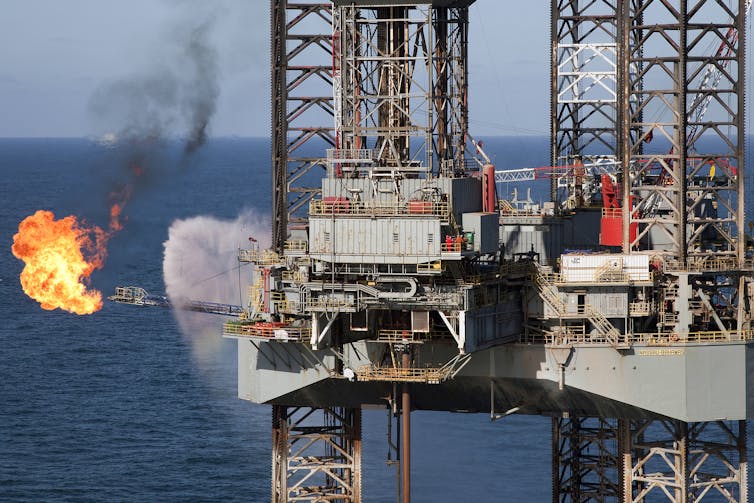
The second, “that the carbon emissions associated with the production of UK gas [must be] lower than the equivalent emissions from imported liquefied natural gas (LNG)”, ignores the emissions associated with burning gas (known as scope 3 under the international accounting protocol for greenhouse gases).
These scope 3 emissions account for 65%-85% of the total emissions and are often omitted from statements about the lower carbon content of UK gas. Instead of comparing the carbon footprint of UK gas with imported LNG, pipeline gas from Norway would be a more appropriate (and lower-carbon) comparison.
In any case, the UK oil and gas industry’s targets for decarbonisation set out in the North Sea transition deal signed in 2021 have been criticised by the Climate Change Committee as insufficiently ambitious.
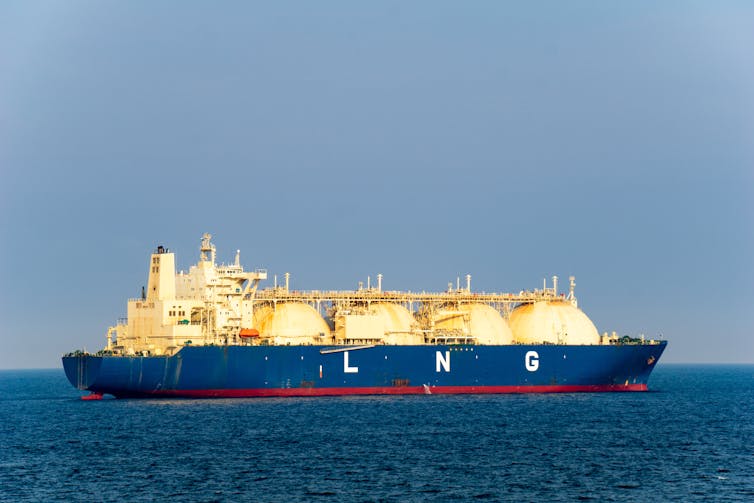
The government plan proposes the carbon emissions of producing UK gas be compared with those of imported LNG. The Mariner 4291/Shutterstock
The prominence of oil and gas licensing in the government’s legislative plans is striking. Fossil fuel licensing is a potent political symbol, and not only for campaigners who have worked for years to get licensing onto the agenda. Sunak and Starmer are now harnessing that symbolism for political ends.
A fixation on new licensing, however, is a distraction. It offers comfort in the possibility of conserving oil and gas production through developing new fields, rather than grasping the challenge of a rapid transition.
It leaves untouched the pressing issue of how to phase down oil and gas production from existing licences in a just and equitable way. It deflects from the enormous challenge of decommissioning offshore infrastructures, and the questions that need to be asked about what the North Sea is for and how it can sustain our collective future.
Don’t have time to read about climate change as much as you’d like?
The influential Conservative-linked Centre for Policy Studies (CPS) has been pushing for further North Sea oil and gas drilling while several of its board members hold financial interests in the industry, a DeSmog investigation has found.
The news follows the government’s approval of the major Rosebank oilfield and the issuing of new North Sea licences, which the government intends to turn into a mandatory annual process, as announced in this week’s King’s Speech.
Five of the think tank’s board have financial interests in North Sea oil and gas, including its chair Lord Spencer, a major Conservative Party donor whose exploration company is bidding for licences in the current round.
The think tank, which is based at 57 Tufton Street in Westminster, meets regularly with ministers. It has called for new oil and gas projects to be accelerated, labelled the windfall tax on energy companies a “terrible idea”, and argued for a more generous fiscal environment for the UK’s fossil fuel producers.
Prime Minister Rishi Sunak is quoted on the organisation’s website as saying that “Lots of exciting ideas are being generated at the CPS… many of which are finding their way into government.”
Tessa Khan, executive director of climate group Uplift, said the findings were an example of how some think tanks have “long been little more than lobbying vehicles for private interests, including oil and gas”. The CPS denies that it is a lobbying group.
Khan added that organisations like the CPS “amplify the voices” of the oil and gas industry.
“This maybe goes some way to explaining why this government is set on subsidising new oil and gas fields when they represent such a bad deal for the public, in that they won’t lower bills, won’t increase energy security but will make the climate crisis worse,” she said.
Nature broadcaster Chris Packham, who is threatening to take the government to court over its recent watering down of climate measures, said: “Just weeks after we learn that not a single new offshore wind project will be going ahead this year due to the government’s intransigence – and as Rishi Sunak tears up vital climate policies – these findings are shocking.
“They provide further evidence that Number 10’s fossil fuel agenda is far from accidental. There are powerful vested interests at work and the Centre for Policy Studies seems to be at the heart of it. The government’s plan to hand out more than a hundred new North Sea drilling licences in the coming months is looking grubbier than ever.”
DeSmog previously revealed that the Conservative Party received £3.5 million from fossil fuel interests in 2022, including from the North Sea industry. This week, DeSmog also revealed that the government watered down its windfall tax on the excess profits of energy firms after a lobbying blitz by the oil and gas industry.
When asked about its board members’ business interests, a CPS spokesperson said that the think tank is “grateful for all our supporters, especially the support of our board members, but the investments of other boards on which they sit have no bearing on their relationship with the CPS”.
They claimed that DeSmog was “cherry-picking in order to manufacture an incorrect picture of the CPS’s position” and that it was “misleading and below journalistic standards.”
They added that “the Centre for Policy Studies has been one of the most prominent champions of free-market environmentalism, with a dedicated workstream on net zero” and that “Where our work is sponsored, this is made clear in the report acknowledgments, in press releases, and in event invitations.”
The North Sea Transition Authority (NSTA), the regulator in charge of issuing drilling licences, said that oil and gas were “forecast to play an important role in the energy mix for decades to come”. A spokesperson said the NSTA was “pleased” with the number of applications received in the current oil and gas licensing round and that the process of assessing them was “progressing well”.
The Department for Energy Security and Net Zero declined to add any further comment.
At the end of September, the International Energy Agency, of which the UK is a member, released a report reiterating the need for a phaseout of fossil fuels if climate goals are to be met.
Lord Deben, the recently retired chair of the UK’s Climate Change Committee, which advises the government, argued in August that the government should stop approving North Sea licences.
Deltic Energy
Lord Spencer, who has chaired the CPS since the start of 2020, is the largest shareholder of Deltic Energy, which holds stakes in 18 North Sea areas, known as blocks, according to NSTA data.
A former Conservative Party treasurer, Spencer was given a life peerage by Boris Johnson. Official data shows that he has donated more than £7.5 million to the Conservative Party, individual Tory politicians and officially affiliated groups since 2015. He also sits on the board of the party’s multi-million-pound endowment fund. DeSmog revealed earlier this year that many of its directors have significant fossil fuel interests.
Through his holding company, IPGL, Spencer owns a £17.5 million stake in Deltic, according to Refinitiv data – nearly a fifth of the firm. He has held a significant shareholding since at least 2018, and bought more shares in 2019 from its founder Algy Cluff, a pioneer of the original North Sea oil boom in the 1970s who himself later joined the CPS board.
Responding to an enquiry from DeSmog, Cluff said that although the value of the company “may have increased in the view of management”, the stock market is “unimpressed and very much aware of the risks associated with any oil investments nowadays”. He described the “small number” of options he holds in the company as “presently worthless”.
Cluff has nevertheless spoken of the North Sea’s “second coming”, claiming that there is “a lot more oil to be found” and a “huge amount of gas”.
Deltic has made significant discoveries in recent years, touting its “enviable reputation as proven hydrocarbon finders” on its website, and has seen its market value rise in tandem.
It won blocks in North Sea licensing rounds in both 2018 and 2020, with the former is said to represent an area the “size of Bedfordshire”.
In its latest annual report, for the 2022 calendar year, Deltic criticises the government’s windfall tax but praises its accompanying investment allowance, which provides North Sea companies with tax breaks to encourage investment.
A presentation it gave investors in March describes its strategy as “Identify. Explore. Monetise. Repeat.” It says the investment allowance “significantly enhances economics from investment in Deltic exploration”, touts controversial gas-derived “blue hydrogen” as environmentally friendly, and highlights “established export infrastructure” and “regular licensing rounds” as attractive features of the North Sea.
Deltic is chaired by Mark Lappin, a former technical director of fracking company Cuadrilla who has publicly called for more oil and gas production, criticising opposition to new drilling.
Lord Spencer’s Conservative donations, made either personally or through IPGL and ICAP, include £25,000 gifts to the 2022 leadership campaigns of Sunak, Liz Truss, and Penny Mordaunt.
Spencer made £20,000 donations to Johnson, Jeremy Hunt, Michael Gove and Sajid Javid in 2019, and has made smaller donations to numerous other leading figures within the party in recent years, including Kwasi Kwarteng, Dominic Raab, Theresa May, Brandon Lewis, and Andrew Griffith.
Spencer has also funded “Blue Collar Conservatism”, a large caucus of Conservative MPs working to “champion working people”, with donations totalling £25,000 in 2019 and 2020. The group has campaigned against fuel duty rises.
Spencer’s Other Fossil Fuel Interests
Lord Spencer has also publicly talked up the fossil fuel industry, telling LBC’s Nick Ferrari last September that the UK “sadly has opposed further investment in North Sea oil and gas”. During the interview, he praised then Prime Minister Liz Truss for speaking out against windfall taxes on the sector, calling them “not Tory policy” and “not pro-business”.
He also expressed support for fracking, praised Truss’s “strategy” and “ideology”, and called for investment in renewable energy, but omitted to mention his interests in oil and gas.
In addition to the North Sea, Spencer has various other fossil fuel interests. According to Refinitiv, he holds the second largest stake in Pantheon Resources, a UK company exploring for oil in Alaska that recently hailed a potentially enormous discovery.
His brokerage firm ICAP also includes an oil and gas trading arm. Until December last year, Spencer held shares in Petrofac, an oilfield services firm heavily involved in the North Sea, including the controversial Cambo project.
Spencer’s shareholdings are disclosed to the House of Lords – indicating either a stake worth more than £70,000 or significant control over the company. They include Cluff Energy Africa, described as an “early stage oil prospecting company, seeking licences in Africa (Angola and Sierra Leone)”.
Its founder, Algy Cluff, told DeSmog that they had “wound the company up” because they “found the premium being asked by governments for the right to explore not to be consonant with the rewards”.
Cluff was a director of the CPS between 1995 and 2006, coinciding with the executive directorship of the late Tessa Keswick. Cluff confirmed to DeSmog that Keswick helped him find investors for his North Sea consortium in the 1970s, as has been reported.
Tessa’s husband Henry Keswick, chairman emeritus of the conglomerate Jardine Matheson and a major Tory donor, used to own the influential conservative Spectator magazine and sold it to Cluff in the early 1980s. Cluff was its chairman until 2004, during which Charles Moore, Dominic Lawson, and Boris Johnson were editors.
The magazine was edited in the 1960s by the late Nigel Lawson, who would become Thatcher’s chancellor and in later life promote climate science denial through the Global Warming Policy Foundation, based at 55 Tufton Street.
Cluff’s remaining business interests include Cluff Mineral Resources, an Africa-focused gold and coal exploration company, which was temporarily based at 55 Tufton Street before moving next door to share an address with the CPS.
The Board
Another CPS board member, Lord Strathclyde, is a senior strategic adviser to Hibiscus Petroleum, a Malaysian oil and gas company that has amassed stakes in 11 North Sea blocks in recent years.
Ithaca, the firm behind the high-profile Rosebank and Cambo projects, is partnering with Hibiscus on one of the blocks.
Hibiscus is also one of the firms to have been awarded stakes in the latest round of oil and gas licences.
Strathclyde, who was leader of the House of Lords under David Cameron, is an adviser to oil trading giant Trafigura.
Sir Douglas Flint, chair of Abrdn – formerly, Standard Life Aberdeen – also sits on the CPS board. Abrdn has been targeted by protesters for its investments in oil and gas, which climate researchers Urgewald estimate at £2.9 billion. According to the latest figures, they include oil majors like BP, Shell and Exxon, as well as North Sea-focused firms Serica Energy, Harbour Energy, and EnQuest.
The major asset manager was reportedly one of a group of financial institutions recently summoned by the Treasury to increase investment in the North Sea.
Lord Spencer’s entry in the register of interests indicates he also holds a stake worth more than £70,000 in Abrdn.
Other CPS board members include Jon Moulton, chair of FinnCap, a financial advisory firm whose activities include raising finance for North Sea oil and gas companies, and Roger Orf, a partner at Apollo Global Management, a US private equity firm with £349 million of investments in BP and Shell, both major North Sea players.
Two further CPS board members have wider interests in oil and gas: Ian Molson, deputy chair of Central European Petroleum, which is exploring for oil in Germany and Poland; and major Tory donor Lord Bamford, chair of construction giant JCB, a sector still heavily reliant on fossil fuels.
In April 2023, DeSmog revealed that CPS board members had donated more than £600,000 to the Conservatives since Rishi Sunak became prime minister.
The CPS also leans on its board for funding. According to the group’s latest accounts – for the period up to September 2022 – its directors donated £1 million to the company during the year. Turnover was £650,000 during the year and ‘other operating income’ hit £1.5 million, meaning that the CPS board contributed nearly half (47%) of its income during the period.
North Sea Push
The Centre for Policy Studies has strongly supported new North Sea oil and gas drilling in recent years.
In a March 2022 economic bulletin, it recommended that the government “look at accelerating regulatory approval for upcoming oil and gas projects such as Rosebank [Phase 1], Clair South, Glengorm, Cambo and Bentley [Phase 2]”.
The bulletin added that introducing a windfall tax on profits would be a “terrible idea” and “completely self-defeating”. It welcomed “reports” suggesting the government was planning to launch another licensing round for fossil fuel projects.
A month later, the CPS welcomed the government’s “energy security strategy”, calling the return of annual North Sea licensing rounds “overdue”. A 33rd licensing round was launched in October.
In February this year, one of the CPS’s senior researchers criticised the “punishment beatings inflicted on the North Sea oil and gas industry from George Osborne onwards” – despite the sector having enjoyed one of the most generous tax regimes in the world until the recent windfall tax.
Other articles published on CapX, a commentary website run by the CPS, have labelled the Labour Party’s policy of no new North Sea licences “more than a little nuts” and the SNP’s similar position a “dangerous gambit”.
Andy Mayer, chief operations officer at the BP-funded Institute of Economic Affairs, writes regularly for CapX. He has used the platform to describe opposition to the Rosebank project as “shrill hysteria”, Shell’s bumper profits this year as “brilliant stuff”, and North Sea companies being fined for gas flaring as a “dotty investment message to send”. Following the announcement of the latest North Sea licences, Mayer wrote a story for CapX headlined “Hurrah for new North Sea oil licences!”
CPS Influence
The CPS has significant political access, having conducted private, one-to-one meetings with ministers on 27 occasions since 2014 and attended many other larger ministerial meetings, according to data compiled by Transparency International from government disclosures.
A number of the think tank’s former employees are now working as government advisers and its homepage carries supportive quotes from former prime ministers Liz Truss and Boris Johnson.
Rishi Sunak spoke at a CPS event at the Conservative Party conference in 2019 and wrote a report for the organisation in 2016 backing the roll-out of freeports, which have since been introduced.
The think tank, which was co-founded by Margaret Thatcher, hosted a “dedicated space” at this year’s party conference, with speakers including Jeremy Hunt, Michael Gove, and Grant Shapps.
The chair of Times Newspapers, which publishes The Times and Sunday Times, and the editor of The Spectator,both sit on the CPS board. All of the titles editorially support new North Sea oil and gas.
Richard Sharp, who was forced to resign as chairman of the BBC earlier this year over his connection to a secret £800,000 loan to Boris Johnson, sat on the CPS board for 19 years before joining the BBC in 2021.
The CPS, which does not disclose its funding, has offices on Tufton Street in Westminster, alongside several other “free market” pressure groups and think tanks, including the climate science denying Global Warming Policy Foundation.
Other board members include Rachel Wolf, a co-author alongside CPS Director Robert Colvile of the 2019 Conservative manifesto, which said the “North Sea oil and gas industry has a long future ahead” and supported a deal with the sector that allows for new drilling projects.
Campaigners take part in a Stop Rosebank emergency protest outside the U.K. Government building in Edinburgh, after the controversial Equinor Rosebank North Sea oil field was given the go-ahead Wednesday, September 27, 2023. (Photo: Jane Barlow/PA Images via Getty Images)
ROSEBANK owner Equinor have once again posted billions in profits – to the fury of climate campaigners.
The Norwegian fossil giant – which has the controlling stake in the huge oil field development in the North Sea – posted profits of £6.6 billion for the past three months.
Environmental campaigners said the firm was adding “insult to injury” with its huge profits as parts of Scotland continue to suffer from extreme weather caused by climate breakdown.
Last week, Storm Babet caused flooding that hit towns across north-east Scotland, with some evacuated residents in Angus told they would not be back in their homes by Christmas.
In September, the UK Government gave the green light for the Rosebank development to go ahead, despite fury from campaigners and across the political spectrum.
The field, which lies north-west of Shetland, contains up to 350 million barrels of oil and is expected to be in operation for decades.