Police officers and protesters clash in Trafalgar Square during a March for Palestine in London, October 14, 2023
CAMPAIGNERS celebrated a ”huge victory for democracy” today after the Court of Appeal ruled key anti-protest legislation was forced through unlawfully.
The Home Office had appealed a High Court ruling that struck down laws brought in by the previous Tory government in 2023.
The measures expanded police powers to interfere with protests, lowering the threshold from what is considered “serious disruption” to community life, from “significant” and “prolonged” to “more than minor.”
Civil rights group Liberty challenged the law change, arguing that the measures had been voted down months earlier and that then home secretary Suella Braverman had used secondary legislation, which requires far less parliamentary scrutiny, to implement them.Ms Braverman used so-called “Henry VIII powers” to introduce the laws by clarifying the definition of “serious disruption” under the Public Order Act 1986.
Liberty argued that the broad redefinition of “serious disruption” effectively granted the police “almost unlimited powers to impose conditions on protests.”
The High Court ruled it unlawful last May, but the previous government initiated an appeal, which was continued by Labour after it came to power.
Upholding the ruling today, Lord Justice Underhill, Lord Justice Dingemans and Lord Justice Edis said that ”the term ’serious’ inherently connotes a high threshold … [and] cannot reasonably encompass anything that is merely ‘more than minor’.”
The unnecessarily violent police intervention at a Quaker place of worship is a PR disaster and will only serve to deepen the chasm between them and the public. SYMON HILL reports
THE police raid on a Quaker place of worship last week was not about preventing crime or arresting criminals. It was an attempt to intimidate peaceful protesters. It will not succeed.
At about 7.15pm on Thursday March 27, at least 20 police officers broke down the door of Westminster Quaker Meeting House in St Martin’s Lane in London. They could have just rung the doorbell.
The police, some armed with tasers, charged into a room where the non-violent protest group Youth Demand were holding a welcome talk. Women in their late teens and early twenties were grabbed and handcuffed behind their backs.
They swarmed through the rest of the building, entering every room, including one that had been hired by a life drawing class and even a room where a private counselling session was taking place.
This horrific incident was made possible by the draconian anti-protest laws introduced by the previous Tory government and maintained by their Labour successors. The police reportedly used the Police, Crime, Sentencing and Courts Act as they arrested six women. The youngest was 18.
When the Act was passed in 2022, we were told that the police would use it only in extreme situations. That promise is now as broken as Westminster Meeting House’s door.
In their media statement, the Metropolitan Police said that Youth Demand are planning civil disobedience in London. In recent years there has been a noticeable increase in campaigners being arrested for things they are only talking about doing. Even so, this went further.
This Youth Demand gathering was a welcome talk. It was a public event, open to people who had never even considered engaging in civil disobedience before. The police arrested other Youth Demand members in London and Exeter on the same day.
The police’s thuggery seems designed to intimidate Youth Demand from going ahead with their plans for April. The police may hope that the publicity around the raid will deter others from joining in.
Typically, the police have seriously underestimated the determination of people whose rights are denied.
Lengthy prison sentences have been imposed on five Just Stop Oil activists for coordinating direct action on the M25, the main ring road around London. For a non-violent protest, there is no equivalent in modern times.
The five years for Roger Hallam and four years for the remaining four: Daniel Shaw, Louise Lancaster, Cressida Gethin and Lucia Whittaker de Abreu, have been widely condemned as grossly disproportionate. According to one snap poll, 61% of the public consider the sentences too harsh.
But nobody should be surprised: these sentences are a logical outcome of Britain’s authoritarian turn against protest over the past five years.
Protest in England and Wales was previously dealt with by the courts according to what we call Hoffmann’s Bargain. This meant protesters should accept their guilt in court, but their conscientiousness – along with the wider importance of disruptive protest to democracy – would be rewarded with lenient sentences.
This changed with the prosecution of the Stansted 15, who were charged and found guilty of terrorist-related offences for stopping a deportation flight in 2017. The 15 were sentenced to community service, fines, and for some, short suspended prison sentences. On appeal, the Court of Appeal threw out the charges in 2021, but at the same time hardened the general approach of the courts to protest, confirming that a key defence (known as necessity) was not available to protest defendants in court.
Making it harder for activists to defend themselves
Since then, three things have happened. First, other potential defences that protesters could rely on, including lawful excuse, have been systematically restricted by the Court of Appeal.
Second, the Crown Prosecution Service (CPS) has sought where possible to bring more serious charges against protesters than used to be the case. In this they have been encouraged by new legislation brought in by the last government, notably the Police, Crime, Sentencing and Courts Act (2022) and the Public Order Act (2023).
Third, judges have typically sought to control and reduce the time that defendants have in court to explain their motives to the jury, because – without a defence in law – the defendants’ arguments are, in legal terms, not relevant.
We saw each of these dynamics in the Just Stop Oil “Conspiracy 5” trial. Before 2018, public nuisance itself was barely used for protest offences, but the CPS now regularly brings this charge against peaceful protesters. But the charge of a conspiracy to cause public nuisance, which these five defendants faced, is a further escalation as it treats protest movements as a criminal enterprise, and does not allow a lawful excuse defence. As a consequence, the stakes are higher and the outcomes more serious.
In court, the defendants were unable to argue that they had a lawful excuse for their action (Hallam repeatedly tried to argue this in court, and was repeatedly shut down by the trial judge). Finally, although the defendants did manage to explain their motives to the jury, the jury had no opportunity to find them not guilty in law. Although juries still have the power to find defendants not guilty by making a moral rather than a legal decision, this is much harder and rarer.
The result is that the first part of Hoffmann’s Bargain is being abandoned. With no recourse to a defence in law, protest defendants are now regularly being found guilty. But the second part of the bargain, leniency at sentencing, is increasingly being forgotten.
A new benchmark
In April 2023, Just Stop Oil activists Morgan Trowland and Marcus Decker were sentenced to three years and two years seven months in prison respectively after being convicted of public nuisance for disrupting the Dartford Crossing, a large bridge over the Thames to the east of London. Upheld by the Court of Appeal, these sentences have now become a benchmark.
In the Conspiracy 5 case, the trial judge explicitly cited this benchmark as the basis for the sentences he imposed, and any appeal against them will have to reckon with the Court of Appeal’s determination that they are fair.
This case brings into sharp focus two very contrasting visions of what a trial is, and what the criminal law is for. The courts are effectively treating protest trials as a legal flowchart, with a strict distinction between what is and what is not relevant on the shortest route to a verdict.
But defendants often see the courts as a place where they can make urgent arguments about moral values and social justice. Rather than a public nuisance, they consider their actions a public service. By not allowing defendants to account for their actions properly, the courts create an artificial separation between law and politics, and diminish the democratic agency of juries.
By imposing prison sentences on non-violent protesters, they impose authoritarian responses to pressing social problems.
Keir Starmer confirms that his government is cnutier than Suella Braverman on killing the right to protest.Orcas comment on killer apes destroying the planet by continuing to burn fossil fuels.
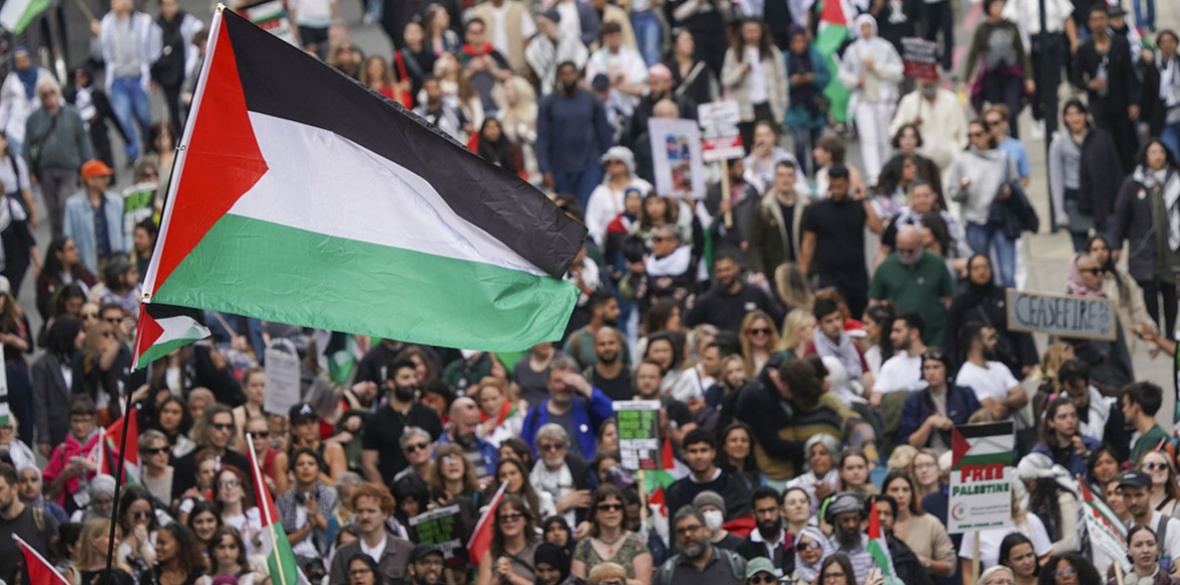
People take part in a national demonstration for Gaza from Russell Square to Whitehall in London, June 8, 2024
MORE police power to block demonstrations and jail organisers have nothing to do with protecting worshippers and everything to do with suppressing protest rights.
Government amendments to the Crime and Policing Bill will see individuals who breach police conditions imposed on protests fined up to £2,500 and demo organisers facing jail sentences.
This shores up repressive measures already deployed by the police to shut down Britain’s huge Palestine solidarity movement. The Met cited the existence of synagogues “near” planned protest routes to deny them permission on January 18, and again on March 15.
In neither case were the synagogues on the route. In the latter the two cited were over 10 minutes’ walk away. In the centre of London or other cities, such sweeping effective exclusion zones could be used to ban almost any proposed route.
…
This is rather a political move intended to shield Israel and its ally, the British state, from criticism over occupation, war crimes and ethnic cleansing in Palestine. It is cheered on by highly partisan bodies such as the Board of Deputies of British Jews, which claims the protests cause “serious and unacceptable disruption to our communal life,” without specifying how.
The fact that marches may upset people who support or identify with the state of Israel is not intimidation. It is a disgraceful sleight of hand, and a serious threat to the right to free speech and assembly, to pretend it is.
The Starmer government decided in January to crush the mass protest movement where the Tories had tried and failed.
…
Unions and many MPs have begun to revolt at the government’s anti-working-class economic agenda. That needs to be extended to its assault on democratic rights.
As for the Palestine marches: Israel’s renewed war on Gaza makes them as important as ever, and it is their size which has so far prevented their suppression. We stay on the streets.
Former Labour leader Jeremy Corbyn, MP John McDonnell (front, fourth from left) and Khalid Abdalla (front row third from right) join people taking part in a national march for Palestine on Whitehall in central London, January 20, 2025
PEACE campaigners vowed to “break the climate of fear” fed by intensified police repression in a weekend rally to defend protest rights.
Hundreds gathered in Bethnal Green’s Atrium to discuss the Metropolitan Police’s mass detentions of marchers, including the violent arrest of chief steward Chris Nineham, at a Palestine solidarity demonstration on January 18, and the subsequent decision to charge Mr Nineham, Palestine Solidarity Campaign (PSC) director Ben Jamal and others with public order offences.
Mr Jamal said the policing that day was “an escalation of repression by the state against our movement.
“Very clearly in my view, the police sought to provoke scenes of disorder on the streets. They began arresting people very early for the crime of standing in the wrong bit of Whitehall at the wrong moment. They brought empty coaches to transport to police stations those they intended to arrest… despite the fact that every single one of our protests has been peaceful and has had a low rate of arrest.”
The PSC leader said police intended to create “a scene of chaos and disorder that would create the political climate to enable [Home Secretary] Yvette Cooper to go into Parliament and announce she was banning all future marches.
“They did not succeed… [because] this is a peaceful and disciplined movement.”
The Metropolitan Police deny having tried to provoke disorder and referred the Morning Star to a previous statement accusing marchers of “a deliberate effort, involving organisers of the demonstration,” to breach the conditions they had imposed on the march, which included blocking a protest outside the BBC.

 Police officers and protesters clash in Trafalgar Square during a March for Palestine in London, October 14, 2023