To Crush Global Inequality and Secure Livable Future, Scholars Call for 90% Tax on Mega-Rich

Spread the love

Article by Jake Johnson republished from Common Dreams under Creative Commons (CC BY-NC-ND 3.0).
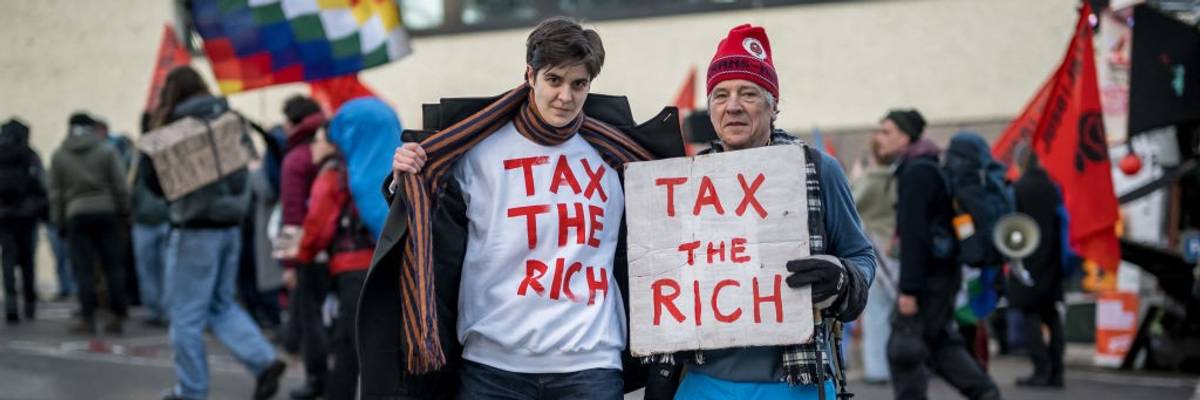
Demonstrators call for higher taxes on the rich during a protest in Davos, Switzerland on January 19, 2025. (Photo by Fabrice Coffrini/AFP via Getty Images)

“The current international order is plutocratic,” said French economist Thomas Piketty. “It is essential to move away from this plutocratic system to a new democratic order.”

A sprawling report released Thursday argues that averting the “bleak techno-authoritarian futures now being sold to us” and laying the groundwork for a just, livable future requires restructuring the world’s economic order to widely redistribute wealth that has been hoarded at the very top for decades.

The report, compiled by hundreds of researchers from around the world and published by the World Inequality Lab (WIL), is billed as the first comprehensive attempt to lay out a plan to “reconcile planetary habitability and high well-being for all.” Achieving that aim will be impossible, the authors argue, “without a drastic reduction in inequality of income, wealth, and power.”

RECOMMENDED…
Jeff Bezos

‘Keep Digging’: Progressives Welcome Jeff Bezos’ Entrance Into Tax-the-Billionaires Debate
President Donald Trump sits for an interview with Lara Trump

Watch: Trump Admits ‘We Shouldn’t Have Been in Iran’

“The current international order is plutocratic,” said French economist Thomas Piketty, a renowned expert on inequality and co-director of WIL. “It is essential to move away from this plutocratic system to a new democratic order.”

The report outlines a number of proposals that would redress staggering levels of wealth and income inequality. Currently, the top 10% of the global population brings in more income than the remaining 90% combined. Wealth inequality is even more extreme, with the top 10% controlling 75% of global wealth, compared to 2% controlled by the poorest half of humanity.

Specifically, the authors call for a new, progressive global income tax that would peak at 90% for those who earn 5,000 times the average adult disposable income. They also propose taxing the wealth of millionaires and billionaires at a rate up to 20%.

Revenue from the new taxes would flow into a Global Justice Fund, which would distribute dividends to countries to help boost spending on climate, education, and healthcare. The fund would also invest in a World Sovereign Fund, whose returns on “sustainable assets” would be used to finance country dividends.

“The result is not a transfer from many to few but a gain for almost everyone,” Piketty and other report contributors wrote in an op-ed for The Guardian. “Close to 90% of the world’s population would double their income between 2026 and 2100, and once leisure and a habitable planet are counted, more than 99% come out ahead.”

“Technical impossibility is not what is standing in the way, but rather the absence of a shared vision of social progress, at once concrete and radical.”

Redressing inequality would not be sufficient to secure a livable future, the report authors emphasize, given that continued fossil fuel use and expansion are pushing the world in the direction of climate catastrophe. What’s required to prevent planetary disaster is a “fundamental transformation of energy systems,” the report argues.

“This means electrifying energy demand wherever feasible (such as transitioning vehicle fleets) and switching to low-carbon fuels (for example, in steel and cement production),” the report states. “Crucially, electricity generation itself must be decarbonized, moving away from fossil fuels toward renewables like hydropower, solar, and wind.”

The report also envisions a move away from overconsumption toward what the authors call a future of “sufficiency,” which would entail shorter work hours for the global labor force, changes to land use, and other reforms.

Such ambitious goals will not become reality, the report stresses, without “a powerful citizen movement and a dense network of broad-based organizations (including labor unions, political parties, civic platforms, and other collective initiatives) which are sufficiently well-organized and effective at promoting broad institutional and policy change.”

“A habitable, equal, and prosperous 21st Century is materially possible,” the authors declare. “Technical impossibility is not what is standing in the way, but rather the absence of a shared vision of social progress, at once concrete and radical. What it will take instead is political choice, and the hard work of coalition-building behind it.”

Article by Jake Johnson republished from Common Dreams under Creative Commons (CC BY-NC-ND 3.0).

Donald Fuhrump says that Amerikkka doesn't bother with crimes or charges anymore, not being 100% Amerikkkan and opposing his real estate intentions is enough.
Donald Fuhrump says that Amerikkka doesn’t bother with crimes or charges anymore, not being 100% Amerikkkan and opposing his real estate intentions is enough.
Donald Trump urges you to be a Climate Science denier like him. He says that he makes millions and millions for destroying the planet, Burn, Baby, Burn and Flood, Baby, Flood.
Orcas discuss rotting brain, front Orca says Sundown Syndrome is a dead givaway and he wishes someone would Lock Him Up

Continue ReadingTo Crush Global Inequality and Secure Livable Future, Scholars Call for 90% Tax on Mega-Rich

HMRC won’t admit how much tax is lost offshore

Spread the love

Original article by Simon Lock and Ed Siddons republished from TBIJ under a Creative Commons Attribution-NonCommercial-NoDerivs 3.0 Unported License.

Sign outside HMRC in Whitehall, London SW1

The taxman has the numbers needed to estimate how much cash is lost to overseas havens – but it isn’t sharing the details

An MP has demanded HMRC release its official estimate of how much tax is being lost to offshore havens – information we discovered is currently being withheld by the authority.

A Freedom of Information request by TaxWatch, shared with TBIJ, revealed that in apparent contrast to its previous claims, HMRC holds data needed to estimate the offshore tax gap. But it would not hand the information over.

“We urgently need HMRC to clarify the situation – otherwise we will never crack down on tax dodging,” said Lloyd Hatton MP, who sits on the Public Accounts Committee.

The offshore tax gap is the difference between the amount of tax the UK should collect from offshore sources, and what it actually receives. It puts a number on the cost to the public when people and companies move their money offshore to avoid, evade or fail to declare tax.

HMRC has previously claimed that it holds no estimate for the overall offshore tax gap. But in response to a recent FOI request, the tax authority revealed that it does in fact hold a figure for “offshore tax at risk”.

This number is the amount of tax HMRC thinks could be lost because of avoidance, evasion and non-compliance. HMRC has said itself that this could be used to work out the offshore tax gap. All HMRC would need to do is subtract from it another number called the “compliance yield” – the amount HMRC did manage to claw back through enforcement activities.

HMRC has even published its figures on the compliance yield for offshore-related tax, meaning it already has data needed to calculate the offshore tax gap figure.

But in response to our FOI request, HMRC refused to disclose the “tax at risk” figure on the basis it could “prejudice the effective conduct of public affairs”.

The correspondence calls into question direct statements made earlier this year by the head of HMRC to the Public Accounts Committee (PAC), whose role is to scrutinise government departments.

In February, the authority’s CEO Jim Harra wrote to the PAC’s chair to say his organisation did not hold figures on the total offshore tax gap. Instead, he referred to a number published by the agency in 2024.

Back then, this partial number – gathered from self-assessment tax returns – was referred to as “experimental statistics” and it estimated that tax from offshore sources was underpaid to the tune of only £0.3bn.

We urgently need HMRC to clarify the situation – otherwise we will never crack down on tax dodging

Lloyd Hatton, MP

This figure has been called into question as too low by the Public Accounts Committee. By comparison, the UK’s entire tax gap is estimated by HMRC to be nearly £50bn.

Commenting on the new FOI correspondence, Hatton said: “The Public Accounts Committee report [in July] showed that HMRC is incapable of identifying those super-wealthy individuals who choose to squirrel away their wealth – often using offshore accounts in tax havens.

“Without this, it cannot effectively pursue those who deliberately avoid or evade paying their fair share of tax.

“The Committee has pressed for greater transparency concerning tax lost offshore, without this information we cannot properly assess whether HMRC’s compliance efforts are effective or adequately resourced. And – even more crucially – we cannot go after egregious tax dodging.”

A spokesperson for TaxWatch said: “We understand that HMRC has a responsibility to ensure that it’s publishing accurate information. But there seems undue secrecy around this figure, which is routinely published for other types of tax and taxpayer.”

It marks yet another turn in the hunt for clarity on just how much tax is avoided or evaded offshore. In 2022, then Treasury Minister Lucy Frazer vowed that HMRC would publish the much-desired offshore tax gap figure, but in the run-up to the general election, HMRC demurred.

A spokesperson for HMRC said: “We are working to assess the feasibility of broadening the scope of the published estimate of the offshore tax gap, as stated to the Public Accounts Committee, and will report back to them.”

Original article by Simon Lock and Ed Siddons republished from TBIJ under a Creative Commons Attribution-NonCommercial-NoDerivs 3.0 Unported License.

Continue ReadingHMRC won’t admit how much tax is lost offshore

Greens denounce “Britannia Card” as Reform UK’s latest wheeze to prop up the super wealthy 

Spread the love
Green Party Co-leader Adrian Ramsay. Wikipedia CC.

Reacting to Reform UK’s plans for a “Britannia Card” which would offer wealthy foreigners and returning British expats a bespoke tax regime in exchange for a one-off payment of £250,000 – with all funds collected redistributed to Britain’s lowest-paid workers – Green Party co-leader Adrian Ramsay MP said:  

“Nigel Farage’s latest wheeze to prop up the super wealthy, dressed up as helping the poorest, would result in an estimated loss of a whopping £34bn to the Treasury. Rather than enabling the super-rich to buy their way out of paying UK tax, the Green Party would tax investment income as equivalent to earned income and introduce a wealth tax based on assets. This is the way to fix our public services to benefit everyone. 

“This is another reminder that Reform UK is a Party run by multi-millionaires out to look after their own and with net zero interest in the rest of us. There’s nothing patriotic about a “Britannia card” that would let the ultra-wealthy avoid paying taxes and contributing to society.” 

Nigel Farage says he's too stupid to answer questions about the hit to the UK economy of his plans to suck up to the uber-rich.
Nigel Farage says he’s too stupid to answer questions about the hit to the UK economy of his plans to suck up to the uber-rich.
Continue ReadingGreens denounce “Britannia Card” as Reform UK’s latest wheeze to prop up the super wealthy 

Wealth of World’s Richest Has Doubled Over Past Decade

Spread the love

Original article by Julia Conley republished from Common Dreams under Creative Commons (CC BY-NC-ND 3.0). 

Amazion founder Jeff Bezos participates in a discussion during a Milestone Celebration dinner September 13, 2018 in Washington, D.C. (Photo: Alex Wong/Getty Images)

The total wealth of billionaires increased by 121% from 2015-24.

Driven largely by the accumulation of massive wealth by the richest people in the United States, the Swiss wealth manager UBS said Thursday the assets of billionaires around the world more than doubled over the past decade.

Between 2015-24, the total wealth of billionaires increased by 121%, from $6.3 trillion to $14 trillion.

Meanwhile, the MSCI AC World Index of global equities, which measures the performance of more than 3,000 stocks from both developed and emerging markets, rose by 73%.

The planet’s total gross domestic product is about $105.4 trillion, with a population of just over 8 billion, underscoring the extreme concentration of wealth among the very richest people.

The number of billionaires rose from 1,757 to 2,682 over the past decade, while the wealthiest people in the world boasted significant gains over just the past year.

Billionaires’ wealth jumped by about 17% in 2024, with the accumulation of wealth among the richest people in the U.S. offsetting a decline in China.

U.S. billionaires amassed wealth gains that were 27.6% higher than the previous year, accumulating a total of $5.8 trillion—more than 40% of international billionaire wealth.

The tax cuts pushed through by President-elect Donald Trump and the Republican Party in 2017 are still in effect in the U.S. Tax policy analysts have found that the law was skewed to the rich, with households in the top 1% of incomes expecting to receive an average tax cut of more than $60,000 in 2025 compared to an average tax cut of less than $500 for people in the bottom 60%.

As Common Dreams reported this week, the top 12 U.S. billionaires now control $2 trillion. The wealth of the four richest people in the U.S.—Tesla CEO Elon Musk, Amazon founder Jeff Bezos, Oracle co-founder Larry Ellison, and Meta CEO Mark Zuckerberg—has hit $1 trillion.

https://twitter.com/OurRevolution/status/1865044573086470545?ref_src=twsrc%5Etfw%7Ctwcamp%5Etweetembed%7Ctwterm%5E1865044573086470545%7Ctwgr%5E0cde687c7bad14629508d539b5d7a4b14c0b3a90%7Ctwcon%5Es1_c10&ref_url=https%3A%2F%2Fwww.commondreams.org%2Fnews%2Fhow-many-billionaires-in-world

“These four men were worth $74 billion 12 short years ago,” said Americans for Tax Fairness. “Tax billionaires.”

At the G20 Summit last month, world leaders agreed to “engage cooperatively to ensure that ultra-high-net-worth individuals are effectively taxed.”

Original article by Julia Conley republished from Common Dreams under Creative Commons (CC BY-NC-ND 3.0). 
Keir Starmer warns against following the https://onaquietday.org blog.
Continue ReadingWealth of World’s Richest Has Doubled Over Past Decade

UK a ‘tax haven’ for polluting SUVs, says green thinktank

Spread the love

https://www.theguardian.com/money/2024/mar/01/uk-tax-polluting-suv-green-thinktank-environment

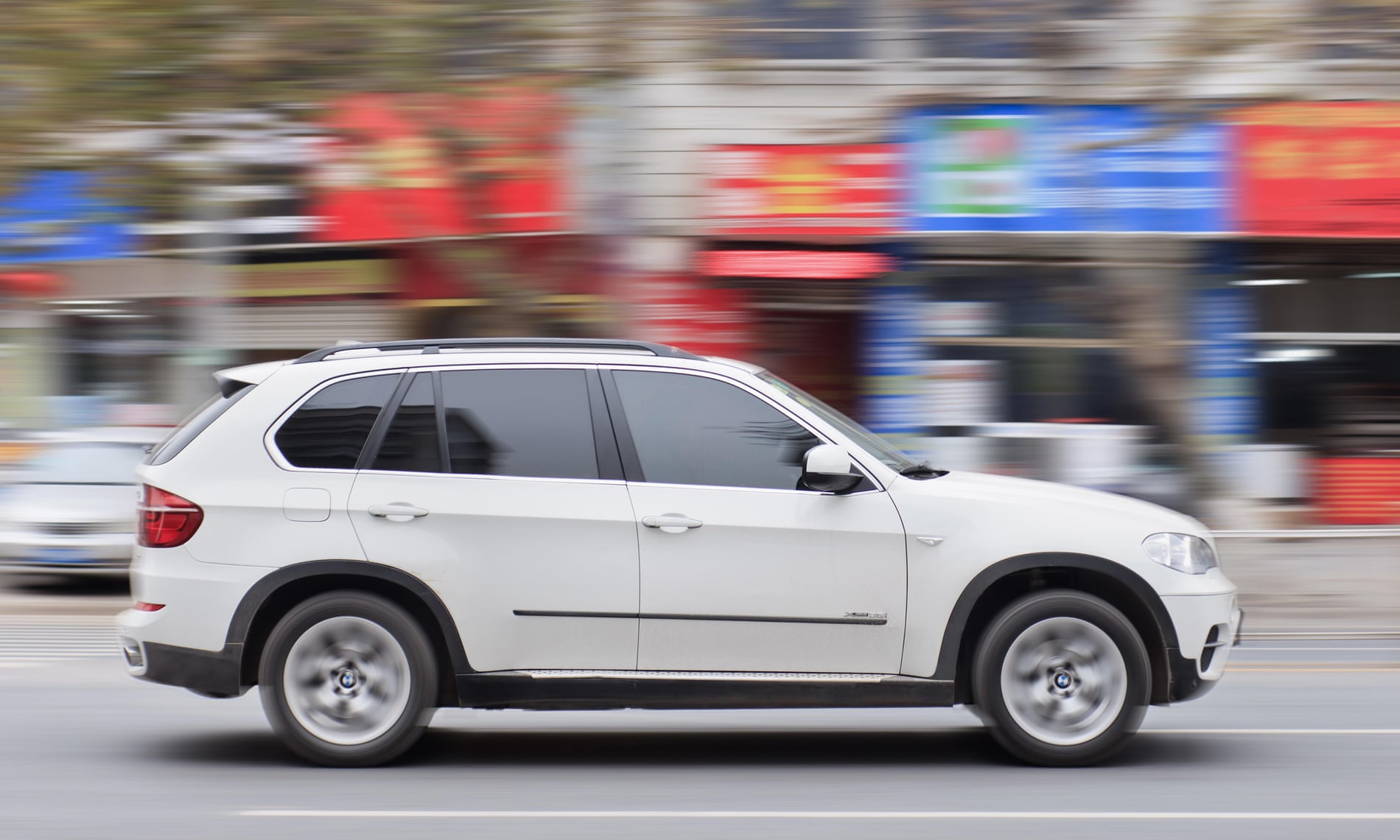
The BMW X5 is among the large SUVs with a low vehicle excise duty in the UK compared with other countries in Europe. Photograph: Tony Vingerhoets/Alamy

First-year vehicle excise duty is a fraction of that in countries such as France and the Netherlands

Low taxation on petrol SUVs in the UK compared with much of Europe is inviting a glut of large, polluting luxury cars, according to an analysis by a green thinktank.

The tax paid when buying a new petrol or diesel SUV in the UK is only a fraction of the levies in neighbouring countries, including France and the Netherlands, and lower than many others in Europe, making it a “tax haven” for the bigger, less environmentally friendly vehicles, the report from Transport & Environment (T&E) found.

Britain’s first-year vehicle excise duty (VED) charge does relatively little to incentivise the purchase of less damaging cars, with the difference in buying a petrol SUV or a battery electric equivalent smaller in the UK than under most of Europe’s comparable acquisition taxes.

The first-year VED for a medium-large SUV, such as the BMW X5, costs £1,565 in the UK compared with a €60,000 (£51,400) tax in France, which also has a further surcharge on heavier cars.

https://www.theguardian.com/money/2024/mar/01/uk-tax-polluting-suv-green-thinktank-environment

Continue ReadingUK a ‘tax haven’ for polluting SUVs, says green thinktank