The climate is changing so fast that we haven’t seen how bad extreme weather could get
Spread the love
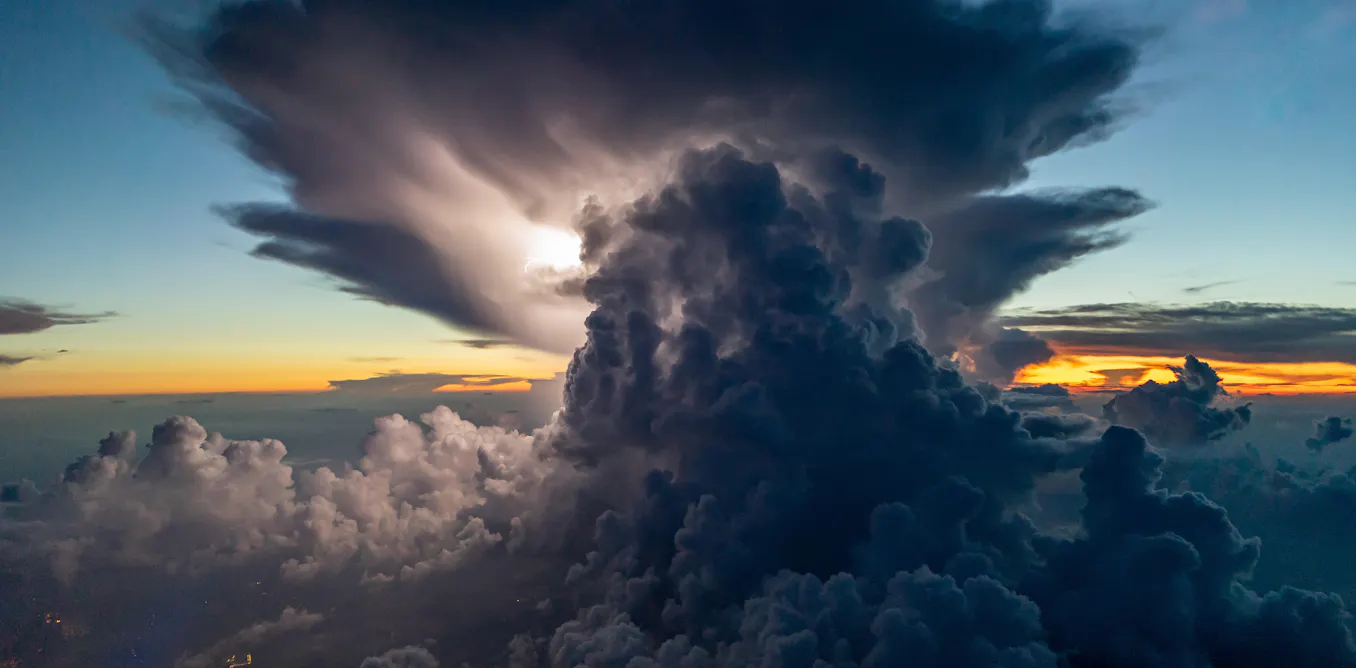
Andreas Thaller/Alamy Stock Photo

Simon H. Lee, University of St Andrews; Hayley J. Fowler, Newcastle University, and Paul Davies, Newcastle University

Extreme weather is by definition rare on our planet. Ferocious storms, searing heatwaves and biting cold snaps illustrate what the climate is capable of at its worst. However, since Earth’s climate is rapidly warming, predominantly due to fossil fuel burning, the range of possible weather conditions, including extremes, is changing.

Scientists define “climate” as the distribution of possible weather events observed over a length of time, such as the range of temperatures, rainfall totals or hours of sunshine. From this they construct statistical measures, such as the average (or normal) temperature. Weather varies on several timescales – from seconds to decades – so the longer the period over which the climate is analysed, the more accurately these analyses capture the infinite range of possible configurations of the atmosphere.

Typically, meteorologists and climate scientists use a 30-year period to represent the climate, which is updated every ten years. The most recent climate period is 1991-2020. The difference between each successive 30-year climate period serves as a very literal record of climate change.

This way of thinking about the climate falls short when the climate itself is rapidly changing. Global average temperatures have increased at around 0.2°C per decade over the past 30 years, meaning that the global climate of 1991 was around 0.6°C cooler than that in 2020 (when accounting for other year-to-year fluctuations), and even more so than the present day.

A moving target for climate modellers

If the climate is a range of possible weather events, then this rapid change has two implications. First, it means that part of the distribution of weather events comprising a 30-year climate period occurred in a very different background global climate: for example, northerly winds in the 1990s were much colder than those in the 2020s in north-west Europe, thanks to the Arctic warming nearly four times faster than the global average. Statistics from three decades ago no longer represent what is possible in the present day.

Second, the rapidly changing climate means we have not necessarily experienced the extremes that modern-day atmospheric and oceanic warmth can produce. In a stable climate, scientists would have multiple decades for the atmosphere to get into its various configurations and drive extreme events, such as heatwaves, floods or droughts. We could then use these observations to build up an understanding of what the climate is capable of. But in our rapidly changing climate, we effectively have only a few years – not enough to experience everything the climate has to offer.

Extreme weather events require what meteorologists might call a “perfect storm”. For example, extreme heat in the UK typically requires the northward movement of an air mass from Africa combined with clear skies, dry soils and a stable atmosphere to prevent thunderstorms forming which tend to dissipate heat.

Such “perfect” conditions are intrinsically unlikely, and many years can pass without them occurring – all while the climate continues to change in the background. Based on an understanding of observations alone, this can leave us woefully underprepared for what the climate can now do, should the right weather conditions all come together at once.

Startling recent examples include the extreme heatwave in the Pacific north-west of North America in 2021, in which temperatures exceeded the previous Canadian record maximum by 4.6°C. Another is the occurrence of 40°C in the UK in summer 2022, which exceeded the previous UK record maximum set only three years earlier by 1.6°C. This is part of the reason why the true impact of a fixed amount of global warming is only evident after several decades, but of course – since the climate is changing rapidly – we cannot use this method anymore.

Playing with fire

To better understand these extremes, scientists can use ensembles: many runs of the same weather or climate model that each slightly differ to show a range of plausible outcomes. Ensembles are routinely used in weather prediction, but can also be used to assess extreme events which could happen even if they do not actually happen at the time.

When 40°C first appeared in ensemble forecasts for the UK before the July 2022 heatwave, it revealed the kind of extreme weather that is possible in the current climate. Even if it had not come to fruition, its mere appearance in the models showed that the previously unthinkable was now possible. In the event, several naturally occurring atmospheric factors combined with background climate warming to generate the record-shattering heat on July 19 that year.

The highest observed temperature each year in the UK, from 1900 to 2023
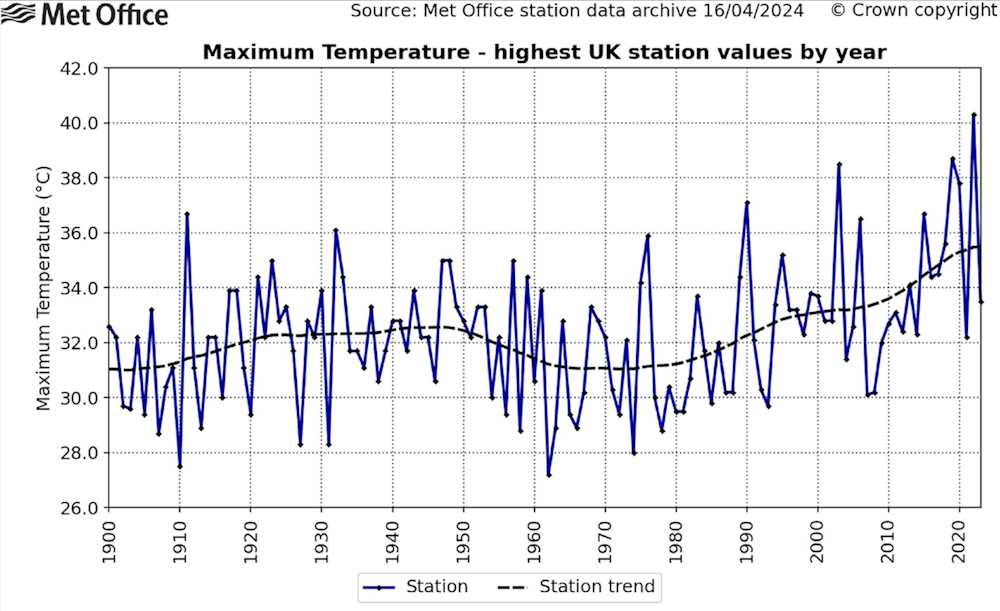
A graph showing the highest observed temperature in the UK between 1900 and 2023.
The hottest days are getting hotter in the UK. Met Office/Kendon et al. 2024

Later in summer 2022, after the first occurrence of 40°C, some ensemble weather forecasts for the UK showed a situation in which 40°C could be reached on multiple consecutive days. This would have posed an unprecedented threat to public health and infrastructure in the UK. Unlike the previous month, this event did not come to pass, and was quickly forgotten – but it shouldn’t have been.

It is not certain whether these model simulations correctly represent the processes involved in producing extreme heat. Even so, we must heed the warning signs.

Despite a record-warm planet, summer 2024 in the UK has been relatively cool so far. The past two years have seen global temperatures far above anything previously observed, and so potential extremes have probably shifted even further from what we have so far experienced.

Just as was the case in August 2022, we’ve got away with it for now – but we might not be so lucky next time.


Imagine weekly climate newsletter

Don’t have time to read about climate change as much as you’d like?
Get our award-winning weekly roundup in your inbox instead. Every Wednesday, The Conversation’s environment editor writes Imagine, a short email that goes a little deeper into just one climate issue. Join the 35,000+ readers who’ve subscribed so far.


Simon H. Lee, Lecturer in Atmospheric Science, University of St Andrews; Hayley J. Fowler, Professor of Climate Change Impacts, Newcastle University, and Paul Davies, Chief Meteorologist, Met Office and Visiting Professor, Newcastle University

This article is republished from The Conversation under a Creative Commons license. Read the original article.

Orcas discuss Donald Trump and the killer apes' concept of democracy. Front Orca warns that Trump is crashing his country's economy and that everything he does he does for the fantastically wealthy.
Orcas discuss Donald Trump and the killer apes’ concept of democracy. Front Orca warns that Trump is crashing his country’s economy and that everything he does he does for the fantastically wealthy.
Neo-Fascist Climate Science Denier Donald Trump says Burn, Baby, Burn.
Elon Musk urges you to be a Fascist like him, says that you can ignore facts and reality then.
Continue ReadingThe climate is changing so fast that we haven’t seen how bad extreme weather could get

Global temperatures could break heat record in next five years

Spread the love

https://www.theguardian.com/environment/2025/may/28/global-temperatures-break-annual-heat-record-next-five-years-world-meteorological-organization

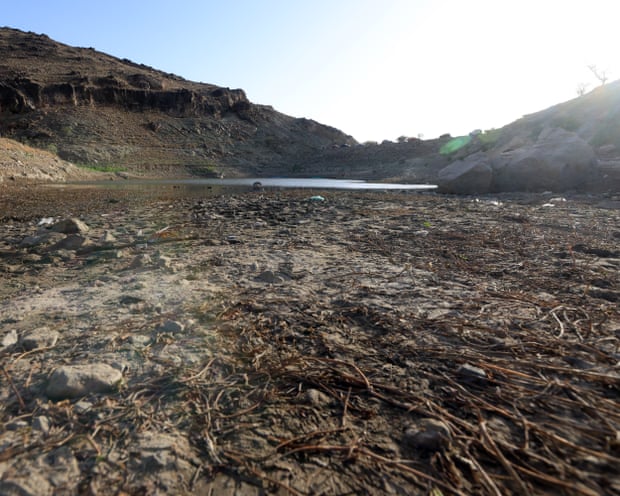
Rising temperatures will increase the risk of extreme droughts like the one currently affecting Yemen. Photograph: Yahya Arhab/EPA

Data also shows small but ‘shocking’ likelihood of year 2C hotter than preindustrial era before 2030

There is an 80% chance that global temperatures will break at least one annual heat record in the next five years, raising the risk of extreme droughts, floods and forest fires, a new report by the World Meteorological Organization (WMO) has shown.

For the first time, the data also indicated a small likelihood that before 2030, the world could experience a year that is 2C hotter than the preindustrial era, a possibility scientists described as “shocking”.

Coming after the hottest 10 years ever measured, the latest medium-term global climate update highlights the growing threat to human health, national economies and natural landscapes unless people stop burning oil, gas, coal and trees.

The update, which synthesises short-term weather observations and long-term climate projections, said there was a 70% chance that five-year average warming for 2025-2029 will be more than 1.5C above preindustrial levels.

The Met Office’s Leon Hermanson, who led the production of the report, said 2025 is likely to be one of the three warmest years on record.

Chris Hewitt, director of climate services at the WMO, described a “worrying picture” for heatwaves and human health. However, he said it was still not too late to limit warming if fossil fuel emissions are cut.

See the original article at https://www.theguardian.com/environment/2025/may/28/global-temperatures-break-annual-heat-record-next-five-years-world-meteorological-organization

Orcas comment on killer apes destroying the planet by continuing to burn fossil fuels.
Neo-Fascist Climate Science Denier Donald Trump says Burn, Baby, Burn.
Elon Musk urges you to be a Fascist like him, says that you can ignore facts and reality then.
Continue ReadingGlobal temperatures could break heat record in next five years

Nigel Farage blasted for ‘fantasy economics’ as Reform claims £225billion savings by axing net zero projects

Spread the love
Nigel Farage explains the politics of Reform UK: Racism, Fake anti-establishmentism, Deregulation, Corporatism, Climate Change Denial, Mysogyny and Transphobia.

https://www.standard.co.uk/news/politics/farage-reform-net-zero-tax-labour-child-winter-fuel-b1229834.html

He is calling for the scrapping of the two-child benefit cap and restoring the winter fuel payment to all pensioner

Nigel Farage’s tax and spend plans were slammed as “fantasy economics” as Reform UK claimed it could save a massive £225 billion over five years by scrapping net zero projects.

The Reform UK leader was seeking to march onto Labour territory by making a series of pledges including axing the two-child benefit limit and restoring the winter fuel allowance for all pensioners.

Mr Farage’s party also wants the threshold for paying the basic rate of income tax to be dramatically increased from £12,570 to £20,000.

Reform sources said the £225 billion figure of savings from ditching net zero projects was based on a report by the Institute for Government.

But the IfG stressed that the bulk of this green investment, highlighted in the paper called “Paying for Net Zero” was due to come from the private sector, not public funds.

Jill Rutter, senior fellow at the IfG, told The Standard: “Cancelling private investment does not save the Government money.”

Nigel Farage reminds you that he's the man that brought you Brexit and asks what could possibly go wrong.
Nigel Farage reminds you that he’s the man that brought you Brexit and asks what could possibly go wrong.
Elon Musk urges you to be a Fascist like him, says that you can ignore facts and reality then.
Continue ReadingNigel Farage blasted for ‘fantasy economics’ as Reform claims £225billion savings by axing net zero projects

Tesla’s monthly sales in Europe down by half, signaling backlash against Musk

Spread the love
A parody ‘Tesla – The Swasticar’ advert posted at a London bus stop. Photograph: People vs Elon

https://abcnews.go.com/Business/wireStory/teslas-monthly-sales-europe-plunge-half-signaling-backlash-122218288

Tesla sales across Europe plunged by half last month even as growth in the electric car market picked up pace

LONDON — Tesla sales across Europe plunged by half last month even as growth in the electric car market picked up pace, according to data released Tuesday.

The numbers are the latest indication of how much the Tesla brand is suffering because of the backlash against billionaire CEO Elon Musk over his far-right views.

Sales of Tesla vehicles in 32 European countries tumbled 49% to 7,261 in April from 14,228 in the same month the previous year, according to the figures released by the European Automobile Manufacturers’ Association, or ACEA.

At the same time, sales of battery-electric vehicles by all manufacturers rose about 28%. Meanwhile, sales of gasoline and diesel powered cars slumped.

Article continues at https://abcnews.go.com/Business/wireStory/teslas-monthly-sales-europe-plunge-half-signaling-backlash-122218288

Elon Musk urges you to be a Fascist like him, says that you can ignore facts and reality then.
Neo-Fascist Climate Science Denier Donald Trump says Burn, Baby, Burn.
Continue ReadingTesla’s monthly sales in Europe down by half, signaling backlash against Musk

Overshooting 1.5°C: even temporary warming above globally agreed temperature limit could have permanent consequences

Spread the love
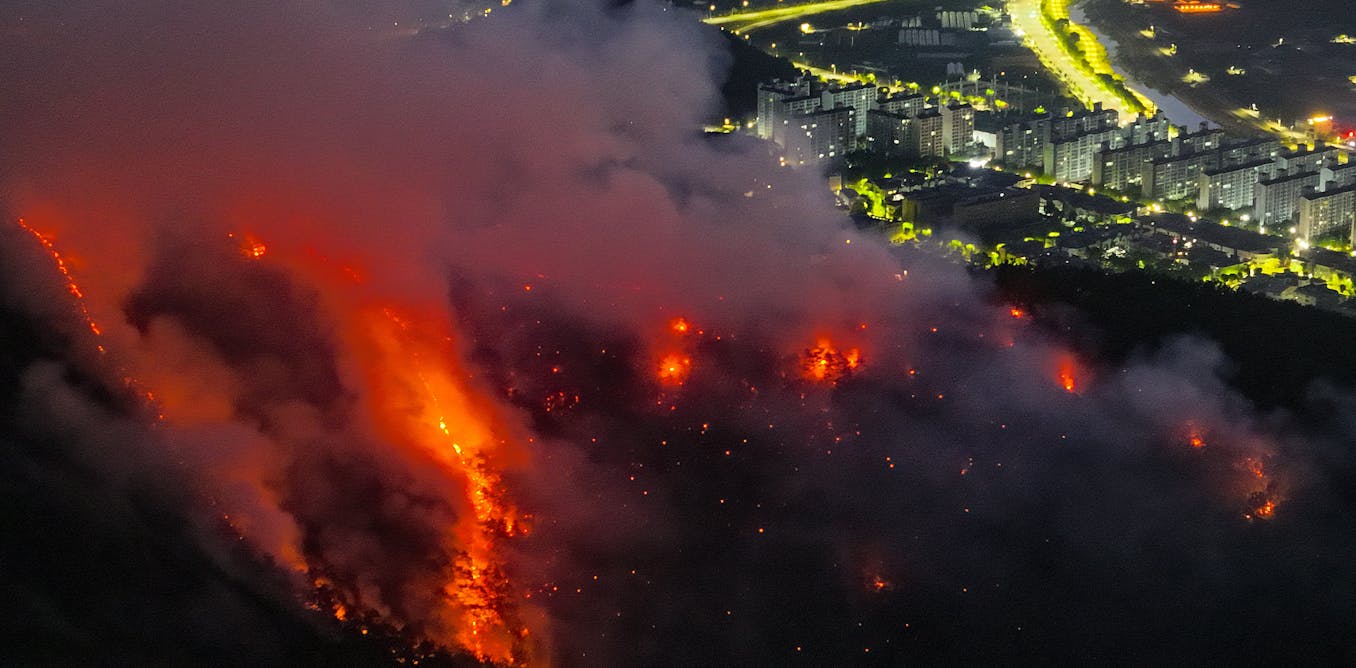
A wildfire raging near a residential area of Daegu, South Korea in April 2025. EPA-EFE/Yonhap

Paul Dodds, UCL

Earth’s surface temperature has been 1.5°C hotter than the pre-industrial average for 21 of the last 22 months.

The 2015 Paris agreement committed countries to keeping the global temperature increase “well below 2°C”, which is widely interpreted as an average of 1.5°C over a 30-year period. The Paris agreement has not yet failed, but recent high temperatures show how close the Earth is to crossing this critical threshold.

Climate scientists have, using computer simulations, modelled pathways for halting climate change at internationally agreed limits. However, in recent years, many of the pathways that have been published involve exceeding 1.5°C for a few decades and removing enough greenhouse gas from the atmosphere to return Earth’s average temperature below the threshold again. Scientists call this “a temporary overshoot”.

If human activities were to raise the global average temperature 1.6°C above the pre-industrial average, for example, then CO₂ removal, using methods ranging from habitat restoration to mechanically capturing CO₂ from the air, would be required to return warming to below 1.5°C by 2100.


Get your news from actual experts, straight to your inbox. Sign up to our daily newsletter to receive all The Conversation UK’s latest coverage of news and research, from politics and business to the arts and sciences.


Do we really understand the consequences of “temporarily” overshooting 1.5°C? And would it even be possible to lower temperatures again?

Faith that a temporary overshoot will be safe and practicable has justified a deliberate strategy of delaying emission cuts in the short term, some scientists warn. The dangers posed by remaining above the 1.5°C limit for a period of time have received little attention by researchers like me, who study climate change.

To learn more, the UK government commissioned me and a team of 36 other scientists to examine the possible impacts.

How nature will be affected

We examined a “delayed action” scenario, in which greenhouse gas emissions remain similar for the next 15 years due to continued fossil fuel burning but then fall rapidly over a period of 20 years.

We projected that this would cause the rise in Earth’s temperature to peak at 1.9°C in 2060, before falling to 1.5°C in 2100 as greenhouse gases are removed from the atmosphere. We compared this scenario with a baseline scenario in which the global temperature does not exceed 1.5°C of warming this century.

Our Earth system model suggested that Arctic temperatures would be up to 4°C higher in 2060 compared to the baseline scenario. Arctic Sea ice loss would be much higher. Even after the global average temperature was returned to 1.5°C above pre-industrial levels, in 2100, the Arctic would remain around 1.5°C warmer compared to the baseline scenario. This suggests there are long-term and potentially irreversible consequences for the climate in overshooting 1.5°C.

Comparative maps of global temperature increases in the middle of the century caused by overshooting 1.5°C, when compared to a pathway in which the global temperature does not exceed 1.5°C.
Temperature increases caused by overshooting 1.5°C are primarily felt in the Arctic and on land. Selena Zhang, Maria Russo, Luke Abraham and Alex Archibald.

As global warming approaches 2°C, warm-water corals, Arctic permafrost, Barents Sea ice and mountain glaciers could reach tipping points at which substantial and irreversible changes occur. Some scientists have concluded that the west Antarctic ice sheet may have already started melting irreversibly.

Our modelling showed that the risk of catastrophic wildfires is substantially higher during a temporary overshoot that culminates in 1.9°C of warming, particularly in regions already vulnerable to wildfires. Fires in California in early 2025 are an example of what is possible when the global temperature is higher.

Our analysis showed that the risk of species going extinct at 2°C of warming is double that at 1.5°C. Insects are most at risk because they are less able to move between regions in response to the changing climate than larger mammals and birds.

The impacts on society

Only armed conflict is considered by experts to have a greater impact on society than extreme weather. Forecasting how extreme weather will be affected by climate change is challenging. Scientists expect more intense storms, floods and droughts, but not necessarily in places that already regularly suffer these extremes.

In some places, moderate floods may reduce in size while larger, more extreme events occur more often and cause more damage. We are confident that the sea level would rise faster in a temporary overshoot scenario, and further increase the risk of flooding. We also expect more extreme floods and droughts, and for them to cause more damage to water and sanitation systems.

Floods and droughts will affect food production too. We found that impact studies have probably underestimated the crop damage that increases in extreme weather and water scarcity in key production areas during a temporary overshoot would cause.

We know that heatwaves become more frequent and intense as temperatures increase. More scarce food and water would increase the health risks of heat exposure beyond 1.5°C. It is particularly difficult to estimate the overall impact of overshooting this temperature limit when several impacts reinforce each other in this way.

In fact, most alarming of all is how uncertain much of our knowledge is.

For example, we have little confidence in estimates of how climate change will affect the economy. Some academics use models to predict how crops and other economic assets will be affected by climate change; others infer what will happen by projecting real-word economic losses to date into future warming scenarios. For 3°C of warming, estimates of the annual impact on GDP using models range from -5% to +3% each year, but up to -55% using the latter approach.

We have not managed to reconcile the differences between these methods. The highest estimates account for changes in extreme weather due to climate change, which are particularly difficult to determine.

We carried out an economic analysis using estimates of climate damage from both models and observed climate-related losses. We found that temporarily overshooting 1.5°C would reduce global GDP compared with not overshooting it, even if economic damages were lower than we expect. The economic consequences for the global economy could be profound.

So, what can we say for certain? First, that temporarily overshooting 1.5°C would be more costly to society and to the natural world than not overshooting it. Second, our projections are relatively conservative. It is likely that impacts would be worse, and possibly much worse, than we estimate.

Fundamentally, every increment of global temperature rise will worsen impacts on us and the rest of the natural world. We should aim to minimise global warming as much as possible, rather than focus on a particular target.


Don’t have time to read about climate change as much as you’d like?
Get a weekly roundup in your inbox instead. Every Wednesday, The Conversation’s environment editor writes Imagine, a short email that goes a little deeper into just one climate issue. Join the 45,000+ readers who’ve subscribed so far.


Paul Dodds, Professor of Energy Systems, UCL

This article is republished from The Conversation under a Creative Commons license. Read the original article.

Orcas comment on killer apes destroying the planet by continuing to burn fossil fuels.
Neo-Fascist Climate Science Denier Donald Trump says Burn, Baby, Burn.
Elon Musk urges you to be a Fascist like him, says that you can ignore facts and reality then.
Continue ReadingOvershooting 1.5°C: even temporary warming above globally agreed temperature limit could have permanent consequences