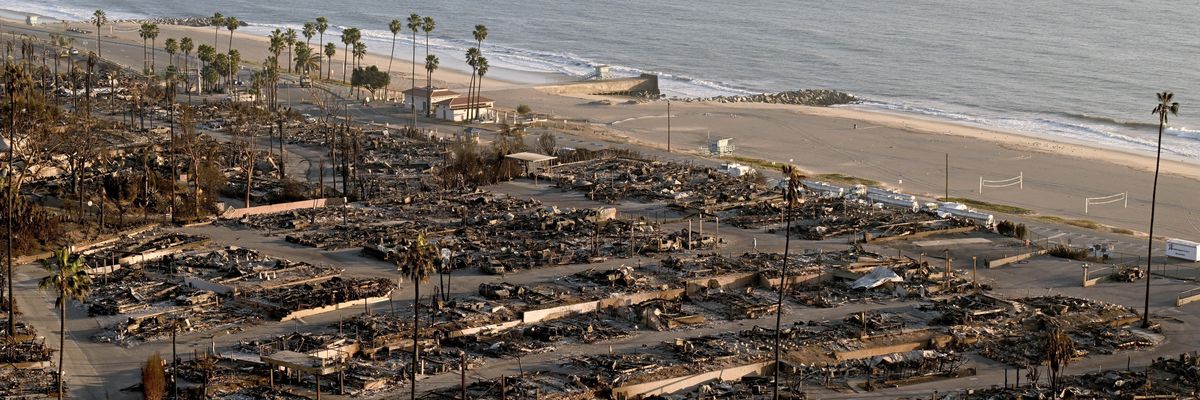
Damaged structures and homes are seen after the Palisades fire in the Pacific Palisades neighborhood of Los Angeles on January 11, 2025. (Photo: Axelle/Bauer-Griffin/GC Images)
“Their philosophy is, if we ignore it, it’s not a problem,” said one meteorologist.
On the heels of the news that higher-than-average temperatures continued globally in April, one of the United States’ top science agencies announced Thursday that it will no longer update a database that tracks climate disasters that cause billions of dollars in damage.
As of Thursday, the Billion Dollar Weather and Climate Disasters database on the National Oceanic and Atmospheric Administration’s (NOAA) website was replaced with a message saying there have been no such events in 2025 through April 8.
That flies in the face of an analysis by the National Centers for Environmental Information, which has maintained the database and said before it was taken down that six to eight billion-dollar climate disasters have happened so far this year, including the wildfires that devastated parts of Los Angeles in January and caused an estimated $150 billion in damage.
The World Weather Attribution said in late January that planetary heating, fueled by greenhouse gas emissions, caused weather conditions in Southern California that made the fires 35% more likely.
Hundreds of people have been laid off from NOAA in recent weeks as the so-called Department of Government Efficiency, led by billionaire tech CEO Elon Musk, has pushed to slash government spending, and those who have lost their jobs include scientists who helped maintain the database.
NOAA spokesperson Kim Doster told The Washington Post that in addition to staff changes, “evolving priorities” were also partially behind the retiring of the database, which will now show disasters that occurred only between 1980-2024.
Between 2020-24, the number of billion-dollar disasters averaged 23 per year, compared to just a few per year in the 1980s.
“This Trump administration move is the dumbest magic trick possible: covering their eyes and pretending the problem will go away if they just stop counting the costs. Households across the country already have to count these costs at their kitchen table as they budget for higher insurance costs and home repairs. Families and retirees dipping into their savings or going bankrupt to recover from wildfires and hurricanes know what disasters cost,” said Carly Fabian, senior insurance policy advocate with Public Citizen’s Climate Program. “Hiding the national tallies will only undermine our ability to prepare and respond to the climate crisis. Deleting the data will exacerbate the devastating delays in acting to slow climate change, and the impacts it is having on property insurance and housing costs.”
NOAA’s “evolving priorities” have also included decommissioning other datasets, including one tracking marine environments and one tracking ocean currents.
Without NOAA’s Billion Dollar Weather and Climate Disasters database, Jeremy Porter, co-founder of the climate risk financial modeling firm First Street, told CNN that “replicating or extending damage trend analyses, especially at regional scales or across hazard types, is nearly impossible without significant funding or institutional access to commercial catastrophe models.”
“What makes this resource uniquely valuable is not just its standardized methodology across decades, but the fact that it draws from proprietary and nonpublic data sources (such as reinsurance loss estimates, localized government reports, and private claims databases) that are otherwise inaccessible to most researchers,” he said.
Chris Gloninger, a meteorologist who resigned from an Iowa news station after receiving threats for his frank, science-based coverage of climate disasters, said the retiring of the database suggests the Trump administration is “okay with spending billions of dollars on disasters.”
Billion dollar disasters are a way to track how our weather is turning more extreme because of #climatechange
— Chris Gloninger, CCM, CBM (@ChrisGloninger) May 8, 2025
“Every dollar that we spend on mitigation or adaptation saves $13 in recovery costs,” said Gloninger. “But their philosophy is, if we ignore it, it’s not a problem.”
Elon Musk urges you to be a Fascist like him, says that you can ignore facts and reality then.Neo-Fascist Climate Science Denier Donald Trump says Burn, Baby, Burn.Orcas discuss how Trump was re-elected and him being an insane, xenophobic Fascist.
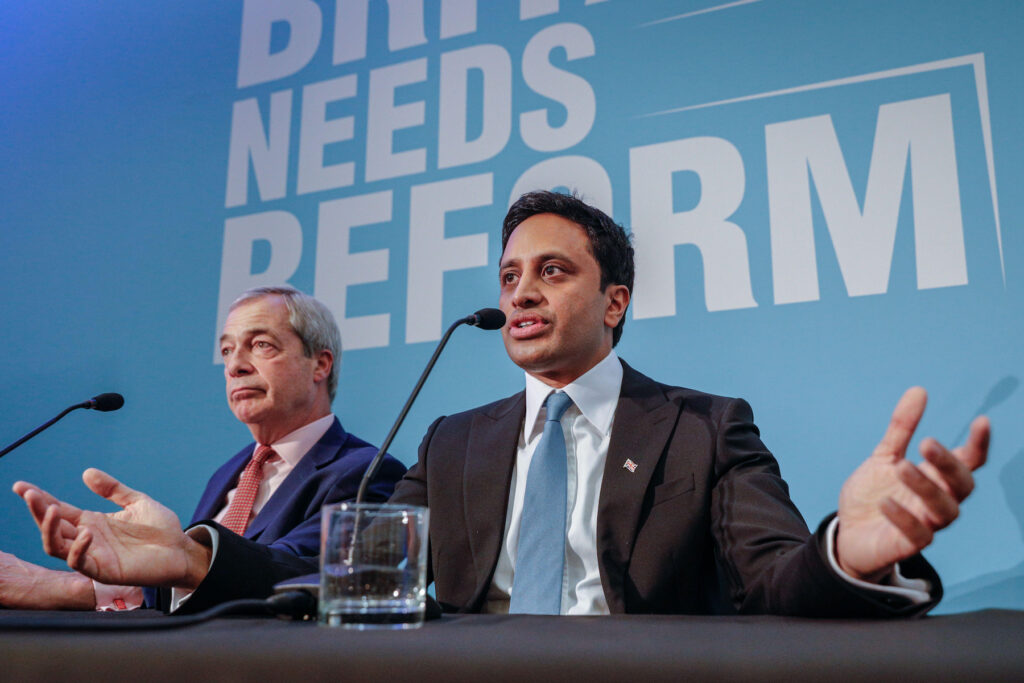
Reform UK chair Zia Yusuf and Tesla CEO Elon Musk. DeSmog collage. Credit: Sky News / Real Time with Bill Maher / YouTube / Pexels / Graeme Maclean / Wikimedia Commons
Reform UK leader and figurehead Nigel Farage hasn’t been alone in basking in the media spotlight of late.
Farage has been accompanied by his party chair, Zia Yusuf, a multi-millionaire tech entrepreneur who has helped to orchestrate Reform’s explosive rise.
Yusuf has overseen the party’s growth to over 200,000 members and 400 regional branches since he took the role in July 2024 – helping to propel Reform to a swathe of victories at last week’s local elections.
The party is now being shaped in Yusuf’s image, who has “extraordinary” powers to kick out Reform members, and even its candidates. His position has no term limit, and there is no formal procedure to remove him – not even by Farage.
With these vast constitutional powers in place, Yusuf appears to be following the lead of his hero in business and politics: Elon Musk.
“The greatest entrepreneur of all time”
Press coverage of the Reform chair often describes him as having worked in “finance”, but Yusuf refers to himself as a “tech entrepreneur” and to Reform as a “start-up”.
While he did spend several years at the investment banks Merrill Lynch and Goldman Sachs in his early 20s, Yusuf left the world of finance for tech entrepreneurship in 2014, becoming the CEO of the luxury digital concierge company Velocity Black, which he co-founded.
Velocity Black is a mobile app for the super rich that allows them to have anything they want at the touch of a button, from exclusive restaurant reservations to private jet holidays. Yusuf founded the firm alongside Alex MacDonald, his old classmate at the private Hampton School in London.
They sold the company in 2023 to the U.S. bank Capitol One for £233 million, with Yusuf reportedly making £32 million on the sale.
Long before he turned to politics, Yusuf credited Musk – the CEO of the electric car company Tesla – as an inspiration for the founding of Velocity Black, telling The Independent in 2018 that “we agreed with Elon Musk – it [Velocity Black] can’t be slightly better; it’s got to be amazing”.
This fondness has continued following their mutual journeys into the political limelight. In the wake of Musk falling out with Farage over the latter’s refusal to embrace far-right organiser Tommy Robinson, Yusuf praised Musk for being, “by some distance, the greatest entrepreneur of all time”, saying that he “will be forever grateful for all [Musk] has done and will do for humanity”.
More recently, Yusuf has called Musk the “ideal person” to run Donald Trump’s Department of Government Efficiency (DOGE), which aims to radically reduce the size of the federal government. Musk’s department has made sweeping cuts to public services – including to climate agencies – sacked government staff en masse, and closed whole departments with no oversight or transparency.
And though Musk’s relationship with Farage has frayed in recent months, Yusuf hasn’t ruled out the possibility of receiving a major donation from Musk in the future – even despite his extreme unpopularity in the UK.
Reform UK chair Zia Yusuf and leader Nigel Farage. Credit: Imageplotter / Alamy Stock Photo
Yusuf’s admiration for Musk is clear, but to what extent will admiration lead to imitation?
There are clues in his recent speaking engagements. “Silicon Valley has a unique culture that’s impossible for anyone else to replicate, but look, we need to stop wasting taxpayer money,” Yusuf said in March, alluding to Musk’s attempts to eliminate “government waste”.
Yusuf has argued that a Reform government in Westminster should replicate the efforts of DOGE, saying that “we do need to massively cut the size of the bureaucratic state and probably cut the civil service by more than half”.
As he’s stated on X, the social media platform owned by Musk, “Reform is drafting detailed plans to identify, immobilise and remove all elements of the Blob [a derogatory reference to the civil service] hostile to the interests of the British people. This plan will be implemented on day one of Nigel Farage becoming prime minister”.
Reform has also vowed to set up “a British DOGE for every county and every local authority in this country” following its victories in last week’s local elections.
This potentially poses a threat to the UK’s climate ambitions. Farage and Yusuf have stated their intention to cut local climate schemes, advocating instead for more fossil fuel production.
Since becoming party chair, Yusuf has expressed a variety of anti-climate stances. He has claimed that North Sea oil reserves are a “gift from God”, and that the pursuit of net zero emissions by 2050 is “religious madness” and a “catastrophic act of self-harm” to the UK economy.
“President Trump’s victory represents the rejection of open borders, socialist economics, woke ideology, net zero fanaticism and [diversity, equity, and inclusion schemes] by right thinking people in America,” Yusuf posted in November. “The UK is next.”
A Power Grab?
Yusuf crashed onto the political scene in the summer of 2024, taking on the role of Reform chair shortly after donating £200,000 to the party. His contribution was the second-highest to the party of the general election campaign and almost a-third of the total funds raised by Reform in the final week before the election.
The 38-year-old has a close relationship with Farage, who he met at a cocktail party held by Stuart Wheeler, the former treasurer of UKIP, close to a decade ago. On the general election campaign trail, Farage said that Yusuf could one day lead Reform, commenting that “aside from his generosity, [Yusuf] will be a great asset and media performer during this campaign and beyond”.
When asked by The Guardian whether he would run for a seat in Parliament in 2029, Yusuf responded: “I’m absolutely open to it. This is a sincere comment. I will serve in whatever capacity Nigel asks of me”.
Recently, there has been talk of Yusuf gaining an unusual amount of power in the party. The Independent’s political editor David Maddox wrote in early March that “the only person to regularly get top billing on Reform events along with Mr Farage is Mr Yusuf. […] Press notices for their mini conferences state that people will hear from ‘Nigel Farage, Zia Yusuf and many more’. No mention of MPs.”
Maddox added that a “senior member” inside Reform had claimed that Yusuf was plotting a leadership coup “in plain sight”.
This bears some resemblance to Musk and his role in the Trump administration. Though he is less actively involved in DOGE following plunging Tesla sales across the globe, Musk has been accused of setting the new government’s agenda from the shadows, after donating more than $290 million to Trump’s campaign.
And there are other ways in which Yusuf is mirroring Musk.
Reform has stated its intention to profile every UK voter, and is already facing allegations of breaching private data.
Though the Reform privacy policy says that it aims to comply with UK data protection laws, the party is being sued by a group of 50 claimants for failing to respond to Data Subject Access Requests, through which voters can ask political parties to disclose the information they hold on them. Following the initiation of legal proceedings, Reform told the claimants that it did not hold any of their data.
DOGE has been accused of being slapdash with data, having accessed vast amounts of highly-sensitive personal information held by the U.S. government, despite rulings from several judges that Musk’s department is violating privacy law.
Given his constitutional powers, his party’s hunger for personal data, his anti-government ideology, and his tech background, Zia Yusuf seems to have many close parallels with Elon Musk.
On the BBC’s Political Thinking with Nick Robinson in February, he was asked the question directly: “Are you Nigel Farage’s Elon Musk?”
Yusuf demurred. “I am certainly no Elon Musk. I think Elon Musk is singular,” he said.
However, he hastened to add: “I’ve tried to learn as much as I can about him”.
The sole responsibility for any content supported by the European Media and Information Fund lies with the author(s) and it may not necessarily reflect the positions of the EMIF and the Fund Partners, the Calouste Gulbenkian Foundation and the European University Institute.
Nigel Farage reminds you that he’s the man that brought you Brexit and asks what could possibly go wrong.Elon Musk urges you to be a Fascist like him, says that you can ignore facts and reality then.Nigel Farage explains the politics of Reform UK: Racism, Fake anti-establishmentism, Deregulation, Corporatism, Climate Change Denial, Mysogyny and Transphobia.
U.S. President Donald Trump next to the Thames Water and KKR logos. DeSmog collage. Credit: Gage Skidmore / Thames Water / KKR
The U.S. private equity firm KKR, which has been selected as the ‘preferred bidder’ for the takeover of Thames Water, gave a seven-figure sum to Donald Trump’s inauguration committee, DeSmog can report.
Official records show that Kohlberg Kravis Roberts Co LP (KKR) donated $1 million to the Trump Vance Inaugural Committee on 7 January. The committee is appointed by the president-elect to arrange the inauguration ceremony, when a U.S. president is formally sworn into office.
The embattled London-based utilities provider Thames Water, in debt to the tune of £20 billion, is attempting to secure new investment to save it from nationalisation. In March, KKR was granted preferred bidder status, giving it a 10-week period to raise the equity to buy the water company.
KKR is reported to have lodged an initial £4 billion bid in exchange for a majority stake in Thames Water, which serves 16 million customers.
However, campaigners have raised concerns about KKR’s suitability to own Thames Water, given its financial ties to Trump.
“KKR recently donated $1 million to the inauguration fund of President Trump, a man who has repeatedly called the climate crisis a hoax,” said Matthew Topham, lead campaigner at the pro-nationalisation campaign group We Own It. “Let’s not kid ourselves that this company will swoop in and clean up our rivers and lakes.
“The government has ducked the issue for too long – special administration to slash the rotten debt, then full public ownership, is the only way to reverse this catastrophe.”
The new Trump administration has initiated a bonfire of clean air and water regulations – rules that were set to save the lives of 200,000 people according to The Guardian. Gina McCarthy, chair of the Environmental Protection Agency (EPA) under former U.S. President Barack Obama, said the announcement of the mass rollbacks was the “most disastrous day in EPA history”. During his first term, from 2017 to 2021, Trump repealed more than 100 environmental regulations.
Since being inaugurated for a second time, Trump has pledged to once again withdraw the U.S. from the flagship 2015 Paris Agreement, which set an international target for limiting global warming, and has declared a “national energy emergency” to allow the U.S. to “drill, baby, drill” for new fossil fuels.
KKR’s prospective ownership of a vital public utility has also been questioned on the basis of the U.S. firm’s business model. Private equity firms – which buy and restructure companies – are known to cut costs, and increase prices for consumers, in order to maximise their profits.
KKR was infamously dubbed the “Barbarians at the Gate” in the late 1980s for its takeover of U.S. conglomerate RJR Nabisco.
“It beggars belief that anyone could seriously think this is a business model and owner who will truly fix the crisis at Thames Water,” said Mathew Lawrence, director of the think tank Common Wealth. “It is exactly the behaviour of loading Thames Water up with debt, extracting money, and underinvesting that has led us to this point. What is needed is long-term stewardship, patient investment, and putting the public and our water system first for once – not the interests of elite financial firms.”
These sentiments were reflected in Parliament this week, through a House of Lords address by Labour peer Prem Sikka. “Thames Water was put on the road to ruin by private equity,” he said. “Now its shareholders have designated KKR, another private equity group, as their preferred bidder. KKR’s business model is profiteering, high leverage, low investment, asset stripping and high cash extraction. That will inevitably multiply Thames’s problems.”
KKR and Thames Water were approached for comment.
Debt and Donations
Thames Water’s debt ballooned under the ownership of Australian private equity firm Macquarie, increasing from £3.4 billion in 2006 to £10.8 billion when the firm sold its stake in 2017.
During Macquarie’s ownership of Thames Water, the private equity firm extracted roughly £2.7 billion in dividends and a further £2.2 billion in loans. Despite this, Macquarie has recently said that it is “very proud” of its ownership record.
KKR’s preliminary bid proposed a mechanism that would allow the holders of Thames Water debt – including the U.S. hedge fund Elliott Management – to become Thames Water shareholders.
Elliott Management is an activist hedge fund that recently built up a large stake in BP and has urged the British fossil fuel major to ditch a number of its green commitments. BP’s profits recently dropped by 48 percent amid this pivot back to oil and gas. The hedge fund is run by Paul Singer, who also donated $1 million to Trump’s inauguration committee.
Turning around the performance of Thames Water will take considerable investment and business acumen. Thames Water reported a 40 percent increase in pollution incidents in the first half of 2024, while the firm has been allowed to raise customer bills by 35 percent on average over the upcoming years. Senior KKR Europe executive Johannes Huth said last year that water bills must rise to boost investment in ageing infrastructure.
KKR also has a 25 percent stake in Northumbrian Water, which it acquired in 2022.
KKR’s Connections
In addition to its donation to Trump’s inauguration fund, KKR has other ties to fossil fuels and those who oppose climate action.
Analysis by the investigative group Private Equity Climate Risks published in April 2024 reported that KKR has a large fossil fuel portfolio, with 188 assets in 21 countries.
KKR has also created a $50 billion fund with Energy Capital Partners to invest in artificial intelligence (AI) data centre energy infrastructure. Data centres are heavily energy intensive, and DeSmog recently revealed that AI executives have told major polluters that the nascent industry can keep fossil fuels alive.
KKR is also the co-owner of Marshall Wace, a hedge fund co-founded by UK media baron Paul Marshall, holding a 39.9 percent stake as of June 2023. The same month, Marshall Wace reported investments of at least £1.8 billion in fossil fuels companies, including in the oil and gas giants Shell, Chevron, and Equinor.
Marshall is the co-owner of GB News, a broadcaster that has frequently given a platform to climate falsehoods, and is an opponent of policies to reach net zero emissions.
Speaking at a conference in February hosted by the Alliance for Responsible Citizenship (ARC), a group funded by Marshall, he said that the UK’s net zero plans are “leading the way in wrecking our industrial base”, “impoverishing people”, “sacrificing our energy security”, and “sacrificing our ancient rural landscape.”
The UK’s net zero sector is growing at three times the rate of the rest of the economy, according to the Confederation of British Industry (CBI).
DeSmog also revealed that Warren Stephens, Trump’s ambassador to the UK, donated $4 million to the president’s inauguration fund on the day that he was nominated for the diplomatic position.
The inauguration committee raised a record $239 million, including from fossil fuel giants Chevron ($2 million), ExxonMobil ($1 million), the U.S. branches of BP and Shell ($500,000 each), and Valero ($250,000).
The United Nations Food and Agriculture Organization’s (FAO) food price index registered a 1% rise in April in comparison to March and a 22% rise compared to the same month last year.
Global food prices recorded an increase in April largely due to the tariff war waged by Donald Trump’s administration in the US, the UN agency Food and Agricultural Organization (FAO) said in a report last week.
Major food products such as cereals, dairy products, and meat registered a rise in their prices across the globe in April in comparison to March.
Grains and cereals such as wheat, rice, and maize make the largest component of FAO’s food price index. Their prices increased the most, raising its index by 1% month over month.
The price of dairy products increased by 2.4% month over month while the price of meat soared by 3.2%, making life significantly more difficult for people. Compared to the same month last year, dairy prices rose by 22.9%.
Year over year, the global food prices were higher by 7.6% in comparison to April last year.
The rise in food prices is attributed to several factors, including the seasonal rise in demands. However, the FAO notes that the main driver of the increase is the tariff policies announced by the Trump administration in the US in early April.
“Adjustments to the US’ import tariff policies-including the exemption to Mexico, the leading importer of US maize, and a 90 day pause on import tariffs above 10% for several other trading partners-further contributed to the upward price pressure,” the FAO said.
Fulfilling his threats to impose high tariffs on most of its trade partners Trump announced its “reciprocal tariff” policy in early April. Imports from most of the countries faced tariffs ranging between a minimum 10% to a whopping 145% against China.
Trump later suspended the imposition of reciprocal tariffs for three months, seeking bilateral agreements with several countries. However, the announcement of the high tariffs has already created uncertainty in the global economy.
Rise in food prices impacts the poor the most
Though the FAO acknowledged there were several factors impacting the rise in global food prices, such as the reduction in wheat exports from Russia due to sanctions, the war in Ukraine, and a weaker US dollar, the tariff war made the “strongest impact.”
Several economists and experts have already warned of a rise in local food prices, due to the Trump administration’s tariff policies creating a similar or worse impact than the war in Ukraine did in its initial months.
The global food markets are closely interconnected so major global events may affect prices at the local level – just as they did in the initial days of the war in Ukraine, after European and US sanctions led to a reduction in Russian wheat.
According to the FAO, its food price index recorded its highest jump in March 2022, immediately after the war in Ukraine started. The rise in prices at the time intensified a cost of living crisis even in relatively richer countries in Europe and intensified food insecurity in the developing and poorest countries.
Increases in food prices affect the poor the most as their share of expenditure on food is higher. It is expected to intensify the existing food crisis situation in most of the developing and poorer countries in Asia and Africa.
If Trump’s tariff war drags on, the prices of fertilizers will also see a jump, affecting agricultural production in the developing world and affecting the prices of food products further, claims Lotanna Emediegwu, who teaches economics at Manchester Metropolitan University.
US and European sanctions have already negatively affected the global supply of fertilizers from Russia.
Neo-Fascist Climate Science Denier Donald Trump says Burn, Baby, Burn.Elon Musk urges you to be a Fascist like him, says that you can ignore facts and reality then.
The “wealthiest 10%” of people on the planet are “responsible” for 65% of the 0.61C increase in global average temperatures over 1990-2020, according to new research.
The study, published in Nature Climate Change, uses a field of climate science called “attribution” to determine the contribution of the world’s “wealthiest population groups” to climate change through the greenhouse gases they emit.
The authors also calculate the contribution of these high-income groups to the increasing frequency of heatwaves and droughts.
For example, the study finds the wealthiest 10% of people – defined as those who earn at least €42,980 (£36,605) per year – contributed seven times more to the rise in monthly heat extremes around the world than the global average.
In another finding, the Amazon rainforest faced a threefold increase in the likelihood of droughts over the period studied, most of which was driven by the wealthiest 10% of the world’s population.
The authors also explore country-level emissions, finding that the wealthiest 10% in the US produced the emissions that caused a doubling in heat extremes across “vulnerable regions” globally.
One scientist not involved in the study tells Carbon Brief that efforts to attribute global warming to individual income groups is an “important step towards targeted policies” and could support climate litigation.
Emissions inequality
Humans emit more than 40bn tonnes of CO2 into the atmosphere every year. Developed countries are responsible for the majority of global emissions, as a result of the typically more carbon-intensive lifestyles of their residents.
Meanwhile, the most severe impacts of climate change are disproportionately felt by the poorest and most vulnerable people.
The new study uses an income and wealth inequality dataset from the World Inequality Database to track inequality over 1990-2019, showing how much the world’s wealthiest 10%, 1% and 0.1% of society have contributed to warming over 1990-2020. (For details on the method, see the modelling inequalities section below.)
The world’s wealthiest 10% all earn more than €42,980 (£36,605) per year, according to the database. Meanwhile, the world’s wealthiest 0.1% earn more than €537,770 (£458,011) per year.
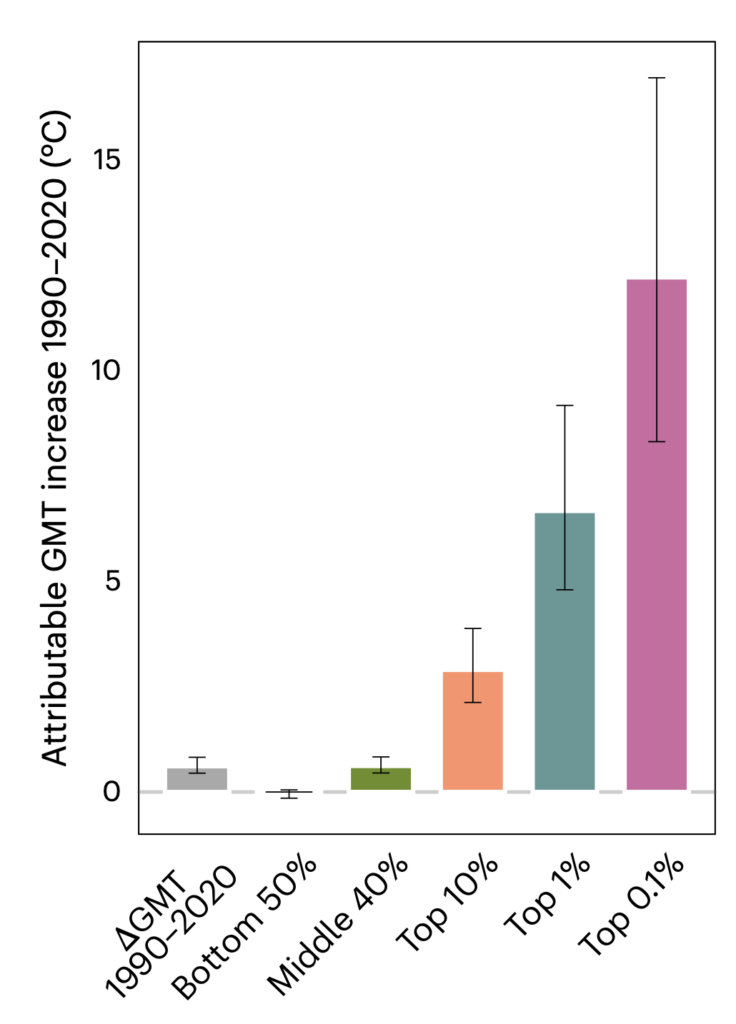
Of the 0.61C increase in global average temperatures over 1990-2020, the authors estimate that 65% was due to the emissions of the wealthiest 10% of people on the planet. For the wealthiest 0.1%, the estimate is 8%.
The graph below shows how much global temperatures would have risen over 1990-2020 if everyone in the world emitted as much as the world’s poorest 50% (purple), middle 40% (green), richest 10% (orange), richest 1% (blue) and richest 0.1% (pink) people. The grey bar shows how much global temperatures actually rose.
How global temperatures would have risen if everyone in the world emitted the world produced the same amount of emissions, on average, as individuals in the bottom 50% (purple), middle 40% (green), top 10% (orange), top 1% (blue) and top 0.1% (pink) of the world’s emitters. Source: Schöngart et al (2025).
The authors find that if the whole world had emitted as much as the wealthiest 10% of people over 1990-2020, global average temperatures would have risen by 2.9C, instead of 0.61C. If the global population had emissions as large as the wealthiest 0.1%, temperatures would have risen by 12.2C.
Meanwhile, the study calculates that if the whole world had emissions as low as the poorest 50%, global temperatures would have remained close to 1990 levels.
Hot and dry extremes
As greenhouse gas emissions cause the climate to warm, extreme weather events such as heatwaves and droughts are becoming more intense, frequent and long-lasting.
The authors use attribution – a field of climate science that aims to identify the “fingerprint” of global warming on these events – to determine the contribution of the emissions of the world’s wealthiest people to the increasing frequency of heatwaves and droughts.
The authors assess “extremely hot” and “extremely dry” months, defined as the most extreme 1% of months in a pre-industrial climate during the hottest month of the year regionally. (In a pre-industrial climate, only one of each extreme would be expected every 100 years on average.)
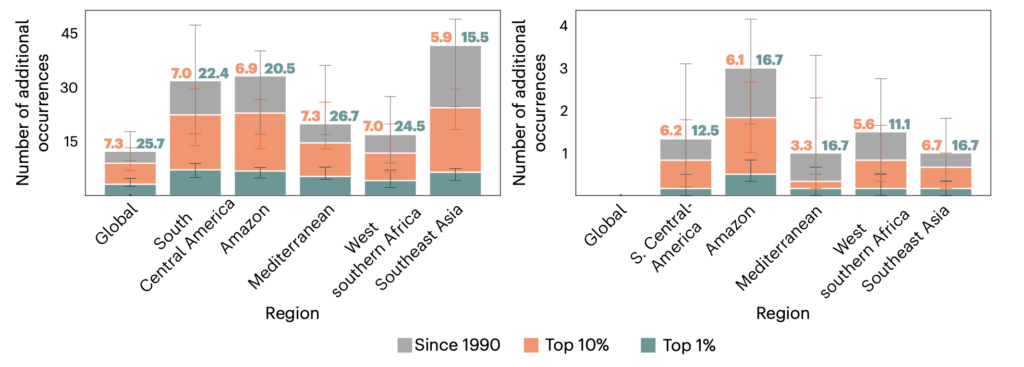
The graphs below show the number of additional heatwaves (left) and droughts (right) that have occurred since 1990 due to climate change in different regions of the world.
The full bar shows the total number of additional heatwaves due to human-cased climate change in each region. The green bar shows additional occurrences due to the wealthiest 1%. The green and orange bars combined show the wealthiest 10%.
The numbers in green and orange show how much the wealthiest 1% and 10% of the planet contributed to the extreme, compared to the global average. (For example, an orange number of 7.0 means that the wealthiest 10% of people contributed seven times more to the extreme event than the global average.)
The number of additional heatwaves (left) and droughts (right) that have occurred since 1990 in different regions of the world, caused by the wealthiest 10% (orange) and 1% (green) of the world’s population. The numbers in green and orange show how much more the wealthiest 1% and 10% of the planet contributed to the extreme, compared to the global average. Source: Schöngart et al (2025).
The study finds that an average of 11.5 additional heat events observed in August – the month where the rise in heat extremes is, on average, most pronounced – are attributable to the wealthiest 10%.
It also calculates that emissions from this group resulted in, on average, an additional 2.3 droughts in the Amazon in October – the month with the strongest attributable drying trend in the region.
Highest emitters
The authors also assess the contributions of the wealthiest people to climate extremes on a country level, identifying the US, the EU, China and India as the world’s four highest emitting regions.
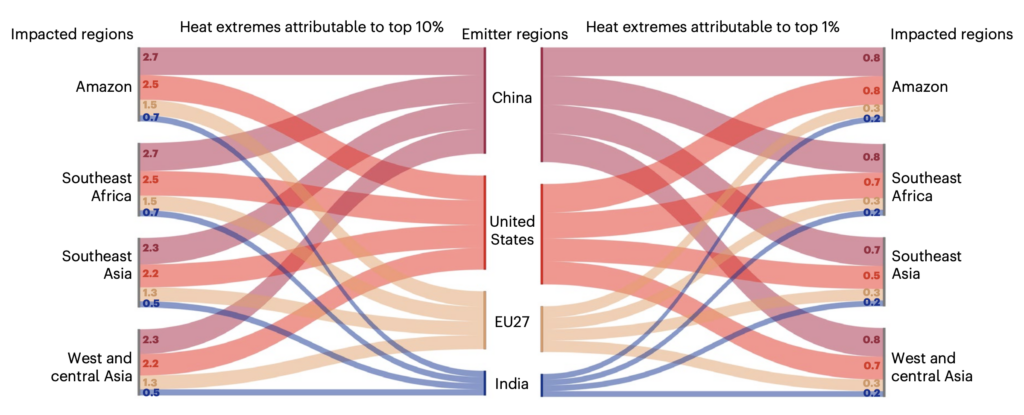
The graphic below shows the increase in frequency of one-in-100 year peak summer heat extremes in selected regions attributable to the wealthiest 10% of people (left) and 1% of people (right) in China (red), the US (pink), the EU (peach) and India (blue).
The increase in frequency of one-in-100 year peak summer heat extremes in selected regions that is attributable to the wealthiest 10% of people (left) and 1% of people (right) in China (red), the US (pink), the EU (peach) and India (blue). Source: Schöngart et al (2025).
Emissions from the wealthiest 10% in the US resulted in an average of 1.3 extra heat events globally, the authors find. However, this increase is distributed unevenly across the globe.
For example, the authors find this income group was responsible for the emissions that contributed to 2.7 additional heat events in “heat-affected areas” such as the Amazon and south-east Africa.
Emissions from the wealthiest 10% of people in the EU resulted in an additional 1.5 heatwaves in both the Amazon and south-east Africa.
Meanwhile, the Amazon faces 2.1 more heat extremes in 2020 than in 1990 due to the emissions of the richest 1% in the US, China, EU and India.
While inequalities between one country or region and another are well documented, it should also be noted that “inequalities within developing countries are increasing”, Dr Carl Schleussner, study author and leader of the integrated climate impacts research group at the International Institute for Applied Systems Analysis (IIASA), tells Carbon Brief.
For example, he notes that the paper shows “very high levels” of emissions from “the Chinese middle and upper classes”.
However, he says that many existing global frameworks to address climate change “treat countries as a whole” and fail to “differentiate” between income groups within countries.
Schleussner argues that the study highlights the need for “progressive policies” for climate action, which involve “tackling particularly high emitters” in all countries.
“Quantifying the contribution of individual income groups to global warming and changes in climate extremes is an important step towards targeted policies and further supports climate litigation. Supporting climate injustice with concrete numbers will hopefully help the most vulnerable and least responsible strengthen their case.”
Modelling inequalities
The study uses a range of methods to attribute changes in heat and drought to the emissions of particular wealth groups. To model global greenhouse gas emissions by wealth group, the paper uses a “wealth-based carbon inequality assessment” from a 2022 study.
The study uses income and wealth inequality dataset from the World Inequality Database to track inequality over 1990-2019. It combines economic data with information on per-capita carbon footprints – calculated using “input-output” methodologies combined with data from the “distributional national accounts” project.”
The model considers three factors. The first is private consumption – made up of emissions from the direct use of fossil fuels and emissions embedded into goods and services. The second includes emissions from government spending in that person’s country – such as government administration, public roads or defence. The final component of a person’s carbon footprint is from their investments.
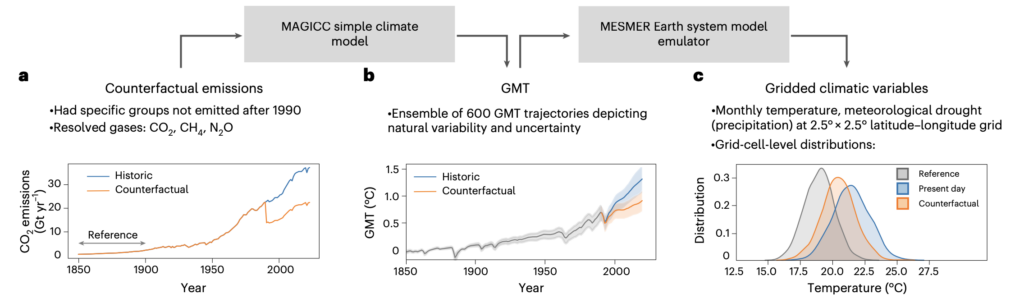
The authors then created a series of “counterfactual” emissions pathways, which imagine the world without the emissions of the wealthiest 10%, 1% and 0.1% of society, respectively. The emissions pathways include CO2, methane and nitrous oxide emissions, expressed as CO2-equivalent.
Lead author Schöngart tells Carbon Brief that including methane in the models is important, because it has “really high potency and near-term warming”. However, she notes that the team needed to make some assumptions about methane emissions – for example, assuming that each income group emits the same relative amount of methane compared to other greenhouse gas emissions.
Using a “simple” climate model called MAGICC, the authors model global average temperatures under these counterfactual emissions pathways. This allows them to calculate how much the planet would have warmed over 1990-2020 without the emissions of the 10%, 1% and 0.1% of society, respectively.
The authors use the global average temperature trends to produce temperature and rainfall data for every land-based grid square on Earth via a climate model emulator called MESMER.
Schöngart tells Carbon Brief that an emulator is “an approximation of an Earth system model” which “allows us to generate incredible amounts of data”, while using less computing power and taking less time to run.
The study authors then use attribution methods to identify how the emissions from the world’s wealthiest members of society have affected the frequency of heatwaves and droughts, by comparing the world as it is to a “counterfactual” world without human-caused climate change.
Earth system scientist Zscheischler praises the methods in the study. He tells Carbon Brief that “the main innovation of work lies in its novel combination of relatively simple emulators that capture the most important relationships between emissions and global warming and changes in extremes”.
He adds that emulators have been evaluated in other studies and are “trustworthy for this type of delicate analysis”.
Prof Wim Thiery – an associate professor at Vrije Universiteit Brussel, who was not involved in the study – also commends the use of emulators. He tells Carbon Brief that “producing the information presented in this study with a suite of full-blown Earth system models is impossible from a computational cost and human effort perspective”.