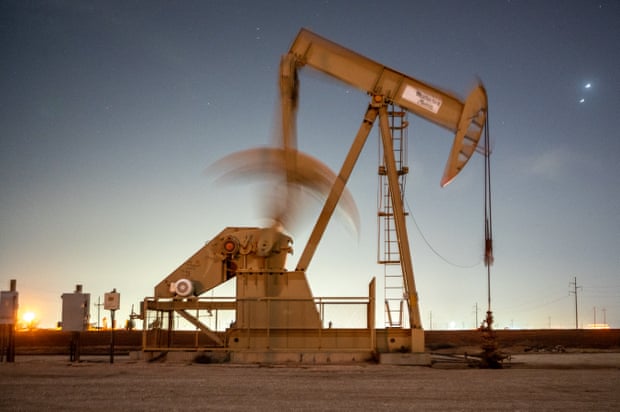
Expected greenhouse gas emissions from US oil and gas fields has jumped under Trump, after previously dropping under Biden, forecasts show. Photograph: Bloomberg/Getty Images
Tariff chaos hampers Trump’s pledge to ‘drill, baby, drill’, but analysis still shows surge in planet-heating emissions
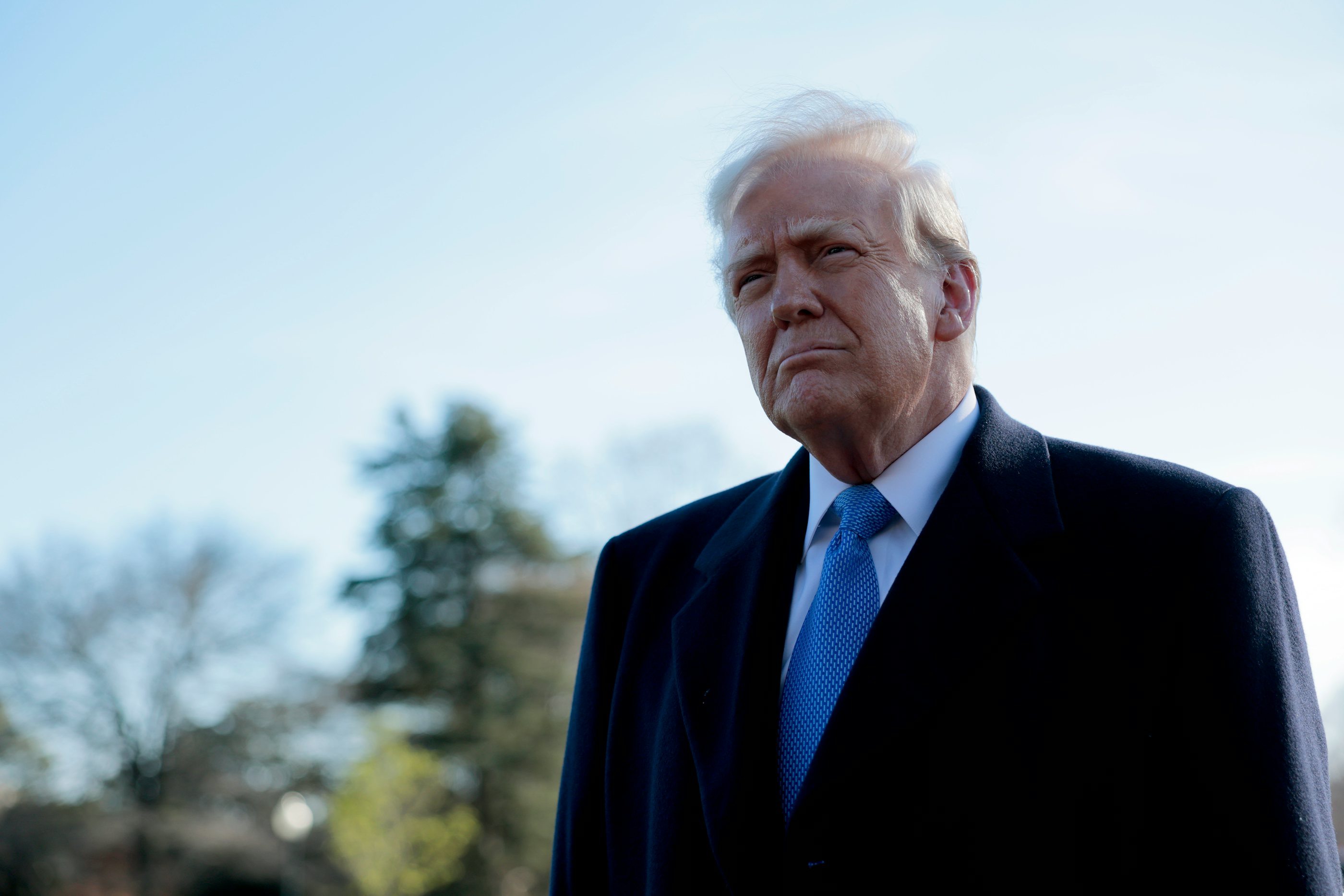
Donald Trump’s ambitions for the US to “drill, baby, drill” for more fossil fuels have ironically been hampered by the economic chaos unleashed by his own tariffs, but the US is still on track to increase oil and gas extraction, causing a surge in planet-heating emissions, a new analysis shows.
The US was already the world’s leading oil and gas power, producing more of the fossil fuels than any country in history during Joe Biden’s administration. But Trump has sought to escalate this further, declaring an “energy emergency” to open up more land and ocean for drilling and launching an unprecedented assault on environmental regulations in his first 100 days back in the White House.
This new political climate means that the expected amount of greenhouse gas emissions from active and planned projects in US oil and gas fields has jumped under Trump, after previously dropping under Biden, forecasts shared with the Guardian show.
Despite awarding more drilling leases than Trump in his first 100 days, Biden also pursued policies to combat the climate crisis that saw oil and gas companies revise down their production estimates. That situation has now reversed, threatening a pulse of new pollution that will further add to the fever of a planet already suffering from heatwaves, floods, droughts and other disasters accelerated by global heating.
“The uptick in embodied emissions from forecast US oil and gas production is worrying,” said Olivier Bois von Kursk, policy adviser at the International Institute for Sustainable Development, which tracks emissions projections from the lifetime of projects, based on data from research consultancy Rystad Energy. “The world can’t afford more climate chaos.”
…
The International Energy Agency, which has forecast that global oil and gas demand will peak by 2030, has said that no new major fossil fuel projects can occur if the world is to stay within agreed temperature limits and avoid catastrophic climate impacts. Last year was the hottest, worldwide, ever recorded and governments are collectively failing to meet targets to avert escalating disasters.
…
Tariffs on solar panels from Vietnam, Cambodia and Malaysia have been ratcheted up to as much as 3,521%. “We don’t want windmills in this country,” the president said shortly after his inauguration in January. “We don’t want windmills. You know what else people don’t like? Those massive solar fields.”
Neo-Fascist Climate Science Denier Donald Trump says Burn, Baby, Burn.Elon Musk urges you to be a Fascist like him, says that you can ignore facts and reality then.Orcas discuss Donald Trump and the killer apes’ concept of democracy. Front Orca warns that Trump is crashing his country’s economy and that everything he does he does for the fantastically wealthy.
What’s not to like about an all-female celebrity crew riding a rocket into space? Quite a lot, as it turns out.
Katy Perry and her companions were initially portrayed in the media as breaking down gender barriers. On their return to Earth, the team enthused about protecting the planet and blazing a trail for others. Perry even sang What a Wonderful World during the flight, and kissed the ground on exiting the spacecraft.
But the backlash was swift. Fellow celebrities piled in to highlight the “hypocrisy” of such an energy-intensive endeavour from a former Unicef climate champion. Evidence was quickly presented to dispute the pollution-free claims of the Blue Origin rocket, which is fuelled by oxygen and hydrogen. (In fact, the water vapour and nitrogen oxide emissions it creates add to global heating, on top of the emissions from the programme as a whole.)
But it’s the negative social effects of this kind of display from celebrities (of any gender) that our research sheds light on. I’m part of a team of social scientists researching the powerful effects of politicians, business leaders and celebrities who lead by example on climate change – or don’t.
Social kickback
Space tourism, and other energy-intensive activities by people in the public eye, such as using helicopters and private jets, have a much wider knock-on effect than the direct damage to the climate caused by the activity itself.
We carried out focus groups with members of the public to understand their reactions to the high-carbon behaviour of leaders in politics, culture and business. We also conducted experiments and surveys to test the effects of leaders “walking the talk” on climate change. We found that observing unnecessary high-carbon behaviour demotivates people and reduces the sense of collective effort that is essential for a successful societal response to climate change.
Solving climate change and other environmental crises requires fundamental changes to economies, societies and lifestyles according to climate science. Using much less energy, not just different kinds of energy, can play a big part in halting the damage. And it is the wealthiest people in the richest countries who use the most energy and set the standards and aspirations for the rest of society. That’s why the Blue Origin dream (of space exploration for the unfathomably wealthy) is a nightmare for the climate because it perpetuates an unsustainable culture.
Our findings reveal that when people see public figures behaving like this, they are less willing to make changes to their own lives. “Why should I do my bit for the climate when these celebrities are doing the opposite?” is the question people repeatedly asked in our research.
Many of the changes to behaviour necessary to tackle climate change will require people to accept trade-offs and embrace alternative ways of living. This includes using heat pumps instead of gas boilers, trading in large, fossil-fuelled vehicles (or even avoiding cars altogether) and forgoing flights – because there is no way to decarbonise long-distance flights in time.
When celebrities (or politicians and business leaders, for that matter) ignore the environmental damage of their choices, it sends a powerful signal that they are not really serious about addressing climate change.
Not only does this undermine people’s motivation to make changes, it reduces the credibility of leaders. That in turn makes coordinated climate action less likely, because shifting to a low-carbon society will require public trust in leadership and a sense of collective effort.
Individual choices matter
The widespread aversion to Perry’s space flight contradicts the popular argument that tackling the climate crisis “is not about individual behaviour”.
On the contrary, the response shows that these actions from celebrities and other leaders have much greater symbolic meaning than is captured by the idea of an “individual choice”. People are highly attuned to the behaviour of others because it signals and reinforces the values, morals and norms of our society. As such, few if any choices are truly “individual”.
This message of collective responsibility is one our current economic and political system works hard to suppress by championing unlimited freedom to consume, while ignoring the loss of freedom that such behaviour causes: freedom to live in a stable climate, freedom from pollution, freedom from extreme weather, freedom for future generations.
In fact, research reveals that most people understand the interconnectedness of society and the need for a coordinated response to the climate crisis. Climate assemblies, which convene ordinary citizens to discuss and deliberate a course of climate action, have revealed a willingness to curtail some activities in a fair way.
When it comes to preserving a liveable planet and a stable climate, most people know that space tourism and ultra-high-carbon living are off the agenda. Celebrities have a positive role to play in leading by example. It’s not rocket science.
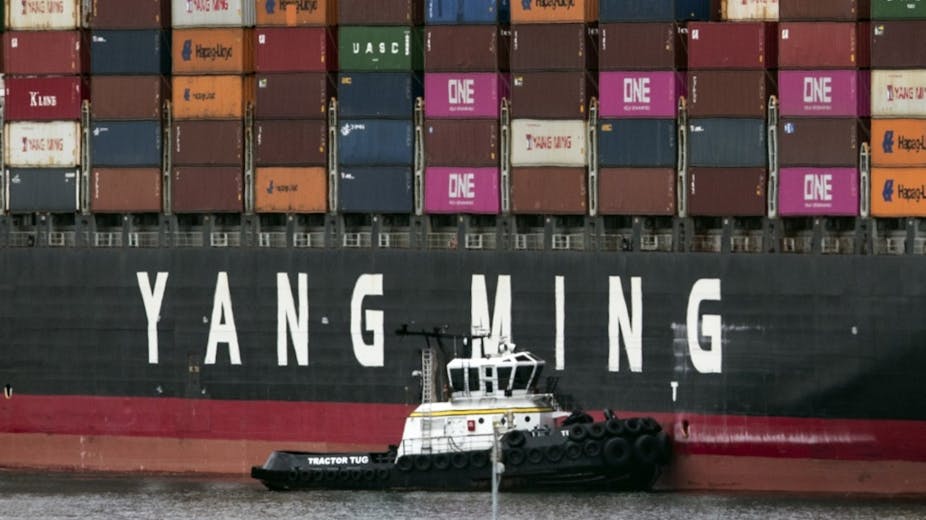
US ports are now starting to see scheduled shipments from China decline as the result of Donald Trump’s 145% tariffs on Chinese goods. The port of Los Angeles, the biggest port for Chinese goods in the US, is predicting scheduled shipments in early May to be about a third lower than the same time last year.
Declining numbers of ships arriving stocked with Chinese imports are likely to affect US supermarket shelves soon, and after warnings from US supermarket bosses, Trump responded by saying trade talks between the US and China were under way in the past few days. But Chinese president Xi Jinping quickly denied talks were happening, suggesting he has no intention of backing away from a fight with the US.
As one of the most powerful leaders in the history of the People’s Republic of China, Xi has fashioned himself as a nationalistic icon. So if China perceives Trump’s tariffs as a bully tactic designed to undermine it, backing down from a confrontation with the US would seriously undermine Xi’s strongman image and rhetoric.
This is something that Trump probably hadn’t considered. At a rally marking his 100 days in office, the US president was still suggesting that China would just back down and “eat the tariffs”.
While tariffs appear to be the primary weapon in the trade war, China might have more tactics to hit back at Trump and the US economy. The question is what might they be?
A few weeks ago it seemed like Washington might punish China’s lack of willingness to negotiate with more tariffs, but now it’s clear that Trump is willing to make a deal and is trying to get China to come to the table. Trump is now implying that US tariffs on China could come down substantially. And US treasury secretary Scott Bessent has called the trade war with China “unsustainable”.
Leveraging agriculture and energy
China has reduced its reliance on US farm imports since the trade war began in Trump’s first presidency. This is bad news for Washington as agriculture is one few sectors in the US that actually has a large trade surplus with China. The 125% retaliatory tariffs will harm the sector’s profitability.
But China’s retaliatory tariffs aren’t the only issue American farmers have to contend with. As the trade war escalates, China has been using bureaucratic hurdles to restrict US agricultural products from entering China and as a potential negotiation tool. For instance, China has delayed the renewals of export license renewals of US pig farmers, and refused to renew licenses of poultry farmers for “health and safety” reasons.
Beijing’s actions might be designed to particularly hit the economy in core Trump supporting states. A major part of Trump and the Republican party’s base lies in “red states”, such as Nebraska, Iowa and Kansas, all have significant farming communities. Focusing on agricultural issues is a tactic that Beijing realises will hit home with Trump voters.
Out of the 444 US counties designated by the United States Department of Agriculture (USDA) as farming-dependent, 77.7% voted for Trump during the 2024 US presidential election. So, any hardship faced by the agriculture sector due to Trump’s own actions is likely to lose him support from a major political base. And with mid-term elections in 2026, Trump has to tread carefully when antagonising Beijing.
Another support base that Beijing might seek to undermine is those involved in the fossil fuel sector. In the past, the US has been a top supplier of natural gas to China.
China has not imported natural gas from the US since early February 2025, and has sought its natural gas from Australia, Indonesia, and Brunei. As the trade war continues, it is unlikely that the US would be able to sell its natural gas to China anytime soon, and this will have an impact on the energy industry – one of Trump’s major political support bases.
Restricting minerals
Another huge problem that the US faces stems from China’s restriction of the export of critical minerals. They include seven rare earth minerals namely samarium, gadolinium, terbium, dysprosium, lutetium, scandium and yttrium. While these are used in the clean energy and automobile sectors, the biggest concern would come from the US defence complex.
The White House probably anticipated export restrictions of critical minerals from China. After all, Beijing had banned the export of critical minerals to Japan in 2010 over a fishing trawler dispute, and stopped exporting “dual-use” metals that can be used to produce civilian and military technology, such as gallium, germanium and tungsten.
What’s next?
For the last few years, China has been trying to overcome an ailing economy that was primarily fuelled by a real-estate crisis. Trump probably expected China to buckle under pressure and come crawling to the negotiation table. After all, the Chinese Communist Party needs to fix its economy fast. The establishment has long relied on delivering economic prosperity to legitimise its rule over China.
Right now the tit-for-tat battle continues. By April 11, US tariffs on China peaked at 145%, while China’s retaliatory tariffs on US goods reached an unprecedented 125%.
Although it is clearly fighting back, China could go even further by selling off US treasuries and increasing US interest rates and thus borrowing cost. But unlike Trump, Xi often plays the long game. After all, Trump’s term as president will be over in less than four years, while Chinese president Xi has no term limits. All the latter has to do is exercise patience, and a friendlier US president might come around.
The Trump administration is a serious threat to democracy. They’re also laughably incompetent. But the result is no laughing matter.
…
Clown-show fascism describes a regime marked simultaneously by hubristic and defiant assaults on the democratic and constitutional order on the one hand and, on the other, a nearly laughable incompetence in just about every other area of the regime’s activity. The first characteristic certainly applies to the Trump administration, and it’s chilling and frightening and not at all funny. Just ask Mahmoud Khalil.
Yet at the same time, in other areas, the incompetence has been staggering. Trump’s constant about-faces and walk backs on tariffs have been an international embarrassment. Elon Musk’s DOGE has fired federal workers willy-nilly only to turn around and rehire many after the Musketeers realized they weren’t deep-state bloodsuckers and the work they did was kind of essential, after all—you know, like the people who tend the country’s nuclear weapons stockpile.
It can be hilarious to watch. But it carries two consequences that are no laughing matter.
First and more obviously, we have the prospect of the impact of Trump’s tariffs policy on real people. Will they cause inflation and a recession, as most experts now believe? As fate would have it, Trump will go to bed the night of his 100th day in office—Tuesday—and wake up the very next morning to the release of the first-quarter GDP number. Economists expect anemic results. The Atlanta Fed even predicts negative growth, around -2.5 percent. During Trump’s first week in office, its forecast nudged a gaudy 4 percent, but the president’s actions have liberated that figure ever downward.
Second and more insidiously: Even the gross incompetencies take us into treacherous territory because they contribute to making this all about one man, the man who must be in front of the cameras every day. He doesn’t have policies so much as he has urges, which he must announce to the world on a constant basis in a desperate plea that we keep him front of mind at all times. Some of those urges are cruel; some of them are a joke. What unites them is that they make the story entirely about him.
That is not how it’s supposed to work in democracies. Which we still are, for now, as we reach this 100-day mark. Only 1,361 to go.
Neo-Fascist Climate Science Denier Donald Trump says Burn, Baby, Burn.Elon Musk urges you to be a Fascist like him, says that you can ignore facts and reality then.
Original article by Roger Hallam republished from Roger Hallam. I have not asked to republish this article, expect that it will be ok.
Shymkent, Kazakhstan. Image by Raban Haaijk.
This month, the world’s elites will throw the first dice on how many millions they will have killed for their greatest of all crimes.
As of 28 April 2025, Asia is being battered by a brutal, life-threatening heatwave. Millions of people – right now – are facing unbearable temperatures. In many places it’s over 40°C. In some areas it’s approaching 46°C. In the Philippines, the heat index – the ‘feels like’ temperature – is hitting 53°C. That’s deadly.
People are collapsing in the streets. Children, the elderly, the poor – they’re the first to go. This isn’t just uncomfortable. It’s lethal. Heatstroke. Organ failure. Death in under six hours if you don’t have air conditioning – and most people don’t.
Crops are failing. Water supplies are drying up. Whole regions are becoming uninhabitable. In China, places like Zhejiang and Jiangsu have already hit record-breaking temperatures. In Bangladesh, Myanmar, Thailand – vast populations are at risk. In West Asia, where conflict and poverty already devastate lives, the heatwave is tipping people over the edge.
Let’s be absolutely clear: this is just the beginning. And it’s not a natural disaster – it’s a crime scene. A direct result of thirty years of lies, inaction, and wilful destruction by the people at the top – fossil fuel executives, politicians, and the liberal classes who let them get away with it.
This is the first phase of climate genocide. And it’s happening now.
So here we are. We’ve finally arrived.
2025 will be the second year in a row that global temperatures sit above 1.6°C. That’s not a statistic. That’s a death sentence – for millions. From this point on, every month is a roll of the dice. And if it lands on a six? The wet bulb threshold is breached – that deadly combination of heat and humidity where your body can’t cool down. People without air conditioning – the majority of humanity – die in six hours. That’s it. Game over.
Billions of people – in poor city slums, in rural villages, in places no one in power cares about – are now inside a roulette wheel of death. Waiting for their number to come up. That is what the ruling elites have created. That is what the liberal and professional classes have enabled – through cowardice, distraction, and silence. They could have stood up. They could have resisted. They chose not to. They are complicit.
The consequences? Beyond catastrophic. And if you sit back now, shrug your shoulders, and go back to your life – you are handing over the final keys. You are helping to lock in human extinction within the next ten years. If it hasn’t already been sealed.
Let’s stop pretending we don’t know what’s coming.
Do the numbers. We’re already at 1.6°C. Another 0.4°C rise is expected over the next decade. Add 0.5°C when air pollution clears and no longer cools the atmosphere. Add 0.3°C from the carbon lag – the delay between what we emit and when it shows up. Then add the collapse of forests, the melting permafrost, the methane, the wildfires.
We’re on track to blow through 3°C before 2050.
What does that mean? Ask the British insurance industry – they’ve already said it: 4 billion people dead. Half the human race. And that’s just the start. Because 3°C triggers feedbacks in the Earth system that take us past 5°C – the point where the human body, the human brain, life itself, no longer functions. That’s extinction. Everyone. Gone. Forever.
And even if there was just a 10% chance of this happening – which there isn’t, it’s now the central scenario – then to take that risk, to sit on your hands, is the greatest crime in history.
And if you still do nothing now, at this moment – then what are you?
Rev21 is hosting an online global convention this May, bringing together leading activists, writers, scientists, and changemakers to confront the realities of social and ecological collapse—and to begin designing the revolution we need. Held via Zoom with multiple talks, workshops, and breakout spaces, it’s a space to learn, connect, and collaborate on what 21st-century revolution can look like: holistic, nonviolent, and rooted in real relationships. For some, it’s a powerful networking moment; for others, it’s a first step into serious action. With solidarity pricing and an open invitation to those ready to shape the future, this isn’t just an event—it’s the beginning of a revolution.
Original article by Roger Hallam republished from Roger Hallam. I have not asked to republish this article, expect that it will be ok.
Neo-Fascist Climate Science Denier Donald Trump says Burn, Baby, Burn.Elon Musk urges you to be a Fascist like him, says that you can ignore facts and reality then.