6 Billionaire Fortunes Bankrolling Project 2025

Spread the love

Original article by Joe Fassler republished from DeSmog
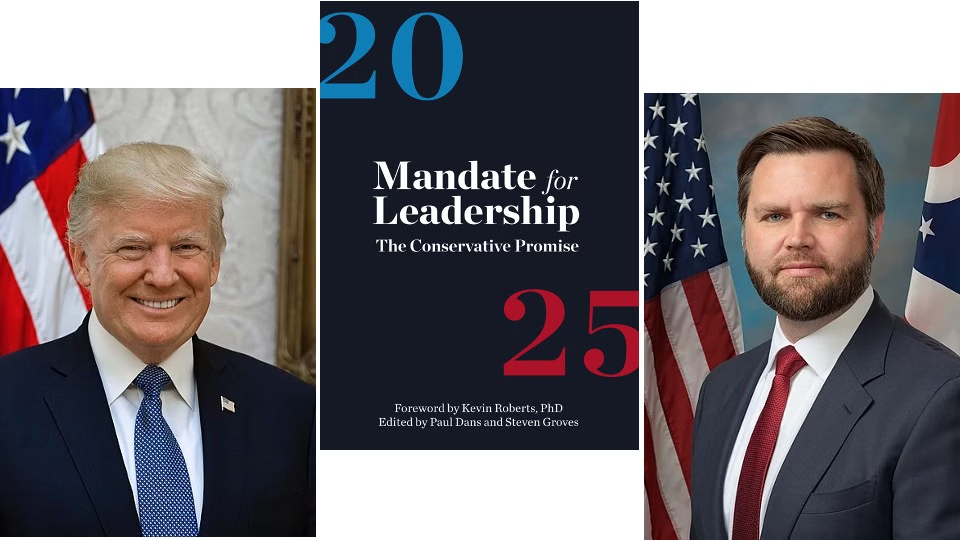
More than $120 million from a few ultra-wealthy families has powered the Heritage Foundation and other groups that created the plan to remake American government.

Since 2020, donor networks linked to just six family fortunes have funneled more than $120 million into Project 2025 advisory groups, a DeSmog analysis has found. 

More than 100 nonprofits led by the Heritage Foundation, a right-wing think tank that has engaged in climate change denial and obstruction for decades, have signed on as advisors to the Project 2025’s 900-page “Mandate for Leadership” document — a plan to rapidly “reform,” or radically alter, the U.S. government by shuttering bureaus and offices, overturning regulations, and replacing thousands of public sector employees with hand-picked political allies. 

In its official Project 2025 materials, Heritage Foundation leadership repeatedly draws attention to the size and diversity of its advisory board, suggesting that its numerous “coalition partners” are part of a broad, “movement-wide effort” representing a variety of independent viewpoints.  

“Project 2025 is unparalleled in the history of the conservative movement—both in its size and scope but also for organizing [so many] different groups under a single banner,” the organization wrote in an October 2023 press release

But an analysis of financial disclosure forms shows the same small group of donors supporting Project 2025’s advisors again and again — hardly a sign of ideological diversity. Of the 110 nonprofits formally supporting Project 2025, almost 50 received major donations from the same six sources of wealth since 2020.

Many of the organizations the six families funded also have close ties to Donald Trump and his running mate, Ohio Senator JD Vance, DeSmog found. Trump has repeatedly denied involvement in or knowledge of Project 2025, though that position conflicts with a growing number of news reports — a disavowal made more awkward by the fact that Vance wrote the foreword to Dawn’s Early Light, a forthcoming book by Heritage Foundation president Kevin D. Roberts that describes his Project 2025 vision. DeSmog’s review of Project 2025’s financial backers found additional links to Trump, Vance, and key figures in their orbit that had not been previously known. 

These six donor networks, linked to the family fortunes of a handful of wealthy industrialists, have spent years working to loosen environmental regulations and promote climate change denial. Though Heritage describes Project 2025 as a mainstream effort to “return government to the people,” its funding sources suggest something far less populist: a vehicle for the obsessions of ultra-rich donors on the far-right fringe, pushing an agenda to reshape American democracy and overturn regulations needed to maintain a livable climate.

Representatives from the six donor networks did not respond to DeSmog’s outreach on this story. The Heritage Foundation did not reply to a request for comment. 

The Coors Family 
At least $2.7 million to Project 2025 groups since 2020 

In 1972, Joseph Coors, grandson of Coors Brewing Company founder Adolph Coors, kick-started the Heritage Foundation with an initial gift of $250,000. For years, he supported the conservative think tank’s growth, ultimately funneling his funds through the Adolph Coors Foundation, the nonprofit he started with his brother Bill in 1976. 

“There wouldn’t be a Heritage Foundation without Joe Coors,” former Heritage president Edwin J. Feulner wrote in a 2003 tribute.  

Joseph Coors meets with Ronald Reagan in 1981. Credit: Wikipedia

The tradition continues today, with billionaire Peter H. Coors — retired beer magnate and Adolph’s great-grandson — at the helm. The Adolph Coors Foundation funded 22 Project 2025 advisory groups between 2020 and 2023, including $300,000 to the Heritage Foundation. Vance has been connected to Heritage since at least 2017, when he wrote the forward to that organization’s “Index of Culture and Opportunity” and gave a keynote address at a Heritage event promoting the report.  

Of the Project 2025 groups, Coors funded Hillsdale College, which The New Yorker called “the Christian liberal-arts college at the heart of the culture wars,” most heavily, with nearly $900,000 in donations since 2020. Former Heritage staffer James Braid, today Vance’s deputy chief of staff and legislative director, spent 10 months as a James Madison fellow at Hillsdale College in 2021. Braid appeared on camera in a Project 2025 training video recently obtained by ProPublica and Documented. Braid was also an advisor at American Moment, another Project 2025 group. 

The Coors Foundation gave an additional $5.9 million to DonorsTrust, a not-for-profit that describes itself as a philanthropic partner for conservative and libertarian donors — and that gives hundreds of millions of dollars to conservative causes annually, including to numerous Project 2025 advisors, as well as other organizations that downplay or deny the science and urgency of climate change. 

Charles G. Koch 
At least $9.6 million to Project 2025 groups since 2020 

In terms of raw numbers, Charles Koch — the CEO and chairman of Koch Industries, a sprawling conglomerate with an oil refinery focus — isn’t the biggest donor to Project 2025 groups in the past few years. But his support for the vast fundraising apparatus that powers conservative charities, including dozens of the initiative’s coalition partners, goes back decades, and his influence can’t be underestimated. A review of public financial disclosures by Greenpeace found that the network of charitable foundations linked to Koch and his late brother, David Koch, donated more than $165 million to climate-change-denying groups between 1986 and 2018. That includes more than $23 million to 16 nonprofits that Project 2025 lists among its advisors. 

Throughout the 1990s, Koch Industries was also a “vital supporter” of the American Legislative Exchange Council (ALEC), a Project 2025 advisor. A membership group that connects more than 2,000 state legislators to over 300 corporations and private foundations, ALEC calls itself “a forum for stakeholders to exchange ideas”; New Yorker investigative journalist Jane Mayer, in her book Dark Money, describes it as an enormously successful effort “aimed at waging conservative fights in every state legislature in the country.” Foundations linked to Charles G. Koch donated more than $1.2 million to ALEC since 2020, Desmog’s review found, mostly through his Stand Together Trust

Charles Koch in 2019. Credit: Wikipedia

Koch’s largest donations to Project 2025 groups since 2020 included $3.8 million to the Texas Public Policy Foundation (TPPF), a climate-change-denying nonprofit with close links to both the Heritage Foundation and the Trump administration. In 2018, Trump tapped Brooke Rollins, TPPF’s CEO since 2003, for a post at the Office of American Innovation; in 2020, he named her to lead his administration’s domestic policy strategy. By 2019, there were so many connection points between TPPF and the Trump administration that Politico’s E & E News wrote a story about it. 

Rollins was succeeded at TPPF by Kevin Roberts, who had been promoted to CEO by 2021, when he left to become president of The Heritage Foundation. Koch-linked nonprofits also donated $845,000 to Heritage since 2020. 

Richard and Elizabeth Uihlein
At least $13 million to Project 2025 groups since 2020

The Uihleins are co-founders of Uline, a company that sells shipping and packing supplies — including its ubiquitous brand of cardboard boxes — and other bulk business goods. They donate heavily to conservative causes through the Ed Uihlein Foundation, named after Richard’s father, a packaging company entrepreneur whose grandfather was an original founder of the Schlitz beer company. 

Among its donations to 13 different Project 2025 groups since 2020, Uihlein’s largest grants went to the Foundation for Government Accountability ($6.6 million), a limited-government think tank that has railed against “the Biden administration’s radical climate agenda,” and the American Cornerstone Institute ($2.5 million), founded by neurosurgeon and former Trump cabinet member Dr. Ben Carson. Carson has called climate change “irrelevant” as recently as 2015. 

Outside the nonprofit sphere, the Uihleins are major donors to the Trump campaign. An analysis of Federal Election Commission data showed that the couple donated $10 million to Make America Great Again, Inc., a pro-Trump super PAC, in May 2024. 

The Scaife Family
At least $21.5 million to Project 2025 groups since 2020

Richard Mellon Scaife died in 2014, but his contribution to conservative causes is still felt today. A billionaire heir to the vast Mellon fortune, which was created thanks to his progenitors’ exploits in oil and aluminum production, banking, and other industries, Scaife provided years of critical financial support to the Heritage Foundation, starting in 1973. A 1999 article in the Washington Post called him the “funding father of the Right.” 

Today, two foundations Scaife once controlled — the Sarah Scaife Foundation and the Allegheny Foundation — continue to give heavily to conservative causes, including to numerous organizations involved in climate change denial. DeSmog’s review found that Scaife family foundations gave $4.1 million to the Heritage Foundation since 2022, while also contributing to 22 other Project 2025 advisory groups. 

Since 2020, Scaife Family Foundations gave $1.75 million to the Intercollegiate Studies Institute (ISI), a Project 2025 advisor that promotes conservative thought on college campuses. Paypal founder Peter Thiel, who pumped at least $15 million into JD Vance’s campaign for Senate, is an ISI alum who maintains close ties to the organization. Vance himself gave an ISI-sponsored lecture on “our civilizational crisis” in 2021, where he promoted his controversial idea that Americans with children should receive more votes

Scaife foundations also donated an additional $1.2 million to the State Policy Network, an ALEC-linked group that supports conservative nonprofits that oppose government regulation, including 25 members of Project 2025’s coalition. 

Barre Seid
At least $22.4 million to Project 2025 groups since 2020

The enigmatic industrialist Barre Seid primarily built his fortune through his company Tripp Lite, an electronics manufacturer specializing in surge protectors. He is reportedly a major benefactor supporting the Heartland Institute, a Project 2025 advisor organization that The Economist called “the world’s most prominent think tank supporting skepticism about man-made climate change” — a description Heartland approvingly quotes on its website.

In late 2020, Barre donated 100 percent of Tripp Lite’s shares to Marble Freedom Trust, a nonprofit controlled by Federalist Society co-chairman Leonard A. Leo. In early 2021, Leo sold the shares, netting $1.65 billion. The amount is said to be “among the largest — if not the largest — single contributions ever made to a politically focused nonprofit,” according to The New York Times. 

Since May 2020, Marble Freedom Trust has donated $100 million to Concord Fund, also known as the Judicial Crisis Network, a Leo-linked nonprofit. In that time, Concord has donated $22.4 million to eight Project 2025 groups, giving most heavily ($11.9 million) to Susan B. Anthony Pro-Life America. 

Seid also gave $2 million to Independent Women’s Voice, the sister organization of Independent Women’s Forum, a Project 2025 advisor. During her time as director for the Independent Women’s Forum’s Center for Energy and Conservation, Mandy Gunasekara, a former Trump administration Environmental Protection Agency official, authored Project 2025’s chapter on restructuring the EPA — with recommendations that include “cutting its size and scope” dramatically.

The Bradley Family 
At least $52.9 million to Project 2025 groups since 2020 

The Lynde and Harry Bradley Foundation was originally established in 1942 by brothers Lynde and Harry Bradley, founders of the Allen-Bradley company, which made its fortune manufacturing a wide range of electronic products. Their descendants have continued to financially support the foundation for years to come, including with a reported $200 million gift in 2015. 

But it was Michael W. Grebe, who served as CEO of the foundation between 2002 and 2016, who cemented its reputation as a conservative powerhouse, steering donations to a network of activist organizations like The Heritage Foundation, the Mackinac Center for Public Policy, and the Heartland Institute (all Project 2025 coalition partners). The current chairman is James Arthur “Art” Pope, CEO of the North Carolina grocery chain Variety Wholesalers, a longtime Koch ally. 

The Bradley Foundation and a second philanthropic vehicle it supports, the Bradley Impact Fund, donated over $50 million to 29 different Project 2025 advisors since 2020. That’s not including an additional $56 million to DonorsTrust, which a 2013 Mother Jones investigation dubbed, along with its affiliate group Donors Capital Fund, the “dark money ATM” of the U.S. conservative movement. 
The Bradley Foundation’s Project 2025-linked donations include more than $7.7 million to Turning Point USA, a “powerful ally” of the Trump presidential campaign, which promotes conservative causes on university campuses and is funded in part by the fossil fuel industry. Its single largest donation was $27.1 million in 2022 to Project 2025 advisor Turning Point Legal, founded by former Trump advisor, and past president of a coal lobby group, Stephen Miller.

Original article by Joe Fassler republished from DeSmog
Continue Reading6 Billionaire Fortunes Bankrolling Project 2025

Peer gave Keir Starmer more clothes worth £16,000, declared as money for private office

Spread the love

https://www.theguardian.com/politics/2024/sep/27/peer-gave-keir-starmer-more-clothes-worth-16000-declared-as-money-for-private-office

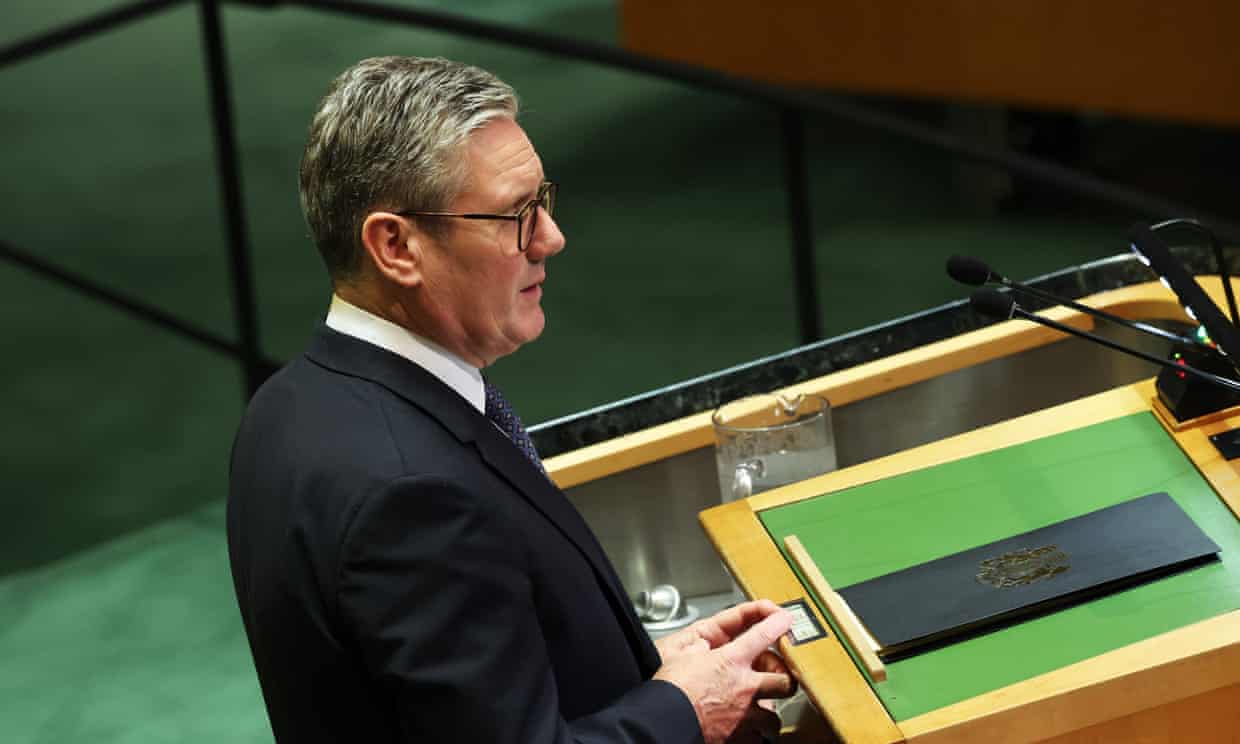
It is understood that Starmer has sought advice from the registrar of MPs’ interests and that the donations will be recategorised as donations in kind of clothing. Photograph: Michael M Santiago/Getty Images

Keir Starmer was given a further £16,000 worth of clothes by the Labour peer Waheed Alli, which was declared as money for his private office, the Guardian can reveal.

The donations, comprising £10,000 in October 2023 and £6,000 in February 2024, bring the total amount in gifted clothes to £32,000.

These latest gifts were not previously known about as they were described as being “for the private office of the leader of the opposition”.

The revelation is likely to reignite a row over the extent of donations that Starmer and some of his frontbench team acccepted while in opposition, much of it from Alli.

He has also been criticised for accepting tens of thousands of pounds’ worth of football and concert ticket freebies while leader of the opposition. His wife, Victoria, also received clothes as donations, as did Rachel Reeves, the chancellor, and Angela Rayner, the deputy prime minister.

https://www.theguardian.com/politics/2024/sep/27/peer-gave-keir-starmer-more-clothes-worth-16000-declared-as-money-for-private-office

Continue ReadingPeer gave Keir Starmer more clothes worth £16,000, declared as money for private office

Ending Oil Subsidies, Taxing the Rich Could Help Free Up $5 Trillion a Year for Climate: Report

Spread the love

Original article by Jake Johnson republished form Common Dreams under Creative Commons (CC BY-NC-ND 3.0).

Wildfires are seen in San Marcos Sierra, Cordoba province, Argentina, on September 23, 2024. (Photo: Stringer/AFP via Getty Images)

“The real question isn’t whether we can afford to act, but whether we can afford not to.”

Research published Tuesday estimates that rich countries could mobilize over $5 trillion a year for climate action worldwide by cutting off subsidies to the oil and gas industry, imposing a levy on big polluters, and cracking down on tax evasion by large corporations and the rich.

The new report from Oil Change International (OCI) was released as world leaders gathered in New York City for high-level United Nations General Assembly talks, a meeting that comes less than two months before the COP29 climate summit in Azerbaijan.

OCI’s research, which includes a fact sheet outlining various proposals to raise funds for climate action, stresses that “there is no shortage of public money available for rich countries to pay their fair share on fair terms for climate action at home and abroad.”

“The urgency and extent of growing economic inequality, unfair sovereign debt crises, climate disasters, and fossil fuel profits have created significant momentum towards many of these measures in international and domestic policy spheres,” OCI’s research brief notes. “Finance has been in the spotlight in most major international political fora in the past few years in recognition that our current financial architecture is a major driver of these overlapping crises.”

Among the proposals laid out in OCI’s brief are an equitable end to “public finance, direct subsidies, and state-owned company investments in fossil fuels,” which could raise $846 billion a year globally; a “climate damages tax” on fossil fuel extraction, which could raise $618 billion a year; a 25% minimum corporate tax rate, which could raise $479 billion annually; and a wealth tax on billionaires, which could raise roughly $2.60 trillion a year in the Global North and over $5.6 trillion worldwide.

Laurie van der Burg, OCI’s public finance lead, said that the rich nations most responsible for the climate emergency “owe this money to Global South countries that have not caused this crisis and need fair finance to deliver strong climate plans next year that phase out fossil fuels.”

“This is essential to avoid climate breakdown and save lives,” she added.

The COP29 climate summit will take place a year after nations agreed at COP28 to transition “away from fossil fuels in energy systems” in a “just, orderly, and equitable manner.”

The success of that pledge, OCI said, depends on rich nations contributing massively to global climate finance after years of falling short of their pledges and continuing to expand fossil fuel extraction and handouts. Worldwide, environmentally harmful subsidies—including fossil fuel subsidies—have surged to $2.6 trillion a year, according to a report released last week.

“Global North countries have a responsibility to redirect their share of these subsidies in support of climate action,” OCI said Tuesday.

The new report comes on the heels of a record-hot summer and amid devastating extreme weather, from massive flooding across Europe and Africa to wildfires in South America.

Andreas Sieber, associate director of policy and campaigns at 350.org, said Tuesday that “the real question isn’t whether we can afford to act, but whether we can afford not to.”

“It is a bitter irony that rich nations hide behind claims of fiscal restraint, yet trillions are still spent on fossil fuel subsidies and militarization,” said Sieber. “The truth is simple: the money exists, but the political will does not. By treating climate finance as a zero-sum game, wealthy countries not only deepen global inequality but also undermine their own futures.”

“The energy transition isn’t charity—it’s an investment in global stability and security,” Sieber added. “Ignoring the need for support only worsens the climate crisis, which knows no borders.”

Original article by Jake Johnson republished form Common Dreams under Creative Commons (CC BY-NC-ND 3.0).

Continue ReadingEnding Oil Subsidies, Taxing the Rich Could Help Free Up $5 Trillion a Year for Climate: Report

Fair taxes on private jets and superyachts could have raised up to £2bn last year, Oxfam finds

Spread the love

https://morningstaronline.co.uk/article/fair-taxes-private-jets-and-superyachts-could-have-raised-ps2bn-last-year-oxfam-finds

A private jet operated by Aeropartner, comes in to land at Stansted Airport in Essex

FAIR taxes on private jets and superyachts could have raked in £2 billion last year to help communities devastated by climate change, an Oxfam report revealed today.

Britain has the second-highest number of private jet flights in Europe, trailing only behind France.

Oxfam found that there were 192,052 private jet flights to and from Britain last year, not including those for medical, government, or military purposes.

According to climate charity Possible, flying by private jet can be up to 30 times more polluting than standard flights.

Oxfam also found that Britain is also home to 450 fuel-guzzling superyachts.

Indiana University academics found that a superyacht with a permanent crew, helicopter pad, submarines and pools emits an estimated 7,020 (US) tonnes of CO2 a year. In comparison, petrol cars produce about 1,749kg a year.

Oxfam is calling on Chancellor Rachel Reeves to increase taxes on the super-rich using these modes of transport, and redirect the funds to help tackle the climate emergency, while preventing lower-income families from shouldering the burden.

https://morningstaronline.co.uk/article/fair-taxes-private-jets-and-superyachts-could-have-raised-ps2bn-last-year-oxfam-finds

Continue ReadingFair taxes on private jets and superyachts could have raised up to £2bn last year, Oxfam finds

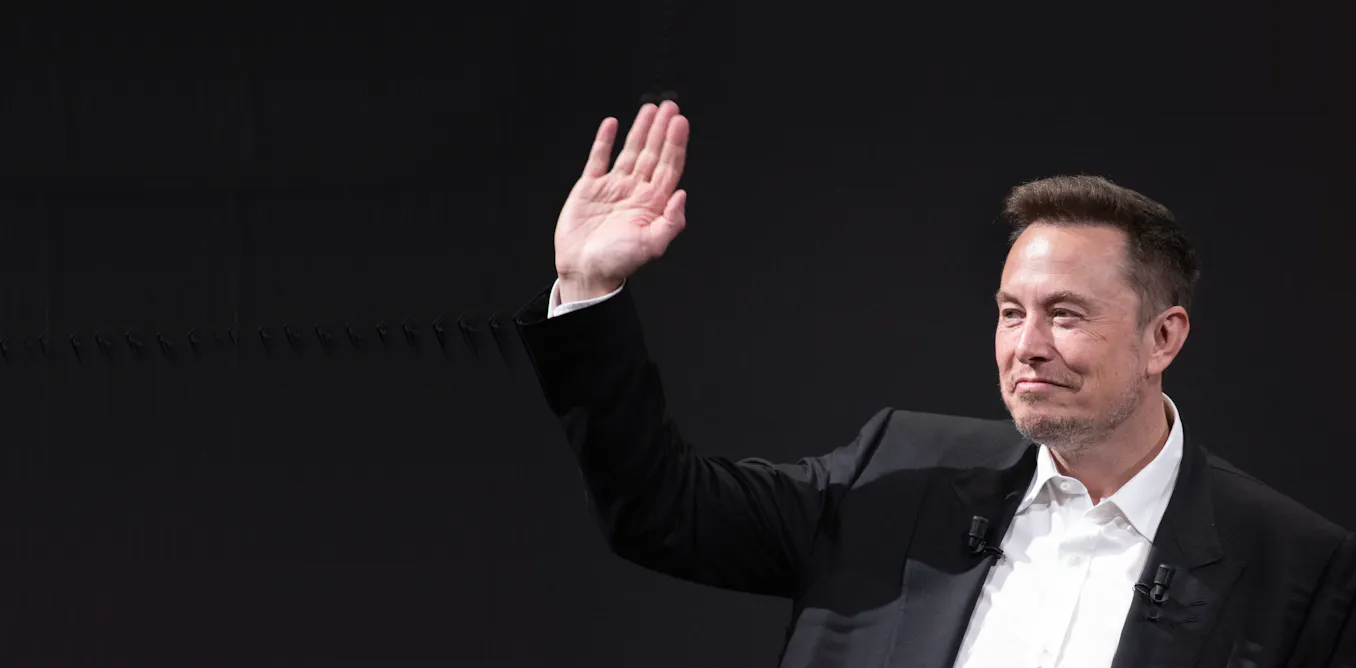
Tech billionaire Elon Musk is on track to become the world’s first trillionaire. It’s a sign markets aren’t working

Spread the love
FredericLegrand/Shutterstock

Richard Denniss, Crawford School of Public Policy, Australian National University

Apparently, the world is about to get its first trillionaire.

A report from the business intelligence agency Informa Connect says, at his present rate of wealth accumulation, tech billionaire Elon Musk is on track to be the world’s first trillionaire, three years from now.

At the moment Musk is said to be worth US$195 billion (A$293 billion), but if his wealth continues growing at the recent rate of 110% per year, he will hit US$1.195 trillion in 2027.

The next trillionaire after Musk should be Indian mining magnate Gautam Adani, followed by Nvidia chief Jensen Huang and Indonesian mining mogul Prajogo Pangestu, all of whom are on track to hit the milestone in 2028.

The nearly 1 billion human beings who don’t yet have electricity connected to their homes will doubtless be looking on with interest as the tech bros and mining bosses vie to crack 13 digits.

Before examining how it is that someone could ever make a trillion-dollar fortune, and what it might mean for the world for so much of the world’s wealth to be held in the hands of one person, it is important to first try to comprehend how big a trillion actually is.

One trillion seconds last 31,000 years

A million is a big number: it is 1,000 thousands. If you managed to retire with that many dollars in superannuation, you would have saved up more than 90% of your fellow retirees.

One billion is 1,000 millions. It takes 12 days for a million seconds to pass, but 31 years for a billion seconds to tick over.

That means a trillion seconds would equal 31,000 years.

If you had $1 trillion and did no more than stick it in the bank where it earned 4% interest per year you would get $40 billion per year in interest.

No one needs $1 trillion, and it is hard to see how anyone could spend it as fast as it grew, which raises important questions about how societies, economies and democracies will be able to function if and when governments allow trillionaires to emerge.

For mortals, a trillion is hard to justify

The palace at Versaille could have cost $300 billion in today’s dollars. WikimediaCommons, CC BY-NC-SA

France’s King Louis XIV spent today’s equivalent of US$200 billion-300 billion building his palace at Versailles, and it was by no means his only palace.

Pyramids and sphinxes didn’t come cheap either, but these sorts of expenditures were seen as needed for beings selected by gods and not entirely mortal.

For mortals, some believe that the entire population benefits when a small minority controls most of the resources on the basis that it builds incentives.

Just as peasants spent millennia awaiting their reward in the afterlife while their rulers enjoyed heaven on earth, in modern economies we are told wealth and prosperity will trickle down to us eventually if we keep working hard.

Unfortunately for most of us, despite the wealth of the richest 200 Australians growing from A$40.6 billion to $625 billion over the past 20 years, neither the Australian economy nor the wages of ordinary Australians are soaring.

High profits are meant to be temporary

Incentives can and do play an important role in our economy.

In the so-called “free market” envisaged by 18th-century economist Adam Smith, if my new farming technique or silicon chip is so good that everyone wants one, it is considered only fair that I get an initial reward.

But after a while, everyone else will be free to compete with me by selling similar goods and in turn stopping me from getting an extraordinary ongoing reward.

The problem is that some markets aren’t free and don’t work properly. It is no accident that the world’s biggest fortunes are held by those who have monopoly rights to sell natural resources or technologies that are protected by patents or systems that lock in users.

That’s bad news for those still waiting patiently for wealth to trickle down or to be spread more evenly.

Technofeudalism keeps profits growing

In his latest book former Greek finance minister Yannis Varoufakis describes the world we now live in as one of technofeudalism in which online platforms have the ongoing opportunity to exploit workers, consumers and producers in ways Smith could not have imagined.

Having created digital platforms where the price of entry is handing over your personal details and preferences, modern tech titans use a new form of alchemy to convert data into knowledge that allows them to keep you on their platform and exploit you or advertisers or suppliers in the belief that you won’t leave.

And while there are physical limits to how big a car factory or fast-food chain can grow, there are almost no physical limits on how much money tech platforms can make by selling ads they didn’t make for products they didn’t make to consumers they know nearly everything about.

Restraining profits is pro-market

It isn’t anti-capitalist to want those profits competed away, it’s pro-market.

When the United States broke up J.D. Rockerfeller’s oil monopoly in the early 20th century, the oil industry prospered rather than vanished. consumers and the businesses that had dealt with Rockerfeller were better off, and so was the economy as a whole.

Democracies have, for now, the power to use taxes and regulations to redistribute the enormous benefits flowing to the new class of billionaires (and soon trillionaires) from the sale of scarce resources and the creation of platforms that keep us trapped.

Whether and how we use that power is up to us, but we mightn’t have it for long. The more the new class of billionaires and trillionaires becomes entrenched, the more it will be able to use the political system to protect their interests rather than those of mere mortals.

Richard Denniss, Adjunct Professor, Crawford School of Public Policy, Australian National University

This article is republished from The Conversation under a Creative Commons license. Read the original article.

Continue ReadingTech billionaire Elon Musk is on track to become the world’s first trillionaire. It’s a sign markets aren’t working