After 14 years of billionaires doubling their wealth, the political elite’s choice of starving pensioners and children shows austerity as a complete con job.
Jeremy Corbyn MP, former leader of the Labour Party
Every day, my constituents make tough choices. Tough choices like deciding whether to heat their homes or put food on the table. Tough choices like taking out a loan to pay for this month’s rent. Tough choices like selling their home to pay for their family’s social care.
People are making tough choices because governments have made the wrong choices. We warned that Tory austerity would weaken our economy and decimate our public services. We were ignored, and the poorest in society paid the price. Austerity is not just a buzzword. It is the ongoing, brutal reality for millions of people who have been pushed into destitution. It is the face of desperation and anxiety of those forced into a spiral of debt. It is a freezing cold night for the record numbers of people sleeping rough on the streets. It is the graveyard for those left without vital support: more than 300,000 excess deaths have been attributed to austerity policies.
We often talk about austerity in terms of cuts to public spending, but that is just one side of the coin. By starving public services of resources, the government manufactured a convenient excuse for their privatisation. We saw this most acutely with the NHS: an underfunded public service does not just cause satisfaction to plummet, but the belief in the principle of public healthcare itself. Austerity was never about saving money (the UK’s debt pile increased every single year under the Tories). It was about transferring money from the poorest to the richest. Between 2010 and 2018, aggregate wealth in the UK grew by £5.68 trillion. 94% went to the richest 50% of households. 6% went to the poorest 50%. As child poverty was heading towards its highest levels since 2007, Britain’s billionaires more than doubled their wealth.
It was a political decision to defund, dismantle and auction off our public services. And it will be a political decision to repeat this failed economic experiment. ‘It’s going to be painful’, the Prime Minister told the nation last week, prepping the public for ‘difficult choices’ ahead. Did he get permission from the Tories to reuse their trademark slogans? Other ministers have gone one step further, indicating that they do not have any choice at all but to impoverish children and pensioners. Keeping children in poverty is unavoidable, apparently, if we want to restore the public finances. Scrapping the winter fuel allowance is a necessity, we were risibly told, if we want to stop a run on the pound.
It is astonishing to hear government ministers try to pull the wool over the public’s eyes. The government knows that there is a range of choices available to them. They could introduce wealth taxes to raise upwards of £10 billion. They could stop wasting public money on private contracts. They could launch a fundamental redistribution of power by bringing water and energy into full public ownership. Instead, they have opted to take resources away from people who were promised things would change. There is plenty of money, it’s just in the wrong hands — and we will not be fooled by ministers’ attempts to feign regret over cruel decisions they know they don’t have to take.
Until recently, Elon Musk was just a wildly successful electric car tycoon and space pioneer. Sure, he was erratic and outspoken, but his global influence was contained and seemingly under control.
But add the ownership of just one media platform, in the form of Twitter – now X – and the maverick has become a mogul, and the baton of the world’s biggest media bully has passed to a new player.
What we can gauge from watching Musk’s stewardship of X is that he’s unlike former media moguls, making him potentially even more dangerous. He operates under his own rules, often beyond the reach of regulators. He has demonstrated he has no regard for those who try to rein him in.
Under the old regime, press barons, from William Randolph Hearst to Rupert Murdoch, at least pretended they were committed to truth-telling journalism. Never mind that they were simultaneously deploying intimidation and bullying to achieve their commercial and political ends.
Musk has no need, or desire, for such pretence because he’s not required to cloak anything he says in even a wafer-thin veil of journalism. Instead, his driving rationale is free speech, which is often code for don’t dare get in my way.
This means we are in new territory, but it doesn’t mean what went before it is irrelevant.
A big bucket of the proverbial
If you want a comprehensive, up-to-date primer on the behaviour of media moguls over the past century-plus, Eric Beecher has just provided it in his book The Men Who Killed the News.
Alongside accounts of people like Hearst in the United States and Lord Northcliffe in the United Kingdom, Beecher quotes the notorious example of what happened to John Major, the UK prime minister between 1990 and 1997, who baulked at following Murdoch’s resistance to strengthening ties with the European Union.
In a conversation between Major and Kelvin MacKenzie, editor of Murdoch’s best-selling English tabloid newspaper, The Sun, the prime minister was bluntly told: “Well John, let me put it this way. I’ve got a large bucket of shit lying on my desk and tomorrow morning I’m going to pour it all over your head.”
MacKenzie might have thought he was speaking truth to power, but in reality he was doing Murdoch’s bidding, and actually using his master’s voice, as Beecher confirms by recounting an anecdote from early in Murdoch’s career in Australia.
In the 1960s, when Murdoch owned The Sunday Times in Perth, he met Lang Hancock (father of Gina Rinehart) to discuss potentially buying some mineral prospects together in Western Australia. The state government was opposed to the planned deal.
Beecher cites Hancock’s biographer, Robert Duffield, who claimed Murdoch asked the mining magnate, “If I can get a certain politician to negotiate, will you sell me a piece of the cake?” Hancock said yes. Later that night, Murdoch called again to say the deal had been done. How, asked an incredulous Hancock. Murdoch replied: “Simple […] I told him: look you can have a headline a day or a bucket of shit every day. What’s it to be?”
Between Murdoch in the 1960s and MacKenzie in the 1990s came Mario Puzo’s The Godfather with Don Corleone, aided by Luca Brasi holding a gun to a rival’s head, saying “either his brains or his signature would be on the contract”.
Former British Prime Minister John Major fell foul of Rupert Murdoch – and paid the price. Lynne Sladky/AP/AAP
Changing the rules of the game
Media moguls use metaphorical bullets. Those relatively few people who do resist them, like Major, get the proverbial poured over their government. Headlines in The Sun following the Conservatives’ win in the 1992 election included: “Pigmy PM”, “Not up to the job” and “1,001 reasons why you are such a plonker John”.
If media moguls since Hearst and Northcliffe have tap-danced between producing journalism and pursuing their commercial and political aims, they have at least done the former, and some of it has been very good.
The leaders of the social media behemoths, by contrast, don’t claim any fourth estate role. If anything, they seem to hold journalism with tongs as far from their face as possible.
They do possess enormous wealth though. Apple, Microsoft, Google and Meta, formerly known as Facebook, are in the top ten companies globally by market capitalisation. By comparison, News Corporation’s market capitalisation now ranks at 1,173 in the world.
Regulating the online environment may be difficult, as Australia discovered this year when it tried, and failed, to stop X hosting footage of the Wakeley Church stabbing attacks. But limiting transnational media platforms can be done, according to Robert Reich, a former Secretary of Labor in Bill Clinton’s government.
Despite some early wins through Australia’s News Media Bargaining Code, big tech companies habitually resist regulation. They have used their substantial influence to stymie it wherever and whenever nation-states have sought to introduce it.
Meta’s founder and chief executive, Mark Zuckerberg, has been known to go rogue, as he demonstrated in February 2021 when he protested against the bargaining code by unilaterally closing Facebook sites that carried news. Generally, though, his strategy has been to deploy standard public relations and lobbying methods.
But his rival Musk uses his social media platform, X, like a wrecking ball.
Musk is just about the first thing the average X user sees in their feed, whether they want to or not. He gives everyone the benefit of his thoughts, not to mention his thought bubbles. He proclaims himself a free-speech absolutist, but most of his pronouncements lean hard to the right, providing little space for alternative views.
Kamala wants to destroy your right to free speech under The Constitution https://t.co/oJN5T8nPLn
Some of his tweets have been inflammatory, such as him linking to an article promoting a conspiracy theory about the savage attack on Paul Pelosi, husband of the former US Speaker, Nancy Pelosi, or his tweet that “Civil war is inevitable” following riots that erupted recently in the UK.
As the BBC reported, the riots occurred after the fatal stabbing of three girls in Southport. “The subsequent unrest in towns and cities across England and in parts of Northern Ireland has been fuelled by misinformation online, the far-right and anti-immigration sentiment.”
Nor does Musk bother with niceties when people disagree with him. Late last year, advertisers considered boycotting X because they believed some of Musk’s posts were anti-Semitic. He told them during a live interview to “Go fuck yourself”.
He has welcomed Donald Trump, the Republican Party’s presidential nominee, back onto X after Trump’s account was frozen over his comments surrounding the January 6 2021 attack on the capitol. Since then both men have floated the idea of governing together if Trump wins a second term.
Is the world better off with tech bros like Musk who demand unlimited freedom and assert their influence brazenly, or old-style media moguls who spin fine-sounding rhetoric about freedom of the press and exert influence under the cover of journalism?
That’s a question for our times that we should probably begin grappling with.
Introducing a wealth tax would indicate this is a progressive government. But that seems unlikely
Taking as his theme the need to “fix the foundations” after “14 years of rot” under Tory rule, new Labour prime minister Keir Starmer this week delivered a message that should bring discomfort to everyone in the months and perhaps years to come.
Those “14 years of rot” are of no surprise to voters; indeed, they helped ensure a landslide Labour victory in the election in July. But Starmer’s plans to resolve them appear likely to be far harsher than many voters expected.
The chancellor of the Exchequer, Rachel Reeve, has made numerous hints that hard times are ahead. Her October budget will be uncompromising in its commitment to raising revenue to help fill a fiscal hole reckoned to be around £20bn – but much of this money seems likely to be taken from the poorer sections of society, not the rich.
Labour will retain unpopular policies introduced by the Conservatives – the ‘bedroom tax’ and limiting child benefit allowances to the first two children, for example – while introducing its own cost-cutting measures, such as reducing the winter fuel allowances for many pensioners.
These actions contribute to a growing sense that the Starmer government will prove to be decidedly right-of-centre in a country beset with deep divisions of wealth and poverty. Some areas may see an improvement, such as labour rights, but even there, it is a matter of the devil in the detail.
One area where the government does apparently have cash to spash, though, is military spending, which is set to be substantially increased despite the manifest failures in Afghanistan, Iraq and Libya, and the deeply unpopular Israeli wars on Gaza and the West Bank.
Labour’s attitude to Israel is certainly unlikely to change, with the Department for Business and Trade reporting on efforts to strike a new trade deal with the country, saying: “Our teams will be entering negotiating rooms as soon as possible, laser-focused on creating new opportunities for UK firms.” An official from the British Embassy in Israel also recently wrote of the “tremendous opportunity for collaboration between Israeli and British companies”.
A full-scale Strategic Defence Review is also underway, and there are few if any indications that it will start by addressing the grievous failures of the past two decades. If previous experience is anything to go by, it will likely also omit the main challenge to international security: climate breakdown. Without that, the review will not be worth the paper it is written on. Net zero secretary Ed Miliband may be doing his best to maintain the idea of a green transition but the issue would be sidelined by any major increase in government spending.
On the domestic front, less than two months into the new Labour government the contrast between Food Bank Britain and the ludicrous levels of runaway wealth is apparent. It was coincidentally yet powerfully illustrated just four days before Starmer’s pre-budget speech, by a full-page property advertisement from Sotheby’s in the Financial Times.
Of the seven properties on sale, one was a relatively modest three-bedroom apartment in Chelsea, on sale for a mere £5m, while the others included a six-bedroom house in Belgravia offered at £18m and a nine-bedroom/five-bathroom place near Regent’s Park for £20m. Another Regent’s Park number was on sale for £25m million, which at least had 7 bathrooms for the 6 bedrooms. Trumping all was a triplex number in Knightsbridge – £50m with exclusive access to Hans Place Gardens.
While we have to wait for the October budget announcements, we can be reasonably sure that there will be some attempts to raise modest amounts from the wealthier sectors of society, possibly involving changes in capital gains and inheritance taxes. But the best indicator of a changed government would be one willing to bring in wealth taxes, especially those directed at the super-rich.
Onee of Britain’s largest trade unions, Unite, recently proposed a 1% per annum tax on those with net assets of over £4m, which would include property, shares and bank holdings but not mortgaged property. That is estimated to yield £25bn a year but would be bitterly opposed, with the Daily Mail informing us that: “Millionaires are looking to flee the UK in their droves to escape Labour’s tax raids – with a record number of wealthy Britons tipped to leave the country this year.”
As things stand, the budget is expected to include substantial cuts in public spending that could be at least partly avoided by such a wealth tax, and it is worth noting that some European countries such as Switzerland and Spain have already introduced them. At least Britain’s wealthy won’t be fleeing “in their droves” to those countries.
If adopted in October, in even a modest form, a wealth tax would be a reasonable marker for a progressive government. If not, then an opportunity will be missed for placing Labour in a more progressive place in the political spectrum than currently seems at all likely.
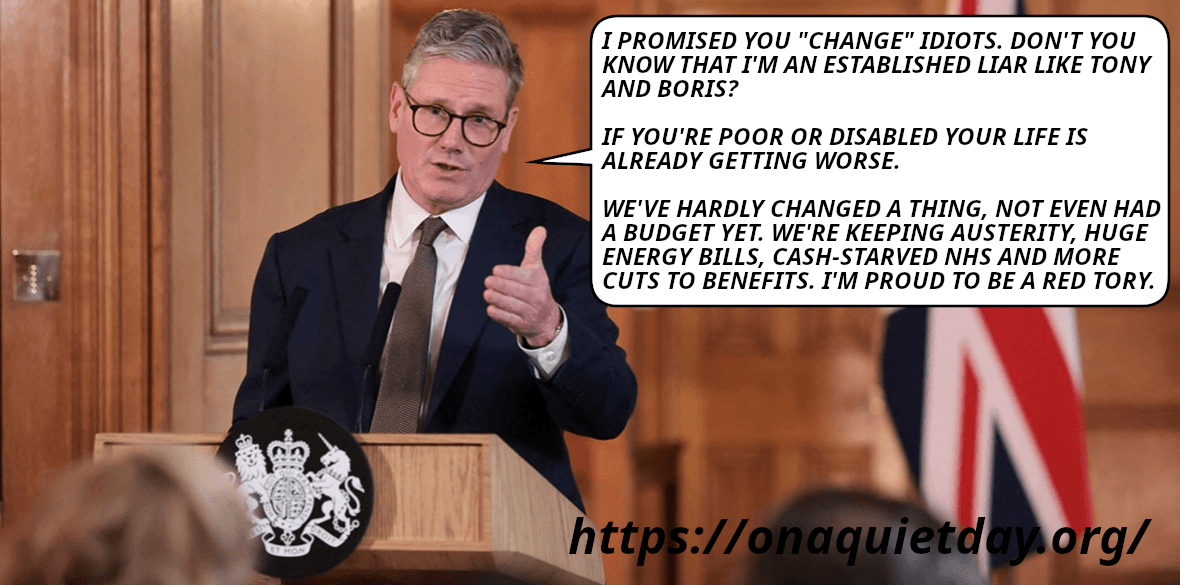
Keir Starmer confirms that he is continuing Tory policies and that he’s proud to be a red Tory.Keir Starmer says pensioners can freeze to death and poor children can starve and be condemned to failure and misery all their lives.
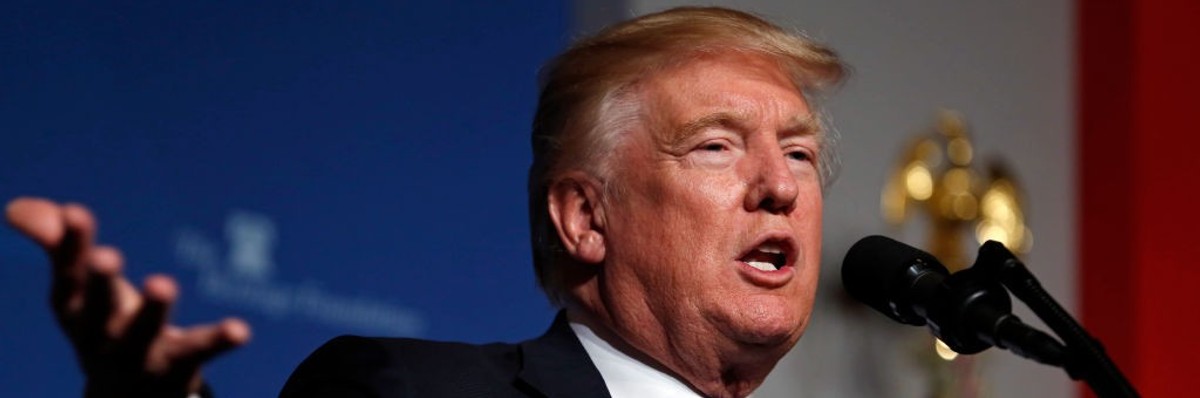
Then-President of the United States Donald Trump speaks at a Heritage Foundation meeting in 2017. (Photo: Martin H. Simon – Pool/Getty Images)
“This analysis lays bare how the extreme, conservative Project 2025 plan is more of the same from conservative leaders—delivering handouts to the wealthy and corporations on the backs of working people.”
The Center for American Progress on Tuesday released an analysis of the tax plans in Project 2025, a right-wing manifesto whose authors have close ties to Republican presidential nominee Donald Trump, showing that conservatives aim to lower taxes on corporations and the rich while raising them on working- and middle-class Americans.
The liberal research and advocacy group, which published the analysis as part of a series of in-depth articles on Project 2025, found that the right-wing plan would raise income taxes for the median family of four by about $3,000, cut taxes by at least $1.5 million for a household earning more than $10 million per year, on average, and cut the corporate tax rate to 18% from 21%, an already historically low rate instituted by Republicans in 2017.
The analysis, authored by Brendan Duke, a senior director of economic policy at CAP, shows that, of households with a married couple and two children, only those earning more than $170,000 per year would see a tax break under the Project 2025 plan.
“This analysis lays bare how the extreme, conservative Project 2025 plan is more of the same from conservative leaders—delivering handouts to the wealthy and corporations on the backs of working people,” Kobie Christian, a spokesperson at Unrig Our Economy, an advocacy group, said in a statement.
Project 2025’s income tax plan would increase taxes on middle class families. Only families making over $170,000 would get a tax cut.
The Project 2025 plan would consolidate seven tax brackets into just two—15% and 30%—on the grounds that it would “simplify” the tax code. However, CAP says that the existing number of tax brackets don’t create any additional complexity and are easily dealt with by tax-filing software. Moreover, 70% of tax filers only deal with the two lowest tax brackets—10% and 12%—”so they effectively are already in a two-bracket system,” Duke wrote.
CAP’s findings about the impact of Project 2025’s tax proposals on median earners are in keeping with those of the Democrats on the U.S. congressional Joint Economic Committee, who released a similar analysis earlier this month.
CAP included projections of the impact that Project 2025 would have on median income earners in each state and in the District of Columbia. Only in D.C., a high-earning area, were median earners projected to pay lower taxes under the right-wing plan; in all 50 states, their taxes went up.
It’s unclear how popular the Project 2025 tax plans would be. Polling from Navigator Research, a progressive polling firm, in February showed that the vast majority of Americans favor increasing taxes on the rich and large corporations.
In addition to the immediate tax plans laid out above, Project 2025 also puts forth a long-term plan to replace all income taxes with a value-added tax—a flat, regressive proposal endorsed by some U.S. House Republicans. In addition to the injustice of such a plan, it may also be impractical. CAP found that it would require a value-added tax—similar to a sales tax—on everything, even essential items such as groceries and healthcare, of at least 45%, if it were to replace lost government revenues, and warned that this would cause inflation.
Project 2025 policy agenda is a 920-page manifesto written by right-wing groups including the Heritage Foundation. The plan has drawn intense media attention in recent months and has proven unpopular with the American public, leading Trump, who was president from 2017 to 2021, to repeatedly try to distance himself from it. However, 140 of his former administration officials helped create the manifesto.
Stephen Moore, a Heritage Foundation fellow and an outside economic adviser to Trump, helped write Project 2025 tax plan, according to Duke. Moore drew scrutiny this week for questioning the need for the child tax credit.
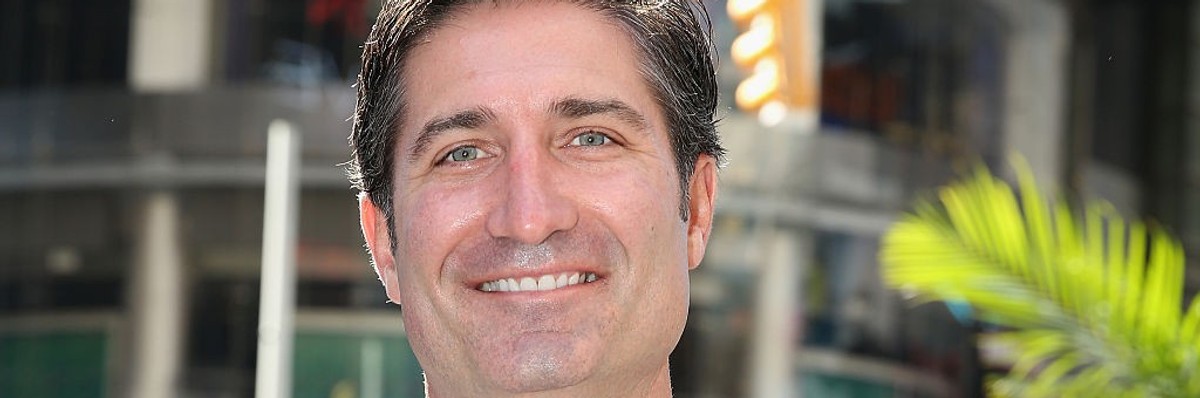
Brian Niccol, seen here in a 2015 photo, is Starbucks’ new CEO. (Photo: Robin Marchant/Getty Images)
“These jets are a stark symbol of social and climate injustice, where a privileged few indulge in the most environmentally damaging form of travel for mere convenience,” said one Greenpeace campaigner.
Green groups’ anger percolated this week after it was revealed that Brian Niccol, Starbucks’ new CEO, will “supercommute” approximately 1,000 miles between one of his homes in California and the coffee giant’s Seattle headquarters three times a week.
A Starbucks spokesperson said earlier this week that “while Brian will have an office in Southern California, his primary office and a majority of his time will be spent in our Seattle Support Center.”
“When he is not traveling for work, he will be in our Seattle office at least three days a week, in alignment with our hybrid work policies,” the spokesperson added. “He will also have a home in Seattle.”
“A private jet flight causes about 10 times more CO2 emissions than a regular flight per flight per person.”
Greenpeace—which for years has been running a campaign to ban private jets and regularly stages protests against them at airports around the world—led condemnation of Niccol’s harmful commute.
“As the world faces unprecedented heatwaves, droughts, floods, and other dire consequences of an accelerating climate crisis, it is unjustifiable for companies to offer company aircraft as employee perks,” Greenpeace campaigner Clara Thompson told The Washington Post on Thursday.
“These jets are a stark symbol of social and climate injustice, where a privileged few indulge in the most environmentally damaging form of travel for mere convenience,” Thompson added.
While most of us are being encouraged to choose a bike or public transport for our commute, these guys are taking a private jet to get to work.
A private jet flight causes about 10 times more CO2 emissions than a regular flight per flight per person, and 50 times more than the average train ride. Eighty percent of the world’s population have never flown, yet they’re the ones most impacted by the climate crisis. In just one hour, a single private jet can emit two tons of CO2. The global average energy-related carbon footprint is around 4.7 tons of CO2 per person per year.
While private jets account for a tiny fraction of global greenhouse emissions, the world’s richest 1% produce more than double the emissions of the poorest 50%, and a single billionaire produces a million times more emissions than an average person, according to a 2022 Oxfam study.
Some critics accused Starbucks—which in 2020 set a goal of reducing carbon emissions by 50% this decade—of hypocrisy, with one social media user contrasting Niccol’s private jet commute with the company’s introduction of widely despised and environmentally dubious paper straws. Another eagle-eyed observer spotted a book titled How to Avoid a Climate Disaster on display in Niccol’s office in a Wall Street Journal article photo.
Shameful for @Starbucks & CEO to fly private jet 1000miles 3x each week. Our forest are on fire; oceans are dying and glaciers are melting. Performative sustainability of banning plastic straws isn't enough
Starbucks CEO faces backlash over 1000mile commute by private jet
;)