Jeremy Corbyn: Keir Starmer says there’s no money – I don’t believe him
https://metro.co.uk/2025/03/05/jeremy-corbyn-keir-starmer-says-no-money-dont-believe-22673792/

‘There’s no money’.
That always seems to be the current government’s response when asked to tackle the enormous crises affecting the UK.
But as Keir Starmer announces he will ramp up military spending, and as Rachel Reeves plans to slash welfare budgets, we must never forget what impact government funding choices have on the most vulnerable people in society.
As we speak, 4.3 million children in the UK are living in relative poverty. Over 350,000 people are homeless in England.
Millions are worried about the cost of heating their home, braced for yet another hike in energy bills. Meanwhile, billionaires are richer than ever.
So what is the government doing?
They could lift children out of poverty, if they wanted to, by scrapping the two-child benefit cap.

They could help pensioners with energy bills, if they wanted to, by restoring universal winter fuel allowance.
They could ensure nobody had to sleep rough on the streets, if they wanted to, by launching a massive council-house-building programme.
Instead, they have signed off on a 13.4 billion increase in military spending. With that money, the government could scrap the two-child benefit cap 10 times over.
Now, today, we’re told the government is preparing to cut billions from welfare budgets.
…

Put simply: there is never any money for the poor, but always enough money for war. I just wish the government was honest about that.
…
Original article at https://metro.co.uk/2025/03/05/jeremy-corbyn-keir-starmer-says-no-money-dont-believe-22673792/


Refusing to Help DOGE ‘Dismantle Critical Public Services,’ 21 Tech Experts Resign
Original article by Jessica Corbett republished from Common Dreams under Creative Commons (CC BY-NC-ND 3.0).
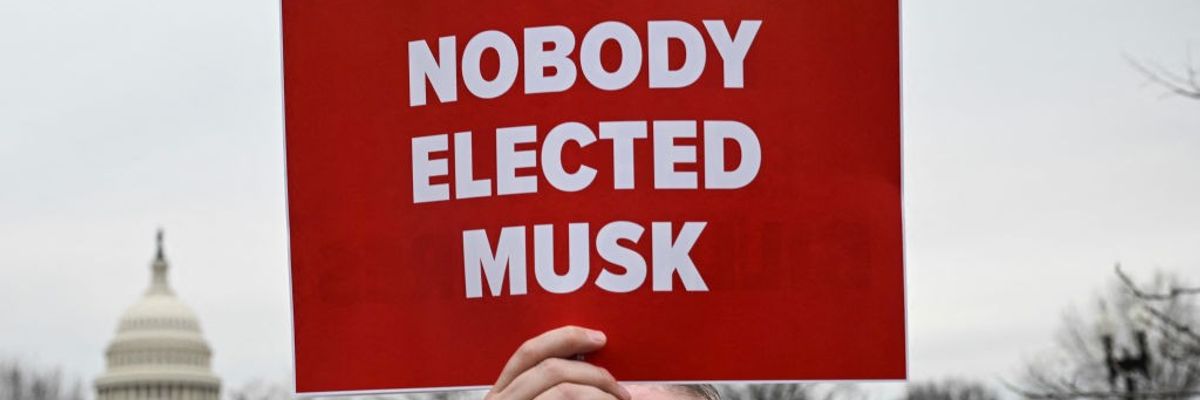
“We swore to serve the American people and uphold our oath to the Constitution across presidential administrations,” they wrote. “However, it has become clear that we can no longer honor those commitments.”
Over 20 U.S. federal tech workers who were forced into President Donald Trump and billionaire Elon Musk’s Department of Government Efficiency resigned in protest on Tuesday, according to a joint letter obtained by The Associated Press.
The 21 data scientists, engineers, and product managers were initially part of the United States Digital Service, established during the Obama administration. However, one of Trump’s first executive orders states that it “is hereby publicly renamed as the United States DOGE Service (USDS) and shall be established in the Executive Office of the President.”
As the AP detailed, “earlier this month, about 40 staffers in the office were laid off,” leaving about 65 employees who “were integrated into DOGE’s government-slashing effort.” About a third of the spared workers—who previously worked for companies such as Amazon and Google—joined the mass resignation.
“We swore to serve the American people and uphold our oath to the Constitution across presidential administrations,” wrote the 21 staffers, according to the news agency. “However, it has become clear that we can no longer honor those commitments.”
“We will not use our skills as technologists to compromise core government systems, jeopardize Americans’ sensitive data, or dismantle critical public services,” they explained. “We will not lend our expertise to carry out or legitimize DOGE’s actions.”
Their resignation letter sounds the alarm about recent interviews conducted by Musk loyalists that “created significant security risks,” noting that “several of these interviewers refused to identify themselves, asked questions about political loyalty, attempted to pit colleagues against each other, and demonstrated limited technical ability.”
The letter also criticizes the recent USDS layoffs that “focused on people in roles like designers, product managers, human resources, and contracting staff,” according to the AP, which cited interviews with current and former staff.
“These highly skilled civil servants were working to modernize Social Security, veterans’ services, tax filing, healthcare, disaster relief, student aid, and other critical services,” the letter states. “Their removal endangers millions of Americans who rely on these services every day. The sudden loss of their technology expertise makes critical systems and American’s data less safe.”
The firings at USDS are just part of Musk and Trump’s sweeping effort to slash government spending and the federal workforce.
“Musk clearly loves to depict DOGE as a lean, mean efficiency machine,” Intelligencer columnist Ed Kilgore wrote last week. “But it seems increasingly obvious that its efforts to reduce personnel levels and spending mostly reflect an ideology that treats whole areas of government as illegitimate and completely arbitrary reductions in force as a valuable end in themselves.”
Fueling such arguments, the APrevealed Tuesday that nearly 40% of the federal contracts the Trump administration has canceled won’t save any money. The Musk-led effort “published an updated list Monday of nearly 2,300 contracts that agencies terminated in recent weeks across the federal government,” the news agency reported. “Data published on DOGE’s ‘Wall of Receipts’ shows that more than one-third of the contract cancellations, 794 in all, are expected to yield no savings.”
Reporting on DOGE’s failures and the mass resignation came amid mixed messaging about a Saturday email from the Office of Personnel Management (OPM), the government’s human resources agency, ordering federal workers to respond by the end of Monday with five bullet points listing what they did last week. Musk said on his social media platform X that “failure to respond will be taken as a resignation.”
Then, Politico and The Washington Post reported Monday that the Trump administration had told federal department heads that they could direct staff to ignore the list requirement and Musk’s threat, and emails from agency leaders informing workers they should not respond began circulating on social media.
Further adding to the confusion, the president told reporters Monday afternoon that anyone who doesn’t reply would be “sort of semi-fired—or you’re fired,” and Musk later wrote on X: “Subject to the discretion of the president, they will be given another chance. Failure to respond a second time will result in termination.”
Meanwhile, a Monday guidance from OPM states in part that responses to the initial Saturday email “should be directed to agency leadership,” who “may exclude personnel from this expectation at their discretion and should inform OPM of the categories of the employees excluded and reasons for exclusion.”
Everett Kelley, national president of the American Federation of Government Employees, a union that has pushed back on DOGE initiatives, said in a Monday statement that “Elon Musk’s latest email fiasco is yet another example of the chaotic and callous treatment of federal employees that has been the hallmark of Trump’s second term.”
“It was nothing but a cynical attempt to demean federal workers and terrorize them into quitting,” Kelley continued. “To be clear, federal employees report to the agencies who employ them through established chains of command. They do not report to OPM, ‘DOGE,’ and definitely not to Elon Musk.”
“I’m glad reality is teaching them the lessons they refuse to teach themselves on how to run a functional civil service,” the union leader added. “Make no mistake we will continue to hold Elon Musk and the entire Trump administration accountable for their illegal actions.”
While DOGE has hit some legal snags thanks to challenges from unions and other critics, the Trump administration has demonstrated a willingness to defy court orders and congressional Republicans are already targeting some federal judges with articles of impeachment for impeding the president’s agenda.
Original article by Jessica Corbett republished from Common Dreams under Creative Commons (CC BY-NC-ND 3.0).


Site changes in progress

There are site changes in progress valued audience. Doing DNS techy stuff, site may be inaccessible for 15/30 min over the next hour or so.

February Strike of 1941: When Citizens Took to the Streets Against the Nazis
Original article by Mary Dingee Fillmore republished from Common Dreams under Creative Commons (CC BY-NC-ND 3.0).

Remembering how Amsterdam’s working class stood up against Adolf Hitler’s extermination of the Jews.
In three days, Amsterdam organized the only general strike in Europe to protest the first roundup of Jews. People poured into the streets on February 25, 1941—an estimated 300,000 of the 800,000 total who lived in the city.
The first to march were the tram and dock workers. The civil servants followed and word spread through the whole city, even to the small sewing workshop where a woman named Mientje Meijer worked. She and her husband had talked about it, and he came to the window to let her know it was really happening. She stopped her treadle, rose to her feet, and said, “Ladies, all of Amsterdam has come to a standstill because they’ve been rounding up Jews and taking them away. We’ve got to join in.”
The ladies poured out, even the boss, and joined the multitudes: teachers, metal workers, factory employees, shop clerks, people from across the political spectrum. Some were furious that their fellow citizens’ rights had been violated, some wanted to protest the Nazi occupation, and some just hated the Germans. Whatever their motives, they stopped the city in its tracks.
How did they organize so fast? A road builder and a street sweeper who belonged to the banned but well-organized Communist Party decided to call a meeting and take action. They had heard that hundreds of Jewish men had been rounded up on the square between the immense Portuguese Synagogue and the four smaller Ashkenazi ones. The communists gathered with trade union representatives and others at the Noorderkerk in the workers’ part of the city. They enlisted political and moral allies. Soon, a mimeographed leaflet urged everyone to “Strike! Strike! Strike! Shut down all of Amsterdam for a day!” And they did. The Strike even reached a few other cities before the German occupiers reacted with force.
Only limited public protest was heard the year before, at the time when Jews were fired from the civil service, including professors from the universities. Therefore, the Germans were dumbfounded in February 1941 when the Dutch, their Aryan brothers and sisters, took to the streets en masse. But the Nazis recovered fast and ordered the use of rifles and hand grenades to stop the strike.
By the time it was over a few days later, about 200 people had been arrested, nine had been killed, and 50 injured. For the rest of the war, the February Strike remained the only general strike in Europe to protest the roundups. Tragically, it was futile: about 75% of the Dutch Jewish population was mass murdered. Yet the strike remains in our memories as one of the few times ordinary people stood together against the deportation of their Jewish neighbors. It meant something to many Dutch survivors as long as they lived.
I learned about the Strike at the time of its 60th commemoration in 2001. Every year, people gather to remember, right where the first roundups took place. They stand around the statue of the Dockworker who is the symbolic figure of the Strike. Sculpted by a resistance worker who survived, the hefty figure wears a worker’s cap, looking not at us but beyond us, his hands at his sides, open but ready to form fists.
In 2001, the square was crammed with people, some old enough to have been alive at the time, others young families, others men of all ages with yarmulkes, and individuals formally dressed in black who proved to be diplomats. Everyone was quiet, even little children. The commemoration began with a few short speeches and a poem, but the main event was this: people were invited, a few at a time, to approach the Dockworker, stand for a moment, and lay flowers.
The elders approached first, those who might have been present at the Strike. Next the Jewish organizations placed their big wreaths, often laid by children. Similar offerings came from the European Trade Union Federation, from the people of Sweden and the United States, and others. But the vast majority of the flowers were small bouquets tied with ribbons, like a dozen red tulips bound by aluminum foil with a bit of wet paper inside. Some were accompanied by a personal note written in ink in a scrawly hand.
It took an hour and a half on that frigid afternoon to lay all the flowers, and they stayed there unmolested for days. The flowers remained until they were all dead and had to be carried away.
Original article by Mary Dingee Fillmore republished from Common Dreams under Creative Commons (CC BY-NC-ND 3.0).