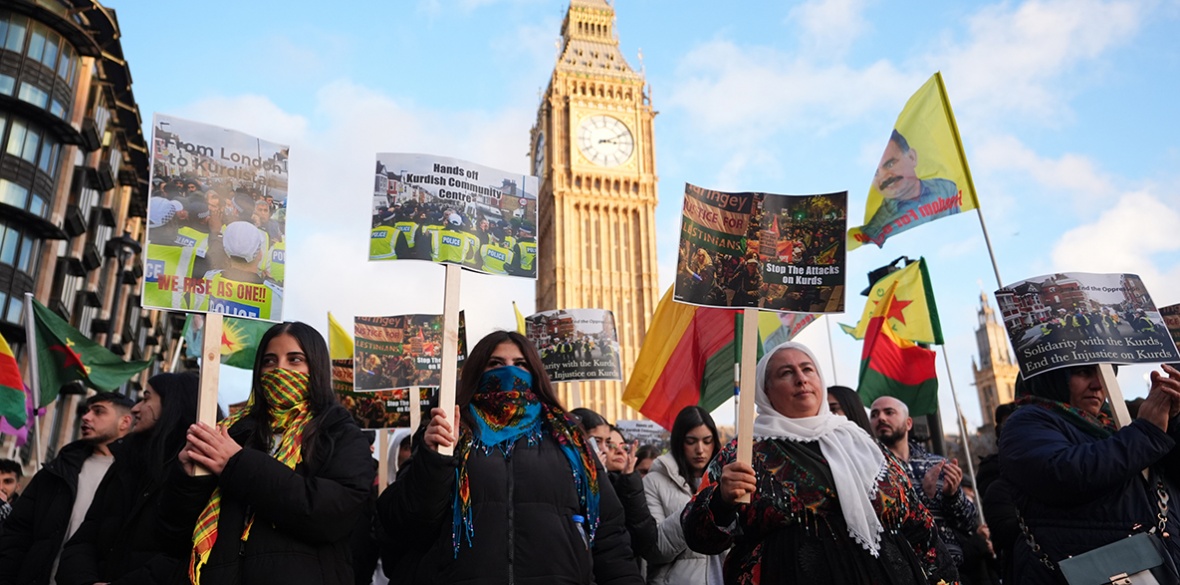
People take part in a Kurdish community march in central London in response to the arrest of seven people said to be associated with the Kurdistan Workers Party, known as the PKK. The group is proscribed by the government, and expressing support for it is a criminal offence, Scotland Yard said, December 1, 2024
SOCIALIST councillors in Haringey have expressed outrage at the Metropolitan Police’s treatment of the borough’s Kurdish community.
Six members of the Kurdish community in the north London borough were charged with membership of the Kurdistan Workers’ Party (PKK) on Tuesday, following raids on their homes and community centre on November 27. The organisation is proscribed as a terrorist organisation by Turkey and Britain.
Independent Socialist Group on Haringey Council leader Councillor Lotte Collett said that the raids seemed “totally disproportionate when measured against the charges that have been laid.”
She said: “We are minded to believe that this raid was a politically motivated assault on a minority ethnic community that have made their home in our borough carried out at the behest of the Turkish government and was probably sanctioned here at cabinet level.
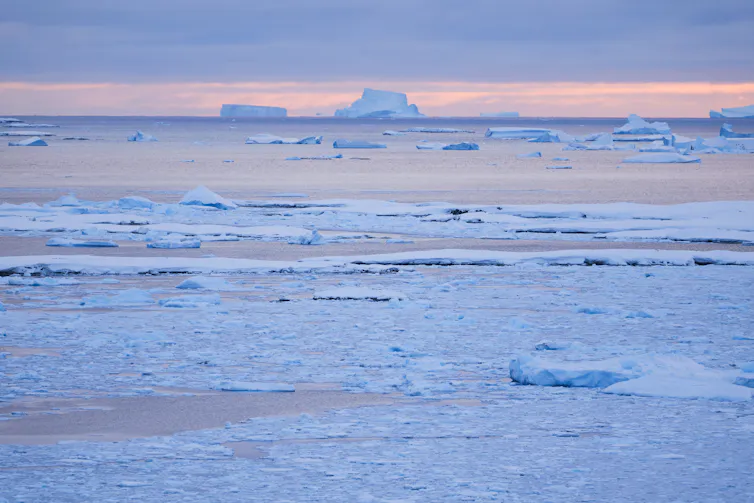
Antarctica, the world’s most remote, harsh and pristine continent, is not free from marine pollution. Where human activity goes, plastic debris inevitably follows.
What might the early explorers of this icy wilderness think today, upon discovering a continent transformed by permanent fishing activities, research stations, military presence, tourism, and all their environmental impacts? Among these, plastic pollution stands out, as it has created a unique new ecological niche in the ocean.
Once it gets into the water, plastic debris provides surfaces that can be quickly colonised by microbial communities, forming a biofilm. This plastic-borne community is known as the plastisphere, and it poses a serious threat to marine ecosystems, particularly in the cold, understudied waters of the Southern Ocean.
The plastisphere: an emerging threat
As plastic debris drifts through the ocean, the plastisphere develops through typical ecological succession, eventually becoming a complex and specialised microbial community. Plastics not only provide shelter for these microorganisms but also act as a vector, allowing potentially harmful pathogens like Vibrio spp., Escherichia coli, and bacteria carrying antibiotic resistance genes, to spread across marine environments, even reaching remote, untouched areas.
Beyond being a home for microbes, the plastisphere can disrupt the natural balance of ocean life at the microscopic level. These changes don’t stay in the water, as they can spread outward, potentially affecting how the ocean absorbs carbon and produces greenhouse gases. This has consequences for the air we breathe around the world.
However, it’s not all bad news, as bacteria known for their potential to degrade plastics or hydrocarbons – such as Alcanivorax sp., Aestuariicella sp., Marinobacter sp. and Alteromonas sp. – are frequently identified on plastics.
The Antarctic plastisphere under the microscope: bacteria colonizing polystyrene. Author’s own
A hostile research environment
We currently know very little about the plastisphere, especially in the Southern Ocean, where uncovering its dynamics is key to understanding its impacts on one of the planet’s most remote and vulnerable marine environments. For this reason, our recent study sought to investigate the abundance and diversity of microbial communities in the Southern Ocean plastisphere, particularly following the initial colonisation of plastic debris.
Working in Antarctica is not an easy task. Just reaching this continent is a challenge, and once there, scientists have to contend with harsh environmental conditions: freezing temperatures, powerful winds, icebergs, and the constant pressure of limited time to carry out their work. These challenges make every moment in the field both demanding and invaluable.
This is why we approached our study with a controlled and manageable experiment. We set up aquariums filled with seawater collected near the Spanish research station on Livingston Island, South Shetlands. Inside, we placed small, rounded pellets of the three most common types of plastic polluting the sea – polyethylene, polypropylene, and polystyrene. We left them at environmental conditions (around 0 ºC and between 13 – 18 h of sunlight) for 5 weeks, aiming to recreate the most plausible outcomes in the field.
We compared the colonisation of plastics with glass, an inert surface. Samples of plastics and glass were collected periodically to track bacterial colonisation.
Plastisphere dynamics in Antarctica
Studying bacteria means making the invisible visible, so we combined several techniques to get a better picture of the plastisphere. Using scanning electron microscopy, we obtained biofilm images. We combined flow cytometry and bacterial culture to count total cells and colonies, and we sequenced the 16S rRNA gene to identify the succession of bacterial settlers.
This meticulous approach revealed that time was the key driver of change. Microbes quickly colonised the plastic, and within less than two days, bacteria like genus Colwellia were already fixed in the surface, showing a clear progression from initial settlers to a mature diverse biofilm including other genera like Sulfitobacter, Glaciecola or Lewinella.
These species, although also detected in water, show a clear preference for the social life of a biofilm community. Moreover, we did not detect clear differences between the bacterial communities from plastics and glass, suggesting that any stable surface can host these communities.
While similar processes happen in the other oceans, in Antarctica the process seems slower. The region’s lower temperatures slow bacterial development.
Plastic-eating bacteria?
One key discovery was the presence of Oleispira sp. on polypropylene. This bacteria is hydrocarbon-degrading, meaning it belongs to a group of microorganisms that can break down oil and other pollutants.
Their role within the Antarctic plastisphere raises important questions, like whether these kinds of bacteria could mitigate the impacts of plastic pollution. If so, they could be key to the future of Antartica and our oceans.
However, there is still much to be discovered, particularly regarding their potential for bioremediation in extreme environments. Understanding these processes could pave the way for innovative strategies to address the growing challenge of plastic waste in marine ecosystems.
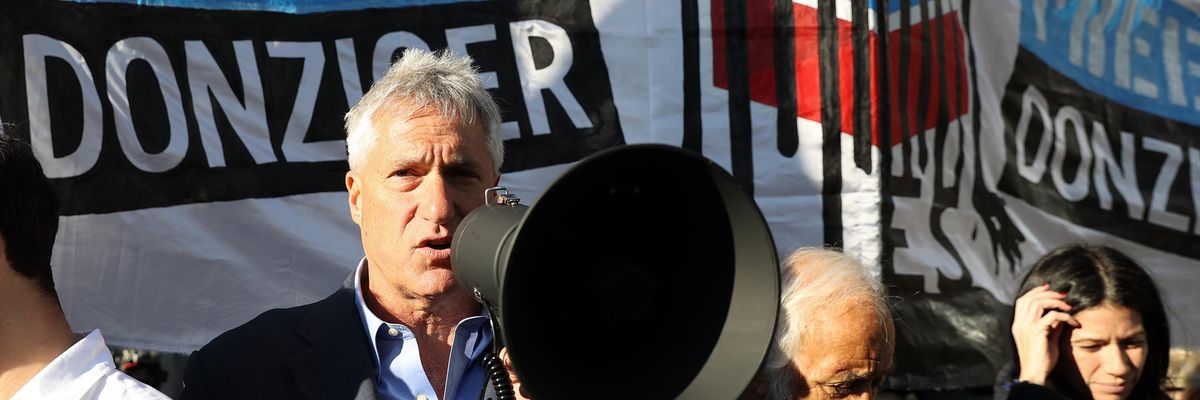
Steven Donziger speaks at a “Free Donziger” rally held in front of the Manhattan Court House in New York City on October 1, 2021. (Photo: Tayfun Coskun/Anadolu Agency via Getty Images)
“We are deeply concerned about the chilling effect this case will have on all advocates working on behalf of other frontline communities, victims of human rights violations, and those seeking environmental justice.”
More than 30 Democratic members of Congress on Wednesday called on outgoing U.S. President Joe Biden to pardon environmental and human rights lawyer Steven Donziger, who endured nearly 1,000 days in prison and house arrest after successfully representing Ecuadoreans harmed by Big Oil’s pollution of the Amazon rainforest.
In a letter to Biden led by Rep. Jim McGovern, (D-Mass.), 33 House and Senate Democrats plus Independent U.S. Sen. Bernie Sanders of Vermont noted the “troubling legal irregularities” in Donziger’s case, which have been “criticized as unconstitutional or illegal by three federal judges, 68 Nobel laureates, and five high-level jurists from the Working Group on Arbitrary Detention of the United Nations.”
Donziger represented a group of Ecuadorean farmers and Indigenous people in a 1990s lawsuit against Texaco—which was later acquired by Chevron—over the oil company’s deliberate dumping of billions of gallons of carcinogenic waste into the Amazon. He played a key role in winning a $9.5 billion settlement against Chevron in Ecuadorian courts.
Sorry, this content could not be embedded. WordPress / X
However, Chevron fought Donziger in the U.S. court system, and when the attorney refused to disclose privileged client information to the company, federal District Judge Lewis Kaplan—who was invested in Chevron—held him in misdemeanor contempt of court. Loretta Preska, Kaplan’s handpicked judge to preside over Donziger’s contempt trial, is affiliated with the Chevron-funded Federalist Society.
Donziger’s case drew worldwide attention and solidarity, with human rights experts and free speech groups joining progressive U.S. lawmakers in demanding his release. He was released in April 2022 after 993 days in prison and house arrest.
“Donziger is the only lawyer in U.S. history to be subject to any period of detention on a misdemeanor contempt of court charge,” the 34 lawmakers wrote. “We believe that the legal case against Mr. Donziger, as well as the excessively harsh nature of the punishment against him, are directly tied to his prior work against Chevron. We do not make this accusation lightly or without evidentiary support.”
The legislators warned:
Notwithstanding the personal hardship, this unprecedented legal process has imposed on Mr. Donziger and his family, we are deeply concerned about the chilling effect this case will have on all advocates working on behalf of other frontline communities, victims of human rights violations, and those seeking environmental justice. Those who try to help vulnerable communities will feel as though tactics of intimidation—at the hands of powerful corporate interests, and, most troublingly, the U.S. courts—can succeed in stifling robust legal representation when it is needed most. This is a dangerous signal to send.
“Pardoning Mr. Donziger,” the lawmakers added, “would send a powerful message to the world that billion-dollar corporations cannot act with impunity against lawyers and their clients who defend the public interest.”
The lawmakers join more than 100 environmental and human rights groups that have urged Biden to pardon Donziger.
Sorry, this content could not be embedded. WordPress / X
In an April opinion piece published by Common Dreams, Donziger contended that “I need this pardon because I am the only person in U.S. history to be privately prosecuted by a corporation.”
“More specifically, the government (via a pro-corporate judge) gave a giant oil company (Chevron) the power to prosecute and lock up its leading critic,” he continued. “As a result of this unprecedented and frightening private prosecution, I still cannot travel out of the country and I have been prohibited from meeting with clients I have represented for over three decades. Nor can I practice law, maintain a bank account, or earn a livelihood.”
“No matter where one stands on the political spectrum,” Donziger added, “we should all be able to agree that what happened to me should not happen to anybody in any country that adheres to the rule of law.”
The appeal for a Donziger pardon comes amid a wave of eleventh-hour pleas from lawmakers for Biden to grant clemency to figures ranging from WikiLeaks founder Julian Assange and National Security Agency whistleblower Edward Snowden to Indigenous activist Leonard Peltier—often described as the nation’s longest-jailed political prisoner—and federal death row inmates including Billie Jerome Allen, who advocates say was wrongly convicted of murder.
Original article republished from Memo under a Creative Commons Attribution-NonCommercial-ShareAlike 4.0 International License.
Shrine of Shimon in Chamaa, Lebaon [Ibrahimamirnaeem/Wikipedia]
Israeli occupation forces destroyed a historic religious shrine during their incursion into the village of Chamaa in southern Lebanon on Friday night, Lebanese media have reported. Lebanese sources revealed that the occupation forces deliberately rigged explosive charges on what is known as the Shrine of Shimon in Chamaa and completely destroyed it.
The state-run National News Agency reported that the occupation forces withdrew from the hill where the shrine was located due to significant resistance from Hezbollah. A UN peacekeeping site nearby was hit by artillery fire as a result of the bombardments, according to the report.
The UN peacekeeping forces said on Friday that a live 155mm artillery shell struck their headquarters in the western sector but did not explode. UNIFIL reported that Italian peacekeeping forces stationed there dealt with the shell safely, adding that no peacekeeping personnel were harmed in the strike.
Since the start of its ground incursion into southern Lebanon, the occupation forces have blown up and demolished entire villages, employing a scorched earth policy to prevent Hezbollah from operating in areas near the border with the settler-colonial state.